People's Bank (Paterson, NJ)

Episode Information

Episode UID
5759484990621
Episode Type
Suspension โ†’ Closure
Bank Type
state
Bank ID
575948499 hash
Start Date
September 24, 1851
Location
Paterson, New Jersey (40.917, -74.172)

Metadata

Model
gpt-5-mini (chosen from majority vote of a three-model LLM ensemble)
Short Digest
69bce52d46e67a6a

Response Measures

None

Description

Contemporary reports attribute failure to cashier self-dealing and inability to redeem bills; receivers were appointed.

Events (2)

1. September 24, 1851 Suspension
Cause
Bank Specific Adverse Info
Cause Details
Cashier's misconduct and inability to redeem bills; bank closed and brokers refused its bills.
Newspaper Excerpt
The People's Bank, at Paterson, New Jersey, failed to-day.
Source
newspapers
2. November 27, 1851 Receivership
Newspaper Excerpt
The Receivers appointed to investigate the affairs of this Bank, have closed their labors, and will soon make a report to the Chancellor.
Source
newspapers

Newspaper Articles (21)

Article from American Telegraph, September 25, 1851

Click image to open full size in new tab

Article Text

POSTSCRIPT! [Despatched to the American Telegraph.] BALTIMORE, September 25-2 p. m. Sales of 500 bbls. Howard street flour have been made to-day at $8 87 to 94. Grain is scarce and prices unchanged. There is no alteration in the Northern markets. The Examination at Lancaster of the Christiana Rioters. LANCASTER, September 23, p. n.-The magistrates met in the Court-house at 11 o'clock, this morning, for the purpose of hearing Castner, Hanaway, Elijah Lewis, and others, charged with aiding and abetting in the Sadsbury township murder, and also with treason in resisting the execution of the laws of the United States. The following counsel appeared on the part of the Commonwealth-Hon. John L. Thompson, District Attorney; William B. Fordney, esq.; Thomas E. Franklin, Attorney General of Lancaster county; George L. Ashmead, esq., of Philadelphia, a representative of the United States authorities in place of John W. Ashmead, United States District Attorney, absent on official business; and Robert J. Brent, Attorney General of Maryland. For the defence-Thaddeus Stephens, Reah Frazer, Ford, Kline, and Dickey, esq'rs. Long before the hour for the examination. to commence, the court-room was crowded to excess, and the most intense interest was manifested in the proceedings. Five witnesses were examined, among whom were United States Marshal Kline, Dr. Pierce, and Mr. Hutchins. Nothing important, further than what has heretofore been published, has as yet been elicited. However, it is apparent that a strong case of treason has been made out. The defence intimated that they had some thirty witnesses to be examined. The case will probably not be got through before Thursday morning. It seems to be the general impression among the members of the bar that the prisoners will be committed to answer the charge of treason against the United States. The crowd in attendance continued very large up to the hour of adjournment. PHILADELPHIA, September 24, p. m.-Bank Failure. - The People's Bank, at Paterson, New Jersey, failed to-day. Its circulation we understand is very small. TRENTON, (N. J.,) September 24th.-The September term of the United States circuit court opened here yesterday. The grand jury found two indictments. The civil docket was then called, and the principal case was Goodyear vs. Day, involving the validity of the Goodyear India Rubber Patents. The action in law being first in order, the defendants expressed themselves desirous of trial. The plaintiffs making no motion, the defendants' counsel moved a nonsuit. The court declined to consider the motion at this time, and refused to try the case in the absence of Judge Grier. It was accordingly postponed till his arrival on Tuesday next. BOSTON, Sept. 24.-The steamship Niagara sailed to-day, with fifty-five passengers, and $335,000, on freight. Accounts from Cherryfield, Maine, state that the whole country was being burnt up, and scarcely an acre of green land was left along the seaboard. The flames had swept over Mt. Drescot, destroying several houses. In Hancock county they were suffering severely, the roads being almost impassable from the smoke and flames. The timber of the Cutler company was damaged to the amount of $150,000. An accident happened on the Central railroad, near West Hartford, this afternoon, caused by the passenger train while descending a grade, running at the rate of fifty miles an hour, coming in collision with the ascending freight train. The cars and passenger train were completely demolished. Seventeen persons were badly injured, and four killed. Nine had their limbs broken. Mr. C. Kimbal, conductor, and Mr. Frederick Palmer, brakesman, were fatally injured. The engineer and fireman was escaped by jumping off. The freight train running out at the time. John Smith, conductor on the Stonington railroad, was knocked off the train to-day, and his head cut off by the wheels. NORWAY, Me., Sept. 24th.-Bernett's Hotel and five other buildings have been destroyed by fire. Loss $20,000.
Article from The New York Herald, September 25, 1851

Click image to open full size in new tab

Article Text

FINANCIAL AND COMMERCIAL. MONEY MARKET. WEDNESDAY, Sept. 24-6 P.M. The stock market was a little more buoyant to-day. There was not 80 much activity as we have noticed for name days past; but the bulls succeeded in putting prices up a fraction. How long they will sustain themwelves, is a question time only can solve. We do not we many outside operators among the brokers in or out of doors. The few about exhibit very little disposition to take hold of any of the fancies, and appear to have lost confidence in the future. So long as this feeling lasts, any permanent improvement in the market is entirely out of the question. Rumors of failures continue plenty, and it would not surprise us if the suspension of some of the houses named was actually brought about by the effect of such reports on their credit. The receipts at the office of the Assistant Treasurer of this port, to-day, amounted to $75,170; payments, $20,650-balance, $4,017,507 58. Bills of the People's Bank, of Paterson, N. J., were refused to-day by the brokers in Wall street. We do not know the cause; but it would be well enough for holders to wait a day or two before submitting to any great merifice. The steamship Niagara, for Liverpool, carried out $535,000 in specie, principally American gold. The steamship Africa brings three days later intelligence from Europe. The accounts continue favorable in a commercial point of view. There was a moderate demand for American securities. The market for breadstuffs was quiet, in consequence of the activity among farmers in securing their harvests. The track of the Chicago and Galena Railroad, to Mavengo, will be ready by the 10th of October and to Belvidere by the 10th of November; seven miles of road beyond Belvidere, to Cherry Valley, have been put under eontract. This will give eighty seven miles of railroad from Chiesgo. The accounts from California, relative to operations of mines, are of the most favorable character, and it is anticipated that the yield during the next three or four months will be enormous, greater than ever before in the same length et time. From every part of the minin gregions, the most encouraging and satisfactory reports each us, and it is estimated that full ten thousand persens will leave California for the Atlantic States during the approaching winter. The South Shore Railroad Company have declared a dividend of three per cent. Several failures have occurred within the past week among the dry goods dealers, in Boston, principally retailers. It is represented that, as a general thing, the mercantile community of Boston, bear the financial pressure remarkably well. The official returns of the Banks of New Hampshire, for September 1st, compared with those for March, 1850, present the annexed compartive statement:BANEROK New


Article from The New York Herald, September 26, 1851

Click image to open full size in new tab

Article Text

MONEY MARKET. THURSDAY, Sept 25-6 P. M. Wall street affairs are in a very curious condition. and confidence stems to be getting less and less every day. Where all this will end no one can tell. Within the past month, several heavy failures have taken place, and the names of more than a dozen others are reported. The effect of these things is bad, and must lead to unfortunate results. There* is no doubt but that many meroantile houses are seriously embarrassed in this affair, and find it difficult to get along from day to day. The rumors that are so freely circulated are, therefore, caleulated to make the position of these concerns more uncertain, and actually cause failures which otherwise would not have occurred. We have within the past day or two, heard of failures which we know have not taken place, and we have bee D exceedingly cautious in giving currency to any of the rumors afloat in the market. Almost any house having heavy payments to make, experiences difficulty in raising the money, at the highest rates of interest, with their credit untarnished; but when rumors of their having' failed are abroad, it becomes impossible to obtain the ways and means to meet their engagements, and the result is easily seen. We would. therefore, like to impress as strong as possible upon the minds of every bear speculator in the stock market-of every creaker in and out of the street- the importance of putting down at once every idle rumor relative to failures, and to be su e of the truth of any report before greater circulation is given to it. By so doing, the excitement in commercial circles will be considera bly allayed, and all symptoms of a panic soon disappear. Money is in active demand. It it seldom that a tighter market is experienced, and the most exorbitant rates of interest rule. Railroad acceptances are plenty enough in the street, and any amount can be purchased at one and a half and two per cent per month. At this rate the floating debts of our railroad companies must be exceedngly embarrassing, and the payments of interest make erious inroads into their net revenue. Erie Railroad acceptances are daily negotiated at the rate of eighteen per cent per annum Business paper ranges from ten to twenty.four per cent per annum, and purchasers are particularly cautious in buying even at the greatest shave, These rates are ruinous, but they are freely submitted to. It is stated that the failure of the People's Bank of Paterson. N. J., will be a bad one. According to re turns made to the Legislature of New Jersey, last fall. the condition of the bank was as annexed:-


Article from Weekly National Intelligencer, October 4, 1851

Click image to open full size in new tab

Article Text

A BANKER'S DODGE.-A story is current here, of a little sharp practice on the part of the Cashier of the People's Bank of Paterson, which is too good to be lost. The morning this institution failed he came into town, expecting to make arrangements to go on as usual but his agent here very properly refused to redeem the bills unless supplied before with the needful, which was not for hooming and the Cashier accordingly started on his return to make preparations for closing the bank. On arriving at Jersey City he found quite a number of brokers collected, who had got wind of the trouble, and were on their way to Paterson to secure, if possible, the re demption of the bills in their hands. The train started, the hungry bill-holders Feated in the cars, and the Cashier, who is President of the Railroad Company, stending with the engineer on the locomotive. After a run of a few miles, the bolt by which the engine drew its burden was quietly withdrawn, and the locomotive, carrying the Cashier, shot onward to Paterson, leaving the cars to follow at their leisure. As soon as he had taken leave of his passenger, the engineer put back to bring up the train, and found it at a dead stand in an interesting locality, where the passengers had abundant time and opportunity to examine the scenery and cool the fever of their impatience. When the train reached Paterson the score of brokers rusbed to the bank, but found it closed, with an interesting placard attached to the door ! [New York Journal of Commerce.


Article from The Miners' Express, October 8, 1851

Click image to open full size in new tab

Article Text

BANK FAILURES.-Unf telegrapa.re. the other night, brought news of the failure of the peoples Bank, Patterson, N. J. W enow learn from the Louisville Democrat that the Merchants Bank of Cincinnati has suspended. No. body to blame-officers all honest; but somehow the people have to bear the loss.


Article from Oxford Democrat, October 10, 1851

Click image to open full size in new tab

Article Text

Sharp Practice. The Journal of Commerce tells the following story of some sharp practice on the part of the Cashier of the People's Bank, Patterson, N. J. who happens also to be President of the Railroad Company. The morning this institution failed, the Cashier came in town, expecting to make arrangements to go on as usual; but his agent here very properly refused to redeem the bills unless supplied beforehand with the "needful" which was not forthcoming, and the Cashier accordingly started on his return to make preparations for closing the bank. On arriving at Jersey City, be found quite a number of brokers collected. who had got wind of the trouble. and were on their way to Patterson to secure. if possible the redemption of the bills in their hands. The train started. the hungry bill holders seated in the ears, and the Cashier, who is President of the Railroad Company standing with the Engineer on the locomotive After a run of a few miles the bolt by which the engine drew its burthen. was quietly withdrawn, and the train carrying the Cashier, shot onward to Patteason, leaving the cars to follow at their leisure.As soon as he had taken leave of his passenger, the engineer put back to bring up the train, and found it at a dead stand in an interesting locality, where the passengers had abundant time and opportunity to examine the scenery, and cool the fever of their impatience. When the train reached Patterson. the score of brokers rushed to the Bank, but found 11 closed. with an interesting placard attached to the door!"


Article from The Daily Crescent, October 11, 1851

Click image to open full size in new tab

Article Text

Too Good tobe Lost.-A story is current here of a little sharp practice on the part of the cashier of the People's Bank of Paterson, which is to good to be lost. The morning this institution failed, be came in town, expecting to make arrangements to goon as usual ;but his agent very properly refused to redeem the bills unless supplied beforehand with the need. fel, which was not forthcoming, and the cashier accordingly started on his return to make preparations for closing the bank. On arriving at Jersey city, he found quite a number of brokers collected, who had got wind of the trouble, and were on their way to Paterson to secure, if possible, the redemption of the bills in their hands. The train started, the hungry bill-holders seated in the cars, and the cashier, who is President of the Railroad Company, standing with the engineer on the locomic tive. After a run of a few-miles, the bolt by which the engine drew its burden was quietly withdra wn, and the locomotive, carrying the ceshier, shot onward to Paterson, leaving the care to follow at their leisure. As soon as he had taken his leave of his passenger, the engineer put back to bring up the train, and found it as a dead stand in an interesting locality, where the passengers had abundant time and opportunity to examine the scenery, and cool the fever of their impatience. When the train reached Paterson, the score of brokers rushed to the bank, but found it closed. with an interesting placard attached to the door! (Jour. Commerce.


Article from Eastern Times, October 16, 1851

Click image to open full size in new tab

Article Text

A story is current here, of a little sharp practice on the part of the cashier of the People's Bank of Paterson, which is too good to be lost. The morning this institution failed, he came in town, expecting to make arrangements to go on as usual ; but his agent here very properly refused to redeem the bills unless supplied beforehand with the needful, which was not forthcoming, and the cashier accordingly started on his return to make preparations for closing the bank. On arriving at Jersey city, he found quite a number of brokers collected, who had got wind of the trouble, and were on their way to Patterson to secure, if possible, the redemption of the bills in their hands. The train started, the hungry bill-holders seated in the cars, and the cashier, who is president of the railroad company standing with the engineer on the locomotive. After a run of a few miles, the bolt by which the engine drew its burden, was quietly withdrawn, and the locomotive, carrying the cashier, shot onward to Patterson, leaving the cars to follow at their leisure. As soon as he had taken leave of his passenger, the engineer put back to bring up the train, and found it at a dead stand in an interesting locality, where the passengers had abundant time and opportunity to examine the scenery, and cool the fever of their impatience. When the train reached Patterson, the score of brokers rushed to the bank, but found it elosed, with an interesting placard attached to the door. Journal of Commerce.


Article from Portage Sentinel, October 20, 1851

Click image to open full size in new tab

Article Text

A Banker's Dodge. A story is current here, of a sharp practice on the part of the Cashier of the l'eople's Bank f Patterson, which is 100 good to be lost The morning the institution failed he came into town, expecting to make arrangements to go on as usual; but his agent here very properly refused to redeem the bills unless supplied before with the needful, which was not forthcoming; and the Cashier accordingly started on his re turn to make preperations for closing the bank. On arriving at Jersey City he found quite a number of brokers collected who had got wind of the trouble, and were on their way to Paterson to secure, if possible, the redemption of the bills in their hands. The train started, the hungry bill holders sented in the cars, and the Cashier, who was President of the Rail Road Com. pany, standing with the engineer on the locomotive. After a run of a few miles, the bolt by which the engine drew its bur. den was quitely withdrawn, and the loco. motive carrying the Cashier, shot on ward to Patterson, leaving the cars to follow at their leisure. As soon as he had taken leave of his passenger, the engineer put back to bring up the train, and found it at a dead stand in an interesting locality, where the passengers had abundant time and opportunity to examine the scenery and cool the fever of their impatience.When the train reached Patterson, the score of brokers rushed to the bank, but found it closed with an interesting placard attached to the door!-N. Y. Journal of Commerce


Article from The Star of the North, October 23, 1851

Click image to open full size in new tab

Article Text

A Banker's Dodge, A very good story is told of a little sharp practice on the part of the Cashier of the People's Bank of Patterson. The morning this institution failed he went to Philadelphia, expecting to make arrangements to go on as usual; but his agent there very properly refused to redeem the bills unless previously supplied with the needful, which was not forthcoming and the Cashier accordingly started on his return to make preparations for closing the banks.-On arriving at Jersey City he found quite a number of brokers collected, who had got wind of the trouble, and were on their way to Patterson to secure it possible, the redemption of the bills in their hands. The train started, the hungry bill-holders seated in the cars, and the Cashier, who is President of the Railroad Company, standing with the engineer on the locometive. After a run of a few miles, the bolt by which the engine drew its burthen was quietly withdrawn, and the locomotive carrying the Cashier, shot onward to Patterson, leaving the cars to follow at their leisure. As soon as he had taken leave of his passengers, the engineer put back to bring up the train, and found it at a dead stand in an interesting locality, where the passengers had abundant time and opportunity to examine the scenery, and cool the fever of their impatience. When the train reached Patterson the score of brokers rushed to the bank, but found it closed, with an interesting placard attached to the door.


Article from The Minnesota Pioneer, November 6, 1851

Click image to open full size in new tab

Article Text

SHARP PRACTICE ON THE PART OF A BANK CASHIER.-The Journal of Commerce tells the following story of some sharp practice on the part of the Cashier of the People's Bank, Patterson, N. J., who happens also to be President of the Railroad Company. "The morning this Institution failed, the Cashier came in town expecting to make arrangements to go on as usual; but hisagent here very properly refused to redeem the bills unless supplied beforehand with the 'needful,' which was not forthcoming, and the Cashier accordingly started on his return to make preparations for closing the Bank. On arriving at Jersey City, he found quite a number of brokers collected who had got wind of the trouble, and were on their way to Patterson, to secure, if possiblethe redemption of the bills in their hands. The train started, the hungry bill holders seated in the cars, and the Cashier, who is President of the Railroad Company, standing up with the engineer on the locomotive. After a run of a few miles, the bolt by which the engine drew its burthen, was quietly withdrawn, and the train carrying the cash. ier, shot upward to Patterson, leaving the cars to follow at their leisure. As soon as he had taken leave of his passengers, the engineer put back to bring up the train, and found it at a deal stand, in an interesting locality, where the passengers had abundant time and opportunity to examine the scenery, and cool the fever of their impatience. When the train reached Patterson, the score of brokers rushed to the Bank, but found it closed, with an interesting placard attached to the door!"


Article from Jeffersonian Republican, November 6, 1851

Click image to open full size in new tab

Article Text

A Banker's Dodge. A story is current here, of a little sharp practice on the part of the Cashier of the People's Bank of Paterson, which is too good to be lost. The morning this institution failed he came into town, expecting to make arrangements to go on as usual; but his agent here very properly refused to redeem the bills unless supplied before with the needful, which was not forthcoming; and the Cashier accordingly started on his return to make preparations for closing the bank. On arriving at Jersey City he found quite a number of brokers collected, who had got wind of the trouble, and were on their way to Paterson to secure, if possible, the redemption of the bills in their hands. The train started, the hungry bill-holders seated in the cars, and the Cashier, who is President of the Railroad Company, standing with the engineer on the locomotive. After a run of a few miles, the bolt by which the engine drew its burden was quietly with-drawn, and the locomotive carrying the Cashier, shot onward to Paterson, leaving the cars to follow at their leisure. As soon as/he had taken leave of his passenger, the engineer put back to bring up the train, and found it at a dead stand in an interesting locality, where the passengers had abundant time and opportunity to examine the scenery and cool their impatience. When the train reached Paterson the score of brokers rushed to the bank, but found it closed, with an interesting placard attached to the door!-New York Journal of Commerce.


Article from Washington Telegraph, November 12, 1851

Click image to open full size in new tab

Article Text

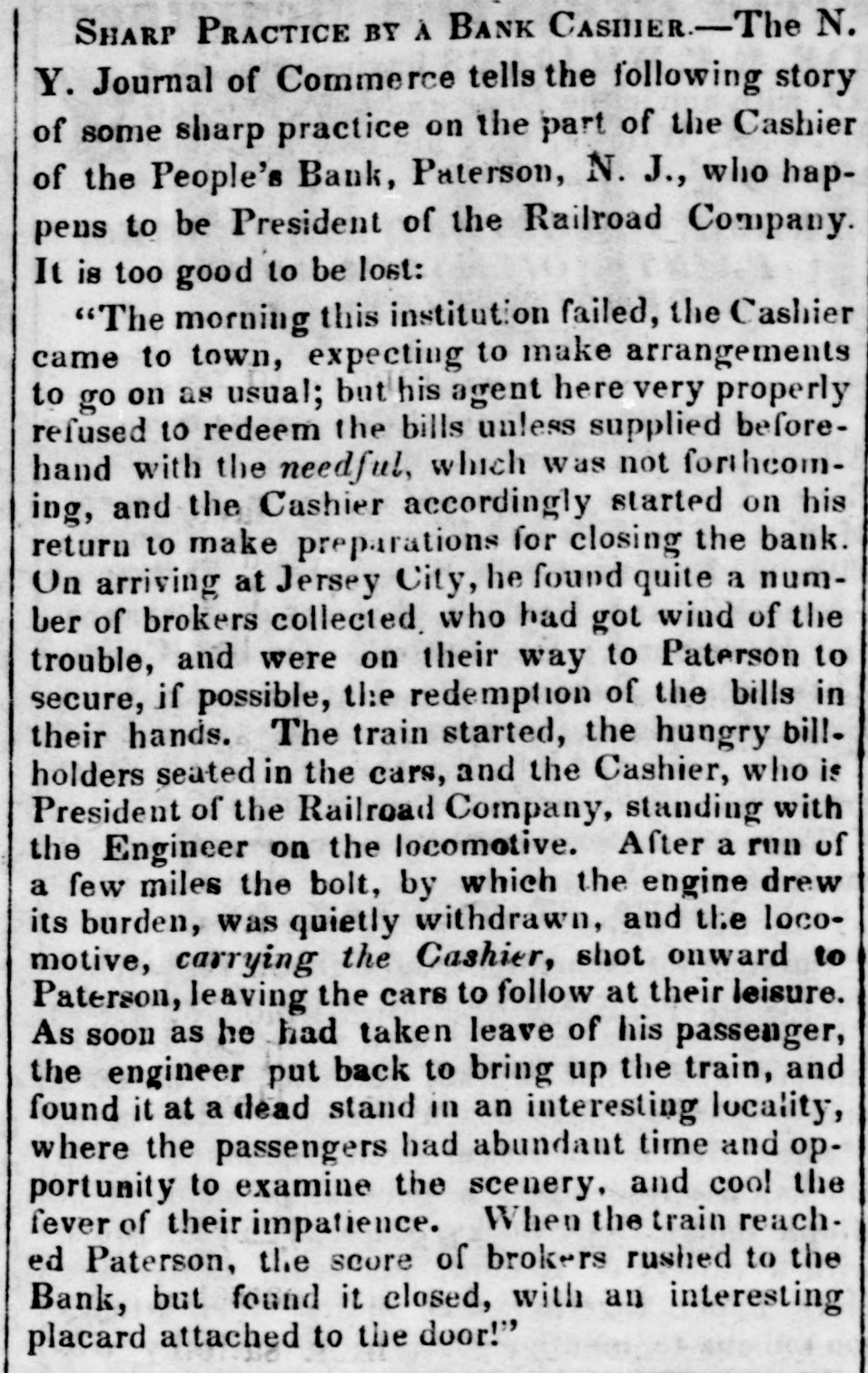
SHARP PRACTICE BY ร€ BANK CASHIER.-The N. Y. Journal of Commerce tells the following story of some sharp practice on the part of the Cashier of the People's Bank, Paterson, N. J., who happens to be President of the Railroad Company. It is too good to be lost: "The morning this institution failed, the Cashier came to town, expecting to make arrangements to go on as usual; but his agent here very properly refused to redeem the bills unless supplied beforehand with the needful, which was not forthcoming, and the Cashier accordingly started on his return to make preparations for closing the bank. On arriving at Jersey City, he found quite a number of brokers collected who had got wind of the trouble, and were on their way to Paterson to secure, if possible, the redemption of the bills in their hands. The train started, the hungry bill. holders seated in the cars, and the Cashier, who is President of the Railroad Company, standing with the Engineer on the locomotive. After a run of a few miles the bolt, by which the engine drew its burden, was quietly withdrawn, and the locomotive, carrying the Cashier, shot onward to Paterson, leaving the cars to follow at their leisure. As soon as he had taken leave of his passenger, the engineer put back to bring up the train, and found it at a dead stand in an interesting locality, where the passengers had abundant time and opportunity to examine the scenery, and cool the fever of their impatience. When the train reached Paterson, the score of brokers rushed to the Bank, but found it closed, with an interesting placard attached to the door!"


Article from Jeffersonian Republican, November 27, 1851

Click image to open full size in new tab

Article Text

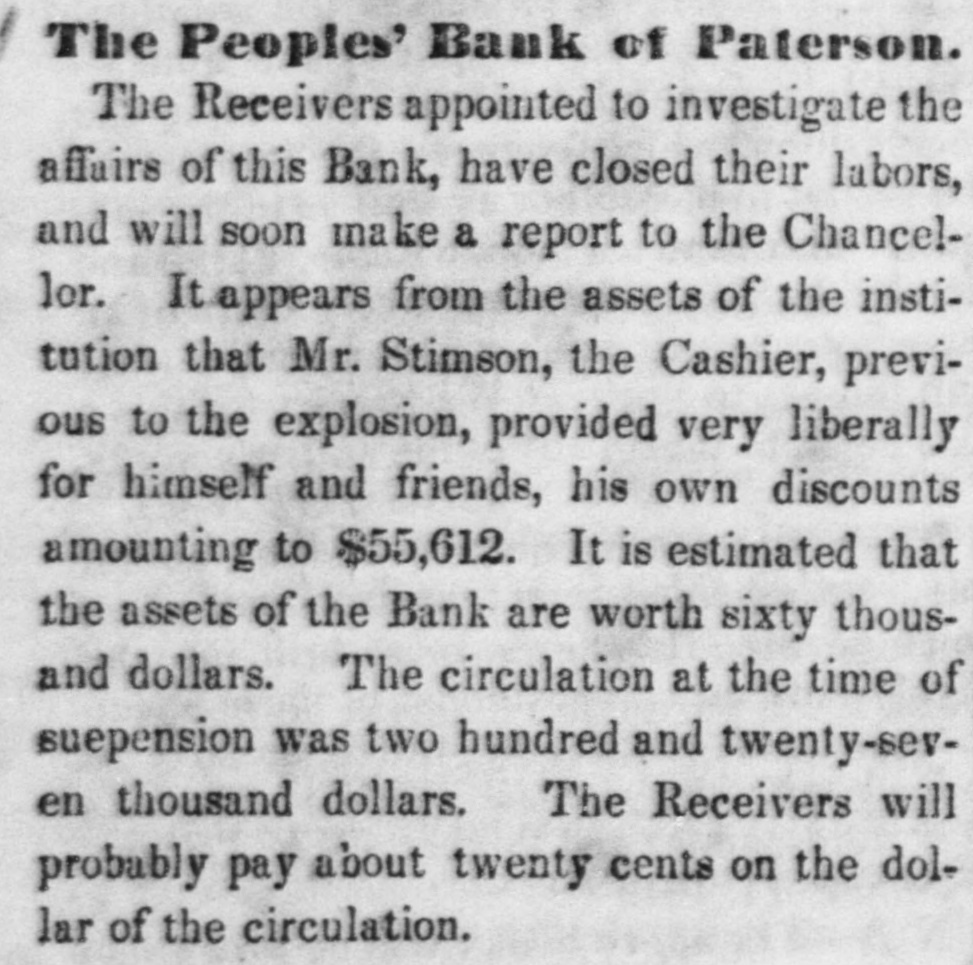
The Peoples' Bank of Paterson. The Receivers appointed to investigate the affairs of this Bank, have closed their labors, and will soon make a report to the Chance!lor. It appears from the assets of the institution that Mr. Stimson, the Cashier, previous to the explosion, provided very liberally for himself and friends, his own discounts amounting to $55,612. It is estimated that the assets of the Bank are worth sixty thousand dollars. The circulation at the time of suepension was two hundred and twenty-seven thousand dollars. The Receivers will probably pay about twenty cents on the dollar of the circulation.


Article from The Athens Post, November 28, 1851

Click image to open full size in new tab

Article Text

The assets of the People's Bank of Pat terson, New Jersey, is estimated at about sixty thousand dollars. The circulation at the time of the suspension, was two hun. dred and twenty-seven thousand dollars.The receivers will probably pay about twenty cents on the dollar of the circula. tion.


Article from New-York Daily Tribune, June 25, 1852

Click image to open full size in new tab

Article Text

The receivers of the suspended People's Bank of Paterson have declared an intermediate dividend of fifteen per cent. out of the assests of that institution. The Rutland Washington Railroad will be opened for travel next week. The Vermont Central Railroad has advertised a sale of five hundred thousand dollars of Second Mortgage Bonds at auction, at Boston, on Satur. day next.


Article from The New York Herald, August 7, 1854

Click image to open full size in new tab

Article Text

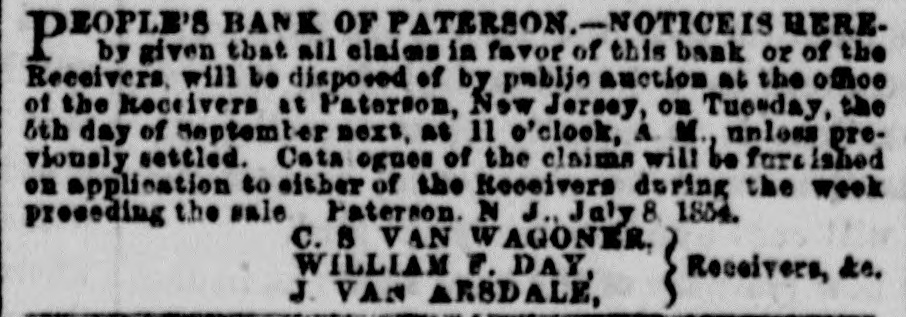
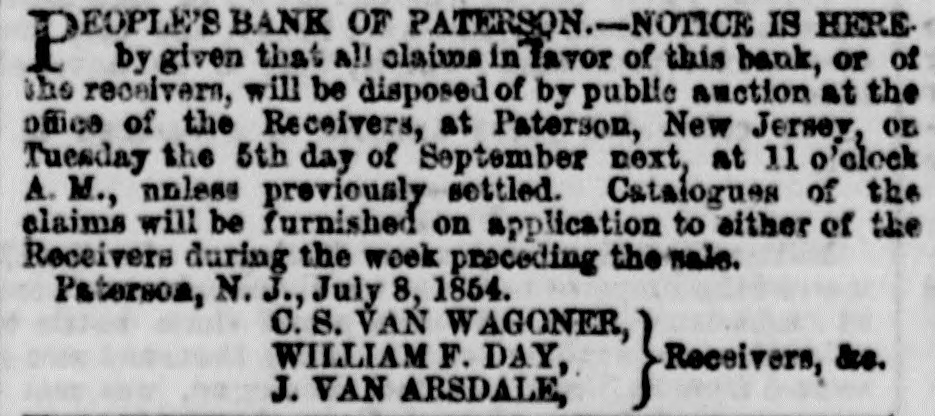
EOPLE'S BANK OF PATERSON.-NOTICE IS HEREP by given that all claims in favor of this bank, or of the receivers, will be disposed of by public Anction at the office of the Receivers, at Paterson, New Jersey, on Tuesday the 5th day of September next, at 11 o'clock A. M., unless previously settled. Catalogues of the claims will be furnished on application to either of the Receivers during the week preceding the sale. Paterson, N.J., July 8, 1854. C.S. van WAGONER, Receivers, &c. WILLIAM F. DAY, J. van ARSDALE,


Article from The New York Herald, August 25, 1854

Click image to open full size in new tab

Article Text

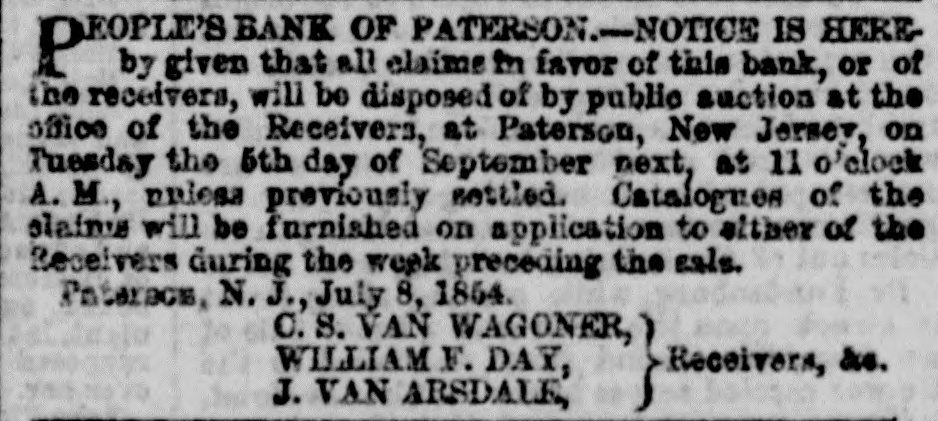
EOPLE'S BANK OF PATERSON.-NOTICE IS HEREP by given that all claims in favor of this bank, or of the receivers, will be disposed of by public suction at the office of the Receivers, at Paterson, New Jersey, on Tuesday the 5th day of September next, at 11 o'clock s. M., unless previously settled. Catalogues of the claims will be furnished on application to either of the Receivers during the week preceding the sale, Paterson, N.J., July 8, 1854. C.S. van WAGONER, Receivers, &c. WILLIAM F. DAY, J. VAN ARSDALE,


Article from The New York Herald, September 22, 1854

Click image to open full size in new tab

Article Text

PEOPLE'S BANK OF PATERSON.-NOTICE IS HERE by given that all claims in favor of this bank, or of the receivers, will be disposed of by public auction at the office of the Receivers, at Paterson, New Jersey, on Tuesday the 5th day of September next, at 11 e'elock a. M., nuless previously settled. Catalogues of the claims will be farnished on application to alther of the Receivers during the week precading the sale. Paterson, N.J., July 8, 1854. C.8. VAN WAGONER, Receivers, be. WILLIAM F. DAY, J. VAN ARSDALE,


Article from The New York Herald, October 6, 1854

Click image to open full size in new tab

Article Text

EOPLE'S BANK OF PATERSON.--NOTICE IS HEREP by given that all claims m favor of this bank, or of the receivers, will be disposed of by public suction at the office of the Receivers, at Paterson, New Jersey, on Tuesday the 5th day of September next, at 11 o'clock A. M., unless previously settled. Catalogues of the slaims will be furnished on application to elther of the Receivers during the week preceding the sals. Paterace, N. J., July 8, 1864. C.S. VAN WAGONER, Receivers, &s. WILLIAM F. DAY, J. VAN ARSDALE,


Article from The Jeffersonian, June 28, 1855

Click image to open full size in new tab

Article Text

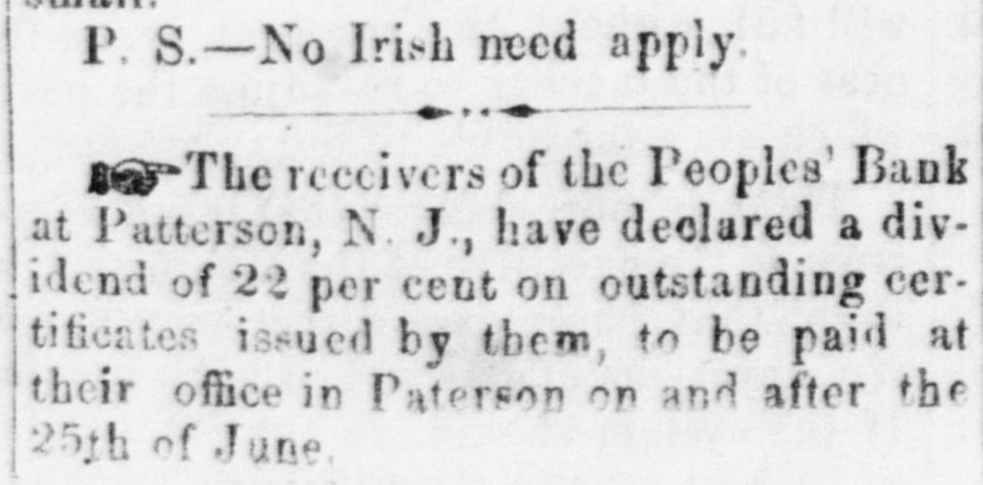
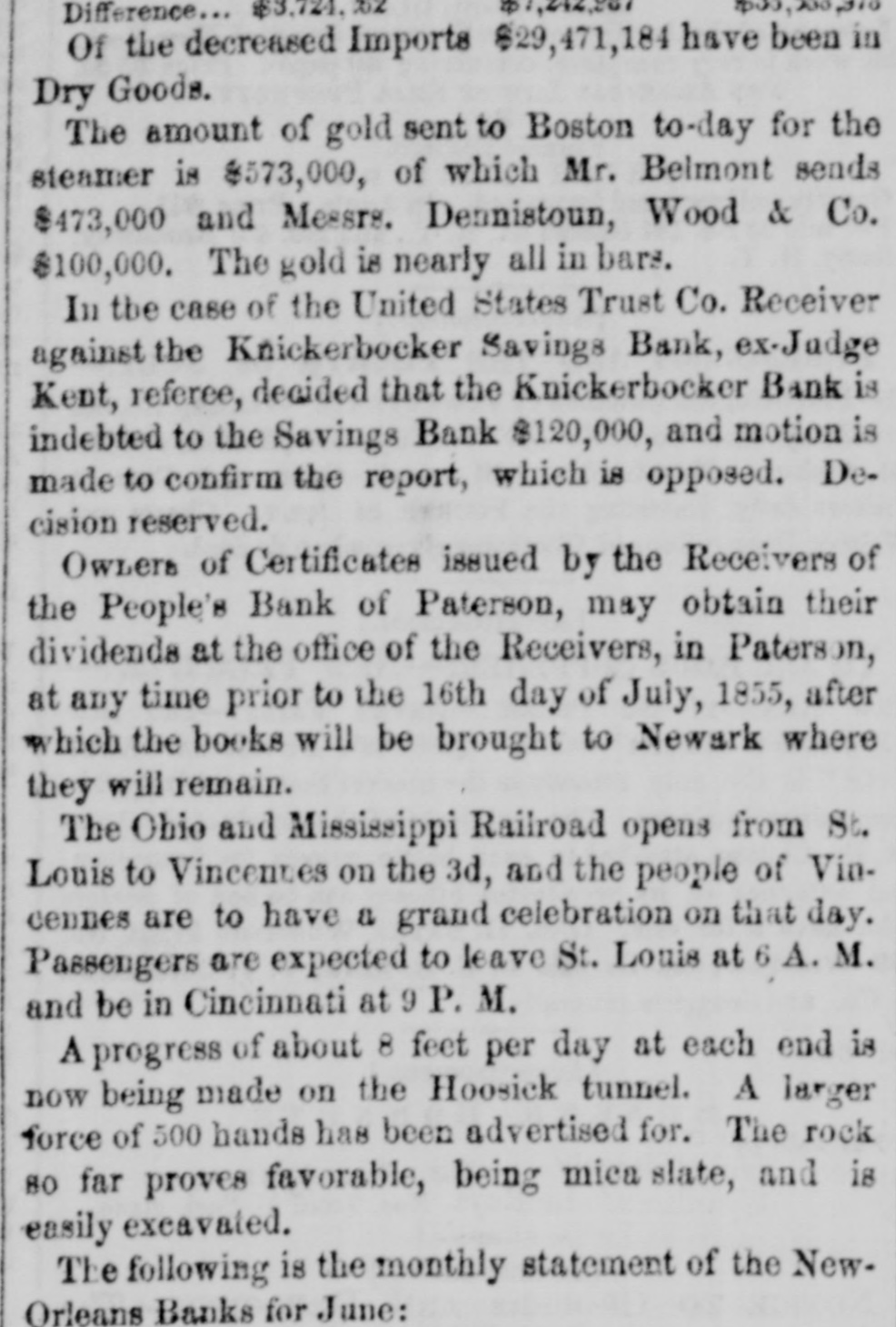
P. S.-No Irish need apply. The receivers of the Peoples' Bank at Patterson, N.J., have declared a dividend of 22 per cent on outstanding certificates issued by them, to be paid at their office in Paterson on and after the 25th of June,