Milwaukee Avenue Bank (Chicago, IL)

Episode Information

Episode UID
5766861191280
Episode Type
Suspension β†’ Run β†’ Closure
Bank Type
state
Bank ID
576686119 hash
Start Date
August 7, 1906
Location
Chicago, Illinois (41.850, -87.650)

Metadata

Model
gpt-5-mini (chosen from majority vote of a three-model LLM ensemble)
Short Digest
9c5577903a696ce8

Response Measures

None

Description

Failure caused by internal defalcations/embezzlement; receiver appointed and bank did not resume normal operations.

Events (3)

1. August 7, 1906 Suspension
Cause
Bank Specific Adverse Info
Cause Details
Suspension followed revelations of large embezzlements/forgery by president Paul O. Stensland and cashier Hering, and flight of the president.
Newspaper Excerpt
announcement of the failure ... the Milwaukee Avenue bank was responsible for the death of one of the depositors ... on hearing that the bank had suspended payment
Source
newspapers
2. August 17, 1906 Receivership
Newspaper Excerpt
The court appointed Henry Hiestand receiver and fixed his bond at $10,000. The collapse of the Milwaukee Avenue Bank ... the attorneys for the creditors said ... they had been unable to ascertain the amount of the bank's liabilities
Source
newspapers
3. August 24, 1906 Run
Cause
Bank Specific Adverse Info
Cause Details
Depositors surged to withdraw funds after disclosure of the bank's wreck and announcement of partial payments by the receiver following the suspension.
Measures
Receiver Fetzer arranged partial payments (20% to batches of depositors) to settle claims.
Newspaper Excerpt
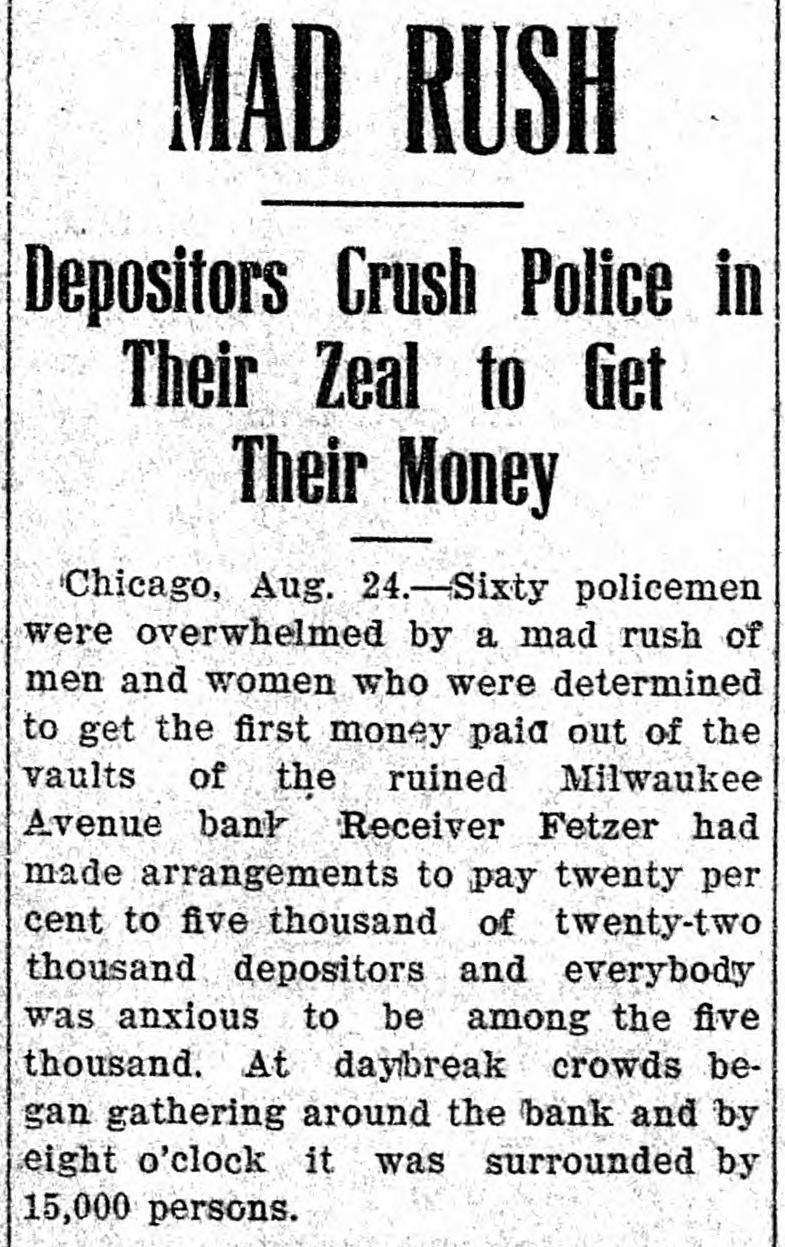
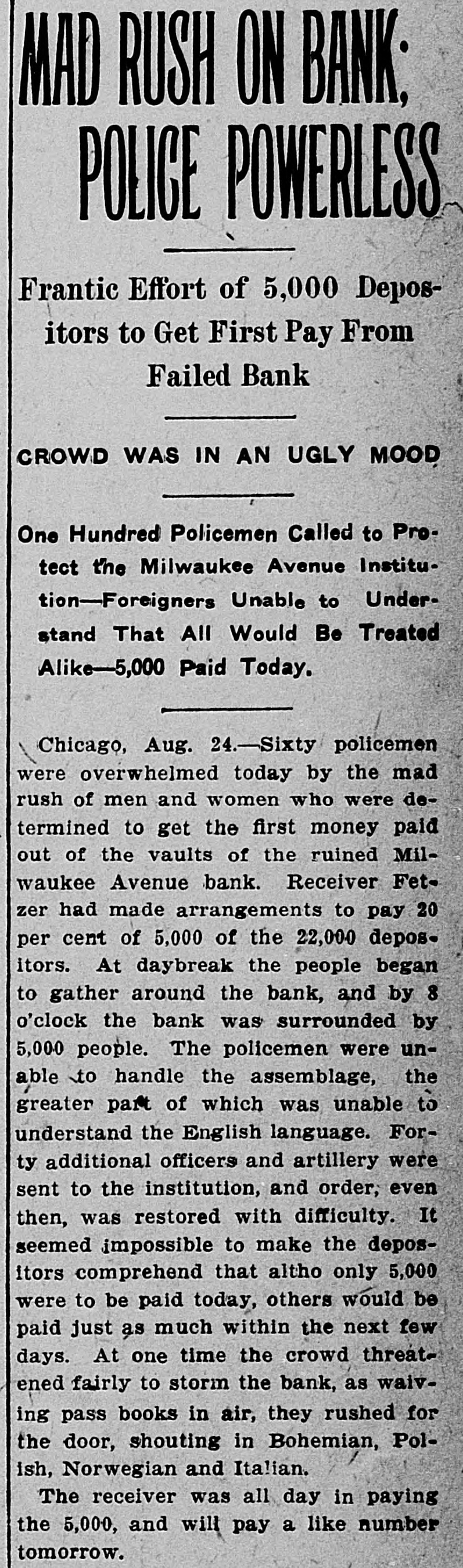
Sixty policemen were overwhelmed by a mad rush of men and women ... Receiver Fetzer had made arrangements to pay twenty per cent to five thousand of twenty-two thousand depositors ... the bank was surrounded by 15,000 persons
Source
newspapers

Newspaper Articles (21)

Article from The Topeka State Journal, August 7, 1906

Click image to open full size in new tab

Article Text

CAUSES TWO DEATHS. Fatal Consequences of the Chicago Bank Failure. Aug. .-The 3 failure Chicago, of the Milwaukee Avenue bank was responsible for the death of one of the depositors and led to the suicide of another man who a month ago had placed his earnings of a lifetime in the institution for safekeeping. In the excitement following the announcement of the failure J. G. Visser, an official of the Royal League, who had on deposit in the bank funds of that organization, fell dead of heart failure. Henry Koepke, a small grocer, on hearing that the bank had suspended payment went to the rear of his store and shot himself. He died a few minutes later, while being taken to a hospital.


Article from Rock Island Argus, August 7, 1906

Click image to open full size in new tab

Article Text

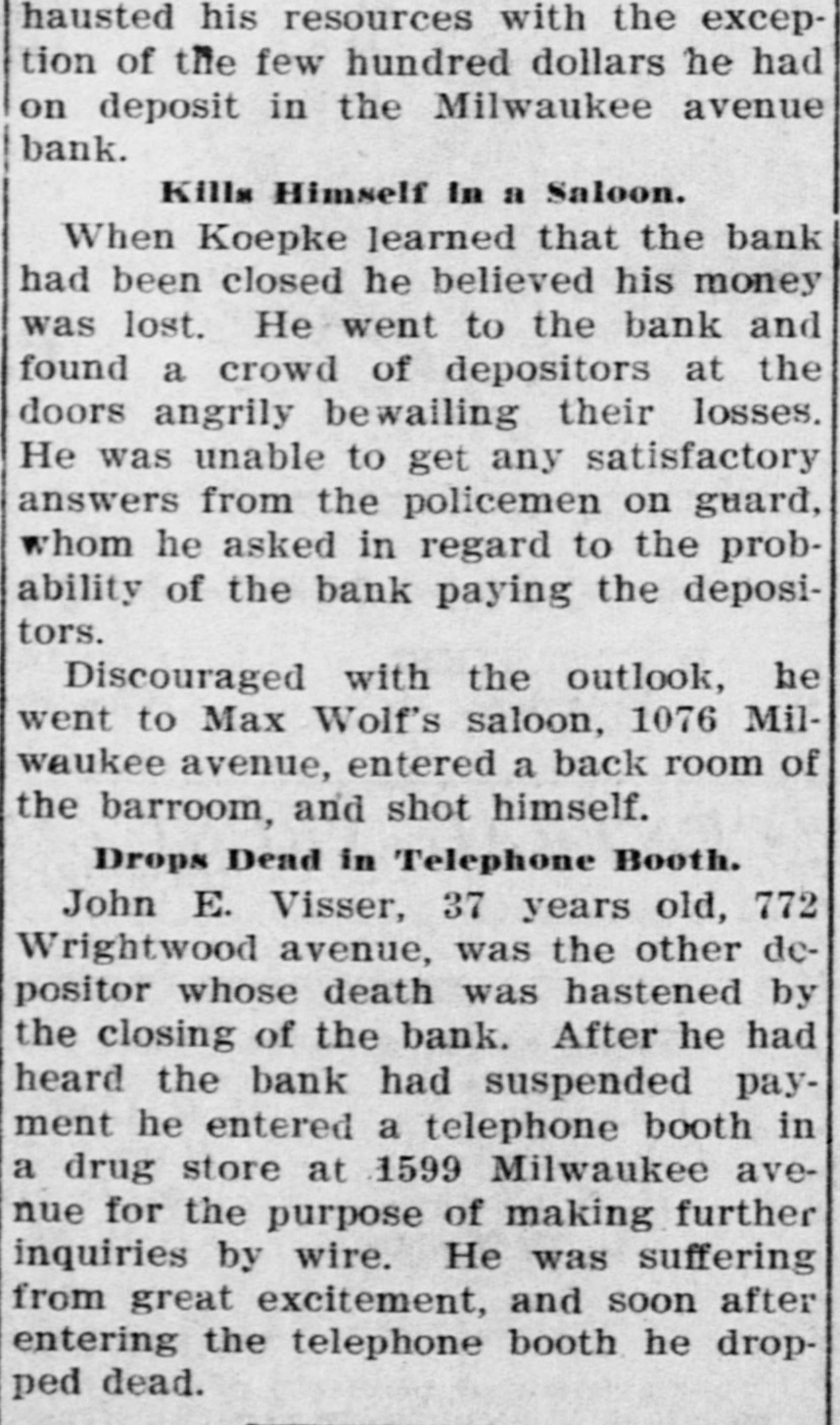
hausted his resources with the exception of the few hundred dollars he had on deposit in the Milwaukee avenue bank. Kills Himself In a Saloon. When Koepke learned that the bank had been closed he believed his money was lost. He went to the bank and found a crowd of depositors at the doors angrily bewailing their losses. He was unable to get any satisfactory answers from the policement on guard, whom he asked in regard to the probability of the bank paying the depositors. Discouraged with the outlook, he went to Max Wolf's saloon, 1076 Milwaukee avenue, entered a back room of the barroom, and shot himself. Drops Dead in Telephone Booth. John E. Visser, 37 years old, 772 Wrightwood avenue, was the other depositor whose death was hastened by the closing of the bank. After he had heard the bank had suspended payment he entered a telephone booth in a drug store at 1599 Milwaukee avenue for the purpose of making further inquiries by wire. He was suffering from great excitement, and soon after entering the telephone booth he dropped dead.


Article from The Daily Ardmoreite, August 14, 1906

Click image to open full size in new tab

Article Text

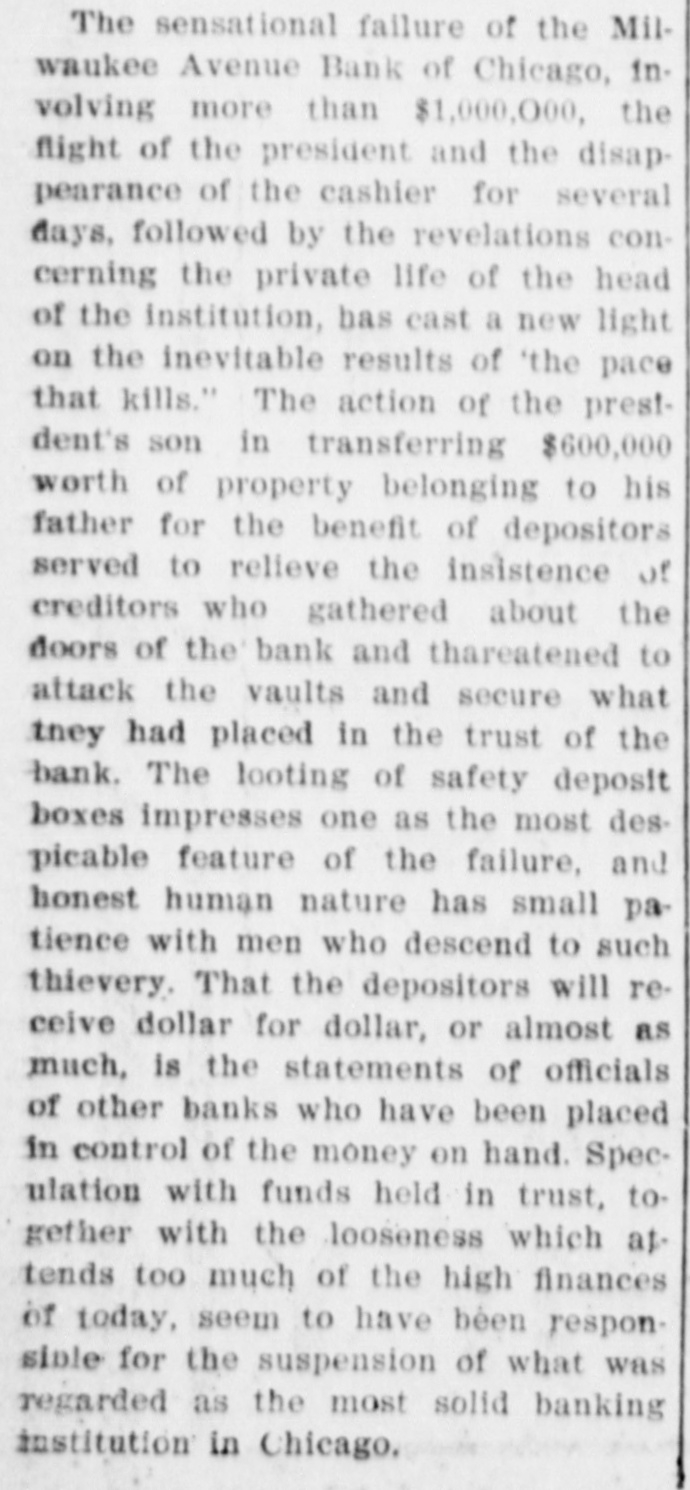
The sensational failure of the Milwaukee Avenue Bank of Chicago, involving more than $1,000,000, the flight of the president and the disappearance of the cashier for several days, followed by the revelations concerning the private life of the head of the institution, has east a new light on the inevitable results of 'the pace that kills." The action of the prestdent's son in transferring $600,000 worth of property belonging to his father for the benefit of depositors served to relieve the insistence of creditors who gathered about the doors of the bank and thareatened to attack the vaults and secure what they had placed in the trust of the bank. The looting of safety deposit boxes impresses one as the most despicable feature of the failure, and honest human nature has small patience with men who descend to such thievery. That the depositors will receive dollar for dollar, or almost as much, is the statements of officials of other banks who have been placed in control of the money on hand. Specrulation with funds held in trust, together with the looseness which at. tends too much of the high finances of today, seem to have been responsinle for the suspension of what was regarded as the most solid banking institution in Chicago.


Article from The Aberdeen Democrat, August 17, 1906

Click image to open full size in new tab

Article Text

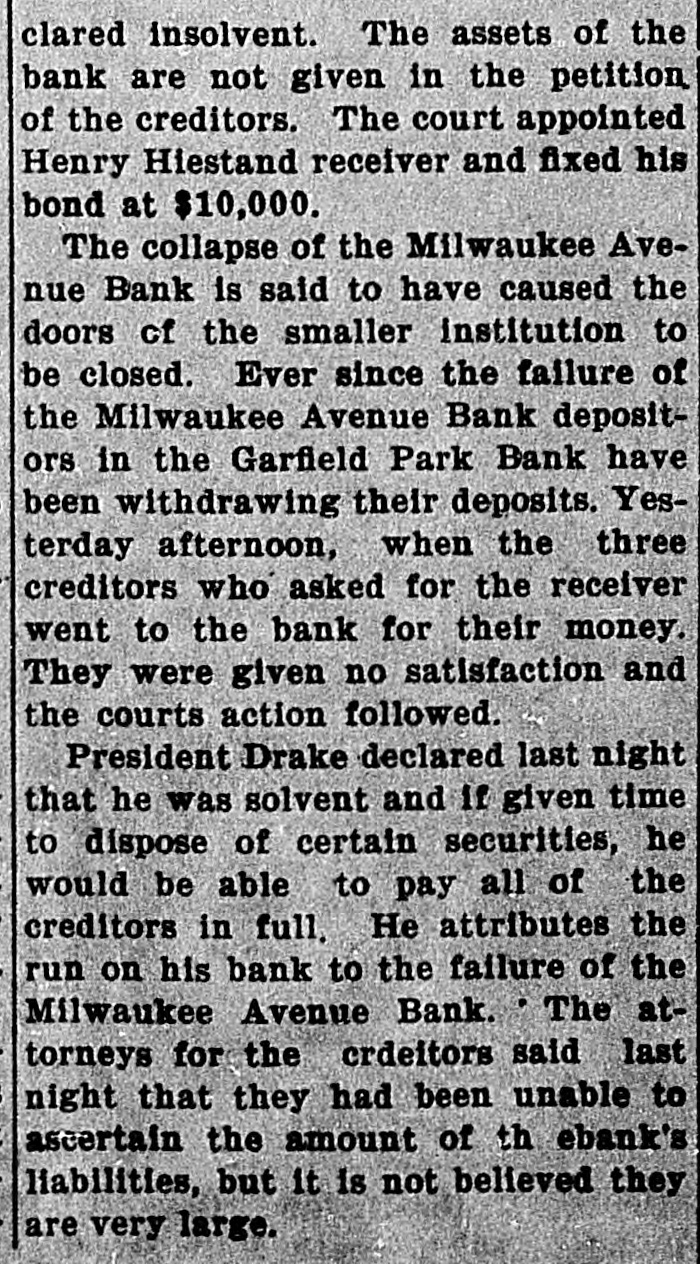
clared insolvent. The assets of the bank are not given in the petition of the creditors. The court appointed Henry Hiestand receiver and fixed his bond at $10,000. The collapse of the Milwaukee Avenue Bank is said to have caused the doors of the smaller institution to be closed. Ever since the failure of the Milwaukee Avenue Bank depositors in the Garfield Park Bank have been withdrawing their deposits. Yesterday afternoon, when the three creditors who asked for the receiver went to the bank for their money. They were given no satisfaction and the courts action followed. President Drake declared last night that he was solvent and if given time to dispose of certain securities, he would be able to pay all of the creditors in full. He attributes the run on his bank to the failure of the Milwaukee Avenue Bank. The attorneys for the crdeitors said last night that they had been unable to ascertain the amount of th ebank's liabilities, but it is not believed they are very large.


Article from The Ocala Banner, August 17, 1906

Click image to open full size in new tab

Article Text

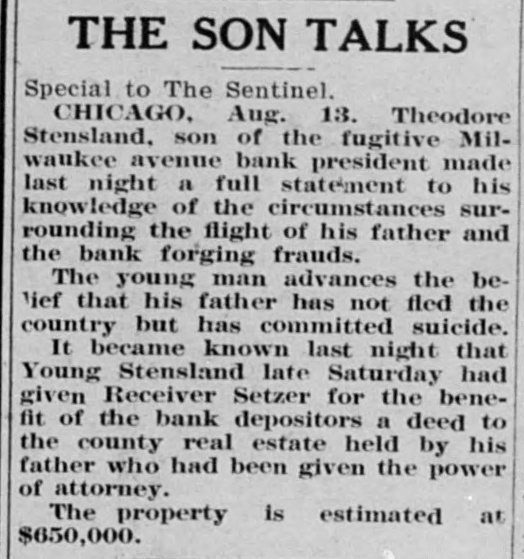
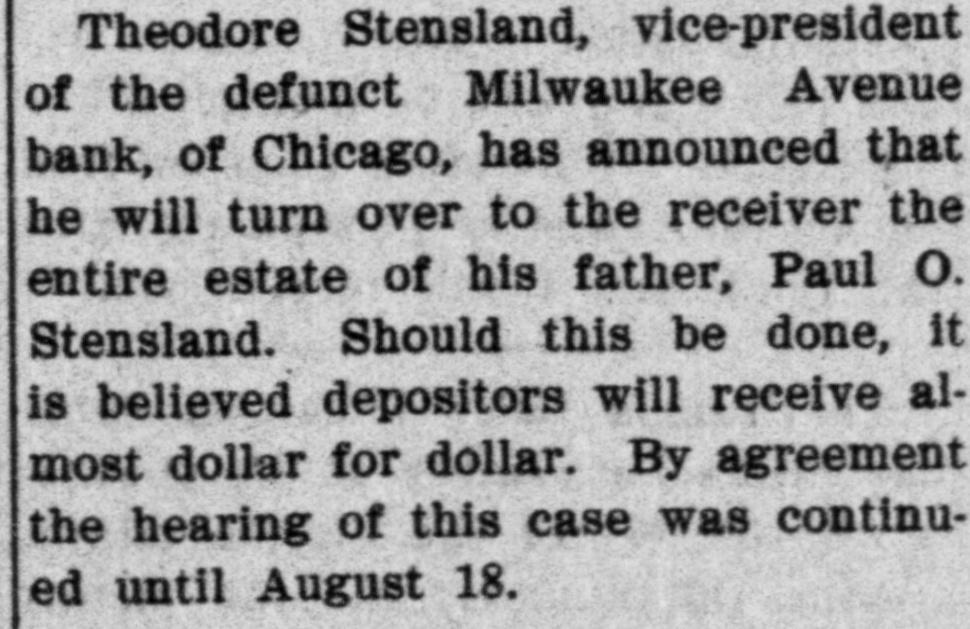
Theodore Stensland, vice-president of the defunct Milwaukee Avenue bank, of Chicago, has announced that he will turn over to the receiver the entire estate of his father, Paul O. Stensland. Should this be done, it is believed depositors will receive almost dollar for dollar. By agreement the hearing of this case was continued until August 18.


Article from The News-Herald, August 23, 1906

Click image to open full size in new tab

Article Text

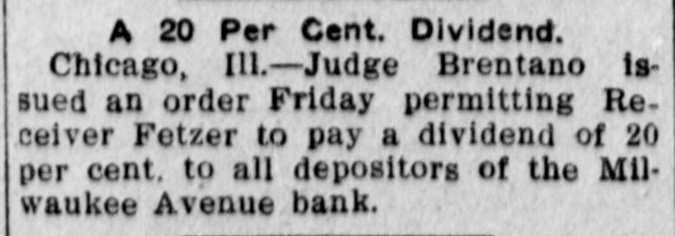
A 20 Per Cent. Dividend. Chicago, III.-Judge Brentano issued an order Friday permitting Receiver Fetzer to pay a dividend of 20 per cent. to all depositors of the Milwaukee Avenue bank.


Article from Bismarck Daily Tribune, August 24, 1906

Click image to open full size in new tab

Article Text

MAD RUSH Depositors Crush Police in Their Zeal to Get Their Money Chicago, Aug. 24.-Sixty policemen were overwhelmed by a mad rush of men and women who were determined to get the first money paid out of the vaults of the ruined Milwaukee Avenue bank Receiver Fetzer had made arrangements to pay twenty per cent to five thousand of twenty-two thousand depositors and everybody was anxious to be among the five thousand. At daybreak crowds began gathering around the bank and by eight o'clock it was surrounded by 15,000 persons.


Article from Rock Island Argus, August 24, 1906

Click image to open full size in new tab

Article Text

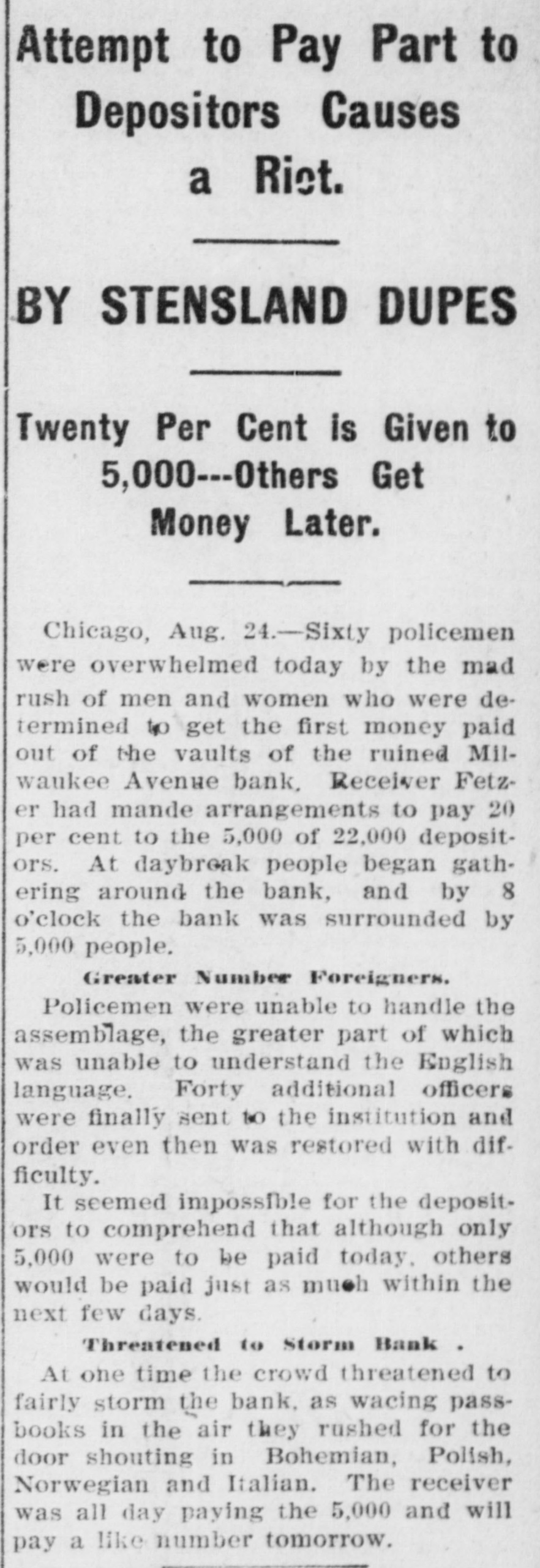
Attempt to Pay Part to Depositors Causes a Riet. BY STENSLAND DUPES Twenty Per Cent is Given to 5,000---Others Get Money Later. Chicago, Aug. 24.-Sixty policement were overwhelmed today by the mad rush of men and women who were determined to get the first money paid out of the vaults of the ruined Milwaukee Avenue bank. Receiver Fetzer had mande arrangements to pay 20 per cent to the 5,000 of 22,000 depositors. At daybroak people began gathering around the bank, and by 8 o'clock the bank was surrounded by 5,000 people. Greater Number Foreigners. Policemen were unable to handle the assemblage, the greater part of which was unable to understand the English language. Forty additional officers were finally sent to the institution and order even then was restored with difficulty. It seemed impossible for the depositors to comprehend that although only 5,000 were to be paid today. others would be paid just as much within the next few days. Threatened to Storm Bank . At one time the crowd threatened to fairly storm the bank. as wacing passbooks in the air they rushed for the door shouting in Bohemian, Polish, Norwegian and Italian. The receiver was all day paying the 5,000 and will pay a like number tomorrow.


Article from Lewiston Evening Teller, August 25, 1906

Click image to open full size in new tab

Article Text

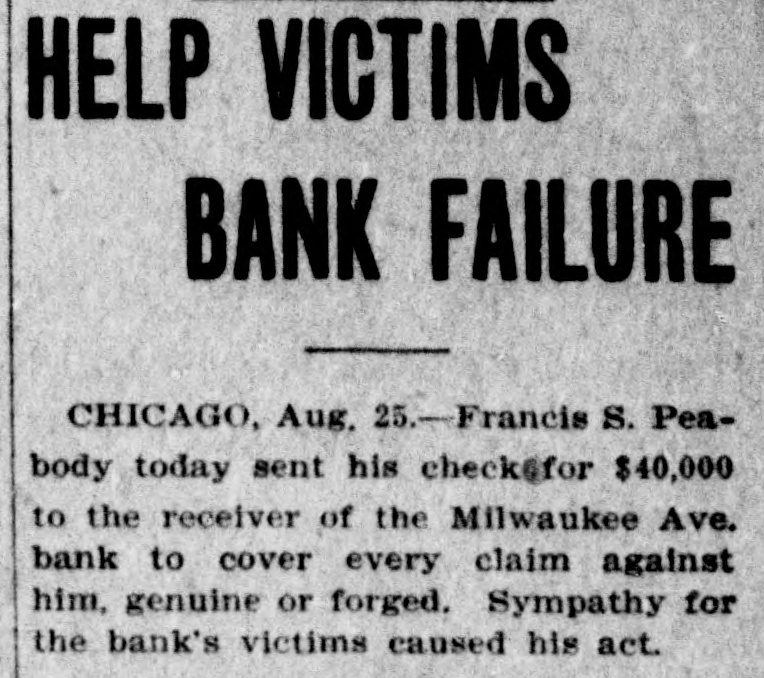
HELP VICTIMS BANK FAILURE CHICAGO, Aug. 25.-Francis S. Peabody today sent his checksfor $40,000 to the receiver of the Milwaukee Ave. bank to cover every claim against him, genuine or forged. Sympathy for the bank's victims caused his act.


Article from Rock Island Argus, August 25, 1906

Click image to open full size in new tab

Article Text

MAKES STENSLAND FORGED PAPER GOOD Charles S. Peabody, Out of Sympathy for Victims, Pays Over $40,000. Chicago, Aug. 25.-Francis S. Pea. body today sent a check for $40,000 to the receiver of the Milwaukee avenue bank to cover every claim held against him at the bank whether in the form of genuine or forged papers. Peabody's action was taken in sympathy for the victims of the bank.


Article from The Bemidji Daily Pioneer, August 25, 1906

Click image to open full size in new tab

Article Text

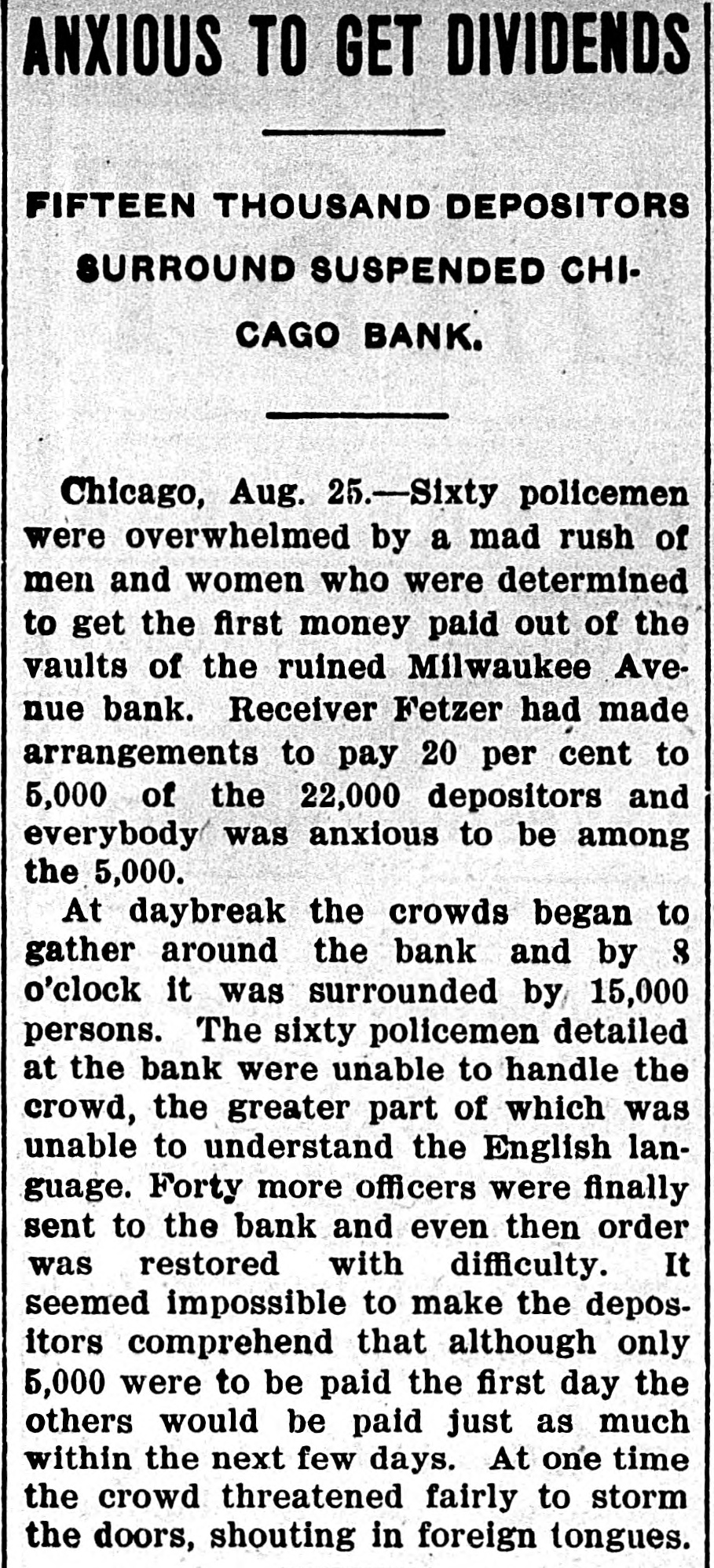
ANXIOUS TO GET DIVIDENDS FIFTEEN THOUSAND DEPOSITORS SURROUND SUSPENDED CHICAGO BANK. Chicago, Aug. 25.-Sixty policemen were overwhelmed by a mad rush of men and women who were determined to get the first money paid out of the vaults of the ruined Milwaukee Avenue bank. Receiver Fetzer had made arrangements to pay 20 per cent to 5,000 of the 22,000 depositors and everybody was anxious to be among the 5,000. At daybreak the crowds began to gather around the bank and by 8 o'clock it was surrounded by 15,000 persons. The sixty policemen detailed at the bank were unable to handle the crowd, the greater part of which was unable to understand the English language. Forty more officers were finally sent to the bank and even then order was restored with difficulty. It seemed impossible to make the depositors comprehend that although only 5,000 were to be paid the first day the others would be paid just as much within the next few days. At one time the crowd threatened fairly to storm the doors, shouting in foreign tongues.


Article from The San Francisco Call, August 26, 1906

Click image to open full size in new tab

Article Text

PEABODY SENDS $40,000 TO MILWAUKEE AVENUE BANK CHICAGO, Aug. 25.-Francis S. Peabody of this city sent a check for $40,000 to the receiver of the Milwaukee Avenue Bank today to cover every claim against him at the bank. whether in the form of genuine or forged papers. Peabody's action was taken through sympathy with victims of the bank and a desire to bring about a speedy adjustment of its affairs.


Article from The Mena Weekly Star, August 30, 1906

Click image to open full size in new tab

Article Text

OVERWHELMED THE POLICE. Mad Rush of Depositors of Wrecked Milwaukee Avenue Bank to Get Their Money. Chicago, Aug. 25.-Sixty policemen were overwhelmed Friday by a mad rush of men and women who were determined to get the first money paid out of the vaults of the ruined Milwaukee Avenue bank. Receiver Fetzer had made arrangements to pay 20 per cent to 5,000 of the 22,000 depositors and everybody was anxious to be among the 5,000. At day break the crowds swarmed around the bank, and by 8 o'clock the bank was surrounded by 15,000 people. Sixty policemen had been sent to the bank but they were unable to handle the crowd, the greater part of which was unable to understand the English ianguage. Forty mere officers were finally sent to the bank and order was even then restored with difficulty. It seemed impossible to make the depositors comprehend that although only 5,000 were to be paid Friday the others would be paid just as much within the next few days. At one time the crowd threatened to fairly storm the bank, as waving their pass books in the air they rushed for the doors shouting in Bohemian, Polish, Norwegian and Italian. The receiver was all day paying the 5,000 and will pay as many more Saturday.


Article from The Bamberg Herald, August 30, 1906

Click image to open full size in new tab

Article Text

DEPOSITORS IN MAD RUSH. Great Scramble to Get First Money Paid by Wrecked Bank. Sixty policemen were overwhelmed in Chicago Friday by a mad rush of men and women who were determined to get the first money paid out by the ruined Milwaukee Avenue bank. Receiver eFtzer had made arrangements to pay 20 per cent to 5,000 of the 22,000 depositors and everybody was anxious to be among the 5.000.


Article from The Columbia Herald, August 31, 1906

Click image to open full size in new tab

Article Text

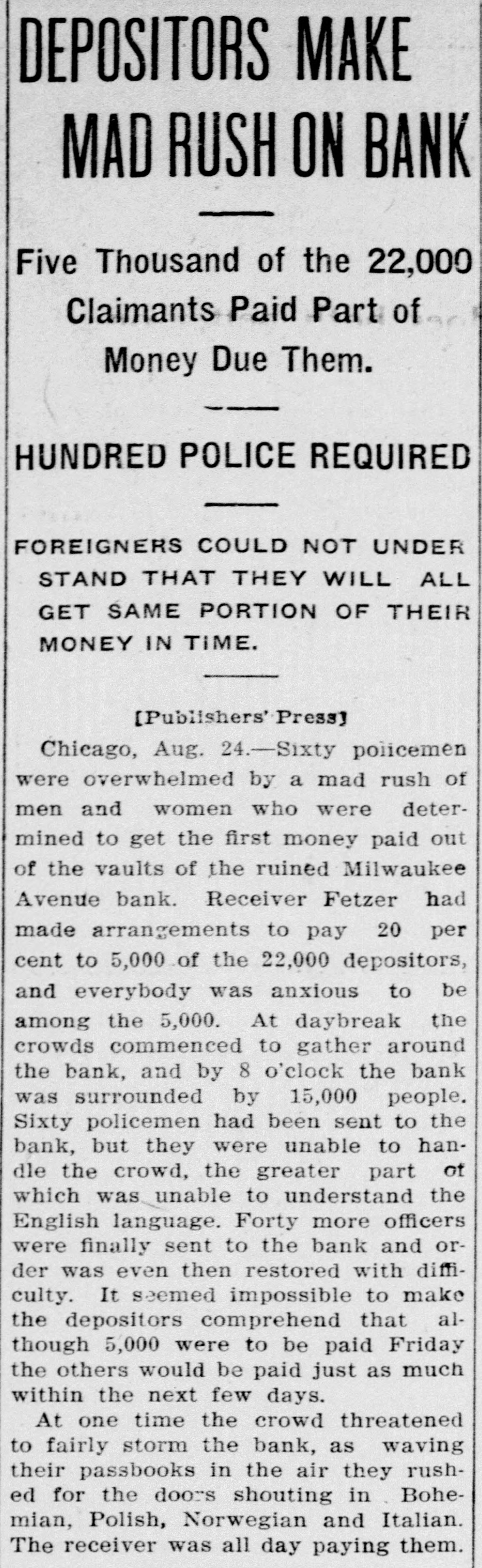
HUNDRED POLICEMEN SCARCELY ABLE TO HANDLE THE CROWD ABOUT BANK. Receiver of Chicago's Failed Milwaukee-Avenue Institution Had Announced a Partial Payment. CHICAGO, Aug. 24.-Sixty policemen were overwhelmed by a mad rush of men and women who were determined to get the first money paid out out of the vaults of the ruined Mitwaukee-Avenue Bank, Receiver Fetzer had made arrangements to pay 20 per cent. to 5,000 of the 21,000 depositors, and everybody was enxious to be among the 5,000. At daybreak the crowds commenced to gather around the bank, and by 8 o'clock the bank was surrounded by 15,000 people. Sixty policemen had been sent to the bank, but they were unable to handle the crowd, the greater part of which was unable to understand the English language. Forty or more officers were finally sent to the bank, and order was even restored with difficulty. It geemed impossible to make the depositors comprehend that, although only 5,000 were to be paid today, the others would be paid just as much within the next few days. At one time the crowd threatened to fairly storm the bank, as, waiving their pass-books in the air, they rushed for the doors, shouting in Bohemian, Polish, Norwegian and Italian. The receiver was all day paying the 5,000, and will pay as many tomorrow.


Article from Daily Kennebec Journal, September 5, 1906

Click image to open full size in new tab

Article Text

FULL CONFESSION. Stensland Talks Freely About His Defalcations. Chicago, Sept. 4.-A cable dispatch to the Tribune from Tangier, says: Paul Stensland's confession made to Assistant State's Attorney Olsen yesterday clears up much of the mystery surrounding the events leading up to the crash which involved the ruin of the Milwaukee Avenue Bank. He took much of the blame upon himself but declared Cashier Hering was the forger and that Hering got most of the money. He exonerated his son Theodore and the bank directors. He declared it a lie that he had spent any money on Leone Langdon Key or any other woman. He declared that he never spent more than $5000 a year himself, and that all the money he stole he put into real estate or investments in the hope of "making good." In his heart he was glad he was no longer a wanderer on the face of the earth. "Why." said he. "think of using a name not your own. It is worse than stealing. I did not know it would be so hard to be a fugitive." Stensland did not delude himself either with the idea of escaping punishment. "You have not been found guilty yet; you have a chance to make a fight in court." was suggested. Stensland laughed and said: "I know I what a Chicago jury will do to me. know Chicago juries." He said he had made up his minl to flee on the Thursday preceding the Sun- All day in which he left Chicago. Wednesday night he wrestled with the problem whether to blow his brains out he to run. In the hours of darkness decided or to kill himself but postponed the act until dawn and with the sunlight came the primal instinct to hold onto life and flight won over death. His preparations were hurried. He had for surrendered his life insurance policy $5000 and had received $8000, as commission the sale of property of the Co-opera- Inon tive store to the Northwestern Life surance Co., which had held a mortgage lien on the premisΓ©s. He drew $1500 as salary from the Mount Olive Cemetery he Association. This was all the money had taken with him. "Why with a million of dollars cash in the bank did you not take more?" "I could have taken a quarter of a million dollars without trouble." said he, "but I did not want to. I never took one in cent of cash from the bank and put It my own pocket. I never took a dollar belonging to other people." Stensland's health at first was not the best. When he boarded the train on the start of his flight he fainted and was unconscious for a while. On board ship was again stricken and for four days he on his back. In his first few days he was Tangier he was far from well and took went in to Spain, knowing the risk he in moving from what he regarded as proteeted soil. Stensland made no attempt to deny His his and only tried to minimize. that confession guilt began with a statement total was surprised to learn that the would less he involved in the bank's failure reach $2,000,000. He said: "I cannot understand how the shortage knowlbe $2,000,000. To my certain not can my Fability to the bank does must exceed edge $500,000. Anything over that have been stolen by Hering. "My indebtedness began a long while 2 in 1896. It was a small affair, ago. amount, and God knows I never intended small to steal. I was in a tight hole needed money. I put my own Then note, genuine, and not a forgery. in the box. bank it was suggested to me that the (Continued on Page Four.)


Article from Omaha Daily Bee, September 7, 1906

Click image to open full size in new tab

Article Text

Trustworthy Business Barometers. Philadelphia Record. Insolvency statistics constitute one of the most trustworthy barometers of the state of trade; for panics and depressions are always preceded by losses which are reflected in the tables of commercial mortality. It is an important fact, therefore, that Bradstreet's tables show that the insolvencies last month were smaller than in any preceding month for seven years. The aggregate liabilities were swelled by the HOT suspension of the Real Estate Trust company here and the Milwaukee Avenue bank in Chicago. But omitting these, the total of liabilities, like the number of insolvencies, is exceptionally small.


Article from Rock Island Argus, September 15, 1906

Click image to open full size in new tab

Article Text

Failures Are Few Insolvency statistics constitute one of the most trustworthy barometers of the state of trade; for panics and depressions are always preceded by losses which are reflected in the tables of commercial mortality. It is an important fact, therefore, that Bradstreets' tables show that the insolvencies last month were smaller than in any preceding month for seven years. The aggregate liabilities were swelled by the suspension of the Real Estate Trust company in Philadelphia and the Milwaukee Avenue bank in Chicago. But, omitting these, the total of liabilities, like the number of insolvencies, is exceptionally small.


Article from Deseret Evening News, October 20, 1906

Click image to open full size in new tab

Article Text

The Chicago Clearing House association sent to James Keeley, managing editor of the Chicago Tribune, a check for $5,000, the amount of the reward offered by the association for the capture of Paul O. Stensland, the former president of the Milwaukee Avenue bank. He turned it over to the receiver of the bank for the benefit of the depositors. He wanted no reward, feeling that virtue is its own reward.


Article from The News-Democrat, November 13, 1906

Click image to open full size in new tab

Article Text

RACE TRACK GAMBLING IS RESPONSIBLE FOR CRIME The fact should not be overlooked that race track gambling was partly responsible for the wreckage of the Milwaukee Avenue bank of Chicago, in which some thousands of poor working people, including many foreigners, lost their savings. It appears. from evidence disclosed since the president of the bank fled. that he, "in company with a caterie of friends, was a heavy plunger on the races." As high as $75,000 of savings deposits was used for this purpose in a single day. A book was kept in a secret place containing memoranda. of "campaigns on the turf." The cashier of the bank. according to his own admissions, was a regular follower of the ponies." With the two chief officials of the bank playing the races. ruin and loss were inevitable, soon or late. It was only the astonishing complaisance of the bank's board of directors in allowing such characters as Stensland and Hering to remain in charge of the institution which postponed the crash for so long. Race-track gambling is not often responsible for 80 large a theft in one sum as in the case of the plunderings of these men. but we have no doubt that if an accurate record could be made of all the defalcations. embezzlements, and petty thefts committed in a single year in the United States and traceable to this source, it would run into the millions. Most of the states have banished the professional race tracks from their borders. In the Empire State alone they remain under the protection of law. making New York the chief center of race track gambling and the pool-room industry for the entire country. Truly a noble distinction!


Article from Heppner Gazette, November 15, 1906

Click image to open full size in new tab

Article Text

RESUME OF THE WEEK'S DOINGS General Review of Important Hap penings Presented In a Brief and Comprehensive Manner for Busy Readere-National Political, Historical and Commercial. Cuban liberals are divided on account of friendship with America. A dirigible balloon sent up from the Milan exposition crossed the Alps safely. A new plague has caused 12 deaths in a small Texas town, and doctors are unable to control it. It is reported that King Alfonso of Spain has been assagginated, but the report cannot be verified. Wireless messages state that the presidential party is off the Florida coast and enjoying fine weather. The wrecking of the Milwaukee Avenue bank of Chicago was re enacted on the stage in Chicago and nearly caused a riot. Sceintists have made arrangements with the Italian government to complete the excavation of the ancient Roman city of Herculaneum. The Forestry bureau of the United States has failed in its efforts to compel the railroads to nse oil for fuel on enginee passing through forest reserves. It now develops that the Standard Oil company, aided by the railroads, did their best to defeat Hoch for governor. Hoch received a majority of over 2,000. The boiler of a Southern Pacific passenger enginhe exploded at Sargent, a small station in Southern California, killing two persons and wrecking the depot and four cars. Hearst may ge: the mayoralty of New York. Idaho land fraud trials will begin soon at Moscow. An American consulate has been opened at Mukden. Cuban liberals are making trouble for Governor Magoon. All the provincial governors of the republic of Panama will meet Roosevelt. Russian terrorists dynamited a train, massacred the military guard, and secured $500,000. A small powder magazine 30 miles from Chicago exploded, breaking windows three miles distant. Four men were killed and the foundd ation laid for a lasting fend in Kentucky over the recent election. la All British employes on the Panama canal will have a holiday to celebrate ca the birthday of King Edward. A whale ship has diecovered an Esh kimo band on Prince Edward island U who had never seen a white man. c A crazy Chilean who tried to gain fa admission to the White House some time ago has been arrested at Panama. Secretary Bonaparte says the strength shown by Hearst shows that the quesb tion must be dealt with "in a spirit at once liberal and conservative.' 8 Taft 13 on a tour of inspection of rmy posts. President Roosevelt went to Oyster th th Bay and cast his vote, returning then to Washington. F President Roosevelt has arranged to di receive the Ute chiefe at the White Br House and hear their troublee. ha in The Royal Hawaiian band, which in has been making a tour of the United ri States, is stranded in Ogden, Utah. a di The president has diemissed in die So grace a whole battalion of negro troops re for refusing to disclose the identity of eq some wrong doers among them, and er will also court martial a white officer ula hi fgor making derogatory remarks against the negrc troops. Navy yard employee were given leave of absence long enough to vote. the Chicago ewitchmen will go on strike Ma unless the railroads acecde to their deto mande. or ma It ie probable that the authorities of Co Harvard will prohibit football after be the present season. Pr me The Harriman lines are building fav wreck-proof steel mail care to replace agΓ‘ their present wooden care. tha in Thomas Kineey, pureer on the Attio lantic liner St. Paul, has crossed the ocean 901 times, more than any other living man. He has sailed a total of 2,703,000 miles. exp Sailors who were debarred from at dancing in an amueement hall at Newthe port, R. I., have begun euit against und the prorpietor. Roosevelt has contribexp uted $100 to help their case. tan Thr The heire of the estate of Pabet, the wo Milwaukee brewer, will have to pay had lure the inheritance tax on $4,000,000 stock tip in the Pabet Brewing company, transferred to them shortly before his death. Steneland and Hering, the wreckree o of the Milwaukee Avenue bank, of Chicom cago, were today sentenced to indeter. pro thei minate terms of imprisonment, which to may run from one to ten years. This men will not increase Steneland's present sentence. beer