gpt-5-mini (chosen from majority vote of a three-model LLM ensemble)
Short Digest
6dbb30d37643e092
Response Measures
Borrowed from banks or large institutions, Clearinghouse loan, Capital injected, Full suspension, Books examined
Clearinghouse involved: Yes
(loan, examination, or other measures)
Receivership Details
Depositor recovery rate
100.0%
Date receivership started
1908-01-30
Date receivership terminated
1909-04-14
OCC cause of failure
Losses
Share of assets assessed as good
54.9%
Share of assets assessed as doubtful
40.6%
Share of assets assessed as worthless
4.5%
Description
Receiver appointed Jan. 30, 1908; bank remained in receivership and paid dividends rather than resuming normal operations.
Events (7)
1.April 18, 1901Chartered
Source
historical_nic
2.January 30, 1908Receivership
Source
historical_nic
3.January 30, 1908Receivership
Newspaper Excerpt
Receiver Named...Bank Examiner Charles A. Hanna...was today appointed temporary receiver for the New Amsterdam National bank of New York.
Source
newspapers
4.January 30, 1908Run
Cause
Local Banks
Cause Details
Heavy withdrawals and contagion following the closing/distress of the National Bank of North America and other Morse-related institutions
Measures
Bank officers conferred with clearing house and Controller; no successful independent measures prevented closure
Newspaper Excerpt
the closing of the National Bank of North America...started fresh reports...which necessitated the liquidation of the bank...about one-half of the bank's cash reserve had been depleted by withdrawals
Source
newspapers
5.January 30, 1908Suspension
Cause
Government Action
Cause Details
Controller of the Currency ordered the bank closed and examiners took charge because reserves were heavily depleted and further withdrawals were expected
Newspaper Excerpt
ordered the New Amsterdam National Bank to be closed...and instructed the national bank examiners of this city to take charge of its affairs pending the appointment of a receiver
Source
newspapers
6.March 9, 1908Other
Newspaper Excerpt
Notice...claims against 'The New Amsterdam National Bank of N. Y.' must be presented to the Receiver... Charles A. HANNA, Receiver New Amsterdam National Bank.
Source
newspapers
7.June 3, 1908Other
Newspaper Excerpt
Depositors in the suspended New Amsterdam National Bank received yesterday the long looked for initial dividend of 25 per cent.
Source
newspapers
Newspaper Articles (24)
1.October 21, 1907Evening Times-RepublicanMarshalltown, IA
Click image to open full size in new tab
Article Text
STOCK MARKET TODAY New York Speculators Take More Favorable View of Financial Situation -Associated Banks Assist Mercantile National Third Consecutive Day. New York, Oct. -Encouraged by protective measures adopted over Sunday by the clearing house banks, speculators took a more favorable view of the financial situation this morning. The stock market opened strong and higher. The Mercantile National bank today owed the clearing house on balance, $1900.000, and the National Bank of North America owed $850,000. These sums were unexpectedly large and indicated that heavy withdrawals were being made from these two banks. The sum owed by the Merchants' and Traders' National Bank was $430,000, and that owed by the New Amsterdam National Bank, $200,000. The clearing house committee decided at a meeting to assume responsibility for the Mercantile National Bank's large debt balance. This is the third consecutive day on which the associated banks have gone to the assistance of the Mercantile. The only weak features in the stock situation today were stocks and bonds of the Consolidated Steamship Company. This is the company in which Charles W. Morse is the controlling factor. United States Copper advanced two points. Seth M. Milliken, new president of the Mercantile National Bank, was in charge of the institution's affairs today. He said that the affairs at the bank were progressing satisfactorily. Questioned as to loans made to F. A. Heinze and Charles W. Morse, Milliken said it was expected that they would repay the loans made to them as soon as they were able. Ed O. Eldridge, cashier of the new Amsterdam National Bank, said today that there was no more than the usual business being done this morning in the way of deposits.
2.January 30, 1908New-York TribuneNew York, NY
Click image to open full size in new tab
Article Text
cessful movement. But the closing of the National Bank of North America, attracting renewed attention to the interests which had previously dominated both institutions in their past administrations, started fresh reports of an exaggerated and sensational nature, which necessitated the liquidation of the bank. No loss will be sustained by depositors, and the stockholders will receive a substantial dividend. CASH RESERVE HALF GONE. At 8 late hour last night National Bank Examiner Hanna made this statement: William B. Ridgely, Controller of the Currency, at the request of its president, ordered the New Amsterdam National Bank to be closed. late this afternoon. and instructed the national bank examiners of this city to take charge of its affairs pending the appointment of a receiver. President F. W. Kinsman, jr., informed the Controller's representative that about one-half of the bank's cash reserve had been depleted by withdrawals and payments during the course of the day. and it was feared that further heavy demands from depositors would be made tomorrow. which the bank would be in no position to meet Controller Ridgely is not in the city, having returned to Washington on Tuesday night. President Kinsman was downtown all the afternoon in conference with other bankers. He had expected on Tuesday night to be able to retire the bank's outstanding Clearing House loan certificates yesterday. the amount of which had been reduced to but the withdrawals of deposits were so heavy yesterday as to make it out of the question to carry that purpose into execution. The following statement of the assets and liabilities was given out by Mr. Hanna at the bank last night
Receiver Named. Washington. D. C., Jan. 30.-Bank Examiler Charles A. Hanna, temporary receiver of the National Bank of North America, was today appointed temporary receiver for the New Amsterdam National bank of New York. Plenty of Resources. No statement has yet been made as
CLOSING PRECIPITATES RUN New York, Jan. 30.-A run on Oriental bank, at Broadway and J street, began when the doors of institution were opened at 10 o'c this morning, but this afternoon it declared that the attack would withstood successfully. The tro followed the announcement that New Amsterdam National bank the Mechanics and Traders' bank been forced to suspend business account of heavy withdrawals of posits.
5.January 31, 1908The SunNew York, NY
Click image to open full size in new tab
Article Text
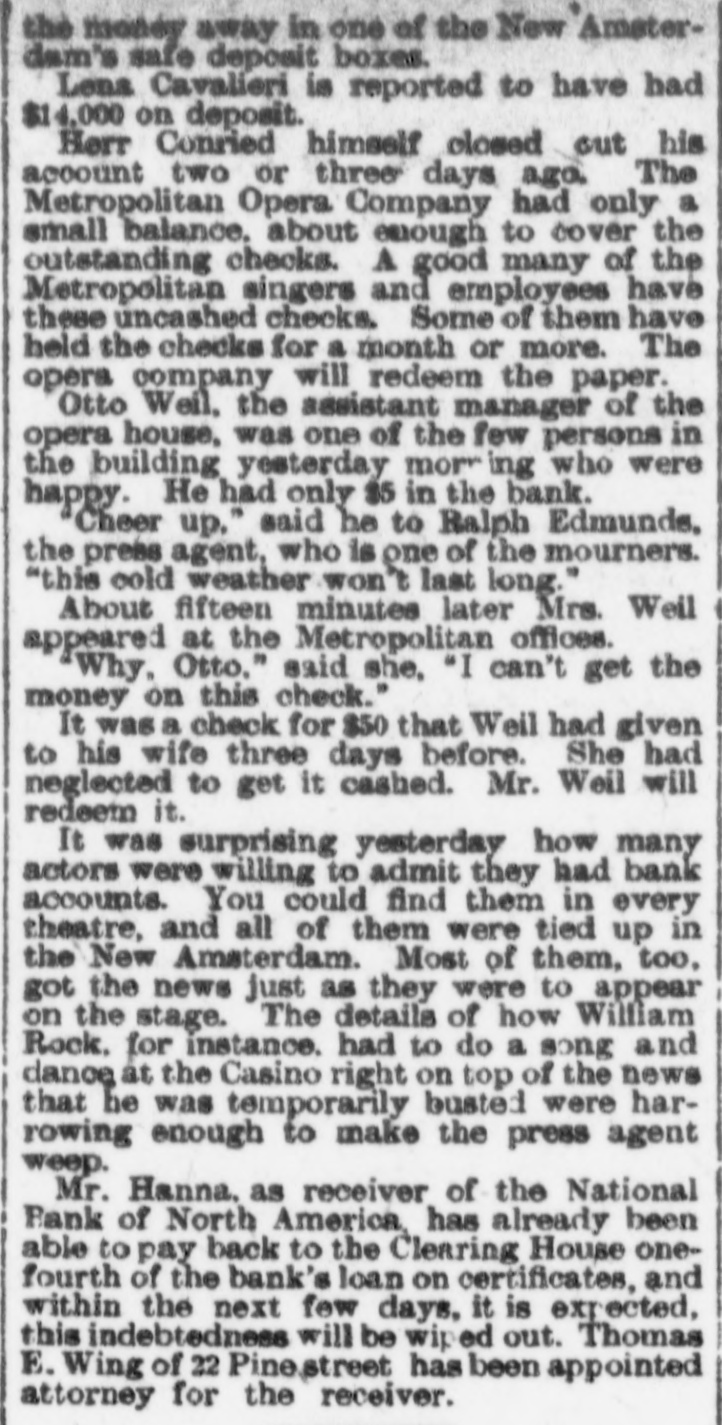
the money away in one of the New Amsterdam's safe deposit boxes. Lena Cavalieri is reported to have had $14,000 on deposit. Herr Conried himself closed cut his account two or three days ago. The Metropolitan Opera Company had only a small balance. about enough to cover the outstanding checks. A good many of the Metropolitan singers and employees have these uncashed checks. Some of them have held the checks for a month or more. The opera company will redeem the paper. Otto Weil, the assistant manager of the opera house, was one of the few persons in the building yesterday morn ing who were happy. He had only $5 in the bank. Cheer up." said he to Ralph Edmunds, the press agent, who is one of the mourners. "this cold weather won't last long." About fifteen minutes later Mrs. Weil appeared at the Metropolitan offices. "Why, Otto." said she, "I can't get the money on this check." It was a check for $50 that Weil had given to his wife three days before. She had neglected to get it cashed. Mr. Weil will redeem it. It was surprising yesterday how many actors were willing to admit they had bank accounts. You could find them in every theatre, and all of them were tied up in the New Amsterdam. Most of them, too, got the news just as they were to appear on the stage. The details of how William Rock. for instance. had to do a song and dance at the Casino right on top of the news that he was temporarily busted were harrowing enough to make the press agent weep. Mr. Hanna. as receiver of the National Bank of North America. has already been able to pay back to the Clearing House onefourth of the bank's loan on certificates, and within the next few days, it is expected, this indebtedness will be wiped out. Thomas E. Wing of 22 Pinestreet has been appointed attorney for the receiver.
6.February 2, 1908The Greenville TimesGreenville, MS
Click image to open full size in new tab
Article Text
Bank Examiner Charles A. Hanna, temporary receiver of the National Bank of North America, has been appointed temporary receiver of the New Amsterdam National Bank of New York.
7.February 6, 1908The Mena Weekly StarMena, AR
Click image to open full size in new tab
Article Text
YORK EXCITED AGAIN Closing of Two Banks Causes Small Flurry Among Depositors in Other Institutions. THE ORIENTAL BANK WITHSTANDS A RUN When the New Amsterdam National and Mechanics' and Traders' Failed to Open, Depositors in Other Banks Became Scared and Began to With draw Their Money.
8.February 6, 1908The Brandon NewsBrandon, MS
Click image to open full size in new tab
Article Text
Effect is Small. Memphis, Tenn.-Announcement of the suspension of two banking institutions in New York had little effect in financial circles there. The fact that both institutions were known to have been carried by the clearing house banks through the serious panic times was generally known, and their failure to keep on their feet after they were put on their feet is no surprise. Bank examiners took active charge of the affairs of the New Amsterdam National bank and the Mechanics and Traders' bank, a state institution. Both of these banks were included in the Morse-Heinz chain of banks, and after the closing of the National Bank of North America a few days ago there had been what practically amounted to runs upon them. Both of them were still unable to take up their allotment of the certificates which the clearing house issued during the stringency beginning in October, and when the renewed drain upon their resources began, the clearing house authorities declined to further extend their credit.
9.March 4, 1908The White Pine NewsEly, NV
Click image to open full size in new tab
Article Text
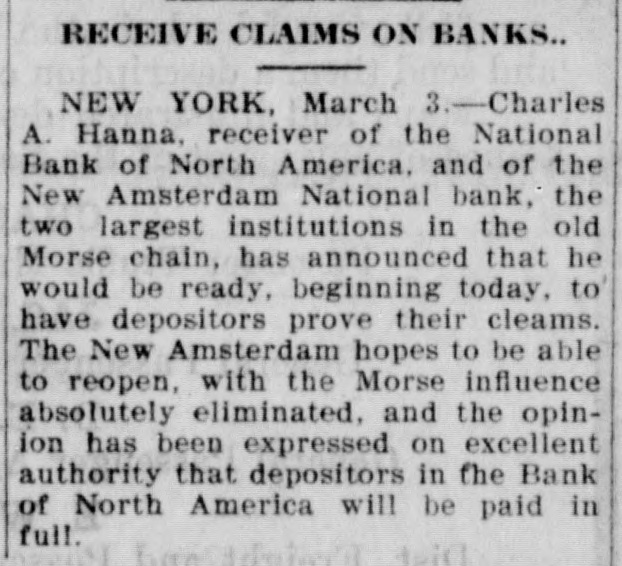
RECEIVE CLAIMS ON BANKS. NEW YORK, March 3.-Charles A. Hanna, receiver of the National Bank of North America, and of the New Amsterdam National bank, the two largest institutions in the old Morse chain, has announced that he would be ready, beginning today, to have depositors prove their cleams. The New Amsterdam hopes to be able to reopen, with the Morse influence absolutely eliminated, and the opinion has been expressed on excellent authority that depositors in the Bank of North America will be paid in full.
10.March 9, 1908New-York TribuneNew York, NY
Click image to open full size in new tab
Article Text
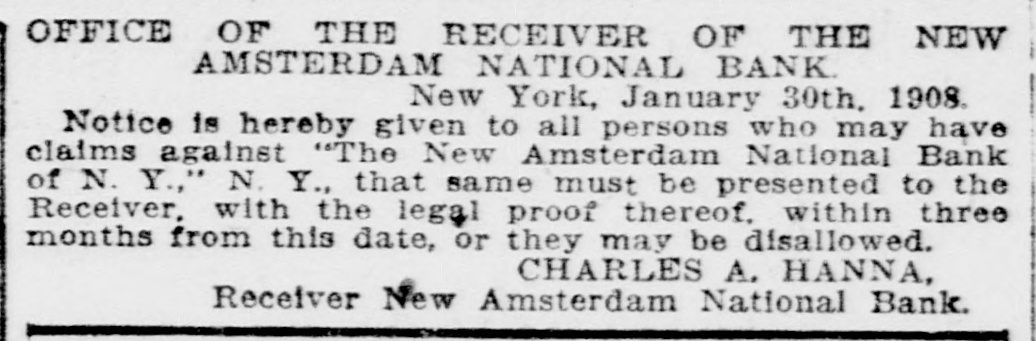
OFFICE OF THE RECEIVER OF THE NEW AMSTERDAM NATIONAL BANK New York, January 30th. 1908. Notice is hereby given to all persons who may have claims against "The New Amsterdam National Bank of N. Y.," N. Y., that same must be presented to the Receiver, with the legal proof thereof. within three months from this date, or they may be disallowed. CHARLES A. HANNA, Receiver New Amsterdam National Bank.
11.March 16, 1908The Evening WorldNew York, NY
Click image to open full size in new tab
Article Text
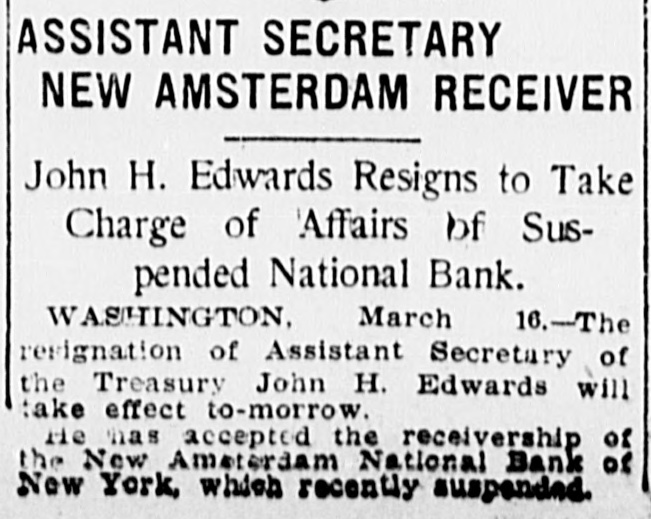
ASSISTANT SECRETARY NEW AMSTERDAM RECEIVER John H. Edwards Resigns to Take Charge of Affairs bf Suspended National Bank. WASHINGTON, March 16.-The resignation of Assistant Secretary of the Treasury John H. Edwards will take effect to-morrow. He has accepted the receivership of the New Ameterdam National Bank of New York, which recently suspended.
12.March 16, 1908The Washington TimesWashington, DC
Click image to open full size in new tab
Article Text
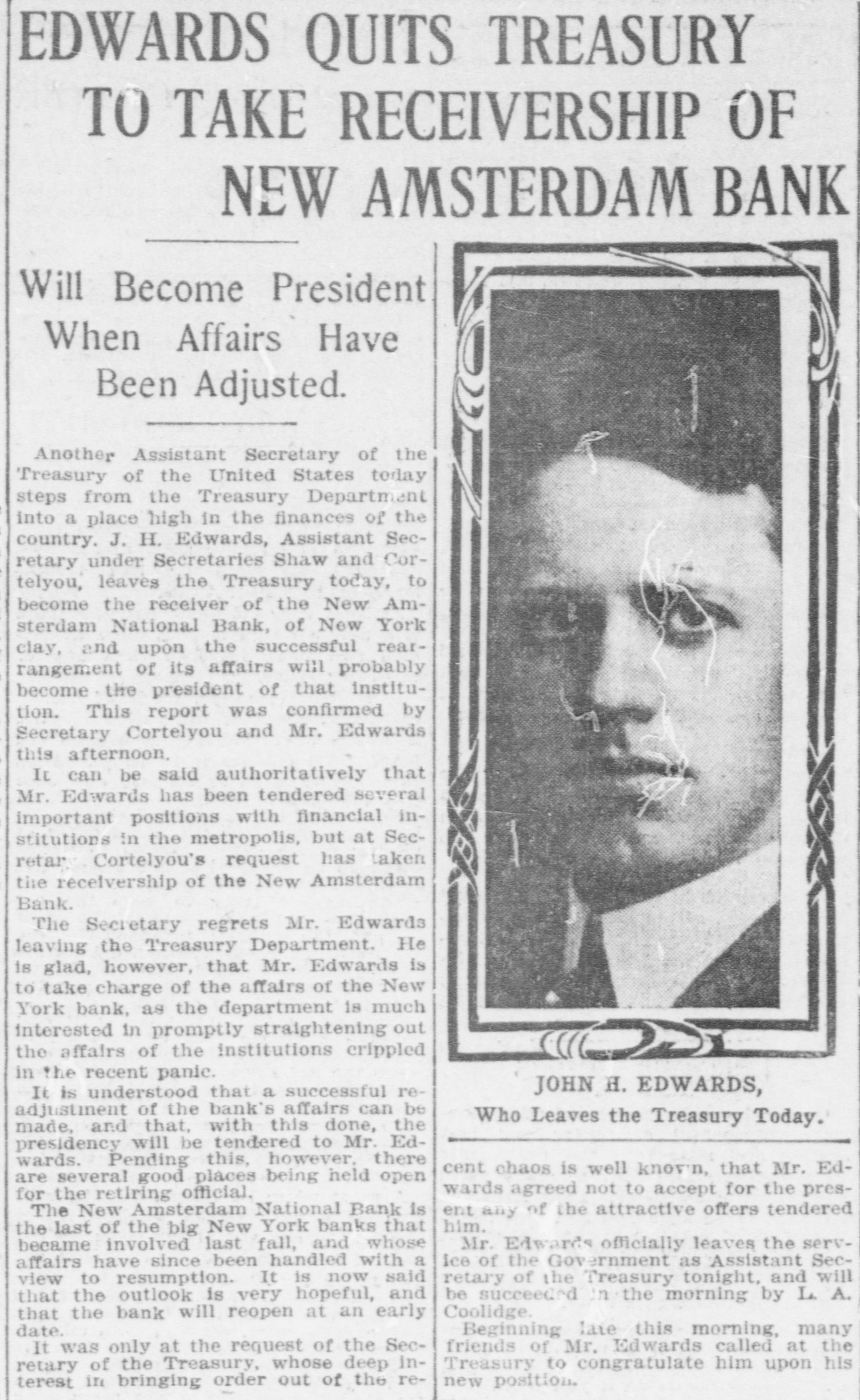
EDWARDS QUITS TREASURY TO TAKE RECEIVERSHIP OF NEW AMSTERDAM BANK Will Become President When Affairs Have Been Adjusted. Another Assistant Secretary of the Treasury of the United States today steps from the Treasury Department into a place high in the finances of the country. J. H. Edwards, Assistant Secretary under Secretaries Shaw and Cortelyou, leaves the Treasury today, to become the receiver of the New Amsterdam National Bank, of New York clay, and upon the successful rearrangement of its affairs will probably become the president of that institution. This report was confirmed by Secretary Cortelyou and Mr. Edwards this afternoon. It can be said authoritatively that Mr. Edwards has been tendered several important positions with financial institutions in the metropolis, but at Secretar Cortelyou's request has taken the receivership of the New Amsterdam Bank. The Secretary regrets Mr. Edwards leaving the Treasury Department. He is glad, however, that Mr. Edwards is to take charge of the affairs of the New York bank, as the department is much interested in promptly straightening out the affairs of the institutions crippled in the recent panic. JOHN H. EDWARDS, It is understood that a successful readjustment of the bank's affairs can be Who Leaves the Treasury Today. made, and that, with this done, the presidency will be tendered to Mr. Edwards. Pending this, however. there cent chaos is well known, that Mr. Edare several good places being held open wards agreed not to accept for the presfor the retiring official. The New Amsterdam National Bank is ent any of the attractive offers tendered him. the last of the big New York banks that became involved last fall, and whose Mr. Edwards officially leaves the servIce of the Government as Assistant Secaffairs have since been handled with a view to resumption. It is now said retary of the Treasury tonight, and will that the outlook is very hopeful, and be succeeded in the morning by L. A. Coolidge. that the bank will reopen at an early date. Beginning late this morning, many friends of Mr. Edwards called at the It was only at the request of the SecTreasury to congratulate him upon his retary of the Treasury, whose deep innew position. terest in bringing order out of the re-
13.March 17, 1908The Washington HeraldWashington, DC
Click image to open full size in new tab
Article Text
as Assistant Secretary of that department, made himself deservedly popular by his efficient services with those who were associated with him. A man of exceptional ability. he merited the esteem of his superiors, and it was with regret that Secretary Cortelyou sanctioned his departure. The retiring Assistant Secretary will be succeeded by Louis Coolidge, who will take the oath of office to-day. Mr. Edwards, the retiring Assistant secretary, came to Washington from Ohio, and has administered the affairs of the office in a particularly able manner. He has enjoyed the confidence of bla superiors to a marked degree and has been deservedly popular with those who frequent the second floor of the Treasury Building. Secretary Cortelyou said yesterday that Mr. Edwards had received three attractivo offers from financial institutions in New York, but that he prevailed upon Mr. Edwards to suspend consideration of them for a time. He did so, he said, because he felt that he needed Mr. Edwards' services in the receivership of the New Amsterdam Bank. He added that he regarded his assistant as especially qualified for this work. Mr. Cortelyou said he regretted exceedingly that Mr. Edwards was leaving the Assistant Sec. retaryship, as he had discharged the duties of that office with excep ional ability. It was stated yesterday that the New Amsterdam Bank will eventually resume business. and that other institutions in the same vicinity will be consolidated with it to form a banking house of large capital. Mr. Edwards will, as receiver, take an active part in the reorganization of the New Amsterdam and the other banks which are to be consolidated with that institution, and it is supposed that his appointment is preliminary to his election as president of the consolidated concern. Mr. Edwards was private secretary to Leslie M. Shaw when Mr. Shaw was Secretary of the Treasury, and was appointed Assistant Secretary when Robert M. Armstrong retired from the department to become president of a banking institution in New York. Business on the Washington Stock Exchange yesterday was small in volume, chiefly because there was little stock to be had. It was clear to the observer that there was a good demand for stocks. Prices were in most instances bid up, brokers standing ready to take shares at prices better than the closing bid. Indeed, there was a good deal of sparring in the way of bids, in the hope of uncovering stock; and the impression left by the day's business was that much more stock could have been soid than was offered. The chief business was the utility shares, Capital Traction leading. It sold somewhat under the highest of last week, at 118 1-2 and 119. Washington Railway and Electric preferred went at 70 1-8, and 24 1-2 was bid for the common. Gas was sold in fractional lots above 62, and Washington Railway and Electric 4s brought L321-2.
14.March 17, 1908Daily Kennebec JournalAugusta, ME
Click image to open full size in new tab
Article Text
CAPITAL JOTTINGS. Government receipts Monday: From internal revenue, $1,300,038; customs, $660,006: miscellaneous, $95,068. Expenditures, $2,230,000. Assistant Secretary of the Treasury John H. Edwards, whose resignation will take effect Tuesday. March 17, has accepted the receivership of the New Amsterdam National Bank of New York which recently suspended. The House sub-committee on fortification appropriation bill with the esti(Continued on Page Two.)
15.April 15, 1908The Star and Newark AdvertiserNewark, NJ
Click image to open full size in new tab
Article Text
FIVE BANKS EXPELLED. Clearing House Chalks Off Sus= pended Institutions. NEW YORK, April 15.-Five banks were expelled formally from the New York Clearing House Association at a recent meeting in pursuance or the provision requiring this action in the case of institutions. that have suspended. They were the National Bank of North America, the Oriental Bank, the Mechanics and Traders' Bank, the New Amsterdam National Bank and the First National Bank, of Brooklyn.
PANIC-MAKING BANKS EXPELLED. Official announcement was made by the New York Clearing House Association last week that the banks which had failed because of mismanagement had been expelled from the association. This is the formal and official stigma which the clearing house association has put upon the financial institutions which brought about the panic of last fall, and it is an incontrovertible evidence as to what did cause the panic. Trust companies, like the Knickerbocker for instance, had never been admitted to membership in the association, so they, of course, could not be expelled. The president of the Knickerbocker confessed his pait in the disaster by committing suicide. Some others followed his example, and still others are under indictment. But the banks, properly speaking, were for the most part members of the clearing house association and came under its disciplinary jurisdiction. Such membership is a coveted asset and thepunishmenti is as severe as could be inflicted upon the institutions as such. So the official announcement goes out to the world that the following banks are no longer members of the New York Clearing House Association: National Bank of North America. Oriental bank. Mechanics' and Traders' bank. New Amsterdam National bank. First National Bank of Brooklyn. There is something pathetic in this announcement to those who are familiar with financial history in New York. More than one of these institutions long enjoyed an honored name. That is why they were able to catch so many thousand depositors when corrupt speculators got control of them and used the funds for their own unrighteous purposes. That is why confidence was shaken to its very foundations when the crash came and people began to clamor for their money. It is eloquent testimony as to the real causes of the panic, and it is idle for vicious partisanship and perverse selfinterest to seek to place the blame where it does not belong.
17.June 3, 1908New-York TribuneNew York, NY
Click image to open full size in new tab
Article Text
NEW AMSTERDAM BANK'S DIVIDEND. Depositors in the suspended New Amsterdam National Bank received yesterday the long looked for initial dividend of 25 per cent. The bank closed its doors on January 29. and Charles A. Hanna, national bank examiner and receiver of the National Bank of North America, took charge temporarily. The bank. although a Morse institution, was understood to be in fairly good shape, with sufficient assets to pay off all the depositors in full. John H. Edwards, ex-Assistant Secretary of the Treasury, was appointed receiver two months ago. Mr. Edwards said yesterday that he expected to pay a second dividend of 25 per cent in the near future. It is understood that plans for the reorganization and eventual reopening of the bank under a new name and with new interests in the directorate are well under way.
18.July 26, 1908New-York TribuneNew York, NY
Click image to open full size in new tab
Article Text
MR. MORSE OPTIMISTIC. Financier Says He'll Soon Take the Public Into His Confidence. Charles W. Morse, when seen yesterday in the National Bank of North America, where he had been in consultation with Charles A. Hanna, the receiver, said that his plan to pay off all the bank's depositors and then have the bank's assets turned over to the stockholders was making excellent headway. Mr. Morse said that depositors representing hundreds of thousands of dollars had already availed themselves of his offer to pay the full amount of all claims. In regard to his plans for paying off the depositors of the New Amsterdam National Bank, and then taking over the assets of that institution, Mr. Morse said that he was not quite ready as yet to take the public into his confidence, but added that he expected to have some important announcements to make along that line in the near future. Asked concerning the activities of the Morse Securities Company, which was incorporated in Bath, Me., some time ago, to buy and sell stocks. bonds and other securities, Mr. Morse said he had nothing new to divulge just at present. Mr. Morse expressed himself as optimistic on the general financial situation. Asked how much further he thought the present rise in the stock and bond market was likely to go. he said: "The pendulum always swings too far, you know. Last fall it swung much too low. Now it may swing too far the other way." Mr. Morse seemed to be in better health and spirits than at any time since last October, when he resigned from all the banking institutions with which he was connected.
19.July 27, 1908Daily Kennebec JournalAugusta, ME
Click image to open full size in new tab
Article Text
To Take Public Into His Confidence, Morse Says. Will Soon Give Out Plans For Bank of North America. Optimistic as to Financial Situation -Health Is Good. New York, July 26.-Charles W. Morse, when seen yesterday in the National Bank of North America, where he had been in consultation with Charles A. Hanna, the receiver, said that his plan to pay off all the bank's depositors and then have the bank's assets turned over to the stockholders was making excellent headway. Mr. Morse said that depositors representing hundreds of thousands of dollars had already availed themselves of his offer to pay the full amount of all claims. In regard to his plans for paying off the depositors of the New Amsterdam National Bank. and then taking over the assets of that institution, Mr. Morse said that he was not quite ready as yet to take the public into his confidence, but added that he expected to have some important arnouncements to make along that line in the near future. Asked concerning the activities of the Morse Securities Co., which was incorporated in Bath, Me., some time ago, to buy and sell stocks, bonds and other securities, Mr. Morse said he had nothing new to divulge just at present. Mr. Morse expressed himself as optimistic on the general financial situation. Asked how much further he thought the present rise in the stock and bond market was likely to go, he said: "The pen.
20.September 11, 1908The Washington TimesWashington, DC
Click image to open full size in new tab
Article Text
An additional dividend of 40 per cent to the depositors of the New Amsterdam National Bank, of New York city, was ordered today. Receiver Edwards informed the Comptroller of the Currency in a personal conference that the assets are amply sufficient to pay the remaining 10 per cent of indebtedness with interest at an early date.
21.September 16, 1908The Detroit TimesDetroit, MI
Click image to open full size in new tab
Article Text
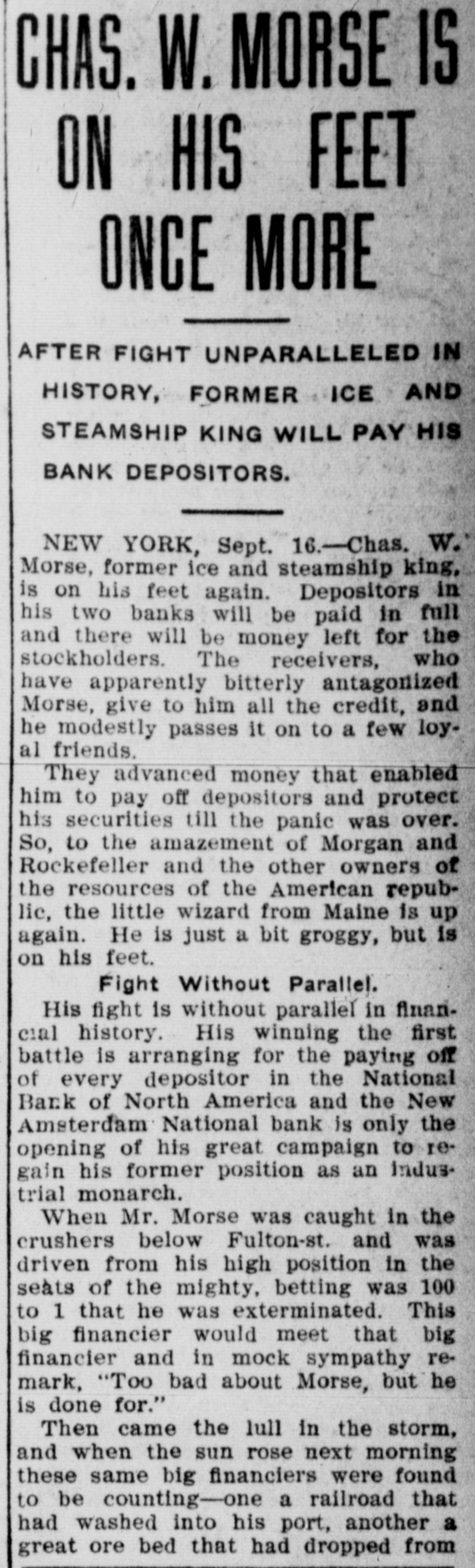
CHAS. W. MORSE IS ON HIS FEET ONCE MORE AFTER FIGHT UNPARALLELED IN HISTORY, FORMER ICE AND STEAMSHIP KING WILL PAY HIS BANK DEPOSITORS. NEW YORK, Sept. 16.-Chas. W. Morse, former ice and steamship king, is on his feet again. Depositors in his two banks will be paid in full and there will be money left for the stockholders. The receivers, who have apparently bitterly antagonized Morse, give to him all the credit, and he modestly passes it on to a few loyal friends. They advanced money that enabled him to pay off depositors and protect his securities till the panic was over. So, to the amazement of Morgan and Rockefeller and the other owners of the resources of the American republic, the little wizard from Maine is up again. He is just a bit groggy, but is on his feet. Fight Without Parallel. His fight is without parallel in financial history. His winning the first battle is arranging for the paying off of every depositor in the National Bank of North America and the New Amsterdam National bank is only the opening of his great campaign to regain his former position as an industrial monarch. When Mr. Morse was caught in the crushers below Fulton-st. and was driven from his high position in the seats of the mighty, betting was 100 to 1 that he was exterminated. This big financier would meet that big financier and in mock sympathy remark, "Too bad about Morse, but he is done for." Then came the lull in the storm, and when the sun rose next morning these same big financiers were found to be counting-one a railroad that had washed into his port, another a great ore bed that had dropped from
22.September 26, 1912River Falls JournalRiver Falls, WI
Click image to open full size in new tab
Article Text
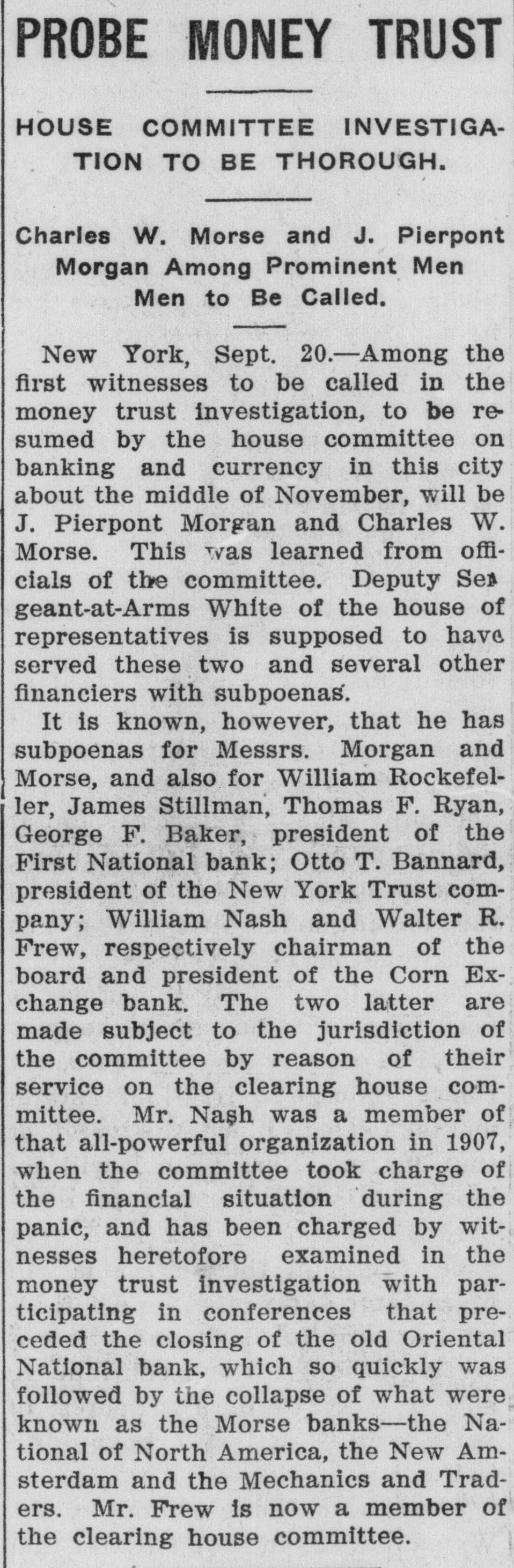
PROBE MONEY TRUST HOUSE COMMITTEE INVESTIGATION TO BE THOROUGH. Charles W. Morse and J. Pierpont Morgan Among Prominent Men Men to Be Called. New York, Sept. 20.-Among the first witnesses to be called in the money trust investigation, to be resumed by the house committee on banking and currency in this city about the middle of November, will be J. Pierpont Morgan and Charles W. Morse. This was learned from officials of the committee. Deputy Ser geant-at-Arms White of the house of representatives is supposed to have served these two and several other financiers with subpoenas. It is known, however, that he has subpoenas for Messrs. Morgan and Morse, and also for William Rockefeller, James Stillman, Thomas F. Ryan, George F. Baker, president of the First National bank; Otto T. Bannard, president of the New York Trust company; William Nash and Walter R. Frew, respectively chairman of the board and president of the Corn Exchange bank. The two latter are made subject to the jurisdiction of the committee by reason of their service on the clearing house committee. Mr. Nash was a member of that all-powerful organization in 1907, when the committee took charge of the financial situation during the panic, and has been charged by witnesses heretofore examined in the money trust investigation with participating in conferences that preceded the closing of the old Oriental National bank, which so quickly was followed by the collapse of what were known as the Morse banks-the National of North America, the New Amsterdam and the Mechanics and Traders. Mr. Frew is now a member of the clearing house committee.
23.September 26, 1912The Progressive West VirginianWilliamson, WV
Click image to open full size in new tab
Article Text
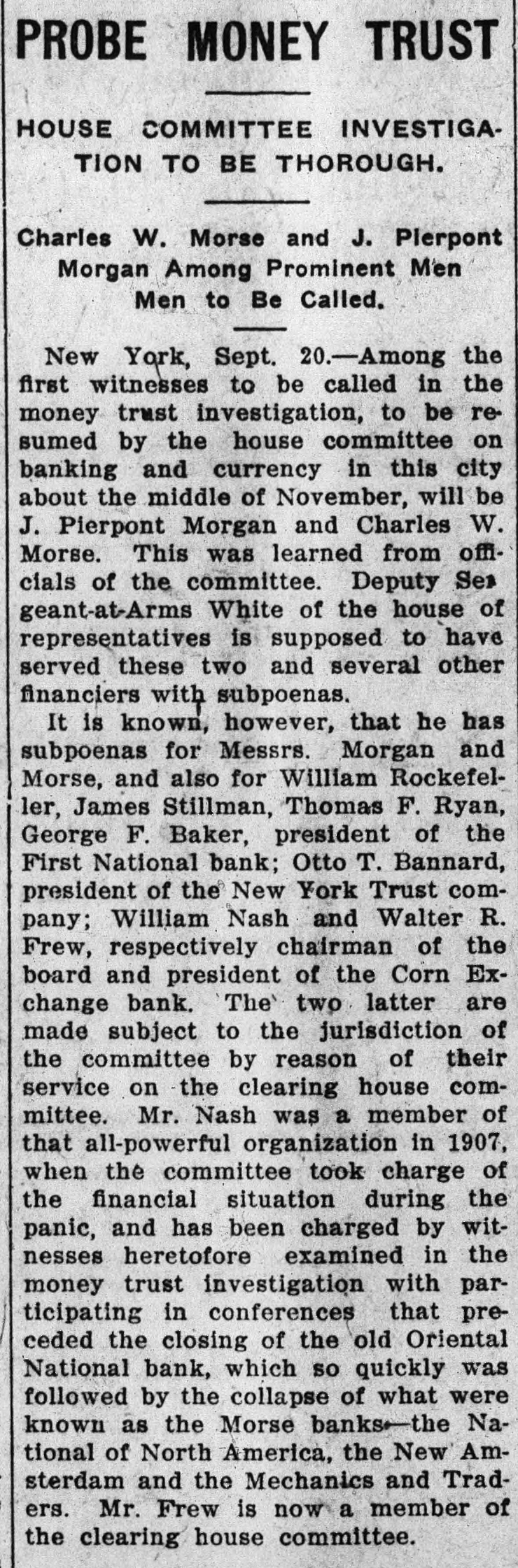
PROBE MONEY TRUST HOUSE COMMITTEE INVESTIGATION TO BE THOROUGH. Charles W. Morse and J. Pierpont Morgan Among Prominent Men Men to Be Called. New York, Sept. 20.-Among the first witnesses to be called in the money trust investigation, to be resumed by the house committee on banking and currency in this city about the middle of November, will be J. Pierpont Morgan and Charles W. Morse. This was learned from officials of the committee. Deputy Ser geant-at-Arms White of the house of representatives is supposed to have served these two and several other financiers with subpoenas. It is known, however, that he has subpoenas for Messrs. Morgan and Morse, and also for William Rockefeller, James Stillman, Thomas F. Ryan, George F. Baker, president of the First National bank; Otto T. Bannard, president of the New York Trust company; William Nash and Walter R. Frew, respectively chairman of the board and president of the Corn Exchange bank. The two latter are made subject to the jurisdiction of the committee by reason of their service on the clearing house committee. Mr. Nash was a member of that all-powerful organization in 1907, when the committee took charge of the financial situation during the panic, and has been charged by witnesses heretofore examined in the money trust investigation with participating in conferences that preceded the closing of the old Oriental National bank, which so quickly was followed by the collapse of what were known as the Morse banks-the National of North America, the New Amsterdam and the Mechanics and Traders. Mr. Frew is now a member of the clearing house committee.
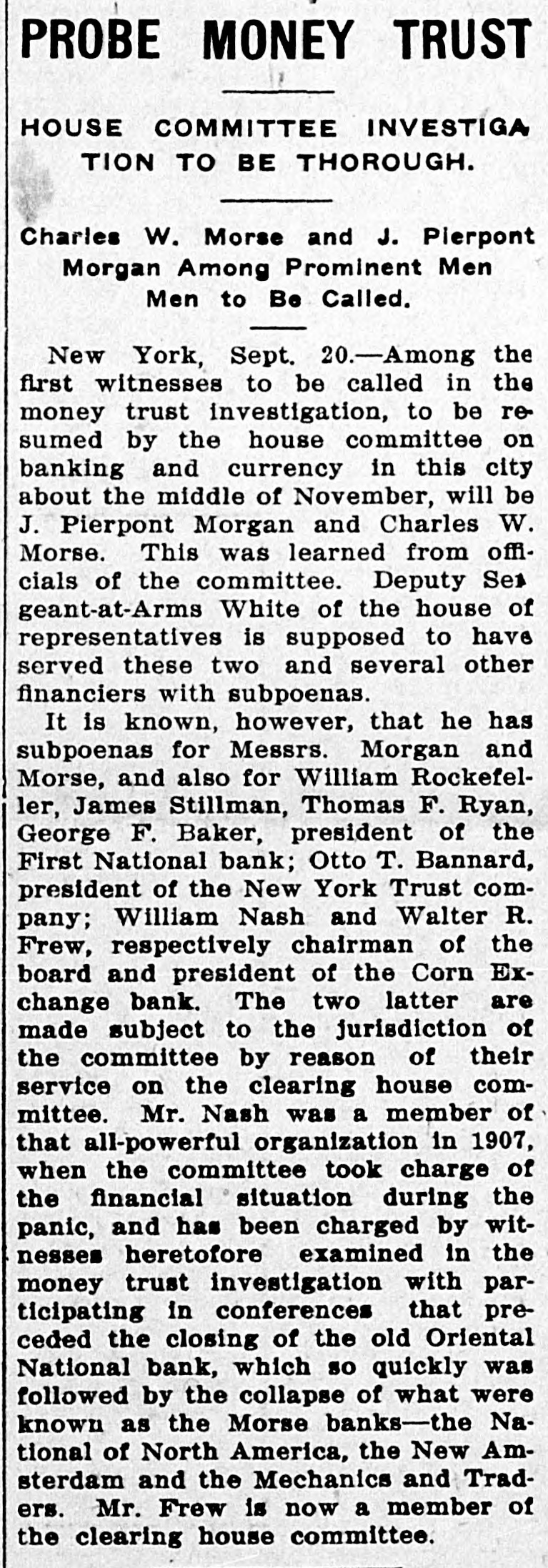
PROBE MONEY TRUST HOUSE COMMITTEE INVESTIGA TION TO BE THOROUGH. Charles W. Morse and J. Pierpont Morgan Among Prominent Men Men to Be Called. New York, Sept. 20.-Among the first witnesses to be called in the money trust investigation, to be resumed by the house committee on banking and currency in this city about the middle of November, will be J. Pierpont Morgan and Charles W. Morse. This was learned from officials of the committee. Deputy Set geant-at-Arms White of the house of representatives is supposed to have served these two and several other financiers with subpoenas. It is known, however, that he has subpoenas for Messrs. Morgan and Morse, and also for William Rockefeller, James Stillman, Thomas F. Ryan, George F. Baker, president of the First National bank; Otto T. Bannard, president of the New York Trust company; William Nash and Walter R. Frew, respectively chairman of the board and president of the Corn Exchange bank. The two latter are made subject to the jurisdiction of the committee by reason of their service on the clearing house committee. Mr. Nash was a member of that all-powerful organization in 1907, when the committee took charge of the financial situation during the panic, and has been charged by witnesses heretofore examined in the money trust investigation with participating in conferences that preceded the closing of the old Oriental National bank, which so quickly was followed by the collapse of what were known as the Morse banks-the National of North America, the New Amsterdam and the Mechanics and Traders. Mr. Frew is now a member of the clearing house committee.
Bank runs are almost always and everywhere a deterioration of bank fundamentals.
But not for you.
You are the measure-zero exception: great fundamentals, solid bank, and yet the Diamond Dybvig fairy spread its rumor. Depositors woke up. Your collateral was not prepositioned. The Clearinghouse had it for you.
Do not pass Go. Do not collect $200. Go directly to jail… or worse.