North American Trust & Banking Company (New York, NY)

Episode Information

Episode UID
5868844590580
Episode Type
Suspension β†’ Closure
Bank Type
state
Bank ID
586884459 hash
Start Date
April 17, 1848
Location
New York, New York (40.714, -74.006)

Metadata

Model
gpt-5-mini (chosen from majority vote of a three-model LLM ensemble)
Short Digest
69a7ddb03dcdeb4e

Response Measures

None

Events (3)

1. April 17, 1848 Receivership
Newspaper Excerpt
The receiver of the North American Trust and Banking Company of New York, has advertised its assets for sale at auction, on the 26th inst.
Source
newspapers
2. April 22, 1850 Other
Newspaper Excerpt
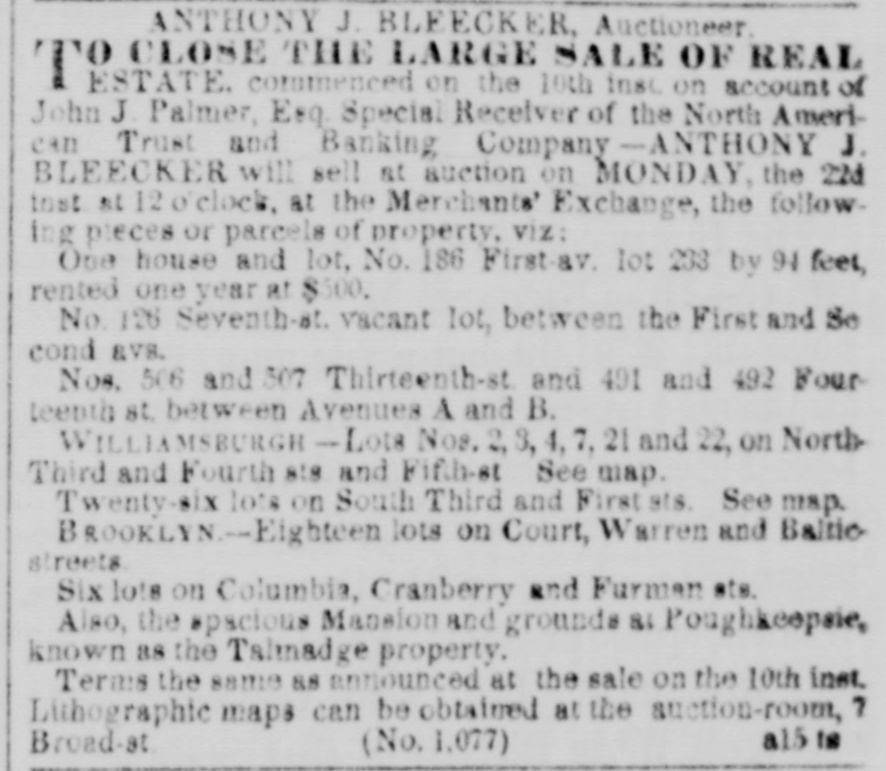
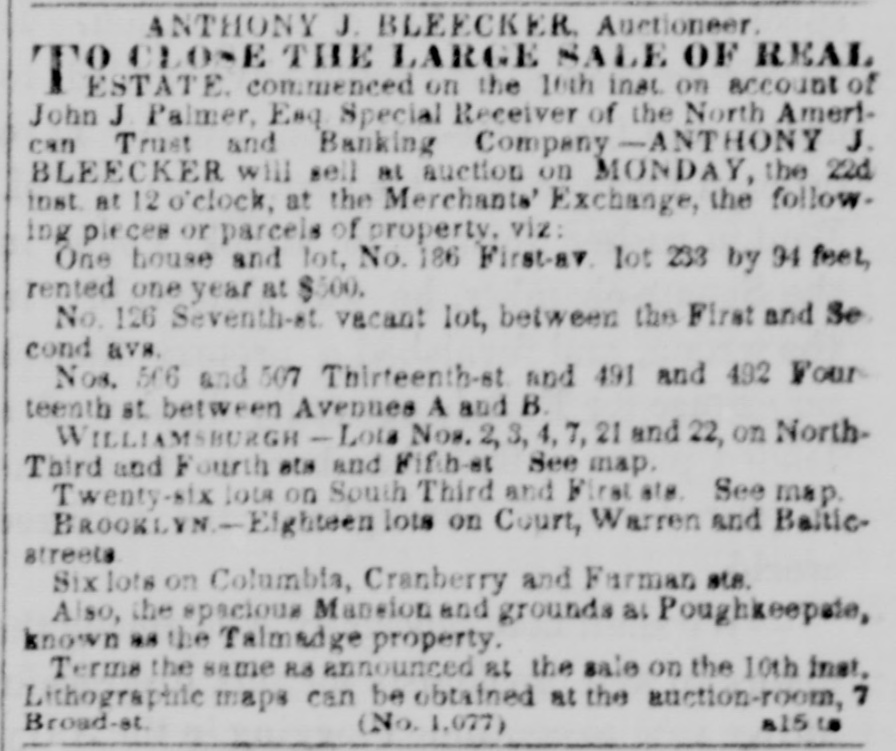
Sale . . . on account of John J. Palmer, Esq. Special Receiver of the North American Trust and Banking Company; will sell at auction on MONDAY the 22d inst. at 12 o'clock, at the Merchants' Exchange
Source
newspapers
3. November 27, 1857 Other
Newspaper Excerpt
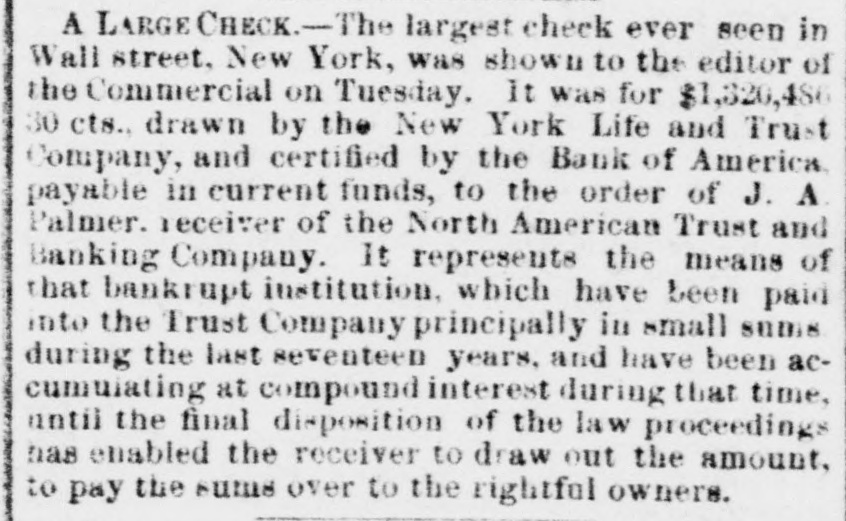
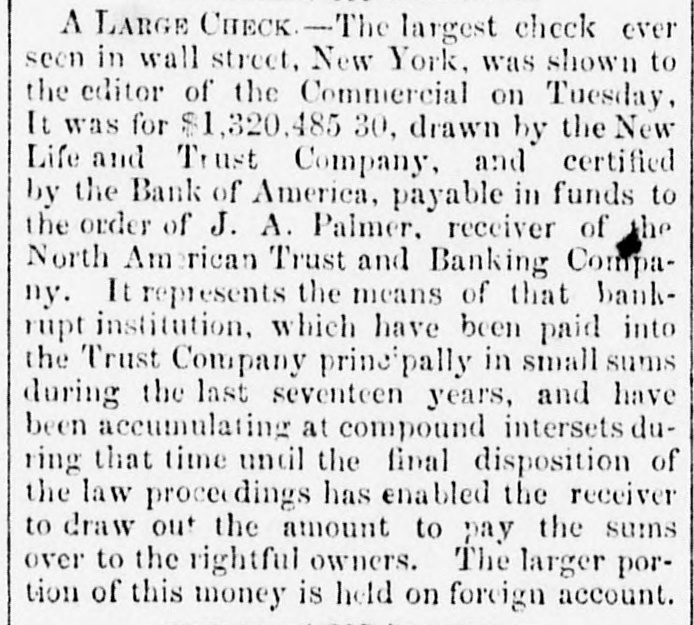
A large check ... drawn by the New York Life and Trust Company ... to the order of J. A. Palmer, receiver of the North American Trust and Banking Company; represents the means of that bankrupt institution
Source
newspapers

Newspaper Articles (12)

Article from The New York Herald, February 10, 1842

Click image to open full size in new tab

Article Text

294,618 Speaie, $4,982.45 This is melancholy picture for an institution that short time since was one of the best in Philadelphia In the relation to the State deposites the report has the following The efforts made by this Bank to prepare for the pay. ment the interest and to sustain itself under the most pressure hich came upon it, will be seen'from the following ements The amount of interest to be paid on the first of Februry was $864,410 64; and the premium on currency for specie. The Treasurer of the State had caused to be placed to credit of the in this Bank. the first 1841, and the 31st January 1842, sum about different received This at times, in different partly in checks on various its Banks and this on and Harris in neigh place burg and Easton. the principal part of which was paid and checks on the Girard Bank. large these received. amount were notes six hunbeing dred thousand upwards, that thought expedient out to depositors and others freely possible, order diminish the amount. The deposites of the been of all treated special character, and other general deposites have been. By this the circulation and deposites of this Bank were greatly reduced. The Bank being then undoubted in fully expected that its own notes, then as they been, ceived in the until and the the Bank twenty January, tne doubt the payment of the It their belief, that if that pressure, previous preparation could difto resist, had not taken place, no ficulty would existed in making that payment. it show the character and extent of this pressure is stated. on the three consecutive days, the 27th, of January, the Bank paid of its Deposites, $406,9S6 And of its notes 60,692 $466,778 Over and above its receipts, The following is an extract from the message of Go vernor Porter of Pennsylvania, in relation to the State interest Late on the evening of the 1st February a successf arrangement by which have reason to be. lieve the payment the interest due now been com menced be completed as soon as the funds can for the purpose. This arrangement consists in application of the available funds of the Bank of Pennsyl Ivania, $116,000 Foreign Bills of Exchange, of the value of Specie, 234 000 150,000 receivable and soon available, And the proceeds requisition made upon the other banks, which will be to pay the balance fthe interest due, the whole of which will assuredly met in the course or three weeks. The State himself assistants. will the Treasurer make by pay ments of interest at the bank, or at the Treasury Letters from Cincinnati describe that city in state of the highest excitement in relation to banking affairs on the instant- heavy run was kept up on the Urbana Bank. The known rottencess of all the banks, added to the approaching day fixed for resumption, March 4th, renders the populace anxious to get rid of as much bank paper possible. a The Bank of Montreal has given assurance by formal vote, that it is responsible for the issues of the Bank of the People. me In the State Assembly Mr. Townsend presented morial of the New York Banks, charging the Bank Com. missioners with mal conduct, in permitting the Safety Fund to be wasted, and demanding Legislative investigation. This is a most admirable movement. The Commissioners are appointed to protect the public from the misconduct ef the banks, and to keep a watch over the banks, to close them up when they are going wrong, before their capitals are sunk, in order to prevent loss to the safety-fund, and thereby inflicting loss upon the well managed banks: Instead of performing this duty, however, they have not only allowed bank after bank to explode, after sinking their whole capitals, but also the whole Safety Fund, and leaving an unprovided for balance of $400,000,!for which the sound banks are to be taxed for years to come. At the same.moment Mr. Chandler Starr took it upon himself to publish a card censuring this paper for cautioning the public against those banks, which he should, in the discharge of his duty have previously wound up. This is an important matter and well worthy the scrutiny of the Legislature. It will be remembered. that on the first of January, the interest of the State of Arkansas on its debt was not paid The interest is ayable by the Real Estate Bank, and the State Bank .in whose behalf the bonds were issued. The Real Estate Bank, sent forward to meet its share of the interest, some of its assets maturing in this city in May and June. These were to have been discounted by the Phonix bank where the interest is payable,bnt owing to the pressure in the market,that institution was unable do so, and the interest remained unpaid. The State Bank having some difficulty in raising money did notremit until the time had gone by. Within a few days, how ever specie has arrived to meet part of the interest. of the bonds issued to the Real Estate Bank of Arkansa $500,000 were, will be remembered, pothecated by the commissioners, Messrs. Harris and Briscoe, to the North American Trust and Banking Company of this city and by them sold to Mesars. Holford, Brancker & Co Subsequently, in consequence of the failure of the North American Trust & Banking Company on its part of the contract, Messrs. Harris & Briscoe declared t contract void, and the question of repudiation has been raised in Arkansas. One party contends, that although the Real Estate Bank pledged the bonds in violation of the law, that Messrs. Holford, Brancker & Co. are theinnocent purchasers, and the State is bound to pay the bonds according to their face. The following is an extract from the Little Rock Times & Advocate on the subject Repullation, representative in Congress, Judge Cross, the honest and just any party where, except cases of fraud and manifest violation of law and moral right. We agree with him, and contend that there violation either moral right" in the purchase of the bonds by the North American Trust Company of of flaw and moral right' is the part Estate Bank in the bonds con of meral violation towards right' security on the and bound bank does might the se note refuse individual pay that curity note, had been fourth of face, the refuse bonds because the banksold them for their thon less The following,is a letter.from GovernorY ell of Arkan. sas gentleman in this city in relation to the para graph here quoted: Rock Jan. 19. 1942 This from the organ of one of the political parties in the state, (whig). They may up bond and anti-bond Jatter answer the your to my of party 10th November last. and shall have respectreply soon. The world seems topsey turvey YEL A. Yours, The question of paying or not paying, with the western States, is not one of will, but of ability; which ability may be tested very nearly by a comparison of the resources of each state with the State of New York, which state finds it almost impossible to raise money to meet its liabilities. We recently gave the report of the committee of ways and means of the State of Indiana, in which they avow their inability to meet the demands upon the state. From the resent returns of the census statistics of the United States, we come at the actual resources of each state. In estimating the value of the products we must take into consideration that the grains and other produce of the west, are of much less money value to the producers who have to pay the taxes. than to those of the Atlantic states. For instance, the price of wheat in New York is 1 25; at the west it varies from
Article from The Daily Crescent, April 17, 1848

Click image to open full size in new tab

Article Text

ONE OF THE BUBBLES.-The receiver of the North American Trust and Banking Company of New York, has advertised its assets for sale at auc. tion, on the 26th inst. To such base uses has this great moneyed institution come It began business some years ago with a capital of $3,500,000, and under the direction of several of the most celebrated financiers. High hopes were cherished for its future prosperity. After a protracted struggle, it is to give up its existence under the vulgar hammer of an auctioneer.


Article from New-York Daily Tribune, April 15, 1850

Click image to open full size in new tab

Article Text

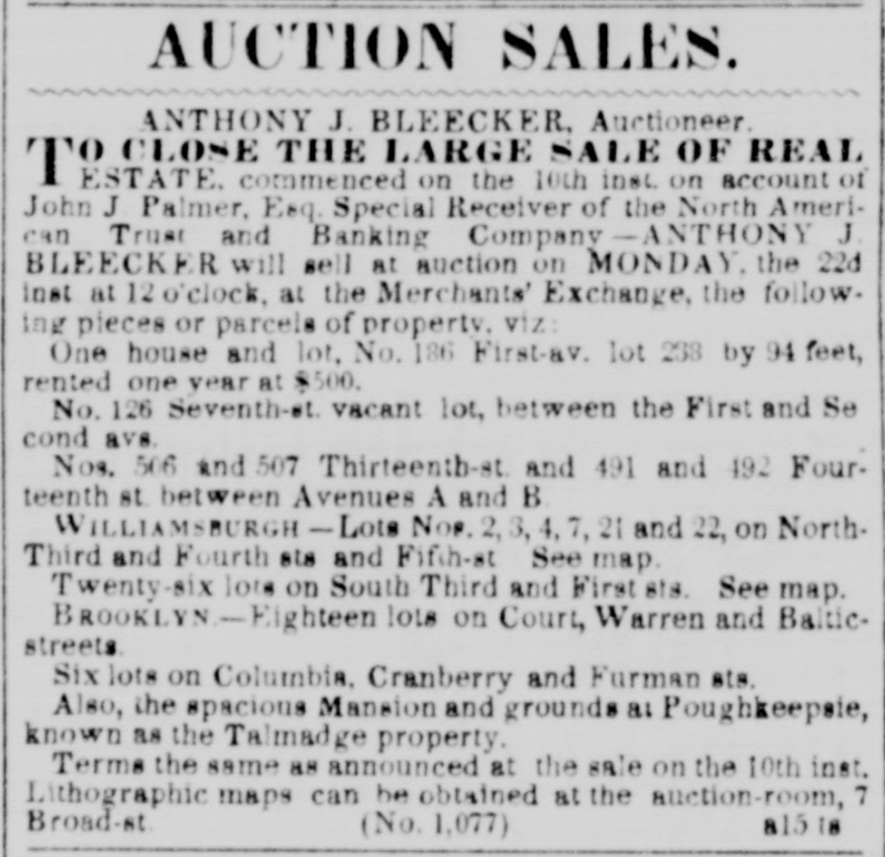
AUCTION SALES. ANTHONY J. BLEECKER, Auctioneer TΒ° CLOSE THE LARGE SALE OF REAL ESTATE. commenced on the 10th inst. on account of John J Palmer, Esq. Special Receiver of the North American Trust and Banking Company - -ANTHONY J BLEECKER will sell at auction on MONDAY the 22d lost at 12 o'clock at the Merchants' Exchange, the follow. ing pieces or parcels of property, viz: One house and lot, No. 186 First-av. lot 238 by 94 feet, rented one year at $500. No. 126 Seventh-et. vacant lot, between the First and Se cond ave. Nos. 506 and 507 Thirteenth-st. and 491 and 492 Fourteenth st between Avenues A and B WILLIAMSBURGH - Lots Nos. 2, 3, 4,7,21 and 22, on North. Third and Fourth sis and Fifth-st See map. Twenty-six lote on South Third and First sts. See map. BROOKLYN.-Fighteen lots on Court, Warren and Balticstreets Six lots on Columbia, Cranberry and Furman ats. Also, the spacious Mansion and grounds at Poughkeepsie, known as the Talmadge property. Terms the same as announced at the sale on the 10th inst. Lithographic maps can be obtained at the auction-room, 7 Broad-st. a15 18 (No. 1,077)


Article from New-York Daily Tribune, April 16, 1850

Click image to open full size in new tab

Article Text

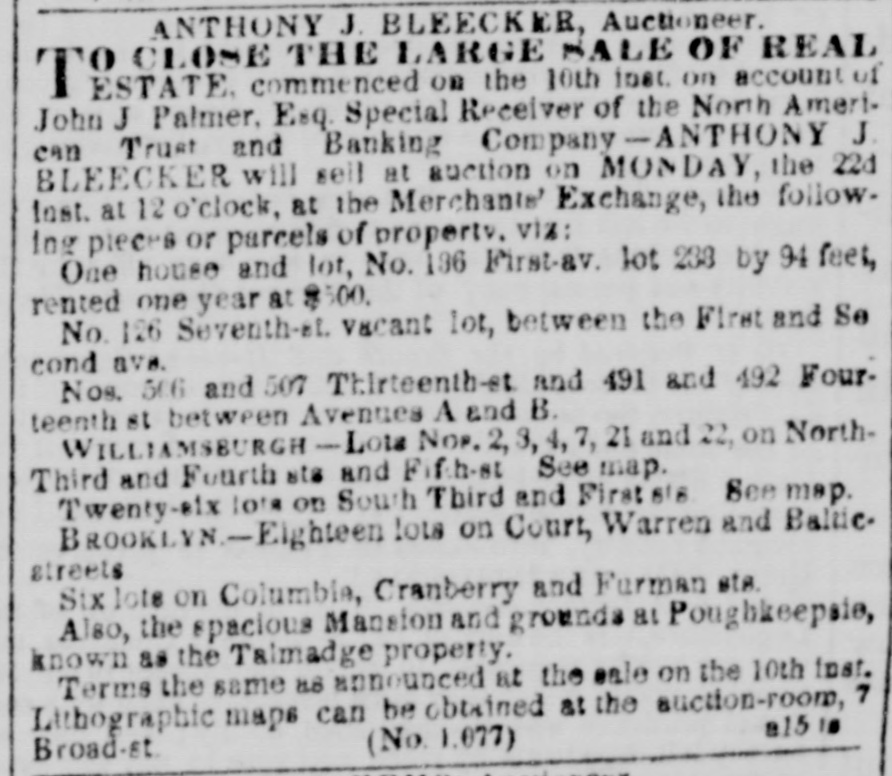
ANTHONY J. BLEECKER, Auctioneer. TO CLOSE THE LARGE SALE OF REAL ESTATE, commenced on the 10th inst. on account of John J Palmer, Esq. Special Receiver of the North American Trust and Banking Company - ANTHONY J. BLEECKER will sell at auction on MONDAY, the 22d last. at 12 o'clock, at the Merchants' Exchange, the following pieces or parcels of property, viz: One house and lot, No. 136 First-av. lot 233 by 94 feet, rented one year at $500. No. 126 Seventh-st. vacant lot, between the First and Second ave. Nos. 506 and 507 Thirteenth-st and 491 and 492 Fourteenth st between Avenues A and B. WILLIAMSBURGH - Lots Nos. 2, 3, 4, 7, 21 and 22, on North-Third and Fourth sts and Fifth-st See map. Twenty-six lots on South Third and First sts. See map. BROOKLYN-Eighteen lots on Court, Warren and Baltic-streets Six lots on Columbia, Cranberry and Furman sts. Also, the spacious Mansion and grounds at Poughkeepsie, known as the Talmadge property. Terms the same as announced at the sale on the 10th inst. Lithographic maps can be obtained at the auction-room, 7 Broad-st (No. 1.077)


Article from New-York Daily Tribune, April 18, 1850

Click image to open full size in new tab

Article Text

ANTHONY J. BLEECKER, Auctioneer. TO CLOSE THE LARGE SALE OF REAL ESTATE, commenced on the 10th inst. on account of John J. Palmer, Esq. Special Receiver of the North American Trust and Banking Company - ANTHONY J. BLEECKER will sell at auction on MONDAY, the 22d inst. at 12 o'clock, at the Merchants' Exchange, the following pieces or parcels of property, viz: One house and lot, No. 186 First-av. lot 233 by 94 feet, rented one year at $500. No. 126 Seventh-st. vacant lot, between the First and Second avs. Nos. 506 and 507 Thirteenth-st. and 491 and 492 Fourteenth st, between Avenues A and B. WILLIAMSBURGH - Lots Nos. 2, 3, 4, 7, 21 and 22, on North-Third and Fourth sts and Fifth-st See map. Twenty-six lots on South Third and First sts. See map. BROOKLYN - Eighteen lots on Court, Warren and Baltic streets. Six lots on Columbia, Cranberry and Furman sts. Also, the spacious Mansion and grounds at Poughkeepsie, known as the Talmadge property. Terms the same as announced at the sale on the 10th inst. Lithographic maps can be obtained at the auction-room, 7 Broad-st (No. 1,077) a15 te


Article from New-York Daily Tribune, April 19, 1850

Click image to open full size in new tab

Article Text

ANTHONY J. BLEECKER Auctioneer CLOSE THE LARGE SALE OF REAL ESTATE. commenced on the 10th inal on account of John J Palmer, Esq Special Receiver of the North American Trust and Banking Company -ANTHONY J. BLEECKER will sell at auction on MONDAY, the 22d inst at 12 o'clock at the Merchants' Exchange, the follow. ing pieces or parcels of property, viz: One house and lot, No. 186 First-av lot 233 by 94 feet, rented one year at $500. No. 126 Seventh-st. vacant lot, between the First and Se cond ave. Nos. 506 and 507 Thirteenth-st and 491 and 492 Four teenth at between Avenues A and B. WILLIAMSBURGH - Lota Nos. 2, 3,4,7,21 and 22, on NorthThird and Fourth ats and Fifthet See map. Twenty-six lots on South Third and First See map. BROOKLYN-Elghteen lots on Court, Warren and Baltlestreets Sixlots on Columbia, Cranberry and Farman ats. Also, the spacious Mansion and grounds at Poughkeepate, known as the Talmadge property. Terms the same R.S announced at the sale on the 10th inst, Lichographic maps can be obtained at the auction-room, 7 Broad-st. alst. (No. 1,077)


Article from The New York Herald, October 16, 1857

Click image to open full size in new tab

Article Text

The Ordisance of the Judges of the Supreme Court. Everybody, we presume, except a few vindictive merchants, was well pleased to hear that the Judges had decided that a suspension of specie payments by a bank involved no such thing as insolvency, and that so long as the banks behaved themselves 50 as to deserve a continuance of the esteem by the Supreme Court bench, they might pay their creditors in country money, city bills, shinplasters or specie, as they chose. Everybody, we say was pleased at this cutting of the gordian knot; for what good would it have done us, in the long run, to have broken up all these non-specie paying banks, to have had receivers appointed, and the concerns forced into liquidation under the present pressure Evidently none; and it was a thoughtful and a considerate thing of their honors to meet over the breakfast table and settle that matter in the quiet imperial way they did. Of course when we come to look into the decision legally there are points which must stick in the throats of old fashioned lawyers. Let us pass over the convenience of the applications for injunctions, which enabled the question to be brought before the court just in the very nick of time: feigned issues have long been a com. mon resort, when it was desired to take the sense of a court or any law point. Let us come at once to the gist of the decision, which is that no injunction need be granted, and no receiver appointed to a bank which is solvent, though it may have suspended specie payments and therefore (the Judges assuming that our city banks are solvent) that no injunction can be granted or receiver appointed to them. This strikes us as wonderful law and wonderful practice. How do the Judges know that our banks are solvent? What evidence have they of the fact, when no evidence was taken in the case? How can they presume to decide how much of the banks' bills receivable will prove worth anything at maturity? As to the dictum of law which is sought to be derived from the judgment in the case of the North American Trust and Banking Company, namely, that a bank may be solvent without paying specie, we hold that to be very bad law, or at least, very inapplicable to the present case. The principle on which all banks are established and endowed with especial privileges and immunities is that they shall be great reservoirs of specie for the public use and on the express condition that they shall, when required EO to do, give such specie in exchange for their-paper or other claims on them, they are allowed to do-what is denied to the public-to circulate as money their promises to pay. When a bank ceases to be able to pay specie, it ceases at common law to be a bank and can only be saved from instant destruction by speedy rescue at the hands of the Legislature. This we take to be the law. Their honors of the Supreme Court view it otherwise; by some ingenious process of refinement they draw a distinction between specie insolvency and paper insolvency, and decide that so far as this city is concerned the suspension of specie payments by the banks will not make the least legal difference to their business. We can only congratulate the banks on their good fortune in finding Judges not only ready to interpret the law 80 manifestly to their advantage, but willing to come forward in the nick of time, and publish their decision, in the shape of a decree, ordinance or imperial mandate, and as a warning to ill-conditioned fellows not to presume to molest the banke. Such decisions are happily rare-quite as rare as the emergency which called them forth. Should we be so unfortunate as to be assailed by famine this winter, and should the mob gut the store of a flour merchant, the merchants and bankers would perhaps be taken aback by a merited sentence of a majority of the Judges, in next day's papers, declaring that such acts did not properly fall within the purview of the criminal code, and that a distinction must be drawn between robbery for gastronomical and robbery for lucrative purposes. We question whether the Judges would go further out of their way to do more violence to the law in that case than they have in this. It is however perhaps all for the best.


Article from The Daily Dispatch, November 27, 1857

Click image to open full size in new tab

Article Text

A LARGE CHECK.- The largest check ever seen in Wall street, New York, was show 11 to the editor of the Commercial on Tuesday. It was for $1,320,486 30 cts. drawn by the New York Life and Trust Company, and certified by the Bank of America payable in current funds, to the order of J. A Palmer. receiver of the North American Trust and Banking Company. It represents the means of that bankrupt institution, which have been paid into the Trust Company principally in small sums during the last seventeen years. and have been accumuiating at compound interest during that time, until the final disposition of the law proceedings has enabled the receiver to draw out the amount, to pay the sums over to the rightful owners.


Article from The Cecil Whig, November 28, 1857

Click image to open full size in new tab

Article Text

A LARGE БпСск--The largest check ever seen in wall street, New York, was shown to the editor of the Commercial on Tuesday, It was for $1,320,485 30, drawn by the New Life and Trust Company, and certified by the Bank of America, payable in funds to the order of J. A. Palmer, receiver of the North American Trust and Banking Company. It represents the means of that bankrupt institution, which have been paid into the Trust Company principally in small sums during the last seventeen years, and have been accumulating at compound intersets during that time until the final disposition of the law proceedings has enabled the receiver to draw out the amount to pay the sums over to the rightful owners. The larger portion of this money is held on foreign account.


Article from The Day Book, November 28, 1857

Click image to open full size in new tab

Article Text

A LARGE CHECK.-The largest check ever seen in Wall street, New York, was shown to the editor of the Commercial on Tuesday It was for $1.320.485 30,drawn by the New York Life and Trust Company, and certified by the Bank of America, payable in current funds to the order of J. A. Palmer,receiver of the North American Trust and Banking Company. It represents the means of that bankrupt institution, which have been paid into the Trust Crmhany principally in small sums during the last seventeen years, and have been accumulating at compound interest during that time until the final disposition of the law proceedings has enabled the receiver to draw out the amount to pay the sums over to the rightful owners. The larger portion of this money is held on foreign account,and was probably sent out by the steamer yesterday either in bills or specie.


Article from Daily Iowa State Democrat, December 1, 1857

Click image to open full size in new tab

Article Text

AN IMPORTANT CASE DECIDED.After nearly twenty years of litigation, a final decision by the Court of Appeals attended with immense cost and immense fees to lawyers a large portion of the Trust fund of the North American trust and banking Company, was paid over to the legal claimants yesterday. The deposit of J. J. Palmer, special receiver of the Company, in the New York Life and Trust Company, amounting to about $600,000 or $700,000 was yesterday withdrawn and paid over to the holders of the company's trust bonds on account of their claim, awarded by the late decision of the Court of Appeals. The balance of the assets in the hands of the special receiver amounting to about the same sum, and consisting of bonds and mortgages on real estate, will be paid over rateably to the holders as soon as collected. Only a portion of the funds thus thrown into the market have been re-iuvested here, the largest portion having been engaged to go out by the Arabia to-day. The recipients, Messrs. Palmer, McKillop, Dent & Co., of London, will doubtless be giad to receive even a portion of their old and long and contested claim.-N. Y. Herald.


Article from The Evansville Daily Journal, December 4, 1857

Click image to open full size in new tab

Article Text

# A LARGE CHECK The largest check ever seen in Wall street, New York, was shown to the editor of the Commercial, on Tuesday It was for $1,350,450 80, drawn by the New York Life and Trust Company, and certified by the Bank of America, payable to the order of J. A. Palmer, receiver of the North American Trust and Banking Company. It represents the means of the bankrupt institution, which have been paid into the Trust Company, principally, in small sums, during the last seventeen years, and have been accumulating at compound interest during that time until the final disposition of the law proceedings has enabled the receiver to draw out the amount to pay the sums over to the rightful owners. The larger portion of this money is held on foreign account, and was probably sent out by the steamer last week, either in bills or specie.