First National Bank (Pilger, NE)

Episode Information

Episode UID
593701492
Episode Type
Run → Suspension → Closure
Bank Type
national
Bank ID
59370 national
Charter Number
5937
Start Date
April 9, 1924
Location
Pilger, Nebraska (42.009, -97.054)

Metadata

Model
gpt-5-mini (chosen from majority vote of a three-model LLM ensemble)
Short Digest
ff9d272fd457462b

Response Measures

Full suspension

Receivership Details

Depositor recovery rate
21.9%
Date receivership started
1924-04-22
Date receivership terminated
1930-03-31
OCC cause of failure
Economic conditions
Share of assets assessed as good
35.3%
Share of assets assessed as doubtful
42.2%
Share of assets assessed as worthless
22.5%

Description

Receivership for the Pilger bank is recorded 1924-04-22.

Events (5)

1. August 12, 1901 Chartered
Source
historical_nic
2. April 9, 1924 Run
Cause
Rumor Or Misinformation
Cause Details
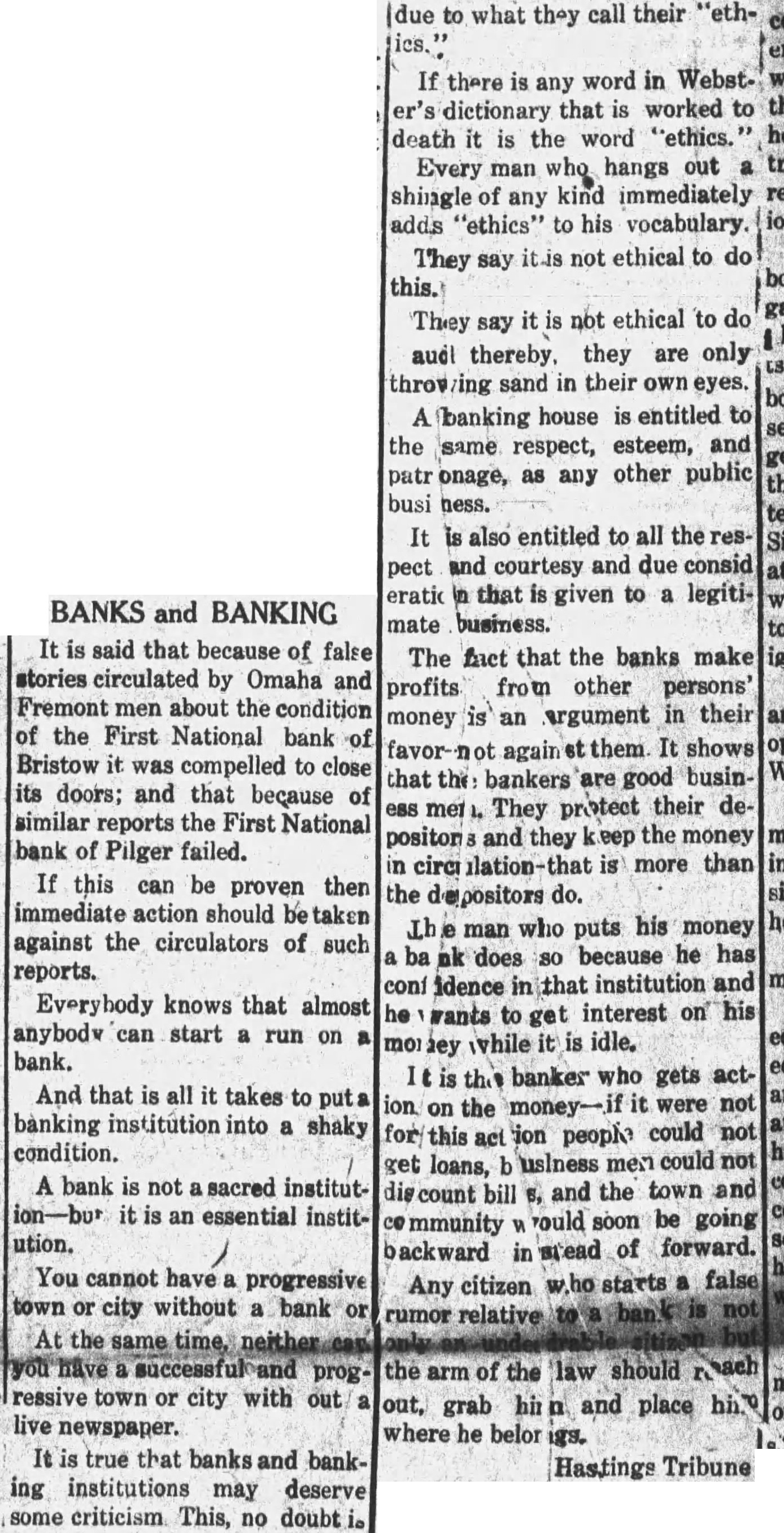
False stories/rumors circulated by men in Omaha and Fremont about the bank's condition triggered loss of confidence and withdrawals.
Newspaper Excerpt
It is said that because of false stories ... the First National bank of Pilger failed.
Source
newspapers
3. April 17, 1924 Suspension
Cause Details
Gradual shrinkage of deposits and frozen paper cited as proximate causes of suspension/closure (rumors also reported in contemporaneous pieces).
Newspaper Excerpt
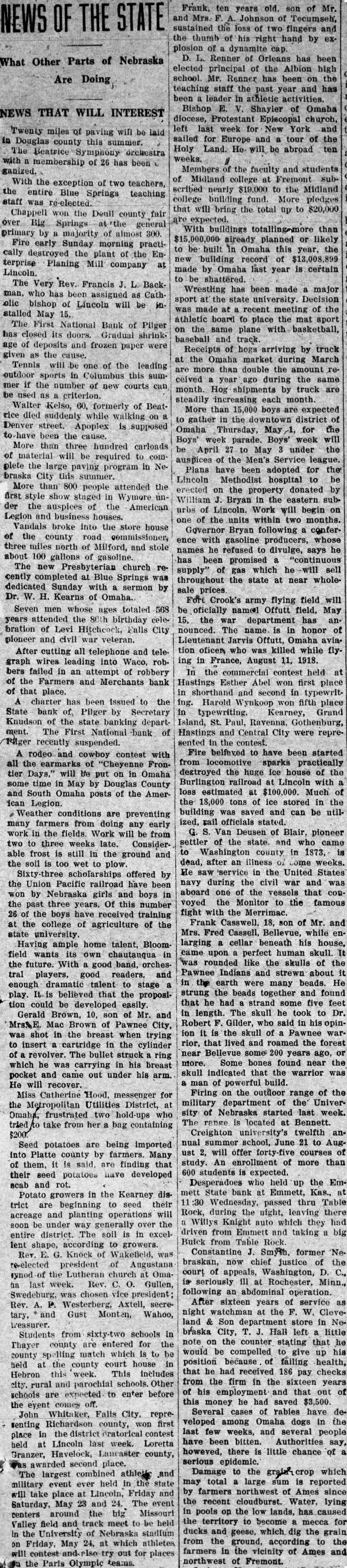
The First National Bank of Pilger has closed its doors. Gradual shrinkage of deposits and frozen paper were given as the cause.
Source
newspapers
4. April 22, 1924 Receivership
Source
historical_nic
5. April 22, 1924 Receivership
Newspaper Excerpt
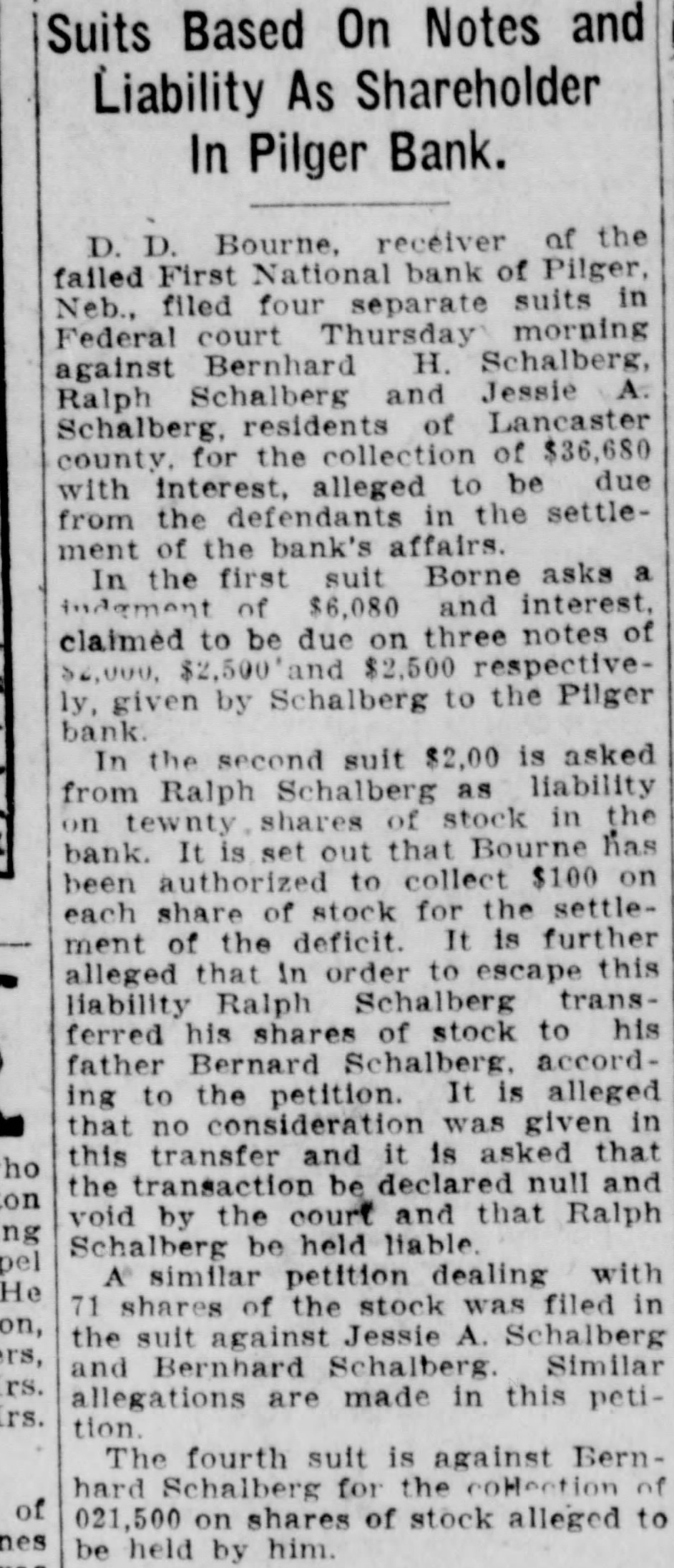
D. D. Bourne, receiver of the failed First National bank of Pilger, Neb., filed four separate suits ...
Source
newspapers

Newspaper Articles (7)

Article from The Hastings Daily Tribune, April 9, 1924

Click image to open full size in new tab

Article Text

BANKS AND BANKING. It is said that because of false stories circulated by Omaha and Fremont men about the condition of the First National bank of Bristow was compelled to close its doors; and that because of similar reports the First National bank of Pilger failed. If this can be proven then immediate action should be taken against the circulators of such reports. Everybody knows that almost anybody can start a run on a bank. And that is all it takes to put any banking institution into a shaky condition. A bank is not a sacred institution—but, it is an essential institution. You can not have a progressive town or city without a bank or banks. At the same time, neither can you have a successful and progressive town or city without a live newspaper. It is true that banks and banking institutions may deserve some criticism. This, no doubt, is due to what they call their "ethics." If there is any word in Webster's dictionary that is worked to death it is the word "ethics." Every man who hangs out a shingle of any kind immediately adds "ethics" to his vocabulary.


Article from Evening World-Herald, April 11, 1924

Click image to open full size in new tab

Article Text

Banks and Banking. (Hastings Tribune.) It is said that because of false stories circulated by Omaha and Fremont men about the condition of the First National bank of Bristow it was compelled to close its doors; and that because of similar reports the First National bank of Pilger failed. If this can be proven then immediate action should be taken against the circulators of such reports. Everybody knows that almost anybody can start a run on a bank. And that is all it takes to put any banking institution into a shaky condition. A bank is not a sacred institution—but, it is an essential institution. You cannot have a progressive town or city without a bank or banks. At the same time, neither can you have a successful and progressive town or city without a live newspaper. It is true that banks and banking institutions may deserve some criticism. This, no doubt, is due to what they call their "ethics." If there is any word in Webster's dictionary that is worked to death it is the word "ethics." Every man who hangs out a shingle of any kind immediately adds "ethics" to his vocabulary. They say it is not ethical to do this. They say it is not ethical to do that. And thereby, they are only throwing sand in their own eyes. A banking house is entitled to the same respect, esteem, and patronage, as any other public business. It is also entitled to all the respect and courtesy and due consideration that is given to a legitimate business. The fact that banks make profits from other persons' money is an argument in their favor—not against them. It shows that the bankers


Article from Omaha World-Herald, April 11, 1924

Click image to open full size in new tab

Article Text

Banks and Banking. (Hastings Tribune.) It is said that because of false stories circulated by Omaha and Fremont men about the condition of the First National bank of Bristow it was compelled to close its doors; and that because of similar reports the First National bank of Pilger failed. If this can be proven then immediate action should be taken against the circulators of such reports. Everybody knows that almost anybody can start a run on a bank. And that is all it takes to put any banking institution into a shaky condition. A bank is not a sacred institution—but, it is an essential institution. You cannot have a progressive town or city without a bank or banks. At the same time, neither can you have a successful and progressive town or city without a live newspaper. It is true that banks and banking institutions may deserve some criticism. This, no doubt, is due to what they call their "ethics." If there is any word in Webster's dictionary that is worked to death it is the word "ethics." Every man who hangs out a shingle of any kind immediately adds "ethics" to his vocabulary. They say it is not ethical to do this. They say it is not ethical to do that. And thereby, they are only throwing sand in their own eyes. A banking house is entitled to the same respect, esteem, and patronage, as any other public business. It is also entitled to all the respect and courtesy and due consideration that is given to a legitimate business. The fact that banks make profits from other persons' money is an argument in their favor—not against them. It shows that the bankers


Article from The Bristow Enterprise, April 17, 1924

Click image to open full size in new tab

Article Text

BANKS and BANKING It is said that because of false stories circulated by Omaha and Fremont men about the condition of the First National bank of Bristow it was compelled to close its doors; and that because of similar reports the First National bank of Pilger failed. If this can be proven then immediate action should be taken against the circulators of such reports. Everybody knows that almost anybody can start a run on a bank. And that is all it takes to put a banking institution into a shaky condition. A bank is not a sacred institution—but it is an essential institution. You cannot have a progressive town or city without a bank or At the same time, neither can you have a successful and progressive town or city without a live newspaper. It is true that banks and banking institutions may deserve some criticism. This, no doubt is due to what they call their "ethics." If there is any word in Webster's dictionary that is worked to death it is the word "ethics." Every man who hangs out a shingle of any kind immediately adds "ethics" to his vocabulary. They say it is not ethical to do this. They say it is not ethical to do and thereby, they are only throwing sand in their own eyes. A banking house is entitled to the same respect, esteem, and patronage, as any other public business. It is also entitled to all the respect and courtesy and due consideration that is given to a legitimate business. The fact that the banks make profits from other persons' money is an argument in their favor—not against them. It shows that the bankers are good business men. They protect their depositors and they keep the money in circulation—that is more than the depositors do. The man who puts his money in a bank does so because he has confidence in that institution and he wants to get interest on his money while it is idle. It is the banker who gets action on the money—if it were not for this action people could not get loans, business men could not discount bills, and the town and community would soon be going backward instead of forward. Any citizen who starts a false rumor relative to a bank is not only an undesirable citizen but the arm of the law should reach out, grab him and place him where he belongs. Hastings Tribune


Article from The Shelton Clipper, April 17, 1924

Click image to open full size in new tab

Article Text

BANKS AND BANKING. It is said that because of false stories circulated by Omaha and Fremont men about the condition of the First National bank of Bristow it was compelled to close its doors; and that because of similar reports the First National bank of Pilger failed. If this can be proven then immediate action should be taken against the circulators of such reports. Everybody knows that almost anybody can start a run on a bank. And that is all it takes to put any banking institution into a shaky condition. A bank is not a sacred institution—but, it is an essential institution. You cannot have a progressive town or community without a bank or banks. At the same time, neither can you have a successful and progressive town or city without a live newspaper. It is true that banks and banking institutions may deserve some criticism. This, no doubt, is due to what they call their "ethics." If there is any word in Webster's dictionary that is worked to death it is the word "ethics." Every man who hangs out a shingle of any kind immediately adds "ethics" to his vocabulary. They say it is not ethical to do this. They say it is not ethical to do that. And thereby, they are only throwing sand in their own eyes. A banking house is entitled to the same respect, esteem, and patronage, as any other public business. It is also entitled to all the respect and courtesy and due consideration that is given to a legitimate business. The fact that banks make profits from other persons' money is an argument in their favor—not against them. It shows that the bankers are good business men. They protect their depositors and they keep the money in circulation—that is more than the depositors do. The man who puts his money in a bank does so because he has confidence in that institution and he wants to get interest on his money while it is idle. It is the banker who gets action on the money—if it were not for this action people could not get loans, business men could not discount


Article from The Randolph Times, April 17, 1924

Click image to open full size in new tab

Article Text

NEWS OF THE STATE What Other Parts of Nebraska Are Doing NEWS THAT WILL INTEREST Twenty miles of paving will be laid in Douglas county this summer. The Beatrice Symphony orchestra with a membership of 26 has been organized. With the exception of two teachers, the entire Blue Springs teaching staff was re-elected. Chappell won the Deuel county fair over Big Springs at the general primary by a majority of almost 300. Fire early Sunday morning practically destroyed the plant of the Enterprise Planing Mill company at Lincoln. The Very Rev. Francis J. L. Beckman, who has been assigned as Catholic bishop of Lincoln will be installed May 15. The First National Bank of Pilger has closed its doors. Gradual shrinkage of deposits and frozen paper were given as the cause. Tennis will be one of the leading outdoor sports in Columbus this summer if the number of new courts can be used as a criterion. Walter Kelso, 60, formerly of Beatrice died suddenly while walking on a Denver street. Apoplexy is supposed to have been the cause. More than three hundred carloads of material will be required to complete the large paving program in Nebraska City this summer. More than 800 people attended the first style show staged in Wymore under the auspices of the American Legion and business houses. Vandals broke into the store house of the county road commissioner, three miles north of Milford, and stole about 100 gallons of gasoline. The new Presbyterian church recently completed at Blue Springs was dedicated Sunday with a sermon by Dr. W. H. Kearns of Omaha. Seven men whose ages totaled 568 years attended the 80th birthday celebration of Levi Hitchcock, Falls City pioneer and civil war veteran. After cutting all telephone and telegraph wires leading into Waco, robbers failed in an attempt of robbery of the Farmers and Merchants bank of that place. A charter has been issued to the State bank of Pilger by Secretary Knudson of the state banking department. The First National bank of Pilger recently suspended. A rodeo and cowboy contest with all the earmarks of "Cheyenne Frontier Days," will be put on in Omaha some time in May by Douglas County and South Omaha posts of the American Legion. Weather conditions are preventing many farmers from doing any early work in the fields. Work will be from two to three weeks late. Considerable frost is still in the ground and the soil is too wet to plow. Sixty-three scholarships offered by the Union Pacific railroad have been won by Nebraska girls and boys in the past three years. Of this number 26 of the boys have received training at the college of agriculture of the state university. Having ample home talent, Bloomfield wants its own chautauqua in the future. With a good band, orchestral players, good readers, and enough dramatic talent to stage a play. It is believed that the proposition could be developed easily. Gerald Brown, 10, son of Mr. and Mrs. E. Mac Brown of Pawnee City, was shot in the breast when trying to insert a cartridge in the cylinder of a revolver. The bullet struck a ring which he was carrying in his breast pocket and came out under his arm. He will recover. Miss Catherine Hood, messenger for the Metropolitan Utilities District, at Omaha, frustrated two hold-ups who tried to take from her a bag containing $200. Seed potatoes are being imported into Platte county by farmers. Many of them, it is said, are finding that their seed potatoes have developed scab and rot. Potato growers in the Kearney district are beginning to seed their acreage and planting operations will soon be under way generally over the entire district. The soil is in excellent shape, according to growers. Rev. E. G. Knock of Wakefield, was re-elected president of Augustana synod of the Lutheran church at Omaha last week. Rev. C. O. Gullen, Swedeburg, was chosen vice president; Rev. A. P. Westerberg, Axtell, secretary, and Gust Monten, Wahoo, treasurer. Students from sixty-two schools in Thayer county are entered for the county spelling match which is to be held at the county court house in Hebron this week. This includes city, rural and parochial schools. Other schools are expected to enter before the event comes off. John Whitaker, Falls City, representing Richardson county, won first place in the district oratorical contest held at Lincoln last week. Loretta Granzer, Havelock, Lancaster county, was awarded second place. The largest combined athletic and military event ever held in the state will take place at Lincoln, Friday and Saturday, May 23 and 24. The event centers around the big Missouri Valley field and track meet to be held in the University of Nebraska stadium on Friday, May 24, at which athletes will contest and rise try out for places on the Paris Olympic teams. Frank, ten years old, son of Mr. and Mrs. F. A. Johnson of Tecumseh, sustained the loss of two fingers and the thumb of his right hand by explosion of a dynamite cap. D. L. Renner of Orleans has been elected principal of the Albion high school. Mr. Renner has been on the teaching staff the past year and has been a leader in athletic activities. Bishop E. V. Shayler of Omaha diocese, Protestant Episcopal church, left last week for New York and sailed for Europe and a tour of the Holy Land. He will be abroad ten weeks. Members of the faculty and students of Midland college at Fremont subscribed nearly $19,000 to the Midland college building fund. More pledges that will bring the total up to $20,000 are expected. With buildings totalling more than $15,000,000 already planned or likely to be built in Omaha this year, the new building record of $13,008,899 made by Omaha last year is certain to be shattered. Wrestling has been made a major sport at the state university. Decision was made at a recent meeting of the athletic board to place the mat sport on the same plane with basketball, baseball and track. Receipts of hogs arriving by truck at the Omaha market during March are more than double the amount received a year ago during the same month. Hog shipments by truck are steadily increasing each month. More than 15,000 boys are expected to gather in the downtown district of Omaha Thursday, May 1, for the Boys' week parade. Boys' week will be April 27 to May 3 under the auspices of the Men's Service league. Plans have been adopted for the Lincoln Methodist hospital to be erected on the property donated by William J. Bryan in the eastern suburbs of Lincoln. Work will begin on one of the units within two months. Governor Bryan following a conference with gasoline producers, whose names he refused to divulge, says he has been promised a "continuous supply" of gas which he will sell throughout the state at near wholesale prices. Fort Crook's army flying field will be officially named Offutt field, May 15, the war department has announced. The name is in honor of Lieutenant Jarvis Offutt, Omaha aviation officer, who was killed while flying in France, August 11, 1918. In the commercial contest held at Hastings Esther Abel won first place in shorthand and second in typewriting. Harold Wynkoop won fifth place in typewriting. Kearney, Grand Island, St. Paul, Ravenna, Gothenburg, Hastings and Central City were represented in the contest. Fire believed to have been started from locomotive sparks practically destroyed the huge ice house of the Burlington railroad at Lincoln with a loss estimated at $100,000. Much of the 18,000 tons of ice stored in the building was saved and can be utilized, rail officials stated. G. S. Van Deusen of Blair, pioneer settler of the state and who came to Washington county in 1873, is dead, after an illness of some weeks. He saw service in the United States navy during the civil war and was aboard one of the vessels that convoyed the Monitor to the famous fight with the Merrimac. Frank Casswell, 18, son of Mr. and Mrs. Fred Cassell, Bellevue, while enlarging a cellar beneath his house, came upon a perfect human skull. It was rounded like the skulls of the Pawnee Indians and strewn about it in the earth were many beads. He strung the beads together and found that he had a strand some five feet in length. The skull he took to Dr. Robert F. Gilder, who said in his opinion it is the skull of a Pawnee warrior, that lived and roamed the forest near Bellevue some 200 years ago, or more. Some bones found near the skull indicated that the warrior was a man of powerful build. Firing on the outdoor range of the military department of the University of Nebraska started last week. The range is located at Bennett. Creighton university's twelfth annual summer school, June 21 to August 2, will offer forty-five courses of study. An enrollment of more than 600 students is expected. Desperadoes who held up the Emmett State bank at Emmett, Kas., at 11:30 Wednesday, passed thru Table Rock, during the night, leaving there a Willys Knight auto which they had driven from Emmett and taking a big Buick from Table Rock. Constantine J. Smyth, former Nebraskan, now chief justice of the court of appeals, Washington, D. C., is seriously ill at Rochester, Minn., following an abdominal operation. After sixteen years of service as night watchman at the F. W. Cleveland & Son department store in Nebraska City, T. J. Hall left a little note on the counter stating that he would be compelled to give up his position because of failing health, that he had received 186 pay checks from the firm in the sixteen years of his employment and that out of this money he had saved $3,500. Several cases of rabies have developed among Omaha dogs in the last few weeks, and several people have been bitten. Authorities say, however, there is little chance of a serious epidemic. Damage to the grain crop which may total a large sum is reported by farmers northwest of Ames since the recent cloudburst. Water, lying in pools on the low lands, has caused the territory to become a mecca for ducks and geese, which dig the grain from the ground, according to the farmers in the vicinity of Ames and northwest of Fremont.
Article from The Lincoln Star, September 18, 1924

Click image to open full size in new tab

Article Text

Suits Based On Notes and Liability As Shareholder In Pilger Bank. D. D. Bourne, receiver of the failed First National bank of Pilger, Neb., filed four separate suits in Federal court Thursday morning against Bernhard H. Schalberg, Ralph Schalberg and Jessie A. Schalberg, residents of Lancaster county, for the collection of $36,680 with interest, alleged to be due from the defendants in the settlement of the bank's affairs. In the first suit Bourne asks a judgment of $6,080 and interest, claimed to be due on three notes of $2,000, $2,500 and $2,500 respectively, given by Schalberg to the Pilger bank. In the second suit $2,000 is asked from Ralph Schalberg as liability on twenty shares of stock in the bank. It is set out that Bourne has been authorized to collect $100 on each share of stock for the settlement of the deficit. It is further alleged that in order to escape this liability Ralph Schalberg transferred his shares of stock to his father Bernard Schalberg, according to the petition. It is alleged that no consideration was given in this transfer and it is asked that the transaction be declared null and void by the court and that Ralph Schalberg be held liable. A similar petition dealing with 71 shares of the stock was filed in the suit against Jessie A. Schalberg and Bernhard Schalberg. Similar allegations are made in this petition. The fourth suit is against Bernhard Schalberg for the collection of $21,500 on shares of stock alleged to be held by him.