Article Text
WHEELER TURNS GUNS ON DAWES
Montanan Reviews What He Terms "Record of Man Trying to Kidnap Constitution."
CITES BANK SCANDAL
Declares General Was Involved in Lorimer Institution Failure—Hits at Minute Men Order.
CHICAGO, Sept. 20.—(By Associated Press.)—Opening his campaign in the middlewest, Senator Wheeler of Montana, vice presidential candidate on the third ticket, in a speech here tonight turned his guns on Charles G. Dawes, the running mate of President Coolidge.
Senator Wheeler focused his attack on General Dawes on the noted Lorimer bank failure and on the organization of the Minute Men of the Constitution, which has been charged by its critics as opposing organized labor.
Prefacing his remarks with a statement that if the public did not know his own record it was "no fault of the republican national committee," Senator Wheeler plunged into his attack on General Dawes.
Says Statements Are True.
"Every statement I shall make will be based either on court documents, on printed statements of the candidate himself, or on other public records easily obtainable by any one who cares to verify my assertions," Senator Wheeler began.
"Mr. Dawes' political philosophy, his view on the relation of the people to their government, helps to explain certain events of his career and certain of his recent activities. It helps to explain how he could lend himself to a fraudulent banking transaction that robbed 4000 Chicago citizens of their savings; it helps to explain why he organized the little political army which he calls the Minute Men of the Constitution.
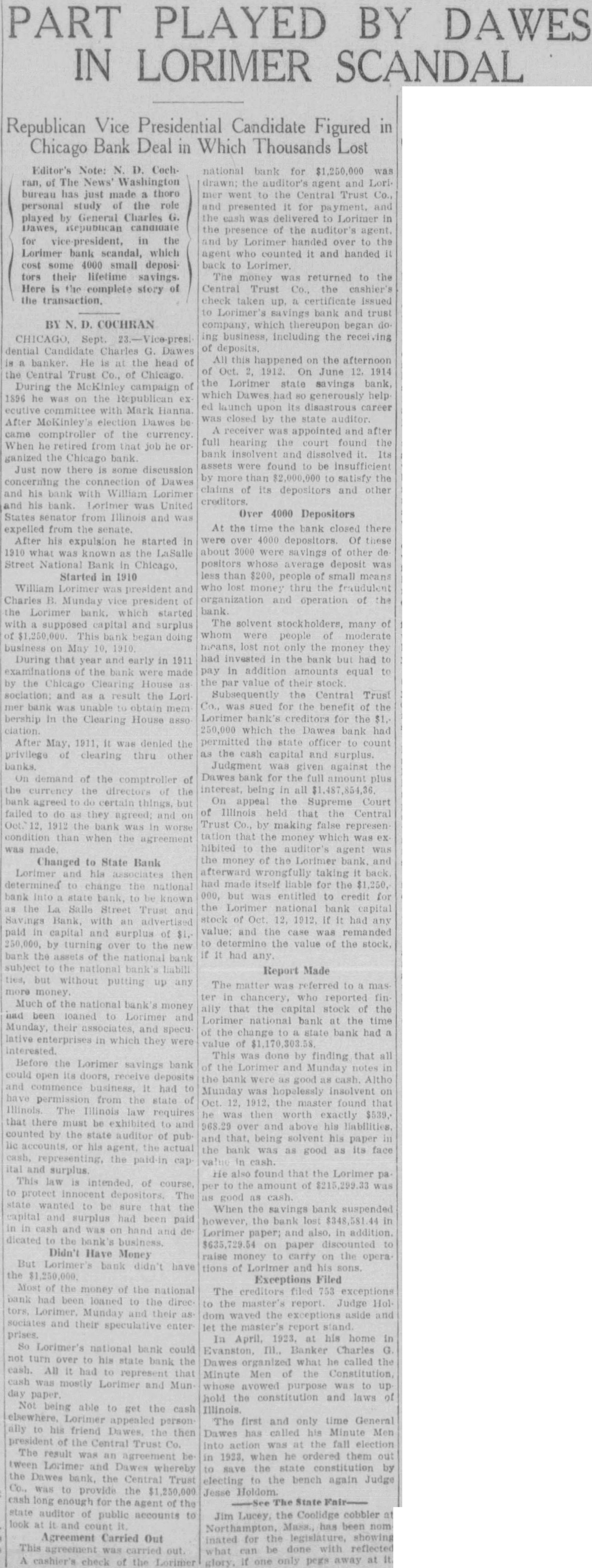
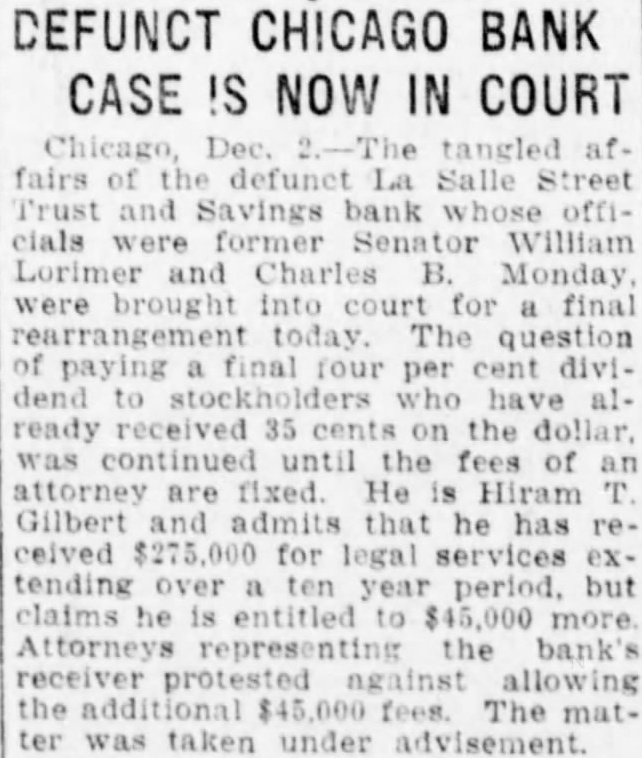
"In 1902 Mr. Dawes organized the Central Trust Company of Chicago, with himself as president. Some years later another bank was organized in Chicago, the La Salle Street National bank. At its head was one William Lorimer, who had retired from the United States senate in somewhat the same manner that Newberry of Michigan retired two years ago. Lorimer's bank began business in May, 1910. Examiners of the Chicago Clearing House association refused to grant it membership in the clearing house association. The directors agreed, on the demand of the United States comptroller of the currency, to do certain things to strengthen the bank's condition, but failed to keep their promise, and by October 12, 1912, the bank was in a bad way.
"Lorimer and his associates then decided to change their national bank into a state bank, to be known as the La Salle Street Trust and Savings bank. They proposed to turn over the assets of their national bank to the new bank, along with its liabilities, of course, but they did not propose to put in any additional money. Much of this bank's money had been loaned to officers and directors and friends of Lorimer and his associates.
"The new bank announced a capital and surplus of $1,250,000. Under the state banking laws of Illinois it thereupon became necessary to show the state auditor of public accounts that the new bank actually had 1,250,000 in cash.
Says Dawes Loaned Cash.
"Lorimer's new bank did not have $1,250,000. Efforts were made to obtain that amount in Chicago and New York and failed. Then Lorimer appealed to Dawes, head of the Central Trust company. Here's what happened:
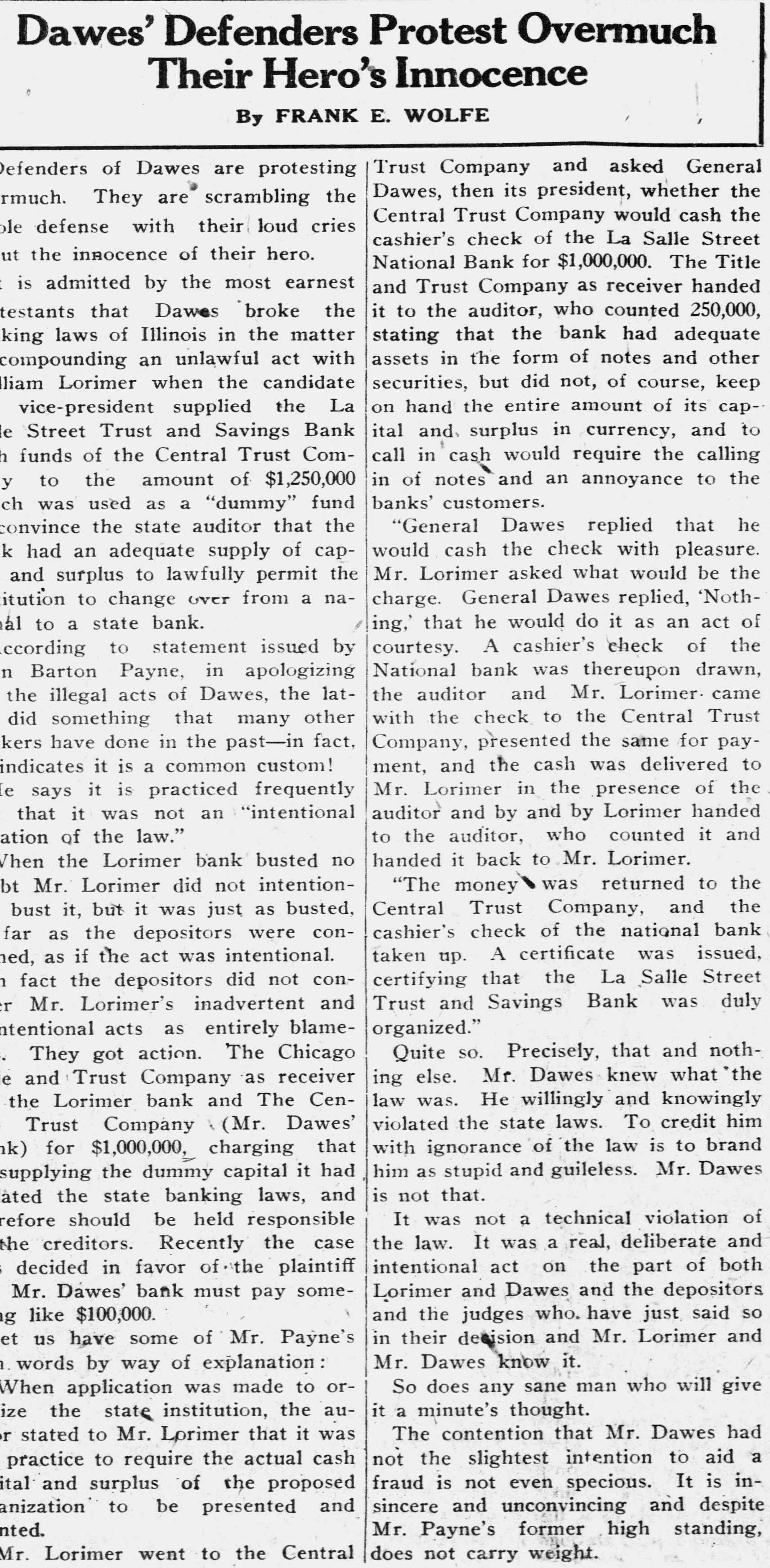
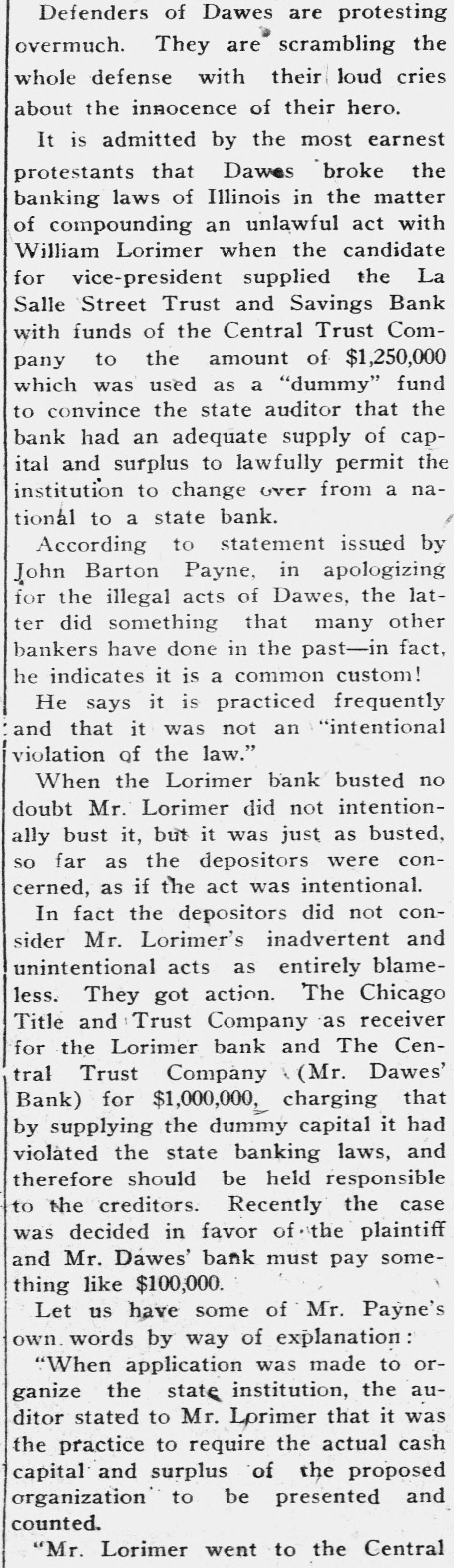
"On the afternoon of October 21, 1912, Dawes turned over to Lorimer's new bank the required $1,250,000. The agent of the state auditor of public accounts counted it and issued a certificate authorizing Lorimer's bank to do business. Then the $1,250,000 was handed back to Dawes' Central Trust company. All in one afternoon. The La Salle Street Trust & Savings bank thus began business with an advertised and certified capital and surplus of $1,250,000, when as a matter of fact there was nothing in the bank to represent the sum.
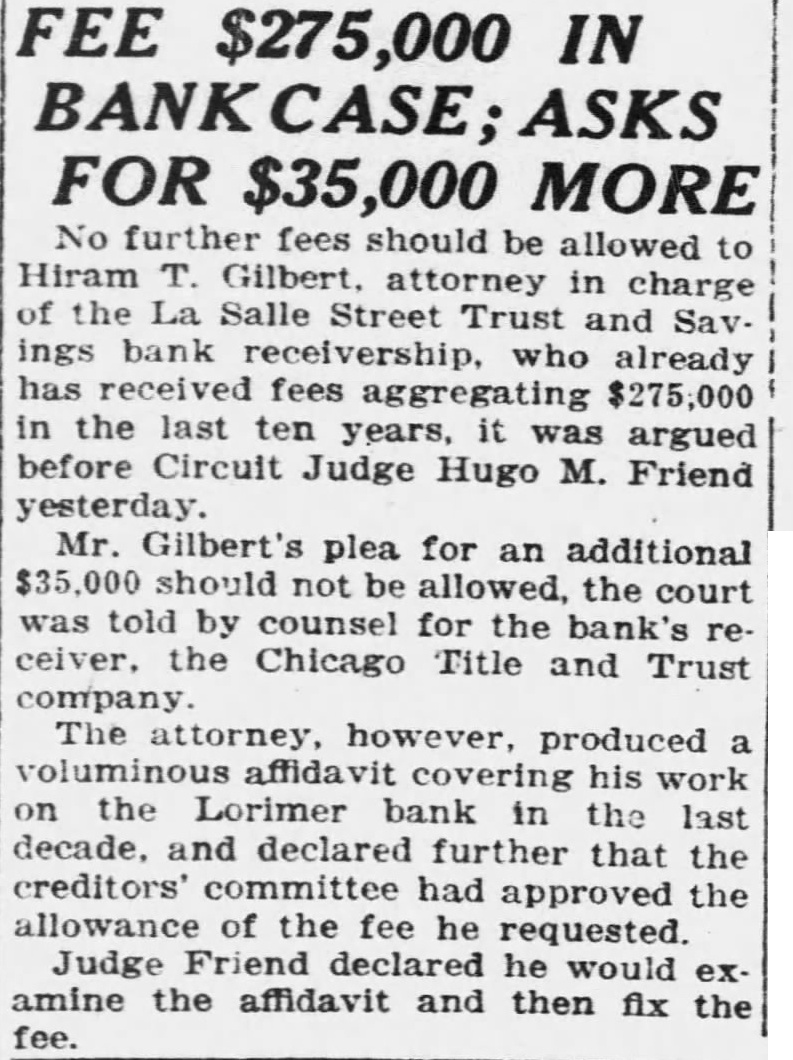
"You people of Chicago know how long Lorimer's bank lasted. Within 20 months it had been closed and a receiver appointed. Its assets were found to be $2,000,000 less than needed to satisfy depositors and other creditors. There were 4000 of these depositors, mostly little folks. Three thousand of the depositors were in the savings department. In addition to the depositors a large number of small stockholders in the bank lost their investment.
"The part that Mr. Dawes had taken in this transaction became known when the receiver, appointed by the court, tried to find the $1,250,000 of cash which had been exhibited to the state auditor's agent the day the bank was given permission to do business. So he brought suit in the Cook county circuit court"