
Franklin Bank (Baltimore, MD)

Episode Information

Episode UID
6132717590493
Episode Type
Run β†’ Suspension β†’ Reopening
Bank Type
trust
Bank ID
613271759 hash
Start Date
January 2, 1841
Location
Baltimore, Maryland (39.290, -76.612)

Metadata

Model
gemini-3-flash-preview (chosen from majority vote of a three-model LLM ensemble)
Short Digest
0c9f54309a60771b

Response Measures

None

Description

The bank suspended in Jan 1841 following a run triggered by the Mechanics' Bank discrediting its notes; it later voted to resume active business in Jan 1844.

Events (3)

1. January 2, 1841 Run
Cause
Local Banks
Cause Details
The Mechanics' Bank of Baltimore successfully moved to discredit the issues (notes) of the Franklin Bank, triggering a run.
Measures
The bank decided to place its affairs in a state of liquidation and closed its doors.
Newspaper Excerpt
The officers offer, in apology, an uncourteous run by the Mechanics' Bank. You may depend upon it, there is a deal of excitement about the matter; (not difficult to get up among our population.) hundreds running to and fro
Source
newspapers
2. January 2, 1841 Suspension
Cause
Local Banks
Cause Details
Action by the Mechanics' Bank to discredit Franklin Bank notes forced the directors to suspend and enter liquidation.
Newspaper Excerpt
The FRANKLIN BANK u of this city closed its doors on Saturday. It was step none expected at present
Source
newspapers
3. January 18, 1844 Reopening
Newspaper Excerpt
The stockholders of the Franklin Bank, Baltimore, have decided, by a very large vote, for the Bank to resume active business
Source
newspapers

Newspaper Articles (4)

Article from The Pilot and Transcript, January 4, 1841

Click image to open full size in new tab

Article Text

# RESUMPTION. We see that the Philadelphia Inquirer states that the Bank of the United States has more than $4,000,000 in her vaults, that all doubts as to a general resumption have disappeared, and expresses the hope that the community will glide so gradually from suspension to resumption that the affair will not create a momentary sensation. On the other hand the Mobile Journal says that the branches of the State Bank of Alabama cannot resume even on the first of July; and we quote the Louisiana Advertiser, expressing a decided opinion against resumption in New Orleans. The principal Western Banks are to hold a meeting on the 25th of this month at Louisville, Kentucky, to consult upon the subject of resumption, and we have the authority of one of the most influential Western financiers for saying that the Banks of the West have no confidence in the ability of the Philadelphia and Baltimore Banks to maintain specie payments until the question of the currency shall be finally adjusted by the General Government. In addition to this, the New York Herald, in an article upon the question of resumption says expressly, and professes to give items to prove it, that the Bank of the United States is in a worse condition now than at the adjournment of the Pennsylvania Legislature, and that she cannot maintain specie payments for sixty days. We do not quote "the Herald's" article at large because we will do nothing that may savour of hostility to the Bank. No one will be more gratified than we to see it restored to its former credit and usefulness; but it is not to be con ealed, however much others may be disposed to depreciate the influence of the Herald that its money articles are extensively circulated and must have an important bearing on the question of resumption Those who now suppose that the Bank can use its credit as it once did will be greatly disappointed. Resumption must be sustained by a general confidence. The Banks require the confidence of depositors as vell as the bill holder, and whenever there is a vant of it in either the Banks must suspend. Does not every one know that if the Banks of this city were to-day paying specie, such would be the run upon them in consequence of the suspension of the Franklin Bank as to coerce another suspension? The failure of the Franklin Bank, an institution heretofore in the best credit, and the rumors in relation to others, constitute a serious obstacle to resumption. It is said that those Banks which have done most to supply our circulation, that is, those Banks which have discounte1 business paper, are in the power of those institutions which have dealt in exchange and charge the business banks five per cent. on balances. The consequence must be that the latter must cease to discount. The effect upon the business of the city is obvious. It may be that the Bank of the U. States has four millions of dollars; but that does not prove that she will not be compelled to go into the market and borrow largely. Her liabilities greatly exceed that sum, to meet which she must sell her state securities now in Europe at a great sacrifice, or she must borrow money at usurious interest. Again: It is said, but with how much truth we do not vouch, that the arrearages due from the Treasury and the claims which ought to be adjusted and allowed, will be upwards of $20,000,000. If these should be discharged by an issue of Treasury notes, bearing interest, the Government will come into the market as a borrower for that sum, and the consequence will be ruin to all those who are much in debt, and are at all dependent on bank accommodations for the regular transaction of business. Instead of aiding the business of the country, the capital will be absorbed as it has been by the two great borrowers, the Bank of the United States and the Government of the U. States. Is it not folly for the Banks in Baltimore to resume, under these circumstances? Will not the credit of our Banks be more injured by resumption, than by a further suspension? We say nothing, now, of the necessity for a change in our Tariff. All parties seem to be agreed. We know and speak advisedly, when we say that Mr. Calhoun believes that a duty should be laid on many of the free articles, especially silks and wines, imported from France and this, with the whole question of the Tariff must come before the next Congress, and will have a beneficial influence on the financial condition of the country. The liquidation of the balances due from the Treasury, may be made in a way greatly to aid resumption. This, it is hoped, will be done by the next Congress. It may be done either by funding the debt, or by an issue of Government credit, not bearing interest. Again: The question of the Sub-Treasury and the policy of the Government in relation to the currency, will be disposed of. We shall either have a U. S. Bank, or an issue of Government credit, and we shall have the influence of the Federal Government to sustain the Banks in their resumption. If the Banks can maintain specie payments under the present state of things, there will be no difficulty whatsoever if these arrangements were completed and it does seem to us to be unwise to anticipate them. But there are local considerations which should have great influence with the people of Baltimore. There has been, and will continue to be, a struggle between New York and Philadelphia for a new Bank of the U. States.
Article from Martinsburg Gazette, January 7, 1841

Click image to open full size in new tab

Article Text

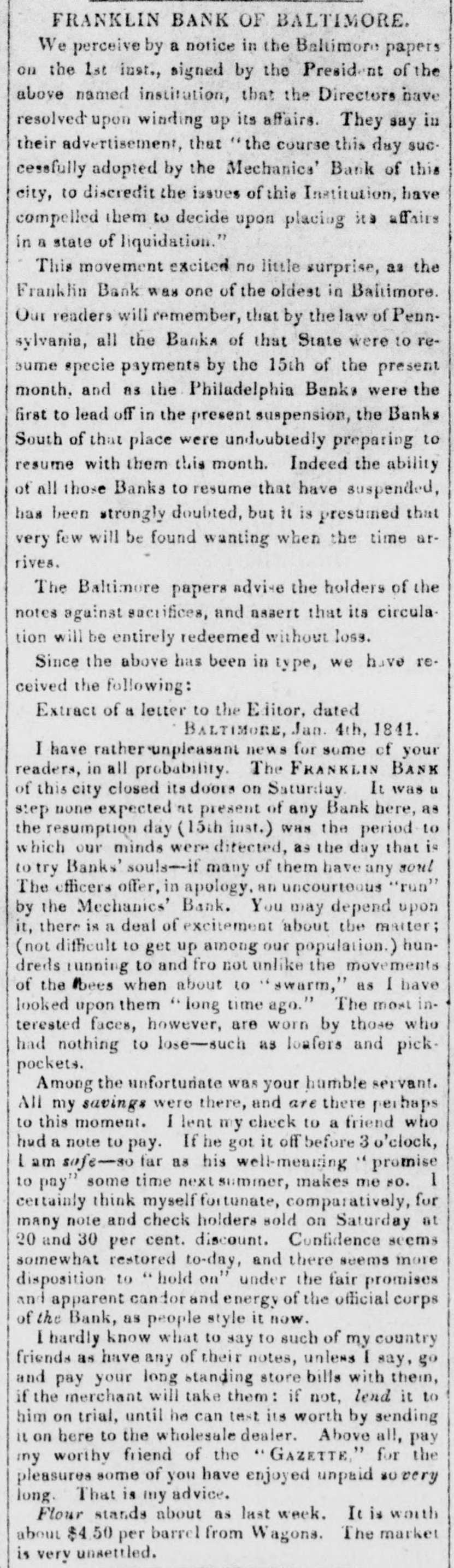
FRANKLIN BANK OF BALTIMORE. We perceive by a notice in the Baltimore papers on the 1st just., signed by the Presid nt of the above named institution, that the Directors have resolved upon winding up its affairs. They say in their advertisement, that "the course this day successfully adopted by the Mechanics' Bank of this city, to discredit the issues of this Institution, have compelled them to decide upon placing its affairs in a state of liquidation." This movement excited no little surprise, as the Franklin Bank was one of the oldest in Baitimore. Our readers will remember, that by the law of Pennsylvania, all the Banka of that State were to resume specie payments by the 15th of the present month. and as the Philadelphia Banks were the first to lead off in the present suspension, the Banks South of that place were unduubtedly preparing to resume with them this month. Indeed the ability of all those Banks to resume that have suspended, has been strongly doubted, but it is presumed that very few will be found wanting when the time arrives. The Baltimore papers advise the holders of the notes against sacrifices, and assert that its circula tion will be entirely redeemed without loss. Since the above has been in type, we have received the following: Extract of a letter to the Editor, dated BALTIMORE, Jan. 4th, 1841. I have rather-unpleasant news for some of your readers, in all probability. The FRANKLIN BANK u of this city closed its doors on Saturday. It was step none expected at present of any Bank here, as the resumption day (15th inst.) was the period to which our minds were directed, as the day that is to try Banks' souls-if many of them have any soul The officers offer, in apology, an uncourteous "run" by the Mechanics' Bank. You may depend upon it, there is a deal of excitement about the matter; (not difficult to get up among our population.) hundreds running to and fro not unlike the movements of the bees when about to 'swarm," as I have looked upon them long time ago." The most interested faces, however, are worn by those who had nothing to lose-such as lonfers and pick pockets. Among the unfortunate was your humble servant. All my savings were there, and are there perhaps to this moment. I lent my check to a friend who had a note to pay. If he got it off before 3 o'clock, I am safe-so far as his well-mearing promise 1 to pay" some time next summer, makes me so. certainly think myself fortunate, comparatively, for many note and check holders sold on Saturday at 20 and 30 per cent. discount. Confidence seems somewhat restored to-day, and there seems more disposition to "hold on" under the fair promises and apparent candorand energy of the official corps of the Bank, as people style it now. I hardly know what to say to such of my country friends as have any of their notes, unless I say, go and pay your long standing store bills with thein, if the merchant will take them: if not, lend it to him on trial, until he can test its worth by sending it on here to the wholesale dealer. Above all, pay my worthy friend of the GAZETTE," for the pleasures some of you have enjoyed unpaid sovery long. That is my advice. Flour stands about as last week. It is worth about $4.50 per barrel from Wagons. The market is very unsettled.


Article from New-York Tribune, January 24, 1842

Click image to open full size in new tab

Article Text

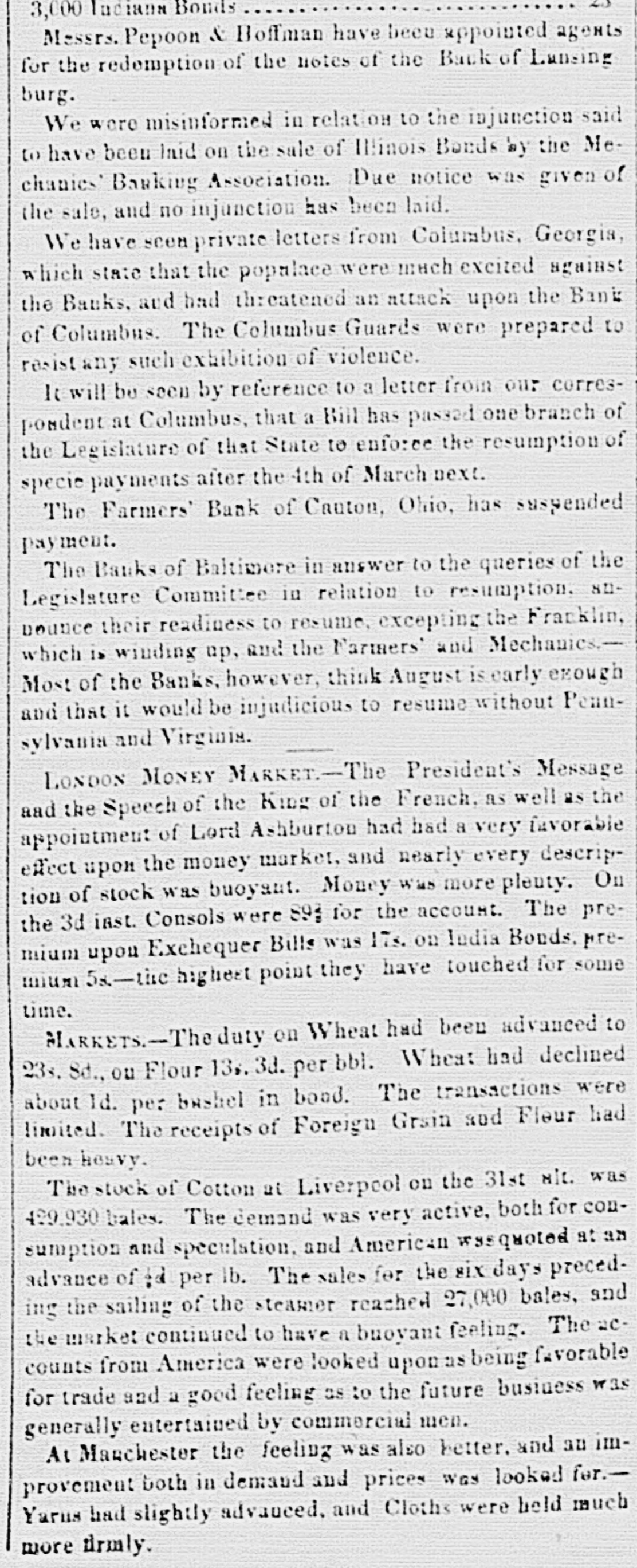
3,000 Indiana Bonds Messrs. Pepoon & Boffman have been appointed agents for the redemption of the notes of the Back of Lansing burg. We were misinformed in relation to the injunction said to have been laid on the sale of Illinois Bonds by the Me chanies' Banking Association. Due notice was given of the sale, and no injunction has been laid. We have seen private letters from Columbus, Georgia, which state that the populace were much excited against the Banks, and had threatened an attack upon the Bank of Columbus The Columbus Guards were prepared to resistant such exhibition of violence. It will be seen by reference to a letter from our correspredent at Columbus, that a Bill has passed one branch of the Legislature of that State to enforce the resumption of specie payments after the 4th of March next. The Farmers' Bank of Cauton, Ohio, has suspended payment. The Banks of Baltimore in answer to the queries of the Legislature Committee in relation to resumption, sn. nounce their readiness to resume. excepting the Fracklin, which is winding up, and the Farmers' and Mechanics.Most of the Banks, however, think August is early enough and that it would be injudicious to resume without Peansylvania and Virginia. LONDON MONEY MARKET.-The President's Message and the Speech of the King of the French. as well as the appointment of Lord Ashburton had had a very favorable effect upon the money market. and nearly every description of stock was buoyant. Money was more plenty. On the 3d inst. Consols were 893 for the account. The premium upon Exchequer Bills was 17s. on India Bonds, premium 5x-the highest point they have touched for some time. MARKETS.-The duty on Wheat had been advanced to 23s. Sd., ou Flour 13% 3d. per bbl. Wheat had declined about 1d. per bashel in bood. The transactions were limited. The receipts of Foreign Grain and Fleur had been heavy. The stock of Cotton at Liverpcol on the 31st HIL. was 499.930 bales. The demand was very active, both for consumption and speculation, and American wysquoted at an advance of R per lb. The sales for the six days preced. ing the sailing of the steamer reached 27,000 bales, and the market continued to have a buoyant feeling. The accounts from America were looked upon as being favorable for trade and a good feeling as :0 the future business was generally entertained by commercial men. At Manchester the feeling was also better. and an improvement both in demand and prices was looked for.Yarus had slightly advanced, and Cloths were held much more firmly.


Article from New-York Daily Tribune, January 18, 1844

Click image to open full size in new tab

Article Text

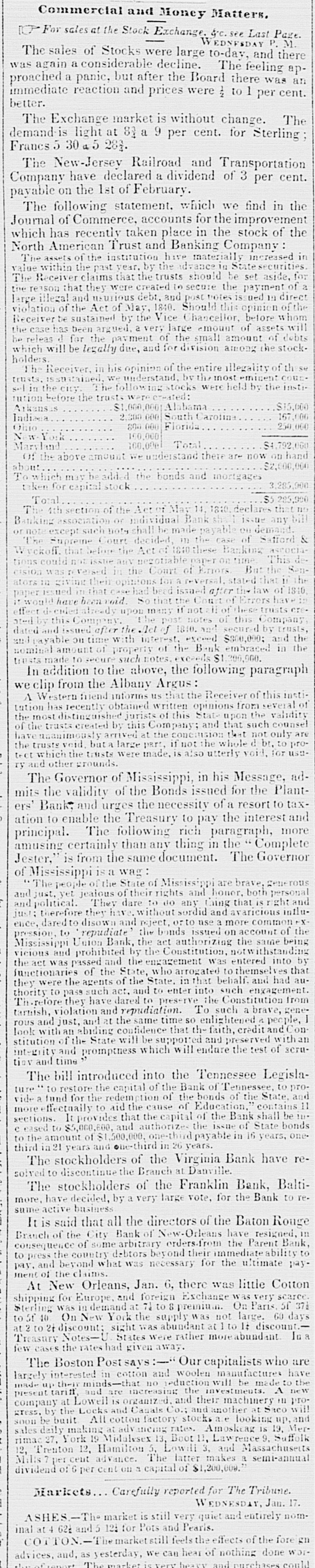
Stock Exchange Ec. Last Page. The sales of Stocks were large WEDNESDAY to-day, and P. M. was again a considerable decline. The feeling there proached a panic, but after the Board there apbetter. immediate reaction and prices were 1/2 to 1 per was cent. an The Exchange market is without change. The demand is light at 83 a 9 per cent. for Sterling Francs 30 a 5 283. The New-Jersey Railroad and Transportation Company have declared a dividend of 3 per cent. payable on the 1st of February. The following statement. which we find in the Journal of Commerce, accounts for the improvement which has recently taken place in the stock of the North American Trust and Banking Company: The assets of the institution have materially increased value within the past year. by the advance 10 State securities in The Receiver claims that the trusts should be set aside. for the reason that they were created in secure the payment of large illegal and usurious debt. and post notes is ued 19 direct a violation of the Act of May, 1840. Should this opinion of the Receiver be sustained by the Vice Chaecellor, before whom the case has been argued. a very large amount of assets will he releas d for the payment of the small amount of debts holders which will be legally due, and for division among the stock. The Receiver, in his opinion of the entire illegality of th trusts, sustained, We understand by the most eminent COUR se sel the city. Thefollowingstocks were held by the insti. aution before the trusts $15,000 Arkansas $1,000,000,Albama 167,000 2,300,000 Indiaga South Carolina 250,000 Florida 800 000 Ohio 100,000 New York Total $4,792,000 100.000 Maryland now of the above amount we understand there are on hand about $2,000,000 which may be added the bonds and mortgages 3,285,900 taken for capital stock Total $5 285,990 The 1th section of the Act Mar 14. 1810. declare that TID Banking association or individual Bank shall issue any bill or note exceptisach note shall be made payable on demand. & The Supreme Court decided. 11) the case of Safford Wvckoff. that before the Act of 1810 these Banking ASPOCE tions could not issue anv negotiable paper on time This Sencision was reversed in the Court of Errors But the ators in giving their opinions for reversal. stated that 11 the issued in that case had bead issued after the of 1840 itwould have been void other the Court of Errors effect already upon many if not ii of these trusts and by this Company. The post notes of this Company dated and issued after Act of 1810. and secured by trusts, and payable on time with interest. exceed $800,000; and the nominal amount of property of the Bank embraced in the trusts made to secure such notes exceeds $1,200,000. In addition to the above, the following paragraph we clip from the Albany Argus: A Western friend informs us that the Receiver of this institution has recently obtained written opinions from several of the most distinguished jurists of this State upon the validity of the trusts created by this Company; and that such counsel havennanimously arrived at the concession that only are the trusts void. but a large part, if not the whole di bt. to protect which the trusts were made. is also utterly void, for usery and other grounds. The Governor of Mississippi, in his Message, admits the validity of the Bonds issued for the Planters Bank, and urges the necessity of a resort to tax ation to enable the Treasury to pay the interest and principal. The following rich paragraph, more amusing certainly than any thing in the Complete Jester," is from the same document. The Governor of Mississippi is a wag: The people of the State of Mississippi are brave. generous and just, yet jealous of their rights and houer, both personal and Ipolitical. They dare to do any thing that is right and just; therefore they have. without sordid and avaricious intluence, dared disown and reject, or to use a more commonex pression, to repudiate the bonds issued on account of the Mississippi Union Bank, the act authorizing the same being vicious and prohibited by the Constitution, not twithstanding the act was passed and the engagement Was entered into by Junctionaries of the State, who arrogated to themselves that they were the agents of the State. in that behalf. and had authority to pass such act, and to enter into such engagement. Therefore they have dared to preserve the Constitution from tarnish, violation and repudiation. To such a brave, generous and just, and at the same time so enlightened a people, I look withan abiding confidence that the faith, crΓ©dit and Constitution of the State will be supported and preserved within integrity and promptness which will endure the test of scrutiov and time The bill introduced into the Tennessee Legislature to restore the capital of the Bank of Tennessee, to provide a fund for the redemption of the bonds of the State, and pre effectually to aid the cause of Education, " contains 11 sections. It provides that the capital of the Bank shall be !!!" creased to $5,000,600, and authorizes the issue of State bonds the amount of $1,500,000. one-third payable in 16 years, one. third in 21 years and one-third in 26 years. The stockholders of the Virginia Bank have resolved to discontinue the Brauch at Danville The stockholders of the Franklin Bank, Baltimore, have decided. by a very large vote, for the Bank to re. same active business It is said that all the directors of the Baton Rouge Branch the City Bank of New-Orleans have resigned, in consequence of some arbitrary orders/from the Parent Bank. to press the country debtors beyond their immediateabili to pay, and beyond what was necessary for the ultimate payment of the claims. At New Orleans, Jan. 6, there was little Cotton shipping for Europe, and foreign Exchange was very scarce Sterling was rdemand at to 8 premium. On Paris of 371 to 5f 10 On New York the supply was not large. 60 days discount sight was abundant at 1 to l: discount.a Treasury Notes- States were rather moreabundant In few cases the rates had given away. The Boston Post says '- Our capitalists who are largely interested in cotton and woolen manufactures have made up then minds-that no reduction will be made to the present tariff and are increasing the investments. A new company at Loweil is organized. and their machinery in progress, by the Locks and Casals Co.; and another at Saco will soon be built All cotton factory stocks are looking up. and daily making adv MAINE rates. Amoskeag IS 19, Merrimac 27, York 19 Middlesex 13, Boot 11, Lawrence 9. Suffolk 12, Trenton 12, Hamilton 5, Lowdi 3. and Massachusetts Mills 7 per cent advance. The latter makes a semi-annual dividend of G per cent on I capital of $1,200,000. Markets Carefully reported for The Tribune. WEDNESDAY, Jan. 17. ASHES.-Th market is still very quiet and entirely nomfinal at 4 622 and 12: for Pots and Pearis. COTTON-Themarketstill feels the effects of the fore gn advices, and, as yesterday, we can hear of nothing done war