
Citizens National Bank (Indianapolis, IN)

Episode Information

Episode UID
61701018
Episode Type
Suspension โ†’ Reopening
Bank Type
national
Bank ID
6170 national
Charter Number
617
Start Date
October 1, 1884*
Location
Indianapolis, Indiana (39.768, -86.158)

Metadata

Model
gpt-5-mini (chosen from majority vote of a three-model LLM ensemble)
Short Digest
6cec01b18971efd7

Response Measures

None

Description

Articles describe two separate episodes (1884 voluntary liquidation and a 1893 suspension/reopening); unclear if same corporate entity persisted.

Events (5)

1. December 9, 1864 Chartered
Source
historical_nic
2. October 1, 1884* Suspension
Cause
Voluntary Liquidation
Cause Details
Bank announced it 'will go into voluntary liquidation' (per news summary).
Newspaper Excerpt
The citizens' National Bank, Indianapolis, will go into voluntary liquidation.
Source
newspapers
3. November 11, 1884 Voluntary Liquidation
Source
historical_nic
4. June 12, 1893 Suspension
Cause
Government Action
Cause Details
Suspension followed regulatory conditions by the comptroller of the currency; bank later complied to reopen.
Newspaper Excerpt
The Citizens' national bank of Indianapolis, Ind., which suspended June 12, has complied with the conditions of the comptroller of the currency
Source
newspapers
5. August 22, 1893 Reopening
Newspaper Excerpt
has ... been permitted to reopen its door.
Source
newspapers

Newspaper Articles (3)

Article from Dodge City Times, October 16, 1884

Click image to open full size in new tab

Article Text

NEWS SUMMARY. MISCELLANEOUS. A reduction in charges has been ordered by the Suez Canal Company. The largest business block of Millican, Texas, was destroyed by fire. The citizens' National Bank, Indianapolis, will go into voluntary liquidation. The Exchange National bank of Cincinnati has gone into voluntary liquidation. Joseph Mulhatton has written a letter of acceptance 88 the drummers' candidate for President. The Ninth Episcopal Congress of the United States met at Detroit. Bishop Harris presided and delivered the address of welcome. The Western Union reports breaks in both the American or Gould cables 700 miles from Canso, Nova Scotia. This leaves the pool six cables. Customs examiners in New York, seized forty-one large diamonds, found in the mail brought by one steamer. The gems are valued at $10,000. Andrew J. Cooper and other Chicagoans have incorporated at Springfield a company with a capital of $1,000,000 to operate a gold mine in Michigan. A pleasure tug carrying about twenty persons left Grand Haven, Michigan, for New Orleans, on a fishing excursion, and expect to take six weeks on the down ward trip. 6 A reduction of ten per cent. has been made in the wages of the men employed in the quarries belonging to the State Ex change of Lehigh and Northampton counties. Capitalists will meet in Pittsburg Oct. 15th to arrange for the construction of an air line 1,2000 miles long to connect New York with Chicago, Council Bluffs and St. Louis. A tragedy in a Negro brothel on Polk Chicago, ended in the death of Minnie Brooks, who once reformed and for a time expended all her means in keepinga refuge for fallen women. All the effects of the St. Louis Malleable Iron Company have been turned over to its officers by order of the Court. Work has been resumed on the large contracts, which will require a run until 1886. An exploaion of gas caused the burning of the Windson hotel at Kingston Canada One guest leaped from a third-story window and others barely escaped with their lives. The loss is estimated at $40,000. H. K. Tyler and E. M. Wilson have been appointed Receivers of the Malleable Iron Works. Bad management is the cause. The owners of the concern are leading capitalists. The assets are largely in excess of the liabilities. Senator Morgan, of Alabama, who has just returned from a trip to California, expresses the opinion that steel ships and cruisers can be built on the Pacific coast at 10 per cent. less cost than on the Atlantic seaboard, on account of the rich iron deposits. Reuben Springer and David Stinton have offered $25,000 each to the Cincinnati Museum to pay for the removal and erection of the present postoffice building on the grounds of the Association in Eden Park, as a sample of the pure Grecian architecture. The Chicago, Burlington & Quincy and Atchison, Topeka & Santa Fe have inaugurateda new line, to be known as the Pacific Coast Fast Freight line, from Chicago to all points in California, New Mexico and Arizona. The scheduled time from Chicago to San Francisco is nine days. It is announced that the Woman's National Christian Temperance Union will meet at St. Louis on October 22, 23, 24 and 25. Prominent lady speakers will occupy some of the church pulpits the preceding Sunday. October 7 will be made a day of prayer by thousands of local unions throughout the country. The general assignment of J. W. Rosenthal & Co., one of the largest clothing manufacturers of Rochester, was filed in the County Clerk's office Oct. 6, and the assignee is Louis Greisheimer, of Chicago, and the claims of the preferred creditors amount to nearly $100,000. The real extent of the failure cannot be learned until the *assignee's schedule is filed. The officers of the Hampden Mutual Fire Association, of Springfield, Mass., have decided to close up business. The general agent, S.C. Warner, has issued a circular calling in the policies, which now number seven or eight hundred. The losses incurred by the burning of the Newton paper mill at Holyoke are the immediate cause of this step. The policy holders will all receive their return premiums. Judge Dealy, of the United States District Court, has delivered an important decision in the case affecting the Oregon Railroad & Navigation Company. Villard, representing the Northern Pacific, took a ninety-three years' lease on the Oregon Railroad Company's road, at $140,000 8 year. Villard's successors endeavored to repudiate the lease, but the Jndge decided that the lease holds good. The Federation of Trades and Labor Unions adopted the following resolution Resolved, That owing to the painful circumstances in connection with the existing trouble between the International and Progressive Cigarmakers Unions, we instruct the Legislative Committee at the close of this congress to open communication with the principal officers of the above unions and offer their services as mediators, with the view of bringing about harmony between those bodies. The earnings of the Union Pacific Railroad, entire system, for August is $2,530,000; decrease from August a year ago, $47,000;. The expenses were $1,101,000; decrease, $275,000. Surplus earnings, $1,328,000; increase, $228,000. For the eight months ending August 31st, the earnings were $15,871,000; decrease from same period last year, $2,066,000. Expenses, $9,372,000; decrease, $148,000. Surplus earnings for eight months, $6,498,000; decrease, $2,215, 000. John L. Sullivan in an interview with a Bulletin reporter, said he intends to train down to 200 pounds or less for a set to with Laflin. After the Laflin fight he desires matches with Alf. Greenfleld, the Eglish athlete, and with Mitchell, if the latter is so inclined. He declares solemnly that he has stopped drinking for all time, and is determined to take care of himself. After completing his engagements in this country he will give some farewell performances and then make a tour to England, Ireland, Scotland and Australia. The lockout at Oliver Bros. & Phillips'

Article from The State Republican, August 24, 1893

Click image to open full size in new tab

Article Text

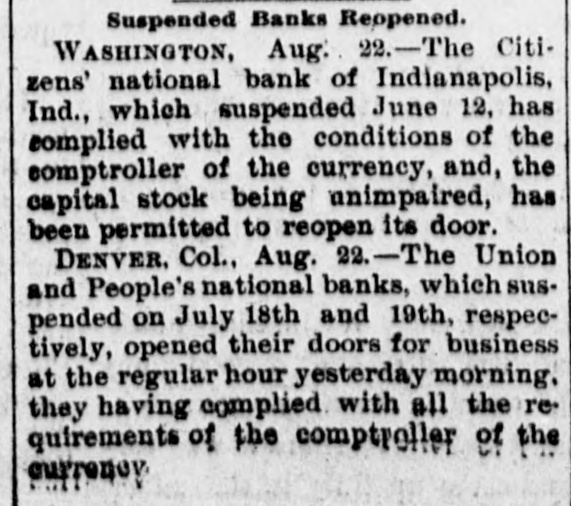
Suspended Banks Reopened. WASHINGTON, Aug. 22.-The Citizens' national bank of Indianapolis, Ind., which suspended June 12, has complied with the conditions of the comptroller of the currency, and, the capital stock being unimpaired, has been permitted to reopen its door. DENVER. Col., Aug. 22.-The Union and People's national banks, which suspended on July 18th and 19th, respectively, opened their doors for business at the regular hour yesterday morning. they having complied with all the requirements of the comptreller of the currency


Article from The Indianapolis Journal, November 23, 1900

Click image to open full size in new tab

Article Text

M. FLETCHER HEARD. His Brief Talk Well Received-The Closing Business. President Coulter announced that, in the absence of Mr. Percival Kuhne, of New York, he had requested Mr. Allen M. Fletcher, formerly of this city, now of New York, to favor the convention with a talk on a subject of his own choosing. Many of the delegates had evidently heard Mr. Fletcher talk on other occasions or else his reputation as a witty and entertaining speaker had reached their ears, since he was greeted with spontaneous applause when he arose to address the convention. Mr. Fletcher spoke as follows: "I confess I hardly know what I am going to say to you. I do not know how to put you in closer touch with my present frame of mind than to tell you a little story, which perhaps you have all heard, although some of you may not. A number of years ago a elergyman was visiting another, and the friend he was visiting was all the time at work writing a sermon-so much SO that it rather embarrassed his friend. Finally he said to him, You should not do that. I never write out my sermons. While you are writing that with a view of bettering some of your people in your church the devil is looking right over your shoulder. preparing arguments to refute all you are going to say. When I go into the pulpit the devil don't know what I am going to say, because I don't know myself. Well, that is a good deal my present frame of mind. I am always ready to help a gentleman from Indiana; I owe that to the State. It has occurred to me that perhaps some of the other members here might be interested in hearing something relative to methods that are fatal to conservative banking. I do not know that I can say anything on that subject that would interest the older ones or that they do not already know or that experience has not taught you already. "To that end let me say to you that the city of Indianapolis only fifteen years ago had sixteen banks. Of the sixteen then existing only three now remain. Now it might occur to you that that was owing to the fact that this was not a good place to bank. That is not the case. It is a good place to bank, it is a safe place, a profitable place, limited only by the limitation of its natural environment. The same is true of any business here. But that result I have given you was brought about by methods in almost every case, yes, in every case, that were fatal to conservative banking. FATE OF THE BANKS. "Of the various banks in existence at the time I speak of, one, the Citizens' National Bank, went into voluntary liquidation with credit to itself, and the Meridian National Bank was absorbed by the Merchants'. It was a solvent bank and went out of business. The other eleven failed-failed. Now if you analyze the cause and effect that led to that result in those various banks you will find in the main that it was owing to three particular, not exactly methods, but facts, and put them under three heads. First, inability to say No when it should be said, and emphatically. When there is any question about a transaction, the making of a loan-any question at all in the mind of the banker-I think it should be said. even if leads to the loss of a good customer. The banker. standing as he does a trusteee of those whose money he has, should not give the customer the benefit of a doubt if a doubt really exists in his mind. Second, the want of courage to face a loss when It has been made, the courage not to put good money with bad. I believe that in nine cases out of ten where a customer has become seriously embarrassed. especially where it is the result of a slow growth, a continuing process of getting into that condition, that it is wiser not to help him, not to try, because the difficulty, the root of it, is below any assistance or advice that you can give him. Of course, where the case is the result of a calamity, something of the kind that is unexpected, that presents quite a different proposition, but a number of the failures here that pa. sed before my eyes have been the result of not sufficient courage to meet the loss and meet it then, not sufficient courage to refrain from putting good money with that which was in effect already gone. The third and greatest trouble of the institutions that I have referred to I think was the desire to create volume. volume at the expense of conservative business management, and when I speak at the expense of conservative business management there are a multitude of little things that come under that head that I won't attempt to go into. I put it broadly on that specification. The habit of rushing out in the clothing store fashion and grabbing of a customer and bringing him in, sometimespretty often-results in a misfit. I don't think in the long run it pays. The taking of a customer because, while he is not all right, simply because you are afraid some other bank is going to get him. I have known that not to be very profitable. NOT A GOOD STEADY DIET. "As a steady diet it don't pay. I think you are justified in knowing all you can about a customer and knowing he is just what you want. If it comes to this, that you are prepared to take him because you think he is all right and yet won't make you a fair statement-I have known that to cause a failure. I don't think the bankers of this State ever had a case of swollen credit-mistaken credit, if you pleasewhich was more difficult and which caused them more trouble than one which occurred in the southern part of the State here, and which you are all familiar with. The advertisement of one's indebtedness for the purpose of creation of volume is all right where you have use for your money, but where call loans don't exist, where collateral security don't exist, in smooth-sailing times it is all right, but clouds come to the banker sometimes, depressed conditions come to him sometimes. The banker who has not been through a panic and an acute one is not a banker in the broad sense of the word: he has yet something to learn. A bank should be evenly balanced, not topheavy in any respect. It should at all times have sufficient money hand to stand any reasonably strong run. The mere fact that a bank is solvent, that it stands high, that it has good directors and good stockholders, is not necessarily proof against disaster. "I well remember the case of the Meridian National Bank here. On the day after the failure of Mr. Haughey, its president, Mr. Gallup, a man of large means personally, worth more than the capital stock of his bank, decidedly more, with available securities in the shape of bonds and stocks -he had not gauged the situation he had before him and taken in his sail, and he found himself needing assistance, and if he