Second National Bank (New York, NY)

Episode Information

Episode UID
6201013
Episode Type
Run Only
Bank Type
national
Bank ID
620 national
Charter Number
62
Start Date
May 14, 1884
Location
New York, New York (40.714, -74.006)

Metadata

Model
gpt-5-mini (chosen from majority vote of a three-model LLM ensemble)
Short Digest
07df6ef4855dfbc4

Response Measures

Accommodated withdrawals, Borrowed from banks or large institutions, Clearinghouse loan, Fed/other loan, Capital injected, Books examined

Other: Private guarantees from Amos R. Eno and other directors were secured to cover deficiencies (private guarantees separate from capital injection).

Clearinghouse involved: Yes (loan, examination, or other measures)

Description

Some reports briefly stated the bank 'suspended' along with others, but primary evidence shows it reopened and met withdrawals.

Events (3)

1. August 13, 1863 Chartered
Source
historical_nic
2. May 14, 1884 Run
Cause
Bank Specific Adverse Info
Cause Details
Discovery of large defalcation/speculative losses by President John C. Eno, prompting heavy withdrawals.
Measures
Directors and Amos R. Eno made up deficits; guarantees secured by examiner; money supplied by authorities; bank paid out $2,412,000 and resumed normal operations.
Newspaper Excerpt
A run on the Second National bank: have secured guarantees for all deficiencies and money will be supplied the bank until the run ceases.
Source
newspapers
3. December 31, 1921 Voluntary Liquidation
Source
historical_nic

Newspaper Articles (24)

Article from Daily Globe, September 8, 1881

Click image to open full size in new tab

Article Text

ALL AROUND THE GLOBE. The New York produce and cotton exchange, clearing house, and all banks will be closed to-day. The mayors of New York and Brooklyn have issued proclamations calling on all to close their places of business, and trade will be suspended in both cities. Robert Steep, of Manville, Kan., nine miles west of there, while crossing the railroad track in a wagon, was killed by railroad train No. 3. Alex. Grey, of Allegheny City, one of the wardens of the western penitentiary, received serious injuries on the Pennsylvania railroad, at Seaman Place, yesterday, dying several hours afterwards.


Article from Daily Kennebec Journal, May 14, 1884

Click image to open full size in new tab

Article Text

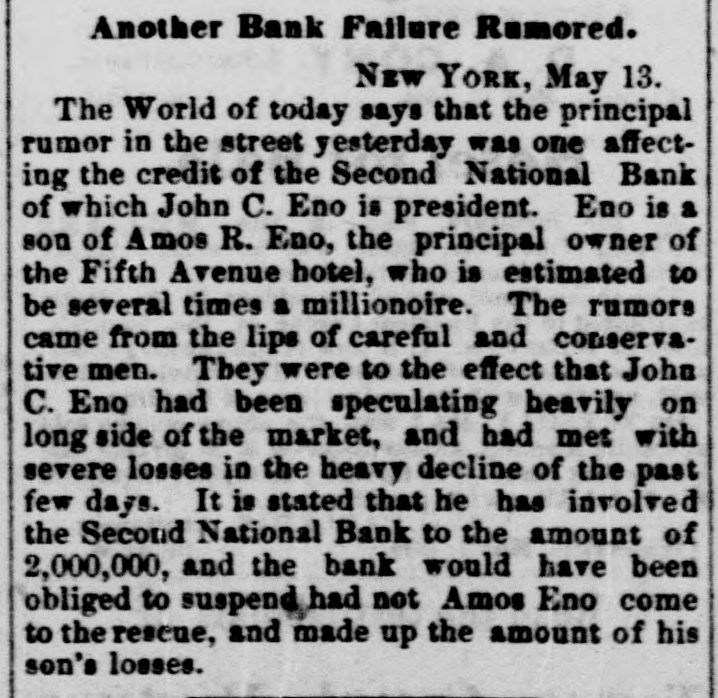
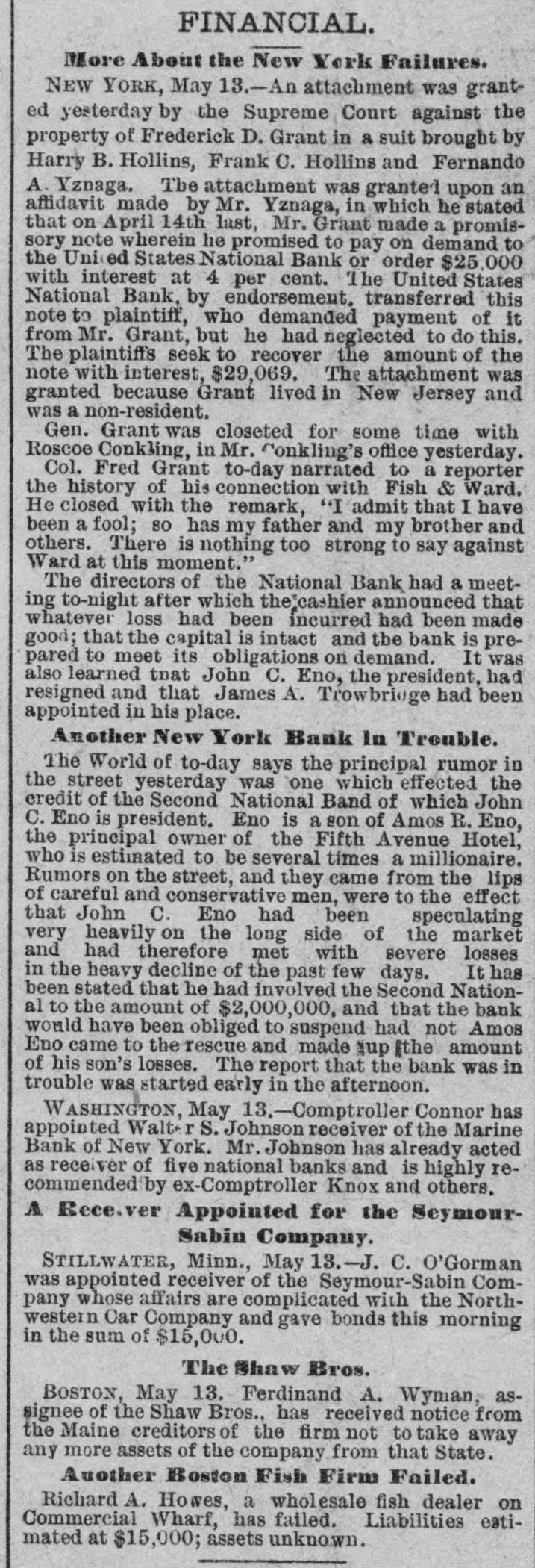
Another Bank Failure Rumored. NEW YORK, May 13. The World of today says that the principal rumor in the street yesterday was one affecting the credit of the Second National Bank of which John C. Eno is president. Eno is a son of Amos R. Eno, the principal owner of the Fifth Avenue hotel, who is estimated to be several times a millionoire. The rumors came from the lips of careful and conserva. tive men. They were to the effect that John C. Eno had been speculating heavily on long side of the market, and had met with severe losses in the heavy decline of the past few days. It is stated that he has involved the Second National Bank to the amount of 2,000,000, and the bank would have been obliged to suspend had not Amos Eno come to the reseue, and made up the amount of his son's losses.


Article from Lancaster Daily Intelligencer, May 14, 1884

Click image to open full size in new tab

Article Text

GATHERED FROM ALL DIRECTIONS A Pastsdelphie maiden Lady 'e Strange Pets An Eloping Family- items From Various sources unt which has been audited in As Philadelphia see orphans' court by Judge the Hanna showed an unusual devotion to ets by Rebecca F. Lockwood, au elderly maiden lady. who died about lived year ago leaving about $1,200. She secluded for years in a little frame house in West Philadelphia, and her only companious were seven dogs of various breeds, a big greyhound, Harry, being he favorite. The income of trust estate the woman support, and sometimes remittances were irregular and conse quently the larder suffered to some dogs extent but, come weal or wor, the ere always well taken care of -even at the sacrifice of comfort by their benefao tor The dog Harry had been twice his to Florida for the bene of taken health, but he finally died in the West Philadelphia house. ilis mistress was onsolable. She kept his body in the house tw weeks, and then the neighbore to began for to complain. They the eatened put the board of health on the place, which succeeded in causing the animal baried After this, fearing the inter. ference of the neighbors with the survivdogs, Miss Lockwood gar hered aboarding her ing pets about her and departed for the house on South street. In the estab animals had free lishment, the but ou South street they had be content with the freedom of the to on shelter taken the After the death of their they Lombard mistress The street. hpase boarding claimed from the estate 846 for of owner. their the board of the dogs, in addition to The 3 board for wed these ms and the remainder nurses, the fund was used in paying phy and funeral exp uses Mortally W bunded His Father Thomas Bradshaw, 56 years of age, shot and mortally outded by hisson Mass. Walter,at their home The son early Tuesday the that father said age lived time from for some he family and contributed nothing back to Recently support the Tuesday morning with them from father awakened his The money some mother and the by the man That Etopes of Pottsville, Schr George She daughter New of Castle, Mrs herself man, Westp that Russian had her been She them being with with absconded der that sent the The cation of of the W Mr. attracted had not learned by his runaway ife. A at Dr. the into directly with tube elastic through ment. She had been suffering tumor the throat, which had so choke up the cosophagus which of Her been give hopes, her be that may from the Erisf Items From all sources American fish culture associate The their thirteenth annual the Washington national museum buil Tuesday Mr. Wallace, the United States minister Turkey has left Constantinople on to months leave of absence in America The comptroller of the currency, at consultation with the president, appoint Walter S. Johnson to be the receiver the Marine bank of New York. 10 the House of Commons Tuesday night, Sir Michael Hicks Beach 8 motion rejected by a vote of 303 275. The Parnellites voted with the m nority. A small quantity of state fell from of the Junction railroad tunnel An Pittsburg, roof Tuesday morning, killing tonio Dobic and Seth Brown Joseph Knight a driver bose, was killed Tuesday by the fall of a hoisting carriage in the Nottinghain mine at Piymouth, Pennsylvania The twentieth anniversary of the boar church extension of the Methodist Tues of Episcopal church, was celebrated day evening in the Philadelphia Academy of music. About $51,000 wastcontributed Miller, during the evening Rev. J G. of Lincoln, Nebraska, subscribed $20,000 shot Tuesday afternoon Charles Sisco Robert Campbell twice through the breast being t in Baltimore. Sisco then fled, and, fired with his three revolvers the 8 pursued, the crowd, two shots taking effect in white, head and arm of Christian Kramer, two in the breast and abdomen and James Johnson, colored. It was not after Sisco had discharged all three The weapons that he was captured crowd then beat him in a horrible manner 11 fracturing his skull. The injuries II Campbell, Johnson, Kramer and Sisco are considered fatal. WALL STREET GREATLY EXCITED. many Rumors and stocks Heavy Decides There was great excitement in Wal street yesterday, especially in the stocks. closing and there was rush to sell Heavy hours, declines occurred in Western other Union Pacific, St. Paul and but stocks. Union, No failures were announced, the Continental bank refused to certify Many more checks for one firm. any reports were in circulation concerning al firms, railroads and banks, but nearly The of them were without foundation. held d directors of the Second National bank loss meeting and announced that any been which the bank had suffered had made good, and that the bank would go


Article from Alexandria Gazette, May 14, 1884

Click image to open full size in new tab

Article Text

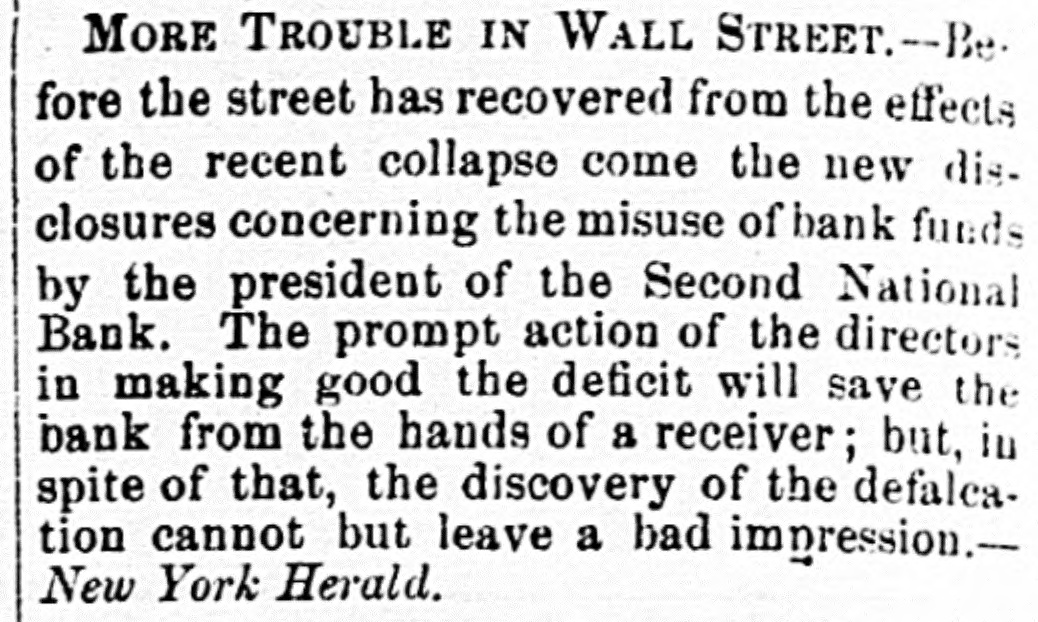
MORE TROUBLE IN WALL STREET.--Be fore the street has recovered from the effects of the recent collapse come the new disclosures concerning the misuse of bank funds by the president of the Second National Bank. The prompt action of the directors in making good the deficit will save the bank from the hands of a receiver; but, in spite of that, the discovery of the defalcation cannot but leave a bad impression.New York Herald.


Article from Daily Republican, May 14, 1884

Click image to open full size in new tab

Article Text

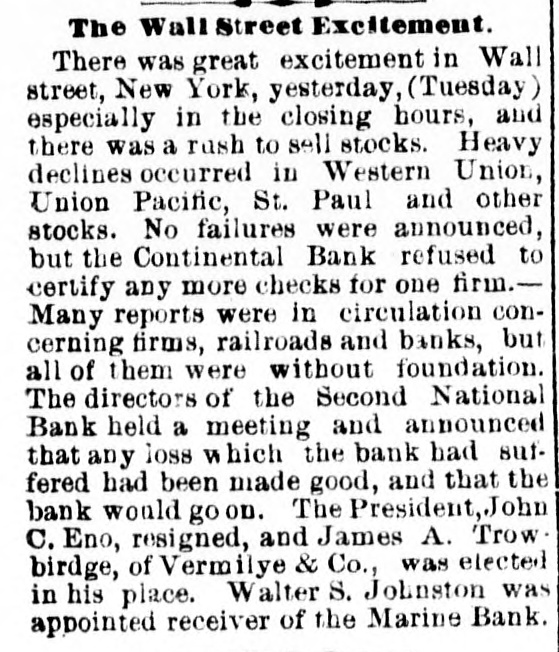
The Wall Street Excitement. There was great excitement in Wall street, New York, yesterday, (Tuesday) especially in the closing hours, and there was a rush to sell stocks. Heavy declines occurred in Western Union, Union Pacific, St. Paul and other stocks. No failures were announced, but the Continental Bank refused to certify any more checks for one firm.Many reports were in circulation concerning firms, railroads and banks, but all of them were without foundation. The directors of the Second National Bank held a meeting and announced that any loss which the bank had suffered had been made good, and that the bank would go OD. The President, John C. Eno, resigned, and James A. Trow birdge, of Vermilye & Co., was elected in his place. Walter S. Johnston was appointed receiver of the Marine Bank.


Article from The Indianapolis Journal, May 15, 1884

Click image to open full size in new tab

Article Text

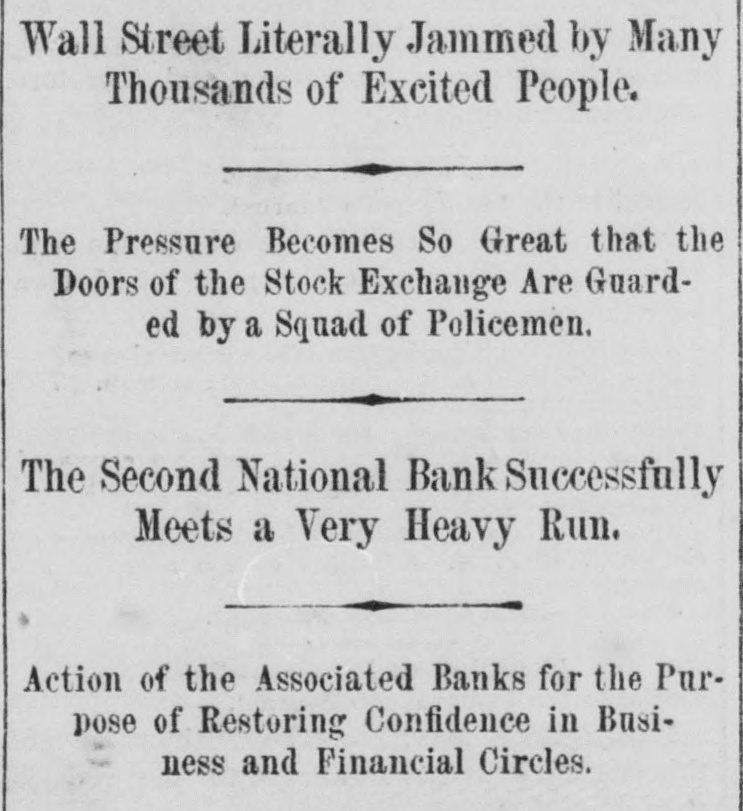
Wall Street Literally Jammed by Many Thousands of Excited People. The Pressure Becomes So Great that the Doors of the Stock Exchange Are Guarded by a Squad of Policemen. The Second National Bank Successfully Meets a Very Heavy Run. Action of the Associated Banks for the Purpose of Restoring Confidence in Business and Financial Circles.


Article from The Daily Cairo Bulletin, May 15, 1884

Click image to open full size in new tab

Article Text

What the Bank Examiner Has Learned. WASHINGTON, D. C., May 14.-The Secretary of the Treasury, with a view to relieving the panicky situation at New York, has ordered the payment of bonds included in the 127th call on presentation. Comptroller Cannon received a dispatch from Bank Examiner Scriba informing him of the run on the Second National Bank; also, that he had secured guarantees for all deficiencies, and that money would be supplied to the Bank until the run ceases. The capital of the bank, he says, is intact, with a small surplus.


Article from The Rock Island Argus, May 15, 1884

Click image to open full size in new tab

Article Text

EFFECT OF THE NEWS. In Chicago. CHICAGO, May 14.-The effect of the New York panic is not proving as disastrous to Chicago values as many supposed it would. Early in the morning, then reports of trouble on Wall street first began to come in, there was a rush to sell both wheat and corn, but considerably more of the former, and offerings were so heavy as to break the market. It is believed, however, that the smaller longs were about the only ones who sold. It may safely be asserted that big holders doubled their deals. The upward course of the market when rumors were the thickest proves this. It was about the only thing they could do. William Young & Co., and Norman Ream were supporters of the market, the former buying largely through brokers, and the latter more openly. This did a great deal to restore confidence. Lindblom was a big better that the Metropolitan bank of New York had not failed but of the fact that it has gone under there seems no question. Private dispatches were received every few minutes by big houses. It was reported before noon that the Phoenix National, the Second National and the Manhattan National banks, in addition to the Metropolitan National, had failed. The Manhattan is a big Wall street bank. Among the private firms reported failing were J. C. Williams, Hatch & Foote, and Nelson, Robinson & Co. A number of prominent bankers were interviewed as to the effects of the Wall street trouble on financial affairs here, and nearly all expressed the opinion that there would be no failures in this city as a result of the 1 crash; neither did they think there would be any appreciable effect in this city and no failures consequent thereupon.


Article from Fort Worth Daily Gazette, May 15, 1884

Click image to open full size in new tab

Article Text

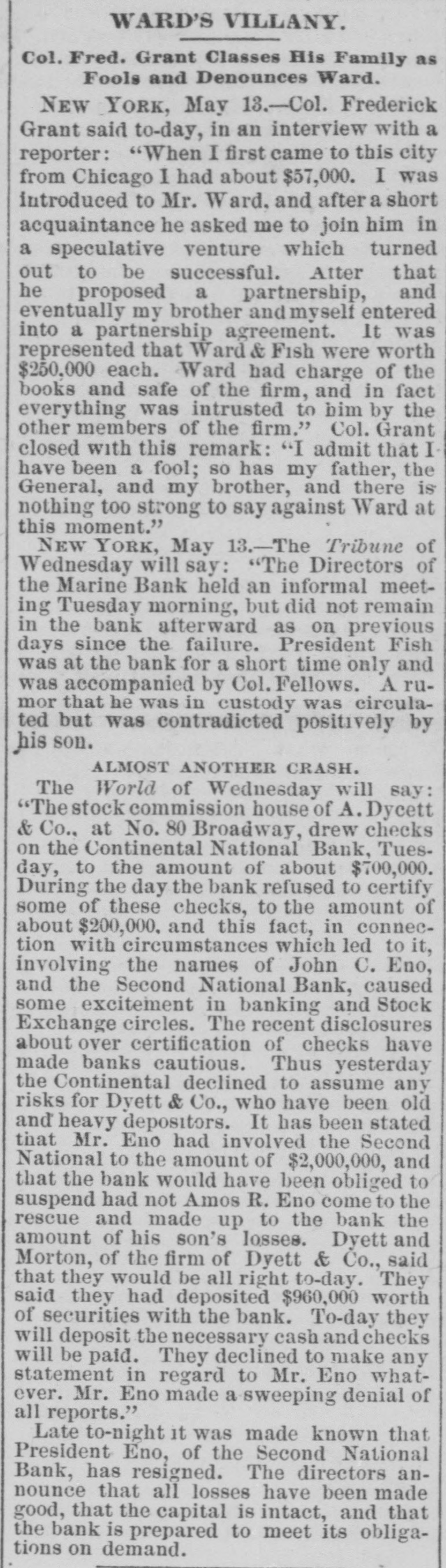
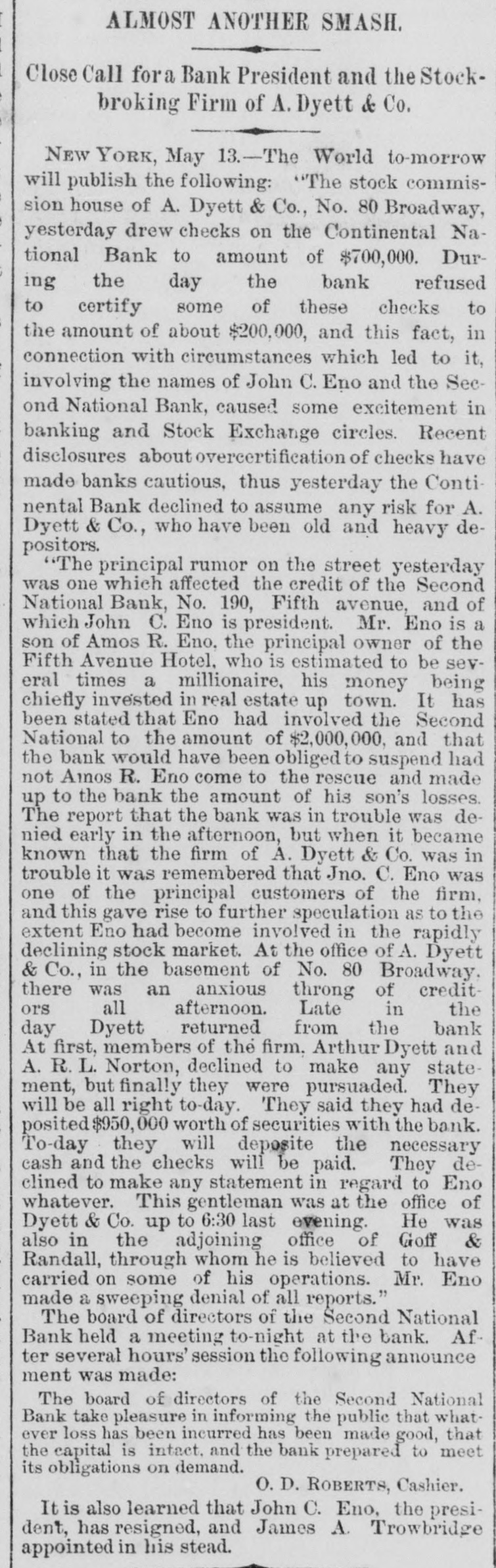
DELAYED TELEGRAMS. DOMESTIC NEWS. THE SECOND NATIONAL BANK. NEW YORK, May 13.-The stock commissioner of the house of A. Dyett & Co., 80 Broadway, yesterday drew checks on the Continental National bank to the amount of $700,000. During the day, the bank refused to certify some of these checks to the amount of about $200,000, and this fact, in connection with the circumstances which led to it in volving the names of John C. Eno and the Second National bank, caused some excitement in banking and stock exchange circles. Recent disclosures about the overcertification of checks have made the banks cautious. The principal rumor on the street yesterday was one which affected the credit of the Second National bank, of which John C. Eno is president. Eno is a son of Amos R. Eno, principal owner of the Fifth Avenue hotel, who is estimated to be several times a millionaire. It has been stated that Eno had involved the Second National bank to the amount of $2,000,000, and that the bank would have been obliged to suspend had not Amos R. Eno come to its rescue, and madè up the amount of his son's losses. The report that the bank was in trouble was denied early in the afternoon, but when it became known that the firm of A. Dyett & Co. were in trouble. it was remembered that John C. Eno was one of the principal customers of the firm, and this gave rise to further speculation as to the extent Eno had become involved in the rapidly declining stock market. At the office of A. Dyett & Co. there was an anxious throng of creditors all the evening. Late in the day Dyett returned from the bank and declined to makes statement, but finally was persuaded to say they would be all right to-day. It is said they had deposited $950,000 worth of securities with the bank. To-day they will deposit the necessary cash and checks will be paid. They made a sweeping denial of all reports of defalcation or heavy losses. The board of directors of the Second 8 National bank helda meeting to night. After several hours session the followe ing announcement was made: "The di0 rectors of the Second National bank d take pleasure in informing the public that whatever loss has been incurred has


Article from Fort Worth Daily Gazette, May 15, 1884

Click image to open full size in new tab

Article Text

SCRIBA'S ACCOUNT. WASHINGTON, May 14.-The comptroller of the currency early this morning telegraphed to Bank Examiner Scriba, in New York, to go to the Second National bank and investigate the rumors of trouble and received in reply the following telegram from Seriba: "A run on the Second National bank: have secured guarantees for all deficiencies and money will be supplied the bank until the run ceases. Capital is intact with small surplus. Particulars by mail.


Article from The Aegis & Intelligencer, May 16, 1884

Click image to open full size in new tab

Article Text

Financial Panic in New York. A great financial panic has occurred in New York which will be felt all over the country. Last week the Marine Bank and the house of Grant & Ward, of New York, failed, and on Wednesday the Metropolitan Bank and the Second National Bank, of the same city, suspended payment. This announcement was followed by the failure of several brokers, whose business has been of an extensive character. A few weeks ago the protectionists predicted the state of affairs that now exists if the Morrison tariff bill were passed. The bill was defeated by the Republicans, aided by a few recreant Democrats. The panic has come, notwithstar ding, and it may justly be attributable to the reckless extravagance and utter disregard of sound business principles which mark the Republican administration at Washington and which have given the keynote to speculation in Wall street. The defeat of the Morrison bill, which was intended to lighten taxation and would have given an impetus to business, was regarded by prudent capitalists as an evil omen, and when they called for cash the whole speculative system, based upon credit, received a shock. It would be little regretted if the bulls and bears of Wall street alone suffered. Unfortunately the panic must inevitably affect the entire commercial and manufacturing business of the country.


Article from New-York Tribune, May 16, 1884

Click image to open full size in new tab

Article Text

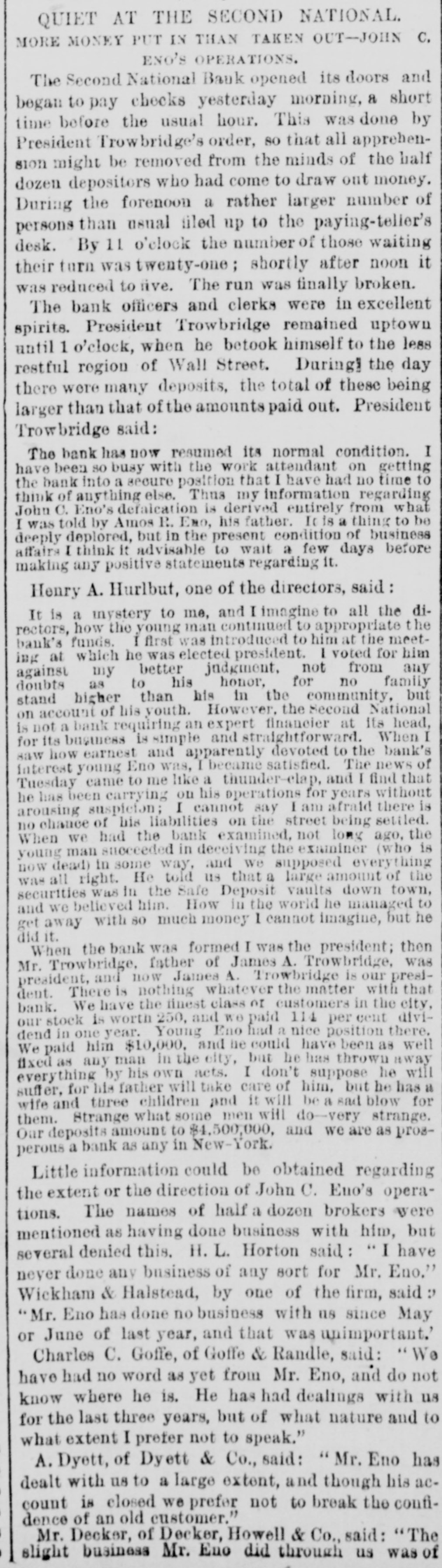
QUIET AT THE SECOND NATIONAL. MORE MONEY PUT IN THAN TAKEN OUT-JOHN C. ENO'S OPERATIONS. The Second National Bank opened its doors and began to pay checks yesterday morning, a short time before the usual hour. This was done by President Trowbridge's order, SO that all apprehension might be removed from the minds of the half dozen depositors who had come to draw out money. During the forenoon a rather larger number of persons than usual filed up to the paying-telier's desk. By 11 o'clock the number of those waiting their turn was twenty-one; shortly after noon it was reduced to five. The run was finally broken. The bank officers and clerks were in excellent spirits. President Trowbridge remained uptown until 1 o'clock, when he betook himself to the less restful region of Wall Street. During! the day there were many deposits, the total of these being larger than that of the amounts paid out. President Trowbridge said: The bank has now resumed its normal condition. I have been so busy with the work attendant on getting the bank into a secure position that I have had no time to think of anything else. Thus my information regarding John C. Eno's defalcation is derived entirely from what I was told by Amos R. Emo, his father. It is a thing to be deeply deplored, but in the present condition of business affairs I think It advisable to wait a few days before making any positive statements regarding it. Henry A. Hurlbut, one of the directors, said It is a mystery to me, and I imagine to all the directors, how the young man continued to appropriate the bank's funds. I first was introduced to him at the meeting at which he was elected president. I voted for him against my better judgment, not from any doubts as to his honor, for no family stand higher than his in the community, but on account of his youth. However, the Second National is not a bank requiring an expert financier at its head, for its business is simple and straightforward. When I saw how earnest and apparently devoted to the bank's interest young Eno was, [became satisfied. The news of Tuesday came to me like a thunder-clap, and I find that he has been carrying on his operations for years without arousing suspicion; I cannot say I am afraid there is no chance of his liabilities on the street being settled. When we had the bank examined, not long ago, the young man succeeded in deceiving the examiner (who is now dead) in some way, and we supposed everything was all right. He told us that a large amount of the securities was in the Safe Deposit vaults down town, and we believed him. How in the world he managed to get away with so much money I cannot imagine, but he did it. When the bank was formed I was the president; then Mr. Trowbridge, father of James A. Trowbridge, was president, and now James A. Trowbridge is our president. There is nothing whatever the matter with that bank. We have the finest class OI customers in the city, our stock is worth 250, and we paid 114 per cent dividend in one year. Young Eno had a nice position there. We paid him $10,000, and he could have been as well fixed as any man in the city, but he has thrown away everything by his own acts. I don't suppose he will suffer, for his father will take care of him, but he has a wife and three children and it will be a sad blow for them. Strange what some men will do-very strange. Our deposits amount to $4,500,000, and we are as prosperous a bank as any in New-York. Little information could be obtained regarding the extent or the direction of John C. Eno's operations. The names of half a dozen brokers were mentioned as having done business with him, but several denied this. H. L. Horton said: I have never done any business of any sort for Mr. Eno." Wickham & Halstead, by one of the firm, said D "Mr. Eno has done no business with us since May or June of last year, and that was unimportant.' Charles C. Goffe, of Goffe & Randle, said: We have had no word as yet from Mr. Eno, and do not know where he is. He has had dealings with us for the last three years, but of what nature and to what extent I prefer not to speak." A. Dyett, of Dyett & Co., said: Mr. Eno has dealt with us to a large extent, and though his account is closed we prefer not to break the confidence of an old customer." Mr. Decker, of Decker, Howell & Co., said: "The slight business Mr. Eno did through us was of


Article from Savannah Morning News, May 17, 1884

Click image to open full size in new tab

Article Text

The Comptroller of the Currency to-day received a telegram from Bank Examiner Scriba, at New York, saying that the Second National Bank paid out $2,412,000 during the run on the 14th and 15th insts., and is considered to be in good condition. The examiner also reports everything going on smoothly at the Metropolitan National Bank, and says that he considers the trouble over so far as the associated banks are concerned.


Article from The Democratic Leader, May 17, 1884

Click image to open full size in new tab

Article Text

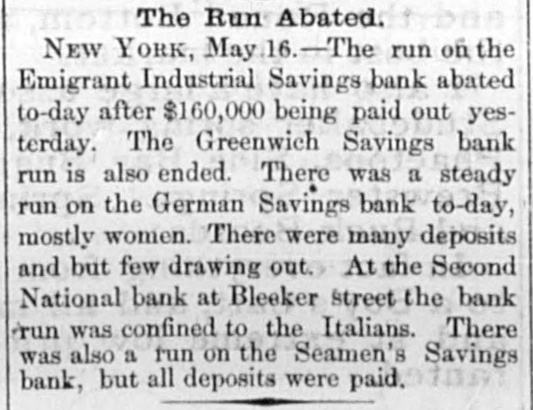
The Run Abated. NEW YORK, May 16.-The run on the Emigrant Industrial Savings bank abated to-day after $160,000 being paid out yesterday. The Greenwich Savings bank run is also ended. There was a steady run on the German Savings bank to-day, mostly women. There were many deposits and but few drawing out. At the Second National bank at Bleeker street the bank run was confined to the Italians. There was also a run on the Seamen's Savings bank, but all deposits were paid.


Article from The Semi-Weekly Miner, May 17, 1884

Click image to open full size in new tab

Article Text

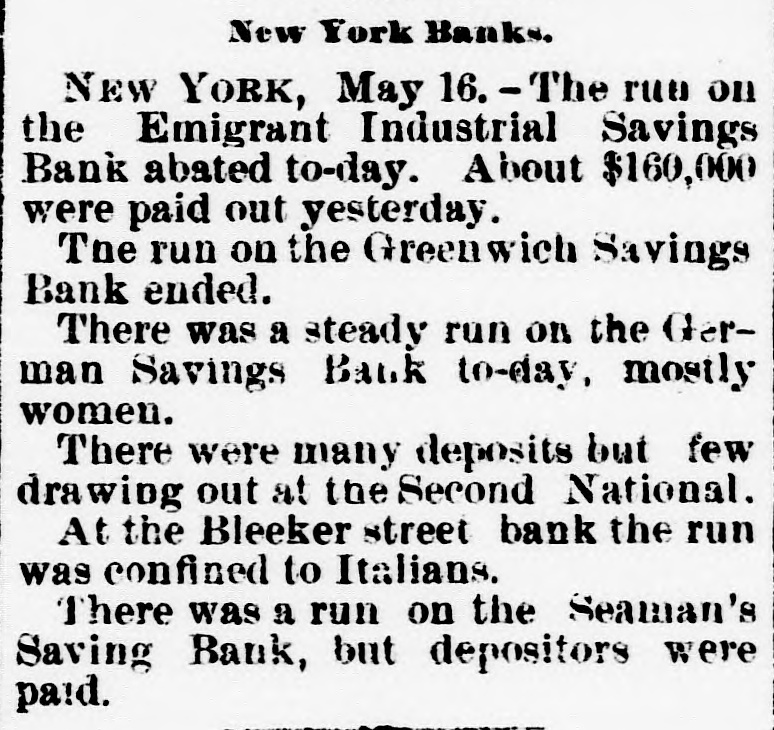
New York Banks. NEW YORK, May 16. - The run on the Emigrant Industrial Savings Bank abated to-day. About $160,000 were paid out yesterday. The run on the Greenwich Savings Bank ended. There was a steady run on the German Savings Bank to-day, mostly women. There were many deposits but few drawing out at the Second National. At the Bleeker street bank the run was confined to Italians. There was a run on the Seaman's Saving Bank, but depositors were paid.


Article from The Sedalia Weekly Bazoo, May 20, 1884

Click image to open full size in new tab

Article Text

upon?" No. sir, nothing of that kind has been or will be done now. We shall not make an assignment unless satisfied we cannot go on or settle our business satisfactorily without it." "What are your liabilities?" "We cannot tell exactly, in the neighborhood of $3,000,000." How much are your assets worth?" "They will be more than that. We shall pav every dollar, I now think." "Is there any truth in the rumor that Sen y unloaded Cleveland, Youngstown and Pittsburg bonds on you?" "Not a word of truth. President Seney has unloaded nothing on us at any time." "What has been the character of your securities? "They have been such as would commend themselves to the conservative judgment. The greatest shrinkage in their value has been in some railroad bonds upon which we made advances." "Cleveland, Youngstown & Pittsburg?" "These and some others." "How much was your deposit in the Metropolitan?" "It was a good deal larger than we could have wished Can you not resume now that the Metropolitan has done so? That is what we are trying to find out ; we shall know to-morrow. It is understood that you have been offered $200,000 to help you out Yes, S. B. Elkins offered that but that would have been a drop in the bucket; we were offered several hundred thousand dollars by cable, but We must see where we stand first. An attache of the firm told the reporter that matters had gone SO far that resumption would be impossible; the $200,000 offered by S. B. Elkins was made in good faith, and may lead to the re-establishment of the concern under a new name. The members of the firm are MISSOURIANS. Robert W. Donnell, the head of the concern, was formerly a merchant of St. Joseph, where he is a large stockholder in in the Savings' bank. He is also a partner in the banking firm of Donnell, Clark & Larabie, of Deer Lodge, Montana, the second member of which is a millionaire. Lawson and Donnell married sisters. The former was a lawyer at Boonville, Mo. He is a member of the Union League and Manhattan Club Simpson lives in Orange, N. J. He formerly resided in Kansas City. THE LOANS OF THE HOUSE were all passed upon by him. The banking house was besieged all day with messengers and clerks copying notices and persons calling to have signatures identitied. Hotehkiss, of the firm of HOTCHKISS, BURNAM & COMPANY say that they would resume. It was only a question of time. They were hard at work straightening out their affairs and had get sufficiently far to prove they could pay overy dollar they owed the office of O. M. Bogart & company remained cleared. Yesterday the assignee began to his examination into the condition of affairs. but late in the afternoon he was not able to give any information settlements of balances at the clearing house between associated banks were accomplished without trouble. The Metropolitan bank received an issue of about $2,000,000 on loan certificates. The Second National bank applied for $6,000,000, the total amount issued to five banks is $5,000,000. Wm. A. Camp, MANVGER OF THE CLEARING HOUSE spoke encouragingly of the situation. With regard to particulars of the failure of Fisk & Hatch he said "I am certain it can in no way affect the banks." The Second National bank opened its doors and began to pay checks yesterday morning. During the day there were many deposits, the total of these being larger than that paid out. The assignee of A. W. Dimmick & C., says their liabilities are large but he expected the firm to resume. Soon after 2 o'clock the feeling was general that the day would pass WITHOUT ANY FURTHER DISASTERS, and when at 2:40 it was announced that Fisk & Aateh were unable to meet their obligations. there was great surprise and much sorrow. No explanation of the failure was given. "The firm bas suspended payment," was the answer given to the avalanche of questions. For more than an hour Nassau street in front of the banking house was almost impassible. Fisk & Hatch handed th following notice to an Associated Press representatives. TO OUR DEPOSITORS. and other creditors. It is with great sorrow we are obliged to announce to you our suspension, which has been brought about by a combination of circumstances, the long continued decline in the market price of securities, even the very best, accompanied by a general weakening of confidence in financial matters, together with a heavy drainage of deposits, are the principal causes of our unfortunate position. We can only request those having claims against us to extend to us such consideration and indulgence as we may need and it may be in their power to grant. FISK & HATCH. [Signed.] WM. LUMMIS, who has become acting president of the Stock Exchange through "the failure of Fisk & Hatch, said the failure will have much less effect in the street than is gen.


Article from The Valley Virginian, May 22, 1884

Click image to open full size in new tab

Article Text

ednesday last. The N.Y. of the Baltimore American ves a graphic review of wha 00 follows He at last. The panic so many times averted took Wall, street this morning, hat have seemed days confu Idest excitement and dreadfu saster reigned supreme. The hange was pandemonium e banks were besieged all depositors, and the streetsT. New, Exchange Place ith wild thousands until ame impossible. Among the Wall street were to be ladies, some of whom n other motives than curiosity of the disasters spread rapidity. Private carriages d servants, from the up-town ent flying through the streets stood outside the doors of arious banking houses. The E, nearly all the banks sion or present in their buildfor any emergency. The doors * Exchange were guarded and the visitors' galeries were No one was admitted to cept members, clerks and This was done because the iv.ored to gain admittance r the capacity of the building de really began before the Stock pened. The rumors of yester d to the defalcation of John lent of the Second National confirmed last night, and were it this morning. Last night the directors of the Second ink took place at the house of 1. Phelps, a stockholder. The e Amos R. Eno, Henry Isaac N. Phelps, Wm. Walter : Darling, of the Fifth Avenue ison Phelps Stokes, and Mr. W To cover the deficit no, father of John C. Eno, and rs each contributed a certain what proportion is not certainIt is thought though, and not denied by the directors, that R. Eno furnished the greater son was president. Mr. Trowelected president, and the bank virtually settled. This ni order to accommodate the as expected, the bank opened ck. mmediately a stream of dred people began to pour in. n being ladies. vere greatly complicated in this y the fact that A. Dyett & Co., of the speculating president of National, had last evening 1 to suspend, the Continental ng to certify their checks. se things became known there rush to the Stock Exchange e outlying offices and before rmal opening, in spite of the anic stricken crowd began is overboard. It was but a few fore the failure was announced Robinson & Co., and but a few ore when Goffe & Randall 1. Almost immΓ©diately they "Β°00 a Bosert W O sq pape he old and highly respected atch & Foote. The condition as fearful. Upon the top of ea thunderclap the announcehe Metropolitan National Bank ts doors. At one time it seemed the Exchange would have to business suspended, but very dois 01 you St alarm would have been intenhis been done. Black Friday the panie of 1873 were already prominent in the memories of ket opened 1 to 6 per cent it closed yesterday, and : prices there was a continuous al decline until 11 o'clock. minutes after H call there reaction of 1 to 2 per cent., eclined again, and on the t of the failure of the Metro ional Bank ran into a panicky or three-quarters of an hour at which time the lowest prices nade, showing a decline of from cent., as compared with 08:21 07 du pur cold & tell recovery of 1/2 to 34 per cent. n with Northwestern, Missou Union Pacific, St. Paul, Lacka e Shore, and Northern Pacific ENES AT THE BANKS. le there were as exciting scene


Article from The Bolivar Bulletin, May 22, 1884

Click image to open full size in new tab

Article Text

What the Bank Examiner Has Learned, WASHINGTON, D. C., May 14. Secretary Folger with a view to relieving the panicky situation at New York, has ordered the payment of bonds included in the 127th call on presentation. Comptroller Cannon received a dispatch from Bank Examiner Scriba informing him of the run on the Second National Bank; also, that he had secured guarantees for all deficiencies, and that money would be supplied to the Bank until the run ceases. The capital of the bank, he says, is intact, with a small surplus, and he is assured it will be able to successfully stem the tide that has set against it


Article from St. Johnsbury Caledonian, May 22, 1884

Click image to open full size in new tab

Article Text

Items of the Financial Crash. The Newark Savings Bank, which failed four years ago and resumed, closed it doors again Friday. The second failure is due to the suspension of Fisk & Hatch, who owed the bank a million dollars. The decline in listed stocks and securities since 1881 is estimated at $1,500,000,000, and everybody looks for the farmer to raise good crops, get ready sales, good prices, and help the country out. The price of Western Union telegraph stock has been as follows: May, 1879, 102Γ·; May, 1884, 49β‚Ί. John C. Eno, president of the Second National bank of New York, who has been speculating heavily in Wall street, admitted Monday that he had ruined that institution. The defalcation, said to be over $4,000,000, has been made up by his father, *Amos R. Eno, and the bank is now continuing its business. The day before the failure of Grant & Ward, the Wall street brokers, Gen. Grant went to Vanderbilt and asked for a loan of $150,000 in order to tide over an apprehended difficulty the next day. He gave his own check on Grant & Ward to pay for the loan, but the check was not paid. Gen. Grant and Mrs. Grant at once made over to Vanderbilt all of their personal property and real estate to idemnify him for the loan, but the latter, very much to his credit, sent back the papers, with expressions of sympathy, saying to Gen. Grant that he need not trouble himself about the matter and could repay the loan whenever he got able. Then he set sail for Europe, probably a happier man than if he had received his $150,000.


Article from South Branch Intelligencer, May 23, 1884

Click image to open full size in new tab

Article Text

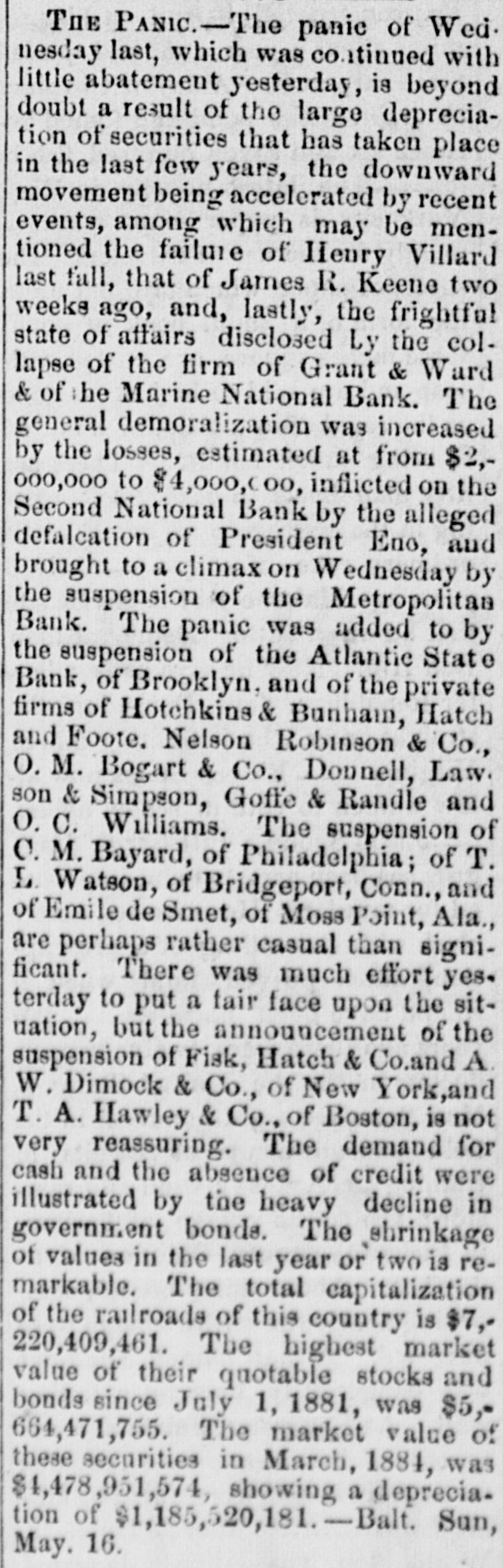
The PANIC.-The panic of Wed. nesday last, which was itinued with little abatement yesterday, is beyond doubt a result of the large depreciation of securities that has taken place in the last few years, the downward movement being accelerated by recent events, among which may be mentioned the failure of Henry Villard last full, that of James R. Keene two weeks ago, and, lastly, the frightful state of affairs disclosed Ly the collapse of the firm of Grant & Ward & of the Marine National Bank. The general demoralization was increased by the losses, estimated at from $2,000,000 to $4,000,000, inflicted on the Second National Bank by the alleged defalcation of President Eno, and brought to a climax on Wednesday by the suspension of the Metropolitan Bank. The panic was added to by the suspension of the Atlantic Stat Bank, of Brooklyn, and of the private firms of Hotchkins & Bunham, Hatch and Foote. Nelson Robinson & Co., O. M. Bogart & Co., Donnell, Law. son & Simpson, Goffe & Randle and O. C. Williams. The suspension of C. M. Bayard, of Philadelphia; of T. L. Watson, of Bridgeport, Conn., and of Emile de Smet, of Moss Point, Ala., are perhaps rather casual than significant. There was much effort yes. terday to put a fair face upon the situation, but the announcement of the suspension of Fisk, Hatch & Co.and A. W. Dimock & Co., of New York,and T. A. Hawley & Co., of Boston, is not very reassuring. The demand for cash and the absence of credit were illustrated by the heavy decline in government bonds. The shrinkage of values in the last year or two is remarkable. The total capitalization of the railroads of this country is $7,220,409,461. The highest market value of their quotable stocks and bonds since July 1, 1881, was $5,664,471,755. The market value of these securities in March, 1884, was $4,478,951,574, showing a depreciation of $1,185,520,181.-Balt. Sun, May. 16.


Article from The Daily Dispatch, May 23, 1884

Click image to open full size in new tab

Article Text

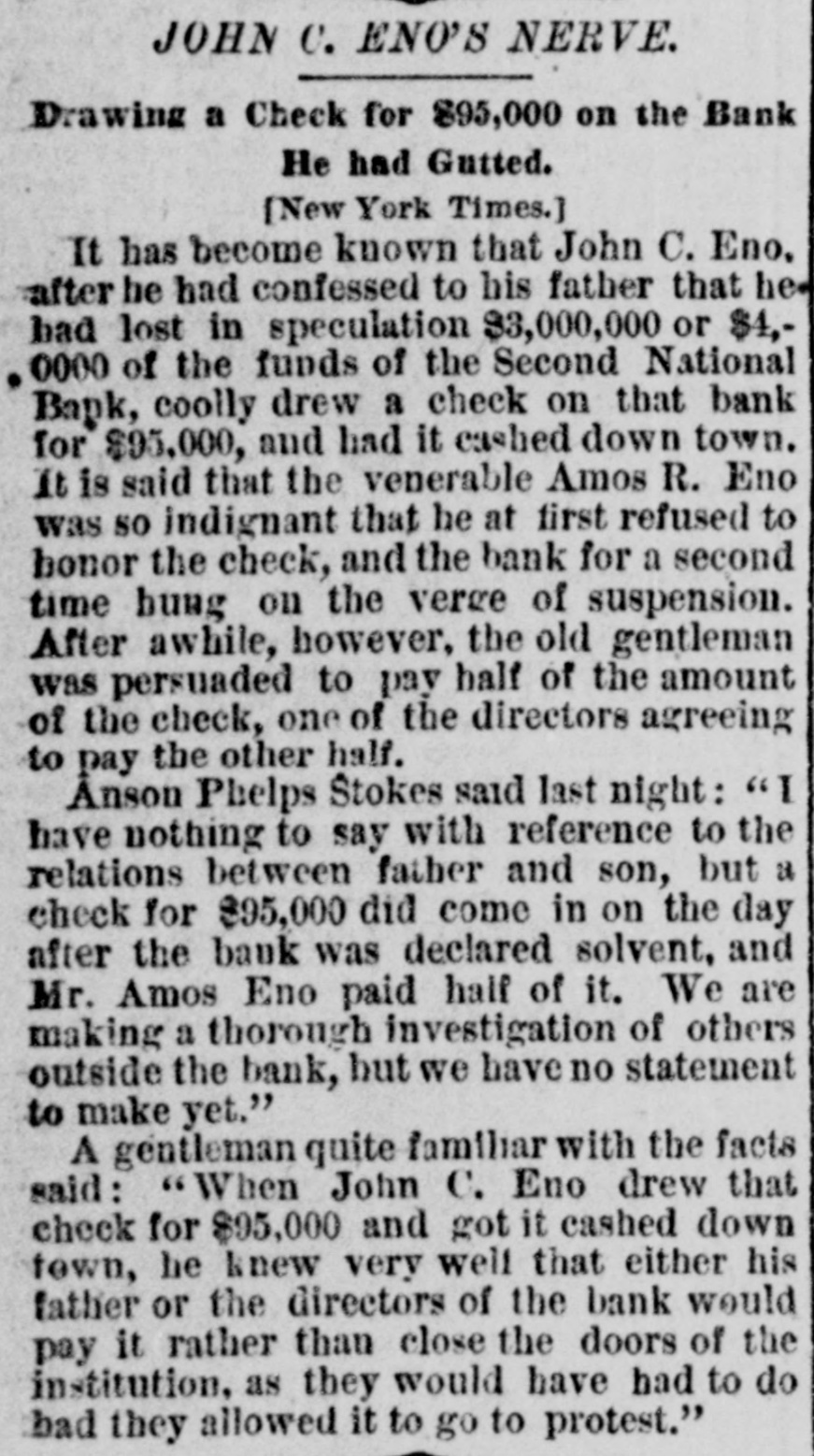
JOHN C. ENO'S NERVE. Drawing a Check for $95,000 on the Bank He had Gutted. [New York Times.] It has become known that John C. Eno. after he had confessed to his father that hehad lost in speculation $3,000,000 or $4,0000 of the funds of the Second National Bank, coolly drew a check on that bank for $95,000, and had it cashed down town. It is said that the venerable Amos R. Eno was so indignant that he at first refused to honor the check, and the bank for a second time bung on the verge of suspension. After awhile, however, the old gentleman was persuaded to pay half of the amount of the check, one of the directors agreeing to pay the other half. Anson Phelps Stokes said last night: have nothing to say with reference to the relations between father and son, but a check for $95,000 did come in on the day after the bank was declared solvent, and Mr. Amos Eno paid half of it. We are making a thorough investigation of others outside the bank, but we have no statement to make yet." A gentleman quite familiar with the facts said: "When John C. Eno drew that check for $95,000 and got it cashed down town, he knew very well that either his father or the directors of the bank would pay it rather than close the doors of the institution, as they would have had to do bad they allowed it to go to protest."


Article from The Weekly Elko Independent, May 25, 1884

Click image to open full size in new tab

Article Text

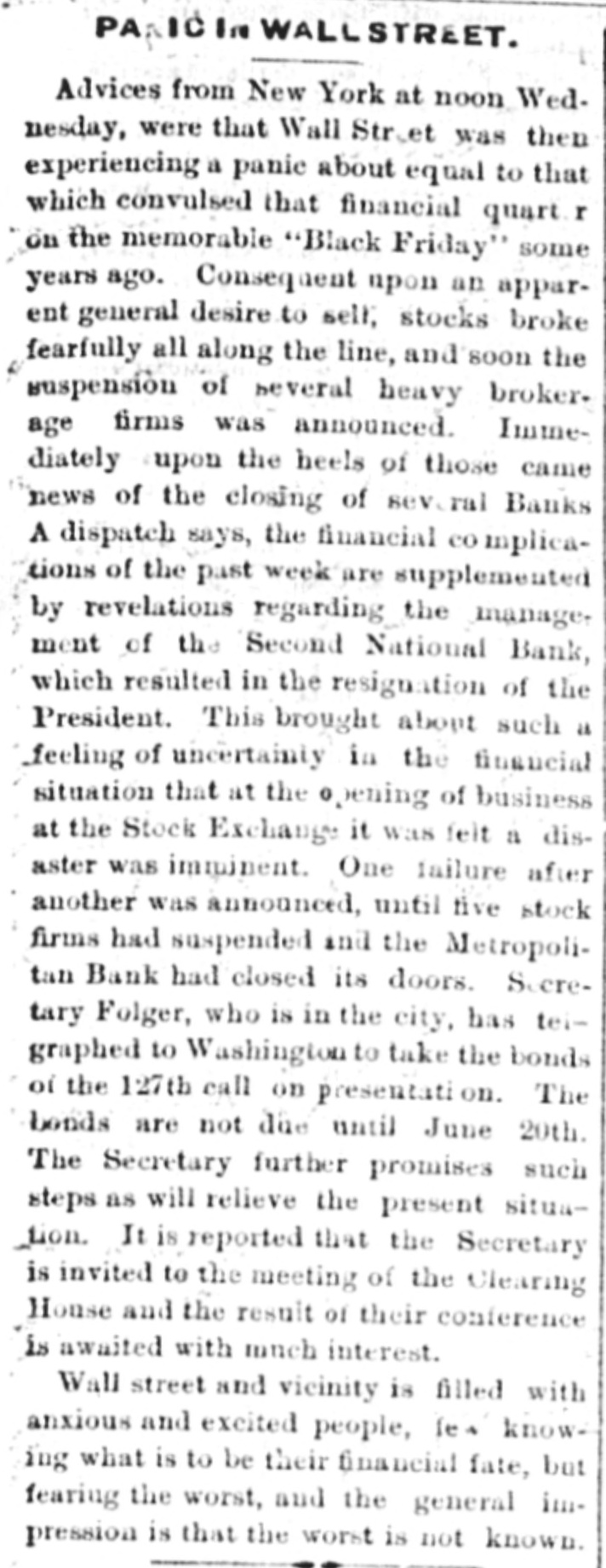
In WALLSTREET. Advices from New York at noon Wednesday, were that Wall Street was then experiencing a panic about equal to that which convulsed that financial quart r on the memorable "Black Friday" some years ago. Consequent upon an apparent general desire to self, stocks broke fearfully all along the line, and soon the suspension of several heavy broker. age firms was announced Immediately upon the heels of those came news of the closing of sev ral Banks A dispatch says, the financial co implications of the past week are supplemented by revelations regarding the manage ment of the Second National Bank, which resulted in the resignation of the President. This brought about such a .feeling of uncertainly in the financial situation that at the o, pening of business at the Stock Exchange it was felt a disaster was imminent One failure after another was announced, until five stock firms had suspended and the Metropolitan Bank had closed its doors. Steretary Folger, who is in the city, has teigraphed to Washington to take the bonds of the 127th call on presentation. The bonds are not due until June 20th. The Secretary further promises such steps as will relieve the present situaLion. It is reported that the Secretary is invited to the meeting of the Clearing House and the result of their conference is awaited with much interest. Wall street and vicinity is filled with anxious and excited people, le . knowing what is to be their financial fate, but fearing the worst, and the general in pression is that the worst is not known.


Article from The Portland Daily Press, June 2, 1884

Click image to open full size in new tab

Article Text

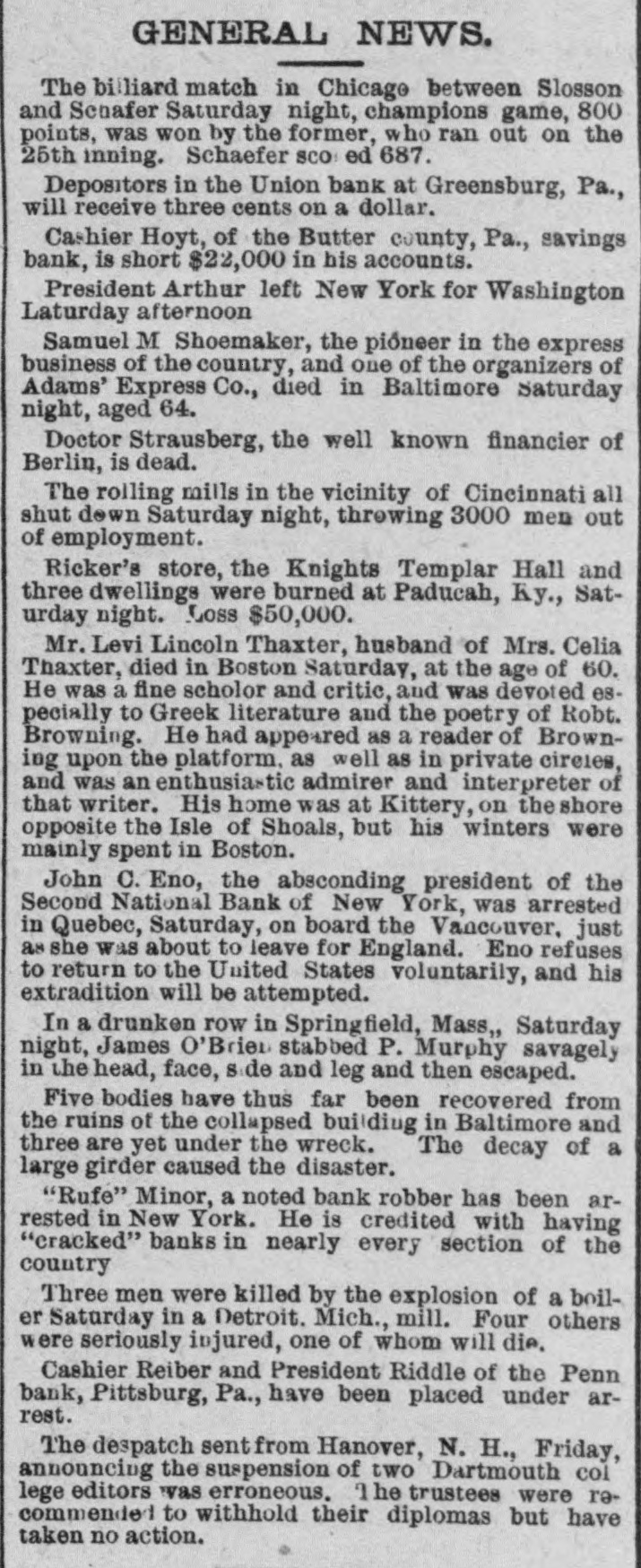
GENERAL NEWS. The billiard match in Chicago between Slosson and Senafer Saturday night, champions game, 800 points, was won by the former, who ran out on the 25th inning. Schaefer SCO ed 687. Depositors in the Union bank at Greensburg, Pa., will receive three cents on a dollar. Cashier Hoyt, of the Butter county, Pa., savings bank, is short $22,000 in his accounts. President Arthur left New York for Washington Laturday afternoon Samuel M Shoemaker, the pioneer in the express business of the country, and one of the organizers of Adams' Express Co., died in Baltimore Saturday night, aged 64. Doctor Strausberg, the well known financier of Berlin, is dead. The rolling mills in the vicinity of Cincinnati all shut down Saturday night, throwing 3000 men out of employment. Ricker's store, the Knights Templar Hall and three dwellings were burned at Paducah, Ky., Saturday night. Loss $50,000. Mr. Levi Lincoln Thaxter, husband of Mrs. Celia Thaxter, died in Boston Saturday, at the age of 60. He was a fine scholor and critic, and was devoted especially to Greek literature and the poetry of Robt. Browning. He had appeared as a reader of Browning upon the platform, as well as in private circies, and was an enthusiastic admirer and interpreter of that writer. His home was at Kittery, on the shore opposite the Isle of Shoals, but his winters were mainly spent in Boston. John C. Eno, the absconding president of the Second National Bank of New York, was arrested in Quebec, Saturday, on board the Vancouver, just as she was about to leave for England. Eno refuses to return to the United States voluntarily, and his extradition will be attempted. In a drunken row in Springfield, Mass, Saturday night, James O'Brien stabbed P. Murphy savagely in the head, face, 8 de and leg and then escaped. Five bodies have thus far been recovered from the ruins of the collapsed buildiug in Baltimore and three are yet under the wreck. The decay of a large girder caused the disaster. "Rufe" Minor, a noted bank robber has been arrested in New York. He is credited with having "cracked" banks in nearly every section of the country Three men were killed by the explosion of a boiler Saturday in a Detroit. Mich., mill. Four others were seriously injured, one of whom will die. Cashier Reiber and President Riddle of the Penn bank, Pittsburg, Pa., have been placed under arrest. The despatch sentfrom Hanover, N. H., Friday, announcing the suspension of two Dartmouth col lege editors was erroneous. 1 he trustees were recommended to withhold their diplomas but have taken no action.


Article from Savannah Morning News, June 5, 1884

Click image to open full size in new tab

Article Text

The Penn Bank Case. Mr. Riddle, the President of the broken Penn Bank, of Pittsburg, pleads in extenuation of his wrong-doing that the directors were equally guilty with him in wrecking the bank. The tenor of his story is that his speculations in oil, with the bank's funds, were for the purpose of making up losses which the bank had sustained, and were undertaken with the knowledge and approval of the directors. If what he says about the conduct of the directors in carrying off the funds and securities of the bank after the suspension is true, there is certainly work for the grand jury to do in Pittsburg. It is remarkable that so little has been done towards enforeing the laws against those who were shown by the late panic to be guilty of misconduct in connection with the trusts reposed in them. There would have been no panic, perhaps, if there had not been so much rascality among those holding high places in the financial world. The troubles of all the banks which suspended temporarily or permanently were brought about by wrongful acts of the Presidents or other officials. Those who have taken the trouble to read the statements of the troubles of the Marine, Metropolitan, Second National and West Side Banks, of New York, the Atlantic Bank, of Brooklyn, Newark of Newark, Bank, Savings Penn Bank, of Pittsburg, Middleton's Bank in Washington, and others, will recognize the truth of this statement. The banker who uses the funds of depositors in hazardous speculations is deserving of no more consideration than the one who puts the bank's cash in his pocket or valise and runs away with it. There are a few officials who seek to cover their wrong doing by depositing unmarketable securities as collateral for cash. When the institutions which they have robbed are wrecked they claim that the disaster was caused by the depreciation of securities. It is not probable that any one of those whose rascality aided in bringing about the recent panic will be punished. The indignation of the sufferers appears to have expended itself, and the authorities show no disposition to see that the laws are vindicated. They are too busy looking after the petty thieves and those who steal to keep from starving to look after those who unceremoniously pocket thousands and millions of dollars of other people's property.