Western Exchange Fire & Marine Insurance Company Bank (Chicago, IL)

Episode Information

Episode UID
6268263190778
Episode Type
Suspension โ†’ Run โ†’ Reopening
Bank Type
private
Bank ID
626826319 hash
Start Date
October 1, 1864
Location
Chicago, Illinois (41.850, -87.650)

Metadata

Model
gpt-5-mini (chosen from majority vote of a three-model LLM ensemble)
Short Digest
41c16189d2be6c54

Response Measures

None

Description

Articles use variant names (Western Marine and Fire Insurance Co. / Western Marine Bank); treated as same institution.

Events (4)

1. October 1, 1864 Other
Newspaper Excerpt
A mob threatened the Western Marine Bank, and Fred. Tuttle, a director, narrowly escaped being hung, being rescued by the military, which was called out.
Source
newspapers
2. October 1, 1864 Suspension
Cause
Bank Specific Adverse Info
Cause Details
Bank unable to meet liabilities after speculative losses and New York account discrepancies; refused payment of large checks and was reported failed or closed.
Newspaper Excerpt
the Western Marine and Fire Insurance Company Bank ... were compelled to refuse the payment of large checks till Monday.
Source
newspapers
3. October 2, 1864 Run
Cause
Bank Specific Adverse Info
Cause Details
Public withdrawals and mob action followed the bank's suspension/failure and perceived misappropriation of the Twelfth Ward draft and other discrepancies
Measures
Directors lodged securities and promised payment on Monday; later negotiated to accept stock/certificates in compromise.
Newspaper Excerpt
on Saturday a general run took place on most of the other banking institutions ... but in the afternoon confidence seemed to be in a measure restored
Source
newspapers
4. October 26, 1864 Reopening
Newspaper Excerpt
the depositors of the late Western Marine and Fire Insurance Company Bank have conditionally accepted the proposition ... the bank to continue its existence under a new regime
Source
newspapers

Newspaper Articles (11)

Article from The Evening Telegraph, October 3, 1864

Click image to open full size in new tab

Article Text

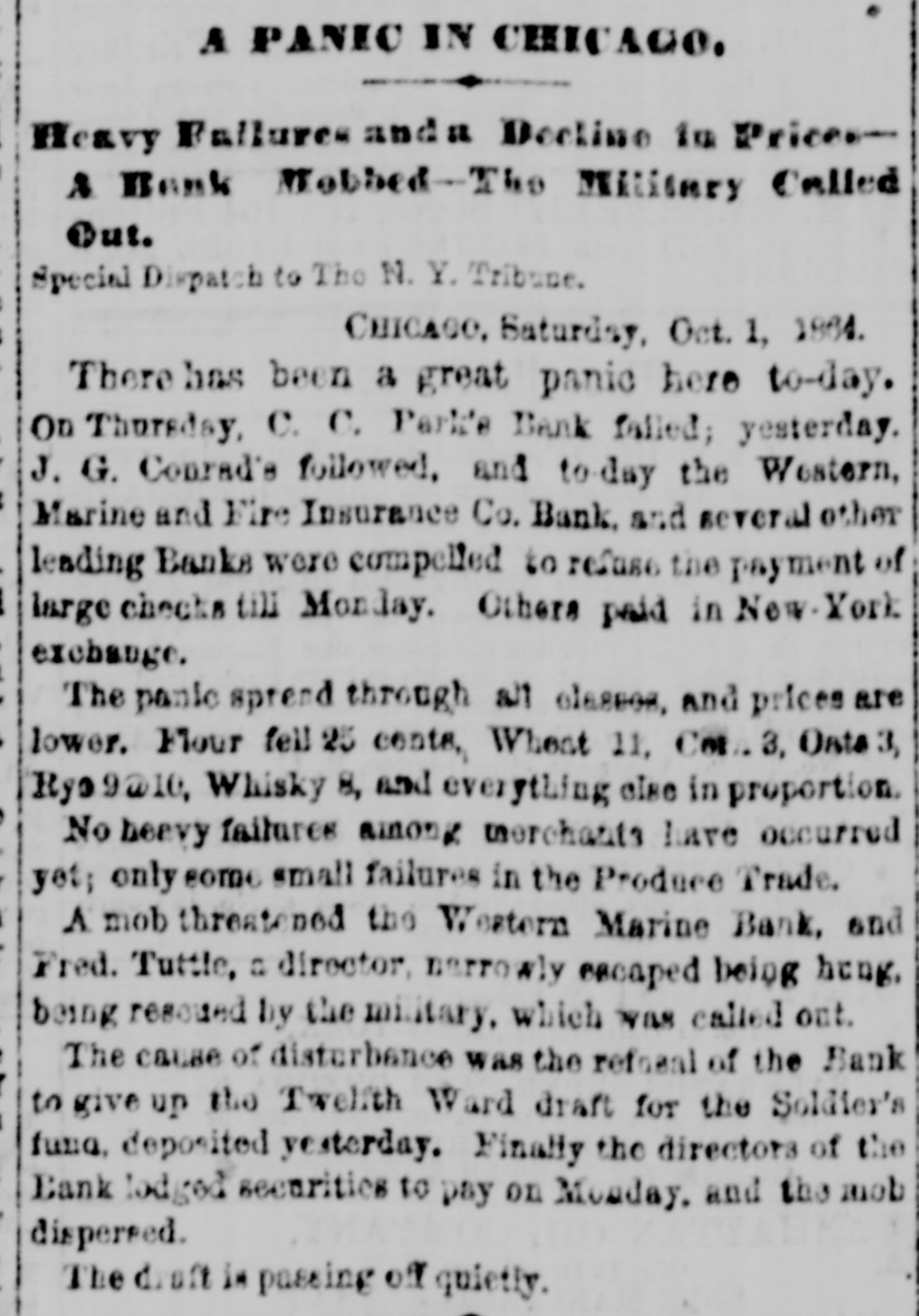
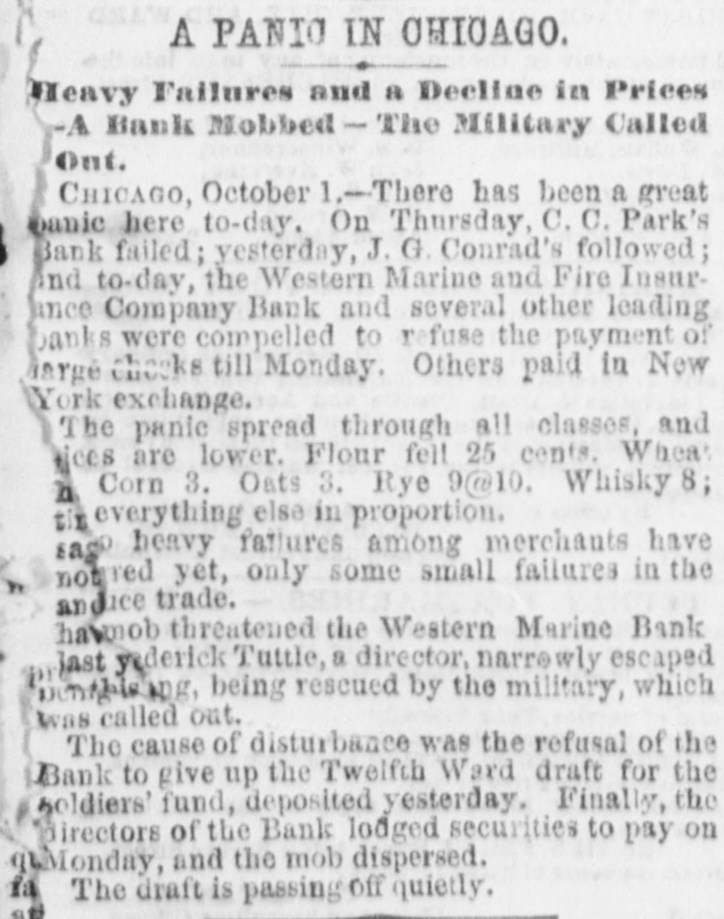
A PANIO IN CHICAGO. Heavy Failures and a Decline in Prices -A Bank Mobbed - The Military Called Out. CHICAGO, October 1.-There has been a great banic here to-day. On Thursday, C. C. Park's Bank failed; yesterday, J. G. Conrad's followed; and to-day, the Western Marine and Fire Insurance Company Bank and several other leading banks were compelled to refuse the payment of large checks till Monday. Others paid in New York exchange. The panic spread through all classes, and rices are lower. Flour fell 25 cents. Wheat ร  Corn 3. Oats 3. Rye 9@10. Whisky 8; tin everything else in proportion. sago heavy fathures among merchants have not red yet, only some small failures in the andice trade. havmob threatened the Western Marine Bank last vederick Tuttle, a director, narrowly escaped punighis NR, being rescued by the military, which was called out. The cause of disturbance was the refusal of the Bank to give up the Twelfth Ward draft for the soldiers' fund, deposited yesterday. Finally, the directors of the Bank lodged securities to pay on quMonday, and the mob dispersed. 18 The draft is passing off quietly.


Article from The Sun, October 3, 1864

Click image to open full size in new tab

Article Text

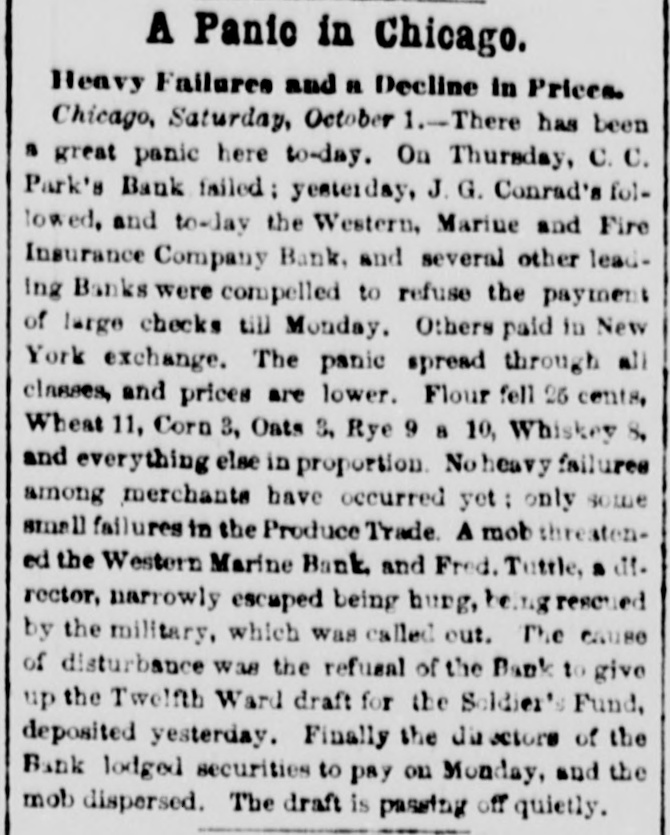
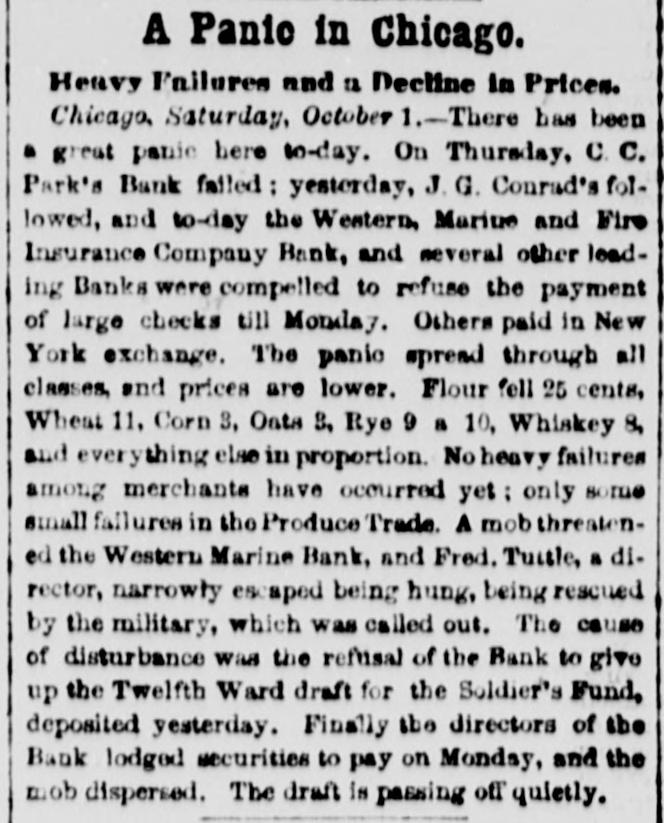
A Panic in Chicago. Heavy Failures and a Decline in Prices. Chicago, Saturday, October 1.-There has been great panic here to-day. On Thursday, C. . C. Park's Bank failed: yesterday, J. G. Courad's followed, and to-day the Western. Mariue and Fire Insurance Company Bank, and several other leading Banks were compelled to refuse the payment of large checks till Monday. Others paid in New York exchange. The panic spread through all classes, and prices are lower. Flour fell 25 cents, Wheat 11. Corn 3, Oats 3, Rye 9 a 10, Whiskey 8, and everything else in proportion. No heavy failures among merchants have occurred yet : only some small failures in the Produce Trade. A mob threatened the Western Marine Bank, and Fred. Tuttle, a director, narrowly escaped being hung, being received by the military, which was called out. The cause of disturbance was the refusal of the Bank to give up the Twelfth Ward draft for the Soldier's Fund, deposited yesterday. Finally the directors of the Bank lodged securities to pay on Monday, and the mob dispersed. The draft is passing off quietly.


Article from The New York Herald, October 3, 1864

Click image to open full size in new tab

Article Text

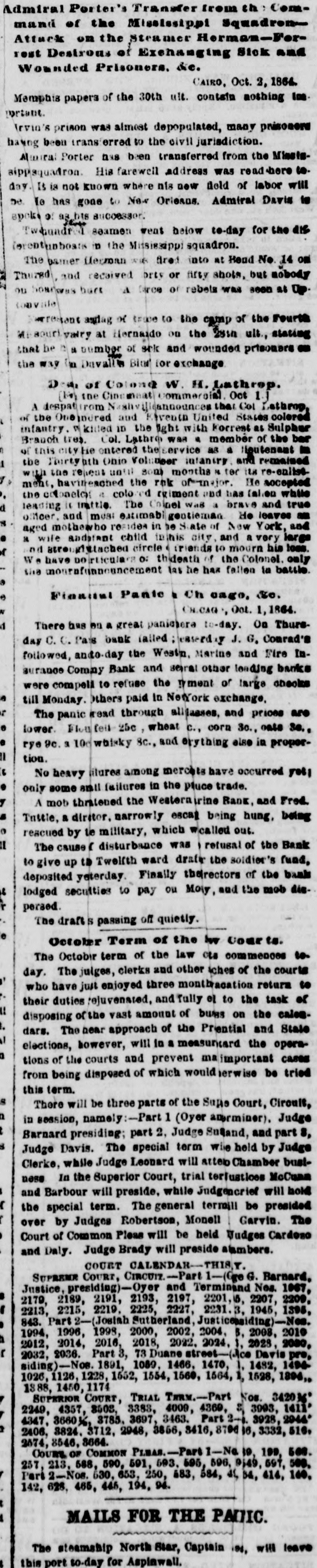
Admiral Porter's Transfer from th : Command of the Mississippi SquadronAttack on the Steamer Herman-Ferrest Desirous of Exchanging Sick and Wounded Prisoners. &c. CAIRO,Oct. 2, 1864. Memphis papers of the 30th ult. contain nothing In portant. Arvin's prison was almost depopulated, many prisoners having been transferred to the civil jurisdiction. Alunra Porter nas been transferred from the Minetaaippsquadron. His farewell address was read-bere w day It is not known where nis new field of labor will be to has gone to New Orienus. Admiral Davis to spoke of his successor. Her !whoundr seamon went below to-day for the dis D the Mississippi squadron. The barner Leeman AR fire into at Head No 14 on 2 Thured and received Drty or firty shots, but nobody ou Sources bur A Oirce or rebels was seen at up conville error aglag of trace to the camp of the Fourte ME souri-valry at Hornaido on the 2510 ult., stating that be c is number of sek and wounded prisonare the way in Davally Bital for exchange Dear of Colone W. H. Lathrop. (1) the Cinameat commercial Oct 1.1 A despatirom avilidannouncer that Col Lethrop, of the Opeinered and Iventa United States colored infantry. actided ID the fight with Forrest Sulpher Branch trus. Col. Lathro was a member of the bar a of this city He entered the service as a |gutenant in the Thirty ith Onio Voluneer infantry and remained 1 with the remeat until som months for its re-enlisty ment, havineached the rok of He accepted the cobaelo a colored rgiment and has (alien while P. leading it trattle. The Coinel was a brave and true d officer. and must estimate gentieman He leaves N aged mothewho resides in be State of New York, and e is wife audstant child ininis city, and a very large nd strengthtached circle friends to mourn his loss. of W. have porticulars o: thideath of the Colonel. only the anournfuinncuncement las he has fallen in battle. a Financial Pante . Ch cago. (so. e N CHLCAGE Oct. 1, 1864. 1 There has on a great panichera to-day. On Thurs. day C.C. Pass bank failed easy J. G. Courad's followed, ando-day the Westn, Marine and Fire Inaurance Commy Bank and seral other leading banks were compell to refuse the !ment or large checks a till Monday Others paid In NetYork exchange. r The panic read through alliances, and prices are e lower Flou fell 25c, wheat c., corn 30., oats so., e rye 9c. a 10 whisky 8c., and arything also in properII tion. & No heavy litures among mercets have occurred yet, e only some smill failures in the Pluce trade. A mob thratened the Westernirine Rank, and Fred. y a Tattle, a diretor. narrowly escat being hung. being o recued by to military, which wcalled out. II The cause disturbance was retugal of the Bank to give up to Twelfth ward drair the soldier's fund, deposited yeterday Finally thelrectors of the bank & lodged secuties to pay ou Moly and the mob die. r persed. The draft passing off quietly. e October Term of the he Courts. The Octobir term of the law cts commences to. day. The julges, clerks and other (ches of the courts 1 who have just enjoyed three monthacation return to their duties rejuvenated, and Tully el to the task of II disposing of the vast amount of bures on the calon. 1. dars. The near approach of the Prential and State I elections, however, will in a measuricard the operab tions of the courts and prevent maimportant cases from being disposed of which would herwise be tried this term. S There will be three parts of the Suns Court, Circuit, h in session, namely:- 1 (Oyer anominer). Judge t Barnard presiding; part Judge Suland, and part s, 3 Judge Davis. The special term wie held by Judge Clerke, while Judge Leonard will attelo Chamber bustness In the Superior Court, trial terjustices McCuna : and Barbour will preside. while Judgencrief will hold ( the special term. The general termill be presided The over by Judges Robertson, Monell Garvin. Court of Common Pleas will be held Wudges Cardono and Daly. Judge Brady will preside alambers. COURT CALENDAR-THI8Y SUPREME Barnard. Justice, presiding)-Oyer and Terminand Nos. 1067, 2179, 2189, 2191, 2193, 2197, 2201,15, 2207, 2209. s 2213, 2215, 2219. 2225, 2227, 2231.3. 1945, 1395, 843. Part 2- (Jostah Sutherland, Justicebalding)-No. 1994, 1996, 1998, 2000, 2002, 2004, 5, 2008, 2010 2012, 2014, 2016, 2018, 2022. 2024, 1, 2023, 2020, r 2032, 2036. Part 73 Duane street (Ace Davis pro, siding)-Nos. 1891, 1089, 1466, 1470, 1. 1482, 1496 1026,1126, 1228, 1652, 1554, 1560, 1564, 1, 1528, 1894,. 1888, 1450, 1174 SUPERIOR COURT, TRIAL TERV.-Part Nos. 342036 2249, 4357, 8508, 3383, 4009, 4369, S 3993, 1411" 4347, 3660 3785. 3697, 3463. Part 2-6. 2944ยฐ 2406, 3824. 3712, 2948, 3856, 3416, 8796 16, 516, 2574,8546, 8664. COURS OF COMMON PIMAS.-Part1-No 19, 199, 508. 257, 213, 588, 590, 591, 693. 695, 596, 9,49, 597, 500. Part 2-Nos. 630, 653, 250, 683, 584, 41, 54, 414, 160. 142, 628, 465, 446, 194, 94. t 1 MAILS FOR THE PAINC. The steamship North Star, Captain iss, will leave I this port to-day for Aspiawall.
Article from New-York Daily Tribune, October 3, 1864

Click image to open full size in new tab

Article Text

A PANIC IN CHICAGO. Heavy Failures anda Decline in PriceA Bank Mobbed-Tho Military Celled Out. Special Dispatch to The N. Y. Tribune. Chicago, Saturday, Oct. 1, 1864. There has been a great panic here to-day. On Thursday, C. C. Park's Bank failed; yesterday. J. G. Conrad's followed, and to-day the Western, Marine and Fire Insurance Co. Bank, and several other leading Banks were compelled to refuse the payment of large checks till Monday. Others paid in New-York exchange. The panic sprend through all classes, and prices are lower. Flour fell 25 cents, Whent 11, Cor. 3, Oate 3, Ryo 9@10, Whisky 8, and everything clse in proportion. No heavy failures among merchants have occurred yet; only some small failures in the Produce Trade. A mob threatened the Western Marine Bank, and Fred. Tuttle, a director, narrowly escaped being hung, being resoued by the military, which was called out. The cause of disturbance was the refusal of the Bank to give up the Twelfth Ward draft for the Soldier's funa, deposited yesterday. Finally the directors of the Bank lodged securities to pay on Monday. and the mob dispersed. The draft in passing off quietly.


Article from Daily Davenport Democrat, October 4, 1864

Click image to open full size in new tab

Article Text

The Recent Bank Failures in Chicago. Closing of the Western Marine and Fire Insurance Bank on Naturday. Saturday morning it Was generally made known that the Western Marin and Fire Insurance Company bank had failed, and was umable me its habilities. This, at though unexpected. was hus following the example that had been set by other banks on the preceding ays. The Dublic are aware that within the last hundred hours a number of banking institutions have been closed in which the strongest confidence has hitherto been felt. This smisfortune, or rather this series of misfortunes, cannot be hailed as the precursor of a general panic It is fairly known to men actively employed in important branches of business, that the present bank failures are the result of disastrous speculations and were irvetrievable. Wheat seems to have done the mischief directly, although gold, as is always the case, was the root of the evil. Theffuctuations in the gold market within the last ten days have exercised a terrible influence upon the grain market, in which a majority of our leading bankers have been largely interested. The banks which have failed within the last three days are those of C. C. Parks & Co., J. G. Conrad and the Western Marine and Fire Insurance Bank. The suspe asion, of the two first named created but little excitement, and was received as any other similar circumstance has been received heretofore with signs of nuch dissatisfaction and danger of course, but as "a thing that couldn't be helped," and therefore unworthy a waste of argument. But the Intter was more unfortunate. In the failure of the Western Marine and Fire Insurance Company the public, or a large portion thereof at least, saw what they readily construed into deliberate robbery. H. W far this surmise was correct it must remain for our readers to decide, which will be a decision between the assertions of a few coolheaded individuals interested, and an excited multitude similarly concerned. The circumstances cannot be more plainly or briefly stated than as follows: In the Western Marine and Fire Insurance Bank the sum of $7,500, which sum had been raised by subscription to relieve the Twelfth ward of the draft had been deposited near the close of banking hours on Friday. In this ward, as is well known, the draft occurred on Saturday morning, and scarce had the drawing ceased, when the tidings spread abroad that the bank in which the money was deposited had failed. As the deposit had mud eniv the day previous, the entire citizens of the Twelf h ward felt that the DRIVE nau delib ately and wilfully wronged them by receiving the money, and it is not a wonder that their indignation culminated in threats of venzeance. By saying it is Not a wonder does not imply that their action was justifiable; on the cont ary it could not be TWIS than ondemned " y all peace-loving and law abiding citizens. What indiscretions the excited passions of 3 crowd of people led them to commit will be apparent from what follows: ASSEMBLING OF THE CROWD. At half-past one o'clock a growd began to gather in front of the bank on the southwest corner of State and Randolph streets. Gradually and continually the throng was aug. mented until two o'clock, when it was estinated that there were about one thousand persons present. The denunciations of the bank, by the excited crowd, were loud and bitter, and there was no cessation until there was a violent assault upon a gentle man connected with the institution. ATTACK UPON A BANK OFFICER. Mr. Frederick Tuttle, of the firm of Tuttle, Hibbard & Co., formerly president of


Article from Chicago Tribune, October 5, 1864

Click image to open full size in new tab

Article Text

BEOOND WARD, Another meeting of the citizens of the Second *Ward was held last evening at Mirasole's Acidemy, No. 214 Wabash Avenue. Charles H. Ham was placed in the chair. and Benjamin F. Guyton acting Secretary. The meeting was unusually spirited, and socitional subscriptions to the draft fund amounting to over fifteen hundred dollars were received. On motion, the Secretary was 10structed to give notice 10 the pipers that all perSOL who have subscribed to the fund and fail to pay the to-day will have their names publishcd in the city papers to morrow. The Secretary may be found at No. 59 Clark. street. There is still due some $1,600 which has to be provided for immediately. The ,meeting adjourned to meet again this evening. BEVENTH WARD. The paragraph in our paper yesterday relating to one of the men drafted baving sent for his subscription of ten dollare, after having been applied to for an additional subscription, we tearn -ince, was not correct. Be did not take back his original subscription. NINTH WARD. All of the drafted men of the Ninth Ward who have not presented themselves for examination. are requested to report without fall, the office of E. F. Runyan, No. 12 Metropoliten Block, corner of Randolph and Lasalle streets, at 736 o'clock, Wednesday morning. October 5th. It is very 1mportant that every man interested In this call De on hand at the time and place mentioned. By order of the Ninth Ward Committee. TENTH WARD. At a meeting of the citizens of the Tenth. and a resolution was adopted to appoint a committee of tw. nty one to canvass the ward. The following gent emen were selected: Joseph Laree, Geo. Miller, L. Heintz. F. E. Farer, W.J.J. Finley, L. L. Forest B. Hastings. John L. Paterson, A. Wemple. S. P. Lewis, D.W. Clark, H. Stevenson, T. G. Kimman, Wm. Sollet, Mr. Grover, M. McCauley. J. D. Easter, Jas. McGraw, Geo. Whitbeck, Mr. Leichtenberger. ELEVENTH WARD. A large meeting of the citizens of the Eleventh Ward was buld last ovening. at the Aurora Hall, T. S. Fitch in the Chair. A considerable informal discussion took place on the scrip question, and the prevailing opinion smong those present, was that the Ward had every prospect of filling the quots, if the inhabitants will me-forward, and subscribe to the bounty funds, and take some of the county loan. C. H. McCormick took $1,000 in scrip for the benefit of the Ward. There will be a meeting of the citizens of the Wardiat No. 113 Milwaukee avenue, this evening,at TX clock, All are requested to attend. EIGHTH WARD. The collectors of the sub-districts of the Eighth Ward, appointed at a recent meeting. are requested to attend the Ward meeting to be held this evening at George Hocks' ssloon. on Blue Island 9. Avenue, and report their action and success. TWELFTH WARD. All drafted citizens of the Twelfth Ward are quested to appear at 9 o'clock this morning at Buchler's Hall, No. 842 Milwankee avenue for examination. The late W. F. M. Ins. Oo. Yesterday we published the statement of Ms. Woodworth, President of the broken Western Msrine &c. Bank. purporting to describe the cause or the failure of the concern, but it rather added to the darkness than cast light on the adbject. It must be confereed that it is A curious statement. The "discrepancy of $70,000 on the account" is very singular one. That New York correspondent must be a very careless bookkeeper to make such entries. About the first of June, 1864, the bank had a credit in New York of $70,000, and now on the first of October the account is found to be overdrawn $25,000. What has become of the $95,000? Who has got it? Has the New York corre-pondent proven faitnicss and pocketed it, or, has it been lost in gold, stocks, or grain gambling, or like scripture riches, has It it taken unto itself wings and flown awiy? Is any wonder there was alarm among when they got a hiat of the state of the bank's" New York account? The bank had considerable deposits. What has become of them How were they invested, what tort of securities and collattral did the 'Institution" obtain when it loaned or invested the money of its depositors We regret that the President of the bank" has been so reticent on these points. We believe Mr. Woodworth to be an bonorable man but our readers will not be satisfied with his explanation respecting the 15th Ward bounty fund. That money was received by some officer of the bank just before closing business for the day He knew that the bank was burt; that the assignment papers were being prepared, and that it would not open on the morrow. Why did be take the money under such circumstances. What was dose with the money ? was it put into the assignment If so, did not rome of the officers know thats cruel swindle was being perpetrated Did it not occur to them that if the walle of their bank were forty feet thick of cranite they would not be strong enough to retain that volunteer fund obtained under ench circumstances? If their cupidity drowned their common senee the instincts of humanity onght to have warned them. It 18 due to the community, it 16 one to the honor and tair name of Mesers. Wod. worth and Tuttleto inform the peop who It was that took the soloter's fand after the affair was, is fact, defunct, and tried 10 keep it. If no TCguery was intended why was not the money promply banded over to the Committee in the morning? The whole transaction looks bad and needs,explanation, for the sake of the good name of those whom the citizens have believed to be bonorable, upright men. THE BANK P ANIC-THE RUN Oven.-The advic given in the columns of the TEIBUNE during the past two or three days, has been heeded, and the panic is over. The bankers yesterday reported the money market much easier, and in a week, a furthest, commerce will resume its usual channels The banks have been tried, and with three excep. tions, not found wanting. This may be attributed almost entirely to the fact of our having done away with the red-dor, yaller-dog currency, which in former years glatted the West, and the substitution of a genuine circulating medium, founded on the credit of the National Government, and negotiable at par from Maine to Oregon. Had we been pos reaced of an Esstern currency for a circulating me dium, there 18 no knowing how far the pacic might have spread. It might have wept the who e country into a commercial distress stuillar to the


Article from The Weekly Sun, October 8, 1864

Click image to open full size in new tab

Article Text

A Panic in Chicago. Heavy Failures and a Decline in Prices. Chicago, Saturday, October 1.-There has been a great panic here to-day. On Thursday, C. C. Park's Bank failed: yesterday, J.G. Conrad's followed, and to-day the Western, Marine and Fire Insurance Company Bank, and several other leading Banks were compelled to refuse the payment of large checks till Monday. Others paid in New York exchange. The panic spread through all classes, and prices are lower. Flour fell 25 cents, Wheat 11, Corn 3, Oats 3, Rye 9 8 10, Whiskey 8, and everything else in proportion. Noheavy failures among merchants have occurred yet : only some small failures in the Produce Trade. A mob threatened the Western Marine Bank. and Fred. Tuttle, a di. rector, narrowly escaped being hung, being rescued by the military, which was called out. The cause of disturbance was the refusal of the Bank to give up the Twelfth Ward draft for the Soldier's Fund, deposited yesterday. Finally the directors of the Bank lodged securities to pay on Monday, and the mob dispersed. The draft is passing off quietly.


Article from The Burlington Weekly Hawk-Eye, October 8, 1864

Click image to open full size in new tab

Article Text

MARKETS BURLINGTON, Friday, 3 P. M. The past week has been one of extraordinary excitement in financial and commercial circles. In Chicago the failure of small banking houses on Monday, was followed by the suspension of the Western Fire and Marine Co., under circumstances not at all to the credit of its managers. This added to the excitement, and on Saturday a general run took place on most of the other banking institutions, and was continued during a portion of Monday; but in the afternoon confidence seemed to be in a measure restored, and by Tuesday morning the run had entirely subsided. Chicago bankers themselves are in a great measure responsible for the trouble that has come upon them, for weeks and months past they have been advancing money on produce at prices far above its legitimate value, aiding a set of mountebanks that were endeavoring to force up, and keep up, prices of certain leading staples; but gold began to down, and kept on going down, and highwines, whisky, flour, wheat, wool, &c., &c., in turn followed suit, until everything in the way of leading speculative articles had declined nearly 33 per cent; distrust of the soundness of institutions that it was well known had been engaged in that sort of business was one of the most natural things in the world, for without the :aid and backing of bankers, the prices current in Chicago during the past two months could not have been sustained for asingle day. It is to be hoped their recent experience will teach them a salutary lesson. The business of banking institutions should be to furnish means to move the products of the country to market. When they undertaketo carry a parcel of gamblers and speculators in their endeavors to forestall the market for these same products, they estepping outside of straightforward, legitimate banking operations, and it is only a question of time how soon disaster will follow. The Chicago Tribune of yesterday says: "Although the banks are tolerably well supplied with currency, they are discounting nothing at present, and probably will not to any extent for some time to come, unless it be to shippers of produce and beef and pork packers. As for the speculators, they are at present 'out in the cold,' where it is likely they will remain a short time at least. They have kept this market in an inflated condition too long, and they must now stand aside and let actual shippers take their places. We are now approaching the close of navigation, and if we want to have the grain which is now stored in this city at the East before next summer, It ought to be forwarded at an early day." LIVE STOCK.-The leading live stock markets of the country have felt the pressure during the week, and prices arequoted fully $1 per cwt. off, on cattle, and $2 on hogs. In Chicago the principal sales of cattle are at $3 to $4 for packing, and $4 50 to $5 for really choice beeves to butchers. The government agents are buying but sparingly, and are able to make much better terms than they were a few weeks ago. Hogs range from $8 50 to $10 25 for heavy weights. Stock hogs are very dull, and sold down as low as $6. Nothing but a very light receipt prevented 3 break down in the market. In thismarket the receipts of grain are exceedingly light, owing mainly to the state of the weather. It has rained every day since Sunday, with a fair prospect of a continuance of the same. The country roads are in worse condition than at any time since last March, consequently business of all kinds is very quiet. Merchants doubtless would be glad to sell goods, even at a small deduction from last week's prices; but buyers are by no means plenty. With the return of good weather and the more settled condition of the markets, trade will no doubt improve. Corn would probably sell for 85 to 90 cents for old, and 55c for new. Oats 40 to 45c; but in the absence of actual transactions it is hard to give reliable quotations. Millers are getting short of wheat, and would pay $1 25 for good spring and $1 40 for winter, which is relatively much higher than markets elsewhere would warrant for the present. Our usual detailed report of this and other markets will be found annexed STGAR-29@25c: Crushed-29@350c: Pow dered34: A do-33: do-32 COFFEE-18@44c. MOLASSES-By the harrel-Sugar House SI 25 Golden Syrup $1 3001 50. Tenpenny " 25. SALT-SH 50. RICE-13c. BEESWAX Faurr-Raisins, prime 85 75@ 6 00 50 per dozen. FLOUZ-Spring, $9 00; Extra, Cable,' $1100. WHEAT-Spring, $1 25; Winter, $1 10. RYD-81 05 CORN-Old,$! 07:new, 50c. BEANS-22 25@g 50 per bushel POTATOES 00 per bushe ONIONS-F 00-in demand OATS-50C BUTTER-25@0. Eacs-16320c. CHICKENS-32 50 per dozen HAY-Timothy, $12@14 per tou. WOOD-SH 00@$5 00 per cord. Hroz3-Green 71/20; Green Salted part cured 90: Dry Flint, 160; Green Salted 901 Dry Salted 14c.


Article from Richmond Whig, October 10, 1864

Click image to open full size in new tab

Article Text

LATESTFROM THEUNITEDSTATES We have received the New York Herald of the 6th inst which in the way of news is devoid of interest. Its general news, however, sufficiently interesting to justify full extracte. There were rumors of at in Washington on Tuesday of digasters to the Yankees in front of Richmond, which the Herald stigmatizes as "entirely without foundation;" in the next morning's issue of that paper, its tone must have been quite different, as it doubtless published full accounts of the recent fight on the Darbytown Road. In the absence of later "news from the front," the Washington correspondent of the Herald thus sums up: THE MILITARY SITUATION. There is not the slightest foundation for the rumors of disasters put in circulation since the recent rain storm has temporarily arrested active military operations. On both the north and south side of James river, up to this morning, the Union forces hold securely all the positions quired in the advance made a few days ago, and there 18 no fear af their being dislodged.They are only awaiting fair weather and passable roads to advance still further "on to Richmond Sheridan, although out of the reach of telegraphs, is preparing for another movement which will completely flst Richmond, and his army is entirely safe from die aster, even if Lee should precipitate upon it all the rebel troops under bis command. Sherman has not been idle, but has begun a movement which will startle the rebel leaders, and, in 001 nection with other combinations of General Grant, will make assurance doubly sure of the speedy termination of the war, by the sure destruction and defeat of all the rebal simes in the field. Since July, 1861, the prospect of absolute and decisive success was never 80 Drig it and cheerful asst this moment. A few days of good westher will u: question ably tell a tale of victories and successes for the Union armies that will prove that the end of the rebellion and the war is at hand. Perhaps this ex professo appreciation, gotjup under Lincoln's censors, does not mean something more than the correspondent's words imply. THE INVASION OF MISSOURI, The news from Missouri continues to be favorable to the Confederate cause. At latest accounts, the Yankees were concentrating at Rolla, and General Price was between the Pacific and Southwest Branch Railroad. The following despatch is dated from S.. Louis, on the 4:h: An official despatch from Jefferson City says sixty of Colonel Fletcher's men, of Ganeral Ewing's command, have r. acced Herman. No details of their experience have be received General Ewing, with the principal portion of his troops, has anived at Rolia. All 16 quieta J fferson City, the enemy not having ye. app in that vacinity. The rebel army is between the Pacific and Sou hwest Branch Radroads, with a train of 200 wagons, spparen ly aimil g as Rolia, The Pacido road is reported not materially injured, out the southwest branch is almost entirely in the hands of the rebels, and the depots at S:. Clair, Sullivan, Harrison's and Cuba, and the bridges across the Mirameo are burned. Nearly all the goods in Franklin have been taken by the rebeir, and many private dwellings plundered. Ironton and Arcadels are comp etely gutted. Irendate, especia ly, was sacked after Price's chief of siaff and other officers had assured the cit ZOLE that private property would be respected. A dispatch from 0 p. Girar says Colonel Hiller, commanding there, has reccoupled Charlestor and sent - force to Bloomington. His outposts and cavalry are scouting the country n all directions. THE FINANCIAL TORM BIGINNING TO RURET. The Herald ories out to those who are prudent to stand from under, as the financia crisis solong predicte 1 close at hand. The storm first burst at Chicago is now b ming tolower over New York, The Herald says: G Id fell to 188 yesterday, but afterwards recovered, and the closing quotation was 190. Efforts were made to stare off the panic; but it will probably be fruitless. It will be seen by our commercial report that business almost paralyzed. Saveral firms have already BUSpended. Produce bas declined heavily andseveral produce merchants have om3 down with it. After giving a table comparing the quotations of miscel anecus stocks on the 5.h f September with the quotations of the 5:h of October, "so 88 to show the terrible fall," the Herald nevertheless warns its readers against the imminence of the crisis. I: says: We are on the eve of a crisis worse than that of 1857 and 88 dreadful as that of 1887. Those who suffer will receive little sympathy; for the whole country will be benefited by their losses, just as they have grown rich upon the sufferings of the country. From the price of theatra ticket to the rent of a dwelling house, everything must como down. The storm is on the eve f bursting in Wall street and will soon rage likeatempest OVER the leng h and breadth of the land. THE FINANCIAL PANIC IN CHICAGO. There has been something of a stir in Chicago, which came near proving more dreadful than a tempest in & ea-pol, as the military had to interfere to check a threatened mob, in consequence of the suspension of certain banking institutions. We extract the following from the Western papers: [From the Chicago Times, Oct. 8] The public are aware that within the last hundred hours a number of banking institutions have been closed in which the strongest confidence bas bitherto been felt. This mi-fortune, or rather this series of misfortunes, cannot be hailed as the precursor of a general panic.It is fairly known to men actively employed in important branches of business that the present bank failures are the result of trous speculations, and were irretrievable Wheat seems to have dene the mischief directly, although goid, as is always the case, was the root the evil. The fluctuations in the gold market within the last ten days have xercised & rrible in fluence upon the grain market, in which a majority of Gur leading bankers have been largely interested. The banks which have failed within the last three days are those of C. 0 Pa kg & Co., J. G. Conrad, and the Western Marine and re I surance Bank. The suspension of the two first named created but little excitement, and was received as any other similar circumstance has been received heretofore-with signs of much dissatisfaction and an ger, of course, but as **a shing that couldn't be helped, and therefore unworthy a waste of argument But the latter was more unfortunate. In the failure of the Western Marine and Fire esurance Company the public, or & large portion thereof, at least, aw what they readily construed into deliberate robbery. How far this surmise was correct, it must remain for our readers 0 decide, wh ch will be a decision between the assertions of a few cool headed individuals interested and an excited multitude sim larly concerned. At half-past one o'clock a crowd began to gather in front of the bank on the southwest corner of State and Rando ph streets. Gradually and continually the throng was augmented until two o'olock, when it was estimated that there were about one thousand persons present. The denunciations of the bank, by the excited crowd, were loud and bitter, and there was no cessation until there was a violent assaul: upon a gentleman connected with the institution. Mr. Fred rok Tuttle, of the firm of Tattle, Hibbard Co, forme:ly Preside of the Western Marino and re Insurance Bank, and at present a stockholder, wes coming out of the bank, through a window, when be number.


Article from Chicago Tribune, October 26, 1864

Click image to open full size in new tab

Article Text

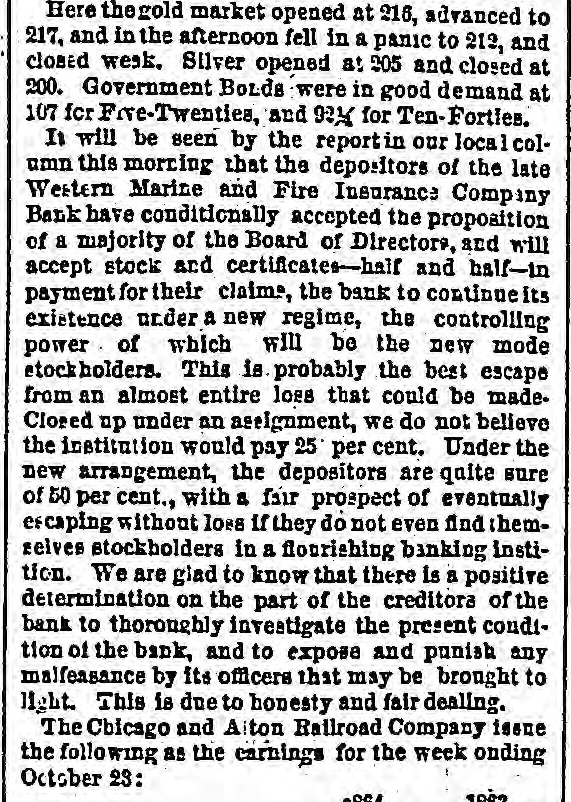
Here thegold market opened at 216, advanced to 217, and in the afternoon fell in a panic to 212, and closed wesk. Silver opened at 205 and closed at 200. Government BoLds were in good demand at 107 for Free-Twenties, and 21% for Ten-Forties. It will be seen by the report in our local column this morning that the depositors of the late Western Marine and Fire Insurance Company Bank have conditionally accepted the proposition of a majority of the Board of Directors, and will accept stock and certificates-half and half-in payment for their claims, the bank to continue its existence under a new regime, the controlling power of which will be the new mode etockholders. This is probably the best escape from an almost entire loss that could be madeClosed up under an assignment, we do not believe the institution would pay 25 per cent. Under the new arrangement, the depositors are quite sure of 50 per cent., with a fair prospect of eventually escaping without loss if they do not even find themrelves stockbolders in a flourishing binking instition. We are glad to know that there is a positive determination on the part of the creditors of the bank to thoroughly investigate the present condition of the bank, and to expose and punish any malfeasance by its officers that may be brought to light. This is due to honesty and fair dealing. The Chicago and Alton Railroad Company issue the following as the earnings for the week onding October 23: -084 1982


Article from The Pacific Commercial Advertiser, November 19, 1864

Click image to open full size in new tab

Article Text

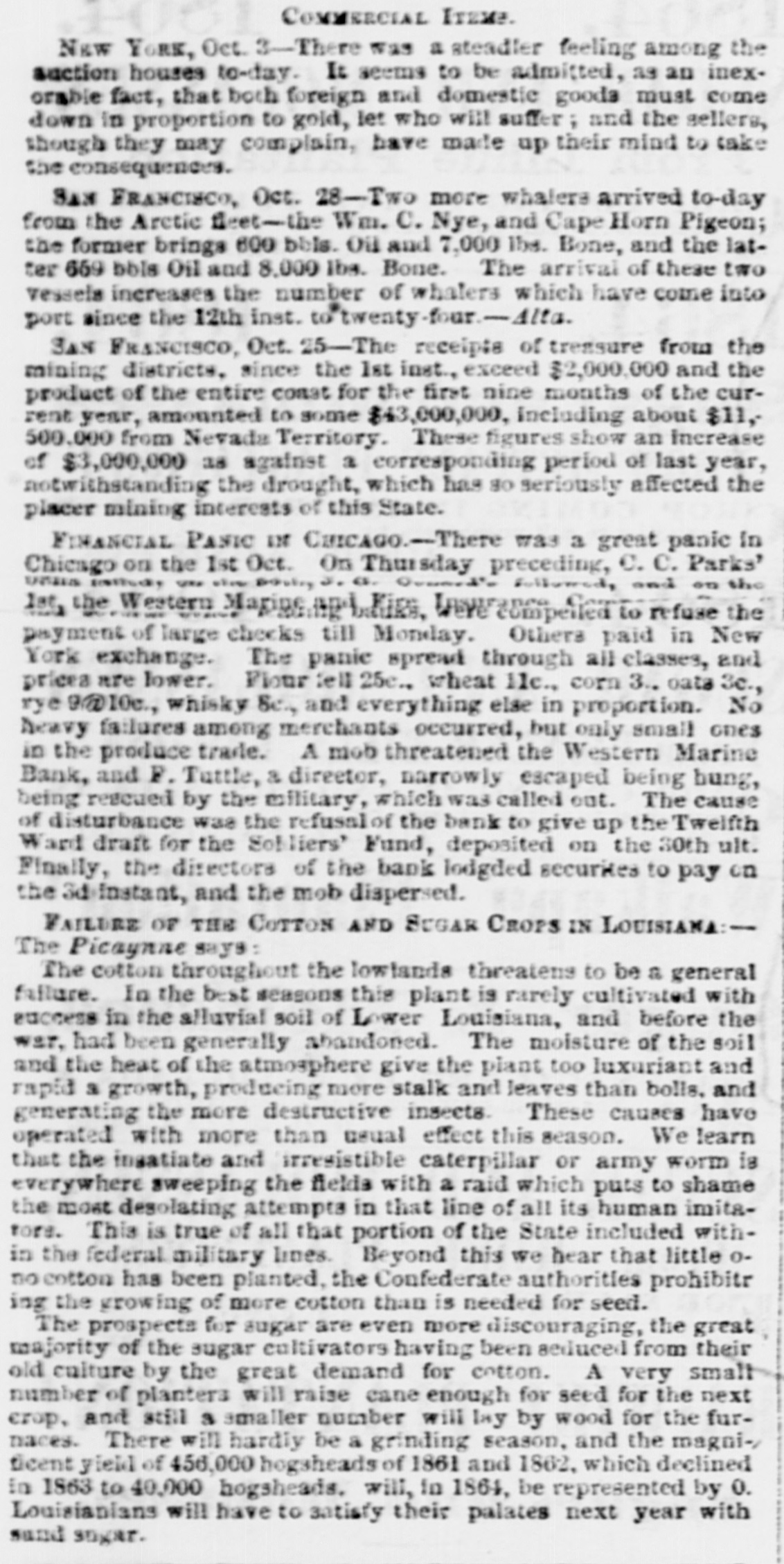
COMMERCIAL ITEMS. New YORK, Oct. 3-There was a steadler feeling among the suction houses to-day. It seems to be admitted, as an inexorable fact, that both foreign and domestic goods must come down in proportion to gold, let who will suffer; and the sellers, though they may complain, have made up their mind to take the consequences. Sax FRANCISCO, Oct. 28-Two more whaters arrived to-day from the Aretic fleet-the Wm. C. Nye, and Cape Horn Pigeon; the former brings 600 bbls. on and 7,000 lbs. Bone, and the latter 669 bbls Oil and 8,000 lbs. Bone. The arrival of these two vessels increases the number of whaters which have come into port since the 12th inst. to"twenty-four.-Aita. 3AN FRANCISCO, Oct. 25-The receipts of trensure from the mining districts, since the 1st inst., exceed $2,000,000 and the product of the entire coast for the first nine months of the current year, amounted to some $43,000,000, including about $11,500.000 from Nevada Territory. These figures show an Increase of $3,000,000 as against a corresponding period of last year, notwithstanding the drought, which has 80 seriously affected the placer mining interests of this State. FINANCIAL PASIC IN CHICAGO.-There was a great panic In Chicago on the 1st Oct. On Thursday preceding, C. C. Parks' units Quand's followed, and on the 1st, the Western Marine Rauling and DEURS, Kirs Insurance were compeiled to refuse the payment of large checks till Monday. Others paid in New York exchange. The panie spread through all classes, and prices are lower. Flour tell 25c., wheat 11c., corn 3., oats 3c., rye 9@10c., whisky Sc., and everything else in proportion. No heavy failures among merchants occurred, but only small ones in the produce trade. A mob threatened the Western Marine Bank, and F. Tuttle, & director, narrowly escaped being hung, being researed by the military, which was called out. The cause of disturbance was the refusal of the bank to give up the Twelfth Ward draft for the Sobliers' Fund, deposited on the 30th ult. Finally, the directors of the bank lodgded securites to pay on the 3d-instant, and the mob dispersed. FAILURE OF THE COTTON AND SUGAR CROPS IN LOUISIANA:The Picaynne says: The cotton throughout the lowlands threatens to be a general fullure. In the best seasons this plant is rarely cultivated with success in the alluvial soil of Lower Louisiana, and before the war, had been generally abandoned. The moisture of the soil and the heat of the atmosphere give the plant too luxuriant and rapid 3 growth, producing more stalk and leaves than bolls. and generating the more destructive insects. These causes have operated with more than usual effect this season. We learn that the ingatiate and irresistible caterpillar or army worm is everywhere sweeping the fields with a raid which puts to shame the most desolating attempts in that line of all its human imitators. This is true of all that portion of the State included within the federal military lines. Beyond this we hear that little 0no cotton has been planted, the Confederate authorities prohibitr ing the growing of more cotton than is needed for seed. The prospects for sugar are even more discouraging, the great majority of the sugar cultivators having been seduced from their old culture by the great demand for cotton. A very small number of planters will raise cane enough for seed for the next crop, and still 3 smaller number will lay by wood for the furnaces. There will hardly be a grinding season, and the magni-, ficent yield of 456,000 hogsheads of 1861 and 1862, which declined in 1863 to 40,000 hogsheads. will, in 1864, be represented by 0. Louisianians will have to satisfy their palates next year with sand sugar.