Bank of Madera (Madera, CA)

Episode Information

Episode UID
6334776891122
Episode Type
Suspension → Reopening
Bank Type
state
Bank ID
633477689 hash
Start Date
June 23, 1893
Location
Madera, California (36.961, -120.061)

Metadata

Model
gpt-5-mini (chosen from majority vote of a three-model LLM ensemble)
Short Digest
fe468fbfdfd970a8

Response Measures

None

Events (2)

1. June 23, 1893 Suspension
Cause
Macro News
Cause Details
Suspension occurred amid the wider banking panic of June 1893 and regional runs/closures; notice on door said temporarily suspended.
Newspaper Excerpt
The Bank of Madera failed to open its doors this morning. A placard on the doors stated: Temporarily suspended. Depositors will be paid in full.
Source
newspapers
2. July 1, 1893 Reopening
Newspaper Excerpt
The Bank of Madera, which suspended last week, reopened its doors this morning.
Source
newspapers

Newspaper Articles (7)

Article from The Morning Call, June 24, 1893

Click image to open full size in new tab

Article Text

The officers of the bank are: Joseph Brown, president; H. H. Garner, vice-president; O. H. Kohl, cashier. Its directors are: Joseph Brown, H. Brinkmeyer, J. W. Hall, O. H. Kohl, W. J. Curtis, L. D. Crandall, H. H. Garner, J. Flanders and John M. James. It has a paid-up capital stock of $100,000, a surplus fund of $25,000 and undivided profits of $7995. There were individual deposits of $261,000; demand certificates of deposit, $98,470. In the last five days between $100,000 and $200,000 in cash has been paid out over the counter. The run on the Farmers' Exchange Bank resulting in the closing of its doors caused the excited depositors to call for their money at the First National. Monday night the craze had subsided and it was thought that the bank had weathered the storm, but when so many banks failed in Los Angeles and other places on Wednesday and Thursday a run on the First National Bank started in anew. The resources of this bank, backed as they are by men of wealth, are fully ample to pay depositors dollar for dollar, and it will be but a short time before it will reopen its doors. This bank and the Farmers' Exchange have pursued a liberal but careful policy in supporting the principal industries of this community, and the citizens are deploring the misfortune that has befallen them. Had not a similar craze been operating in Los Angeles, the First National would have found no difficulty in obtaining cash to meet all demands. A notable feature of the run on this bank has been that several irresponsible parties have throughout the last five days been circulating stories on the street discrediting the bank's ability to pay depositors, and advising everybody to draw his money. These fellows have been openly denounced by others, but to no effect. The craze was on, and nothing, seemingly, could stop it. Everybody concedes the ability of the First National to meet all its obligations, and now there is little or no excitement on the streets. The other banks—the San Bernardino National and Bank of San Bernardino—are considered impregnable, and no further trouble is anticipated. The First National Bank will reopen again to-morrow morning. One of the leading officers of the bank said to-day: "We closed, of course, owing to a depletion of the cash on hand by the steady run made on us for the week past. We could have raised the money by pressing the creditors of the bank, but as this would have involved a great deal of suffering and embarrassment we concluded to close our doors until the present flurry has somewhat abated. The depositors of the bank are amply protected, there being considerably over a dollar of assets to one of liabilities." Since it has been announced that the bank will reopen for business hundreds of citizens have extended their congratulations to Joseph Brown, president of the bank. Many of them realize that the closing of the bank permanently and the placing of it in the hands of a receiver would inevitably bring to many borrowers financial trouble, if not disaster. SAN DIEGO, June 23.—Confidence is being rapidly restored in bank matters. E. S. Babcock, president of the Coronado Beach Company, announced this morning that he will accept checks on the Bank of Commerce and on the First National at their full face value for various lines of merchandise and supplies carried in the company's warehouse and for books of tickets of the streetcar and motor lines. The Bank Examiner is making good progress in examining the Bank of Commerce, and expects to conclude this afternoon. The plan for percentages—10 per cent on resuming and 10 more in sixty and ninety days—is considered as good as adopted, and it is expected the bank will be open Monday. The new Merchants' National Bank, which is crowded with depositors, is enabling business to be transacted as usual. NEW WHATCOM, Wash., June 23.—The Columbian National Bank did not open its doors this morning. A notice on the doors stated: "Owing to inability to realize on securities the directors have decided to close temporarily." Cashier Baker says the assets of the bank are $226,000 and the liabilities $110,000. MADERA, June 23.—The Bank of Madera failed to open its doors this morning. A placard on the doors stated: "Temporarily suspended. Depositors will be paid in full." SAN RAFAEL, June 23.—F. C. de Long, ex-State Senator, has made an assignment to Henry Pierce of San Francisco. LOS ANGELES, June 23.—The bank excitement is a thing of the past. Speculators who have been offering to buy checks at a small discount have found few customers, as every third store displays a notice offering to accept checks on all the closed banks at par. National Bank Examiner Wightman, who arrived from San Francisco to-day, says that the condition of the banks is excellent, and that both the national banks will probably resume next week. The Los Angeles National Bank has a reserve fund of more than $100,000 on hand. There have been more deposits to-day than payments at this bank, upon which the most persistent run was made, and there is a steady increase of redeposits. President M. H. Sherman of the Electric Consolidated Railway Company said to-day that the suspension of the Pacific Bank in San Francisco would not affect the road, as the bank was the owner of only a small minority of the stock. The Chamber of Commerce, at a special session to-day, passed resolutions expressing implicit confidence in the Los Angeles banks, and giving figures to show why they are perfectly sound.

Article from The Herald, June 24, 1893

Click image to open full size in new tab

Article Text

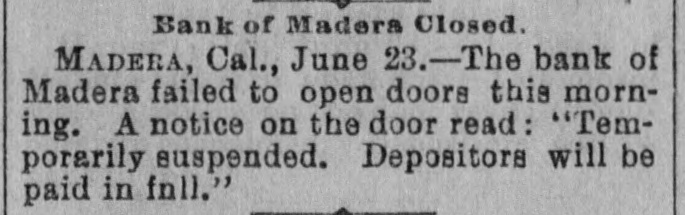
Bank of Madera Closed. MADERA, Cal., June 23.-The bank of Madera failed to open doors this morning. A notice on the door read "Temporarily suspended. Depositors will be paid in fnll."


Article from The Record-Union, June 24, 1893

Click image to open full size in new tab

Article Text

to suspend payment for the present. Should no satisfactory arrangement for an early continuance be affected the depositors will soon be paid in full, with interest, and the assets, if properly handled, will yield the shareholders $2,000,000 o 200 per cent. on the par value of the capital stock. The stock is held in wealthy hands representing millions of money and the liability is such on each shareholder as to prelude the possibility of loss to depositors. Our present liabilities outside of foreign capital and surplus are only about $1,600,000, and considerable of this is subject to reduction by offsets." PRESIDENT M'DONALD SHOCKED. NEW YORK, June 23.-Dr. R. H. McDonald, President of the Pacific Bank, who is in this city, was shocked when he heard to-day that his bank had closed. He said: "Though President of the bank, I have not been active in its management for some time. I am sufficiently familiar with the affairs of the institution, however, to feel confident that there is no chance for any of the depositors lose anything. I think it will liquidate for almost the amount of its capital and surplus, $1,000,000 and $800,000 respectively. The bank had gone into no speculative enterprises up to the time of my departure. Of the local business we had a fair percentage, with an extraordinary number of correspondents out in the country. It was heavy drafts made by country banks, I presume, which forced the suspension." " CONFIDENCE RESTORED AT SAN DIEGO SAN DIEGO, June 23.-Confidence is being rapidly restored intbank matters. E. S. Babcock, President of the Coronado Beach Company, announced this morning that he will accept checks on the Banks of Commerce and on the First National Bank at their full face value for various lines of merchandise and supplies carried on in the company's warehouse and for books of tickets of the street-car and motor lines. The Bank Examiner is making good progress in examining the Bank of Commerce and expects to conclude this afternoon. The plan for percentages-10 per cent. on resuming, 10 more in sixty and ninety days-is considered as good as adopted, and it is expected the bank will be open Monday. The new Merchants' National Bank, which is crowded with depositors, is enabling business to be transacted as usual. There were individual deposits of $261,000: demand certificates of deposit, $89,470. In the last five days between $100,000 and $200,000 in cash have been paid out over the counter. The run on the Farmers' Exchange Bank resulting in the closing of its doors, caused the excited depositors to call for their money at the First National. Monday night the craze had subsided and it was thought that the bank had weathered the storm, but when SO many banks failed in Los Angeles and other places on Wednesday and Thursday, a run on the First National Bank started in anew. The resources of this bank, backed as they are by men of wealth, are fully ample to pay depositors dollar for dollar, and it will be but a short time before it will reopen its doors. This bank and the Farmers' Exchange have pursued a liberal but careful policy in supporting the principal industries of this community, and the citizens are deploring the misfortune that has befallen them. Had not a similar craze been operating in Los Angeles, the First National Bank would have found no difficulty in obtaining cash to meet all demands. The President of the bank, Joseph Brown, stated shortly after closing that the bank would resume business in a short time A notable feature of the run on bank has been that irrehave last sponsible this parties throughout stories several the five been on street the and pay days depositors discrediting circulating advising bank's fellows everybody ability have the to to draw his money. These been openly denounced by others, but to no effect. The craze was on, and nothing, seemingly, could stop it. Everybody concedes the ability of the First National to meet all its obligations, and now there is little or no excitement on the streets. Theother banks- the San Bernardino National and Bank of San Bernardino-areconsidered impregnable, and no further trouble is anticipated. COULD NOT STAND THE RUN. SAN BERNARDINO, June 23. The First National Bank of San Bernardino, which has withstood the run for the last five days with such fortitude, was to-day compelled, shortly after having opened to the to and to to the stringency money depositors "Owing doors, post following close of the its notice doors: and the unusual of the last this deposits market during five withdrawal days, bank is forced to close its doors temporarily." The officers of the bank are: Joseph President; H. O. H. Kohl, are: rectors President; Brown, Joseph Brown, B. Cashier. Garner, H. Brink- Its di- Vice- J. meyer, J. W. Hall, O. H. Kohl, W. Curtis, L. D. Crandall, H. B. Garner, J. Flanders and John M. James. a $100,It a has surplus paid-up capital $25,000 stock and of 000, fund of undivided profits of $7,995. BANK OF MADERA. MADERA, June 23.-The Bank of Madera failed to open its doors this morning.


Article from Idaho County Free Press, June 30, 1893

Click image to open full size in new tab

Article Text

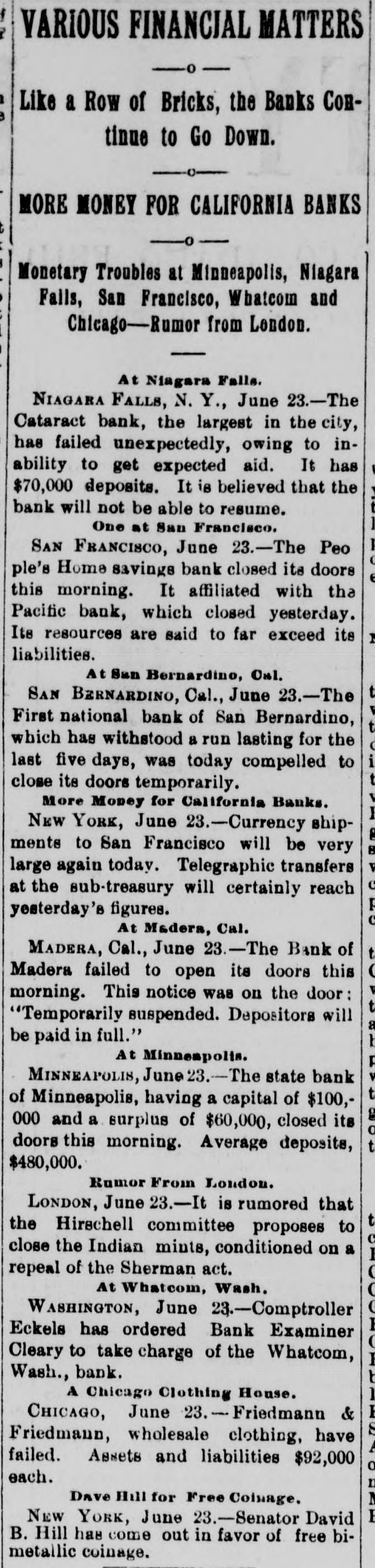
VARIOUS FINANCIAL MATTERS -Like a Row of Bricks, the Banks Continue to Go Down. MORE MONEY FOR CALIFORNIA BANKS Monetary Troubles at Minneapolis, Niagara Falls, San Francisco, Whatcom and Chicago-Rumor from London. At Niagara Falls. NIAGARA FALLS, N. Y., June 23.-The Cataract bank, the largest in the city, has failed unexpectedly, owing to inability to get expected aid. It has $70,000 deposits. It is believed that the bank will not be able to resume. One at San Francisco. SAN FRANCISCO, June 23.-The Peo ple's Home savings bank closed its doors this morning. It affiliated with the Pacific bank, which closed yesterday. Its resources are said to far exceed its I liabilities. At San Bernardino, Oal. SAN BERNARDINO, Cal., June 23.-The First national bank of San Bernardino, which has withstood a run lasting for the last five days, was today compelled to close its doors temporarily. More Money for California Banks. NEW YORK, June 23.-Currency ship@ ments to San Francisco will be very g large again today. Telegraphic transfers at the sub-treasury will certainly reach yesterday's figures. At Madera, Cal. MADERA, Cal., June 23.-The Bank of Madera failed to open its doors this morning. This notice was on the door: "Temporarily suspended. Depositors will be paid in full." At Minneapolis. MINNEAPOLIS, June 23.-The state bank of Minneapolis, having a capital of $100,000 and a surplus of $60,000, closed its doors this morning. Average deposits, $480,000. Rumor From London. LONDON, June 23.-It is rumored that the Hirschell committee proposes to close the Indian mints, conditioned on a repeal of the Sherman act. At Whatcom, Wash. WASHINGTON, June 23.-Comptroller Eckels has ordered Bank Examiner Cleary to take charge of the Whatcom, Wash., bank. A Chicago Clothing House. CHICAGO, June 23. -Friedmann - & Friedmann, wholesale clothing, have failed. Assets and liabilities $92,000 each. Dave Hill for Free Coluage. I NEW YORK, June 23.-Senator David B. Hill has come out in favor of free bimetallic coinage.


Article from The Morning Call, July 2, 1893

Click image to open full size in new tab

Article Text

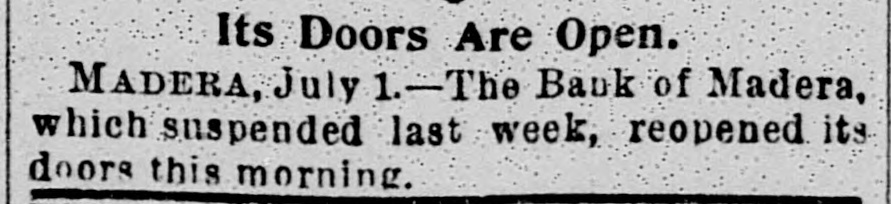
P Its Doors Are Open. MADERA, July 1.-The Bank of Madera, which suspended last week, reopened its doors this morning. -


Article from The Record-Union, February 23, 1894

Click image to open full size in new tab

Article Text

Annual Meeting of the State Bankers' Association. IMPORTANT FINANCIAL QUESTIONS UNDER DISCUSSION. Interior Bankers Desire a Modification of the Rule Relating to the System of Overdrafts—Programme Which Will Occupy the Delegates' Attention To-Day. Special to the RECORD-UNION. SAN FRANCISCO, Feb. 22.—The annual convention of the State Bankers' Association was held in the Chamber of Commerce rooms to-day. In the absence of Mayor Ellert, Lovell White of the San Francisco Savings Union delivered the address of welcome. President Hellman of the Nevada Bank followed with an address which dealt largely with the recent financial crisis and tight-money period that followed it. "We can be proud of how well our banks have weathered the storm," said he. "Our banks have stood better than those elsewhere, owing largely to the wonderful resources of the State. "The crisis affected us here in California in a peculiar way, because we are so far off from financial centers. Ordinarily bankers' balances in New York or Chicago could easily be transferred here, but by reason of the great scarcity of the circulating medium in the Eastern centers we were even refused by our corresponding banks in New York to have our own funds transmitted to us. Another great hardship for California was that the Treasury Department, which had previously made transfers of money from New York to San Francisco by telegraph, had during the hight of the panic even refused to do that. "It was said that of four banks that have closed their doors permanently two should have done so anyway, and would have done so ultimately without the aid of the panic." Now that financial matters are easier, Mr. Hellman urged the importance of banks lending their aid to manufacturing and other enterprises. He condemned the practice of permitting overdrafts, and said also a law should be enacted that would prohibit a savings bank receiving more than $10,000 from any one depositor. "Commercial as well as savings banks," said Mr. Hellman, "are again feeling the favorable effect of a change, and deposits are on the increase, especially in moneyed centers. I do not ascribe it entirely to the increase of trade, but partly to the emptying of stockings and the depleting of safe-deposit boxes from the coin lodged therein during the panic." The Treasurer of the association, George W. Kline of the First National Bank of this city, and Secretary R. M. Welch of the San Francisco Savings Union presented reports giving the dry-bones of details of the work of 1893. Receipts footed up $2,859, and expenses left a cash balance of $920. There are now 175 banks in the association out of 200 in the State. Four banks were dropped during the year for non-payment of dues. Six banks went into liquidation—the City Bank, Los Angeles; Bank of Anaheim; Pacific Bank, San Francisco; Consolidated National Bank, San Diego; Bank of Oceanside; Bank of Madera. Committees were named as follows: Nominations—E. R. Hamilton, Sacramento; C. W. Bush, Woodland; P. E. Bowles, Oakland; L. W. Burris, Santa Rosa; T. P. Lukens, Pasadena. Resolutions—Frank Miller, Sacramento; H. W. Wright, San Jose; H. H. Hewlett, Stockton; C. S. Brooks, Marysville; A. H. R. Schmidt, San Francisco. Auditing—W. E. Gerber, Sacramento; J. M. Elliott, Los Angeles; O. McHenry, Modesto. W. E. Gerber of Sacramento called attention to a desire of interior bankers to have a conference and a hearing with the management of the San Francisco Clearing-house. A modification of the rule, recently enacted by the Clearing-house, abolishing the system of overdrafts, is desired on the ground that the stringent enforcement of details is unjust to interior banks. Mr. Hellman, presiding, said he would decline to make any suggestion to the Clearing-house relative to the matter unless so instructed by the convention. He thought the overdraft abolition action should be final. This opinion excited Railroad Commissioner Beckman, who is President of a Sacramento bank, and he moved that the convention request the hearing that Mr. Gerber asked for. The motion was carried unanimously. The convention will reassemble tomorrow at 10 A. M. Among the papers on the programme to be read before the convention are the following: "Unsecured Loans—Time Versus Demand," Frank Miller of Sacramento. "Savings Banks and Their Dividends to Depositors," J. B. Lankershim of Los Angeles. "Savings Banks—Their Mission and Duties," Lovell White of San Francisco. "Suggestions Concerning Certain Changes in the State Banking Laws," J. M. Elliott of Los Angeles. "A Plea for a Rational Currency System," E. S. Sheffield of Santa Barbara. "How to Preserve the National Banking System," Henry Brunner of San Luis Obispo. "A Talk on the Financial Situation," J. M. C. Marble of Los Angeles. "The Bank Lessons of 1893," Benjamin C. Wright of San Francisco. "The Relations That Should Exist Between City and Country Banks," C. W. Bush of Woodland. MORTON'S POSITION.


Article from The Morning Call, April 19, 1894

Click image to open full size in new tab

Article Text

# The Pacific Bank Is Made a Defendant. # BOND SALE COMMISSION CONTEST # A Policeman Sits in the People's Home Savings Bank to Quell All Disturbance. The Pacific Bank is involved in another entanglement. This time it is an action at law. Thomas Fitch Jr. filed a complaint yesterday against the Pacific Bank, R. H. McDonald Jr., Frank V. McDonald, R. H. McDonald and the California Raisin and Fruit Growers' Association. The suit is for the recovery of $40,000 on the sale of $500,000 of bonds of the California Ratsin and Fruit Growers' Association. It is claimed that these bonds were issued in payment for lands belonging to that corporation, which has its location in Fresno County. After the failure of the John Brown Colony and the Bank of Madsra the Pacific Bank, through its general financial agent, A. F. Johns, took possession of the colony and the bank of Madera. It is alleged by the plaintiff that after this action it occurred to Frank V. McDonald to convey a portion of the lands of the John Brown colony to an independent corporation, and that the California Fruit and Raisin Growers' Association was formed with officers and directors friendly to McDonald. It was then that Mr. Fitch claims that $500,000 of mutual coupon stock bonds were issued, and these bonds he declares were accepted by the Pacific Bank in payment or as security, and the bank conveyed the lands to the California Raisin and Fruit Growers' Association. The object, it was stated, was to sell these bonds to the profit of the incorporators. About this time, it said, that Frank V. McDonald, assisted by A. F. Johns, was trying to float certain securities of the Pacific Bank. Mr. Fitch was then engaged in the commission business in New York. He declares that he was approached by Frank V. McDonald and A. F. Johns, as representatives of the Pacific Bank and of the California Fruit and Raisin-growers' Association, and was finally employed to negotiate the sale of the bouds, and was allowed a commission of 8 per cent on the par value of all bonds sold by him. Fitch, relying on the $1,000,000 capital of the Pacific Bank and its surplus of $800,000, says that he undertook their sale. It was found that the sale of the bonds depended upon McDonald and Johns showing that the securities back of the bonds were good. Fitch declares that the men whom he negotiated with declined to place the bonds with their clients, who were English, unless the Pacific Bank would guarantee the principal and interest of the bonds. This, he asserts, was done in a resolution passed by the board of directors of the Pacific Bank on March 13, 1893. Fitch adds that Gillette & Taylor, bankers and brokers of Chicago and London, agreed to take the entire issue of the bonds at once, and demanded the delivery of the bonds for themselves and associates. At this time Frank V. McDonald was in New York acting in behalf of the Pacific Bank. He declined to deliver the bonds. Then it turned out after the sale had been negotiated, so Fitch claims, that Frank V. McDonald learned that the real purchasers of these bonds were the correspondents of the Pacific Bank in London, and it is claimed that Frank McDonald refused to ratify the sale, because he thought he could effect the sale himself. It is further claimed that R. H. McDonald Jr., from his connection with the Pacific Bank, was cognizant of these facts. Fitch declares that the records of the Pacific Bank and of the California Raisin and Fruit Growers' Association are not not accessible to him, but that the relations of Frank McDonald and Dick McDonald to the two institutions were such that they can be made defendants. With this information and the notoriety which the Pacific Bank has acquired in the press, Fitch thinks that his claim can be established, and as an incident thereto asks that all the facts in connection with the dealings and suspension of the Pacific Bank be made public. To this end, in addition to filing his complaint, he has caused atidavits, notices and subpenas to be issued asking that the depositions of R. H. McDonald Jr., M. H. Sherman and others be taken, and has applied to have Harry J. Lask, a notary public, take these depositions. James Alva Watt appears as the attorney for the plaintiff. It is deemed almost certain that the Grand Jury will take cognizance of the condition of affairs in the Pacific and the People's Home Savings banks and that a searching investigation will be instituted, in which the officials, employes and every one now or at any recent time counected with the institutions will be summoned to appear before that body. As pointing toward this is the fact that McLaughlin, the attorney and politician of Southern California, has come here hastily and has been in close consultation with M. H. Sherman. There were two meetings of the directors of the People's Home Savings Back yesterday, one of which lasted well on ito the evening. It was stated that nothing but the most routine business was transacted. At the same time the Bank Commissioners were continuing their examination, and Attorney-General Hart was at work with an expert on the books. During a good portion of this time Attorney Frank M. Stone sat in the Cafe Royal, adjacent to the bank. It is said that Stone hopes yet to be reinstated in a legal position with the bank. This might be accomplished if the Bank Commissioners and Attorney-General Hart should make such reports as would necessitate the appointment of a receiver, providing that that receiver were the friend of Stone. It is generally believed that the report of the Bank Commissioners will be adverse to the bank. The former report of the Attorney-General was favorable to the bank. The officials at the bank declare that the figures now are as favorable as when the Attorney-General made his last report, and that nothing has taken place whien would require him to change his former favorable opinion. A policeman sat in the bank during office hours yesterday, and the disturbances of the day before were not repeated, Dr. Julius Boushey, president of the bank, declares that he has been greatly annoyed by the visits of persons to his private office to discuss bank matters in a clamorons way, and adds that he is convinced that these persons have been purposely sent there to disturb him.