First National Bank (Milwaukee, WI)

Episode Information

Episode UID
6401264
Episode Type
Run Only
Bank Type
national
Bank ID
640 national
Charter Number
64
Start Date
April 24, 1905
Location
Milwaukee, Wisconsin (43.039, -87.906)

Metadata

Model
gpt-5-mini (chosen from majority vote of a three-model LLM ensemble)
Short Digest
2fe562a1e98b36cc

Response Measures

Accommodated withdrawals, Borrowed from banks or large institutions, Public signal of financial health, Capital injected

Events (2)

1. August 15, 1863 Chartered
Source
historical_nic
2. April 24, 1905 Run
Cause
Bank Specific Adverse Info
Cause Details
Embezzlement/defalcation by president Frank G. Bigelow (โ‰ˆ $1,450,000), disclosed to directors.
Measures
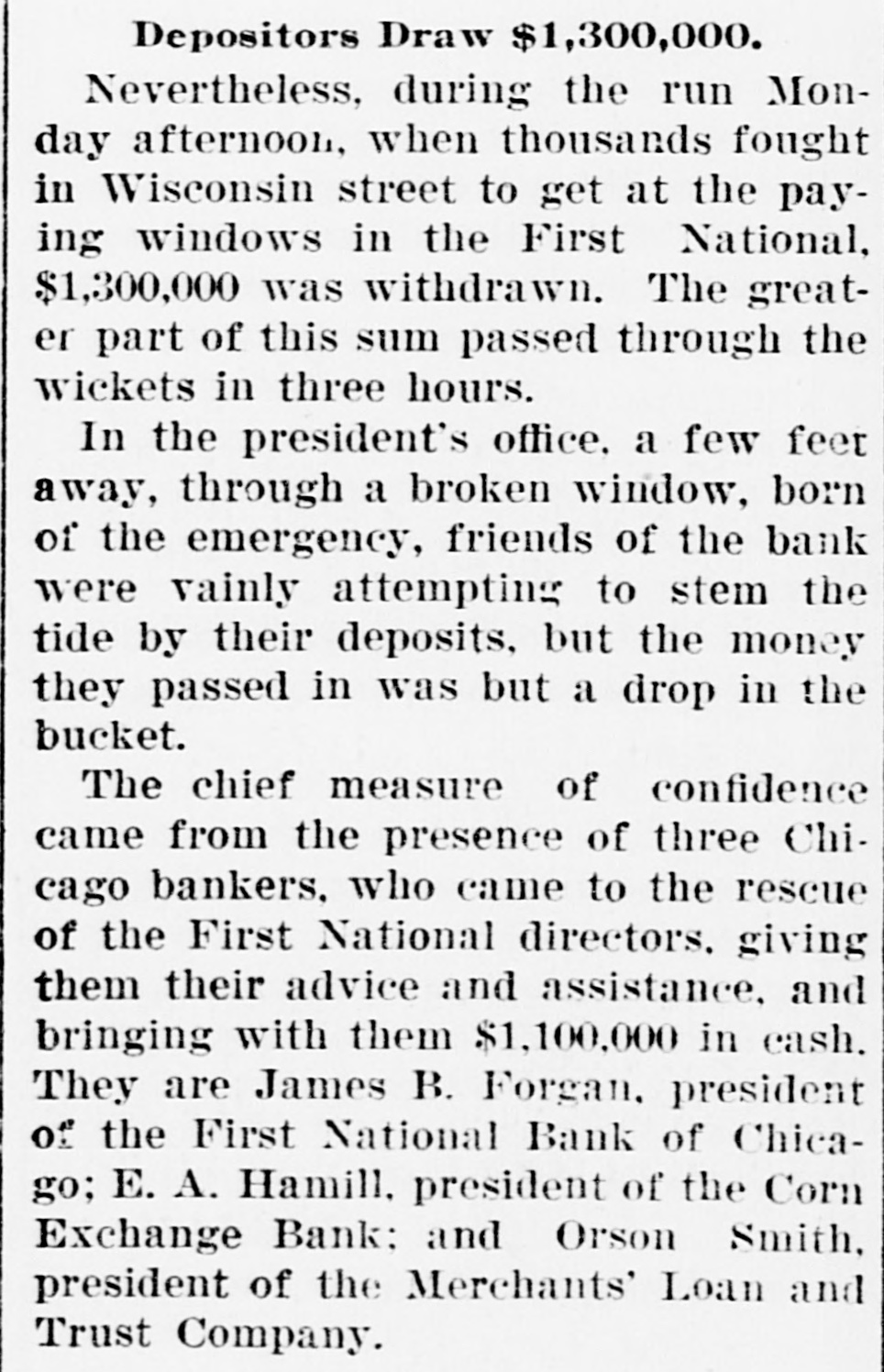
Directors and local financiers subscribed $1,635,000; Chicago banks sent $1,000,000; several hundred thousand dollars in gold transferred; extra clerks and police detail; receiving tellers stationed to take deposits.
Newspaper Excerpt
When the bank closed its doors this afternoon more than 2,000 depositors were clamoring for their money.
Source
newspapers

Newspaper Articles (25)

Article from The Cairo Bulletin, April 25, 1905

Click image to open full size in new tab

Article Text

TOOK $1,450,000 Once a Millionaire, Now Werse Than a Pauper OLD STORY OF STOCKS AND SPECULATORS-FINCT NA. TIONAL BANK OF MILWAUKEE THE SUFFERERHEAVY RUNS. Milwaukee, April 24.-Frank G. Big elow unt today president of the First National bank of Milwaukee, was arrested today charged with embezzlement (f over a hundred thousand dollars of the bank's funds. The arrest of Bigelow followed his confession to the board of directors of the bank that he was a defaulter to the extent of $1 450,000. Following Bigelow's confession he was removed from the presidency of the bank and facts in the ease were laid before the federal authorities. Cashier Also wanted. The complaint was sworn to by United States D strict Attorney ButIt charges that Bigelow, as of the Frst sum exceeding torfield. president embezzled-a National $100,000. bank, A complaint and warrant identical with those in Bigelow's case were made out for Henry G. Goll, a sistan cashier of the bank, but Goll could ant be found 112 to 7 o'clock tonight Bigclow was taken before United States Commissione Bloodgo d anN bail was five at $25,000. B gelow said he lost in speculating in stocks in Wall stree and in wheat Arrested in His Library. When the federal marshal called the Bigelow residence to serve the warrant, the former bank prosiden was in the library with his wife. Mr: Bigelow refused to withdraw and the warrant was read in her presence. "I'll be ready to (go with you a said the banker. Then, h wife an fare k once," ssed his affectionate the well and left with the officer, tw walking to the federal building, wher a court commission was in waiting the None of Bigelow's friends were in court room during the brief proceer ings. How He Covered Up His Tracks. The method of covering up u shortage is thus de cribed: Collect on accounts were manipula ed to the extent of 40 and in some it stances, 50 per cent, to make it appea that the resrve fund was intact, an the amount of the Increased collection fund was diverted to special stock or it erations. The reserve maintained eastern banks was tampered with, the books of the First National being fix ed so that the reserve appeared large by several hundred thousand dollars than it really was. and other is 'a) were pursued by B leged, These methods gelow. it The Cashier Helped. In falsifying records and the ma nipulation of resources Bigelow de clares he was added by As istant Cash ier Goll and two bookkeepers in the bank. These bookkeepers acted un der orders of Bigelow and they have neither been discharged nor suspend ed and they will he called as witness es in criminal pr. ceedings aga nst Big elow. The first intimation of irregularities was Friday evening when a bank em ploye*ca'led at Director Pfister's home and gave him meager informat on. In vestigation was started and Bigelov was accused of irregularities. He said to have admitted his guilt. At a directors meeting following he con fessed. The directors imme:lately ra sed $1,635,000 to make good the sur plus. Chicago banks sent $1 000,000 to Milwaukee and local banks trans ferred several hundred thousand dollars in gold to the First National. Depositors Demand Money. When the bank closed its doors this afternoon more than 2,000 depositors were clamoring for their money. Nearly $1,000,000 had been paid out in the course of two hours and but a small of the customers of their accounts ing per closing centage citters had demand- was been served. One of the first a business man who presented a check for $100,000. the entire amount of his account. He was followed by the city treasurer. who drew out $30,000 of the city funds. The chamber of commerce was one of the concerns that was quick to withdraw its funds. : The state of Wisconsin has several thousand -llars deposited in
Article from The San Francisco Call, April 25, 1905

Click image to open full size in new tab

Article Text

DIRECTORS PAY SHORTAGE. The manipulations of accounts has been going on for months, according to the statement of one of the directors, but so cleverly was the work done that neither the directors nor the National Examiners were able to discover that anything was wrong. The first intimation that there were irregularities came to Charles F. Pfister, one of the directors, on Friday evening. An employe of the bank called at Pfister's home and told him he had something to reveal regarding the bank. Although his confession was meager it was sufficient to awaken the suspicions of Pfister and to start an investigation. President Bigelow was taxed with the irregularities and he is said to have admitted his guilt. Then followed the meeting of the directors and the full confession. As soon as the directors ascertained the full extent of the peculations, steps were taken to protect the depositors and other creditors. Charles F. Pfister subscribed $600,000 to a fund to make good the surplus; John I. Biggs, president of the Milwaukee Electric Railway Company, gave $300,000; William Bigelow, a brother of the president, added $100,000 to the amount. Other directors subscribed lesser sums, until the amount raised reached $1,635,000. Then the following statement was prepared and formally issued: 'For value received, we, the undersigned, severally agree to advance and pay to the First National Bank of Milwaukee, Wis., the sums set opposite our respective names as the same may be needed, for the payment on demand of all deposits now in said bank, or which within thirty days from this date may be placed therein. Our claims hereunder for reimbursement shall be subordinate and postponed to the claims of all depositors and other creditors. (Signed) Charles F. Pfister, $600,000; Fred Vogel Jr., $300,000; John I. Peggs, $300,000; E. Mariner, $100,000; Fred F. Goll, $50,000; George P. Miller, $50,000; J. H. Van Dyke Jr., $50,000; J. K. Kipp. $50,000; Albert G. Trostel, $25,000; August H. Vogel, $10,000; William Bigelow, $100,000; total, $1,635,000." BIG RUN ON THE BANK. Prior to this the directors had been in conference with leading bankers of Chicago and New York. Three Chicago bankers, President Forgan of the First National Bank; Orson Smith, of Loan and Ernest A. the pany Merchants' and Hamill Trust of Com- the Corn Exchange National Bank, came to Milwaukee on an early train and went into conference with the directors of the First National. As a result of this meeting $1,000,000 was sent to Milwaukee by Chicago banks to reach the city before the news of the defalcation was made public. Several hundred thousand dollars in gold was transferred to the First National that was run that was for Bank, the so institution expected. prepared Every precaution was taken to keep the fact of the shortage from the public until the affairs of the bank could be put in condition to meet any emergency that might arise. When the bank closed its doors this afternoon more than 2000 depositors were clamoring for their money. Nearly $1,000,000 had been paid out in the course of two hours and but a small percentage of the customers demanding the closing of their accounts had been served. One of the first callers was a business man, who presented a check for $100,000, the entire amount of his account. He was followed by the City Treasurer, who drew out $300,000 of the city's funds. Withdrawals in sums ranging from $1000 to in the a peo$10,000 o'clock quickly afternoon followed the bank line and east of by 2 ple extended from on Wisconsin street to Broadway, and in


Article from The Times Dispatch, April 25, 1905

Click image to open full size in new tab

Article Text

CONFESSED THEFT OF OVER A MILLION (Continued from First Page.) forty or even fifty per cent. to make It appear that the reserve fund was Intact, and the amount of the increased collection fund was diverted to special stock operations. The reserve maintained in Eastern banks was tampered with, the books of the First National being fixed so that the reserve appeared to be larger by several hundred thousand dollars than It really was. These and other methods were pursued by Bigelow in securing money from the bank. In falsifying. the records and the manipulation of reserves, Bigelow declares he was aided by Assistant Cashier Goll and two bookkeepers in the bank. These bookkeepers noted on orders of Bigelow, and they have neither been discharged nor. suspended." and they will be called as witnesses in the criminal proceedings against the former bank president. The manipulation of accounts has been going on for months, according to the statement of one of the directors, but so cleverly was the work done that neither the directors nor the national bank examiners discovered that anything was wrong with the funds of the bank. Depositors Protected. The first intimation that there were irregularities came to Charles F. Pfister, a director, Friday evening. when an employe of the bank gave Mr. Pfister information sufficient to start an investigation. Then followed a meeting of the directors and the confession. As soon as the directors ascertained the full extent of the speculations, steps were taken to protect the depositors and other creditors. Charles F. Pfister subscribed $600,000 to a fund to make good the surplus. John I. Beggs, president of the Milwaukee Electric Railway and Light Company, gave $300,000. William Bigelow, a brother of President Bigelow, added $100,000 to the amount. Other directors subscribed lesser sums until the amount raised reached $1,635,000. Run on Bank. When the bank closed this afternoon, some two thousand depositors were waiting for their money. Nearly $1,000,000 was paid out in two hoyrs, and many customers, demanding the closing of their accounts, had not been served. One of the first callers was a business man, who presented a check for $100,000, the entire amount of his account. He was foilowed by the city treasurer, who drew out $300,000 of city funds. Withdrawais in sums ranging from $1,000 to $10,000 quickly followed, and soon a long line of people was waiting to withdraw. The depositors in East Water Street were besinging the Wisconsin Trust Company, the savings department of the First National Bank and the run on the savings department assumed the greatest proportions. Depositors of large amounts apparently ceased withdrawals after the facts became well known, and those who sought their deposits, were customers of the savings bank. But, while many savings depositors were seeking to withdraw their funds, other persons who believe in the soundness of the bank, were coming forward with deposits. Officers of the bank are preparing for any possible run to-morrow. A request has been made for a detail of twenty policemen, the same number that was required to handle the crowds to-day, and an extra force of clerks will be employed to handle the business. Money is on the way from New York to strengthen the resources of the bank, and the directors expect to be able to meet all demands promptly. They assert that the bank has


Article from Deseret Evening News, April 26, 1905

Click image to open full size in new tab

Article Text

"The depositors in the First National bank of Milwaukee are having a run for their money.


Article from Abilene Weekly Reflector, April 27, 1905

Click image to open full size in new tab

Article Text

Confidence Restored. Milwaukee, April 26.-Confidence has again been restored in the banking institutions of Milwaukee and the run on the First National bank and the Milwaukee Trust company which was caused by the defalcation of Frank G. Bigelow, until Monday president of the bank, to the extent of over $1,000,000, is a thing of the past and banking affairs in Milwaukee have resumed their normal condition.


Article from The Penn's Grove Record, April 28, 1905

Click image to open full size in new tab

Article Text

Stop Run on Bank. Bags containing $2,000,000 carried in in the view of depositors checked the run on the First National Bank of Mit waukee, Wis.


Article from Troy Weekly News, April 28, 1905

Click image to open full size in new tab

Article Text

Milwaukee, Wis, April 26.-Confidence has again been retsored in banking institutions of Millwaukee, and the run on the First National bank and the Milwankee Trust company, which was caused by the defalcation of Frank G. Bigelow, until Monday president of the bank, of over $1,000,000, is a thing of the past and banking affairs in Millwaukee have resumed. their normal condition.


Article from The Kendrick Gazette, April 28, 1905

Click image to open full size in new tab

Article Text

Milwaukee, Wis, April 26.-Confidence has again been retsored in banking institutions of Millwaukee, and the run on the First National bank and the Milwaukee Trust company, which was caused by the defalcation of Frank G. Bigelow, until Monday president of the bank, of over $1,000,000, is a thing of the past and banking affairs in Millwaukee have resumed their normal condition.


Article from Pullman Herald, April 29, 1905

Click image to open full size in new tab

Article Text

Milwaukee, Wis, April 26.-Confidence has again been retsored in banking institutions of Millwaukee, and the run on the First National bank and the Milwaukee Trust company, which was caused by the defalcation of Frank G. Bigelow, until Monday president of the bank, of over $1,000,000, is a thing of the past and banking affairs in Millwaukee have resumed their normal condition.


Article from Grant County Herald, April 29, 1905

Click image to open full size in new tab

Article Text

Fortunately the First National bank of Milwaukee is so strong and its directors have shown themselves to be men of such prompt initiative and generosity, that there is to be no suspension of business. The bank is to go on, stronger today with the $1,635,000 guarantee of Milwaukee millionaries than it was a few days ago after the defalcation had been made but not discovered. As to Mr. Bigelow himself, he has committed a crime against the laws of the]United States for which he should be punished with all severity.


Article from Pullman Herald, April 29, 1905

Click image to open full size in new tab

Article Text

Milwaukee, Wis, April 26.-Confidence has again been retsored in banking institutions of Millwaukee, and the run on the First National bank and the Milwaukee Trust company, which was caused by the defalcation of Frank G. Bigelow, until Monday president of the bank, of over $1,000,000, is a thing of the past and banking affairs in Millwaukee have resumed their normal condition.


Article from The Ladysmith News and Ingram News, April 29, 1905

Click image to open full size in new tab

Article Text

SAW NO POSSIBILITY OF MAKING UP THE AMOUNT so HE CONFESSED. BANK PROTECT DIRECTORS MAKE UP SHORTAGE AND SECURE ADDITIONAL FUNDS TO MEET A RUN. Milwaukee, April 26.-Frank G. Bigelow, until yesterday president Or the Frst National Bank of Milwaukee, was arrested yesterday charged with the embezzlement of $100,000 of the bank's funds. The arrest of Mr. Bigelow followed his confession to the board of directors of the bank that he was a defaulter to the extent of $1,450,000. Following Mr. Bigelow's confession he was removed from the presidency of the bank and the facts in the case were laid before the federal authorities. A complaint and warrant identical with those in Bigelow's case were made out for Henry G. Goll, assistant cashier of the bank, but Goll could not be found up to 6 o'clock last night. Released on Bail. President Bigelow was taken before United States Court Commissioner Bloodgood. He waived examination and was held to the federal grand jury under $25,000 bond. Dr. Horace M. Brown and Arthur McGeesch certified as sureties and Mr. Bigelow was released. The next federal grand jury has not yet been summoned, but it is expected it will meet some time next month. President Bigelow's confession was made at a special meeting of the board of directors held Saturday evening and continued Sunday and all of Sunday night. In addressing his fellow directors President Bigelow said that the money had been Lost in Speculation in wheat and stocks. Not a dollar of it could be recovered, and the only sum he could offer toward recompensing the bank was personal property valued at approximately $300,000. The confession of President Bigelow astounded the directors of the bank. Mr. Bigelow has been recognized as one of the foremost financiers of the Northwest. In making his statement to the directors of the bank, Mr. Bigelow said he had become involved in stock speculation several months ago. From small manipulations of the bank's funds he had extended the defalcations until his shortage had reached the present stage. He saw no opportunity or possibility of making up the amount, and, therefore, confessed. Assistant Cashier Fired. When the resolution was adopted removing Mr. Bigelow from the presidency, Mr. Goll, the assistant cashier, was also removed. The removal of the assistant cashier was due to the statement of President Bigelow that he was aided by Goll in concealing the shortage in the bank's accounts. The manipulation of accounts has been going on for months, according to the statement of one of the directors, but SO cleverly was the work done that neither the directors nor the national bank examiners were able to discover the fact that anything was wrong with the funds of the bank. As soon as the directors ascertained the full extent of the peculations steps were taken to Protect the Depositors and other creditors. Charles F. Pfister subscribed $600,000 to a fund to make good the surplus. John L. Beggs gave $300,000. William Bigelow, a brother of the president, added $100,000 to the amount. Other directors subscribed lesser sums until the amount reached $1,635,000. Prior to this the directors had been in conference with leading bankers of Chicago and New York. As a result of this conference $1,000,000 was sent from Chicago to reach Milwaukee on an early train. Several hundreds of thousands of dollars were Subscribed by Local Banks, SO the institution was prepared for the run that was expected. Every precaution had been taken to keep the shortage from the public until the affairs of the bank could be placed in position to meet any emergency that might arise. When the bank closed its doors yesterday afternoon more than 2,000 depositors were clamoring for their money. Nearly $1,000,000 had been paid out in the course of two hours, and but a small percentage of the customers demanding the closing of their accounts had been served. But while many of the depositors were seeking to withdraw their funds, other people who believe in the


Article from Vilas County News, May 1, 1905

Click image to open full size in new tab

Article Text

Total $19,567,271.44 Thousands Clamor for Deposits. When the bank closed its doors yesterdayยฎ afternoon, more than 2,000 depositors were clamoring for their money. Nearly $1,000,000 had been paid out in the course of two hours and but a small percentage of the customers demanding the closing of their accounts had been served. One of the first callers was a business man who presented a check for $100,000, the entire amount of his account. He was followed by the city treasurer, who drew out $300,000 of city funds. The Chamber of Commerce was one of the concerns that was quick to withdraw its funds. The state of Wisconsin has several hundred thousand dollars deposited in the bank and it is said that this will also be withdrawn at the opening of business today. Great Throngs in Line. Throngs on East Water street were besieging the Wisconsin Trust company, the savings bank department of the First National bank, and here the run assumed the greatest proportions. When the doors were closed fully 2,000 anxious men and women surrounded the doors of the bank and trust company, clamoring for their money. But while many depositors were seeking to withdraw their funds, other people who believed in the soundness of the bank were coming forward with deposits. Friends Also Persistent. So persistent were the friends of the bank in offering money for deposit that when the bank closed there was a line of depositors in waiting in opposition to the line awaiting to withdraw money. While the bank could not honor checks it could receive deposits and to facilitate the business of the depositors, the bank was cleared at the hour for closing and a hole cut through the plate glass window on the Wisconsin street front. Receiving tellers were stationed here and until a late hour last evening depositors were there leaving their money. Millions on the Way. The officials of the bank expect the resumption of the run today. Money is on the way from New York to strengthen the resources of the bank and the directors expect to meet all demands promptly. They claim that the actual condition of the bank has not yet been impaired by Bigelow's defalcation. Restored Part of Loss. Bigelow's defalcation amounts to about $1,450,000 but he restored $300,000. The directors have subscribed $1,635,000 more, thus leaving the bank better off by about $400,000 than it was before the funds were depleted by the peculations of the president. Left a Poor Man. Bigelow himself is left a poor man. At one time he was personally rated a millionaire. This fortune has been lost, as well as the sum taken from the bank. His total losses in speculation in two years are estimated at over $3,000,000. In addition to his banking interests,

Article from New-York Tribune, May 2, 1905

Click image to open full size in new tab

Article Text

REW ARD FOR H. G. GOLL. Milwaukee Police Anxious to Locate Bigelow's Assistant. Milwaukee, May 1.-A reward of $1,000 has been offered for the arrest of Henry G. Goll, former assistant cashier of the First National Bank of Milwaukee. Goll disappeared on the day the defalcation of Frank G. Bigelow became known, and up to this time has succeeded in eluding arrest. That Bigelow's son Gordon was responsible for his father's downfall is not only denied by some of the banker's friends, but it is reported that the elder Bigelow was aided in his transactions by money which Gordon Bigelow had made in wheat speculation. The extent to which the son is said to have aided his father is estimated at $400,000. The Wisconsin Trust and Security Company, reeeiver of the Frank G. Bigelow estate, was authorized to-day by Judge Landis to make emergency sales of bonds and other securities and to take other action in the interests of the creditors without special court orders. The receiver reported that many of the Bigelow securities are of substantial market value, and are in some cases in excess of liabilities for which they were pledged.


Article from The Minneapolis Journal, May 4, 1905

Click image to open full size in new tab

Article Text

# A CHECK ON TROUBLE Kansas City Star. The other Milwaukee banks were able to check the run on the First National recently. A bank check is useful, indeed, in stopping almost any kind of trouble.


Article from The Kimball Graphic, May 5, 1905

Click image to open full size in new tab

Article Text

MAKES CASSIE LOOK LIKE CHEAP GRAFTER Bigelow of Milwaukee Was the Only Real Napoleon of Finance Extant. BIG TRUSTS DISSIPATED Creditors Are Listed in All Parts of the Country, and the List Is Supposed to Be Still Far from Complation. Milwaukee, April 29.-Frank G. Bigelow. the defaulting First National bank president, has confessed to an indebtedness to banks, commercial institutions and estates of which he has charge, which will aggregate between $2,000,000 and $3,000,000, and based upon his confession :1 voluntary petition in bankruptcy has been filed in the United States district court which contains the names of as many of Bigelow's creditors as he can remember, together with a list of assets on which Bigelow's valnation is $1,419,000. By his own admission his creditors extend all over the United States. One estate has been looted, and his indebtedness to the Broadhead estate being $100,000. The debt is unsecured. It is also believed that other trusts held by the ex-banker have suffered. Those familiar with the situation and with what information they can gleam from the former banker, fear that his liabilities will run to considerable more than his present estimate. as they be-


Article from The Worthington Advance, May 5, 1905

Click image to open full size in new tab

Article Text

DEBTS ARE ENORMOUS. Defaulting Ex-President of Milwaukee Bank Said to Have Liabilities of $3,277,000. Milwaukee, April 28.-The latest step in the career of Frank G. Bigelow, the former bank president who defaulted in the sum of $1,000,000, is the filing of a petition in involuntary bankruptcy. The revised schedules show a total liability on the part of Mr. Bigelow of $3,277,000, of which $1,975,000 is wholly or in part secured. Of the remainder, $1,100,000 is a secondary liability on notes and bills discounted, in which Bigelow figures as indorser. The balance, $192,000, represents unsecured loans, the largest one being an indebtedness of $100,000 to the Broadhead estate, of which Bigelow was executor. The assets of the banker are estimated at $1,849,800, against which a homestead exemption of $5,000 is placed. The rest of the assets consist chiefly of stock in various industrial and other enterprises and 1.600 acres of coal land in Huerfano county, Colorado, valued at $100,000. The schedule states that he has no cash on hand. Late Tuesday Judge Landis appointed the Wisconsin Trust and Security company receiver of the bankrupt estate of Frank G. Bigelow. Milwaukee, May 1.-Fred Vogel, Jr., was Saturday elected president of the First national bank of this city, to fill the vacancy caused by the removal of Frank C. Bigelow, the defaulting president. Mr. Vogel is one of the wealthiest business men in Milwaukee and has long been a director of the bank.


Article from Willmar Tribune, May 10, 1905

Click image to open full size in new tab

Article Text

MISCELLANEOUS. The receiver ousted Frank G. Bigelow, defaulting Milwaukee banker, from his palatial home. Fred Vogel, Jr., has been made president of Milwaukee's First National bank, to succeed defaulter Bigelow. Henry G. Goll, the former assistant cashier of the First National bank, of Milwaukee, Wis., charged with embezzlement, was arrested in Chicago and taken back to Milwaukee. The Krupps' immense contracts, partly for the rearmament of the German artillery and partly for Russian, Japanese and Turkish orders, have required the company to increase the number of workmen from about 24,000 to more than 30,000. Mamie Van Ranst, a daughter of the late C. W. Van Ranst, a publisher of New York, was found dead in her apartments. A shoe string was tied tightly about her neck. She had committed suicide. Three persons were killed and six injured, none fatally, by the collapse of a three-story building during a firce gale at Omaha. Neb. President Alexander of the Equitable society resigned as trustee of the stock left to James H. Hyde. The grand jury in Chicago indicted twelve labor officials on charge of conspiracy in connection with the strike. Thirteen miners were entombed and probably killed by an explosion in the Missouri, Kansas & Texas Coal company's mine No. 19, four miles west of Wilburton, Okla. A double header fast freight train on the Santa Fe railroad struck 7 washout near Gilman siding, 125 milesnorth of Beamont, TeK., overturning both engines and piling live stock in the ditch. Two men were killed. Four men committed suicide in Chicago after quarrels with their wives. Fire destroyed an entire block of buildings at Ettabena, Miss, the loss aggregating $75,000. Mae Woods sued President Roosevelt's private secretary and others for conspiracy to prevent her from publishing Senator T. C. Platt's love etters. Contest proceedings have been prepared by Judge John A. Talty, defeated republican candidate for mayor of St. Louis, against Mayor Rolla Wells. Richard Canfield and other gamblers driven from New York are said to have formed a syndicate to establish a $3,000,000 Monte Carlo in Cuba,


Article from The Abbeville Press and Banner, May 17, 1905

Click image to open full size in new tab

Article Text

Stop Run on Bank. Bags containing $2,000,000 carried in in the view of depositors checked the run on the First National Bank of Milwaukee, Wis.


Article from Grant County Herald, May 17, 1905

Click image to open full size in new tab

Article Text

To Make Up Loss by Bigelow. Milwaukee, May 15.-An assessment of 66 2-3 per cent. has been levied on the stockholders of the First National bank by the comptroller of the currency to make good the capital stock impaired by the Bigelow defalcation. The assessment will agregate $1,000,000. The personal effects of Bigelow, except stocks and bonds, will be sold at public auction by the receiver May 25.


Article from The Central Nevadan, May 18, 1905

Click image to open full size in new tab

Article Text

The other Milwaukee banks were able to check the run on the First National recently. A bank check is useful, indeed, in stopping almost any kind of trouble.-Kansas City Star.


Article from The Wisconsin Tobacco Reporter, May 19, 1905

Click image to open full size in new tab

Article Text

To Make Up Loss by Bigelow. Milwaukee, May 15.-An assessment of 66 2-3 per cent. has been levied on the stockholders of the First National bank by the comptroller of the currency to make good the capital stock impaired by the Bigelow defalcation. The assessment will agregate $1,000,000. The personal effects of Bigelow, except stocks and bonds, will be sold at public auction by the receiver May 25.


Article from The New Age, January 6, 1906

Click image to open full size in new tab

Article Text

4-Earthquakes in India devastate wide range of country and destroy hundreds of lives. 6 -Chicago teamsters strike in sympathy with garment workers. 8-Collapse of water reservoir at Madrid kills or injures 400 persons. Battleship Minnesota launched. 1R Hard frost damages early fruit and garden truck in Central and Southern States. 17-Four boys killed in panic in Indianapolis Masonic Temple. 20-Thirteen lives lost in burning of convent In St. Genevieve, Quebec. 23-Death of Joseph Jefferson. 24-Frank G. Bigelow, president of Mnwaukee First National Bank, acknowledges himself a defaulter for $1,500,000 of bank's funds. Teamsters' strike in Chicago supposed to be ended Earthquakes near Bombay, India, kill fifty persons. 25-Chicago teamsters' strike on again. Rlot28-Death of Gen. Fitzhugh Lee Tornado at Laredo, Tex., ing in Chicago kills sixteen persons. 80-Thirteen miners killed by explosion near Wilburton, Ok.


Article from The Prescott Daily News, March 4, 1911

Click image to open full size in new tab

Article Text

BANKER BIGELOW PAROLED MILWAUKEE "FRENZIED FINANCIER" AGAIN AT LIBERTY. Embezzler of $1,200,000 From Wisconsin Institution Returns to Old Home. Leavenworth, Kas., Mar. 4.-Frank G. Bigelow, the Milwaukee banker who is serving a term in the federal prison for embezzlement of $1,200,000 from the funds of the First National bank of Milwaukee, will be released, after having served about six years of his term. Bigelow was arrested on April 25, 1905, charged with the embezzlement of $1,200,000 from the funds of the First National bank of Milwaukee. He was immediately admitted to $25,000 bail and turned over all his property to the bank officials. The next day he admitted that his debts were $2,200,000, and on April 28 the Wisconsin Trust and Security company was named as receiver. On June 11, 1905, the federal grand jury brought an indictment on one count. Bigelow pleaded guilty. One hour and a half after his sentence he was on his way to Leavenworth. His sentence would have expired February 12, 1912, as commutation is accorded prisoners for good behavior at the rate of ten days for each month.


Article from The Miller Press, March 9, 1911

Click image to open full size in new tab

Article Text

Must Report Monthly. His sentence would have expired February 12, 1912, as commutation is accorded prisoners for good behavior at the rate of ten days for each month. Although at liberty outside the prison walls, Biglow will be required to report monthly to the parole of the prison until the end of his commuted sentence time, which he will be finally discharged. While in the penitentiary Bigelow has maintained a perfect record for complying with prison discipline. He has been employed in the census department, with offices in the special agent's department. Each day it has been his duty to make the rounds of the penitentiary and keep a record of the prisoners, learn the state of their health and to obtain other information for that department. His health has not been materially affected by his imprisonment and about the only change to be noted in his appearance, is that his hair has turned gray. History of the Case. Milwaukee, Wis., March 4.-Frank G. Bigelow was arrested on April 25, 1905, charged with the embezzlement of $1,200,000 from the funds of the First National Bank of Milwaukee. He was immediately admitted to bail in the sum of $25,000 and turned over all of his property to the officials of the bank. The next day he admitted that his debts ewre $2,200,000 and on April 28, the Wisconsin Trust and Security company was named as receiver. In his statement of liabilities and assets on April 28 he claimed that his liabilities were $3,327,000 and his assets but $1,849,800, of which he said that $5,000 was exempt under the law. On June 11, 1905, the federal grand jury brought in an idictment on one count. Bigelow pleaded guilty immediately. One hour and a half after his sentence he was on his way to Leavenworth. A feature of the defalcation was the fact that although it was one of the largest ever uncovered, the depositors did not lose, the stockholders making good the amount.