Hamilton Savings Bank (New York, NY)

Episode Information

Episode UID
6475612791294
Episode Type
Suspension โ†’ Reopening
Bank Type
savings
Bank ID
647561279 hash
Start Date
October 25, 1907
Location
New York, New York (40.714, -74.006)

Metadata

Model
gpt-5-mini (chosen from majority vote of a three-model LLM ensemble)
Short Digest
c939f4d164ed467c

Response Measures

None

Description

Articles state the bank suspended payments during the 1907 panic and was declared solvent; reopening is not reported here but is likely.

Events (1)

1. October 25, 1907 Suspension
Cause
Macro News
Cause Details
Suspension occurred during the nationwide 1907 financial panic and related runs on trusts and banks in New York City.
Newspaper Excerpt
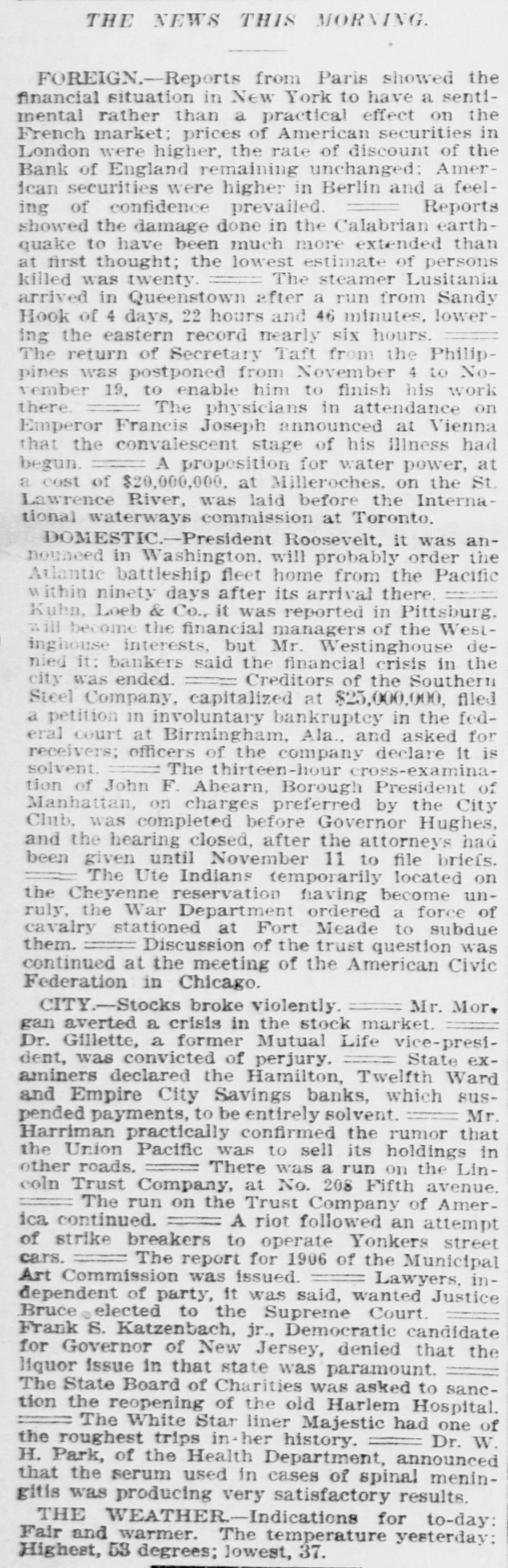
State examiners declared the Hamilton, Twelfth Ward and Empire City Savings banks, which suspended payments, to be entirely solvent.
Source
newspapers

Newspaper Articles (2)

Article from New-York Tribune, October 25, 1907

Click image to open full size in new tab

Article Text

THE NEWS THIS MORNING. FOREIGN.-Reports from Paris showed the financial situation in New York to have a sentimental rather than a practical effect on the French market; prices of American securities in London were higher, the rate of discount of the Bank of England remaining unchanged: American securities were higher in Berlin and a feelReports ing of confidence prevailed. showed the damage done in the Calabrian earthquake to have been much more extended than at first thought; the lowest estimate of persons killed was twenty. The steamer Lusitania arrived in Queenstown after a run from Sandy Hook of 4 days, 22 hours and 46 minutes, lowering the eastern record nearly six hours. The return of Secretary Taft from the Philippines was postponed from November 4 to November 19, to enable him to finish his work there. The physicians in attendance on Emperor Francis Joseph announced at Vienna that the convalescent stage of his illness had begun. A proposition for water power, at a cost of $20,000,000. at Milleroches. on the St. Lawrence River, was laid before the International waterways commission at Toronto. DOMESTIC.-President Roosevelt, it was announced in Washington, will probably order the Atlantic battleship fleet home from the Pacific within ninety days after its arrival there. Kuhn. Loeb & Co., it was reported in Pittsburg, will become the financial managers of the Westinghouse interests, but Mr. Westinghouse denied it: bankers said the financial crisis in the city was ended. Creditors of the Southern Steel Company, capitalized at $25,000,000, filed a petition in involuntary bankruptcy in the federal court at Birmingham, Ala., and asked for receivers; officers of the company declare It is solvent. The thirteen-hour cross-examination of John F. Ahearn, Borough President of Manhattan, on charges preferred by the City Club. was completed before Governor Hughes, and the hearing closed, after the attorneys had been given until November 11 to file briefs. The Ute Indians temporarily located on the Cheyenne reservation having become unruly, the ordered a force of War Department cavalry stationed at Fort Meade to subdue them. Discussion of the trust question was continued at the meeting of the American Civic Federation in Chicago. Mr. Mor. CITY.-Stocks broke violently gan averted a crisis in the stock market. Dr. Gillette, a former Mutual Life vice-president, was convicted of perjury. State examiners declared the Hamilton, Twelfth Ward and Empire City Savings banks, which susMr. pended payments, to be entirely solvent. Harriman practically confirmed the rumor that the Union Pacific was to sell its holdings in other roads. There was a run on the Lincoln Trust Company, at No. 208 Fifth avenue. The run on the Trust Company of America continued. A riot followed an attempt of strike breakers to operate Yonkers street cars. The report for 1906 of the Municipal Art Commission was issued. Lawyers, independent of party, it was said, wanted Justice Bruce elected to the Supreme Court. Frank S. Katzenbach, jr., Democratic candidate for Governor of New Jersey, that denied the liquor issue in that state was paramount. The State Board of Charities was asked to tion of the old Harlem the reopening Hospital. sancThe White Star liner Majestic had one of the roughest trips in-her history. Dr. W. H. Park, of the Health Department, announced that the serum used in cases of spinal meningitis was producing very satisfactory results. THE WEATHER-Indications for to-day: Fair and warmer. The temperature yesterday: Highest, 53 degrees; lowest, 37.

Article from The Abbeville Press and Banner, November 20, 1907

Click image to open full size in new tab

Article Text

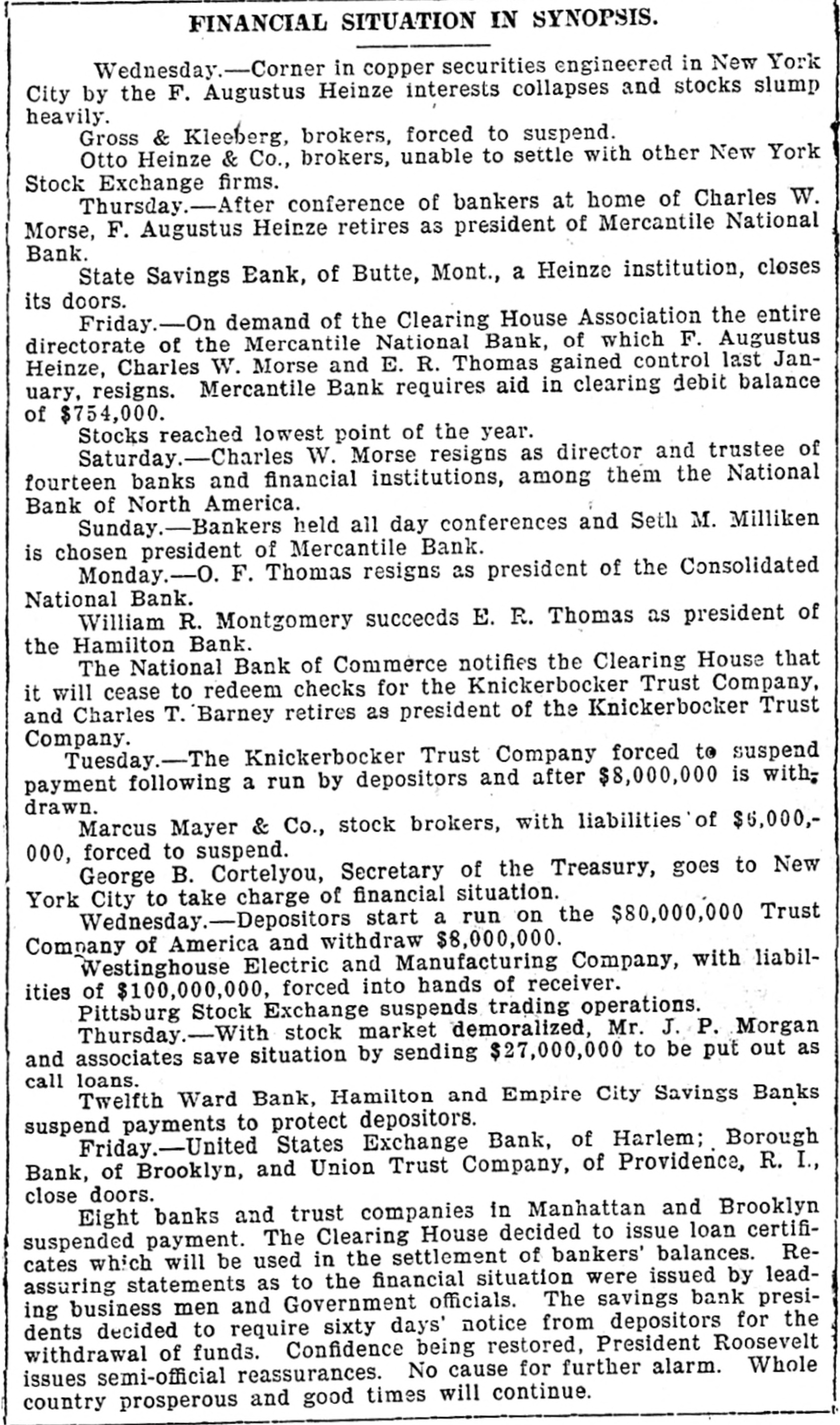
# FINANCIAL SITUATION IN SYNOPSIS. Wednesday.- Corner in copper securities engineered in New York City by the F. Augustus Heinze interests collapses and stocks slump heavily. Gross & Kleeberg, brokers, forced to suspend. Otto Heinze & Co., brokers, unable to settle with other New York Stock Exchange firms. Thursday.- After conference of bankers at home of Charles W. Morse, F. Augustus Heinze retires as president of Mercantile National Bank. State Savings Bank, of Butte, Mont., a Heinze institution, closes its doors. Friday.- On demand of the Clearing House Association the entire directorate of the Mercantile National Bank, of which F. Augustus Heinze, Charles W. Morse and E. R. Thomas gained control last January, resigns. Mercantile Bank requires aid in clearing debit balance of $754,000. Stocks reached lowest point of the year. Saturday.- Charles W. Morse resigns as director and trustee of fourteen banks and financial institutions, among them the National Bank of North America. Sunday.- Bankers held all day conferences and Seth M. Milliken is chosen president of Mercantile Bank. Monday.- O. F. Thomas resigns as president of the Consolidated National Bank. William R. Montgomery succeeds E. R. Thomas as president of the Hamilton Bank. The National Bank of Commerce notifies the Clearing House that it will cease to redeem checks for the Knickerbocker Trust Company, and Charles T. Barney retires as president of the Knickerbocker Trust Company. Tuesday.- The Knickerbocker Trust Company forced to suspend payment following a run by depositors and after $8,000,000 is withdrawn. Marcus Mayer & Co., stock brokers, with liabilities of $5,000,000, forced to suspend. George B. Cortelyou, Secretary of the Treasury, goes to New York City to take charge of financial situation. Wednesday.- Depositors start a run on the $80,000,000 Trust Company of America and withdraw $8,000,000. Westinghouse Electric and Manufacturing Company, with liabilities of $100,000,000, forced into hands of receiver. Pittsburg Stock Exchange suspends trading operations. Thursday.- With stock market demoralized, Mr. J. P. Morgan and associates save situation by sending $27,000,000 to be put out as call loans. Twelfth Ward Bank, Hamilton and Empire City Savings Banks suspend payments to protect depositors. Friday.- United States Exchange Bank, of Harlem; Borough Bank, of Brooklyn, and Union Trust Company, of Providence, R. I., close doors. Eight banks and trust companies in Manhattan and Brooklyn suspended payment. The Clearing House decided to issue loan certificates which will be used in the settlement of bankers' balances. Reassuring statements as to the financial situation were issued by leading business men and Government officials. The savings bank presidents decided to require sixty days' notice from depositors for the withdrawal of funds. Confidence being restored, President Roosevelt issues semi-official reassurances. No cause for further alarm. Whole country prosperous and good times will continue.