Fairbanks Banking Company (Fairbanks, AK)

Episode Information

Episode UID
6593746391333
Episode Type
Run โ†’ Suspension โ†’ Closure
Bank Type
state
Bank ID
659374639 hash
Start Date
January 4, 1911
Location
Fairbanks, Alaska (64.838, -147.716)

Metadata

Model
gpt-5-mini (chosen from majority vote of a three-model LLM ensemble)
Short Digest
a5ec52a55619bdd7

Response Measures

None

Description

Failure dated in sources to January 4, 1911; receivership and permanent closure follow.

Events (4)

1. January 4, 1911 Receivership
Newspaper Excerpt
Judge Overfield appointed Frank W. Hawkins and E.H. Mack, receivers, and they received from the officers of the bank $74,000 in cash ... Soon after Hawkins and Mack were removed, and Judge Overfield appointed Frank Noyes, the present receiver.
Source
newspapers
2. January 4, 1911 Run
Cause
Bank Specific Adverse Info
Cause Details
Large withdrawals exhausted ready cash amid underlying insolvency/poor assets and disputed stock/notes.
Measures
None reported other than subsequent appointment of receivers and payment of dividends by receiver.
Newspaper Excerpt
the bank has closed its doors, probably from a shortage O. ready cash, insufficient to meet a run of depositors that doubtless took place.
Source
newspapers
3. January 4, 1911 Suspension
Cause
Bank Specific Adverse Info
Cause Details
Bank closed due to inability to meet depositor withdrawals and insolvent condition revealed by loans/stock irregularities.
Newspaper Excerpt
At the time of the failure of the Fairbanks Banking Co. on January 4, 1911, Judge Overfield appointed Frank W. Hawkins and E.H. Mack, receivers
Source
newspapers
4. January 15, 1911 Other
Newspaper Excerpt
Following the institution of legal proceedings, the affairs of the bank were put up to the federal court which will look after the business through the medium of Receiver Hawkins
Source
newspapers

Newspaper Articles (17)

Article from Iditarod Pioneer, January 15, 1911

Click image to open full size in new tab

Article Text

Such is the import of a press telegram received here on the last mail, which unfortunately fails to give as full an account of what has been happening in Fairbanks as could be desired All that is known here is that the bank has closed its doors, probably from a shortage O. ready cash, insufficient to meet a run of depositors that doubtless took place. Following the institution of legal proceedings, the ffairs of the bank were put up to the federal court which will look after the business through the medium of Receiver Hawkins Men here, who are interested in the affairs of the old Fairbanks Banking Company and of the Washington Alaska, both as stockholders and depositors are at a loss to account for what has happened. Some think it may have


Article from The Alaska Citizen, January 23, 1911

Click image to open full size in new tab

Article Text

MISS WRENN NOTE IS PAID $5,000 WITH INTEREST IS RECEIVED FROM SOME UNKNOWN PARTY. The hearing on the petition of the Dexter Horton bank to quash and set aside the writ of assistance, whereby the money consigned by the Washington-Alaska bank to the Dexter Horton bank was seized by the United States marshal at Cordova, has been set for February 23. The Dexter Horton bank asks that the money be returned to it. The depositions of W. H. Parsons and two others will be taken in Seattle before M. W. Bolster. Little of interest in connection with the bank failure has transpired during the week. unless it be the forwarding by some party at San Francisco of enough money to pay the Miss Wrenn note for $5,000 with interest, which money was sent by telegraphic exchange through the First National bank here last Thursday. Receiver Hawkins stated last night that he did not know who was the sender of the money. This note, it will be remembered, was one given by Miss Wrenn, a former stenographer at the bank, to cover an advance of $5,000 made to her, and as security for which she gave Fairbanks Banking Company stock. The story goes that Barnette sold Miss Wrenn $10,000 worth of the stock with a stipulation she could get her money back if she ever became dissatisfied with the purchase. A short time afterwards she was informed that her purchase was not a very wise one and she went to the captain and demanded her money. Barnette is said to have given her $5,000 in cash and to have instructed Jackson to advance her another $5,000 on her note, with her stock as security. When Jackson interposed the objection that that was a matter the directors should have a hand in he was ask d whether he was working for Barnette or the directors. It was this note which has just been taken up. whether by Miss Wrenn or Barnette is not known. The payment of the dividend progressed smoothly all week and the bank will be kept open for the accommodation of those who were unable to get to the bank last week. The receivers again urge all those who are indebted to the bank, and able to do so, to discharge their indebtedness as soon as possible, as in this way they will benefit the depositors who have money tied up in the bank


Article from The Daily Alaskan, February 23, 1911

Click image to open full size in new tab

Article Text

WILLIAM NOTE IS PAID According to the Alaska Citizen, the hearing on the petition of the Dexter Horton bank to quash and set aside the writ of assistance. whereby the money consigned by the Washington-Alaska bank to the Dexter Horton bank was seized by the United States marshal at Cordova, has been set for February 23. The Dexter Horton bank asks that the money be returned to it. The depositions of W. H. Parsons and two others will be taken in Seattle before M. W. Bolster. Little of interest in connection with the bank failure has transpired during the week, unless it be the forwarding by some party in San Francisco of enough money to pay the Miss Wrenn note for $5,000 with interest, which money was sent by telegraphic exchange through the First National bank here last Thursday. Receiver Hawkins stated last night that he did not know who was the sender of the money. This note, it will be remembered, was one given by Miss Wrenn, a former stenographer at the bank, to cover an advance of $5,000 made to her, and as security for which she gave Fairbanks Banking Company stock The story goes that Barnette sold Miss Wrenn $10,000 worth of the stock with a stipulation she could get her money back if she ever became dissatisfied with the purchase A short time afterwards she was informed that her purchase was not a very wise one and she wert to the captain and demanded her money. Barnette is said to have given her $5,000 in cash and to have instructed Jackson to advance her another $5,000 on her note, with her stock as security. When Jackson interposed the objection that that was a matter the directors should have a hand in he was asked whether he was working for Barnette or the directors. It was this note which has just been taken up, whether by Miss Wrenn or Barnette is not known. The payment of the dividend progressed smoothly all week and the bank will be kept open for the accommodation of those who were unable to get to the bank last week. The receivers again urge all those who are indebted to the bank, and able to do so, to discharge their indebtedness as soon as possible, as in this way they will benefit the depositors who have money tied up in the bank -


Article from Iditarod Pioneer, December 16, 1911

Click image to open full size in new tab

Article Text

meeting of the creditors, depositors and customers of the Washington-Aluska Bank of Washington and the Washingtonof Nevada, held Fair29, 1911, which banks Alaska March Bank asked at for the following: 1. The removal of F. W. Hawkins as receiver of the Washington - Alaska bank. 2. The appointment of a conscientious as courageous special and competent, citizen a officer to serve any necessary special venires for additional persons to fill the panel of any grand jury called to investigate the alleged fraud ulent acts of the officers of the Fairbanks Banking Company, the Washington Alaska Bank of Washingtor. and the Washington-Alaska Bank of Neva's 3. The permission of the court to allow the depositors, creditors and customers of said bank and institution and the attorney of said depositors, creditors customers to have an ant and bank accountor examiner investigate the accounts of said institution. In answer to this request the judge is said to have stated that he considered that Hawkins was a gentleman; had perfect confidence in him; did not consider the fact that he had been an officer of both the Washington-Alaska Bank of Washington and the Washington-Alaska Bank of Nevada a barrier o the usefulness of Hawkins as reeiver: nor did he consider the rumors e had heard of Hawkins's life and domestic troubles as things that unfit him as receiver; nor could he see that Hawkins could have any object in rearding an investigation of the affairs of the bank, but, on the other hand, had submitted to the grand jury all the evidence asked for and more: and would not remove Hawkins unless other and more substantial facts showing the unitness of Hawkins could be filed with him. The judge further stated his beief that the grand jury which investigated the bank matters was a representative body, and explained the method of selecting grand jurors. The udge refused to allow the request for in accountant or for an examiner of banks, stating that he had plans of his own he did not care to divulge at that time. [It appears that Judge Overfield had written the Attorney General on April 3, ten days before the interview. asking that an examiner be sent to inestigate the bank matter.] Second-It is claimed that F. W. Hawkins was appointed receiver at the request of the directors of the failed bank and others. Third-Biot A. Dodge, representing the Women Depositors' Committee. filed a petition in intervention which brayed for: 1. That the petitioners be made paries defendant in the action entitled Tanana Valley Railroad Company and John Zug vs. Washington-Alaska Bank of Nevada. 2. That the petitioners be permitted o defend the said action as against the plaintiffs and as against the defendants until a receiver shall have been appointed for the Washington - Alaska Bank of Washington, and thereafter, if necessary. 3. That in said action or in any other action wherein the same may appear necessary, the court appoint a receiver for the Washington-Alaska Bank of Washington with full powers in the premises. 4. That the petitioners be permitted o employ accountant or bank examner, and that such examiner and the attorney for the petitioners be allowed o examine and audit the books of the Fairbanks Banking Company, the Washington-Alaska Bank of Washingon, and the Washington-Alaska Bank of Nevada. 5. That F. W. Hawkins be removed as one of the receivers of the Washington-Alaska Bank of Nevada. 6. That the receivers of the Washington-Alaska Bank of Nevada be incourt disburse no more structed by order moneysotherthan of the to those required for necessary X is


Article from Iditarod Pioneer, April 20, 1912

Click image to open full size in new tab

Article Text

# WANTS SETTLEMENT # FOR UNPAID STOCK Fairbanks, April 19.-Receiver Noyes is to demand from the stockholde.s of the old Fairbanks Bank settlement for their unpaid portion of stock. Many subscribers hold shares which were never paid for.


Article from Valdez Daily Prospector, December 12, 1912

Click image to open full size in new tab

Article Text

might have had something to do I with the bank's suspension. don't remember of Capt. Barnette having over forty or fifty thousand dollars in mining property on Domie creek. Mining property was considered a good deal. J. 1.. Tole, sworn: I was a stockholder and depositor of the Fairbanks Banking company. The bank closed twice. On the reorganization I had a conversation with Barnette. He told me Clarence Berry was to take a large block of stock. I agreed to take from three to live thousand dollars' worth. I attended the reorganization meeting and there were 12 directors elected. The statement was then made that stock should be paid for in stock or in notes. Afternoon Session. Chas. Pajoman, indicted for violating election law at Afognak. arraigned and given until Saturday morning al 10 a. m. to plead. Court fixed bond at $2.000. If a lesser bond will guarantee the presence of defendant, court will consider the matter. Jury directed to sign a verdiet regarding defendants being placed in jeopardy in former case. F. G. Noyes, receiver Washington-Alaska bank: I have tried to collect on these stock notes. Have collected but little. Witness identified certain bank exhibits. Jno. 1.. Proctor: Examined the books and papers of bank in question. Those notes were traced back as credit on stock account and made up part of capital stock. Sixteen hundred and ninety-six shares were issued all paid for but about $21,000. The total number of shares issued was 202,200: some was Petired after that. These stock notes were carried in the loans and discounts and are entered as if they were loans for capital stock.


Article from The Alaska Citizen, December 16, 1912

Click image to open full size in new tab

Article Text

# Facts Upon Which Two Decisions Were Based VALDEZ. Dec. 9. Armstrong notary. testifies that the Gold Bar stock is worth $500,000, Dick Woods testified today that there was always disagreement in the Fairbanks Banking company over Barnette's purchase of the Gold Bar stock. The case is moving slowly. VALDEZ, Dec. 9. The joint trial of Captain Barnette and B. R. Dusenbury on the charge of making false reports, will come to an end tonight. Judge Lyons announcing that he will hold a night session. The witnesses for the government were F. G. Noyes, receiver; James W. Hill, one of the owners of the old Fairbanks Banking company; C. C. Page, clerk of the court; Chas. W. Taylor, who was secretary of the depositors' committee at the time of the first failure of the bank; Ray Brumbaugh, the Fairbanks Hardware man; A. T. Armstrong, of Seattle, one of the officers of the Gold Bar Lumber company; Dr. W. G. Cassels, of Fairbanks; John L. Proctor, bank examiner, and R. C. Wood, president of the First National Bank, of Fairbanks. The defense introduced as witnesses: John L. McGinn, the Fairbanks attorney; and J. S. McKenzie, receiver for the Gold Bar Lumber company. Defendant Dusenbury also took the stand in his own behalf. McGinn, testifying in behalf of the defense, stated that he had advised Captain Barnette to file the report which represented that there had been paid into the bank the sum of $17.600 in money, when, as a matter of fact, there was only $145,000 in money, the balance being in notes for stock which were held by the bank. McGinn told the court that he could not remember whether either Barnette or Dusenbury had sworn to the report, although he was the notary. R. C. Wood testified that the purchase of the Gold Bar stock by Captain Barnette had been the cause of considerable disagreement among the stockholders. Attorney A. R. Heilig, of Fairbanks, states that he has not been retained by Captain Barnette in any case to be tried here. He is attending the hearing, he says, so that he may watch the proceedings, the trial for false report being similar to the case which he will be called upon to defend, when W. H. Parsons is placed on trial. VALDEZ, Dec. 10. - Judge Lyons pronounces Barnette and Dusenbury not guilty upon the charge of making a false report of the condition of the Washington-Alaska bank. The court, before which the case was tried, based its decision on the testimony of John L. McGinn, who stated that he had advised Barnette and Dusenbury that they could include in their report as money actually paid into the bank for stock the notes which were given by numerous of the stockholders. The court held that if Barnette and Dusenbury had been so advised by their attorney their action did not indicate that there had been any intent on their part to deceive or defraud. The court stated further that there was not sufficient evidence to show that Barnette and Dusenbury had tried to defraud the creditors of the bank by putting in the Gold Bar stock at an increased value of $93,000, as it had not been shown beyond a reasonable doubt that the interest of the Fairbanks Banking company in the Gold Bar Lumber company was not worth $341,000 at that time; and it had not been shown beyond a reasonable doubt that the $78,000 in notes, which had been paid in, and which were past due on September 14. 1909,


Article from Douglas Island News, January 8, 1913

Click image to open full size in new tab

Article Text

Condition of Fairbanks Bank in Receiver's Hands At the time of the failure of the Fairbanks Banking Co. on January 4, 1911, Judge Overfield appointed Frank W. Hawkins and E.H. Mack, receivers, and they received from the officers of the bank $74,000 in cash, and on telegraphic orders from Judge Overfield $101,000 of coin consigned to Dexter Horton, of Seattle, to settle an overdraft, was seized by the marshal at Cordova and returned to the receivers. This cash was immediately used by the receivers to pay dividends to the depositors. Soon after Hawkins and Mack were removed, and Judge Overfield appointed Frank Noyes, the present receiver. Mr. Noyes, a lumber dealer, is one of the influential men of that section. He was at one time a director of the First National bank and materially aided the bank to weather the panic of 1907. He enjoys the confidence of the community in which he has resided for many years, having come to this country in 1898. In the eight months which followed Noyes collected $198,884.28 and has pending many suits for unpaid notes. Ai the time he assumed charge he received in cash from Hawkins and Mack $4,464.50, and they had at that time unpaid dividends of $48,000. Noyes paid these and also paid other dividends to the depositors. The receiver has been instructed by Judge Overfield to pay to Dexter Horton as soon as he can get it, $59,000 being a 50 per cent dividend which was not paid to them until the court in San Francisco has passed on the ruling of Judge Overfield, and $25,000 of this has already been paid. The bank still has uncollected notes running into many thousands, most of which will never bring in a dollar. They have an equity in the Gold Bar Lumber company for four fifths of the stock of that company, but the Dexter Horton company hold the stock as security for the loan of $118,000, which was an overdraft of the Fairbanks bank with them prior to the failure. Among the uncollected notes are three from Arthur McNeer for about $3,300, borrowed from the bank at different times; $200 of it was borrowed 60 days before the failure of the bank, although at that time he was indebted to the bank and they had been unable to collect from him. Dan Jonas had touched the bank for a loan of $14,000. Jonas has since gone broke and is now in New York working for wages. The bank failed owing depositors $921,357.56, but of this sum $460,678.78 has been paid to them. The receiver has also paid all running expenses of the receivership to date. It is estimated that the bank has uncollectable notes for $141,000, on which nothing practically will be realized.-Ex.


Article from The Alaska Daily Empire, January 29, 1914

Click image to open full size in new tab

Article Text

# GLEANINGS OF GREAT # NORTHERN EMPIRE The report of the receiver of the Fairbanks Banking company, Capt. Barnette's bank, showed a balance on hand of $51,084.33. Much of this sum, however, is held to pay dividends already allowed by the court to persons where the money has been garnished or where there is dispute as to whom it should be paid. M. E. Lane, the Myers Chuck, Ketchikan district, salmon salter, has sold his saltery at Myers Chuck, and will build a salting station at Kendrick Arm. Nome has an indoor baseball league, and the contest for the pennant is becoming one of absorbing interest in the Seward peninsula metropolis. There are 115 pupils enrolled in the Nome public school. Late reports received at Fairbanks indicate that the Tanana Crossing country will develop into a good placer camp. It is said that the results obtained by those doing assessment work last fall were very favorable. There are 25 new cabins in the district, and a good deal of work is planned for next year.


Article from Valdez Daily Prospector, June 12, 1914

Click image to open full size in new tab

Article Text

FAIRBANKS BANK CASES UNJLU ULUIUCU NY Judge Noyes Renders Opinion Against the Receiver in Efforts to Recover From Directors. FAIRBANKS, June 11.-After hearing the arguments in the suit brought by Receiver Noyes, of the Fairbanks Banking Company and the Washington-Alaska Bank against the stockholders of the bank to recover the amount of money paid the stockholders in dividends, decided today for the plaintiffs, the receiver having failed to prove to the satisfaction of the court that the bank was insolvent at the time he dividend was declared. The case agains Dick Wood and the directors of the bank to recover $13,000 paid by the directors to Wood, the court held' that the defendants were not liable for the money taken. The only case now pending is that of Noyes as receiver versus the former receivers, Hawkins and Mack, who were discharged by Judge Overfield because they paid to themselves from the. funds entrusted to them without securing an order of court so to do. They are being sued for money because of illegal compromise alleged by the receiver by which the bank creditors lost.


Article from The Alaska Citizen, June 15, 1914

Click image to open full size in new tab

Article Text

Stockholders Win Out in Bank Case Stockholders of the WashingtonAlaska bank will not be required to make good to the defunct institution the money paid them as dividends. This was decided by Judge Fuller Saturday. The money paid to the bank's directors as dividends must be returned, however. It was held by the court that as the dividends had been paid when the bank was supposed to be solvent, the stockholders were not responsible, even if the dividends were not proper. The court also decided the case of the receiver of the bank against R. C. Wood for $13,000 paid to Mr. Wood for his stock in the Fairbanks Banking Co., by the directors, and Mr. Wood will not have to make the payment. The only remaining case now to be tried is that of Receiver F. G. Noyes against the former receivers of the bank and their bondsmen, and it is probable that the case will not go to trial until after the court returns in September from Iditarod.


Article from The Seward Gateway, May 15, 1915

Click image to open full size in new tab

Article Text

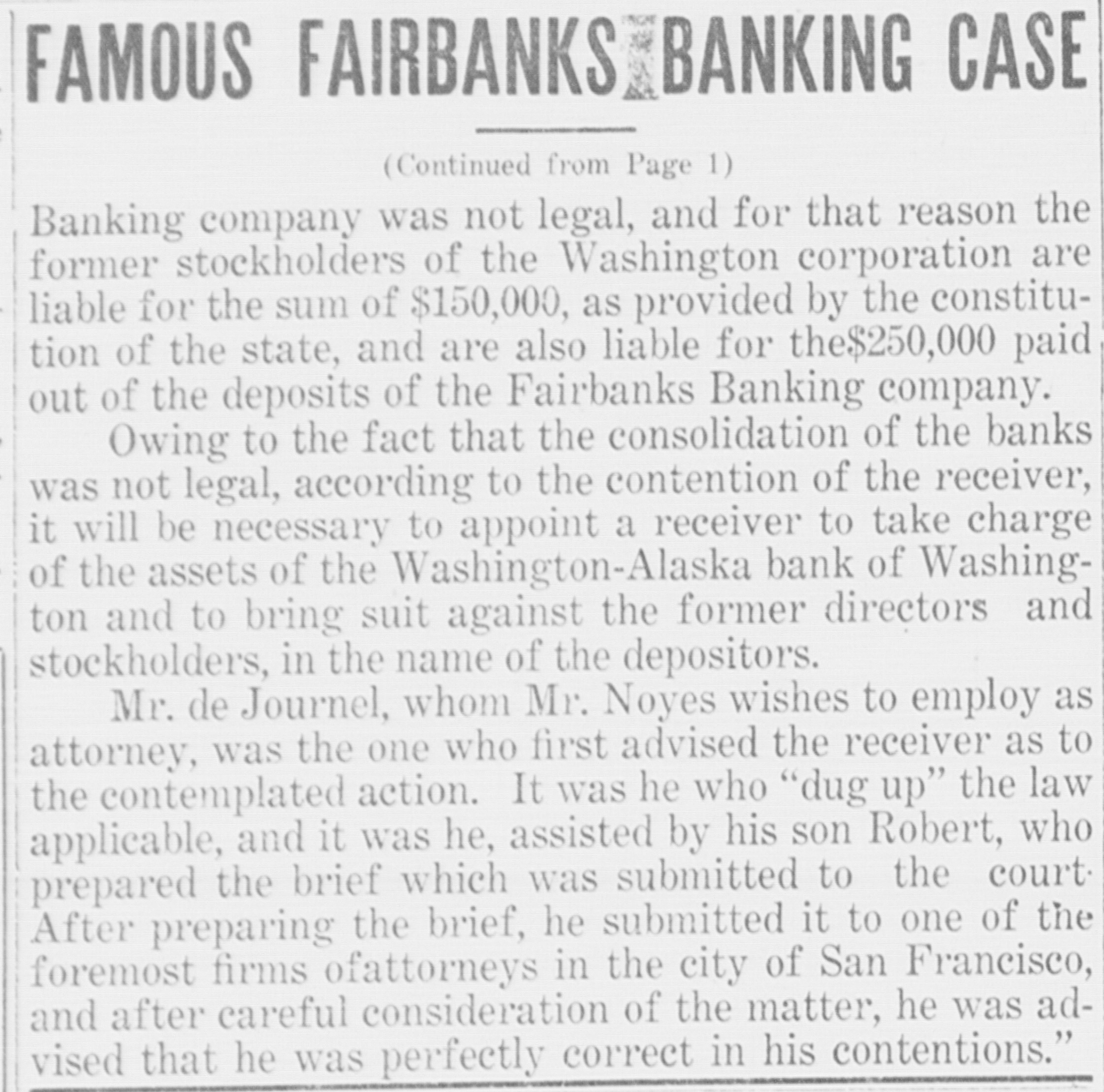
FAMOUS FAIRBANKS BANKING CASE (Continued from Page 1) Banking company was not legal, and for that reason the former stockholders of the Washington corporation are liable for the sum of $150,000, as provided by the constitution of the state, and are also liable for the$250,000 paid out of the deposits of the Fairbanks Banking company. Owing to the fact that the consolidation of the banks was not legal, according to the contention of the receiver, it will be necessary to appoint a receiver to take charge of the assets of the Washington-Alaska bank of Washington and to bring suit against the former directors and stockholders, in the name of the depositors. Mr. de Journel, whom Mr. Noyes wishes to employ as attorney, was the one who first advised the receiver as to the contemplated action. It was he who "dug up" the law applicable, and it was he, assisted by his son Robert, who prepared the brief which was submitted to the court After preparing the brief, he submitted it to one of the foremost firms ofattorneys in the city of San Francisco, and after careful consideration of the matter, he was advised that he was perfectly correct in his contentions."


Article from The Chitina Leader, June 1, 1915

Click image to open full size in new tab

Article Text

Now that Receiver Noyes, of the defunct Fairbanks bank, has a new attorney, that gentleman is devising ways of earning his salary. As a consequence Fernand de Journel has induced Judge Bunnell to sign an order citing E. T. Barnette and Isabelle Barnette to appear in court and show cause why they should not be declared in contempt of court for suing the receiver of the Washington-Alaska Bank, without first obtaining permission from the court. According to the contention of the attorney, no one can start suit against a receiver without first obtaining permission to do so. The object of this is to prevent frivolous and expensive litigation for the purpose of hampering or tying up an estate. Last fall, the Barnettes brought suit against the receiver, while there was no judge in the Fourth division, asking that they be awarded the property which is held by the receiver under a trust deed given by Mr. and Mrs. Barnette. They also asked that the $30,000 collected for rent be turned over to them.


Article from The Nome Daily Nugget, September 4, 1915

Click image to open full size in new tab

Article Text

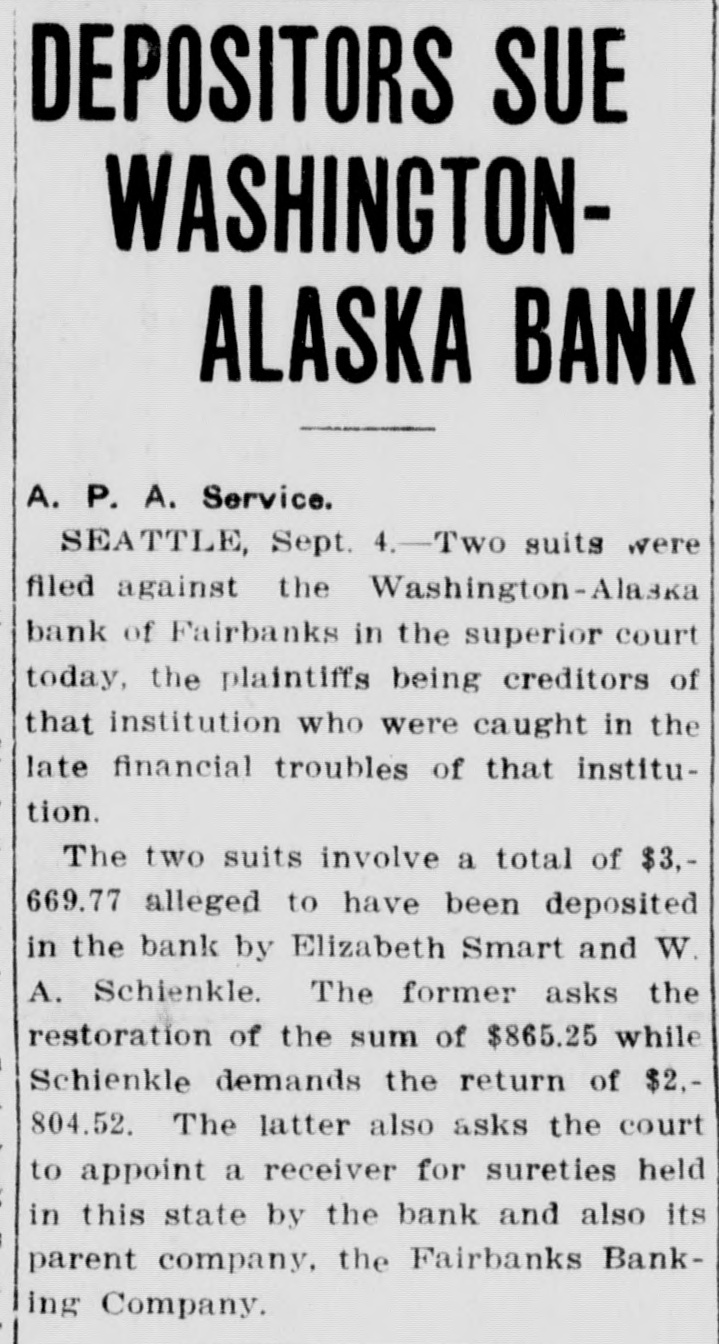
DEPOSITORS SUE WASHINGTONALASKA BANK A. P. A. Service. SEATTLE, Sept. 4. -Two suits were filed against the Washington-Alaska bank of Fairbanks in the superior court today, the plaintiffs being creditors of that institution who were caught in the late financial troubles of that institution. The two suits involve a total of $3,669.77 alleged to have been deposited in the bank by Elizabeth Smart and W. A. Schienkle. The former asks the restoration of the sum of $865.25 while Schienkle demands the return of $2.804.52. The latter also asks the court to appoint a receiver for sureties held in this state by the bank and also its parent company, the Fairbanks Banking Company.


Article from The Alaska Citizen, September 10, 1917

Click image to open full size in new tab

Article Text

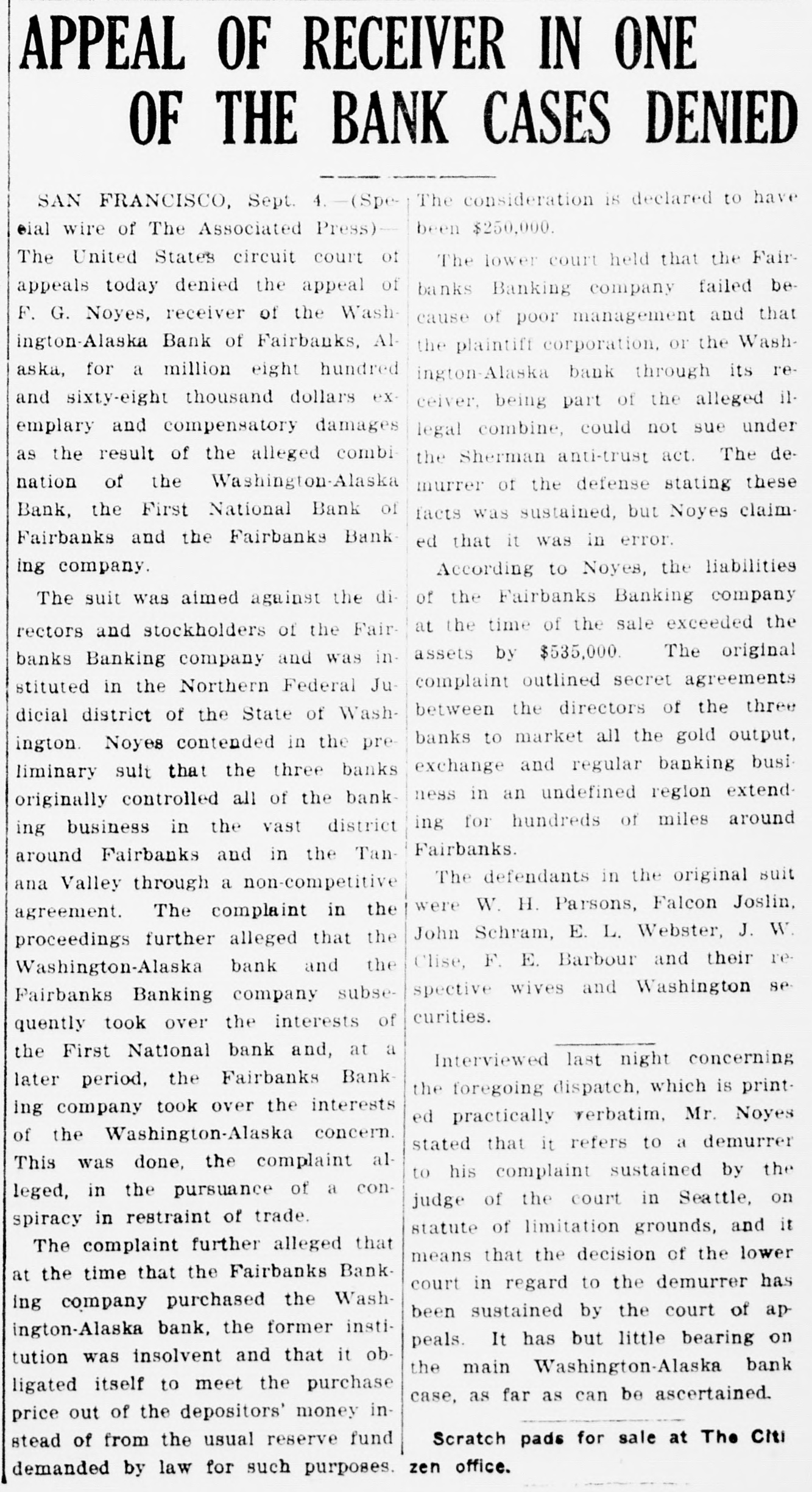
APPEAL OF RECEIVER IN ONE OF THE BANK CASES DENIED The consideration is declared to have SAN FRANCISCO, Sept. 4. (Spe been $250,000. eial wire of The Associated Press) The United States circuit court of The lower court held that the Fairappeals today denied the appeal of banks Banking company failed be F. G. Noyes, receiver of the Washcause of poor management and that ington-Alaska Bank of Fairbanks, Althe plaintiff corporation, or the Washaska, for a million eight hundred ington-Alaska bank through its reand sixty-eight thousand dollars exceiver. being part of the alleged ilemplary and compensatory damages legal combine, could not sue under as the result of the alleged combi the Sherman anti-trust act. The denation of the Washington-Alaska murrer of the defense stating these Bank, the First National Bank of facts was sustained, but Noyes claimFairbanks and the Fairbanks Bank ed that it was in error. ing company. According to Noyes, the liabilities of the Fairbanks Banking company The suit was aimed against the diat the time of the sale exceeded the rectors and stockholders of the Fairassets by $535,000. The original banks Banking company and was in complaint outlined secret agreements stituted in the Northern Federal Jubetween the directors of the three dicial district of the State of Washbanks to market all the gold output, ington. Noyes contended in the preexchange and regular banking busi liminary sult that the three banks ness in an undefined region extendoriginally controlled all of the bank ing for hundreds of miles around ing business in the vast district Fairbanks. around Fairbanks and in the TanThe defendants in the original suit ana Valley through a non-competitive were W. H. Parsons, Falcon Joslin, agreement. The complaint in the John Schram, E. L. Webster, J. W. proceedings further alleged that the Clise, F. E. Barbour and their reWashington-Alaska bank and the spective wives and Washington se Fairbanks Banking company subsecurities. quently took over the interests of the First National bank and, at a Interviewed last night concerning later period, the Fairbanks Bank the foregoing dispatch, which is printing company took over the interests ed practically verbatim, Mr. Noyes of the Washington-Alaska concern. stated that it refers to a demurrer This was done, the complaint alto his complaint sustained by the leged, in the pursuance of a conjudge of the court in Seattle, on spiracy in restraint of trade. statute of limitation grounds, and it The complaint further alleged that means that the decision of the lower at the time that the Fairbanks Bank court in regard to the demurrer has ing company purchased the Washbeen sustained by the court of apington-Alaska bank, the former instipeals. It has but little bearing on tution was insolvent and that it obthe main Washington-Alaska bank ligated itself to meet the purchase case, as far as can be ascertained. price out of the depositors' money inScratch pads for sale at The Citi stead of from the usual reserve fund demanded by law for such purposes. zen office.


Article from The Cordova Daily Times, August 12, 1918

Click image to open full size in new tab

Article Text

Mr. and Mrs. Fred G. Noyes of Fairbanks reached Cordova on yesterday's train, having come as far as Chitina in their own automobile. Mr. Noyes is the receiver of the famous Fairbanks-Alaska bank. and he and his wife are on their way to California, where they will spend the win-

Article from The Daily Alaska Empire, October 7, 1927

Click image to open full size in new tab

Article Text

dated for the purpose of the trial. The charge against the former legislator was that he had converted to his own use funds that had come into his possession as receiver of the Fairbanks Banking Company.