Bank of Southport (Southport, NC)

Episode Information

Episode UID
66044071478
Episode Type
Suspension → Closure
Bank Type
state
Bank ID
6604407 routing
Routing Number
66-0440
Start Date
February 1, 1923
Location
Southport, North Carolina (33.922, -78.020)

Metadata

Model
gpt-5-mini (chosen from majority vote of a three-model LLM ensemble)
Short Digest
eaf4632740d7b5b5

Response Measures

None

Description

Closure tied to insolvency and mismanagement linked to T. E. Cooper; receiver appointed.

Events (2)

1. February 1, 1923 Suspension
Cause
Bank Specific Adverse Info
Cause Details
Bank insolvent after losses and alleged fraud/mismanagement involving Thomas E. Cooper and related Commercial National transactions.
Newspaper Excerpt
closed its doors February 1, 1923.
Source
newspapers
2. April 11, 1923 Receivership
Newspaper Excerpt
The new bank ... Peoples' United Bank, has given the necessary bond and become permanent receiver for the closed Bank of Southport.
Source
newspapers

Newspaper Articles (9)

Article from The News and Observer, April 12, 1923

Click image to open full size in new tab

Article Text

HEALTH OFFICERS TO MEET MONDAY Dr. A. C. Bulla To Deliver Annual President's Address At Asheville The president's annual address delivered by Dr. A. C. Bulla, Wake County Health officer, will feature the thirteenth annual session of the North Carolina Public Health Association which will hold morning, afternoon and evening sessions at Asheville Monday of next week. Other officers of the association are Dr. C. W. Armstrong, of Salisbury, vice president, and Dr. F. M. Register, of Raleigh, secretary. The association will be in session only one day but the program calls for three crowded sessions. President Bulla will make his address at the morning session and the other principal address will be delivered at the evening session by Dr. Cyrus Thompson, of Jacksonville, Fla. Seven papers on public health problems will be read by health officers of the State and specialists and each paper will be discussed by another member of the association. Papers are limited to 15 minutes and discussions to five minutes. The program follows: 9:45 A. M.—1 P. M. 1. Called to order by the president. 2. Prayer: Rev. Willis G. Clarke, Trinity Church, Asheville. 3. President's Annual Address. 4. Report of Secretary: F. M. Register, M. D., Raleigh. 5. Report of Special Committee. 6. Appointment of (a) Committee on president's address; (b) committee on visitors and new members; (c) committee on resolutions; (d) other committees. 7. The Health Officer's Golden Rule—R. S. McGeachy, M. D., Kinston; Discussion by Roy C. Mitchell, M. D., Raleigh. 8. The Sanitary Privy in Disease Prevention, A. J. Ellington, M. D., Goldsboro; Discussion by D. R. Perry, M. D., Lexington. 9. The Importance of Tonsil and Adenoid Operations on Children, with Proposed Plans for Getting it Done—J. R. McCracken, M. D., Waynesville; Discussion by J. B. Green, M. D., Asheville. 10. Malaria in Eastern North Carolina, H. A. Taylor, M. D., Bayboro; Discussion by J. H. Hamilton, M. D., Wilmington. 2:45 P. M.—5 P. M. 1. County Tubercular Problem—How Best Handled—Wm. Jones, M. D., Greensboro; Discussion by Carl V. Reynolds, M. D., Asheville. 2. Administration of Vaccine among Rural School Children, P. C. Carter, M. D., Weldon; Discussion by C. N. Sisk, M. D., Winston-Salem. 3. Mental Hygiene—Albert Anderson, M. D., Raleigh; Discussion by John McCampbell, M. D., Morganton. 7:45 P. M.—10 P. M. 1. The Aims and Purposes of Maternity and Infancy Work in North Carolina—K. P. B. Bonner, M. D., Raleigh; Discussion by M. L. Ilsley, M. D., Asheville. 2. Address—Cyrus Thompson, M. D., Jacksonville, Fla. 3. Adoption of Resolution. 4. Election of Officers. 5. Adjournment. NEW BANK RECEIVER FOR CLOSED SOUTHPORT BANK Southport, April 11.—The new bank here, Peoples' United Bank, has given the necessary bond and become permanent receiver for the closed Bank of Southport. This receivership will be handled without any commission, only actual expenses. It is proposed by the new bank people to liquidate as fast as possible on the collaterals turned over to it from the old bank so that depositors may get some dividends as early as possible.

Article from The News and Observer, January 11, 1924

Click image to open full size in new tab

Article Text

BANK'S AFFAIRS AIRED IN COURT Thos. E. Cooper Alleged To Have Used Fraud On Southport Bank Southport, Jan. 10.—At the spring term of the Superior Court of Brunswick county, in session this week for the trial of civil cases, his honor, Judge Thomas H. Calvert, presiding, the most interesting case of the Receiver of the Bank of Southport vs. Wells and Howard, to recover on a $5,000 note, came up for trial. It is a case of particular importance, as showing the dealing of Thomas E Cooper at that time of the note issuance in 1922, when he was president both of the Commercial National Bank of Wilmington and the Bank of Southport, both banks wrecked through the Coopers. According to the showing in this case, the note of $5,000, made to the order of "myself," signed by Wells and endorsed by Wells and Howard, was drawn to pay for 50 shares of the stock of the Commercial National, which Thomas E. Cooper is alleged to have represented as worth $116 a share, and that a note was perfectly satisfactory to pay for these shares as he, Cooper, could get the note discounted. This note of Wells and Howard was sent to the Bank of Southport by Cooper, who stated in the letter accompanying the note that the endorsers were movie picture men worth $100,000 and that the note was sent because the Commercial Bank needed the money to take up some real estate paper. The note was discounted by the Bank of Southport. About ten days later, Cooper wrote to the bank here to change the proceeds of the note that had been discounted and credited to the Commercial National to his personal account. The defendants made the plea that the note had been secured from them by fraud and misrepresentation. And that Cooper being president of the Bank of Southport, the bank was party to the fraud, and that the note be declared of fraudulent origin, therefore, of no effect. The defendants offered no witnesses. The plaintiff put on the stand the cashier and vice-president of the Bank of Southport, who testified as to receiving and discounting the note, who knew nothing as to the obtaining of the note, but did know of the signers' business standing. Therefore, the bank was an innocent holder and not concerned as to how Cooper procured the note. While the case was largely a matter of law, four issues were drawn up, the second to be presented to the jury for its decision, yes or no, related to whether the Southport bank should be held as cognizant of the Cooper fraud upon which the note was secured. The jury brought in a verdict in favor of the Southport bank receiver. New Jail Nears Completion. Kenansville, Jan. 10.—Duplin county's new jail is well under construction. When completed it is estimated that the total cost will be around $30,000. The need for a new jail has been felt for many years, the one now in use being in bad repair and very unsanitary. The water, lights and sewerage system of the new jail will be modern and as


Article from News and Record, January 11, 1924

Click image to open full size in new tab

Article Text

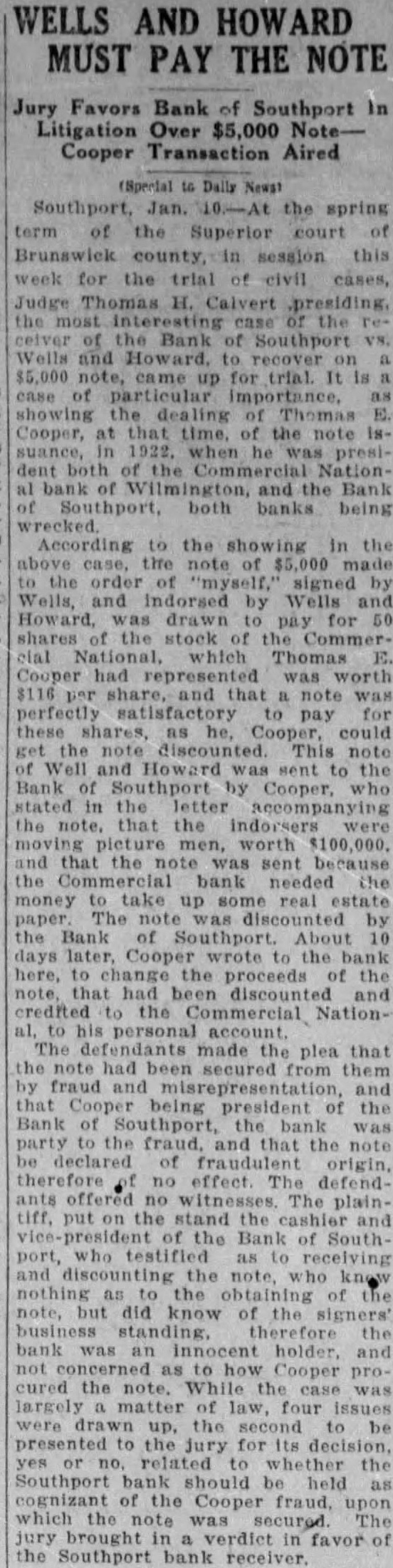
WELLS AND HOWARD MUST PAY THE NOTE Jury Favors Bank of Southport In Litigation Over $5,000 Note—Cooper Transaction Aired (Special to Daily News) Southport, Jan. 10.—At the spring term of the Superior court of Brunswick county, in session this week for the trial of civil cases, Judge Thomas H. Calvert presiding, the most interesting case of the receiver of the Bank of Southport vs. Wells and Howard, to recover on a $5,000 note, came up for trial. It is a case of particular importance, as showing the dealing of Thomas E. Cooper, at that time, of the note issuance, in 1922, when he was president both of the Commercial National bank of Wilmington, and the Bank of Southport, both banks being wrecked. According to the showing in the above case, the note of $5,000 made to the order of "myself," signed by Wells, and indorsed by Wells and Howard, was drawn to pay for 50 shares of the stock of the Commercial National, which Thomas E. Cooper had represented was worth $116 per share, and that a note was perfectly satisfactory to pay for these shares, as he, Cooper, could get the note discounted. This note of Wells and Howard was sent to the Bank of Southport by Cooper, who stated in the letter accompanying the note, that the indorsers were moving picture men, worth $100,000, and that the note was sent because the Commercial bank needed the money to take up some real estate paper. The note was discounted by the Bank of Southport. About 10 days later, Cooper wrote to the bank here, to change the proceeds of the note, that had been discounted and credited to the Commercial National, to his personal account. The defendants made the plea that the note had been secured from them by fraud and misrepresentation, and that Cooper being president of the Bank of Southport, the bank was party to the fraud, and that the note be declared of fraudulent origin, therefore of no effect. The defendants offered no witnesses. The plaintiff, put on the stand the cashier and vice-president of the Bank of Southport, who testified as to receiving and discounting the note, who knew nothing as to the obtaining of the note, but did know of the signers' business standing, therefore the bank was an innocent holder, and not concerned as to how Cooper procured the note. While the case was largely a matter of law, four issues were drawn up, the second to be presented to the jury for its decision, yes or no, related to whether the Southport bank should be held as cognizant of the Cooper fraud, upon which the note was secured. The jury brought in a verdict in favor of the Southport bank receiver.


Article from Asheville Citizen-Times, February 10, 1924

Click image to open full size in new tab

Article Text

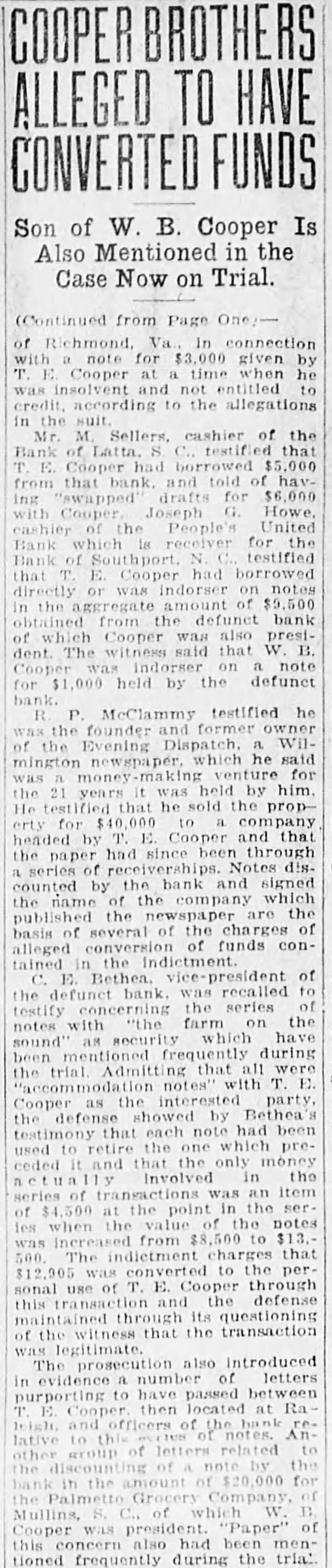
COOPER BROTHERS ALLEGED TO HAVE CONVERTED FUNDS Son of W. B. Cooper Is Also Mentioned in the Case Now on Trial. (Continued from Page One) of Richmond, Va., in connection with a note for $3,000 given by T. E. Cooper at a time when he was insolvent and not entitled to credit, according to the allegations in the suit. Mr. M. Sellers, cashier of the Bank of Latta, S. C., testified that T. E. Cooper had borrowed $5,000 from that bank, and told of having "swapped" drafts for $6,000 with Cooper. Joseph G. Howe, cashier of the People's United Bank which is receiver for the Bank of Southport, N. C., testified that T. E. Cooper had borrowed directly or was indorser on notes in the aggregate amount of $9,500 obtained from the defunct bank of which Cooper was also president. The witness said that W. B. Cooper was indorser on a note for $1,000 held by the defunct bank. R. P. McClammy testified he was the founder and former owner of the Evening Dispatch, a Wilmington newspaper, which he said was a money-making venture for the 21 years it was held by him. He testified that he sold the property for $40,000 to a company headed by T. E. Cooper and that the paper had since been through a series of receiverships. Notes discounted by the bank and signed the name of the company which published the newspaper are the basis of several of the charges of alleged conversion of funds contained in the indictment. C. E. Bethea, vice-president of the defunct bank, was recalled to testify concerning the series of notes with "the farm on the sound" as security which have been mentioned frequently during the trial. Admitting that all were "accommodation notes" with T. E. Cooper as the interested party, the defense showed by Bethea's testimony that each note had been used to retire the one which preceded it and that the only money actually involved in the series of transactions was an item of $4,500 at the point in the series when the value of the notes was increased from $8,500 to $13,500. The indictment charges that $12,905 was converted to the personal use of T. E. Cooper through this transaction and the defense maintained through its questioning of the witness that the transaction was legitimate. The prosecution also introduced in evidence a number of letters purporting to have passed between T. E. Cooper, then located at Raleigh, and officers of the bank relative to this series of notes. Another group of letters related to the discounting of a note by the bank in the amount of $20,000 for the Palmetto Grocery Company, of Mullins, S. C., of which W. B. Cooper was president. "Paper" of this concern also had been mentioned frequently during the trial.


Article from The News and Observer, April 3, 1924

Click image to open full size in new tab

Article Text

NO HABEAS CORPUS FOR STATE WARDS (Continued From Page One.) pay a $50,000 note given for the stock. The Supreme Court holds that there was fraud in the procurement of the note but that the Bank of Southport was an innocent holder in due course and that Thomas E. Cooper, although president of the Southport Bank was inactive and acted in that transaction against the interest of the Southport Bank, not acquainting other officers with facts in his possession. Deciding the law, Chief Justice Clark says: "The Bank of Southport was not affected by the fraud of Thomas E. Cooper in procuring the defendants to execute said note for his individual benefit, and is entitled to recover the sum loaned." In stating the facts Judge Clark says: "In May, 1922, the shares of stock in the name of W. B. Cooper were transferred to his brother, Thomas E. Cooper. At that time such bank was absolutely insolvent, which fact was known to Thomas E. Cooper and W. B. Cooper, chairman of the board and president, respectively, of that bank." Other cases decided yesterday follow: Hunsucker vs. Corbitt, Pitt; No Error. In Re Coston, Sampson; Reversed. State vs. Melton, Hoke; New Trial. Kidder vs. Bailey, New Hanover; Error. Peoples United Bank, Receivers, vs. Wells, Brunswick; No Error. McInnish vs. Board Education Hoke County, Hoke; Affirmed. Blair vs. Commissioners, New Hanover; Error. Bank of Maxton vs. Canady, Robeson; Affirmed. State vs. Williams, Durham; No Error. State vs. Hayes, Durham; No Error. Pyles vs. Pyles, Orange; Error. Peague vs. Current, Person; Modified and Affirmed. In Re Will of Willett, Lee; Per Curiam Judgment Affirmed without written opinion.


Article from News and Record, July 6, 1924

Click image to open full size in new tab

Article Text

CREDITORS OBJECT TO DISCHARGE OF COOPER Take Steps to Keep Lieutenant Governor Under Bankruptcy Proceedings. HE ASKS FOR DISCHARGE (Special to Daily News.) Wilmington, July 5.—Alleging that Lieut. Gov. W. B. Cooper, former chairman of the board of directors of the defunct Commercial National bank of this city, "admits that he received $65,000 in cash or in notes that were later paid from the sale of stock" in the Commercial bank seven months prior to the closing of that institution by federal bank examiners in December, 1922, and charging that "he can not account for what he did with any part of said money," attorneys here today filed notice of objection to Cooper's discharge from bankruptcy now pending in the U. S. district court. Governor Cooper, according to the objection filed by Wright and Stephens and Ruark and Campbell, counsel for objecting creditors, "admits that he gave financial statements during the year 1922 in which he claimed that he was worth over $200,000 and that he has been unable to account for the disappearance of these assets and objecting creditors respectfully ask the court to enlarge their time for filing specifications opposing the bankrupt's discharge until they can investigate the bankrupt's books and his financial transactions so as to enable them more definitely to specify their objections." The United States Savings bank of Washington, the Peoples United Savings bank, receiver of the Bank of Southport, and the Fidelity and Deposit company of New York, are the creditors objecting to the bankruptcy discharge of Governor Cooper. Mr Cooper filed a petition in bankruptcy January 19, 1924, his schedule showing assets of $223,826.54 with liabilities listed $103,875.87. The lieutenant governor took this action after the closing of the Commercial bank which is now in process of litigation by C. L. Williams, receiver. The Commercial bank has not yet paid a cent in dividends to depositors since its closing 18 months ago. June 2nd Governor Cooper filed a petition for discharge claiming that he had been "adjudged bankrupt, that he has duly surrendered all his property and rights of property and had fully complied with all the requirements of the acts and of the orders of the court touching his bankruptcy."


Article from The News and Observer, August 1, 1924

Click image to open full size in new tab

Article Text

CHANGE OF VENUE IN BANK CASE IS DENIED Wilmington, July 31.—Motion has been denied petitioning defendant in the case of North Carolina in relation to the board of commissioners of Brunswick county versus the Peoples United Bank of Southport, receiver for the Bank of Southport, Lieut.-Gov. W. B. Cooper and others. C. L. Williams, receiver of the defunct Commercial National Bank sought removal of the action against them involving $40,000 in bonds of the town of Southport from the Brunswick county superior court to the United States district court. The removal is not justified, the remand order of the federal court stated, for the reason that the petition was not joined in by all of the defendants. The defendants in the action are:


Article from The News and Observer, July 30, 1926

Click image to open full size in new tab

Article Text

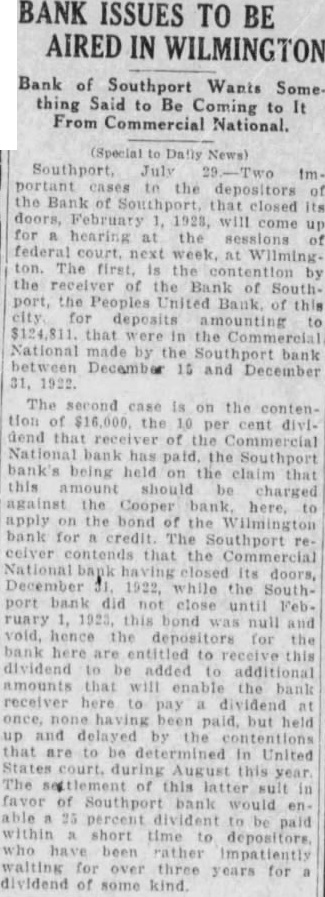
IMPORTANT CASES TO BE HEARD NEXT WEEK Depositors of Bank of Southport Hope Dividends Will Be Forthcoming Southport, July 29.-Two most Kittrell, North Carolina, died at her home in Richmond, on Monday important cases to the depositors morning, July 26th. of the Bank of Southport that Mrs. Hunt, who before her marclosed its doors February 1, 1923, riage was Miss Rosa V. Raney, was will come up for hearing at the a daughter of the late Thomas H. sessions of Federal Court next week Raney and Mrs. Eliza P. Baird Raney at Wilmington. The first is the of Granville county, and sister of demand by the receiver of the Bank the late R. B. Baney of Raleigh and of Southport, the People's United C. W. Raney of Henderson. Bank, of this city, for deposits Mrs. Hunt is survived by her hus. amounting to $124,811 that were in band; four children, John Leigh the Commercial National made by Hunt, Cora Raney Hunt, Mrs. George the Southport bank between De C. Fitzhugh, and Ira Thomas Hunt, cember 15 and December 31, 1922. Jr.; foster son, Herbert Wood; The contention will be made that and one grandchild, Katherine Bevthe trials of W. B. Cooper and erly Hunt, all ofwhom reside in Thomas E. Cooper have shown that Richmond. She leaves also one the Commercial National Bank of brother, T. H. Raney, of Chapel iHII, Wilmington was not solvent when and number of nieces and nephews. these deposits were made, its in Funeral services were held in solvency dating from December 15, Saint Paul's Church of Richmond 1922, and its closing being DeTuesday afternoon, after which she cember 31, 1922. was laid to rest in Hollywood The second case is on the conCemetery. tention that $16,000, the 10 per cent divide dthat of the Commercial Na. tional Bank should be charged against the Cooper bank here, to apply on the bond of the Wilmington bank for & credit. The Southport receiver contends that the Commercial National Bank hav. ing closed its doors December 31, 1922, while the Southport bank did not close until February 1923, this bond was null and void, hence the depositors of the bank here are entitled to receive this dividend to be added to additional amounts that will enable the bank receivers here to pay dividend at once, none having been paid, but held up and delayed by the contentions that are to be deter-


Article from News and Record, July 30, 1926

Click image to open full size in new tab

Article Text

BANK ISSUES TO BE AIRED IN WILMINGTON Bank of Southport Wants Something Said to Be Coming to It From Commercial National. (Special Daily News) July portant to the depositors the of that closed doors, February come for hearing sessions federal The contention by the of the Bank of port, the Peoples United of this for deposits amounting $124,811 that in the National made by the bank December 15 and December 1922. The second case is the contenof the dend that receiver of the National bank has paid, the bank's being held the that claim this amount should be charged against the Cooper bank here, to apply on the bond of the Wilmington bank for credit. The Southport re. celver contends that the Commercial National bank having closed its doors, December 31. 1922, the port bank did not close until Feb. ruary this bond and hence the for the bank here are entitled to dividend to be added to additional amounts will enable the bank receiver here pay dividend having been but held up and delayed by the contentions that are to be determined United August this year The settlement of this latter sult in favor of Southport bank would percent divident to be short time to depositors. have been rather waiting for over three years for dividend of some kind.