State Bank (New Brunswick, NJ)

Episode Information

Episode UID
6626070790885
Episode Type
Run โ†’ Suspension โ†’ Reopening
Bank Type
state
Bank ID
662607079 hash
Start Date
September 25, 1873
Location
New Brunswick, New Jersey (40.486, -74.452)

Metadata

Model
gpt-5-mini (chosen from majority vote of a three-model LLM ensemble)
Short Digest
44467c1417337197

Response Measures

None

Description

A receivership was ordered then stayed while stockholders subscribed funds to restore the bank.

Events (4)

1. September 25, 1873 Run
Cause
Bank Specific Adverse Info
Cause Details
Withdrawals triggered by discovery of large defalcation/misappropriation by cashier Greenleaf W. Appleton and large overdrafts to the New Brunswick Carpet Company.
Measures
Directors/stockholders arranged subscriptions and pledged funds to meet depositors; employed expert J. U. Underhill to investigate.
Newspaper Excerpt
the depositors have since, learning of the defalcation, withdrawn $250,000.
Source
newspapers
2. September 25, 1873 Suspension
Cause
Bank Specific Adverse Info
Cause Details
Payments suspended after exhaustion of cash following the cashier's misappropriation and heavy withdrawals.
Newspaper Excerpt
Yesterday morning the currency balance was exhausted, and payments were suspended.
Source
newspapers
3. October 3, 1873 Receivership
Newspaper Excerpt
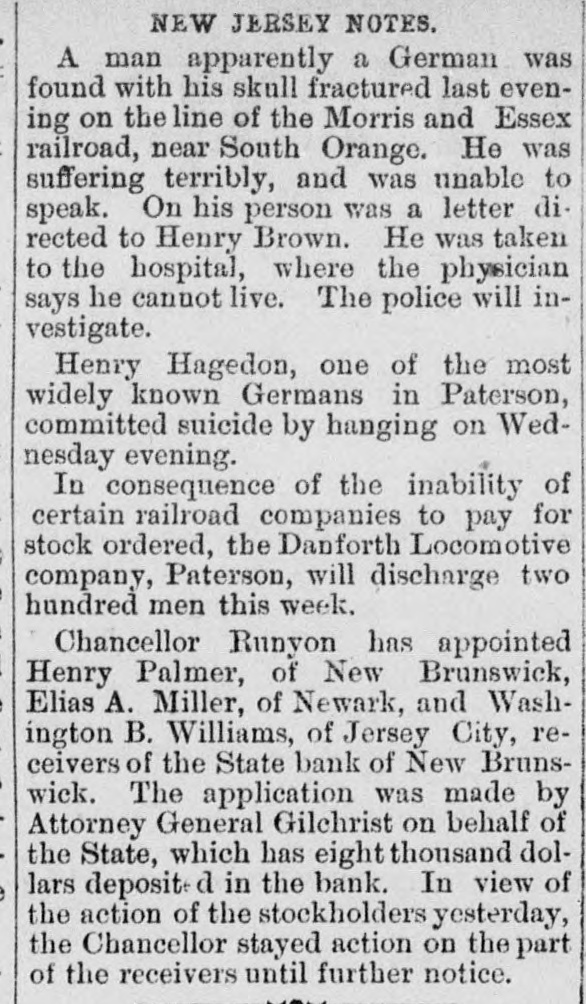
Chancellor Runyon has appointed Henry Palmer... receivers of the State bank of New Brunswick. In view of the action of the stockholders yesterday, the Chancellor stayed action on the part of the receivers until further notice.
Source
newspapers
4. November 7, 1873 Reopening
Newspaper Excerpt
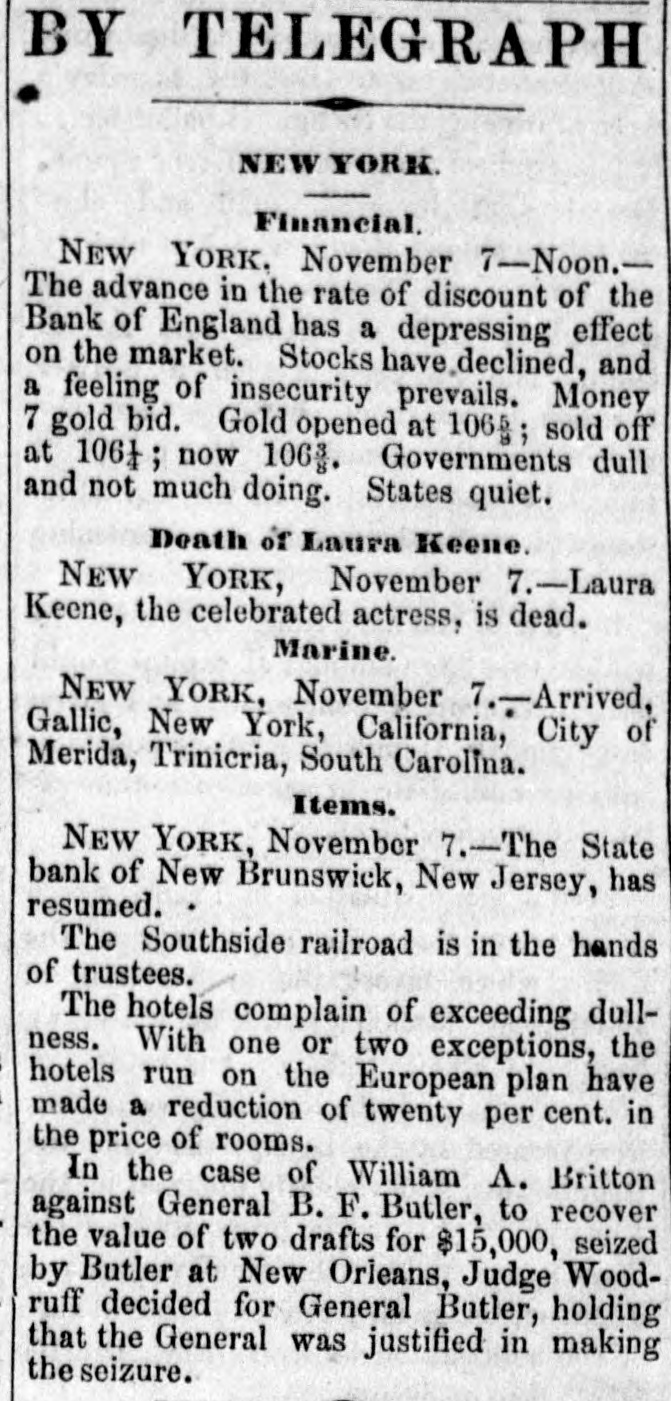
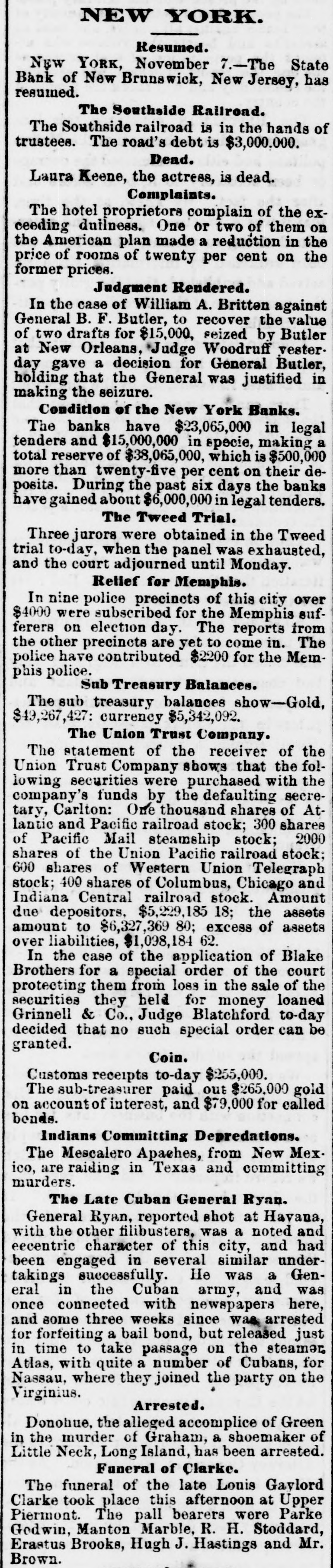
The State bank of New Brunswick, New Jersey, has resumed.
Source
newspapers

Newspaper Articles (20)

Article from The New York Herald, September 5, 1873

Click image to open full size in new tab

Article Text

MORE BANK "IRREGULARITIES." An Old Jersey Bank Troubled Over $200,000-Most Accommodating Cashier-One Customer Allowed to Overdraw Enormously-What the Bank Officers Say. In 1813 the State Bank of New Brunswick, N.J., was established under a charter of the Legislature. Ever since the conduct of its officers has been such that its paper throughout the State has long been quoted as being as good as gold. There is not a bank in New Jersey which holds a higher rank for fair dealing and stability than "the old State" of New Brunswick. Hence it can easily be understood how great an agitation was occasioned in financial circles across the Hudson yesterday when the rumor spread that the old institution had been LET IN FOR TWO HUNDRED THOUSAND DOLLARS. and that, too, by its honored and trusted cashier, Mr. Greenleaf W. Appleton. The rumor reached Newark early in the day, but, while occasioning a great deal of talk in financial circles, caused no excitement. as it was well known that the bank had a surplus fund fully large enough to meet even so huge a discrepancy as the one reported. All sorts of stories noated around as to the character of the defalcation. One had it that Appleton had lately been keeping a stud of horses and a costly house on a salary of $3,000 or $4,000. Another was to the effect that the directors let him run the bank to suit himself, and he did, and his personal friends, too. In order to get at the true state of affairs a HERALD representative visited New Brunswick last evening about six o'clock, and struck out at once for THE FOUNTAIN OF TRUTH, the old bank itself, which is located at the corner of Albany and Peace streets. Just as the HERALD man arrived some of the directors, who had been holding a consultation, were preparing to go away. The former made himself known to the acting cashier and expert, Mr. J. U. Underhill, and stated his desire to obtain the facts about the alleged defalcation. and not be obliged to accept hearsay. Mr. Underhill looked very mysterious at first, but finally, without giving any reply, started off to hold a private conference with director Janeway as to whether he should open up or keep mum. Presently he returned and opened up after a fashion. At first he seemed to be afraid to say more than a word or two, but subsequently put aside his reserve and spoke out freely. Mr. Underhill stated that there had been going on AN INVESTIGATION of the bank's books even since last Saturday, when Cashier Appleton was suspended, and it was not possible to say exactly how matters stood. The only charge against Appleton was that he a had in an unaccountable manner allowed customer, Mr. Woodworth, President of the New Brunswick Carpet Company, to OVERDRAW HIS ACCOUNT $200,000. So far there was no evidence to show that Appleton himself had wrongfully appropriated a dollar. He and Woodworth lived near each other, and so were very intimate. Appleton kept one horse, and that was the extent of the "stud" rumor gave him. The amount overdrawn, Mr. Underhilll said, was covered by real estate securities of Woodworth, so that it was not possible that the bank could lose a dollar by the operation. Besides, its directors represented many millions of dollars. In case a run should be made on the bank to-day arrangements had been made to provide for it. The capital stock is $250,000 and the surplus about the same. Appleton entered the bank as bookkeeper five years ago. and two years ago last April was made cashier, and gave such thorough satisfaction that soon he ran the bank entirely to suit himself. without let or hindrance of the other officers. It appears that while he lived well and comfortably, that he was not extravagant nor ostentatious. He declares that beyond the overdraw everything will be found correct, and that that also will be satisfactorily explained. He is thirty years of age, or so, and has a wife and one child. He has many warm friends in the town. The story that the investigation was started while he was off on a vacation is pure fancy, as he has been away nowhere yet this year. The officers of the bank are John R. Ford, President: Henry Richmond, Vice President; Directors, Henry J. Janeway, Abraham and Ira C. Voorhees, John V. Bergen, Gustavus Anten, John Clark, Garret Conover, Clifford Morragh, Christopher Myer, James Bishop and J. H. Hutchings. President Ford and Messrs. Myers and Bishop are now in Europe.

Article from New Orleans Republican, September 26, 1873

Click image to open full size in new tab

Article Text

WHOLE NUMBER 1986. are on the way, which are expected to arboat and received the official decision of rive to-morrow. race: Brown and Biglin then rowed There is hope that the greenback strinward the shore together, and were recei gency will be over by Saturday morning, with cheers. In answer to the question if not sooner. The entire outlook is more a bystander Biglin acknowledged it wa fair beat. bright, and there is reason for saying that the temporary derangement of our financial houses will be of brief duration. ENGLAND The run on the savings banks has stopped and no new movement of the kind is The Madrid Government Demande threatened. The Secreity Trust Company Seized War Vessels. are maki arrangements to resume. The LONDON, September 25.-It is repor officers say they expect to open by Monday that a note has been received at the Fore next. Office from the Spanish government, urg The Lawrence Savings Bank. which susthe immediate restoration to the Mad pended yesterday. will resume in 2 few authorities of the frigates Victoria a days. Almanza, detained at Gibraltar. It is a Nashville. said. the relations between the two pow NASHVILLE, September 25.-The national will be ruptured if the British governm banks of this city, four in number, in view declines to release the vessels. of the present state of affairs. have agreed Captain Buddington and Party Sailed to suspend currency payments on all balHome. ances exceeding $200. Captain Buddington and compani The Board of Trade. at a full meeting to. sailed for America Tuesday in the stear day. unanimously approved of the course City of Antwerp. Several stean lines of the banks and adopted a resolution refered the party a free passage. questing that merchants and business men Bullion. would continue to deposit with and aid the banks by every means in their power. A The steamer Scandinavian, which general good feeling prevails among busiLiverpool to-day for Quebec. took $500. in bullion. ness men and there are no symptoms of a panic. A Persian Railway. Detroit. The cevemony of turning the first sod DETROIT. Mich. September 25. - Two the first railway in Persia took pl bankers in this city failed to-day. recently at Reshd. in the presence of Charleston. leading Persian officials and foreign suls. CHARLESTON. September 25.-There is no run on the banks here. The Freedmen's Savings Bank exacts sixty days notice be. FRANCE. fore paying its depositors. the other banks pay as usual. No Aid to the Carlists. Selma. PARIS, September 25.-The perman SELMA, September -The Savings Bank committee of the Assembly had a sitt has suspended. Its assets are belived to be to day. The Duke De Broglie was prese ample to meet all liabilities. In reply to an inquiry of a Republic Boston. member of the committee the duke.sta BOSTON. Septempher 35.-The course of that the government would not permit the banks is simply conservative; loans have armament of Carlists in France. He a been reduced. but the urgent wants of busisaid he had as yet received no compla ness are met. from Spain with relation to the alleged P New Brunswick. sage of the Carlist chief Seballos throu French territory. NEW BRUNSWICK. N. J., September 25.The State Bank of New Brunswick has Proposed Action of Republican Deputi failed. A meeting of the Conservatives was h


Article from Elizabeth Daily Monitor, September 26, 1873

Click image to open full size in new tab

Article Text

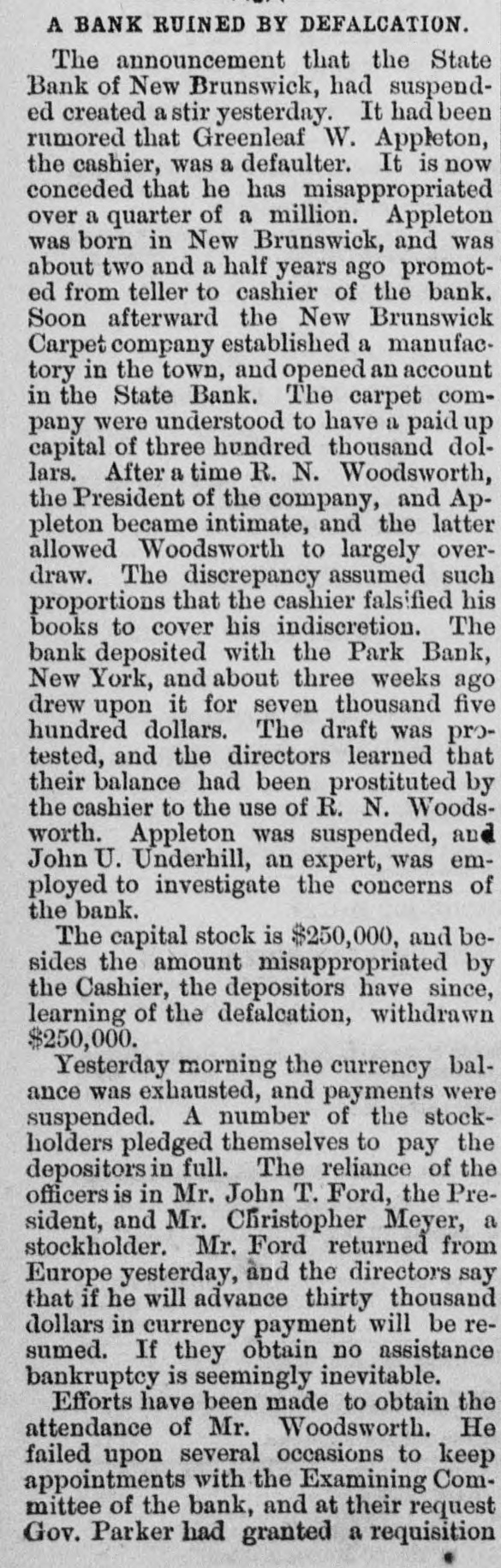
A BANK RUINED BY DEFALCATION. The announcement that the State Bank of New Brunswick, had suspended created a stir yesterday. It had been rumored that Greenleaf W. Appleton, the cashier, was a defaulter. It is now conceded that he has misappropriated over a quarter of a million. Appleton was born in New Brunswick, and was about two and a half years ago promoted from teller to cashier of the bank. Soon afterward the New Brunswick Carpet company established a manufactory in the town, and opened an account in the State Bank. The carpet company were understood to have a paid up capital of three hundred thousand dollars. After a time R. N. Woodsworth, the President of the company, and Appleton became intimate, and the latter allowed Woodsworth to largely overdraw. The discrepancy assumed such proportions that the cashier falsified his books to cover his indiscretion. The bank deposited with the Park Bank, New York, and about three weeks ago drew upon it for seven thousand five hundred dollars. The draft was protested, and the directors learned that their balance had been prostituted by the cashier to the use of R. N. Woodsworth. Appleton was suspended, and John U. Underhill, an expert, was employed to investigate the concerns of the bank. The capital stock is $250,000, and besides the amount misappropriated by the Cashier, the depositors have since, learning of the defalcation, withdrawn $250,000. Yesterday morning the currency balance was exhausted, and payments were suspended. A number of the stockholders pledged themselves to pay the depositors in full. The reliance of the officers is in Mr. John T. Ford, the President, and Mr. Christopher Meyer, a stockholder. Mr. Ford returned from Europe yesterday, and the directors say that if he will advance thirty thousand dollars in currency payment will be resumed. If they obtain no assistance bankruptcy is seemingly inevitable. Efforts have been made to obtain the attendance of Mr. Woodsworth. He failed upon several occasions to keep appointments with the Examining Committee of the bank, and at their request Gov. Parker had granted a requisition


Article from The Rutland Daily Globe, September 26, 1873

Click image to open full size in new tab

Article Text

Suspensions. AT NEWARK. NEWARK, Sept. 25. The State bank at New Brunswick, N.J., suspended to-day. AT ATLANTA. ATLANTA. Ga., Sept. 25. The Dollar Savings Bank suspended today. It has ample securities. AT INDIANAPOLIS. INDIANAPOLIS. Sept. 25. The private banking house of Woolen, Webb & Co. has suspended, which occasioned a run on other banks, but all demands were met, and it is thought there will be no further trouble.


Article from Chicago Daily Tribune, September 26, 1873

Click image to open full size in new tab

Article Text

NEW BRUNSWICK, N. J. NEWARK, N. J., Sept. 25.-The State Bank of Now Brunswick suspended to-day. This is the bank that was crippied by the irregularities of Appleton, its cashier. -


Article from Eureka Daily Sentinel, September 27, 1873

Click image to open full size in new tab

Article Text

NEW JERSEY. NEWARK. Sept. 26. The State Bank of New Brunswick suspended to-dav. This is the bank which was crippled by the irregularities of Appleton, cashier.


Article from The Rutland Daily Globe, September 27, 1873

Click image to open full size in new tab

Article Text

A number of stockholders of the State bank of New Brunswick, the suspension of which was occasioned by the defalcation of the cachier, have pledged themselves to pay depositors in full. Almost up to the last moment, depositors implicitly trusted the bank, and its trouble has thrown the town into a ferment.


Article from Wilmington Daily Gazette, September 27, 1873

Click image to open full size in new tab

Article Text

Failure of n New Jersey Bank. THE STATE BANK OF NEW BRUNSWICK SUSPENDS-$250,000 MISAPPROPRIATED BY THE CASHIER. The announcement of suspension of the State Bank of New Brunswick, New Jersey, created a stir in that city at noon Thursday. During the last month the bank has been considered shaky, as it was known that Greenleaf W. Appleton the, cashier, was a defaulter in a large amount. His operations have extended over a year and a half, and it is conceded that he has misappropriated over a quarter of a million of the funds of the in stitution.


Article from Elizabeth Daily Monitor, September 29, 1873

Click image to open full size in new tab

Article Text

Gov. Parker, Chancellor Runyon, and the Directors of the State bank in New Brunswick concluded on Saturday that nothing could be done at present to resume business. A receiver will be appointed. The Meyer Rubber Company loses thirty-seven thousand dollars, which they had on deposit. According to the books the bank is debtor to the Carpet company one hundred thousand dollars. The defalcation is admitted to be five hundred thousand dollars. It is improbable that the bank will resume.


Article from Memphis Daily Appeal, October 2, 1873

Click image to open full size in new tab

Article Text

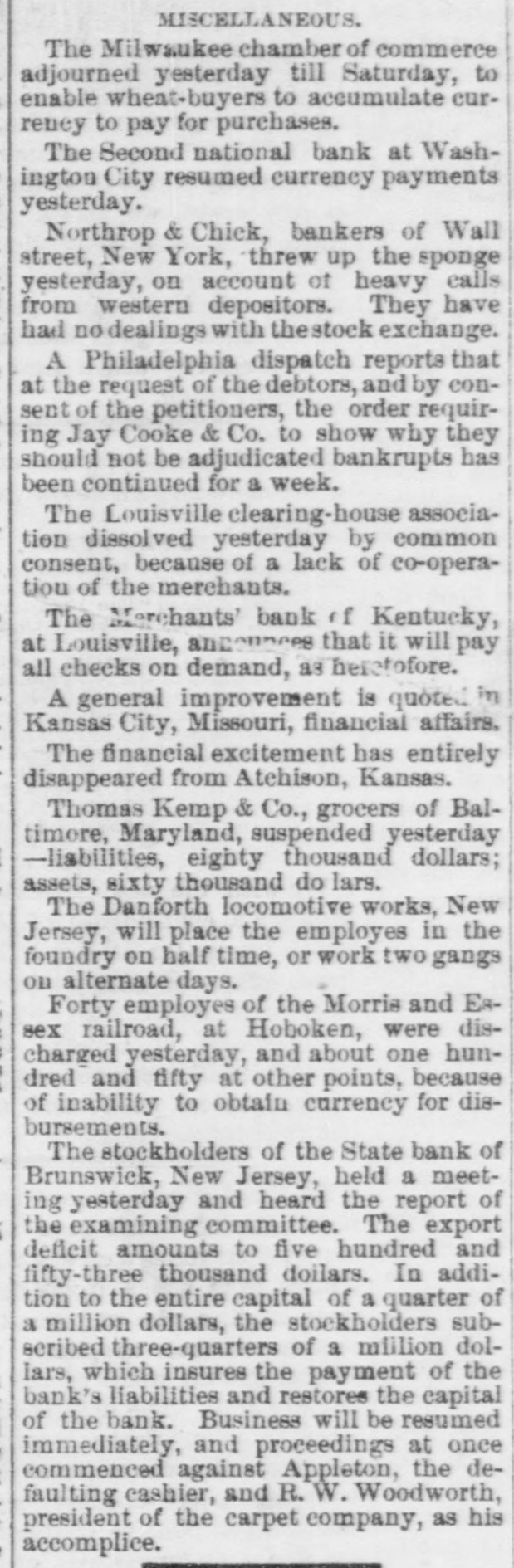
MISCELLANEOUS. The Milwaukee chamber of commerce adjourned yesterday till Saturday, to enable wheat-buyers to accumulate curreney to pay for purchases. The Second national bank at Washington City resumed currency payments yesterday. Northrop & Chick, bankers of Wall street, New York, threw up the sponge yesterday, on account of heavy calls from western depositors. They have had no dealings with thestock exchange. A Philadelphia dispatch reports that at the request of the debtors, and by consent of the petitioners, the order requiring Jay Cooke & Co. to show why they should not be adjudicated bankrupts has been continued for a week. The Louisville clearing-house association dissolved yesterday by common consent, because of a lack of co-operatiou of the merchants. The Corehants' bank of Kentucky, at Louisville, ancounces that it will pay all checks on demand, as heretofore. A general improvement is quote in Kansas City, Missouri, financial affairs. The financial excitement has entirely disappeared from Atchison, Kansas. Thomas Kemp & Co., grocers of Baltimore, Maryland, suspended yesterday -liabilities, eighty thousand dollars; assets, sixty thousand do lars. The Danforth locomotive works, New Jersey, will place the employes in the foundry on half time, or work two gangs on alternate days. Forty employes of the Morris and Essex railroad, at Hoboken, were discharged yesterday, and about one hundred and fifty at other points, because of inability to obtain currency for disbursements. The stockholders of the State bank of Brunswick, New Jersey, held a meeting yesterday and heard the report of the examining committee. The export deficit amounts to five hundred and fifty-three thousand doilars. In addition to the entire capital of a quarter of a million dollars, the stockholders subscribed three-quarters of a million dollars, which insures the payment of the bank's liabilities and restores the capital of the bank. Business will be resumed immediately, and proceedings at once commenced against Appleton, the defaulting cashier, and R. W. Woodworth, president of the carpet company, as his accomplice.


Article from The New York Herald, October 2, 1873

Click image to open full size in new tab

Article Text

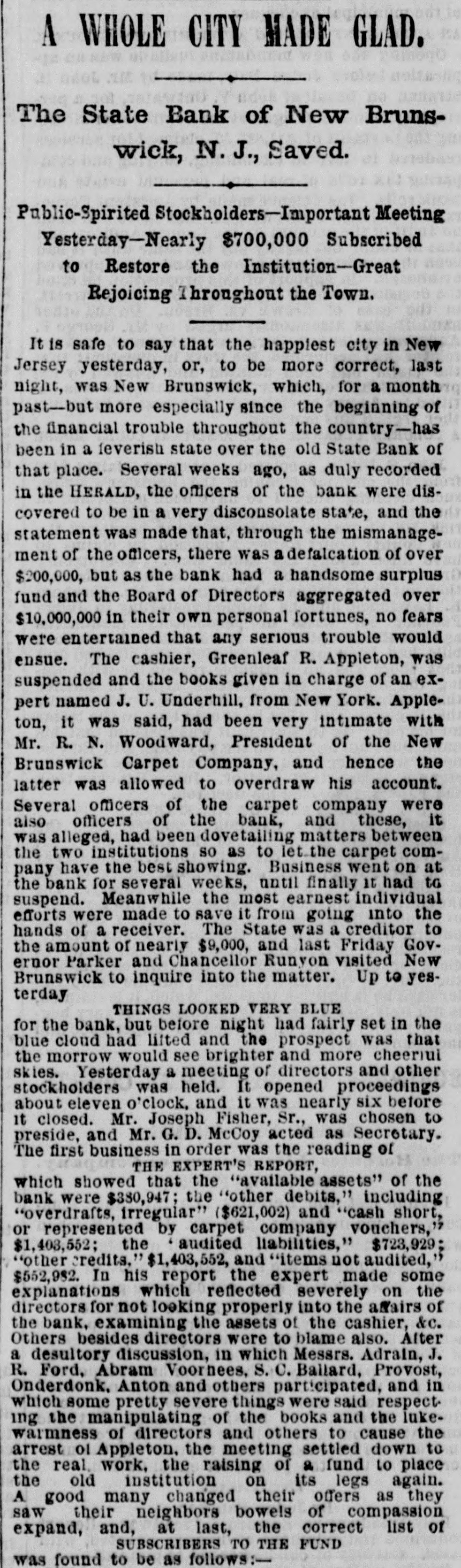
A WHOLE CITY MADE GLAD. The State Bank of New Brunswick, N. J., Saved. Public-Spirited Stockholders-Important Meeting Yesterday-Nearly $700,000 Subscribed to Restore the Institution-Great Rejoicing Throughout the Town. It is safe to say that the happiest city in New Jersey yesterday, or, to be more correct, last night, was New Brunswick, which, for a month past-but more especially since the beginning of the financial trouble throughout the country-has been in a leverish state over the old State Bank of that place. Several weeks ago, as duly recorded in the HERALD, the officers or the bank were discovered to be in a very disconsolate state, and the statement was made that, through the mismanagement of the officers, there was a defalcation of over $200,000, but as the bank had a handsome surplus fund and the Board of Directors aggregated over $10,000,000 in their own personal fortunes, no fears were entertained that any serious trouble would ensue. The cashier, Greenleaf R. Appleton, was suspended and the books given in charge of an expert named J. U. Underhill, from New York. Appleton, it was said, had been very intimate with Mr. R. N. Woodward, President of the New Brunswick Carpet Company, and hence the latter was allowed to overdraw his account. Several officers of the carpet company were also officers of the bank, and these, it was alleged, had been dovetailing matters between the two institutions so as to let the carpet company have the best showing. Business went on at the bank for several weeks. until finally it had to suspend. Meanwhile the most earnest individual efforts were made to save it from going into the hands of a receiver. The State was a creditor to the amount or nearly $9,000, and last Friday Governor Parker and Chancellor Runyon visited New Brunswick to inquire into the matter. Up to yesterday THINGS LOOKED VERY BLUE for the bank, but before night had fairly set in the blue cloud had lifted and the prospect was that the morrow would see brighter and more cheerrui skies. Yesterday a meeting of directors and other stockholders was held. It opened proceedings about eleven o'clock, and it was nearly six before it closed. Mr. Joseph Fisher, Sr., was chosen to preside, and Mr. G. D. McCoy acted as Secretary. The first business in order was the reading of THE EXPERT'S REPORT, which showed that the "available assets" of the bank were $380,947; the "other debits," including "overdrafts, irregular" ($621,002) and "cash short, or represented by carpet company vouchers," $1,403,552; the audited liabilities," $723,929; "other credits. $1,403,552, and "items not audited," $552,982. In his report the expert made some explanations which reflected severely on the directors for not looking properly into the affairs of the bank, examining the assets of the cashier, &c. Others besides directors were to blame also. After a desultory discussion, in which Messrs. Adrain, J. R. Ford, Abram Voornees, S. c. Bailard, Provost, Onderdonk, Anton and others participated, and in which some pretty severe things were said respecting the manipulating of the books and the lukewarmness of directors and others to cause the arrest of Appleton. the meeting settled down to the real, work, the raising of a fund to place the old institution on its legs again. A good many changed their offers as they saw their neighbors bowels of compassion expand, and, at last, the correct list of SUBSCRIBERS TO THE FUND was found to be as follows:-


Article from New-York Tribune, October 2, 1873

Click image to open full size in new tab

Article Text

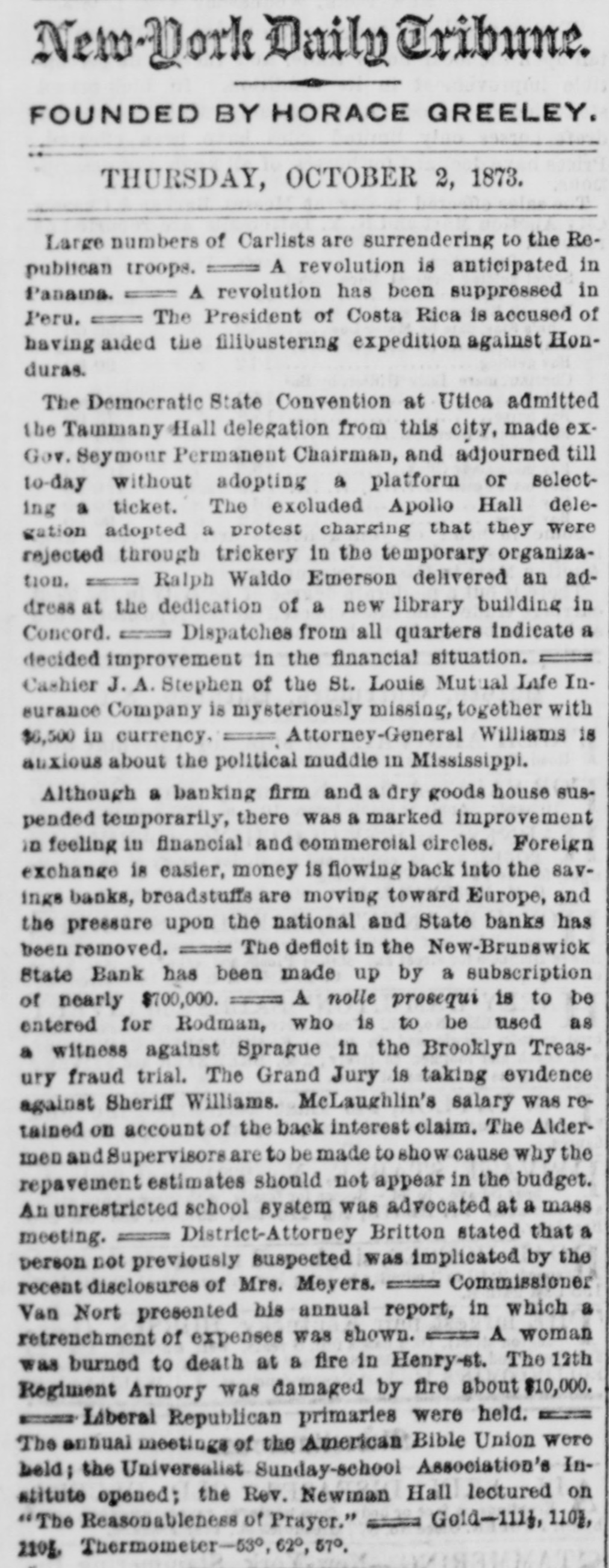
New-York Daily Tribune. FOUNDED BY HORACE GREELEY. THURSDAY, OCTOBER 2, 1873. Large numbers of Carlists are surrendering to the Republican troops. A revolution is anticipated in Panama. A revolution has been suppressed in Peru. The President of Costa Rica is accused of having aided the filibustering expedition against Honduras. The Democratic State Convention at Utica admitted the Tammany Hall delegation from this city, made ex-Gov. Seymour Permanent Chairman, and adjourned till to-day without adopting a platform or selecting a ticket. The excluded Apollo Hall delegation adopted a protest charging that they were rejected through trickery in the temporary organization. Ralph Waldo Emerson delivered an address at the dedication of a new library building in Concord. Dispatches from all quarters indicate a decided improvement in the financial situation. Cashier J. A. Stephen of the St. Louis Mutual Life Insurance Company is mysteriously missing, together with $6,500 in currency. Attorney-General Williams is anxious about the political muddle in Mississippi. Although a banking firm and a dry goods house suspended temporarily, there was a marked improvement in feeling in financial and commercial circles. Foreign exchange is easier, money is flowing back into the savings banks, breadstuffs are moving toward Europe, and the pressure upon the national and State banks has been removed. The deficit in the New-Brunswick State Bank has been made up by a subscription of nearly $700,000. A nolle prosequi is to be entered for Rodman, who is to be used as a witness against Sprague in the Brooklyn Treasury fraud trial. The Grand Jury is taking evidence against Sheriff Williams. McLaughlin's salary was retained on account of the back interest claim. The Aldermen and Supervisors are to be made to show cause why the repavement estimates should not appear in the budget. An unrestricted school system was advocated at a mass meeting. District-Attorney Britton stated that a person not previously suspected was implicated by the recent disclosures of Mrs. Meyers. Commissioner Van Nort presented his annual report, in which a retrenchment of expenses was shown. A woman was burned to death at a fire in Henry-st. The 12th Regiment Armory was damaged by fire about $10,000. Liberal Republican primaries were held. The annual meetings of the American Bible Union were held; the Universalist Sunday-school Association's Institute opened; the Rev. Newinan Hall lectured on "The Reasonableness of Prayer." Gold-111โ…›, 110ยฝ, 210โ…›. Thermometer-53ยฐ, 62ยฐ, 57ยฐ.


Article from New-York Tribune, October 2, 1873

Click image to open full size in new tab

Article Text

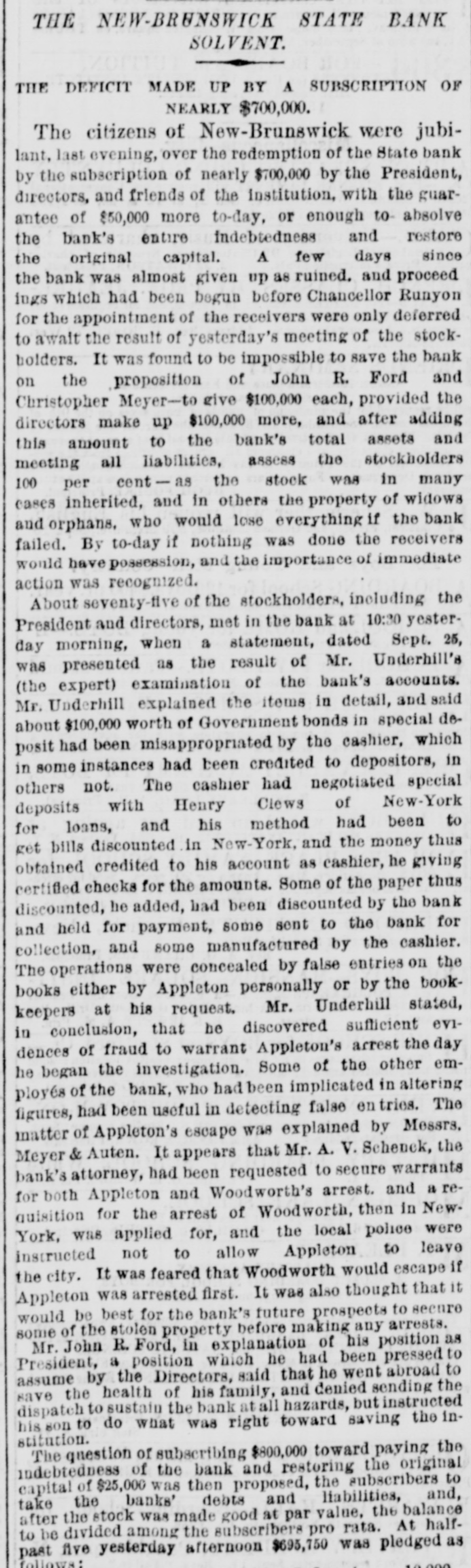
THE NEW-BRUNSWICK STATE BANK SOLVENT. THE DEFICIT MADE UP BY A SUBSCRIPTION OF NEARLY $700,000. The citizens of New-Brunswick were jubilant, last evening, over the redemption of the State bank by the subscription of nearly $700,000 by the President, directors, and friends of the institution, with the guarantee of $50,000 more to-day, or enough to- absolve the bank's entire indebtedness and restore the original capital. A few days since the bank was almost given up as ruined. and proceed ings which had been begun before Chancellor Runyon for the appointment of the receivers were only deferred to await the result of yesterday's meeting of the stockholders. It was found to be impossible to save the bank on the proposition of John R. Ford and Christopher Meyer-to give $100,000 each, provided the directors make up $100,000 more, and after adding this amount to the bank's total assets and meeting all liabilities, assess the stockholders 100 per cent - as the stock was in many cases inherited, and in others the property of widows and orphans. who would lose everything if the bank failed. By to-day if nothing was done the receivers would have possession, and the importance of immediate action was recognized. About seventy-five of the stockholders, including the President and directors, met in the bank at 10:30 yesterday morning, when a statement, dated Sept. 25, was presented as the result of Mr. Underhill's (the expert) examination of the bank's accounts. Mr. Underhill explained the items in detail, and said about $100,000 worth of Government bonds in special deposit had been misappropriated by the cashier, which in some instances had been credited to depositors, in others not. The cashier had negotiated special deposits with Henry Clews of New-York for loans, and his method had been to get bills discounted in New-York, and the money thus obtained credited to his account as cashier, he giving certified checks for the amounts. Some of the paper thus discounted, he added, had been discounted by the bank and held for payment, some sent to the bank for collection, and some manufactured by the cashier. The operations were concealed by false entries on the books either by Appleton personally or by the bookkeepers at his request. Mr. Underhill stated, in conclusion, that he discovered sufficient evidences of fraud to warrant Appleton's arrest the day he began the investigation. Some of the other employรฉs of the bank, who had been implicated in altering figures, had been useful in detecting false entries. The matter of Appleton's escape was explained by Messrs. Meyer & Auten. It appears that Mr. A. V. Schenck, the bank's attorney, had been requested to secure warrants for both Appleton and Woodworth's arrest. and a requisition for the arrest of Woodworth, then in NewYork, was applied for, and the local police were instructed not to allow Appleton to leave the city. It was feared that Woodworth would escape if Appleton was arrested first. It was also thought that it would be best for the bank's future prospects to secure some of the stolen property before making any arrests. Mr. John R. Ford, in explanation of his position as President, a position which he had been pressed to assume by the Directors, said that he went abroad to save the health of his family, and denied sending the dispatch to sustain the bank at all hazards, but instructed his son to do what was right toward saving the institution. The question of subscribing $800,000 toward paying the indebtedness of the bank and restoring the original capital of $25,000 was then proposed, the subscribers to take the banks' debts and liabilities, and, after the stock was made good at par value. the balance to be divided among the subscribers pro rata. At halfpast five yesterday afternoon $695,750 was pledged as 10.000 follows:


Article from Elizabeth Daily Monitor, October 3, 1873

Click image to open full size in new tab

Article Text

NEW JERSEY NOTES. A man apparently a German was found with his skull fractured last evening on the line of the Morris and Essex railroad, near South Orange. He was suffering terribly, and was unable to speak. On his person was a letter directed to Henry Brown. He was taken to the hospital, where the physician says he cannot live. The police will investigate. Henry Hagedon, one of the most widely known Germans in Paterson, committed suicide by hanging on Wednesday evening. In consequence of the inability of certain railroad companies to pay for stock ordered, the Danforth Locomotive company, Paterson, will discharge two hundred men this week. Chancellor Runyon has appointed Henry Palmer, of New Brunswick, Elias A. Miller, of Newark, and Washington B. Williams, of Jersey City, receivers of the State bank of New Brunswick. The application was made by Attorney General Gilchrist on behalf of the State, which has eight thousand dollars deposit d in the bank. In view of the action of the stockholders yesterday, the Chancellor stayed action on the part of the receivers until further notice.


Article from The Daily State Journal, November 7, 1873

Click image to open full size in new tab

Article Text

BY TELEGRAPH NEW YORK Financial NEW YORK. November 7-Noon.The advance in the rate of discount of the Bank of England has a depressing effect on the market. Stocks have declined, and a feeling of insecurity prevails. Money 7 gold bid. Gold opened at 106 ; sold off at 1061; now 106g. Governments dull and not much doing. States quiet. Death of Laura Keene. NEW YORK, November 7. .-Laura Keene, the celebrated actress, is dead. Marine. NEW YORK, November 7.-Arrived, Gallic, New York, California, City of Merida, Trinicria, South Carolina. Items. NEW YORK, November 7.-The State bank of New Brunswick, New Jersey, has resumed. . The Southside railroad is in the hands of trustees. The hotels complain of exceeding dullness. With one or two exceptions, the hotels run on the European plan have made a reduction of twenty per cent. in the price of rooms. In the case of William A. Britton against General B. F. Butler, to recover the value of two drafts for $15,000, seized by Butler at New Orleans, Judge Woodruff decided for General Butler, holding that the General was justified in making the seizure.


Article from New Orleans Republican, November 8, 1873

Click image to open full size in new tab

Article Text

NEW YORK. Resumed. NEW YORK, November 7.-The State Bank of New Brunswick, New Jersey, has resumed. The Southslde Railroad. The Southside railroad is in the hands of trustees. The road's debt is $3,000.000. Dend. Laura Keene, the actress, is dead. Complaints. The hotel proprietors complain of the exceeding duilness. One or two of them on the American plan made a reduction in the price of rooms of twenty per cent on the former prices. Judgment Rendered. In the case of William A. Britten against General B. F. Butler, to recover the value of two drafts for $15,000, seized by Butler at New Orleans, *Judge Woodruff vesterday gave a decision for General Butler, holding that the General was justified in making the seizure. Condition of the New York Banks. The banks have $23,065,000 in legal tenders and $15,000,000 in specie, making a total reserve of $38,065,000, which is $500,000 more than twenty-five per cent on their deposita. During the past six days the banks have gained about $6,000,000 in legal tenders. The Tweed Trial. Three jurors were obtained in the Tweed trial to-day, when the panel was exhausted, and the court adjourned until Monday. Relief for Memphis. In nine police precincts of this city over $4000 were subscribed for the Memphis sufferers on election day. The reports from the other precincts are yet to come in. The police have contributed $2200 for the Memphis police. Sub Treasury Balances. The sub treasury balances show-Gold, $49,267,427: currency $5,342,092. The Union Trust Company. The statement of the receiver of the Union Trust Company shows that the following securities were purchased with the company's funds by the defaulting secretary, Carlton: One thousand shares of Atlantic and Pacific railroad stock; 300 shares of Pacific Mail steamship stock; 2000 shares of the Union Pacific railroad stock: 600 shares of Western Union Telegraph stock; 400 shares of Columbus, Chicago and Indiana Central railroad stock. Amount due depositors. $5,229,185 18; the assets amount to $6,327,369 80; excess of assets over liabilities, $1,098,184 62. In the case of the application of Blake Brothers for a special order of the court protecting them from loss in the sale of the securities they held for money loaned Grinnell & Co., Judge Blatchford to-day decided that no such special order can be granted. Coin. Customs receipts to-day $255,000. The sub-treasurer paid out $265,000 gold on account of interest, and $79,000 for called bends. Indians Committing Depredations. The Mescalero Apaches, from New Mexico, are raiding in Texas and committing murders. The Late Cuban General Ryan. General Ryan, reported shot at Havana, with the other filibusters, was a noted and eecentric character of this city, and had been engaged in several similar undertakings successfully. He was a General in the Cuban army, and was once connected with newspapers here, and some three weeks since was arrested for forfeiting a bail bond, but released just in time to take passage on the steamer. Atlas, with quite a number of Cubans, for Nassau, where they joined the party on the Virginius. Arrested. Donobue, the alleged accomplice of Green in the murder of Graham, a shoemaker of Little Neck, Long Island, has been arreated. Funeral of Clarke. The funeral of the late Louis Gaylord Clarke took place this afternoon at Upper Piermont. The pall bearers were Parke Godwin, Manton Marble, R. H. Stoddard, Erastus Brooks, Hugh J. Hastings and Mr. Brown.


Article from Delaware Republican, November 24, 1873

Click image to open full size in new tab

Article Text

About three weeks ago Greenleaf W. Appleton, a young man who held the position of cashier in the State Bank of New Brunswick, N, J., defaulted. It was supposed at the time that $100,000 at the most covered his peculation; but on Friday week the Bank being compelled to suspend, an investigation into the accounts resulting, it was ascertained that the robbery lay between $500,000 and $600,000. Appleton became involved with a carpet company at New Brunswick, and between him and it the Bank has failed. Of course he fled, and there is nothing left the depositors beyond the gratitying intelligence from his friends that an acute consumption was the cause of his leaving precipitately.


Article from The Washington Times, August 23, 1901

Click image to open full size in new tab

Article Text

NOTE SWINDLERS CAPTURED. Package of New Jersey Bank Bills in Their Possession. John E. Wilkie, Chief of the United States Secret Service, yesterday announced the capture in Portland, Ore., of F. W. Burke and Harry Connors in the act of receiving a package of notes of the defunct State Bank of New Brunswick, N. J. The information relative to the arrests was received from the operator in charge of the San Francisco division of the Secret Service. It is said that the men under arrest received the notes from accomplices in San Francisco. They made a full confession and were held under $1,000 bail on the charge of using the United States mails with intent to defraud. Secret Service agents on August 20 also arrested in San Francisco three men on the charge of passing notes printed from the stolen plates of the defunct State Bank of New Brunswick, N. J. They are Frank J. Perry, William Hogan, and E. W. Smith. The latter has been for eight years chief clerk of the Life Saving Service in San Francisco. Perry, who has been under arrest a week, gave the information on which Hogan and Smith were taken. The arrest of the above on the charge of passing notes printed from the original plates of the State Bank of New Brunswick, N. J., which suspended payment in 1873, disclosed the fact that their source of supply was Jacob Weigel, of New Brunswick, N. J. All the old bank notes which were not issued by the old State Bank of New Brunswick are in the hands of the authorities. Contrary to supposition, the notes circulated were not reprinted from the old plates, but were printed by the bank itself and were never signed by the president and cashier. After the bank went into the hands of a receiver the old note plates were sold to Adam Ludwig, a junk dealer of Richmond Street, New Brunswick, N. J. The junk dealer also bought the waste paper and all the junk out of the bank. In aste paper he dollars found about a half a ne origi worth of notes. These We nal sheets and uncut and un he sold or gave to Jacob Weib a collector of coins and old now kept them some years and then began dispose of them to coin dealers. Among others, he sold some to Greenburg & Smith, of Montgomery Street. San Francisco. This firm, Mr. Weiget says, afterward sent him large orders for the notes, and in all purchased some $175,000 worth, counting their face value. The plates remained in the possession of the junk dealer. On August 19 Secret Service agents went to New Brunswick and saw Mr. Weigel. They were satisfied with his explanation and he gave them what he had remaining of the notes. Ludwig, the junk man, turned over the plates. These were still in the packages in which they were wrapped after last being used. The seals were unbroken.


Article from Newark Evening Star and Newark Advertiser, October 7, 1911

Click image to open full size in new tab

Article Text

TON OF $20 BANK NOTES SOLD FOR JUNK TO DEALER Worthless Now, but Got Into Circulation Throughout U. S. and Canada. all Selling nearly a ton of $20 notes to a junk dealer after the State Bank of New Brunswick failed forty years ago has resulted in thousands of these notes, which to all appearances are genuine, being circulated in this city, throughout the country and Canada. At the time they were issued the notes were genuine, but are now worthless. The sale of the notes was made by the receiver of the bank. How the junk dealer disposed of them is not known. That such notes were in circulation was brought to the attention of the police by a Mrs. Shaw, who keeps boarding-house at 123 Academy street. A young man called at her house sev eral days ago and engaged a room. He offered one of these bills, from which a deposit of $1 was to be taken. The money was changed by another boarder. He was unable to cash the bill and sent it to a friend who is employed in a bank in Passaic. From there the bill was sent to President Henry G. Parker, of the National Bank of New Jersey, in New Brunswick. He sent a letter to an employee of the Passaic bank reading in part as follows: "We are returning the bill herewith with the explanation that it has no value, and that the bank which issued it failed nearly forty years ago, and had no successor. No provision was made to meet its circulation outstanding, and in addition to this fact the inclosed bill was not regularly issued by the bank, but subsequently got into circulation through the carelessness of the receiver of the bank, who never destroyed the circulation which he found on hand, but sold it to a junk dealer, and in that way many thousands of these notes got into circulation throughout the United States and Canada, and have caused no end of trouble." Yesterday a man was arrested in New York for attempting to pass one of these notes. The notes were genuine in their time.


Article from Norwich Bulletin, October 20, 1911

Click image to open full size in new tab

Article Text

NOTES OF 'A DEFUNCT BANK CIRCULATING The state bank of Brunswick, N. J., failed forty years ago, and its matters have all been settled up; and, yet, the economy of the receiver who settled up the affairs of the defunct bank prompted him to sell nearly a ton of $20 notes to a junk dealer, instead of destroying them, who apparently found a profitable way of disposing of them. The Newark Star calls attention to the fact that the proprietor of a Newark boarding house accepted one, a week ago, and returned nineteen dollars change, and a man was arrested in New York, last Friday, for attempting to pass one. They have been faithfully distributed, and a Boston paper says: "Prob. ably specimens could be found in many a tin bank and serving as stuffing for numerous stocking banks, and very likely the Last Man will have a State Bank of New Brunswick note among his assets."