
Bain & Brother (Portsmouth, VA)

Episode Information

Episode UID
6670019491024
Episode Type
Suspension โ†’ Closure
Bank Type
private
Bank ID
667001949 hash
Start Date
April 2, 1885
Location
Portsmouth, Virginia (36.835, -76.298)

Metadata

Model
gpt-5-mini (chosen from majority vote of a three-model LLM ensemble)
Short Digest
7bbd9eaeaadf2aa6

Response Measures

None

Description

Failure grew from Bain & Brother's bad investments and large indebtedness to Exchange National; subsequent litigation over assets followed.

Events (3)

1. April 2, 1885 Suspension
Cause
Bank Specific Adverse Info
Cause Details
Made bad real-estate investments and became heavily indebted to Exchange National; unable to meet deficiencies so the private bank closed.
Newspaper Excerpt
Bain & Brother, bankers in Portsmouth, had suspended
Source
newspapers
2. April 9, 1885 Receivership
Newspaper Excerpt
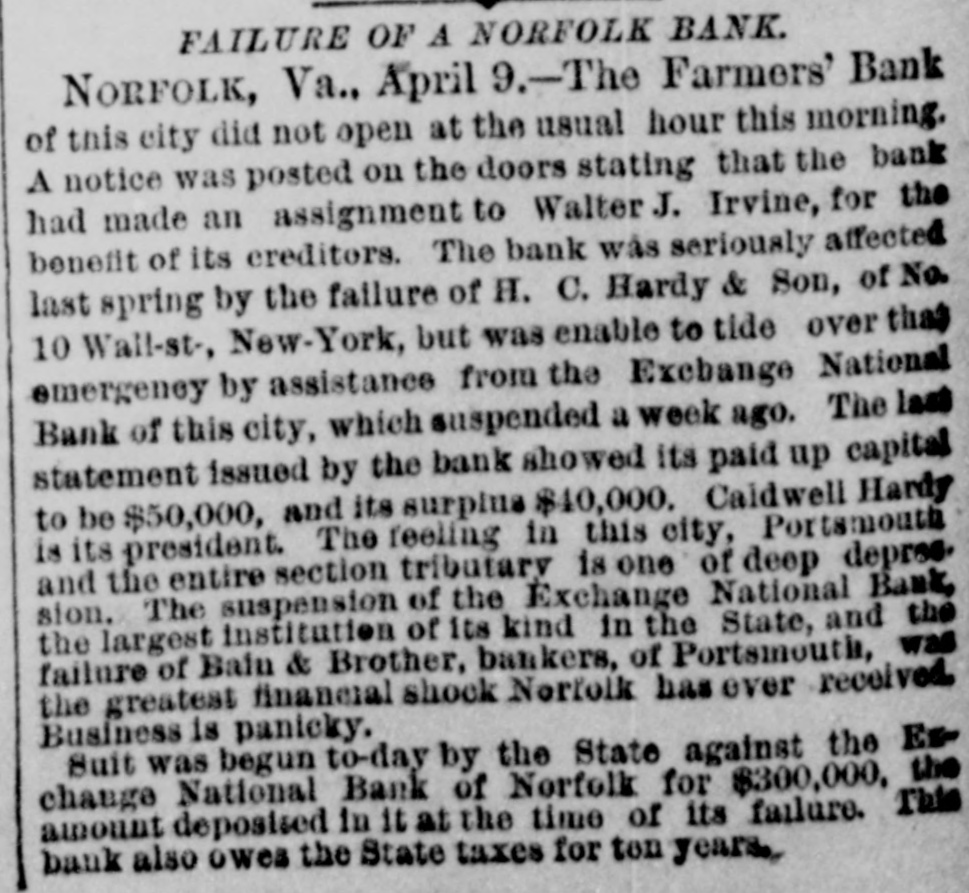
The Farmers' Bank ... made an assignment to Walter J. Irvine, for the benefit of its creditors. ... the failure of Bain & Brother, bankers, of Portsmouth, was the greatest financial shock Norfolk has ever received.
Source
newspapers
3. May 26, 1886 Other
Newspaper Excerpt
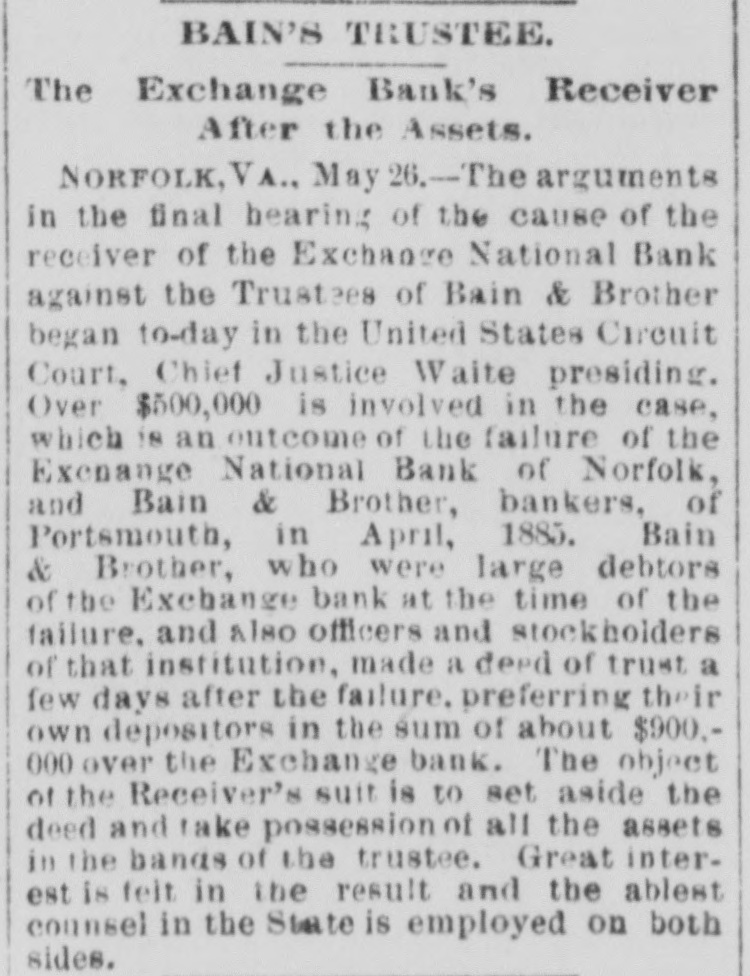
The Exchange Bank's Receiver After the Assets. ... outcome of the failure of the Exchange National Bank of Norfolk, and Bain & Brother, bankers, of Portsmouth, in April, 1885. Bain & Brother ... made a deed of trust ... preferring their own depositors ... The object of the Receiver's suit is to set aside the deed and take possession of all the assets in the hands of the trustee.
Source
newspapers

Newspaper Articles (5)

Article from Richmond Dispatch, April 3, 1885

Click image to open full size in new tab

Article Text

NORFOLK, April 8, 1885. The suspension of the Exchange Natimbal Bank this morning has caused great excitement and almost paralyzed buthers. Crowds have thronged Main street and gathered about the bulletinheards. and even women have paraded the streets in great excitement. Net long after the Exchange Bank closed it was announced that Bain & Brother. benkers in Portsmouth, had suspended, and the excitement increased. Then the Tranklin Savings, which had its deposits in the Exchange, closed its doors. This bank is owned by Mr. John B. Whitehead, president of the Exchange National. CAUSE OF THE TROUBLE. Mr. George M. Bain, of Bain & Brother, Portsmouth, is cashier of the Exchange Bank, and Mr. J. G. Bain, of the same concern, is vice-president. For some time past their affairs have not been regarded as in good condition. is is said that they had real estate asGuaned at $250,000. which would not now realize that amount, and the impression in that the troubles of the Exchange Bank grew out of Bain & Brother's embarrassments. Comptroller Orson Adams came to the city several days ago, and people who knew of his presence here were quite curious to know what his business was, but nobody foundout until to-day, when the Exchange Bank was closed by his instructions. Indeed, I have it on authority that the officers of the bank were moving everything up to the last minute to continue busimean, and it must be said to their credit that as soon as they found that the suspension of the bank was a mere matter of time they closed doors at once without any sort of delay. The bank is one of the oldest in the city and had a capital stock of $300,000. It is a national bank and is the depository for United States funds. The internal-revenue funds collected in this district are deposited in this bank, as are also custom-house collections, postoffice moneys, &c. It is not known how much money of this character the bank had on deposit, but the postoffice and custom-house here had only about $1,100 in the vaults. Of course, all this is secured by Government bonds. It can hardly be that the depositors will lose much. if anything, of their deposits, as the officers of the bank are all sound and honorable men, and Mr. Whitehead alone is said to be worth $300 $300,000. OTHER BANKS. It was intimated yesterday to the other banks that trouble was brewing, and they were in a measure prepared for the shock. All have kept open and their business going and paid out money on demand. It was understood between them, however, that in case a run should be made they would avail themselves of the sixty-days' privilege. Up to this hour (2 P. M.) no runs have been made. All things considered, the condition of things is better than might be expected, as the Exchange National was regarded as the grand bulwark of our banking institutions, and has hitherto tided successfully over every panic. Captain J. E. Barry, president of the Bank of Commerce, says the trouble was caused by the action of the Comptroller of the Currency of the United States, who ordered the doors closed " because of large amounts of discounts allowed by the bank in violation of the law governing the same. He feels sure, however, that the depositors are safe and will not lose a cent. Further Particulars of the Cause of the Trouble- What Cashier Bain Nays. [Special telegram to the Dispatch.] NORFOLK, April 2, 1885. It is understood that the immediate cause of the suspension of the Exchange National Bank was its connection with Bain & Brother. Some years age Bain & Brother had on deposit $250,000 with the Exchange Bank, but thought best to invest in real estate and securities. They began to draw out their funds, and finally became indebted to the bank to the amount of $800,000. Then Orson Adams, the bank-examiner, came and looked into the accounts, and saw that the bank was discounting over or above one tenth of the capital stock, contrary to the law governing the national banks. He found that Bain & Brother had made bad investments and could not meet the deficiencies. They put up securities to the amount of $570,000, but could not raise the balance. Consultation was held. and Mr. Adams reported that with $300,000 the bank could go on, and in three years would be on a gold basis and could pay dividend. & Dr. R. H. McDonald, a large stock holder, was consulted and agreed to furnish the securities, promising to let the bank hear from him on Tuesday but did not respond, and then the Nor falk Clearing- House and F. B. MeDonald agreed to put up $200,000 and $100,000 respectively to raise the ne cessary amount. But in the mean time the matter was found out by some of Bain & Brother's creditors, and a run on the bank was threatened last night. This morning Bain & Brother closed doors and then the Exchange Bank sus pended. It is impossible to learn liabilities but Mr. Hain, the cashier, authorizes the statement that with judicious management the bank can pay all depositors dellar for dollar. He recognizes his Legal responsibility in discounting beyend one tenth of the capital stock, and will not shirk it. He says everything in the bank has been conducted open and above board. as the books will show. A receiver will be here to-mor row to take charge.
Article from New-York Tribune, April 10, 1885

Click image to open full size in new tab

Article Text

FAILURE OF A NORFOLK BANK. NORFOLK, Va., April 9.-The Farmers' Bank of this city did not open at the usual hour this morning. A notice was posted on the doors stating that the bank had made an assignment to Walter J. Irvine, for the benefit of its creditors. The bank was seriously affected last spring by the failure of H. C. Hardy & Son, of No. 10 Wall-st-, New-York, but was enable to tide over that emergency by assistance from the Exchange National Bank of this city, which suspended a week ago. The last statement issued by the bank showed its paid up capital to be $50,000, and its surplus $40,000. Caldwell Hardy is its president. The feeling in this city, Portsmouth and the entire section tributary is one of deep depres. sion. The suspension of the Exchange National Bank, the largest institution of its kind in the State, and the failure of Bain & Brother, bankers, of Portsmouth, was the greatest financial shock Norfolk has ever received. Business is panicky. Suit was begun to-day by the State against the Eschange National Bank of Norfolk for $300,000, the amount deposised in it at the time of its failure. This bank also owes the State taxes for ton years.


Article from Savannah Morning News, May 27, 1886

Click image to open full size in new tab

Article Text

BAIN'S TRUSTEE. The Exchange Bank's Receiver After the Assets. NORFOLK, va., May 26.-The arguments in the final hearing of the cause of the receiver of the Exchange National Bank against the Trustees of Bain & Brother began to-day in the United States Circuit Court, Chief Justice Waite presiding. Over $500,000 is involved in the case, which is an outcome of the failure of the Exenange National Bank of Norfolk, and Bain & Brother, bankers, of Portsmouth, in April, 1885. Bain & Brother, who were large debtors of the Exchange bank at the time of the failure, and also officers and stockholders of that institution, made a deed of trust a few days after the failure. preferring their own depositors in the sum of about $900.000 over the Exchange bank. The object of the Receiver's suit is to set aside the deed and take possession of all the assets in the bands of the trustee. Great interest is felt in the result and the ablest counsel in the State is employed on both sides.


Article from The Times, March 4, 1890

Click image to open full size in new tab

Article Text

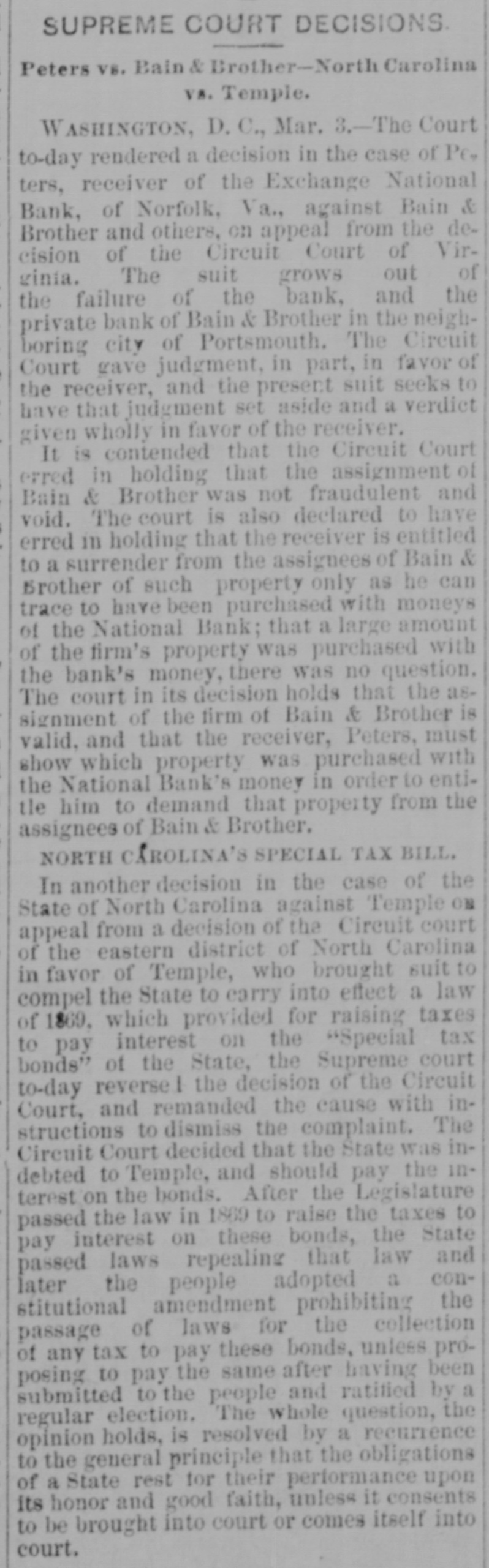
SUPREME COURT DECISIONS. Peters VB. Bain & Brother-North Carolina VA. Temple. WASHINGTON, D. C., Mar. 3.-The Court to-day rendered a decision in the case of Pe, ters, receiver of the Exchange National Bank, of Norfolk, Va., against Bain & Brother and others, on appeal from the decision of the Circuit Court of Virginta. The suit grows out of the failure of the bank, and the private bank of Bain & Brother in the neighboring city of Portsmouth. The Circuit Court gave judgment, in part, in favor of the receiver, and the present suit seeks to have that judgment set aside and a verdict given wholly in favor of the receiver. It is contended that the Circuit Court erred in holding that the assignment of Bain & Brother was not fraudulent and void. The court is also declared to have erred in holding that the receiver is entitled to a surrender from the assignees of Bain & Brother of such property only as he can trace to have been purchased with moneys of the National Bank: that a large amount of the firm's property was purchased with the bank's money, there was no question. The court in its decision holds that the assignment of the firm of Bain & Brother is valid, and that the receiver, Peters, must show which property was purchased with the National Bank's money in order to entitle him to demand that property from the assignees of Bain & Brother. NORTH CAROLINA'S SPECIAL TAX BILL. In another decision in the case of the State of North Carolina against Temple ON appeal from a decision of the Circuit court of the eastern district of North Carolina in favor of Temple, who brought suit to State to carry a of compel 1869. the which provided for into raising effect taxes law to pay interest on the "Special tax bonds" of the State, the Supreme court to-day reversel the decision of the Circuit Court, and remanded the cause with instructions to dismiss the complaint. The Circuit Court decided that the State was indebted to Temple, and should pay the interest on the bonds. After the Legislature passed the law in 1869 to raise the taxes to pay interest on these bonds, the State passed laws repealing that law and later the people adopted a constitutional amendment prohibiting the passage of laws for the collection of any tax to pay these bonds, unless proposing to pay the same after having been submitted to the people and ratified by a regular election. The whole question, the opinion holds, is resolved by a recurrence to the general principle that the obligations of a State rest for their performance upon its honor and good faith, unless it consents to be brought into court or comes itself into court.


Article from New-York Tribune, March 4, 1890

Click image to open full size in new tab

Article Text

UPREME COURT DECISIONS RIGHT OF A CITIZEN TO SUE HIS OWN STATE. AFFECTING THE OPERATIONS OF BANKS. Washington, March 3.-The case of the Louisville, New. and Texas Pacific Railroad Company agt. the of Mississippi was decided in the Supreme Court toThe question involved was the power of the State to railroad companies to" provide within the State sepaccommodations for the two races. The Louisville, ew-Orleans and Texas Pacific was indicted for failure to this, under the provisions of an act passed March 2, was convicted and fined, and appealed. The SuCourt of Mississippi held, the opinion of Justice recites, that the statute applied solely to comwithin the State, and that construction, being the instruction of the statute of the State by its highest must be accepted as conclusive here. "The statin this case, as settled by the Supreme Court of Misssippi," the opinion says, "affects only such commerce thin the State, and comes therefore within the principles laid down. We see no error in the ruling of the SuCourt of the State of Mississippi, and its judgment therefore affirmed." An opinion was rendered in the case of Bernard B. plaintiff in error, agt. the State of Louisiana, here on appeal from the Circuit Court for the District of Louisiana. It is said that from ten twelve million dollars are involved in the case, the deof which turns upon the important constitutional estion of the right of a citizen to sue his own State. It said this question has never been decided. Hans is the of a considerable amount of consolidated bonds of State of Louislana. When the State Issued these LL made provision for the levy of a special tax to the interes) and principal of these bonds. It furtherdeclared the bonds to create a contract between the and the bondholders which should not be impaired, declared that the judicial power should be exercised henever necessary to secure the levy and collection of tax and the payment of the bonds. The State Contution adopted in 1879, however, partly repudiated this reement and directed that the revenue collected by the of the special tax should be diverted to defray the penses of the State Government. Hans, who is a citiof Louisiana, brought suit to have the new State Condeclared invalid so far as it impaired the contract tween the State and the bondholders, on the ground that violated the Constitution of the United States. State set up the plea that it could not te sued by one Its own citizens without its consent, and the Circuit deciding the question in favor of the State, the case here for final decision. Justice Bradley, in his affirming the judgment, says that if, as the plaintiff error contends, he has the right to maintain the suit he is a citizen of Louisiana and not of some other then we should have the anomalous result that cases arising under the Constitution of the United a State may be sued in the Federal Courts by its citizens, though not by citizens of other States, for is forbidden by the Eleventh Amendment. If this the necessary consequence of the language of the ConItution and the law, the result is no less startling and rexpected than was the original decision of this court the case of Chisholm agt. the State of Georgia, that the language of the Constitution a State was liable be sued by citizens of another State. Justice Field expressed his concurrence in the judgment by the Court, But said that he did not wish to nction by his silence the doctrine seemed to be emin the language of the Court. He would not de. the citizen of all protection in controversies with, States, and he also did not agree with the eulogium upon Justice Eredell, because on this one occasion had represented the sentiment of the country, while other justices, who had done more for the country he, had not. Justice Harlan also expressed dissent from some of the atements in the opinion, and thought there was no casion for the reference made to the Chisholm case. The Court reversed the judgment In the State of North arolina, and of Roberts, auditor, against Temple, for the stated In the Hans case. This case involves million dollars, and also presented the question the right of a citizen to sue his own State. The case, far as Roberts, the State Auditor, was concerned. was smissed on the ground that it was really a suit against State. In 1885 the Exchange National Bank of Norfolk, Va., its shutters put up by order of the Controller of Currency, who appointed a receiver and directed that efaffairs of the bank be put in process of liquidation. same day the private banking house of Bain & Brother, the neighboring town of Portsmouth, also failed. facts developed by an examination made by the led to a law suit, brought in the name of IL Peters, receiver of the Exchange National of Norfolk, Va., appellant, against Bain & Brother, al. The Circuit Court for the Eastern District of Inginia rendered judgment only partly in favor of the ceiver, and the case was brought to the United States spreme Court, which to-day finally decided the suit. The Circuit Court refused to declare the assignment and also ruled that although there was no question that considerable of Bain & Brother's property had purchased with money belonging to the National yet that it was entitled to a surrender of such operty only as it could trace to have been purchased Its funds. Mr. Peters contended that the burden of should be upon the assignee of Baln & Brother, and upon the Exchange Bank, and also that the assignwas totally void. These were the two principal testions upon which the case was brought here, and the through Chief Justice Fuller, holds that the opinion the lower court was right in all respects. It says it falls to find that the facts establish conclusively allegations of fraud. and that the inquiry is not whether X Brother had been previously guilty of fraud or abezziement, but whether this particular conveyance made with a fraudulent intent known to the trustees
