Article Text
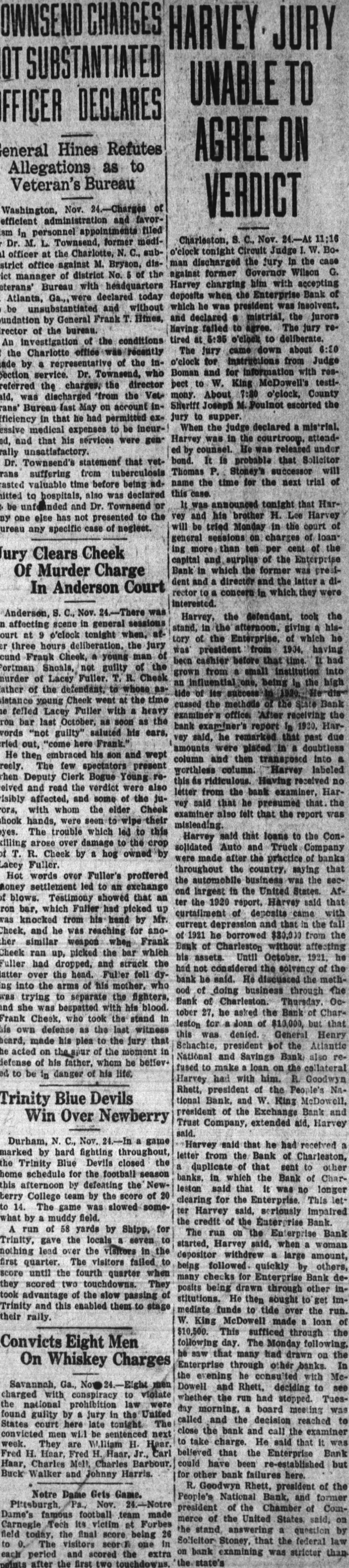
TOWNSEND CHARGES NOT SUBSTANTIATED OFFICER DECLARES
General Hines Refutes Allegations as to Veteran's Bureau
Washington, Nov. 24.—Charges of efficient administration and favoritism in personnel appointments filed by Dr. M. L. Townsend, former medical officer at the Charlotte, N. C., sub-district office against M. Bryson, district manager of district No. 5 of the Veterans' Bureau with headquarters at Atlanta, Ga., were declared today to be unsubstantiated and without foundation by General Frank T. Hines, director of the bureau.
An investigation of the conditions in the Charlotte office was recently made by a representative of the inspection service. Dr. Townsend, who preferred the charges, the director said, was discharged from the Veterans' Bureau last May on account inefficiency in that he had permitted excessive medical expenses to be incurred, and that his services were generally unsatisfactory.
Dr. Townsend's statement that veterans suffering from tuberculosis wasted valuable time before being admitted to hospitals, also was declared to be unfounded and Dr. Townsend or any one else has not presented to the bureau any specific case of neglect.
Jury Clears Cheek Of Murder Charge In Anderson Court
Anderson, S. C., Nov. 24.—There was an affecting scene in general sessions court at 9 o'clock tonight when, after three hours deliberation, the jury found Frank Cheek, a young man of Portman Shoals, not guilty of the murder of Lacey Fuller. T. R. Cheek, father of the defendant, to whose assistance young Cheek went at the time he felled Lacey Fuller with a heavy iron bar last October, as soon as the words "not guilty" saluted his ears, cried out, "come here Frank."
He then embraced his son and wept freely. The few spectators present when Deputy Clerk Bogue Young received and read the verdict were also visibly affected, and some of the jurors, with whom the elder Cheek shook hands, were seen to wipe their eyes. The trouble which led to this killing arose over damage to the crop of T. R. Cheek by a hog owned by Lacey Fuller.
Hot words over Fuller's proffered money settlement led to an exchange of blows. Testimony showed that an iron bar, which Fuller had picked up was knocked from his hand by Mr. Cheek, and he was reaching for another similar weapon when Frank Cheek ran up, picked the bar which Fuller had dropped, and struck the latter over the head. Fuller fell dying into the arms of his mother, who was trying to separate the fighters, and she was bespattered with his blood. Frank Cheek, who took the stand in his own defense as the last witness heard, made his plea to the jury that he acted on the spur of the moment in defense of his father, whom he believed to be in danger of his life.
Trinity Blue Devils Win Over Newberry
Durham, N. C., Nov. 24.—In a game marked by hard fighting throughout, the Trinity Blue Devils closed the home schedule for the football season this afternoon by defeating the Newberry College team by the score of 20 to 14. The game was slowed somewhat by a muddy field.
A run of 58 yards by Shipp, for Trinity, gave the locals a seven to nothing lead over the visitors in the first quarter. The visitors failed to score until the fourth quarter when they scored two touchdowns. They took advantage of the slow passing of Trinity and this enabled them to stage their rally.
Convicts Eight Men On Whiskey Charges
Savannah, Ga., Nov. 24.—Eight men charged with conspiracy to violate the national prohibition law were found guilty by a jury in the United States court here late tonight. The convicted men will be sentenced next week. They are William H. Haar, Fred H. Haar, Fred H. Haar, Jr., Carl Haar, Charles Mell, Charles Barbour, Buck Walker and Johnny Harris.
Notre Dame Gets Game.
Pittsburgh, Pa., Nov. 24.—Notre Dame's famous football team made Carnegie Tech its victim at Forbes field today, the final score being 26 to 0. The visitors scored one in each period and scored the extra points after the first two touchdowns.
HARVEY JURY UNABLE TO AGREE ON VERDICT
Charleston, S. C., Nov. 24.—At 11:16 o'clock tonight Circuit Judge I. W. Bowman discharged the jury in the case against former Governor Wilson G. Harvey charging him with accepting deposits when the Enterprise Bank of which he was president was insolvent, and declared a mistrial, the jurors having failed to agree. The jury retired at 5:35 o'clock to deliberate.
The jury came down about 6:30 o'clock for instructions from Judge Bowman and for information with respect to W. King McDowell's testimony. About 7:30 o'clock, County Sheriff Joseph M. Poulnot escorted the jury to supper.
When the judge declared a mistrial, Harvey was in the courtroom, attended by counsel. He was released under bond. It is probable that Solicitor Thomas P. Stoney's successor will name the time for the next trial of this case.
It was announced tonight that Harvey and his brother H. Lee Harvey will be tried Monday in the court of general sessions on charges of loaning more than ten per cent of the capital and surplus of the Enterprise Bank in which the former was president and a director and the latter a director to a concern in which they were interested.
Harvey, the defendant, took the stand, in the afternoon, giving a history of the Enterprise, of which he was president from 1904, having been cashier before that time. It had grown from a small institution into an influential one, being in the high tide of its success in 1920. He discussed the methods of the State Bank examiner's office. After receiving the bank examiner's report in 1920, Harvey said, he remarked that past due amounts were placed in a doubtless column and then transposed into a worthless column. Harvey labeled this as ridiculous. Having received no letter from the bank examiner, Harvey said that he presumed that the examiner also felt that the report was misleading.
Harvey said that loans to the Consolidated Auto and Truck Company were made after the practice of banks throughout the country, saying that the automobile business was the second largest in the United States. After the 1920 report, Harvey said that curtailment of deposits came with current depression and that in the fall of 1921 he borrowed $30,000 from the Bank of Charleston without affecting his assets. Until October, 1921, he had not considered the solvency of the bank he said. He discussed the method of doing business through the Bank of Charleston. Thursday, October 27, he asked the Bank of Charleston for a loan of $10,000, but that this was denied. General Henry Schachte, president of the Atlantic National and Savings Bank, also refused to make a loan on the collateral Harvey had with him. R. Goodwyn Rhett, president of the People's National Bank, and W. King McDowell, president of the Exchange Bank and Trust Company, extended aid, Harvey said.
Harvey said that he had received a letter from the Bank of Charleston, a duplicate of that sent to other banks, in which the Bank of Charleston said that it was no longer clearing for the Enterprise. This letter Harvey said, seriously impaired the credit of the Enterprise Bank.
The run on the Enterprise Bank started, Harvey said, when a woman depositor withdrew a large amount, being followed quickly by others, many checks for Enterprise Bank deposits being drawn through other institutions. He then sought to get immediate funds to tide over the run. W. King McDowell made a loan of $10,500. This sufficed through the following day. The Monday following, he saw that many had drawn on the Enterprise through other banks. In the evening he consulted with McDowell and Rhett, deciding to see whether the run had stopped. Tuesday morning, a board meeting was called and the decision reached to close the bank and call the examiner to take charge. He said that it was believed that the Enterprise Bank could have been re-established but for other bank failures here.
R. Goodwyn Rhett, president of the People's National Bank, and former president of the Chamber of Commerce of the United States, said, on the stand, answering a question by Solicitor Stoney, that the federal law on bank examining was stricter than the state's.