Article Text
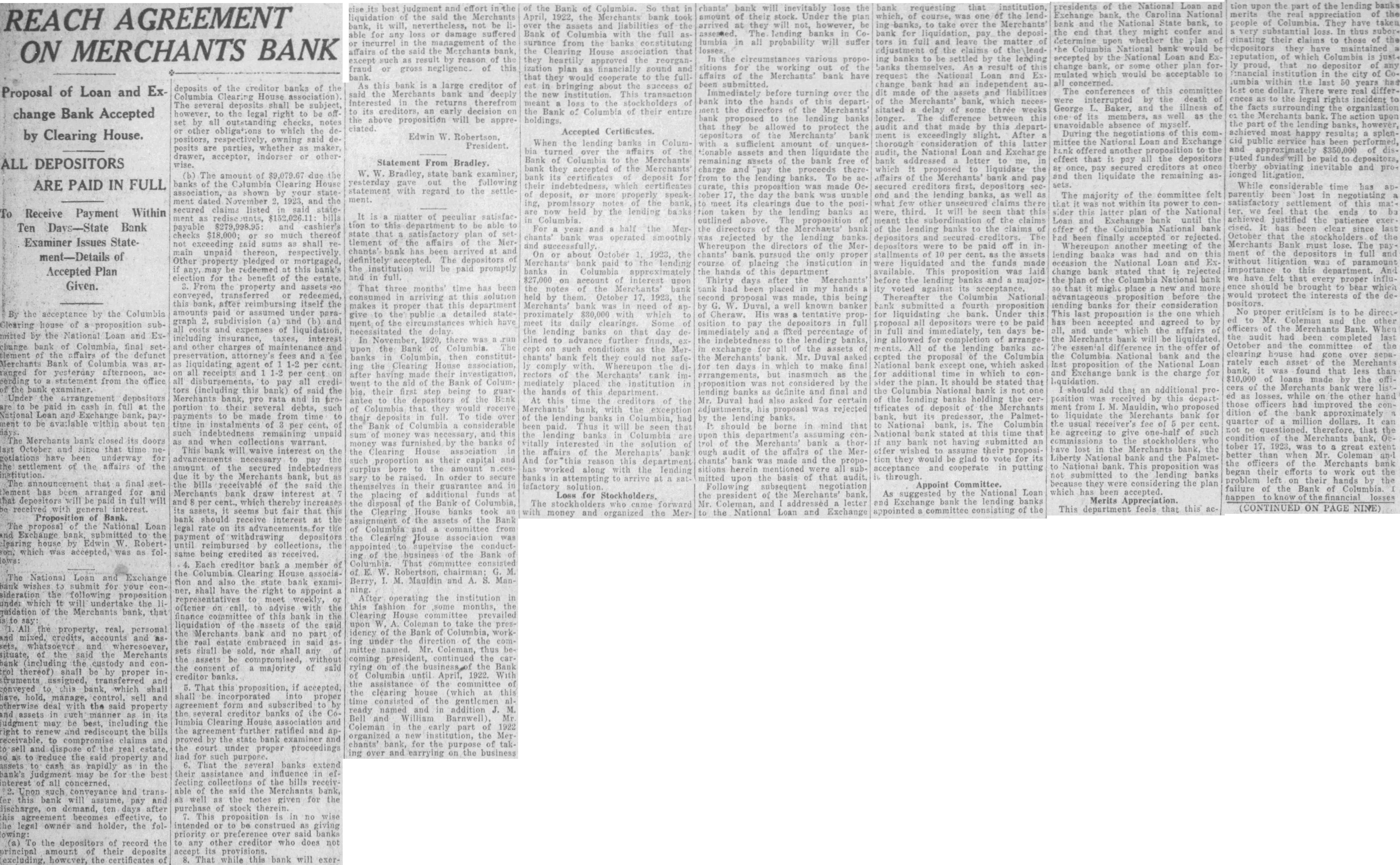
REACH AGREEMENT ON MERCHANTS BANK
Proposal of Loan and Exchange Bank Accepted by Clearing House.
ALL DEPOSITORS ARE PAID IN FULL
To Receive Payment Within Ten Days—State Bank Examiner Issues Statement—Details of Accepted Plan Given.
By the acceptance by the Columbia Clearing house of a proposition submitted by the National Loan and Exchange bank of Columbia, final settlement of the affairs of the defunct Merchants Bank of Columbia was arranged for yesterday afternoon, according to a statement from the office of the bank examiner.
Under the arrangement depositors are to be paid in cash in full at the National Loan and Exchange bank, payment to be available within about ten days.
The Merchants bank closed its doors last October and since that time negotiations have been underway for the settlement of the affairs of the institution.
The announcement that a final settlement has been arranged for and that depositors will be paid in full will be received with general interest.
Proposition of Bank. The proposal of the National Loan and Exchange bank, submitted to the clearing house by Edwin W. Robertson, which was accepted, was as follows:
The National Loan and Exchange bank wishes to submit for your consideration the following proposition under which it will undertake the liquidation of the Merchants bank, that is to say:
1. All the property, real, personal and mixed, credits, accounts and assets, whatsoever and wheresoever, situate, of the said the Merchants bank (including the custody and control thereof) shall be by proper instruments assigned, transferred and conveyed to this bank, which shall have, hold, manage, control, sell and otherwise deal with the said property and assets in such manner as in its judgment may be best, including the right to renew and rediscount the bills receivable, to compromise claims and to sell and dispose of the real estate, so as to reduce the said property and assets to cash as rapidly as in the bank's judgment may be for the best interest of all concerned.
2. Upon such conveyance and transfer this bank will assume, pay and discharge, on demand, ten days after this agreement becomes effective, to the legal owner and holder, the following:
(a) To the depositors of record the principal amount of their deposits (excluding, however, the certificates of deposits of the creditor banks of the Columbia Clearing House association). The several deposits shall be subject, however, to the legal right to be offset by all outstanding checks, notes or other obligations to which the depositors, respectively, owning said deposits are parties, whether as maker, drawer, acceptor, indorser or otherwise.
(b) The amount of $9,079.67 due the banks of the Columbia Clearing House association, as shown by your statement dated November 2, 1923, and the secured claims listed in said statement as rediscounts, $152,026.11; bills payable $279,998.95; and cashier's checks $18,000; or so much thereof not exceeding said sums as shall remain unpaid thereon, respectively. Other property pledged or mortgaged, if any, may be redeemed at this bank's election for the benefit of the estate.
3. From the property and assets so conveyed, transferred or redeemed, this bank, after reimbursing itself the amounts paid or assumed under paragraphs 2, sub-paragraphs (a) and (b), all costs and expenses of liquidation, including insurance, taxes, interest and other charges of maintenance and preservation, attorney's fees and a fee as liquidating agent of 1 1-2 per cent. on all receipts and 1 1-2 per cent. on all disbursements, to pay all creditors (including this bank) of said the Merchants bank, who shall in proportion to their several debts, such payments to be made from time to time in instalments of 3 per cent. of such indebtedness remaining unpaid as the funds collected warrant.
This bank will waive interest on the advancements necessary to pay the amount of the secured indebtedness due it by the Merchants bank, but if the bills receivable of the said the Merchants bank draw interest at 7 and 8 per cent., which thereby increases its assets, it seems but fair that this bank should receive interest at the legal rate on its advancements for the payment of withdrawing depositors until reimbursed by collections, the same being credited as received.
4. Each member bank or member of the Columbia Clearing House association and also the state bank examiner, shall have the right to appoint a representative to meet weekly, or oftener on call, to advise with the finance committee of this bank in the liquidation of the assets of the said the Merchants bank and no part of the real estate belonging to said assets shall be sold, nor shall any of the assets be compromised, without the consent of a majority of said creditor banks.
5. That this proposition, if accepted, shall be incorporated into proper agreement form and subscribed to by the several creditor banks of the Columbia Clearing House association and the agreement further ratified and approved by the state bank examiner and the court under proper proceedings had for such purpose.
6. That the several banks extend their assistance and influence in effecting collections of the bills receivable of the said the Merchants bank, as well as the notes given for the purchase of stock therein.
7. This proposition is in no wise intended or to be construed as giving priority or preference over said banks to any other creditor who does not accept its provisions.
8. That while this bank will exercise its best judgment and effort in the liquidation of the said the Merchants bank, it will, nevertheless, not be liable for any loss or damage sustained or incurred in the management of the affairs of the said the Merchants bank, except such as result by reason of the fraud or gross negligence of this bank.
As this bank is a large creditor of said the Merchants bank and deeply interested in the returns therefrom to its creditors, an early decision on the above proposition will be appreciated.
Edwin W. Robertson, President.
Statement From Bradley. W. W. Bradley, state bank examiner, yesterday gave out the following statement with regard to the settlement.
It is a matter of peculiar satisfaction to this department to be able to state that a satisfactory plan of settlement of the affairs of the Merchants' bank has been arrived at and definitely accepted. The depositors of the institution will be paid promptly and in full.
That three months' time has been consumed in arriving at this solution makes it proper that this department give to the public a detailed statement of the circumstances which have necessitated the delay.
In November, 1920, there was a run upon the Bank of Columbia. The banks in Columbia, then constituting the Clearing House association, after having made their investigation, went to the aid of the Bank of Columbia, their first step being to guarantee to the depositors of the Bank of Columbia that they would receive their deposits in full. To tide over the Bank of Columbia a considerable sum of money was necessary, and this money was furnished by the banks of the Clearing House association in such proportion as their capital and surplus bore to the amount necessary. These banks, in order to protect themselves in their guarantee and in the placing of additional funds at the disposal of the Bank of Columbia, the Clearing House banks took an assignment of the assets of the Bank of Columbia and a committee from the Clearing House association was appointed to supervise the conducting of the business of the Bank of Columbia. That committee consisted of E. W. Robertson, chairman; G. M. Berry, I. M. Mauldin and A. S. Manning.
After operating the institution in this fashion for some months, the Clearing House committee prevailed upon W. A. Coleman to take the presidency of the Bank of Columbia, working under the direction of the committee named. Mr. Coleman, thus becoming president, continued the carrying on of the business of the Bank of Columbia until April, 1922, with the assistance of the committee of the clearing house (which at this time consisted of the gentlemen already named and in addition J. M. Bell and William Barnwell). Mr. Coleman in the early part of 1922 organized a new institution, the Merchants' bank, for the purpose of taking over and carrying on the business of the Bank of Columbia. So that in April, 1922, the Merchants' bank took over the assets and liabilities of the Bank of Columbia with the full assurance from the banks constituting the Clearing House association that they heartily approved the reorganization plan as financially sound and that they would cooperate to the fullest in bringing about the success of the new institution. This transaction meant a loss to the stockholders of the Bank of Columbia of their entire holdings.
Accepted Certificates. When the lending banks in Columbia turned over the affairs of the Bank of Columbia to the Merchants' bank they accepted of the Merchants' bank its certificates of deposit for their indebtedness, which certificates of deposit, or more properly speaking, promissory notes of the bank, are now held by the lending banks in Columbia.
For a year and a half the Merchants' bank was operated smoothly and successfully.
On or about October 1, 1922, the Merchants' bank paid to the lending banks in Columbia approximately $27,000 on account of interest upon the notes of the Merchants' bank held by them. October 17, 1923, the Merchants' bank was in need of approximately $30,000 with which to meet its daily clearings. Some of the lending banks on that day declined to advance further funds, except on such conditions as the Merchants' bank felt they could not safely comply with. Whereupon the directors of the Merchants' bank immediately placed the institution in the hands of this department.
At this time the creditors of the Merchants' bank, with the exception of the lending banks in Columbia, had been paid. Thus it will be seen that the lending banks in Columbia are vitally interested in the solution of the affairs of the Merchants' bank and for this reason this department has worked along with the lending banks in attempting to arrive at a satisfactory solution.
Loss for Stockholders. The stockholders who came forward with money and organized the Merchants' bank will inevitably lose the amount of their stock. Under the plan arrived at they will not, however, be assessed. The lending banks in Columbia in all probability will suffer losses.
In the circumstances various propositions for the working out of the affairs of the Merchants' bank have been submitted.
Immediately before turning over the bank into the hands of this department the directors of the Merchants' bank proposed to the lending banks that they be allowed to protect the depositors of the Merchants' bank with a sufficient amount of unquestionable assets and then liquidate the remaining assets of the bank free of charge and pay the proceeds therefrom to the lending banks. To be accurate, this proposition was made October 17, the day the bank was unable to meet its clearings due to the position taken by the lending banks as outlined above. The proposition of the directors of the Merchants' bank was rejected by the lending banks. Whereupon the directors of the Merchants' bank pursued the only proper course of placing the institution in the hands of this department.
Thirty days after the Merchants' bank had been placed in my hands a second proposal was made, this being by G. W. Duval, a well known banker of Cheraw. His was a tentative proposition to pay the depositors in full immediately and a fixed percentage of the indebtedness to the lending banks, in exchange for all of the assets of the Merchants' bank. Mr. Duval asked for ten days in which to make final arrangements, but inasmuch as the proposition was not considered by the lending banks as definite and final and Mr. Duval had also asked for certain adjustments, his proposal was rejected by the lending banks.
It should be borne in mind that upon this department's assuming control of the Merchants' bank a thorough audit of the affairs of the Merchants' bank was made and the propositions herein mentioned were all submitted upon the basis of that audit.
Following subsequent negotiation the president of the Merchants' bank, Mr. Coleman, and I addressed a letter to the National Loan and Exchange bank requesting that institution, which, of course, was one of the lending banks, to take over the Merchants' bank for liquidation, pay the depositors in full and leave the matter of adjustment of the claims of the lending banks to be settled by the lending banks themselves. As a result of this request the National Loan and Exchange bank had an independent audit made of the assets and liabilities of the Merchants' bank, which necessitated a delay of some three weeks longer. The difference between this audit and that made by this department is exceedingly slight. After a thorough consideration of this latter audit, the National Loan and Exchange bank addressed a letter to me, in which it proposed to liquidate the affairs of the Merchants' bank and pay secured creditors first, depositors second and the lending banks, as well as what few other unsecured claims there were, third. It will be seen that this meant the subordination of the claims of the lending banks to the claims of depositors and secured creditors. The depositors were to be paid off in instalments of 10 per cent. as the assets were liquidated and the funds made available. This proposition was laid before the lending banks and a majority voted against its acceptance.
Thereafter the Columbia National bank submitted a fourth proposition for liquidating the bank. Under this proposal all depositors were to be paid in full and immediately, ten days being allowed for completion of arrangements. All of the lending banks accepted the proposal of the Columbia National bank except one, which asked for additional time in which to consider the plan. It should be stated that the Columbia National bank is not one of the lending banks holding the certificates of deposit of the Merchants bank, but its predecessor, the Palmetto National bank, is. The Columbia National bank stated at this time that if any bank not having submitted an offer wished to assume their proposition they would be glad to vote for its acceptance and cooperate in putting it through.
Appoint Committee. As suggested by the National Loan and Exchange bank the lending banks appointed a committee consisting of the presidents of the National Loan and Exchange bank, the Carolina National bank and the National State bank, to the end that they might confer and determine upon whether the plan of the Columbia National bank would be accepted by the National Loan and Exchange bank, or some other plan formulated which would be acceptable to all concerned.
The conferences of this committee were interrupted by the death of George L. Baker, and the illness of one of its members, as well as the unavoidable absence of myself.
During the negotiations of this committee the National Loan and Exchange bank offered another proposition to the effect that it pay all the depositors at once, pay secured creditors at once and then liquidate the remaining assets.
The majority of the committee felt that it was not within its power to consider this latter plan of the National Loan and Exchange bank until the offer of the Columbia National bank had been finally accepted or rejected.
Whereupon another meeting of the lending banks was had and on this occasion the National Loan and Exchange bank stated that it rejected the plan of the Columbia National bank so that it might place a new and more advantageous proposition before the lending banks for their consideration. This last proposition is the one which has been accepted and agreed to by all, and under which the affairs of the Merchants bank will be liquidated. The essential difference in the offer of the Columbia National bank and the last proposition of the National Loan and Exchange bank is the charge for liquidation.
I should add that an additional proposition was received by this department from I. M. Mauldin, who proposed to liquidate the Merchants bank for the usual receiver's fee of 5 per cent., he agreeing to give one-half of such commissions to the stockholders who have lost in the Merchants bank, the Liberty National bank and the Palmetto National bank. This proposition was not submitted to the lending banks because they were considering the plan which has been accepted.
Merits Appreciation. This department feels that this action upon the part of the lending banks merits the real appreciation of the people of Columbia. They have taken a very substantial loss. In thus subordinating their claims to those of the depositors they have maintained a reputation of which Columbia is justly proud, that no depositor of any financial institution in the city of Columbia within the last 50 years has lost one dollar. There were real differences as to the legal rights incident to the facts surrounding the organization of the Merchants bank. The action upon the part of the lending banks, however, achieved most happy results; a splendid public service has been performed, and approximately $350,000 of disputed funds will be paid to depositors, thereby obviating inevitable and prolonged litigation.
While considerable time has apparently been lost in negotiating a satisfactory settlement of this matter, we feel that the ends to be achieved justified the patience exercised. It has been clear since last October that the stockholders of the Merchants Bank must lose. The payment of the depositors in full and without litigation was of paramount importance to this department. And we have felt that every proper influence should be brought to bear which would protect the interests of the depositors.
No proper criticism is to be directed to Mr. Coleman and the other officers of the Merchants Bank. When the audit had been completed last October and the committee of the clearing house had gone over separately each asset of the Merchants bank, it was found that less than $10,000 of loans made by the officers of the Merchants bank were listed as losses, while on the other hand those officers had improved the condition of the bank approximately a quarter of a million dollars. It cannot be questioned, therefore, that the condition of the Merchants bank, October 17, 1923, was to a great extent better than when Mr. Coleman and the officers of the Merchants bank began their efforts to work out the problem left on their hands by the failure of the Bank of Columbia. I happen to know of the financial losses (CONTINUED ON PAGE NINE)