Lexington Savings Bank (Lexington, SC)

Episode Information

Episode UID
67026371347
Episode Type
Run โ†’ Suspension โ†’ Closure
Bank Type
savings
Bank ID
6702637 routing
Routing Number
67-0263
Start Date
March 1, 1912*
Location
Lexington, South Carolina (33.982, -81.236)

Metadata

Model
gpt-5-mini (chosen from majority vote of a three-model LLM ensemble)
Short Digest
252545736fca35e1

Response Measures

None

Description

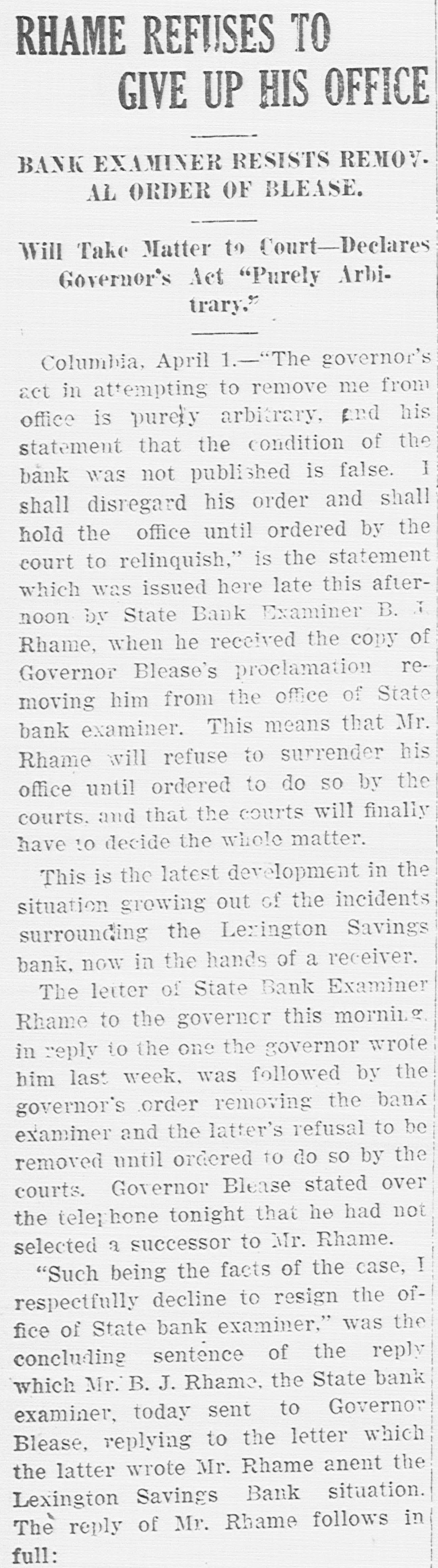
State bank examiner and governor dispute over handling of the bank is mentioned.

Events (3)

1. March 1, 1912* Run
Cause
Rumor Or Misinformation
Cause Details
Widespread rumor of impending failure led depositors to withdraw funds over several weeks.
Newspaper Excerpt
The rumor was carried broadcast several weeks ago ... many depositors made a run on the bank, drawing out their funds.
Source
newspapers
2. March 21, 1912 Receivership
Newspaper Excerpt
W. H. Townsend, receiver, appointed by the court. ... the affairs of the bank ... are in the hand of W. H. Townsend, receiver, appointed by the court.
Source
newspapers
3. March 21, 1912 Suspension
Cause
Government Action
Cause Details
Court-appointed receiver (petition by State Bank Examiner) placed the bank in receivership.
Newspaper Excerpt
Judge Prince ... signed an order appointing W. H. Townsend, receiver for the Lexington Savings Bank, of Lexington.
Source
newspapers

Newspaper Articles (14)

Article from The Lexington Dispatch, March 27, 1912

Click image to open full size in new tab

Article Text

In The Hands of Receiver. The Lexington Savings Bank, for 20 years considered a financial stronghole, is closed, and the affairs of the bank, together with the affairs of its president, Mr. W. P. Roof, are in the hand of W. H. Townsend, receiver, appointed by the court. As a result of the bank's failure the large department store of W. P. Roof is closed, and the whole matter will be settled under bankruptcy proceedings, which were begun in the United States court in Charleston on Saturday. The failure of the bank has occasioned a great deal of regret, and has caused much alarm among the depositors. No statement as to what per cent the creditors will receive has been given to the public and it will be several days before anything definite can be ascertained. The cause of the failure may be assigned to & number of reasons. The rumor was carried broadcast several weeks ago to the effect that the bank was going to the wall and many depositors made a "run" on the bank, drawing out their funds. For a time it was hoped that the bank would be able to stem the heavy tide, but as fast as the money was deposited it would be drawn out by some anxious depositor, it is said. Mr. R of has done more for Lexington than any other liying man. It was he who caused to be built the Lexington Manufacturing Company and the Saxe-Gotha cotton mills, both of which will stand through generations as a living monument to his worth. He has always put his shoulder to the wheel and pushed with all of his energy for every enterprise which looked toward the betterment of his town and community. But few people have ever gone to W. P. Roof for a favor that went away without receiving help. He has held the confidence and esteem of the people of this entire section as no other man has ever held. That he has had confidence in the people is evidenced by the tact that were all the people who are indebted to him to pay up today everyone of his creditors could be paid off dollar for dollar and his mammoth business would continue as if nothing had occurred. Mr. Roof's great misfortune has been-aud this he realizes now when it is too late-his generous nature in furnishing to those from whom he could not secure i-edge collators. County Treasurer E. I. Wingard has deposits amounting to many of dollars tied up in the bank's securities. The State has about $22,000 deposited by Capt. D. J. Griffith as a trust fund. Mr. Wingard is under heavy bond and the county will lose nothing. Clerk of Court Shealy had several thousand dollars deposited in the bank belonging to estates in course of aottlement, but Mr. Shealy has made arrangements, on his personal manhood, auu ne is real to pay every dollar
Article from The Watchman and Southron, March 27, 1912

Click image to open full size in new tab

Article Text

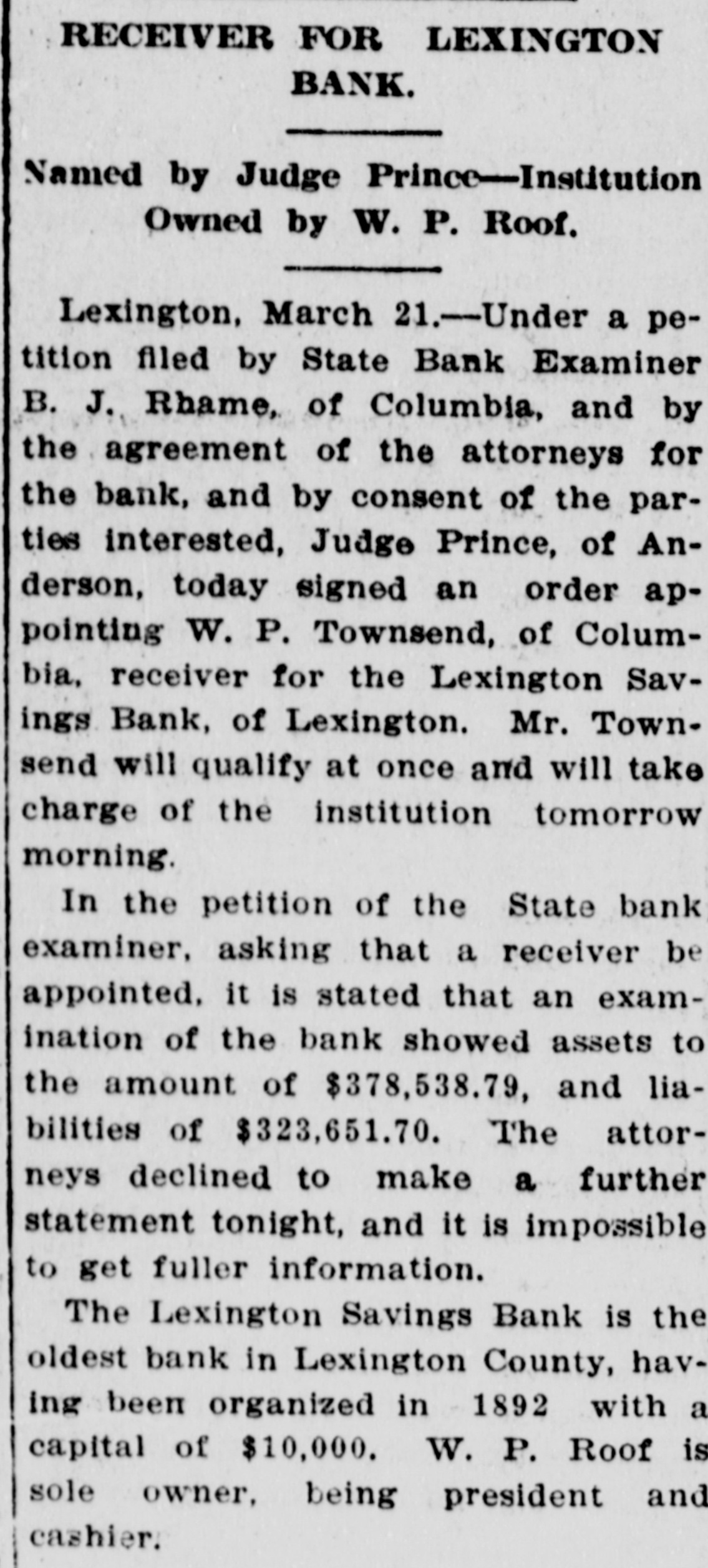
RECEIVER FOR LEXINGTON BANK. Named by Judge Prince-Institution Owned by W. P. Roof. Lexington, March 21.-Under a petition filed by State Bank Examiner B. J. Rhame, of Columbia, and by the agreement of the attorneys for the bank, and by consent of the parties interested, Judge Prince, of Anderson, today signed an order appointing W. P. Townsend, of Columbia, receiver for the Lexington Savings Bank, of Lexington. Mr. Townsend will qualify at once and will take charge of the institution tomorrow morning. In the petition of the State bank examiner, asking that a receiver be appointed. it is stated that an examination of the bank showed assets to the amount of $378,538.79, and liabilities of $323,651.70. The attorneys declined to make a further statement tonight, and it is impossible to get fuller information. The Lexington Savings Bank is the oldest bank in Lexington County, having been organized in 1892 with a capital of $10,000. W. P. Roof is sole owner, being president and cashier.


Article from The Bamberg Herald, March 28, 1912

Click image to open full size in new tab

Article Text

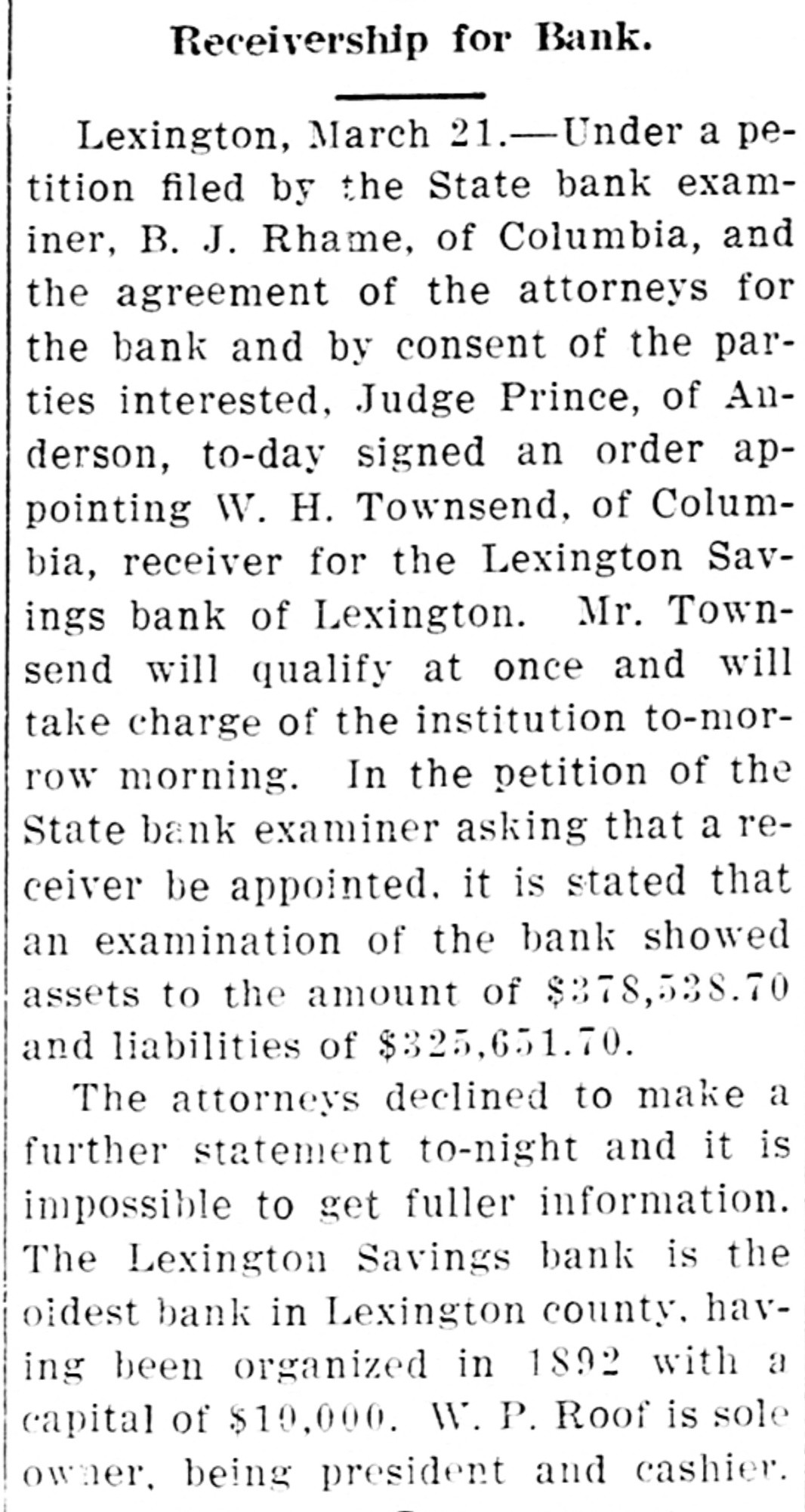
Receivership for Bank. Lexington, March 21.-Under a petition filed by the State bank examiner, B. J. Rhame, of Columbia, and the agreement of the attorneys for the bank and by consent of the parties interested, Judge Prince, of Anderson, to-day signed an order appointing W. H. Townsend, of Columbia, receiver for the Lexington Savings bank of Lexington. Mr. Townsend will qualify at once and will take charge of the institution to-morrow morning. In the petition of the State bank examiner asking that a receiver be appointed. it is stated that an examination of the bank showed assets to the amount of $378,538.70 and liabilities of $325,651.70. The attorneys declined to make a further statement to-night and it is impossible to get fuller information. The Lexington Savings bank is the oldest bank in Lexington county. having been organized in 1892 with a capital of $10,000. W. P. Roof is sole owner. being president and cashier.


Article from The Herald and News, March 29, 1912

Click image to open full size in new tab

Article Text

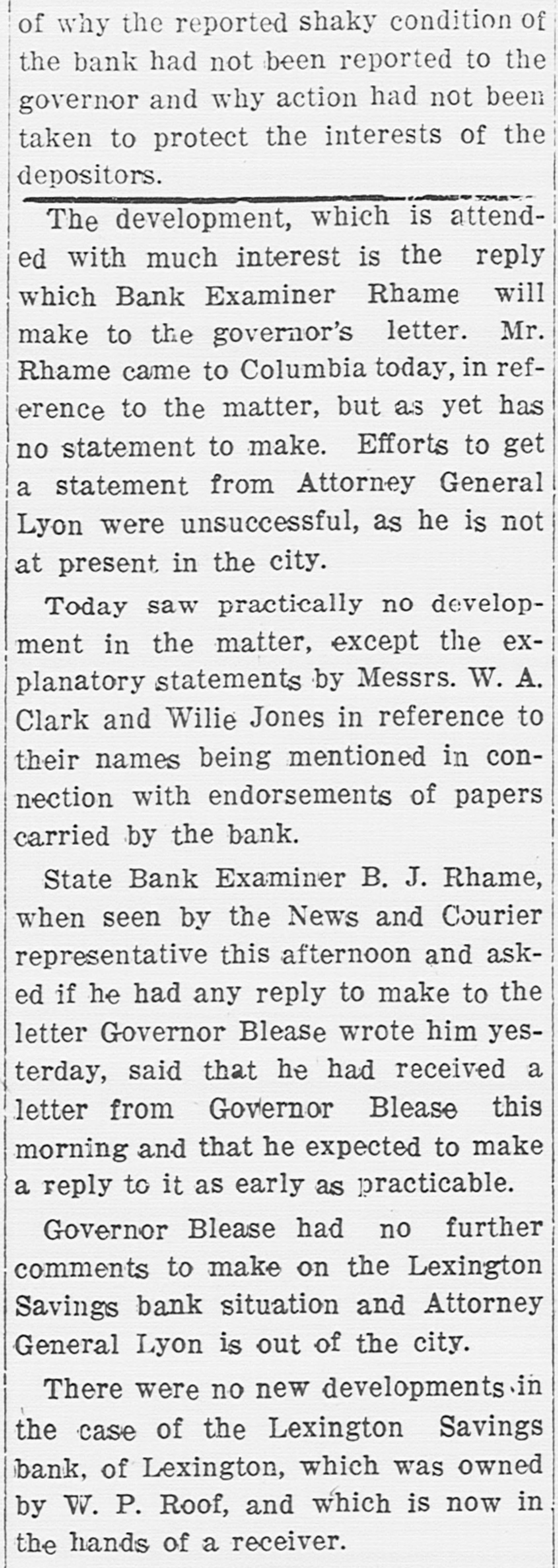
of why the reported shaky condition of the bank had not been reported to the governor and why action had not been taken to protect the interests of the depositors. The development, which is attended with much interest is the reply which Bank Examiner Rhame will make to the governor's letter. Mr. Rhame came to Columbia today, in reference to the matter, but as yet has no statement to make. Efforts to get a statement from Attorney General Lyon were unsuccessful, as he is not at present in the city. Today saw practically no development in the matter, except the explanatory statements by Messrs. W. A. Clark and Wilie Jones in reference to their names being mentioned in connection with endorsements of papers carried by the bank. State Bank Examiner B. J. Rhame, when seen by the News and Courier representative this afternoon and asked if he had any reply to make to the letter Governor Blease wrote him yesterday, said that he had received a letter from Governor Blease this morning and that he expected to make a reply to it as early as practicable. Governor Blease had no further comments to make on the Lexington Savings bank situation and Attorney General Lyon is out of the city. There were no new developments in the case of the Lexington Savings bank, of Lexington, which was owned by W. P. Roof, and which is now in the hands of a receiver.


Article from The Herald and News, March 29, 1912

Click image to open full size in new tab

Article Text

Rhame Will Reply to Governor. Columbia, March 27.-Quite a sensation was created here today by the story which appeared exclusively in the News and Courier in reference to the Lexington Savings bank, which is now in the hands of a receiver, and which was owned and controlled by Mr. W. P. Roof, of Lexington. Not least among the matters of interest involved was the letter addressed by Governor Blease to State Bank Examiner B. J. Rhame, in which the latter was called upon to make explanation


Article from The Watchman and Southron, March 30, 1912

Click image to open full size in new tab

Article Text

RHAME WILL REPLY TO BLEASE STORY OF LEXINGTON BANK CREATES SENSATION. Bank Examiner Will Answer Questions Propounded by Blease. Columbia, March 27.-Quite a sensation was created here today by the story which appeared exclusively in The News and Courier in reference to the Lexington Savings Bank, which is now in the hands of a receiver, and which was owned and controlled by Mr. W. P. Roof, of Lexington. Not least among the matters of interest involved was the letter addressed by Governor Blease to State Bank Examiner B. J. Rhame, in which the latter was called upon to make explanation of why the reported shaky condition of the bank had not be reported to the Governor and W. action had not been taken to protect the interests of the depositors. The development, which is attended with much interest is the reply which Bank Examiner Rhame will make to the Governor's letter. Mr. Rhame came to Columbia today, in reference to the matter, but as yet has no state.. ment to make. Efforts to get a statement from Attorney General Lyon were unsuccessful, as he is not at present in the city.


Article from The Watchman and Southron, April 3, 1912

Click image to open full size in new tab

Article Text

ROOF'S STORE CLOSED. Receiver Kept Busy Checking Up Books of Lexington Merchant and Cotton Mill Owner. Lexington, March 28.-There have been no new developments in the bankruptcy proceedings instituted against W. P. Roof, the well known merchant, banker and cotton mill president, during the last couple of days. The large department store, as well as the bank, has been closed, and W. H. Townsend, the receiver in charge, and his assistants have been kept busy checking up the bank books and Roof's other affairs. Mr. Townsend stated today that he could not as yet give out any statement as to what per cent the creditors would receive, and that it would be several days, perhaps, before any statement to this effect would be issued. The claims have been pouring in since the proceedings began, and the depositors of the bank have been continualling calling at the bank asking all sorts of questions. The Farrish-Stafford company of New York, through its attorney, R. L. Abney, of Columbia, has published notice that it will sell at public auction before the court house door at Lexington, on Saturday, April 13, notes, chattel mortgages and bonds secured by mortgages on real estate, pledged to the company by the Lexington Savings bank, to secure notes owed to it by the Lexington Savings bank. The amount of the notes held by the Farish-Stafford company can not be learned.


Article from The Lexington Dispatch, April 3, 1912

Click image to open full size in new tab

Article Text

Rec iver is Busy. Mr W.H. Townsend, receiver for the Lexington Savings Bank and for W. P. Roof, bankrupt, i- busy arranging the books and accounts and secu ing an inventory of the belongings of Mr. Roof Mr. Townsend cannot give out any statement as yet and it may be several days before a statement can be made. There have been no new developments in the case. We will give our readers 8 full statement as soon as the receiver makes nis report. The whole county has been demoralized by the failure.


Article from The Lexington Dispatch, May 1, 1912

Click image to open full size in new tab

Article Text

Creditors Meet Tomorrow The creditors of the Lexington Savings Bank, which went into the hands of a receiver several weeks ago, and of W. P. Roof, bankrupt, will hold a meeting in the court house tomorrow, and it is expected that the town will be crowded with visitors. It has been rumored for some time that a compromise would be offered at this meeting. Developments of the last few days, however, have changed the situation. and from the best information The Dispatch has been able to gather, it appears now that no compromise will be offered. In case no compromise is offered, the creditors will likely elect one or more trustees, who will proceed to wind-up the affairs as rapidly as the circumstances will permit. What per cent the creditors will realize on the assets of Mr. Roof cannot at this time be intelligently estimated.


Article from The Herald and News, May 7, 1912

Click image to open full size in new tab

Article Text

sented by W. F. Stevenson and H. W. Fraser, whom Governor Blease appointed bank examiner after he removed Mr. Rhame, being represented by B. L. Abney and G. R. Rembert. Attorney General Lyon was present in the court, but took no part in the proceedings, Messrs. Abney and Rembert representing Governor Blease's side, and Mr. Stevenson handling the side of Mr. Rhame. It was a pretty legal argument between some of the best lawyers in the State, and many lawyers were present and listened to the speeches of opposing counsel. When the supreme court renders its decision in this case it will decide who is the legal bank examiner, and also decide the right of the governor to remove the bank examiner, all of which was brought about by the governor's removal of B. J. Rhame from the office of State bank examiner following the publication in the News and Courier of the story of the Lexington Savings bank, now in the hands of a receiver. Judge Thos. S. Sease was appointed by Gov. Blease to sit in this case in place of Associate Justice Fraser, disqualified on account of relationship to Mr. H. W. Fraser.


Article from The Bamberg Herald, October 17, 1912

Click image to open full size in new tab

Article Text

W. P. ROOF GIVES $500 BOND. Charged with Issuing Check Without Funds to Cover. Lexington, Oct. 10.-The latest turn in the bankruptcy proceedings against W. P. Roof and the Lexington Savings Bank was the issuing of a warrant to-day by Magistrate Thos. L. Harman against W. P. Roof, charging Mr. Roof, with giving a check without sufficient funds to cover. The warrant was sworn out by Quincy E. Caughman, a mail carrier on Route 5, Lexington, who, it is said, holds a cashier's check for $500, given the Carolina National Bank, of Columbia, about a week or ten days before the Lexington Savings Bank went into the hands of a receiver and before W. P. Roof was adjudicated a bankrupt. Mr. Roof was not arrested, he having been informed of the issuing of the instrument and immediately gave bond for his appearance at the next term of the court of general sessions in the sum of $500. The trustees of the bankrupt estate of W. P. Roof have consummated the deal with the Farrish-Stafford Company, of New York, by which the trustees are to pay over to the New York firm $50,000 for certain collateral now held by the FarrishStafford Company, amounting to more than $100,000. The trustees will immediately go to work on winding up the estate, collecting what is due and selling the property of the bankrupt estate.


Article from The Herald and News, December 3, 1912

Click image to open full size in new tab

Article Text

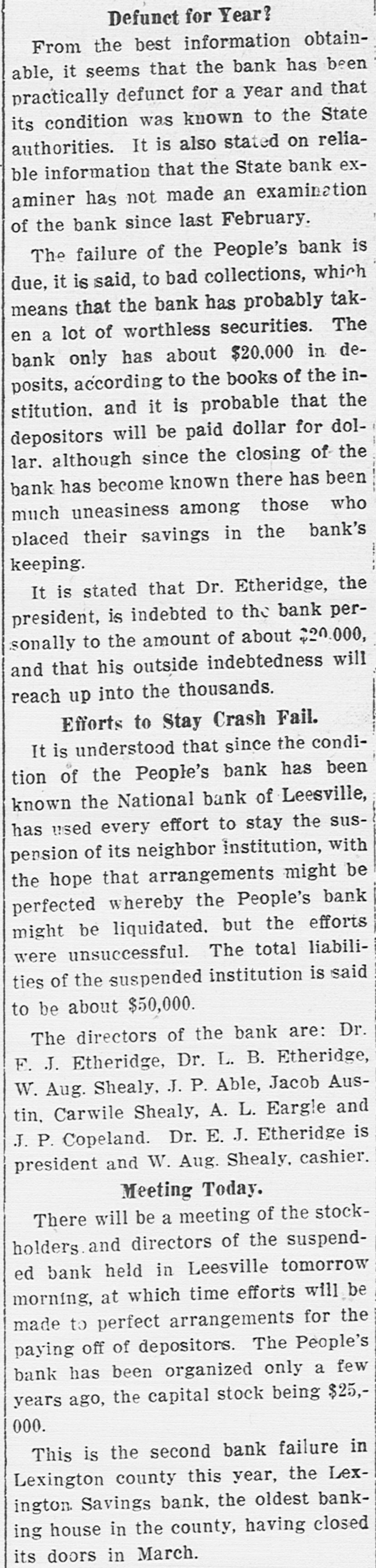
Defunct for Year? From the best information obtainable, it seems that the bank has been practically defunct for a year and that its condition was known to the State authorities. It is also stated on reliable information that the State bank examiner has not made an examination of the bank since last February. The failure of the People's bank is due, it is said, to bad collections, which means that the bank has probably taken a lot of worthless securities. The bank only has about $20,000 in deposits, according to the books of the institution. and it is probable that the depositors will be paid dollar for dollar. although since the closing of the bank has become known there has been much uneasiness among those who placed their savings in the bank's keeping. It is stated that Dr. Etheridge, the president, is indebted to the bank personally to the amount of about $20.000, and that his outside indebtedness will reach up into the thousands. Efforts to Stay Crash Fail. It is understood that since the condition of the People's bank has been known the National bank of Leesville, has used every effort to stay the suspension of its neighbor institution, with the hope that arrangements might be perfected whereby the People's bank might be liquidated. but the efforts were unsuccessful. The total liabilities of the suspended institution is said to be about $50,000. The directors of the bank are: Dr. F. J. Etheridge, Dr. L. B. Etheridge, W. Aug. Shealy, J. P. Able, Jacob Austin, Carwile Shealy, A. L. Eargle and J. P. Copeland. Dr. E. J. Etheridge is president and W. Aug. Shealy. cashier. Meeting Today. There will be a meeting of the stockholders and directors of the suspended bank held in Leesville tomorrow morning, at which time efforts will be made to perfect arrangements for the paying off of depositors. The People's bank has been organized only a few years ago, the capital stock being $25,000. This is the second bank failure in Lexington county this year, the Lexington. Savings bank, the oldest banking house in the county, having closed its doors in March.


Article from Yorkville Enquirer, December 3, 1912

Click image to open full size in new tab

Article Text

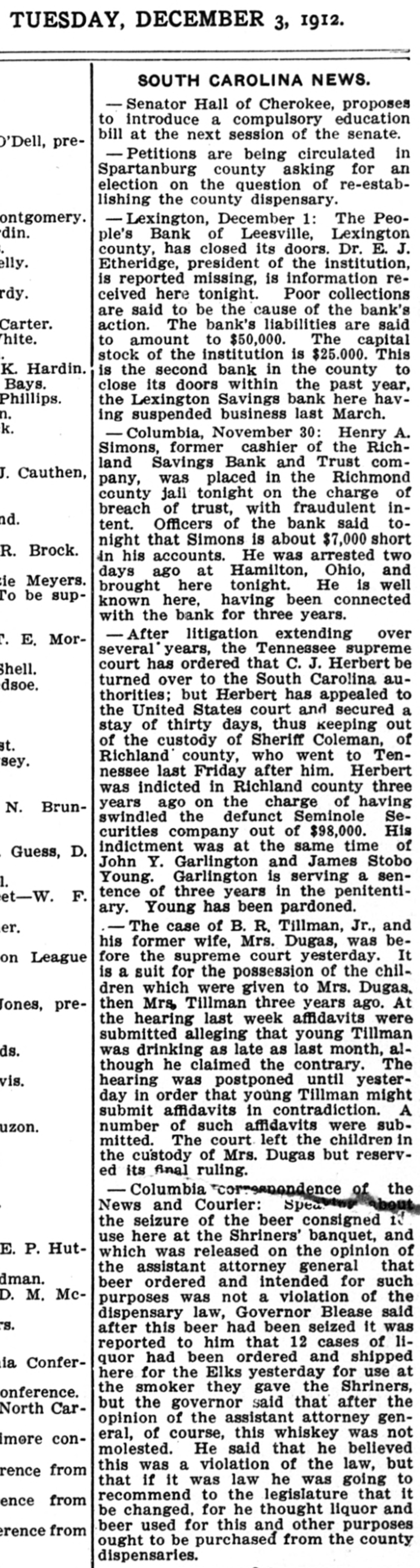
TUESDAY, DECEMBER 3, 1912. SOUTH CAROLINA NEWS. - Senator Hall of Cherokee, proposes to introduce a compulsory education bill at the next session of the senate. D'Dell, pre- Petitions are being circulated in Spartanburg county asking for an election on the question of re-establishing the county dispensary. ontgomery. - Lexington, December 1: The Peodin. ple's Bank of Leesville, Lexington county, has closed its doors. Dr. E. J. Etheridge, president of the institution, is reported missing, is information received here tonight. Poor collections are said to be the cause of the bank's Carter. action. The bank's liabilities are said Thite. to amount to $50,000. The capital stock of the institution is $25.000. This Hardin. is the second bank in the county to Bays. close its doors within the past year, Phillips. the Lexington Savings bank here having suspended business last March. - Columbia, November 30: Henry A. Simons, former cashier of the Richland Savings Bank and Trust comCauthen, pany, was placed in the Richmond county jail tonight on the charge of breach of trust, with fraudulent intent. Officers of the bank said tonight that Simons is about $7,000 short Brock. in his accounts. He was arrested two days ago at Hamilton, Ohio, and Meyers. brought here tonight. He is well To be supknown here, having been connected with the bank for three years. - After litigation extending over MorE. several years, the Tennessee supreme court has ordered that C. J. Herbert be Shell. turned over to the South Carolina authorities; but Herbert has appealed to the United States court and secured a stay of thirty days, thus keeping out of the custody of Sheriff Coleman, of Richland county, who went to Tennessee last Friday after him. Herbert was indicted in Richland county three years ago on the charge of having BrunN. swindled the defunct Seminole Securities company out of $98,000. His indictment was at the same time of D. Guess, John Y. Garlington and James Stobo Young. Garlington is serving a sentence of three years in the penitentiF. ary. Young has been pardoned. - The case of B. R. Tillman, Jr., and his former wife, Mrs. Dugas, was before the supreme court yesterday. It League is a suit for the possession of the children which were given to Mrs. Dugas, then Mrs, Tillman three years ago. At Jones, prethe hearing last week affidavits were submitted alleging that young Tillman was drinking as late as last month, although he claimed the contrary. The hearing was postponed until yesterday in order that young Tillman might submit affidavits in contradiction. A number of such affidavits were submitted. The court left the children in the custody of Mrs. Dugas but reserved its final ruling. - Columbia correspondence of the News and Courier: Spea about the seizure of the beer consigned 10 use here at the Shriners' banquet, and HutP. which was released on the opinion of the assistant attorney general that beer ordered and intended for such McM. purposes was not a violation of the dispensary law, Governor Blease said after this beer had been seized it was reported to him that 12 cases of liquor had been ordered and shipped Conferhere for the Elks yesterday for use at the smoker they gave the Shriners, onference. but the governor said that after the North Caropinion of the assistant attorney general, of course, this whiskey was not conimore molested. He said that he believed this was a violation of the law, but from that if it was law he was going to recommend to the legislature that it from be changed, for he thought liquor and beer used for this and other purposes from ought to be purchased from the county dispensaries.


Article from The Herald and News, July 18, 1913

Click image to open full size in new tab

Article Text

ECHO LEXINGTON BANK CRASH. Judge Shipp Renders Opinion in Interesting Case.-In Favor in Defendant. Lexington, July 14.-One of the most important decisions rendered in the courts of this county in many years has just been handed down by Judge S. W. G. Shipp, of Florence, in favor of the defendant in the case of Sarah C. Eleazer and her husband, H. H. Eleazer, plaintiffs, against Frank W. Shealy, clerk of the court of common pleas and general sessions for Lexington county, and special referee, defendant. This was an action brought by Mr. and Mrs. Eleazer arising out of the sale of certain lands belonging to the estate of John P. Bouknight, deceased, in which the clerk of court sold the property under an order of court for a division among several heirs. The land was bid off by Walter Looney for the price of $440, and thereafter Looney transferred his bid to Sarah C. Eleazer for $500 and authorized the clerk of court to make title to Mrs. Eleazer. The sale was made on the first Monday in February, 1912. On February the 21st, following, H. H. Eleazor, husband of Sarah C. Eleazer, acting for her, came to Lexington and presented to the clerk of court a check on the Lexington Savings bank for $600 drawn by one Riddle, with the request that the clerk then and there make title to the property in favor of his wife, Mrs. Sarah C. Eleazer, and at the same time requesting the clerk to accept the $600 check and give to him (Eleazer) a check for $100, the difference between the bid and the amount of the Riddle check. This the clerk refused to do, stating to Mr. Eeazer at the time, according to the evidence, that he (the clerk) knew bis own check was good, while he was not sure about the other man's. Wanted Cash Only. The clerk requested Mr. Eleazer to step across the street to the Lexington Savings bank, a short distance from the court house, get the $600 check cashed and bring back to him (the clerk) the $500 in money. Mr. Eleazer went out of the clerk's office, so the testimony goes, and returned a short while afterwards with a cashier's check drawn by the Lexington Savings bank for the amount of $500 and presented the same to the clerk of court. The clerk still refused to recognize the check for the reason, he stated, that the Lexington Savings bank was then in bad circumstances and that nothing but the money would go at his office. Mr. Eleazer went out of the clerk's office, carrying a check with him. Returning a second time he again pre-sented the cashier's check to the clerk of court in payment of the bid on the land. The clerk again refused to comply with Mr. Eleazer's request and did not execute the deed of the property in question. Finally an agreement was reached between Mr. Eleazer and the clerk of court to the effect that the clerk of court would keep the check and use every effort he could to collect it at the bank. Clerk Shealy testified at the hearing that he carried the check to the Lexington Savings bank and presented it for collection on the same afternoon, the 21st of February. He was unable, however, to get the check cashed, the teller requesting Mr. Shealy to hold the check for a day or two; that sufficient funds would then be on hand to nay it. A few days later. the clerk testified, he carried the check to the bank a second time for collection and was unable to get the amount. Bank Fails. In the meantime, the clerk said, he addressed several letters to H. H. Eleazer at Chapin, South Carolina, but he declared tlat he was unable to receive an answer. In addition to addressing the letters to Mr. Eleazer, the clerk testified that he communicated with the telephone operator in an effort to get in connection with Mr. Eleazer in reference to the check. On the 23rd day of March, 1912, about a month after Mr. Eleazer tendered the check to the clerk of court, the Lexington Savings bank closed its doors