City Bank (Cincinnati, OH)

Episode Information

Episode UID
6715520690653
Episode Type
Suspension โ†’ Closure
Bank Type
state
Bank ID
671552069 hash
Start Date
May 30, 1854
Location
Cincinnati, Ohio (39.103, -84.515)

Metadata

Model
gpt-5-mini (chosen from majority vote of a three-model LLM ensemble)
Short Digest
db6000109a95b726

Response Measures

None

Description

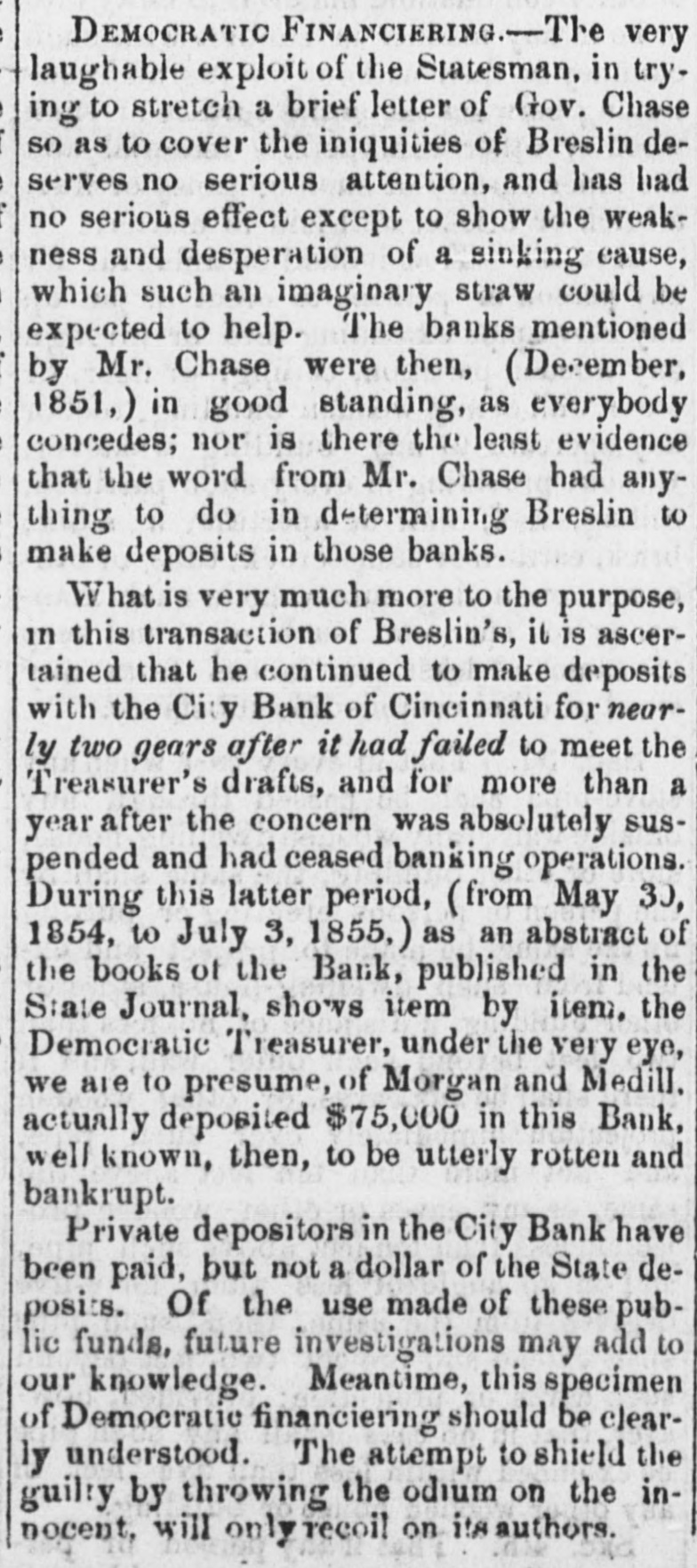
Closure is tied to insolvency and Treasurer Breslin's deposits; articles state the bank ceased banking operations and was suspended.

Events (1)

1. May 30, 1854 Suspension
Cause
Bank Specific Adverse Info
Cause Details
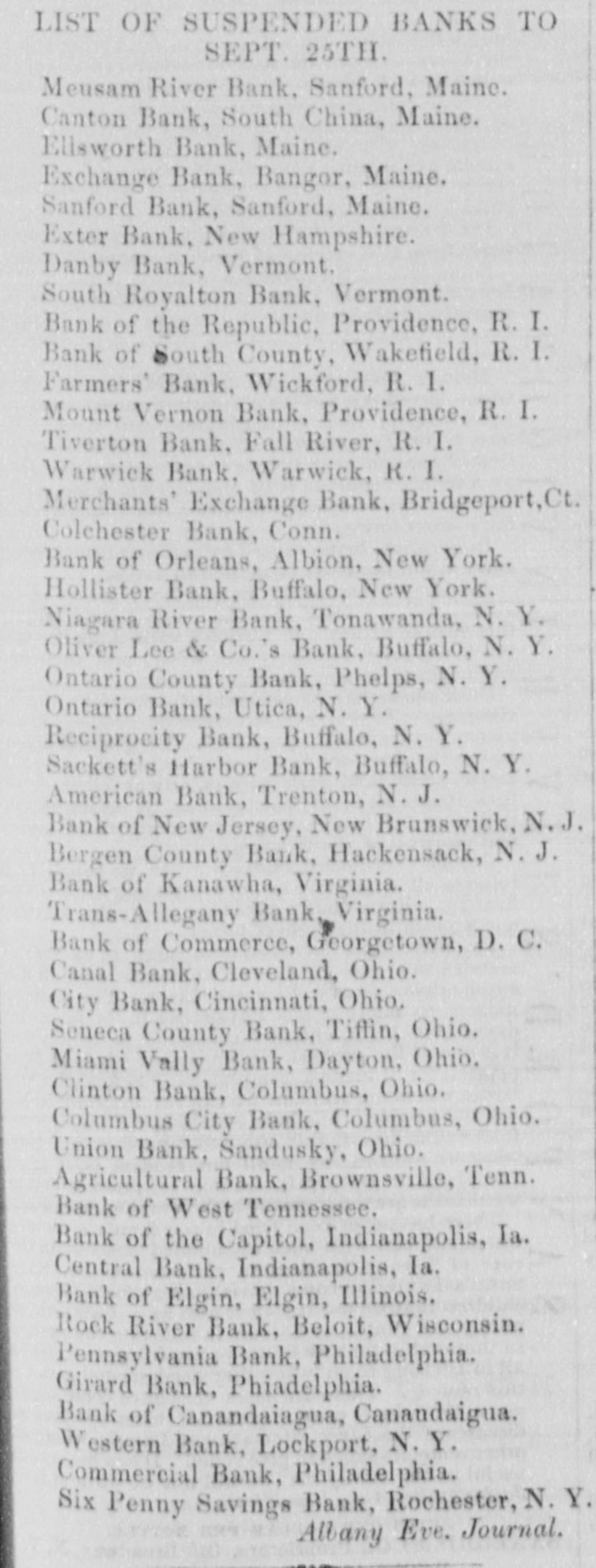
Bank failed to meet Treasurer's drafts and ceased operations amid insolvency and misapplied/public-fund losses linked to Treasurer Breslin; listed among suspended banks in 1857 lists and papers indicating failure and receivership.
Newspaper Excerpt
continued to make deposits with the City Bank of Cincinnati for nearly two years after it had failed to meet the Treasurer's drafts, and for more than a year after the concern was absolutely suspended and had ceased banking operations.
Source
newspapers

Newspaper Articles (11)

Article from Fremont Journal, April 25, 1856

Click image to open full size in new tab

Article Text

Total to the communication herewith committee, Gibson, in March a 29, 1856, that he has submitted, Mr. marked dated times G., states between his predecessor January ceived at various 5th, 1856, sum from of $836,101 on the March gross Mr. Breslin $212, 3. of unand leaving 29th Mr. Breslin, of in March the the hands an unpaid of State balance been of kept in 432 57 3 Had the money with of the the depositaries pecuniary ability, this the treasury, solvency or see and no reason been why paid the questionable: committee can not al once, to have his successor, the balance should late Treasurer office. This, all in over by the of the should in of and the we are at the $ on opinion be done; the transfer that the committee, requires act gratified passed it. in sums being present of cases able the session to state positively that large with, or loanapped institutions It however money were individuals or character public ed to, companies. It not that that high was requisite is pecuniary which were them fit depositaries The result for that moneys should that to make or loaned. of the funds meet the deready to the for be in it, is at that purpose. considerable deposited mands unavailable the upon treasury, portion present, balance to say due from least of of it, to be a on account the bank by Treasurer, the the public There City moneys appears Bank Mr. deposited of Cincinnati Breslin, in said or by his $79,811 orders: Countries 24,927 The late sum Commercial Bank of Toledo, on From W. W. Cones From similarace Beckel & (Day Co. (Cincinnati) $203,324.14 From Total (exclusive of interest) of Cincinnati, as The already comThe City Bank public, has failed. as yet to obtain the known have to the not been able, in regard able to to It is any mittee reliable which information the bank will however be proba- evenble that a dividend pay to its creditors. portion of this debt may the comtually be realized. from information committee that believe Judging deem reliable, from the the Commercial as the mittee that the balance will due be paid in of full, receivers, Bank of Toledo bank, in the hands town lots and buil- of assets of of lands, on sales consist mostly of deferred payments Full payment than real dings, and or personal safely property. anticipated in less trust can two Mr. not years. Beckel be parcels has of executed State, real estate (or a deed to to shall Mr. of secure Bres- have of the certain payment to the in the case the he treasury) the discha-ged lin, late Treasurer, his of the liabilities above stated to condition balance.of $50,000 are, by made by installThese payments of trust, to be times from Jan. by 1, said deed payable at various as will appear subdocuments mitted. the the ments 1857 to Jan. marked 1. 1858, H. and I. herewith balance probability of realizing & Co.of Cincinnati, can not due Of from W. also W. failed, Cones the Those committee who know in who have with confidence. late company differ pay, or something speak of the this divided they will be collecestimates of by legal committee proceedings place little reliance the From ted which of may them. on moneys The that may be P. realized BowHamilton from this source. testimony of Henry county, corrobTreasman, that of county, Treasurer of R. C. Hazlewood, (300 docuit appears for the public orated urer ments L.) elect herewith and by of company the that submitted same the placing standing pecuniary marked Treasurer, of responsi- K. W. mon- and W. Cones at the time of the late warrant eys in bility, their hands was by not such as first to taking his orders, without of the by transactions the repayment hands. those security for placed in their adequate of money believe that part large sums also reason to the State thus the put There of is the moneys of used to establish curleast, their hands, in was Virginia, and to issued give by to the that the into Kanawha in this Bank State, would also paper seem interested rency, that bank. It was, in some way, Cones, who late Treasurer bank. Although Mr. a stockholder in that to have been undoubted is bank, and whether in understood the known who must stoch holder, or not de- on lv have was also a to him Mr. Breslin answer the question M., put it is difficult the point (see any other Mr. Breslin to to interest of the paper we sustain strong that clines explain to the by credit manifested document circumstances by hypothesis of Bow- that add When to these of Henry P. that bank. the declaration, on understood oath, by him interes& Co. and Bank as part Cones man, in that the Kanawha "it was Mr. Breslin room to were doubt owners, that the there ted seems to be little was interested State in to to forbear bank, put the it late in and Treasurer operation, used the or funds at least, of the to sustain express its their tice credit. The of decided committee using the disapprobation public car for not purposes moneys, of of either the any private prac- pri- directly or indirectly, to build up or foster especially having emolument, vate which or or institution, more agent may company any officer or be interthe one custody in of such moneys, ested. laws of a penal searching character, examina- comwith frequent or its committees, and bined Stringent by the Legislature and of the moneys tions, into the management seem to be absolutepublic morals. ly finances necessary of the to State, prevent great depreciation

Article from The Cadiz Democratic Sentinel, June 25, 1857

Click image to open full size in new tab

Article Text

on ount m meys deposited in said bank by th late Treasurer, Mr. Bresiin, or by his orders, the sum of From the Commercial Bank of Toledo on similar account From Daniel Beckel, (Dayton) From W. W. Cones & Co., (Cinc'ti) Total (exclusive of interest) The City Bank of Cincinnati, known to the public, has failed. 'I has not been able, as yet, to obtain information in regard to the divi the bank will be able to pay its e is however, propable that a small po debt may eventually be realized. Judging from information that th deem reliable, the committee beli balance due from the Commercial ledo will be paid in full, but as the bank, in the hands of receivers, co of lands, town lots and buildings, or payments on sales of real and person full payment cannot be sately ai less than two years. Mr. Beckel h a deed of trust of certain parcels of I secure the payment to the State, Breslin, late Treasurer, in case he discharged his liabilities to the treas 000 ofthe above stated balance. ments are, by the conditions of sa trust, to be made by installments, various times from January 1, 1857 1, 1858, as will appear by docume H and I, herewith submitted. Of the probability of realizing the from W. W. Cones of Cincinnati, w failed, the committee cannot speak dence. Those who know somet] late company, differ in their estin dividend they will pay, or which n proceedings, be collected of them. mittee place little reliance on mone be realized from this source. From the testimony of Henry ] Treasurer of Hamilton county, cor that of R. C. Hazlewood, Treasurer same COUI ty, (see documents herew ted, marked K and L,) it appears tl ding of W. W. Cones & Co. for I sponsibility, at the time of placing moneys in their hands by the late by his orders, was not such as to will transactions without first taking as rity for the repayment of the large ney placed in their hands. There son to believe that part at least of of the State thus put into their han to establish the Kanawha Bank of to give currency in this State to the ed by that bank. It would also se late treasurer was in some way i that bank, although Mr. Cones, wl stood to have been a stock holder and who mus: undoubtedly have kr er or not Mr. Breslin was also a declines to answer the question pt that point. (See document M.) to explain by any other hypothesi interest manifested by Mr. Bresli the credit of the paper of that bank these circumstances, we add the di oath of Henry B. Bowman, that "it stoo by him that Come & Co. and were interested in the Kanawha B owners," there seem to be little ro that the late Treasurer was inter bank, and used the funds of the Sta in operation, or at least to sustain i The committee cannot forbear their decided disapprobation of th using the public moneys, either di directly, for purposes of private em to build or loster any private comps tation-more especially one in which or agent having the custody of S may be interested. Stringent laws of a penal charao ned with frequent and searching e by the Legislature or its cominitt management of the moneys and fin State seem to be absolutely necess vent great pecuniary losses to the still greater depreciation of public 1 Since the examination of the trea ment by a commission created for I about nine years ago, no careful ex that department appears to have be Years have gone by since there has critical comparison of the books, vonchers of the auditor and treasu Thus the great object of making tl office a complete check on that of er has for years been rendered entit This state of things has resulted II fective Legislation than from naglect the part of the officers of State; an dently hoped that the legislation of session on this subject will greatly does not entirely cure these evils. The impossibility of going in to amination of all the transactions, be and vouchers of the treasury dep tending through a period of nine committee of the Senate during its be at once seen and acknowledged. dinary legislative duties did not OC the time and attention of the men


Article from New-York Daily Tribune, August 11, 1857

Click image to open full size in new tab

Article Text

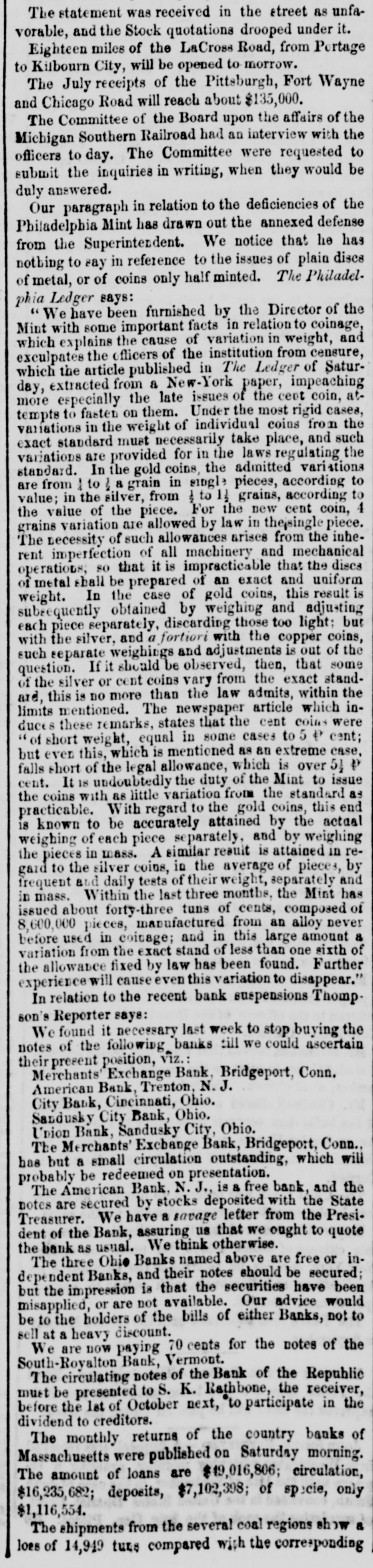
The statement was received in the street as unfavorable, and the Stock quotations drooped under it. Eighteen miles of the LaCross Road, from Portage to Kilbourn City, will be opened to morrow. The July receipts of the Pittsburgh, Fort Wayne and Chicago Road will reach about $135,000. The Committee of the Board upon the affairs of the Michigan Southern Railroad had an interview with the officers to day. The Committee were requested to submit the inquiries in writing, when they would be duly answered. Our paragraph in relation to the deficiencies of the Philadelphia Mint has drawn out the annexed defense from the Superintendent. We notice that he has notbing to say in reference to the issues of plain discs of metal, or of coins only half minted. The Philadelphia Ledger says: We have been furnished by the Director of the Mint with some important facts in relation to coinage, which explains the cause of variation in weight, and exculpates the officers of the institution from censure, which the article published in The Ledger of Saturday, extracted from a New-York paper, impeaching more especially the late issues of the cent coin, attempts to fasten on them. Under the most rigid cases, variations in the weight of individual coins from the exact standard must necessarily take place, and such variations are provided for in the laws regulating the standard. In the gold coins, the admitted variations are from I to 1 a grain in single pieces, according to value; in the silver, from 1 to 11 grains, according to the value of the piece. For the new cent coin, 4 grains variation are allowed by law in theisingle piece. The necessity of such allowances arises from the inherent imperfection of all machinery and mechanical operations, so that it is impracticable that the discs of metal shall be prepared of an exact and uniform weight. In the case of gold coins, this result is subsequently obtained by weighing and adjusting each piece separately, discarding those too light; but with the silver, and a fortiori with the copper coins, such separate weighings and adjustments is out of the question. If it should be observed, then, that some of the silver or cent coins vary from the exact standard, this is no more than the law admits, within the limits mentioned. The newspaper article which induces these remarks, states that the cent coins were "of short weight, equal in some cases to 5 P cent; but even this, which is mentioned as an extreme case, falls short of the legal allowance, which is over 51 P cent. It 18 undoubtedly the duty of the Mint to issue the coins with as little variation from the standard as practicable. With regard to the gold coins, this end is known to be accurately attained by the actual weighing of each piece separately, and by weighing the pieces in mass. A similar result is attained in regard to the silver coins, in the average of pieces, by frequent and daily tests of their weight, separately and in mass. Within the last three months, the Mint has issued about forty-three tuns of cents, composed of 8,600,000 pieces, manufactured from an alloy never before used in coinage; and in this large amount a variation from the exact stand of less than one sixth of the allowance fixed by law has been found. Further experience will cause even this variation to disappear." In relation to the recent bank suspensions Thomp. son's Reporter says: We found it necessary last week to stop buying the notes of the following banks till we could ascertain their present position, viz.: Merchants Exchange Bank, Bridgeport, Conn. American Bank, Trenton, N.J. City Bank, Cincinnati, Ohio. Sandusky City Bank, Ohio. Union Bank, Sandusky City, Ohio. The Merchants' Exchange Bank, Bridgeport, Conn., has but a small circulation outstanding, which will probably be redeemed on presentation. The American Bank, N.J., is & free bank, and the notes are secured by stocks deposited with the State Treasurer. We have a savage letter from the President of the Bank, assuring us that we ought to quote the bank as usual. We think otherwise. The three Ohio Banks named above are free or independent Banks, and their notes should be secured; but the impression is that the securities have been misapplied, or are not available. Our advice would be to the holders of the bills of either Banks, not to sell at a heavy discount. We are now paying 70 cents for the notes of the South-Royalton Bank, Vermont. The circulating notes of the Bank of the Republic must be presented to S. K. Rathbone, the receiver, before the lat of October next, to participate in the dividend to creditors. The monthly returns of the country banks of Massachusetts were published on Saturday morning. The amount of loans are $49,016,806; circulation, $16,235,682; deposits, $7,102,398; of specie, only $1,116,554. The shipments from the several coal regions show a loes of 14,949 tuns compared with the corresponding


Article from Bellevue Gazette, August 20, 1857

Click image to open full size in new tab

Article Text

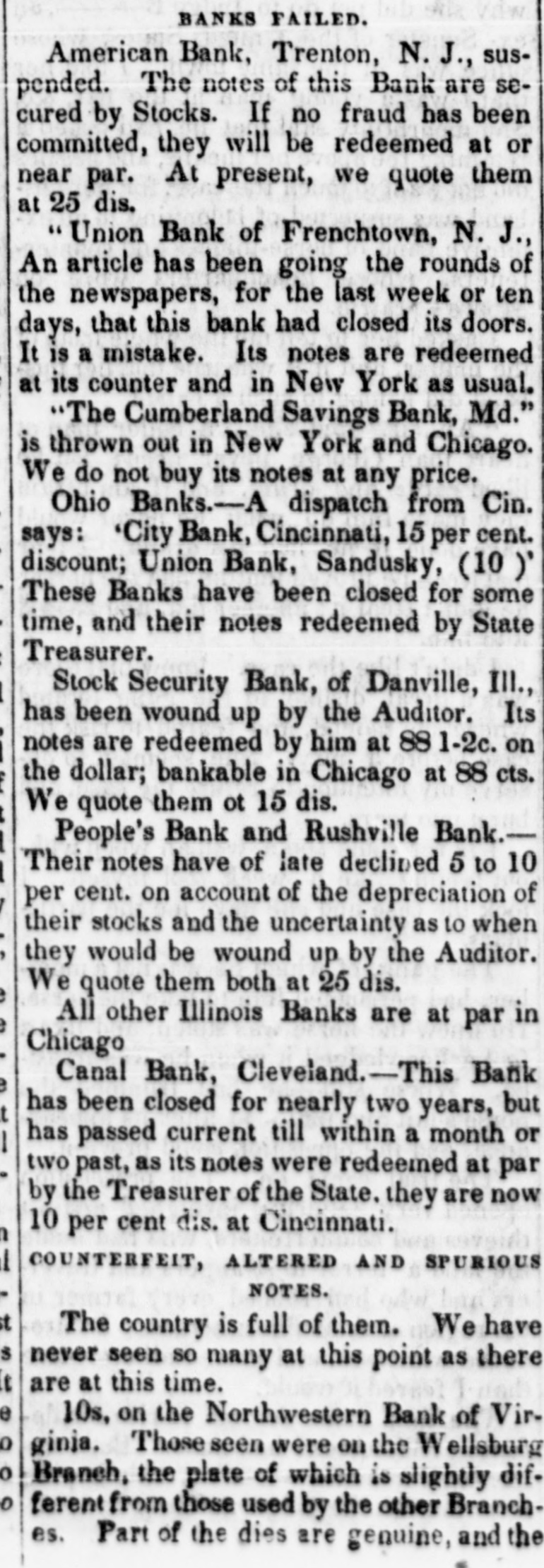
BANKS FAILED. American Bank, Trenton, N. J., suspended. The notes of this Bank are secured by Stocks. If no fraud has been committed, they will be redeemed at or near par. At present, we quote them at 25 dis. Union Bank of Frenchtown, N. J., An article has been going the rounds of the newspapers, for the last week or ten days, that this bank had closed its doors. It is a mistake. Its notes are redeemed at its counter and in New York as usual. "The Cumberland Savings Bank, Md." is thrown out in New York and Chicago. We do not buy its notes at any price. Ohio Banks.-A dispatch from Cin. says: City Bank, Cincinnati, 15 per cent. discount; Union Bank, Sandusky, (10 )' These Banks have been closed for some time, and their notes redeemed by State Treasurer. Stock Security Bank, of Danville, III., has been wound up by the Auditor. Its notes are redeemed by him at 88 1-2c. on the dollar; bankable in Chicago at 88 cts. We quote them ot 15 dis. People's Bank and Rushville Bank.Their notes have of late declined 5 to 10 per cent. on account of the depreciation of their stocks and the uncertainty as to when they would be wound up by the Auditor. We quote them both at 25 dis. All other Illinois Banks are at par in Chicago Canal Bank, Cleveland.-This Bank has been closed for nearly two years, but has passed current till within a month or two past, as its notes were redeemed at par by the Treasurer of the State. they are now 10 per cent dis. at Cincinnati. COUNTERFEIT, ALTERED AND SPURIOUS NOTES. The country is full of them. We have never seen so many at this point as there are at this time. 10s, on the Northwestern Bank of Virginja. Those seen were on the Wellsburg Branch, the plate of which is slightly different from those used by the other Branches. Part of the dies are genuine, and the


Article from Holmes County Republican, August 27, 1857

Click image to open full size in new tab

Article Text

of May Gibson and June, has appeared before us, and submitted Mr. to an examination. In his he deposition which is here to appended, declares that all his official communication relative to the payments alleged to have been made by Mr. Breslin to him were false-and that he received but $303,865 34 from him. It is not unjust to say that his present declarations, however solemnly made, are not entitled to any credit, unless sustained and corroborated by the records of the office, the testimony of others, or the declaration and conduct of Mr. Breslin. His (Mr. Gibson's) motives in making such official communications he states were two-fold: 1st. He was one of the sureties on Breslin's offical bond-and the exposure of ruin the defalcation would involve the pecuniary his of himself and co-sureties, who were friends and neighbors. 2d. He thought that by concealing the fact of the defalcation, he could secure the amount due the State. Whether his motives constitute a justification for a breach of official duty we leave to another tribunal to decide. In considering the evidence against Mr. in Breslin, in order to illustrate the mode bewhich business has been transacted tween successive Treasurers it seems prop- the to go back to the time he assumed duties of that office. Mr. Breslin in taking charge of the Treasury in January, 1852, opened a vari- new of books transferring to them the due set balances which appeared to be from ous his predecessor, Mr. Bliss, and subsequently executed to him a receipt therefor of which the following is a copy: TREASURY OFFICE, OHHo. Columbus, Oct. 20, '52. 1 Received of Albert A. Bliss, Esq., late all Treasurer of State, payment in full Treas- of balances charged against him as said 12 on the books of this office, January 1852, ury and all indebtedness which has appearned against him up to this date. J. G. BRESLIN, Tr. of State, one on reading this receipt would have Any supposed that Mr. Bliss had paid over was the money due the State. Sush the fact. The Receipt was false.There not was a balance of $65,000 due from Mr. Bliss, which was not paid until more thanthree years after this date. In response to a resolution of the addressed Senate December,, 1852, M. Breslin of official communication to that body which is equivalent to a positive assertion the hat Mr. Bliss had paid over to him all public funds belonging to the Treasury. The motives which induced M. Breslin execute this receipt and make his official statement, the undesigned will not attempt divide. His acts were ciearly calculated, misand it is fair to pesume, intended to lead and deceive. It was an unfortunate commencement of an official career. Truth a quality which the people have a right expect in official statements of its sworn ervents. The report of Mr. Breslin for the fiscal euding Nov. 15, 1855, shows a bal- the of $683,574,90 at that date in Treasury. nce In the same report he states the the Commercial Bank of Toledo, W. hat he City Bank of Cincinnati, and W. Cones & Co., had failed with an aggregate $153,851,18 of the pnblic money in their ands. The subtraction of rhis sum from amount in the Treasury, leaves a clear balalance he of $559,723,72. Upon this nce there was no extraordinary demand, the except for the payment of interest on which debt due Jan. 1, 1856, mounted, oreign with the expenses as charged this him to $421,320,75. Deducting the clear balance in the Treasury, as hown rom by his report, there is still a balance the $138,402,97; a sum sufficient with meet daily income of the State, to with egular its liabilities until the settlement fulCounty Treasurers in the Febuary he Besides the last mentioned amount, owing. Mr. Breslin had in his hands $94,- of 788,88-the funds of the Canal Bank h's Cleveland, which he does not notice in report. With the funds in his phssession amply 1 dequate to meet all demands which could made upon the Treasury, he issued a circular to the County Treasurers, referring I hem to the act of 1841, and calling upon hem to make the advances required by hat law to enable him to pay the January nterest. In complience with the demand, . he County Treasurers paid into the State $760,715,70 between the 6th day Treasury November and the time at which he was u ucceeded by Mr. Gibson. it It is true that in making this demand in c the County Treasurers, he acted and pon with the provisions of law,


Article from Vermont Watchman and State Journal, October 9, 1857

Click image to open full size in new tab

Article Text

LIST OF SUSPENDED BANKS TO SEPT. 25TH. Meusam River Bank, Sanford, Maine. Canton Bank, South China, Maine. Ellsworth Bank, Maine. Exchange Bank, Bangor, Maine. Sanford Bank, Sanford, Maine. Exter Bank, New Hampshire. Danby Bank, Vermont. South Royalton Bank, Vermont. Bank of the Republic, Providence, R. I. Bank of South County, Wakefield, R. I. Farmers' Bank, Wickford, R. 1. Mount Vernon Bank, Providence, R. I. Tiverton Bank, Fall River, R. I. Warwick Bank, Warwick, R. I. Merchants' Exchange Bank, Bridgeport, Ct. Colchester Bank, Conn. Bank of Orleans, Albion, New York. Hollister Bank, Buffalo, New York. Niagara River Bank, Tonawanda, N. Y. Oliver Lee & Co.'s Bank, Buffalo, N. Y. Ontario County Bank, Phelps, N.Y. Ontario Bank, Utica, N. Y. Reciprocity Bank, Buffalo, N. Y. Sackett's Harbor Bank, Buffalo, N. Y. American Bank, Trenton, N. J. Bank of New Jersey, New Brunswick, N.J. Bergen County Bank, Hackensack, N. J. Bank of Kanawha, Virginia. Trans-Allegany Bank, Virginia. Bank of Commerce, Georgetown, D. C. Canal Bank, Cleveland, Ohio. City Bank, Cincinnati, Ohio, Seneca County Bank, Tiffin, Ohio. Miami Vally Bank, Dayton, Ohio. Clinton Bank, Columbus, Ohio. Columbus City Bank, Columbus, Ohio. Union Bank, Sandusky, Ohio. Agricultural Bank, Brownsville, Tenn. Bank of West Tennessee. Bank of the Capitol, Indianapolis, Ia. Central Bank, Indianapolis, la. Bank of Elgin, Elgin, Illinois. Rock River Bank, Beloit, Wisconsin. Pennsylvania Bank, Philadelphia. Girard Bank, Phiadelphia. Bank of Canandaiagua, Canandaigua. Western Bank, Lockport, N.Y. Commercial Bank, Philadelphia. Six Penny Savings Bank, Rochester, N. Y. Albany Eve. Journal.


Article from Meigs County Telegraph, October 13, 1857

Click image to open full size in new tab

Article Text

DEMOCRATIC FINANCIERING.-Tre very laughable exploit of the Statesman, in trying to stretch a brief letter of Gov. Chase so as to cover the iniquities of Breslin deserves no serious attention, and has had no serious effect except to show the weakness and desperation of a sinking cause, which such an imaginary straw could be expected to help. The banks mentioned by Mr. Chase were then, (December, 1851,) in good standing, as everybody concedes; nor is there the least evidence that the word from Mr. Chase had anything to do in determining Breslin to make deposits in those banks. What is very much more to the purpose, in this transaction of Breslin's, it is ascertained that he continued to make deposits with the City Bank of Cincinnati for nearly two gears after it had failed to meet the Treasurer's drafts, and for more than a year after the concern was absolutely suspended and had ceased banking operations. During this latter period, (from May 30, 1854, to July 3, 1855,) as an abstract of the books of the Bank, published in the State Journal, shows item by item, the Democratic Treasurer, under the very eye, we are to presume, of Morgan and Medill. actually deposited $75,000 in this Bank, well known, then, to be utterly rotten and bankrupt. Private depositors in the City Bank have been paid, but not a dollar of the State deposits. Of the use made of these public funds, future investigations may add to our knowledge. Meantime, this specimen of Democratic financiering should be clearly understood. The attempt to shield the guilty by throwing the odium on the innocent, will only recoil on its authors.


Article from Cleveland Morning Leader, December 8, 1858

Click image to open full size in new tab

Article Text

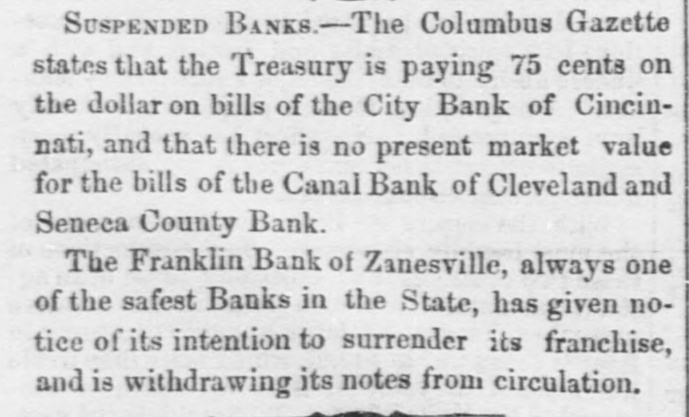
SUSPENDED BANKS.-The Columbus Gazette states that the Treasury is paying 75 cents on the dollar on bills of the City Bank of Cincinnati, and that there is no present market value for the bills of the Canal Bank of Cleveland and Seneca County Bank. The Franklin Bank of Zanesville, always one of the safest Banks in the State, has given notice of its intention to surrender its franchise, and is withdrawing its notes from circulation.


Article from Cleveland Morning Leader, March 10, 1859

Click image to open full size in new tab

Article Text

possible this branch of our inquiries. Mr. Breslin in his last annual report to November 15, 1855, accounted for a portion of the public moneys received by him, by stating that certain depositories in which he had made deposits, as he alleged in pursuance of law, had failed with a resulting loss to the State of $204,536 65. At the same time he claimed he had made payments for exchange on moneys remitted to New York, for the payments of interest and the redemption of the public debt with which he should be credited, to the amount of $21,182 64. These depositories were the $79,811 95 City Bank of Cincinnati, 47,767 99 W. W. Cones & Co., 26,271 23 Commercial Bank of Toledo. 50,785 48 Daniel Beckel $204,636 65 In our opinion the Deposit with W. W. Cones & Co. was not a deposit by the Treasurer of State; but by Henry P. Bowman, Treasurer of Hamilton County, upon his own responsibility. If the loss of this amount is to fall upon the State, it must be by reason of the arrangement by the Treasurer to withhold an immediate demand for the payment, and to receive the money in New York on the 1st of July following Arising out of his connection with the City Bank of Cineinnati, was an indebtedness to Breslin from Sanderson Robert, the last Presi dent of the Bank, of $21,342 59. The notes of Mr. Robert, as before stated, are now in the possession of the Attorney General, but we are unable to state what amount may be realized from them. In 1852, immediately after his accession to office, Breslin invested $15,000 in the Stock of the Bank of Marion, as we have shown, but whether on the sale of this Stock the money was returned to the Treasury, or reinvested in another form is unknown. Among the first of Mr. Breslin's illegal transactions was the renewal of the loan made by E. N. Sill, former Canal Fund Commissioner, to the Akion Branch Railroad, to which we have referred. This was in 1853, and the amount of the loan was $42,000. A portion of this loan was repaid to Breslin, and for the balance due December 13, 1856, $28,549 88, Breslin received sundry bonds of the Cleveland, Zanesville and Cincinnati Railroad Company, which are now in the possession of the Attorney General. What amount may be realized is uncertain. Another investment, or deposit, was made by Mr. Breslin in the "Ohio Savings Institute" in Tiffin, of which Samuel Waggoner was Presideut, or owner. The amount is shown by the note of Mr. Waggoner, dated at Tiffin, November, 1, 1856, for $12,565 83, which is in the hands of the Attorney General. In addition to this sum, Waggoner is indebted to Breslin to the amount of about $8,000, for money advanced to enable Waggoner to obtain some $75,000, of Farmers and Mechanics Bank of Memphis, Tennessee, on which Waggoner is entitled to a credit of $3,000, but whether with the State of Ohio or not is a question. In 1853. with Charles L Johnson and John G. Camp, Breslin established the Elkhart County Bank, in Indiana, and invested in it according to his own statement $58,208 66, $31,596,93 of this sum Breslin says was paid at various times; but whether paid into the State Treasury, or continued in other investments in Greensboro and Seneca County Banks, or with Johnson in his various operations, is unknown. This investment, swelled by the inflating process of Indiana banking, to a meving mass of $400,000 of paper money. Camp sold out what interest he had in this bank to C. L. Johnson, who was to close it up, and account to Breslin for his proportion of the assets and profits. Johnson swears that he made some money in winding up the bank, by the purchase of its currency and otherwise. We suppose a part of this investment, if the proper legal steps be immediately taken, can be obtained from Johnson, who may be responsible. Breslin also purchased from Johnson some North Carolina Bonds, for which he paid cash to the amount of $10,000. What became of he se bonds, or whether they are now in the possession of Breslin, is unknown. We suspect, as explained in other portions of our report, that a large proportion of the amount al leged to have been repaid from the Elkhart in vestments, was in various State bonds, which are now in Breslin's possession or under his control. In 1853, Breslin became interested in the Central Bank, Indianapolis, and its progeny, as previously detailed, which involved the use of $30,000. A part of this amount, ($9,000) Breslin states and Judge Bowen swears, was returned to him, but, as in all cases of the kind, we much doubt if the money was ever again in the Treasury. The certificates of stock in the bank are now with the Attorney General, and such measures will probably be taken as will secure whatever is found in the wreck that is available. There was also an investment in the Delaware County Bank, Indiana, to the amount of $5,000,-all the circumstances of which have been heretofore particularly given. A portion of this investment, it is alleged, was repaid, but whether actually into the Treasury is problematical. The Stock ig in possession of the Attorney General, and whether anything will be ob tained for the State is doubtful. Breslin also made loans, from 1853 to 1855, to # large amount, to the Sandusky, Mansfield and Newark Railroad, as detailed heretofore, the resulting loss being was com promised with George B Wright, the Receiver, on the receipt of $8,500 of the bonds of the new organization of the Company. Of these bonds, with coupons attached, $4,900 have been transa ferred by Breslin to the Attorney General, and are now in his possession, and will probably be paid in full. A loan was made by Breslin to John G. Camp, formerly President of the Sandusky City Bank, and of the Sandusky, Mansfield and Newark Railroad, and connected with Breslin in the Elkhart County Bank, for $6,000. An arrangeb ment was made between Breslin and Camp, by which the former was to receive a mortgage n upon certain real estate in Sandusky City, executed to Wm. H. Gibson, which, upon foreclosure, realized but $2,000. The balance is prob ably a total loss; although Camp's draft upon t J. P. Reznor, with $5,000 of the City Bank of Cincinnati stock as collateral, is in the possession of the Attorney General. There was an understanding that the mortgage was to be retl ceived in discharge of the debt. There is little doubt but Breslin first furnished the money with which to start the Farmers' and Mechanics' Bank of Greensborough, Maryo land; but it is impossible, from the testimony, to ascertain whether he or any other party has really any money invested in that Bank. It was used, as has been heretofore stated, by Breslin for his own purpose, and the fact of his tl original ownership, we think, cannot be questh tioned; but we are at & loss to fix upon any th amount which he had, or which any one now p has, in the institution. re Into the Cumberland Savings Bank, however, B we can trace directly $17,000 of money from the to Treasury, although the investment was not made or until after Breslin ceased to be Treasurer. In ca this instance, his stock was sold by Bartlitt & Smith, at loss of some 000; but, as in other


Article from Cleveland Morning Leader, March 10, 1859

Click image to open full size in new tab

Article Text

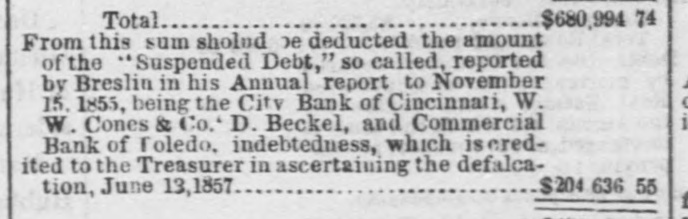
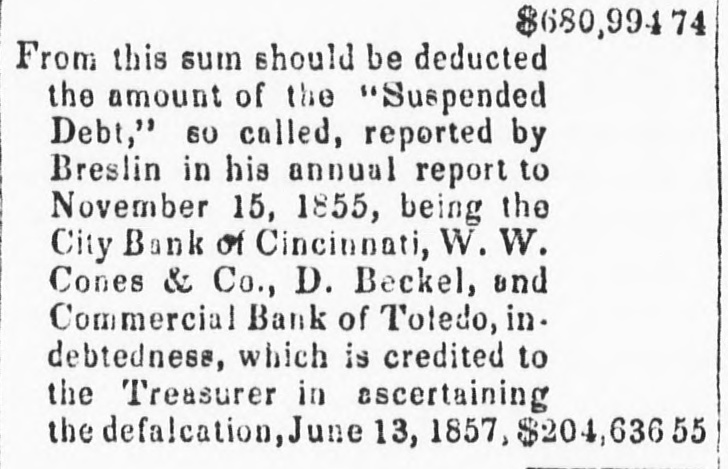
Total $680,994 74 From this sum sholud be deducted the amount of the "Suspended Debt," so called, reported by Breslin in his Annual report to November ( 15. 1855, being the City Bank of Cincinnati, W. i W. Cones & Co. D. Beckel, and Commercial Bank of Toledo, indebtedness, which is credited to the Treasurer in ascertaining the defalca$204 636 55 tion, June 13,1857 1 -


Article from The Weekly Portage Sentinel, March 31, 1859

Click image to open full size in new tab

Article Text

$680,99474 From this sum should be deducted the amount of the "Suspended Debt," 60 called, reported by Breslin in his annual report to November 15, 1855, being the City Bank of Cincinnati, W. W. Cones & Co., D. Beckel, and Commercial Bank of Totedo, indebtedness, which is credited to the Treasurer in ascertaining the defalcation, June 13, 1857, $204,636 55