Article Text
The telegraphic reports state that the Norombega bank, Bangor, 18 in the hands of receivers. It is thought the bills will all be redeemed.
Click image to open full size in new tab
The telegraphic reports state that the Norombega bank, Bangor, 18 in the hands of receivers. It is thought the bills will all be redeemed.
Click image to open full size in new tab
58,125 00 Dividend, 24 cent $3,011 72 Balance to new account The Company have relaid 33 miles of road during the past year, bought new equipage, &c., at an expenditure of $53,000, all of which has been charged to operating expenses. This is equal to another dividend of 21 ₽ cent. The interest coupons on the 3d mortgage and bonds of 1879, of the Harlem Rsilroad, will be paid on the 3d of January at the office of the Company, Fourth avenue and Twenty-sixth street. The interest on the bonds of Kansas will be paid ou the 20th January at the office of Measrs. Ward, No. 39 Exchange place. The Hanover Bank has declared a semi-annual dividend of 34 ₽ cent, payable on the 9th of January, The Cbatham Bank a semi-annual dividend of 31 ₽ cent, payable Jan. 16. The Manhattan Savings Iastitution has declared a semi-annne? dividend at the rate of 6 P cent Dan annum on $500 and under, and at the rate of ₽ cent on larger sums. The Treasurer of the City of Brooklyn gives notice that the bonds of 1845 for $30,000, and of 1850 for $75,000, and all coupons of the city debt due on the 1st of January, will be paid on presentation at the Long Island Bank, on and after the 3d of January. The Etna Insurance Company of Hartford has declared a stock dividend of 50 ₽ cent, and will probably declare a cash dividend in January of 40 ₽ cent. The capital is now $1,500,000, and it has a reinsurance fund of $500,000. The Traders' Bank of Bangor, Me., is thrown out today. The Norombega Bank of Bangor has gone into the hands of a Receiver. The Bank Commissioners think the circulation will be paid. The loan of $900,000 of the Hannibal and St. Joseph Railroad Company was awarded, Dec. 28, at prices ranging from 50@58 ₽ cent. They were taken by a few parties, friends of road. It appears that the Secretary of the Treasury, after advertising for bids for three millions of Treasury Notes, has awarded about four and a half millions. He has awarded 75 ₽ cent on the 6 ₽ cent bids, instead of 51 ₽ cent. This is a financial dodge quite worthy of the gentleman from Georgia, and is one of a series of financial mistakee, not to characterize them by a harsher name, which has marked his administration of the Treasury Department. The annexed dispatch announces the intention of the Secretary: WASHINGTON. Dec. 29, 1859. READ, DREXEL & Co., New York: Upon your bid for one million, the department awards $750,000, having the power to exceed the amount advertised for. you do not want your proportion of this excess, you need not take HOWELL COBB, Sec. of Treasury. The demand for these notes is fair at about 1/8 ₽ cent premium, and Messrs. Reed & Co. have disposed of all the amount awarded them. Another blunder of Mr. Cobb has just culminated. In advertising the 1874 loan the Secretary stated that the deposita for the loan could be made in any Sub-Treasury which should be indicated as most convenient to the bidder. Under this advertisement Mesers. Sweeny, Rittenhouse, Faut & Co. of Washington bid for a large amount, and indicated San Francisco as the place of deposit. Mr. Cobb refused to receive the money there. Messrs. Faut & Co., after making a portion of their deposit declined to go on, appealed to the President to direct the Secretary of the Treasury to receive the remaining installments at San Francisco, and failing in this, will go before Congress with a demand for damages. Mr. Cobb has now advertised for proposals to be received until the 31st of January, for $1,110,000 5 ₽ cent bonds, unisened to Messrs. Faut & Co., upon which, however, they have made 1 P cent deposit, which probably he will forfeit. Measts. Raynor & Blackwell have sold 1 full lot on the south side of 39th-st., about 350 feet east of 6th-av., for $7,800, with a building loan of $5,000: a 4-story brown-stone house is to be erected upon said lot. Also, 2 lote south side of 52d-st., 165 feet east of 4th-av., full in size, at $1,800 P lot. We report the sale of 4 lots south-east corner 5th-av. and 100th-st., and 1 in the rear, south side of 100th-st.--the otasold for $16,000. John McClave has sold 1 3-story and basement dwel ling on south side of 36th-st., about midway of the block between 7th and 8th-avs., for $6,600. Also, 1 lot on south side of 143d-at., 300 feet west of 8th-av., for $350. E. H. Ludlow & Co. sold 2 lots on 55th-st., with 2 on rear on 56th-st., each 25x100, $3,250 each, $13,000. The condition of the banks of the four leading cities of the Union, according to their latest statements at hand, is as follows:
Click image to open full size in new tab
BANGOR, Dec. 31. It is understood here that certain interested parties are determined to bring the Bangor banks into disrepute for purposes of speculation. The banks here were never on a better footing than at present, and there are no grounds for fears that the bills are not good. They are all abundantly able and ready to redeem their circulation, except the Norombega, which is in the hands of the receivers. The trouble with the Norombega Bank was caused entirely by transactions of the cashier, unknown to the president and cirectors, but the assets of the bank are said to be sufficient to redeem the bills.
Click image to open full size in new tab
BANGOR, Saturday, Dec. 31, 1859. It is understood here that certain interested parties are determined to bring Bangor banks into disrepute for purposes of speculation. The banks were never on a better footing than at present, and there are no grounds for fears that the bills are not perfectly good. They are all abundantly able and ready to redeem their circulation, except the Norombega, which is in the hands of receivers. The trouble with the Norombega Bank was caused entirely by transactions of the Cashier, unknown to the President and Directors, bu the assets of the bank are said to be sufficient to redeem the bills.
Click image to open full size in new tab
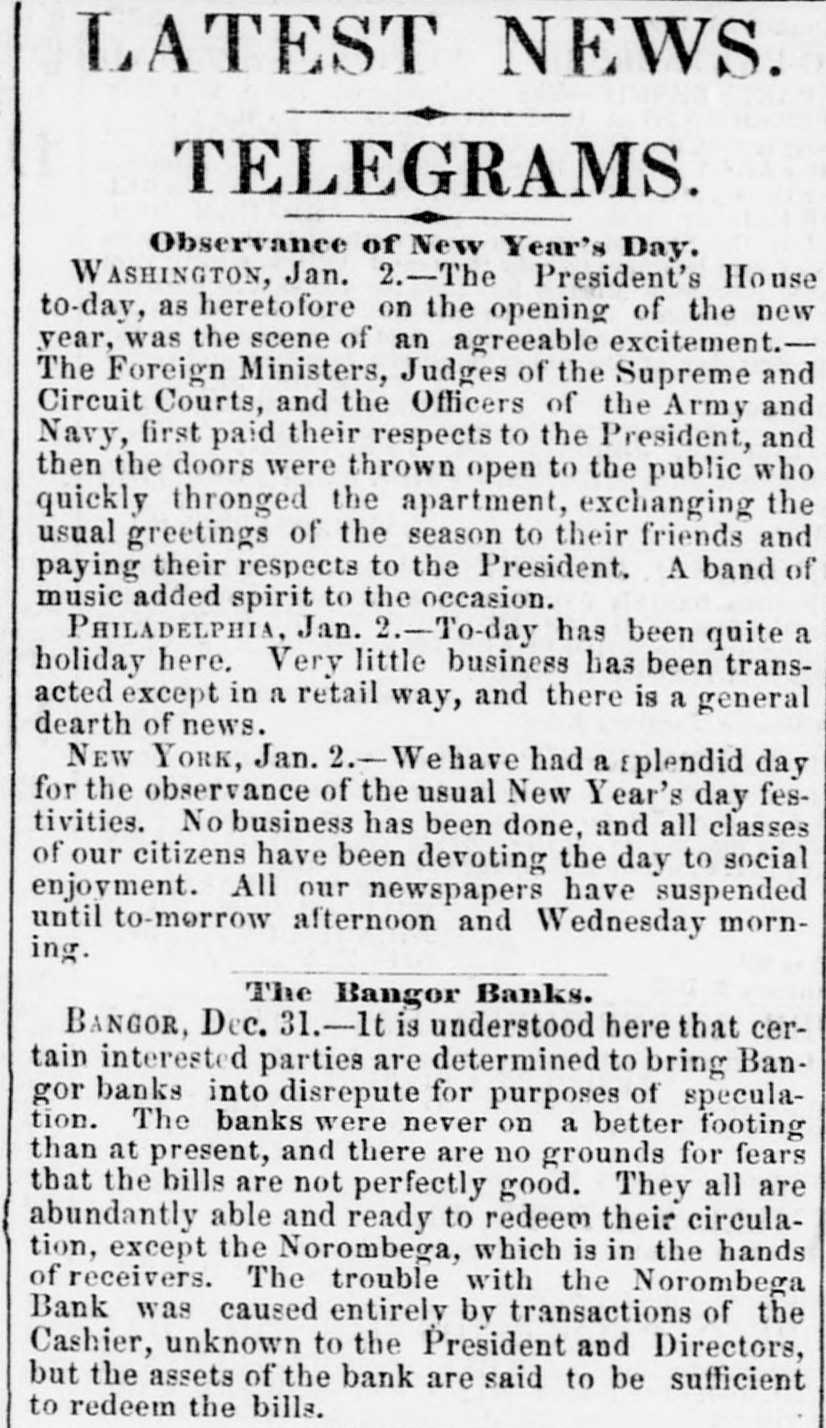
TELEGRAMS. Observance of New Year's Day. WASHINGTON, Jan. 2.-The President's House to-day, as heretofore on the opening of the new year, was the scene of an agreeable excitement.The Foreign Ministers, Judges of the Supreme and Circuit Courts, and the Officers of the Army and Navy, first paid their respects to the President, and then the doors were thrown open to the public who quickly thronged the apartment, exchanging the usual greetings of the season to their friends and paying their respects to the President. A band of music added spirit to the occasion. PHILADELPHIA, Jan. 2.-To-day has been quite a holiday here. Very little business has been transacted except in a retail way, and there is a general dearth of news. NEW YORK, Jan. 2.- Wehave had a splendid day for the observance of the usual New Year's day festivities. No business has been done, and all classes of our citizens have been devoting the day to social enjoyment. All our newspapers have suspended until to-morrow afternoon and Wednesday morning. The Bangor Banks. BANGOR, Dec. 31.-1t is understood here that certain interested parties are determined to bring Bangor banks into disrepute for purposes of speculation. The banks were never on a better footing than at present, and there are no grounds for fears that the bills are not perfectly good. They all are abundantly able and ready to redeem their circulation, except the Norombega, which is in the hands of receivers. The trouble with the Norombega Bank was caused entirely by transactions of the Cashier, unknown to the President and Directors, but the assets of the bank are said to be sufficient to redeem the bills.
Click image to open full size in new tab
The Norombega Bank is in the hands of receivers. The trouble it is said was caused by the loaning of an amount of money on memorandum checks, without the knowledge of the officers. The Courier thinks the bill-holders will not suffer. It also contradicts the malicious reports prejudicial to the other banks in that city,
Click image to open full size in new tab
-The astonishing revelation has been made in Maine that Benjamin D. Peck of Portland, for several years past treasurer of the State, is a defaulter to an amount ranging from $175,000 to $100,000. Rumors to that effect within the past week were but too faithfully verified by the governor and council, on Tuesday, in their publication of an announcement virtually suspending him from office. Mr Peck, who before taking office had been the editor of the Temperance Journal at Portland, had since his election been engaged with others in extensive lumbering operations, having a saw-mill in Canada, and using the funds of the State to sustain himself. His speculations were disastrous and he broke down, carrying with him the Norombega bank of Bangor, the suspension of which was announced last week. No other bank is affected. The State is secured from loss, however, both by Mr Peck's bondsmen and by the amount of property made over as security.

Click image to open full size in new tab
REPORT OF THE JOINT SELECT COMMITTEE ON TWE DEFALCATION of BENJ. D. PECK, Late Treasurer of the State of Maine. The Joint Select Committee, to which was referred " so much of the Governor's Address as relates to Treasury Affairs,' reported on the 27th of January that the deficiency in the accounts of the late State Treasurer a. mounted to the sum of $94,073.04. Upon a more accurate adjustment of balances than they were then enabled to arrive at, the Committee find that the precise deficit is $94,023. 99, and it is their duty now to lay before the Legislature succinct statement of the causes that led to this lamentable result. They beg leave, therefore, to submit the following REPORT: At the time the Committee was appointed, the late Treasurer, B. D. Peck, was confined in jail at Bangor, on a charge brought against him by the Receivers of the Norombega Bank. As soon as he was released from their custody, January 11, a Sub-Committee, consisting of Messrs. Drummond, Porter and Blaine, was dispatched to Bangor, with authority to summon Mr. Peck and secure his attendance at the Capital. He arrived here the next day, and though manifesting a perfect willingness to give his testimony touching the subject under investigation, he alleg. ed his inability to proceed until he was placed in possession of his private papers and memoranda, deposited in an iron safe at Portland, which, as he averred, had been foreibly removed from his house without his permission and against his wishes. Hon. George F. Shepley appeared before the Committee as his counsel and gave additional assurance of the necessity of Mr. Peck's having the papers referred to, and of the utter impossibility of any clear statement being made without them. Mr. Shepley also volunteered his personal pledge that if the Committee would permit Mr. Peck to go to Portland and examine the papers, or place the papers in his possession here, every fact and every figure of any pertinence or significance, would be most freely exhibited and exposed. Preferring to have Mr. Peck remain at Augusta, the Committee accepted the second proposition and appointed threeof their number, Messrs. Robie, Comstock and Blaine, to proceed to Portland with any one Mr. Peck might designate as his friend, and secure the papers referred to. Mr. Peck selected Mr. Charles A. Stackpole as his representative, and on Friday, the 13th of January, the parties named proceeded to Portland and found the safe deposited at the Manufacturers and Traders Bank, to which place they repaired immediately on their arrival in the city. The Committee remained in the Bank until Mr. Stackpole had gone out and procured key to the safe,which on his return was unlocked by him in presence of the Committee, all the papers carefully removed, securely wrapped in several folds of paper and so sealed that it was impossible to have access to them, without the intrusion exposing itself. The package was then deposited in the vault of the bank, and the Cashier instructed not to deliver it until called for by Mr. Stackpole and the Sub-Committee to. gether. The call was made the next day, the package brought to Augusts by the same parties, and by them delivered to Mr. Peck, in presence of Hon. George F. Shepley. The Committee earnestly desired to give the papers a thorough examination before delivering them to Mr. Peck, but to this neither he nor his counsel would assent, and as the Declaration of Rights' in our State Constitution sets forth that "no warrant to search any place or seize any person or thing shall issue, without a special designation of the place to be searched and the person or thing to be seized,' it was quite apparent that to have opened a package whose contents were utterly unknown to the Committee, would have been grave violation of this Constitutional provision. The Committee therefore confined their efforts to the delivery of the papers to Mr. Peck, relying on the personal promises of himself and his counsel, as to the honorable use that should be made of them. On the ensuing Monday morning, January 16th, (the papers having been delivered on the previous Saturday evening,) Mr. Peck, accompanied by his counsel, Mr. Shepley, appeared before the Committee and submitted the following written statement Mr. Peck's Statement. JANUARY 16, 1860. I stand before this committee and before the people of this State, charged with misappropriating the public funds, which I, as Treasure of State, have had in trust. I acknowledge the charge to be true and shall proceed to make such statements and explanations of my transactions as are demanded by my convictions of truth and duty. I do not deem it necessary in this connection to offer any excuses for my conduct, but to state the facts and leave you to judge in reference to each and all of my transactions. I have no wish to involve other parties and other men in any of my questionable or wrong financial operations I can only state what has been done, and others connected with me must vindicate themselves if they can, or suffer with me, the consequences of wrong doing. I have been accustomed from my first connection with the treasury to loan the State's money in large and small sums to some of my bondsmen and to others, who from time to time solicited aid from this quarter. Some of these parties have paid me, and some have not. Sometimes when I have wanted my pay, they have endorsed my notes, upon which I have raised the money on my own and their credit, at the Banks. Names of parties with amounts loaned, and payments made, from time to time, and what remains unpaid now, can be given when desired. I had not got warm in my seat as Treasurer of this State, before I was urgently importuned by some of my bondsmen and others, to loan the money of the State, and for this reason-th: I could in this way add to my income from the office, other treasurers had done it, and it was generally known that all treasurers would do it. This, at least, public men of all parties knew full well. I do not plead these things to cover up my own faults, but on the contrary, make them as simple statement of facts, giving names if desired, that the Committee may have all matters before them which are material to this investigation. There are persons who in the days of my prosperity were glad to avail themselves of the use of the State funds, who could approach me upon my weak side and use me for their purposes, but who now denounce me in newspapers and elsewhere, and who would not, even with all my available property in their hands as security, consent to sign bail bond for my deliverance from jail, into which I was cast upon a trumped-up case, while I was using my utmost endeavors to place all my property in the hands of my bondsmen as security for the loss they had incurred on my account. I do not mention this in any spirit of complaint or by way of retaliation

Click image to open full size in new tab
the been have agent in com tionable F. Leavitt, who also many of the objecthe with check Peck's taking the him for on therefor Norombegn The was their $6000, giving check until to take Suffolk Bank and holding the up. This discount, not was money it suited his not books as such. as the transaction was carried to the cash, and the knowl. cashand The check that was taken of the directors, paid but no edge ier alleges and assent of their of some meetingsonsideration Peck Short- benot at one this $6000, the the bank. cashed interest the deposit on he he kept had in check this of $10,000 amount This interest. be to and ing ly after. in however, the same way, was and to on be paid held the the apand directors same he paid way the other the transaction was, had the one tes- of the same way several of the according to checks proval indeed of objecting, Besides these authority of them timony of Mr. Smith. cashed by that the he gave bank Mr. Smith allege4 of the the so bank, Mr. 987000 or 48000 of 1859 without of the and directors, Peck funds some during the whatever summer on the part entry of bank book any knowledge without Peek any gave Peck his not the fact to on Smith. the and Norombega the-latter bills and checks checks agreed to take back the until October he paid the ve- of let them come that as the Mr. Smith which grew he latter. Peck had It the appears directors approached regard to the money The Mutual deposits medients, ry uneasy secretly in loaned to at the Bank of succeeded however, Redemption by and other and Mr. Smith from as the merit criti saving himself game began on in ed exposure. As the advanced criminal money to his own cal day and was Mr. passed, Smith until. of according them on to In regard these afresh, urious account, securities he had the $16,300 parties egotiating hand. Smith says: me with negotiate 1859. 1, Mr them, Mr. did not previously to rest. Dec. D. that Leavitt derstood agent. all the checks F Leavitt took intiated acting the as Peck to been entrusted Mr. seems Leavitt batch by Peck As to be used required. in his testMr. this point, imony up blew fter Re the for Mr reasons Smith checks failed, of their Monday Smith these After $50 which has been money to In the thus checks addition by Smith the Peek President Schwartz, obtained in of of time checks the bank, discount to This trans$5000. amounting December, the to action approval understood of and the checks, $1,500. the amount, and 1,5000. the on secmade payable thus of January of the treasond. were fifth. to and be sixth provided for year, should of them. Mr obviously ury funds of the in retaining present his control Peck was but not Peck succeed thus advanced to of the bank. hand. The money of the loan cash on to entered as part as according checks were December, the presithe the 22d of Mr. Schwartz, for another On testimony of came to Bangor positive asdent, the Mr. Peck him the most and promised in loan. He gave his re-election better deposit surances the next of year to than keep he a had could previously not the for Norombega Schwartz, however loan to Peck, Mr. fresh prevailed done. be induced to grant conference, a him was for $12,000, check but after farther checks with wanted the exchange that he his check on Peck telling him Schwariz gave Peck gave fer one day only. that amount, and the same sum. with Peck for check for the cashier Schwartz to his proceeded to amount passed for certificate Peck at once check; had the of deposit then to his credit and a with the deposite him by the in the same, together was at once day given Schwartz put which was he in his favor, Later in the $12,000 with was cashier. and the hours before was gainst again charged to the nor loser gainer Peck's credited check, a few him. The bank value neither of dea had deal great posit which the at time was thus of a cent, but made Peck him appear a treasury office com- in insaction over better for the this talked it of Augusta. After and Smith the admission by pleted, Schwartz according to to be used and agreed certificate was good at the both, that making the his evidence, however, had any Peck "in is no Schwartz treasury. There that Mr. Peck's real situameditat going ledge to show whatever of being any party He tion, know or that he which was thus without apparently the fraud arrang scope, and all he were fears quieted. to assented to the ehending its real says, by Smit in both rehim deceived The transac Peck his who extematically and the bank. too culpable to ad to the gard however, to in itselfis or extenuations exhibited Committee tion, mit of any apology of the bank, reveal other serious discreps the on of part The books by the Receivers, any of intent honest the on For example, a bal show to presumption Peck or November, the cashier. the books Peck, and carry 16th of of 93545.07 against a new page he intervening is credit on been ing ance the account without any from debtor Dec. to ed with 93669.22 which the change based. On intervening entries creditor could credits have and debits to have where- been 24th, some there appears $3174,68, honest last date, credit of subtraction, he indebted from balance to his addition and to the bank in of 4039,71, as, by at that account date in the claim sum from him. his regular the Recehorefore. Receivers now clearly exhibit the is There These which entries, bank of $7214,39. between on to the fraud upon some the discrepancy the one hand gross and tements of Smith on the other, in as the bank, up- but amount of have the Receivers Peck's checks not felt settlement called arbitrate, this the Committee inasmuch as the
Click image to open full size in new tab
On the petition of the stockholders of the Nrombega Bank, Bangor. Judge Appleton delivered an opinion, Saturday, against the receivers : and ordering them to pay over all moneys in their hands. The Report of the Directors shows that the Bank has in hand cash and available paper much beyond its liabilities. The bills will probably be redeemed in a short time. The decision of Judge Appleton 18 said to be satisfactory to the citizens of Bangor.
Click image to open full size in new tab
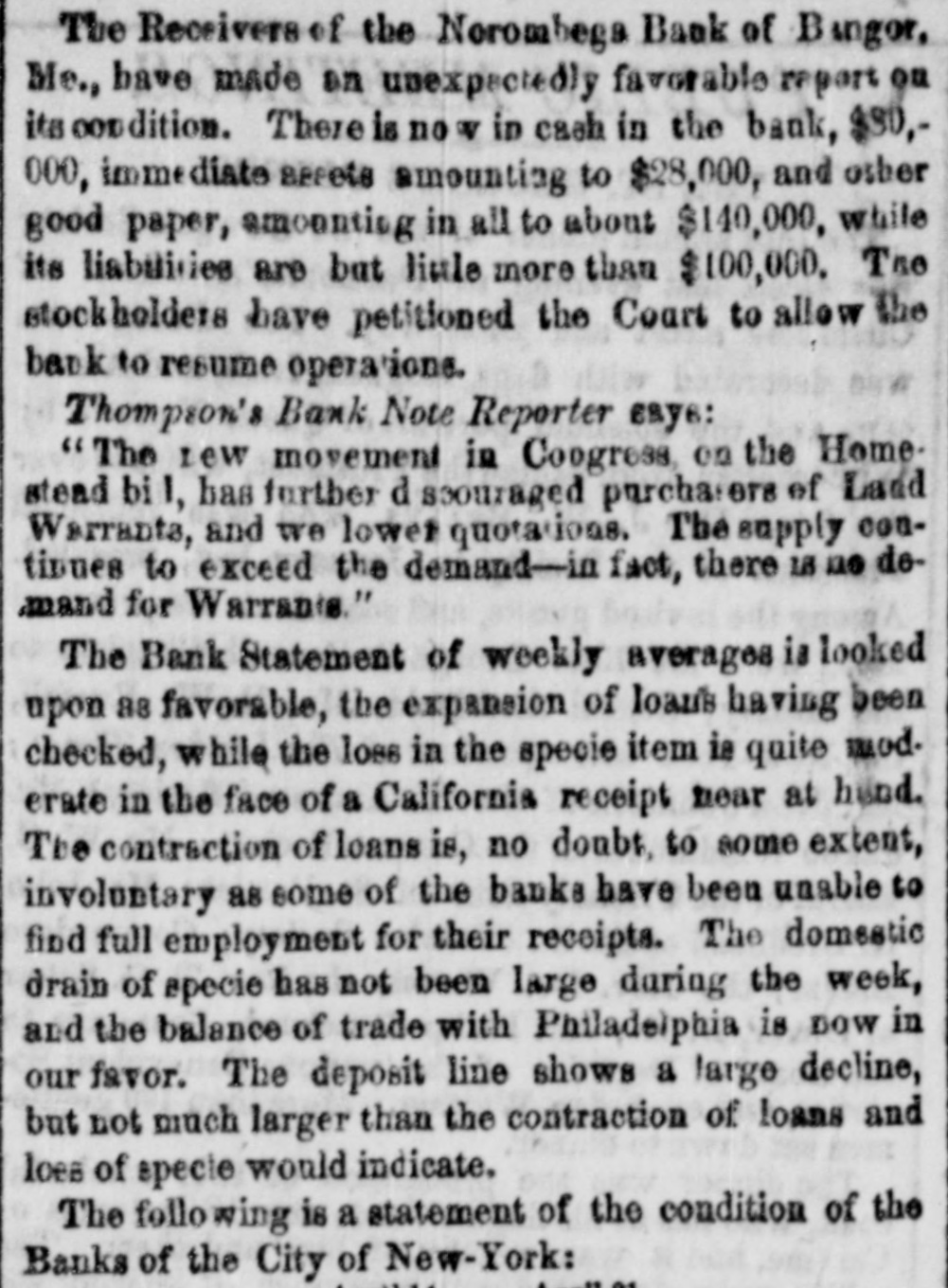
The Receivers of the Norombega Bank of Bingor, Me., have made on unexpectedly favorable report on its condition. There is no * in cash in the bank, $80,000, immediate assets amounting to $28,000, and other good paper, amounting in all to about $140,000, while its liabilities are but listle more than $100,000. Tae stockholders have petitioned the Court to allow the bank to resume operations. Thompson's Bank Note Reporter says: "The Lew movement in Coogress on the Home. stead bil, has further d scouraged purchasers of Land Warrants, and we lower quotations. The supply continues to exceed the demand-in fact, there LB no demand for Warrants." The Bank Statement of weekly averages is looked upon as favorable, the expansion of loans having been checked, while the loss in the specie item is quite smod. erate in the face of a California receipt near at hund. The contraction of loans is, no doubt, to some extent, involuntary as some of the banks have been unable to find full employment for their receipts. The domestic drain of specie has not been large during the week, and the balance of trade with Philadelphia is now in our favor. The deposit line shows a large decline, but not much larger than the contraction of loans and loes of specie would indicate. The follo wing is a statement of the condition of the Banks of the City of New-York: