Fayette City National Bank (Fayette City, PA)

Episode Information

Episode UID
680001530
Episode Type
Suspension โ†’ Closure
Bank Type
national
Bank ID
68000 national
Charter Number
6800
Start Date
June 3, 1927
Location
Fayette City, Pennsylvania (40.100, -79.841)

Metadata

Model
gpt-5-mini (chosen from majority vote of a three-model LLM ensemble)
Short Digest
ca3392463a7ff986

Response Measures

None

Receivership Details

Depositor recovery rate
25.5%
Date receivership started
1927-07-28
Date receivership terminated
1933-03-01
Share of assets assessed as good
21.3%
Share of assets assessed as doubtful
30.4%
Share of assets assessed as worthless
48.3%

Description

Failure tied to alleged misapplication of funds and mismanagement by bank officers; receivership followed closure.

Events (4)

1. May 26, 1903 Chartered
Source
historical_nic
2. June 3, 1927 Suspension
Cause
Bank Specific Adverse Info
Cause Details
Bank insolvency caused by alleged misapplication of funds, unsecured loans, and mismanagement by officials (embezzlement-related allegations).
Newspaper Excerpt
The bank became insolvent last June 3.
Source
newspapers
3. July 28, 1927 Receivership
Source
historical_nic
4. July 28, 1927 Receivership
Newspaper Excerpt
J. Howard Kelly, receiver for the defunct Fayette City bank
Source
newspapers

Newspaper Articles (7)

Article from The Pittsburgh Press, September 2, 1927

Click image to open full size in new tab

Article Text

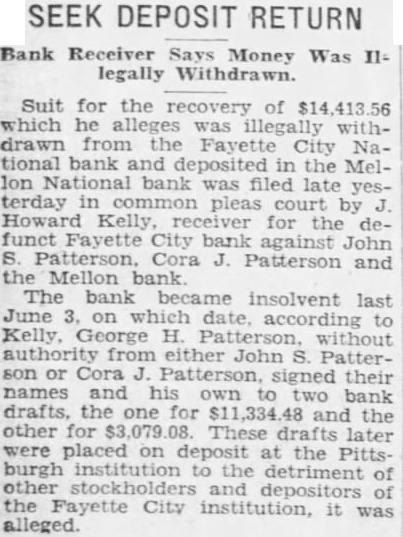
SEEK DEPOSIT RETURN Bank Receiver Says Money Was IIlegally Withdrawn. Suit for the recovery of $14,413.56 which he alleges was illegally withdrawn from the Fayette City National bank and deposited in the Mellon National bank was filed late yesterday in common pleas court by J. Howard Kelly, receiver for the defunct Fayette City bank against John S. Patterson. Cora J. Patterson and the Mellon bank The bank became insolvent last June 3. on which date. according to Kelly, George H. Patterson, without authority from either John S. Patterson or Cora J. Patterson, signed their names and his own to two bank drafts. the one for $11,334 48 and the other for $3,079. These drafts later were placed on deposit at the Pittsburgh institution to the detriment of other stockholders and depositors of the Fayette City institution, it was alleged.


Article from The Daily Herald, September 3, 1927

Click image to open full size in new tab

Article Text

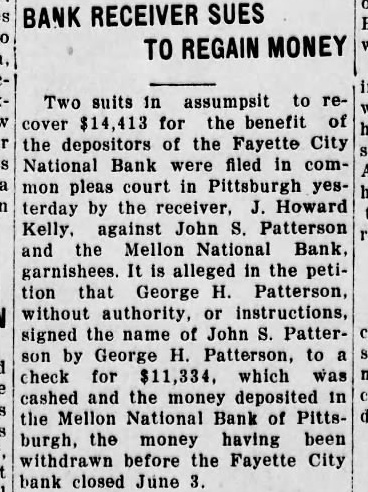
BANK RECEIVER SUES REGAIN Two suits in assumpsit to for the benefit depositors the Fayette City National Bank were filed in mon pleas court terday by receiver, Howard against John Patterson Mellon National Bank, garnishees. alleged in the petition that George H. Patterson, without authority, instructions, signed name of John PatterGeorge Patterson, check for which cashed and the money deposited the Mellon National Bank of burgh, the money having been withdrawn before the Fayette City closed June


Article from The Pittsburgh Press, February 12, 1929

Click image to open full size in new tab

Article Text

BANKER'S TRIAL WILL CONTINUE ON WEDNESDAY U. S. Building Case Against Guy W. Brown, Ex-Fayette County Politician. United States counsel, who yesterday thrust their most striking evidence against Guy W. Brown, former state senator and banker of Fayette City, Pa., will continue to build their case against him tomorrow, following adjournment of Federal Court today, Lincoln's birthday. Three Presbyterian ministers will take the stand against the former church leader, it is expected, in an effort to show his alleged devious conspiracies to embezzle funds. Peter Zemo, former college student and chauffeur for Brown, climaxed yesterday's testimony in the trial of Brown, who is charged with embezzling $132,000 from two banks in Fayette county. Shown a $20,000 note by Asst. Dist. Atty. James L. Marsh, Zemo admitted the signature on the note was his, but declared that when he had signed the note there was no typewritten matter on it. CLAIMS $20,000 UNWARRANTED. Explaining his reason for signing the note, Zemo said he told Brown to apply his salary on some stock for him. He described how he had been given two notes to sign one evening while with Brown in the Fayette City National Bank. The reason for the second note was not brought out in his testimony. Zemo asserted he did not know that his note had been discounted for $20,000 and said he had received no stock from Brown. Three men with names similar to those appearing on notes discounted in the Fayette City Bank, testified they had never heard of the Darby-Virginia Coal Co., many of whose trade acceptances were accepted by Brown's bank, it is alleged. ALLEGES SOME NOTES FALSE. Charles M. Swift, former mine superintendent for the United Coal Mining Corporation, of which Brown was an officer, admitted he had signed a note for $5,000 pending tentative purchase of 50 shares of stock in Brown's company; but denied he had signed other notes found in the assets of the bank, bearing the signature, C. M. Swift. Swift testified that recently Brown told him that the other notes were signed by a man named Chauncey M. Swift, of Philadelphia. The government continued to build up its case against Brown by introducing testimony by Department of Justice investigators, who said they were unable to find C. M. Swift in Philadelphia or to locate the Darby-Virginia Coal Co. in Cincinnati, O. ALLEGE ONE-MAN CONTROL. The failure of the bank's receiver to collect any money on certain notes which had been indorsed by Brown, or even locate the original signers, was described in detail by F. M. Newcomer, chief clerk for the receivers. Government counsel dwelt at length on the importance of the close likeness of certain note signatures with names of men associated with Brown. A. N. Young of Uniontown, for a time mine superintendent of the United Coal Mining Corp., succeeding C. M. Swift and D. A. Teichert, former bookkeeper for the United Coal Mining Corp., also testified. That Brown held one-man control over the Fayette City Bank was implied during Monday's trial by J. L. Krepps, George M. Boyd and A. P. Barnum, former directors. Krepps said he was not aware that numerous trade acceptances had already been accepted before they were brought before the directors for approval.
Article from The Pittsburgh Press, February 28, 1929

Click image to open full size in new tab

Article Text

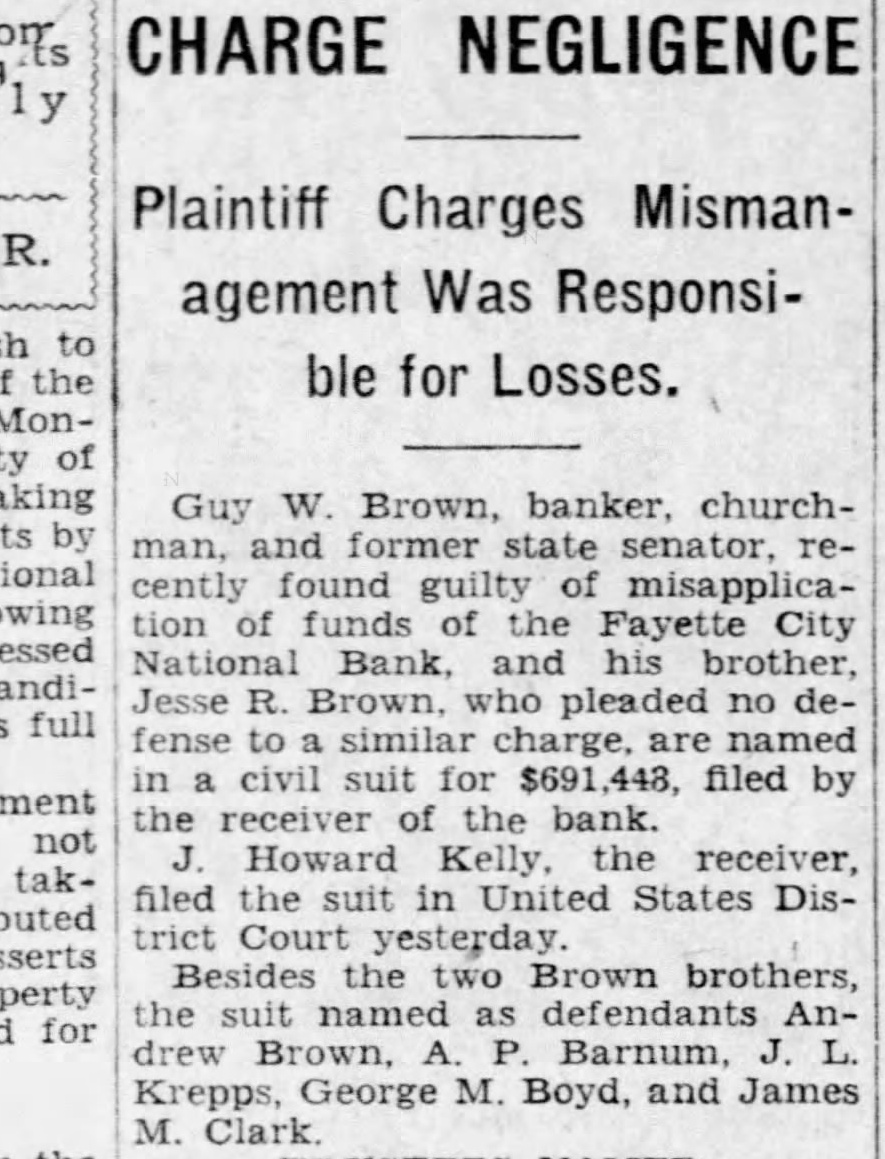
CHARGE NEGLIGENCE Plaintiff Charges Mismanagement Was Responsible for Losses. Guy W. Brown, banker, churchman, and former state senator, recently found guilty of misapplication of funds of the Fayette City National Bank, and his brother, Jesse R. Brown, who pleaded no defense to a similar charge, are named in a civil suit for $691,448, filed by the receiver of the bank. J. Howard Kelly, the receiver, filed the suit in United States District Court yesterday. Besides the two Brown brothers, the suit named as defendants Andrew Brown, A. P. Barnum, J. L. Krepps, George M. Boyd, and James M. Clark.


Article from The Morning Herald, March 1, 1929

Click image to open full size in new tab

Article Text

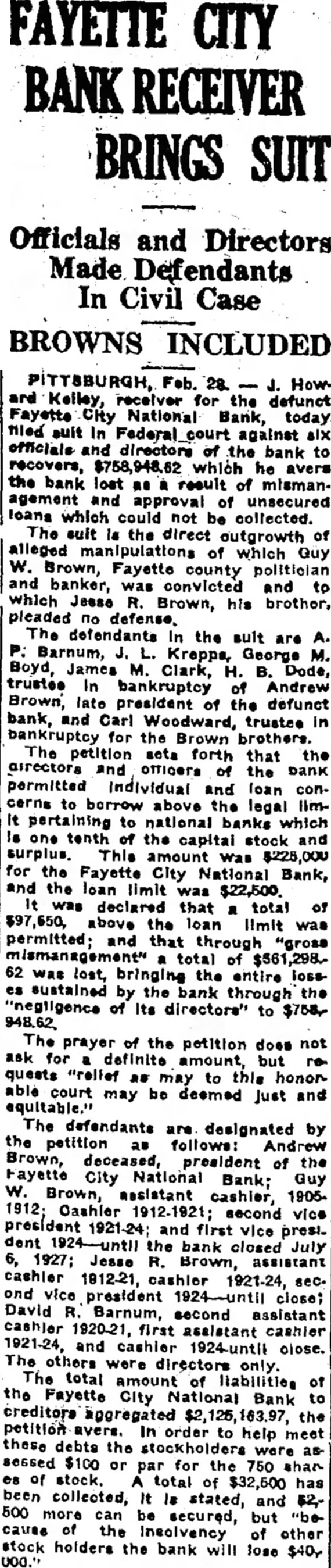
FAYETTE CITY BANK RECEIVER BRINGS SUIT Officials and Directors Made Defendants In Civil Case BROWNS INCLUDED PITTSBURGH, Feb. 28. - J. How and Kelley, receiver for the defunct Fayette City National Bank, today filed suit In Federal court against six officials and directors of the bank to recovers, $758,948.62 which he avers the bank lost as a result of mismanagement and approval of unsecured loans which could not be collected. The suit is the direct outgrowth of alleged manipulations of which Quy W. Brown, Fayette county politician and banker, was convicted and to which Jeese R. Brown, his brother, pleaded no defense. The defendants In the sult are A. P: Barnum, J. L. Krepps, George M. Boyd, James M. Clark, H. B. Dode, trustee In bankruptcy of Andrew Brown, late president of the defunct bank, and Carl Woodward, trustee in bankruptcy for the Brown brothers. The petition acts forth that the directors and officers of the bank permitted Individual and loan concerns to borrow above the legal IlmIt pertaining to national banks which is one tenth of the capital stock and surplus. This amount was $225,000 for the Fayette City National Bank, and the loan limit was $22,500. It was declared that a total of $97,650, above the loan limit was permitted; and that through "gross mismanagement" a total of $561,298.62 was lost, bringing the entire loss es sustained by the bank through the "negiigence of Its directors" to $758. The prayer of the petition does not ask for definite amount, but requests "rellef as may to this honorable court may be deemed just and equitable." The defendants are designated by the petition as follows: Andrew Brown, deceased, president of the Fayette City National Bank; Guy W. Brown, assistant cashier, 1905. 1912; Oashier 1912-1921; second vice president 1921-24; and first vice presi. dent 1924-untll the bank closed July 6, 1927; Jesse R. Brown, assistant cashier 1912-21, cashier 1921-24, sec. and vice president 1924-until close; David R. Barnum, second assistant cashier 1920-21, first assistant cashier 1921-24, and cashier 1924-until olose. The others were directors only. The total amount of liabilities of the Fayette City National Bank to creditors aggregated $2,125,163.97, the petition avers. In order to help meet these debts the stockholders were as sessed $100 or par for the 750 shar 08 of stock. A total of $32,500 has been collected, It is stated, and $2,500 more can be secured, but "because of the Insolvency of other stock holders the bank will lose $40,


Article from The Morning Herald, April 4, 1929

Click image to open full size in new tab

Article Text

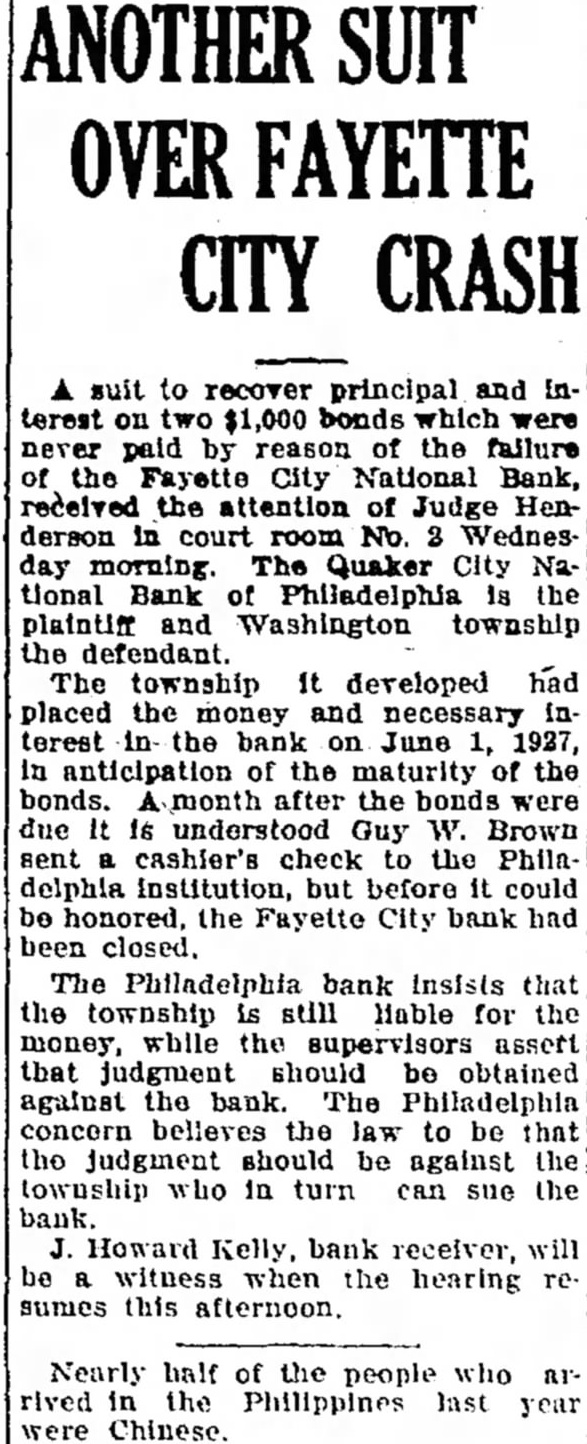
ANOTHER SUIT OVER FAYETTE CITY CRASH A suit to recover principal and interest on two $1,000 bonds which were never paid by reason of the failure of the Fayette City National Bank, received the attention of Judge Henderson in court room No. 3 Wednesday morning. The Quaker City National Bank of Philadelphia is the plaintiff and Washington township the defendant. The township It developed had placed the money and necessary in terest in the bank on June 1, 1927, in anticipation of the maturity of the bonds. A month after the bonds were due It 16 understood Guy W. Brown sent a cashier's check to the Philadelphia Institution, but before it could be honored, the Fayette City bank had been closed. The Philadelphia bank Insists that the township is still liable for the money, while the supervisors assert that judgment should be obtained against the bank. The Philadelphia concern believes the law to be that the judgment should be against the township who in turn can sue the bank. J. Howard Kelly, bank receiver, will be a witness when the hearing resumes this afternoon. Nearly half of the people who RTrived the Philippines last year were Chinese.


Article from The Pittsburgh Press, April 7, 1929

Click image to open full size in new tab

Article Text

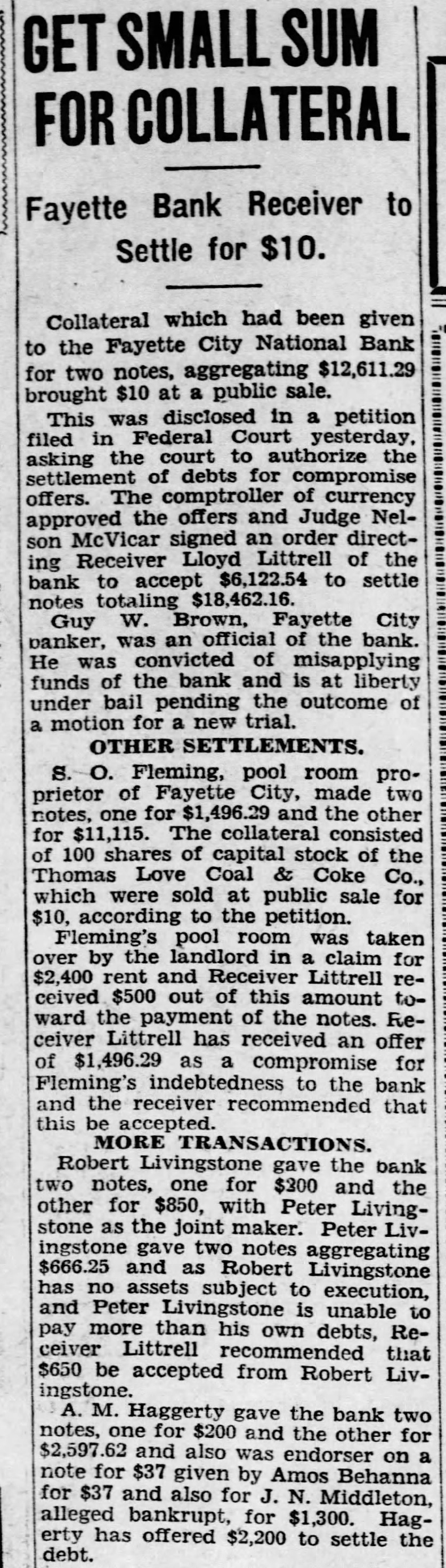
GET SMALL SUM FOR COLLATERAL Fayette Bank Receiver to Settle for $10. Collateral which had been given to the Fayette City National Bank for two notes, aggregating $12,611.29 brought $10 at a public sale. This was disclosed in a petition filed in Federal Court yesterday, asking the court to authorize the settlement of debts for compromise offers. The comptroller of currency approved the offers and Judge Nelson McVicar signed an order directing Receiver Lloyd Littrell of the bank to accept $6,122.54 to settle notes totaling $18,462.16. Guy W. Brown, Fayette City banker, was an official of the bank. He was convicted of misapplying funds of the bank and is at liberty under bail pending the outcome of a motion for a new trial. OTHER SETTLEMENTS. S. O. Fleming, pool room proprietor of Fayette City, made two notes, one for $1,496.29 and the other for $11,115. The collateral consisted of 100 shares of capital stock of the Thomas Love Coal & Coke Co., which were sold at public sale for $10, according to the petition. Fleming's pool room was taken over by the landlord in a claim for $2,400 rent and Receiver Littrell received $500 out of this amount toward the payment of the notes. Receiver Littrell has received an offer of $1,496.29 as a compromise for Fleming's indebtedness to the bank and the receiver recommended that this be accepted. MORE TRANSACTIONS. Robert Livingstone gave the bank two notes, one for $200 and the other for $850, with Peter Livingstone as the joint maker. Peter Livingstone gave two notes aggregating $666.25 and as Robert Livingstone has no assets subject to execution, and Peter Livingstone is unable to pay more than his own debts, Receiver Littrell recommended that $650 be accepted from Robert Livingstone. A. M. Haggerty gave the bank two notes, one for $200 and the other for $2,597.62 and also was endorser on a note for $37 given by Amos Behanna for $37 and also for J. N. Middleton, alleged bankrupt, for $1,300. Haggerty has offered $2,200 to settle the debt.