State bank examiner Charles C. Barksdale took charge and ordered the bank closed because it lacked sufficient quick assets to meet demands of creditor banks
Newspaper Excerpt
the Commonwealth Bank at the close of business on August 29 posted a notice on its doors conveying the information that it had been compelled to close
Source
newspapers
+1 day
2.August 30, 1913Receivership
Newspaper Excerpt
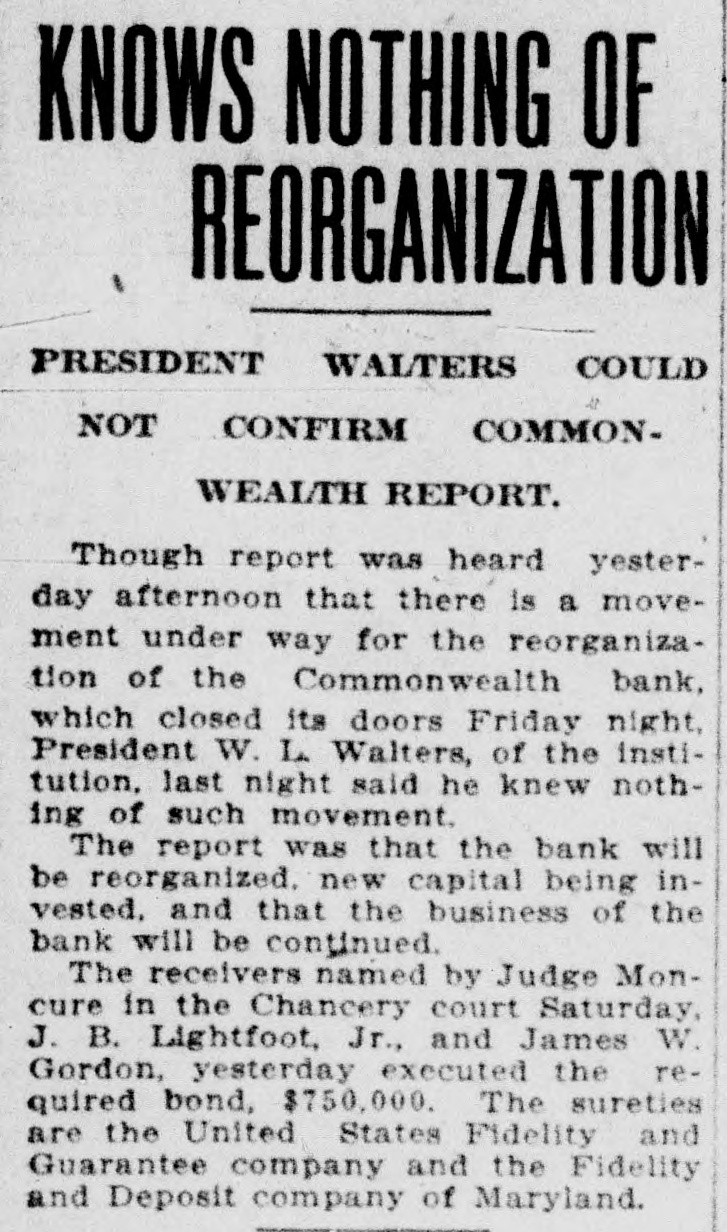
State Bank Examiner C. C. Barksdale ... will apply to Judge Moncure of the Chancery court for a receiver for the bank; receivers named by Judge Moncure were J. W. Gordon and J. B. Lightfoot, Jr.
Source
newspapers
+3 days
3.September 2, 1913Other
Newspaper Excerpt
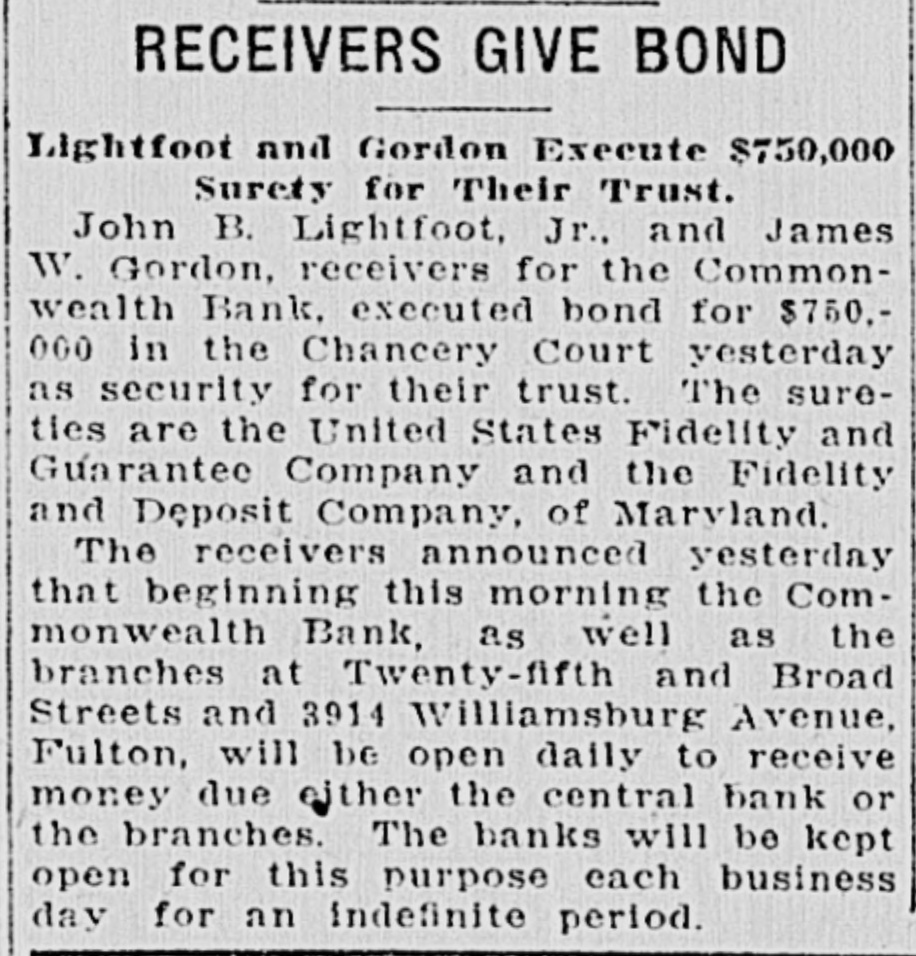
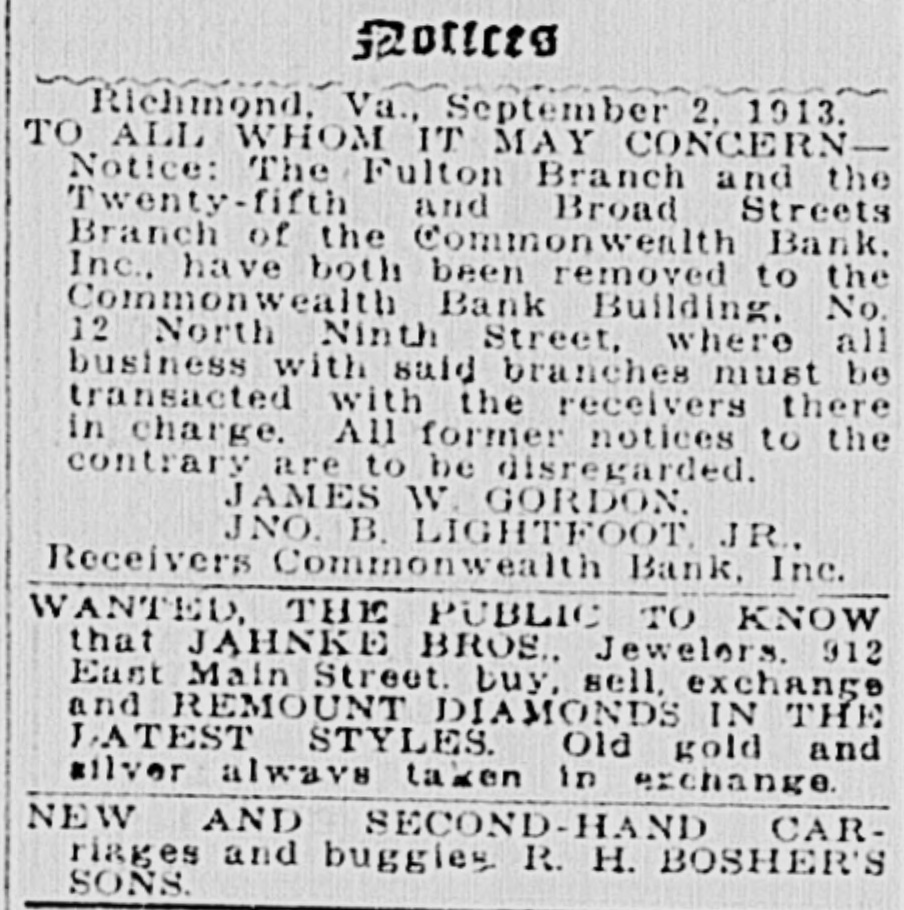
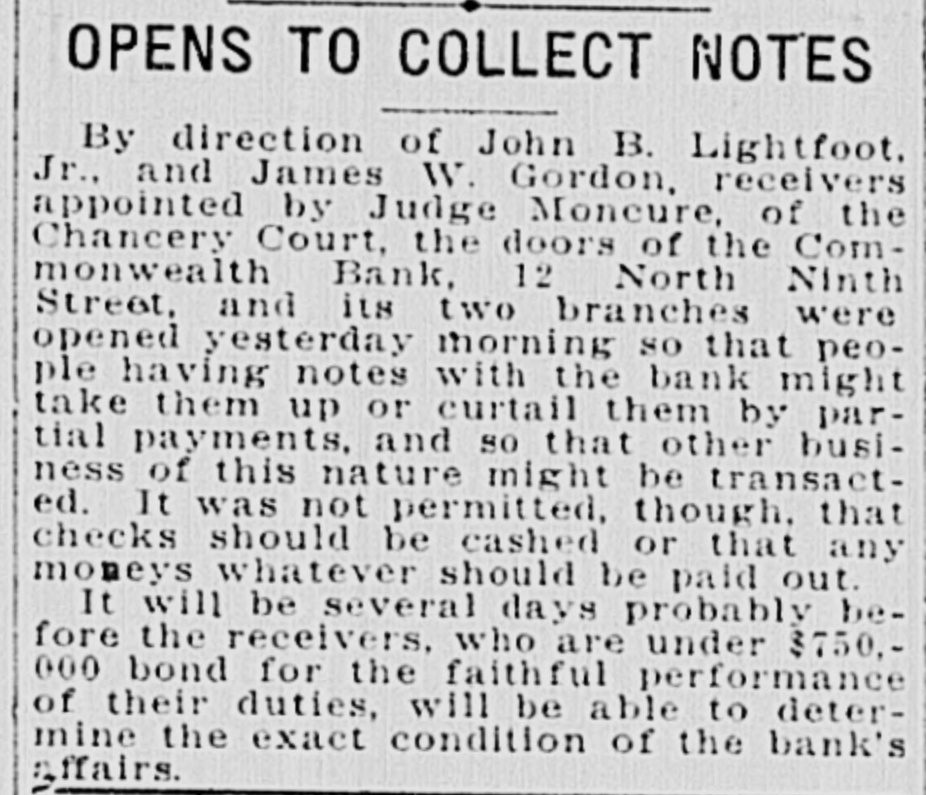
receivers announced ... the banks will be open daily to receive money due either the central bank or the branches; not permitted that checks should be cashed or that any moneys whatever should be paid out
Source
newspapers
+11 months
4.July 20, 1914Other
Newspaper Excerpt
on or about July 20 every person who has money on deposit ... will receive a check for 25 per cent of the amount of his deposit as a first installment
Source
newspapers
+17 months
5.December 22, 1915Other
Newspaper Excerpt
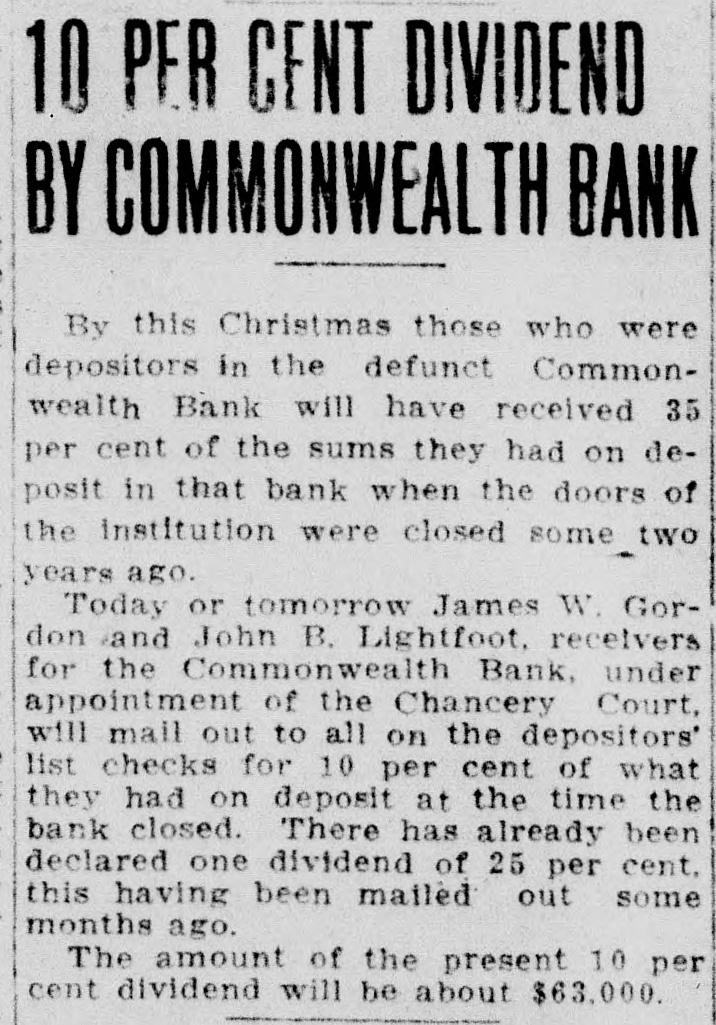
receivers ... will mail out to all on the depositors' list checks for 10 per cent of what they had on deposit
Source
newspapers
Newspaper Articles (21)
1.August 30, 1913Alexandria GazetteAlexandria, VA
Click image to open full size in new tab
Article Text
RIGHMOND DANA CLOSES ITS DOORS e e e Commonwealth Bank Comn pelled to Apply For t Receivers . : b TO PAY DEPOSITORS. State Bank Examiners is Confident Creditors Will Not Lose By Closy ing of Institution. Richmond, Va., Aug. 30.-By order of Charles C. Barksdale, examiner of the Bureau of the poration Banking Commission, the State Common- Corwealth Bank and its branches at 25th and Broad streets and 3914 Williamsburg Avenue, Fulton, were closed yesafternoon. terday Application Moncure, of will be made before Judge the Court, early today by Mr. for the reChancery Barksdale appointment of ceivers. The doors will not be opened notice last night that were posted this morning, they having been closed by direction of the Banking Bureau. "So far as I am able to ascertain, Mr. last will receive money said positors Barksdale, their night, "de- in and I might add further, that, general confull, in my opinion, banking ditions in Richmond are satisfactory and that I see no cause for and sound, citizens of uneasiness among the Richmond. The immediate cause of the Commonwealth's embarrassment, accorda statement issued W. L. ing by President to Waters, last is night the to meet of creditor bank's the demand temporary inability banks for to repayment of money borrowed of its customers. gives assurance the statement take care that The the bank's investments are sound and that every depositor will be paid 100 cents on the dollar. Mr. Barksdale stated in explanation of the banking bureau's action that of the Common finances ,wealth's an examination disclosed that it did not have enough quick assets to raise the necessary cash to meet the usual demands necessary for the protection of its depositors. A large proportion of its loans and invest_ ments are on real estate collateral of which, because of the stringency the money market and the inactivity of real estate are not immediate ly collectable. Complications due to these causes, said Mr. Barksdale, made it necessary to ask for the ap. pointment of a receiver. In the transactions of its business, Commonwealth Bank was inde_ pendent the of the local clearing-house. "The Commonwealth Bank is in no connected with Clearing-House offiway Association of Richmond," said cers of that institution last ngiht. The Commonwealth Bank was founded about seven years ago, and maintained its principal banking It house at 12 North Ninth street. apparently enjoyed a solid growth, establishing branches at 25th and Broad Ave. and 3914 Williamsburg streets home bank and two branches The have about 6,500 depositors. Accord- bank's to the statement of the ing finances at the close of business Aug9 individual and saving deposits certotaled ust $615,396.14. and demand tificates of deposit $31,239..70. Most of the depositors belong to bank the industrial classes, the the having city's been founded, according to s.atement of its officers, to cater par- and ticularly to the small depositor savborrower. The individual small accounts are uniformly modest, savand ings in many cases represent the ings The of news years. of the bank's embarrass- sur last night caused general ment Its stock par, value $100, was prise. yesterday on the Richmond quoted stock market at 112. The bank is to have valuable real estate known holdings, both improved and unimproved. and the hope was expressed generally that it will be able to adjust all demands without loss to deposi. tors. The officers were of the opinion that unless liquidating expenses proved to be unusually heavy. there would be even no loss to the holders of the banks $300,000 of capital stock.
2.August 30, 1913The Richmond VirginianRichmond, VA
Click image to open full size in new tab
Article Text
RICHMOND BANK IS CLOSED BY ORDER OF STATE EXAMINER Receiver for Commonwealth Will be Asked This Morning FIRST FAILURE OF THE KIND IN YEARS Insistence of Outside Creditors and Inability of Bank to Realize on Real Estate Loans Responsible The Commonwealth bank/on Ninth near Main street, will not open its doors as usual for business this morning. Neither will either of its two branches-s 3914 Williamsburg aveTwenty and nue. Fulton, and Broad streets. State Bank Examiner C. C. Barksdale, after a consultation with the bank's officials, which lasted all day. late yesterday afternoon posted a notice on the door of the institution announcing the fact that he had taken charge of it. This morning Mr. Barksdale will apply to Judge Moncure. of the Chancery court, for a receiver for the bank. News Received Quietly. Despite the fact that It is the first bank failure Richmond has had in many years, the news neither has nor will create any sensation for a number of reasons. In the first place Mr. Barksdale waited until late in the afternoon before he made up his mind to take charge of the bank and few saw the notice posted on the door. Secondly. the public generally has absolute confidence in the integrity of the men behind the institution. and further the State bank examiner declares without hesitation that if the securities on the loans the bank has made are good that the depositors will be paid dollar for dollar. Can't Realize on Loans. The bank's embarrassment, it seems is due to the fact that it has loaned considerable money on real estate, upon. which it is unable to realize at short notice, and outside banks to which the institution is indebted are pressing It for settlement. Following the last official statement of the bank, which was of date August 9th. State Bank Examiner Barksdale sent two expert accountants to investigate. The amount of loans given in this statement, which aggregated $913. 764 40 inspired the investigation. Acting upon their report Mr. Barksdale yesterday held an all-day conference with the officials of the bank in an effort to arrange some plan by which the temporary embarrassment could be tided over. but the out. side banks were pressing in their demands and the paper held by the bank on real estate la not collectible at short notice. and the examiner deemed it wise for the protection of the depositors to take charge of the Institution. He will apply for a receiver this morning. and as soon as the receiver qualifies, he will take charge of the bank's affairs. While Bank Examiner Barksdale was conservative in his statements last night. he took a very optimistic view of the situation. He will not be able to leive any definite statement as to the affairs of the bank until he has made a more thorough investigation. and this he will institute this morning Believes Paper Good. He expressed the opinion, however. that if the paper held by the bank on the real estate loans is good-and the bank officials declare that the in vestments have been carefully made— that the depositors will not lose anything The settlement of the bank's affairs. however. will take some time. The inability of the institution to realize on long-time notes. however good they may be, when pressed by outside creditors is responsible for the embarrassment. The present financial stringency has helped to make the situation worse, It is said. Last fall the Commonwealth bank purchased the site at the southwest corner of Main and Tenth streets for $80,000. and it was noised abroad that it contemplated the erection there of a "skyscraper" home. The new owners went so far. in fact. as to give the tenants notice to moye, which they did. and plans were drawn for the building. but for some reason, unannounced. the plans have been held up. The Commonwealth bank is not a member of the Richmond Clearing House association. and the failure will not affect in any way any other local bank. It was established six or seven years ago, and is one of Richmond's youngest financial Institutions. Asked for a statement last night, President W. L. Walters said: President Walters' Statement. "The Commonwealth bank was established with the idea of catering to the small depositor, but particularly to the small borrower. and they have made a specialty of loans in small amounts. However, in the aggregate, the total of such loans does not compose the large Items of money loaned to borrowers; but in the number of loans our bank exceeds that of any other institution in the city. "The investments have been carefully made by the directors, and embrace real estate loans on a safe margin, stocks and bonds of a good character, and good commercial paper: but unfortunately in the stress of the financial world during the past five months, and for the purpose of taking care of the bank's customers, money was borrowed from other flnancial institutions located outside of the city of presmond. Those institutions, in the course of their business. found necessary to make a demand for the repayment by the Commonwealth bank of that borrowed money; but our bank found It Impossible to make the loans in other (Continued on Second Page.)
3.August 31, 1913The Times DispatchRichmond, VA
Click image to open full size in new tab
Article Text
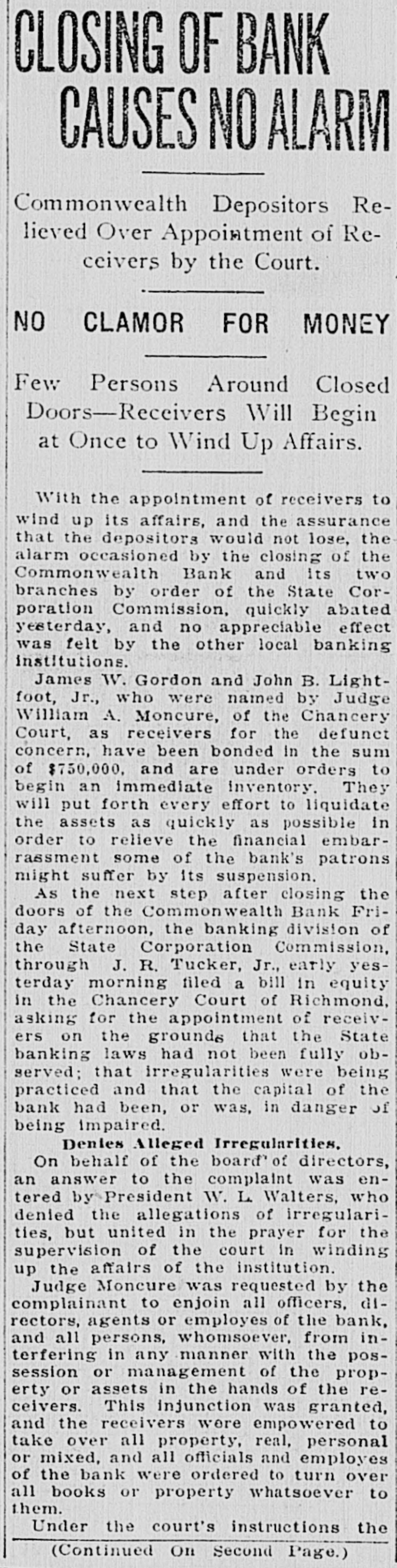
CLOSING OF BANK CAUSES NO ALARM Commonwealth Depositors Relieved Over Appointment of Receivers by the Court. NO CLAMOR FOR MONEY Few Persons Around Closed Doors-Receivers Will Begin at Once to Wind Up Affairs. With the appointment of receivers to wind up its affairs, and the assurance that the depositors would not lose, the alarm occasioned by the closing of the Commonwealth Bank and its two branches by order of the State Corporation Commission, quickly abated yesterday, and no appreciable effect was felt by the other local banking institutions. James W. Gordon and John B. Lightfoot, Jr., who were named by Judge William A. Moncure, of the Chancery Court, as receivers for the defunct concern, have been bonded In the sum of $750,000. and are under orders to begin an immediate inventory. They will put forth every effort to liquidate the assets as quickly as possible in order to relieve the financial embarrassment some of the bank's patrons night suffer by its suspension. As the next step after closing the doors of the Commonwealth Bank Friday afternoon, the banking division of the State Corporation Commission, through J. R. Tucker, Jr., early yesterday morning filed a bill in equity in the Chancery Court of Richmond, asking for the appointment of receivers on the grounds that the State banking laws had not been fully observed; that irregularities were being practiced and that the capital of the bank had been, or was, in danger of being impaired. Denies Alleged Irregularities, On behalf of the board of directors, an answer to the complaint was entered by President W. L. Walters, who denied the allegations of irregularities, but united in the prayer for the supervision of the court in winding up the affairs of the institution. Judge Moncure was requested by the complainant to enjoin all officers, dlrectors, agents or employes of the bank, and all persons, whomsoever, from interfering in any manner with the possession or management of the property or assets in the hands of the receivers. This injunction was granted, and the receivers were empowered to take over all property, real, personal or mixed, and all officials and employes of the bank were ordered to turn over all books or property whatsoever to them. Under the court's instructions the (Continued On Second Page.)
4.August 31, 1913The Richmond VirginianRichmond, VA
Click image to open full size in new tab
Article Text
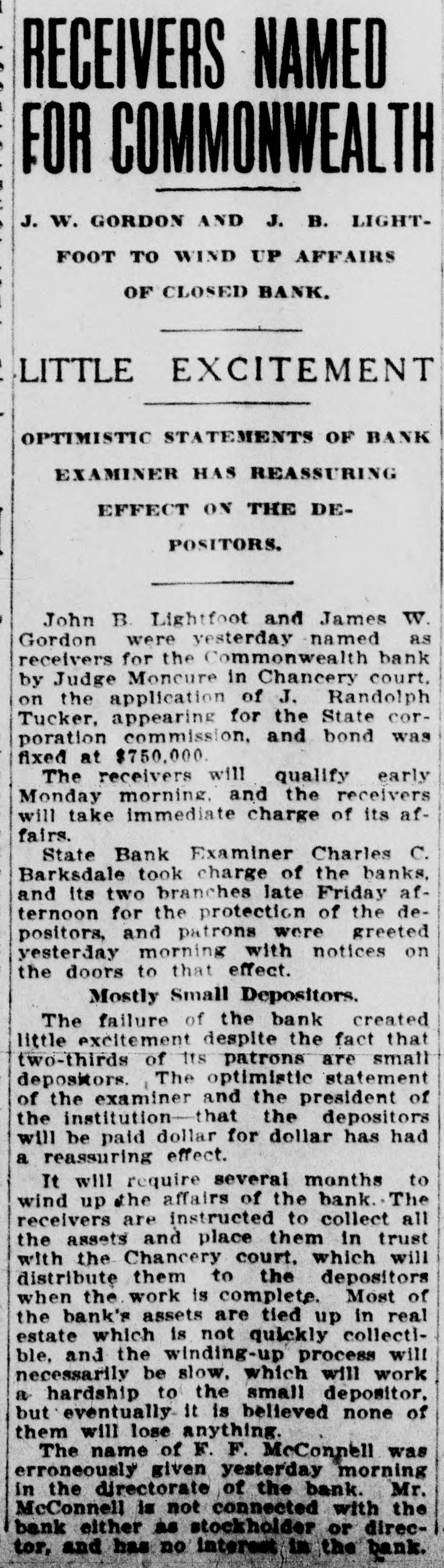
RECEIVERS NAMED FOR COMMONWEALTH J
W. GORDON AND J. B. LIGHTFOOT TO WIND UP AFFAIRS OF CLOSED BANK. LITTLE EXCITEMENT OPTIMISTIC STATEMENTS OF BANK EXAMINER HAS REASSURING EFFECT ON THE DEPOSITORS. John B. Lightfoot and James W. Gordon were yesterday named as receivers for the Commonwealth bank by Judge Moncure in Chancery court. on the application of J. Randolph Tucker, appearing for the State corporation commission, and bond was fixed at $750,000. The receivers will qualify early Monday morning. and the receivers will take immediate charge of its affairs. State Bank Examiner Charles C. Barksdale took charge of the banks, and its two branches late Friday afternoon for the protection of the depositors, and patrons were greeted yesterday morning with notices on the doors to that effect. Mostly Small Depositors. The failure of the bank created little excitement despite the fact that two-thirds of Tts patrons are small depositors. The optimistic statement of the examiner and the president of the institution-that the depositors will be paid dollar for dollar has had a reassuring effect. It will require several months to wind up the affairs of the bank. The receivers are instructed to collect all the assets and place them in trust with the Chancery court, which will distribute them to the depositors when the work is complete. Most of the bank's assets are tied up in real estate which is not quickly collectible, and the winding-up process will necessarily be slow. which will work a hardship to the small depositor. but eventually it is believed none of them will lose anything. The name of F. F. McConnell was erroneously given yesterday morning in the directorate of the bank. Mr. McConnell is not connected with the bank either as stockholder or director, and has no interest in the bank.
5.August 31, 1913The Richmond VirginianRichmond, VA
Click image to open full size in new tab
Article Text
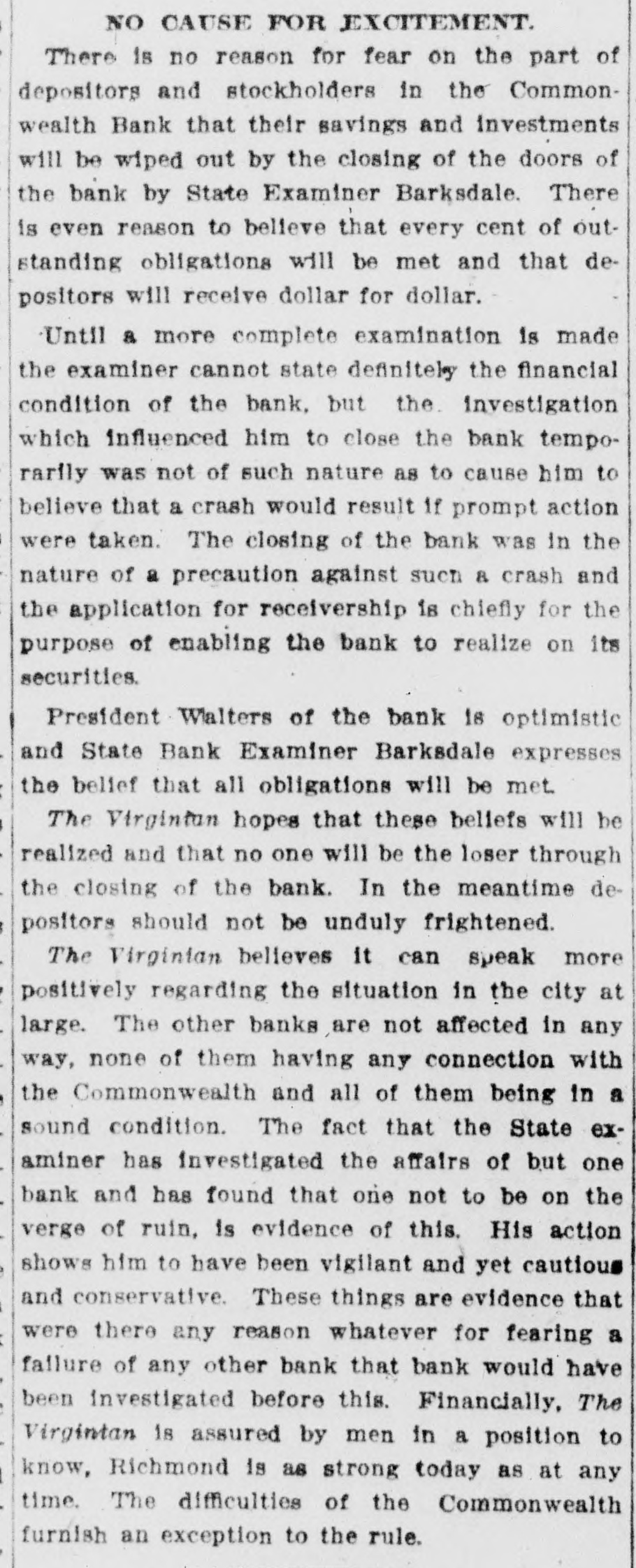
NO CAUSE FOR EXCITEMENT
There is no reason for fear on the part of depositors and stockholders in the Commonwealth Bank that their savings and investments will be wiped out by the closing of the doors of the bank by State Examiner Barksdale. There is even reason to believe that every cent of outstanding obligations will be met and that depositors will receive dollar for dollar. Until & more complete examination is made the examiner cannot state definitely the financial condition of the bank, but the investigation which influenced him to close the bank temporarily was not of such nature as to cause him to believe that a crash would result if prompt action were taken. The closing of the bank was in the nature of a precaution against such & crash and the application for receivership 18 chiefly for the purpose of enabling the bank to realize on its securities. President Walters of the bank 18 optimistic and State Bank Examiner Barksdale expresses the belief that all obligations will be met The Virgintan hopes that these beliefs will be realized and that no one will be the loser through the closing of the bank. In the meantime depositors should not be unduly frightened. The Virginian believes it can speak more positively regarding the situation in the city at large. The other banks are not affected in any way, none of them having any connection with the Commonwealth and all of them being in a sound condition. The fact that the State examiner has investigated the affairs of but one bank and has found that one not to be on the verge of ruin, is evidence of this. His action shows him to have been vigilant and yet cautious and conservative. These things are evidence that were there any reason whatever for fearing a failure of any other bank that bank would have been investigated before this. Financially, The Virgintan 1s assured by men in a position to know, Richmond is as strong today as at any time. The difficulties of the Commonwealth furnish an exception to the rule.
6.September 2, 1913The Times DispatchRichmond, VA
Click image to open full size in new tab
Article Text
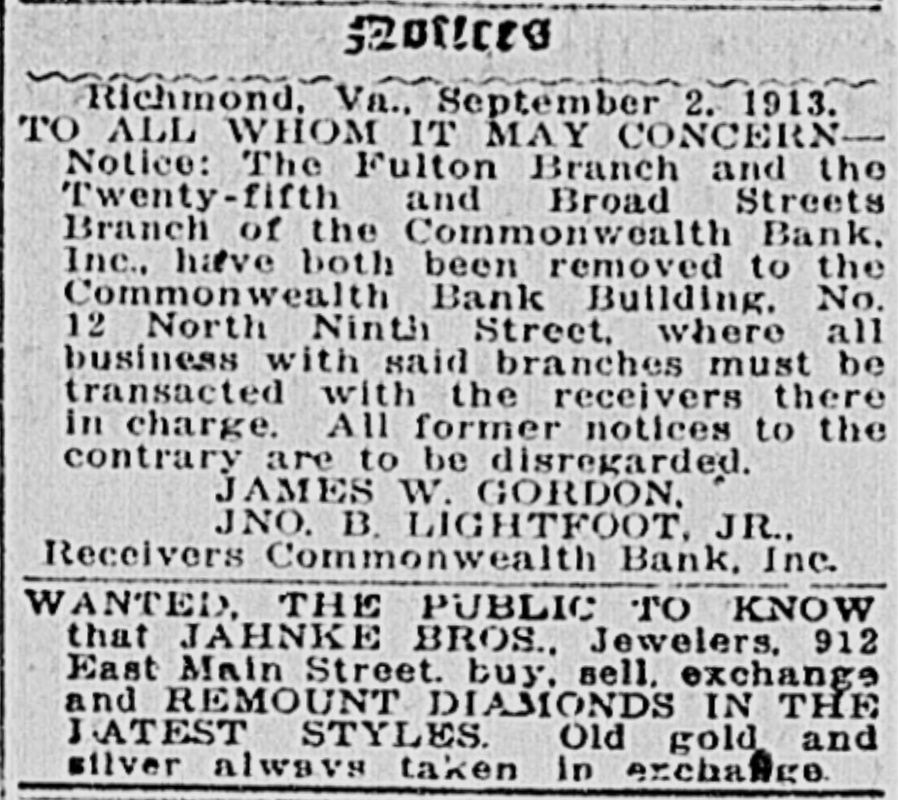
Policed Richmond, Va., September 2. 1913. TO ALL WHOM IT MAY CONCERNNotice: The Fulton Branch and the Twenty-fifth and Broad Streets Branch of the Commonwealth Bank, Inc., have both been removed to the Commonwealth Bank Building. No. 12 North Ninth Street, where all business with said branches must be transacted with the receivers there in charge. All former notices to the contrary are to be disregarded. JAMES W. GORDON. JNO. B. LIGHTFOOT. JR., Receivers Commonwealth Bank, Inc. WANTED, THE PUBLIC TO KNOW that JAHNKE BROS., Jewelers, 912 East Main Street. buy, sell, exchange and REMOUNT DIAMONDS IN THE LATEST STYLES. Old gold and silver always taken in exchange
7.September 2, 1913The Times DispatchRichmond, VA
Click image to open full size in new tab
Article Text
RECEIVERS GIVE BOND Lightfoot and Gordon Execute $750,000 Surety for Their Trust. John B. Lightfoot, Jr., and James W. Gordon, receivers for the Commonwealth Bank, executed bond for $750.000 in the Chancery Court yesterday as security for their trust. The sureties are the United States Fidelity and Guarantee Company and the Fidelity and Deposit Company, of Maryland. The receivers announced yesterday that beginning this morning the Commonwealth Bank, as well as the branches at Twenty-fifth and Broad Streets and 3914 Williamsburg Avenue, Fulton, will be open daily to receive money due either the central bank or the branches. The banks will be kept open for this purpose each business day for an indefinite period.
8.September 2, 1913The Richmond VirginianRichmond, VA
Click image to open full size in new tab
Article Text
KNOWS NOTHING OF REORGANIZATION PRESIDENT WALTERS COULD NOT CONFIRM COMMONWEALTH REPORT. Though report was heard yesterday afternoon that there is a movement under way for the reorganization of the Commonwealth bank, which closed its doors Friday night, President W. L. Walters, of the institution, last night said he knew nothing of such movement. The report was that the bank will be reorganized. new capital being invested, and that the business of the bank will be continued. The receivers named by Judge Moncure in the Chancery court Saturday, J. B. Lightfoot, Jr., and James W. Gordon, yesterday executed the required bond, $750,000. The sureties are the United States Fidelity and Guarantee company and the Fidelity and Deposit company of Maryland.
9.September 3, 1913The Times DispatchRichmond, VA
Click image to open full size in new tab
Article Text
Motters Richmond, Va., September 2, 1913. TO ALL WHOM IT MAY CONCERNNotice: The Fulton Branch and the Twenty-fifth and Broad Streets Branch of the Commonwealth Bank. Inc., have both been removed to the Commonwealth Bank Building. No. 12 North Ninth Street, where all business with said branches must be transacted with the receivers there in charge. All former notices to the contrary are to be disregarded. JAMES W. GORDON. JNO. B. LIGHTFOOT JR., Receivers Commonwealth Bank, Inc. WANTED, THE PUBLIC TO KNOW that JAHNKE BROE.. Jewelers. 912 East Main Street. buy, sell, exchange and REMOUNT DIAMONDS IN THE LATEST STYLES. Old gold and silver always taken in exchange. NEW AND SECOND-HAND CARriages and buggles. R. H. BOSHER'S SONS.
10.September 3, 1913The Times DispatchRichmond, VA
Click image to open full size in new tab
Article Text
OPENS TO COLLECT NOTES By direction of John B. Lightfoot. Jr., and James W. Gordon, receivers appointed by Judge Moncure, of the Chancery Court, the doors of the Commonwealth Bank, 12 North Ninth Street, and its two branches were opened yesterday morning so that people having notes with the bank might take them up or curtail them by partial payments, and so that other business of this nature might be transacted. It was not permitted, though. that checks should be cashed or that any moneys whatever should be paid out. It will be several days probably before the receivers, who are under $750,000 bond for the faithful performance of their duties, will be able to determine the exact condition of the bank's ffairs.
11.September 3, 1913The Richmond VirginianRichmond, VA
Click image to open full size in new tab
Article Text
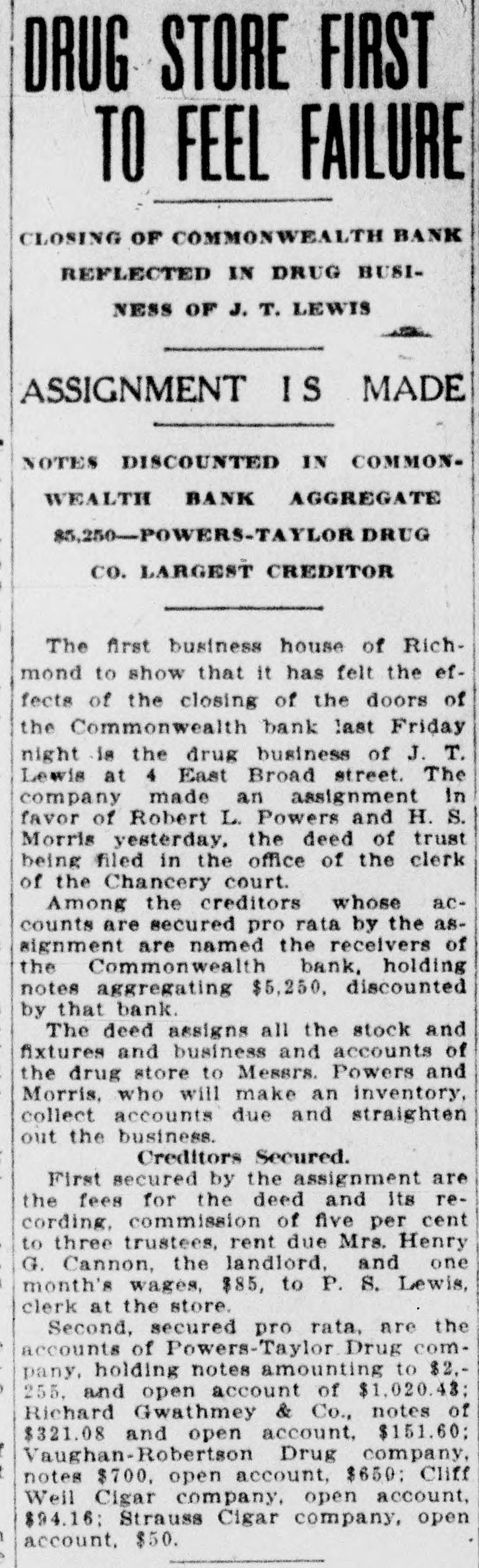
DRUG STORE FIRST TO FEEL FAILURE CLOSING OF COMMONWEALTH BANK REFLECTED IN DRUG BUSINESS OF J. T. LEWIS ASSIGNMENT IS MADE NOTES DISCOUNTED IN COMMONWEALTH BANK AGGREGATE $5,250-POWERS-TAYLOR DRUG CO. LARGEST CREDITOR The first business house of Richmond to show that it has felt the effects of the closing of the doors of the Commonwealth bank last Friday night is the drug business of J. T. Lewis at 4 East Broad street. The company made an assignment In favor of Robert L. Powers and H. S. Morris yesterday. the deed of trust being filed in the office of the clerk of the Chancery court. Among the creditors whose accounts are secured pro rata by the assignment are named the receivers of the Commonwealth bank, holding notes aggregating $5,250. discounted by that bank. The deed assigns all the stock and fixtures and business and accounts of the drug store to Messrs. Powers and Morris, who will make an inventory, collect accounts due and straighten out the business. Creditors Secured. First secured by the assignment are the fees for the deed and Its recording. commission of five per cent to three trustees, rent due Mrs. Henry G. Cannon, the landlord, and one month's wages, $85, to P. S. Lewis, clerk at the store. Second, secured pro rata, are the accounts of Powers-Taylor Drug company, holding notes amounting to $2.255, and open account of $1,020.43; Richard Gwathmey & Co., notes of $321.08 and open account, $151.60; Vaughan-Robertson Drug company, notes $700, open account, $650: Cliff Weil Cigar company, open account, $94.16; Strauss Cigar company, open account, $50.
12.October 26, 1913The Times DispatchRichmond, VA
Click image to open full size in new tab
Article Text
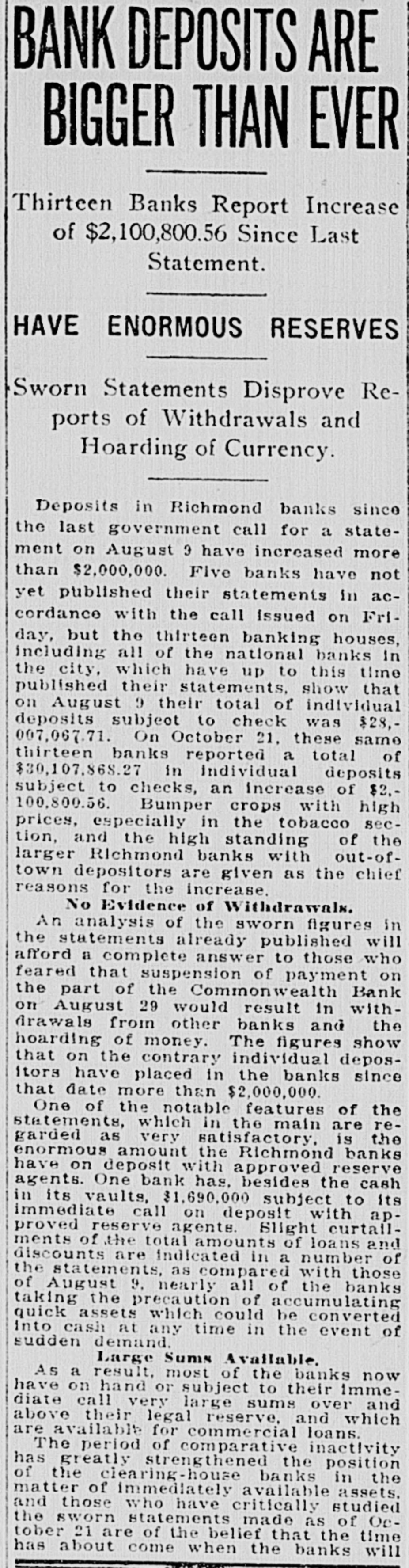
BANK DEPOSITS ARE BIGGER THAN EVER Thirteen Banks Report Increase of $2,100,800.56 Since Last Statement. HAVE ENORMOUS RESERVES Sworn Statements Disprove Reports of Withdrawals and Hoarding of Currency. Deposits in Richmond banks since the last government call for a statement on August 3 have increased more than $2,000,000. Five banks have not yet published their statements in accordance with the call Issued on Friday, but the thirteen banking houses, including all of the national banks In the city, which have up to this time published their statements, show that on August 9 their total of individual deposits subject to check was $28,007,067.71. On October 21, these same thirteen banks reported a total of $30,107,868.27 in Individual deposits subject to checks, an increase of $2.100,800.56. Bumper crops with high prices, especially in the tobacco section, and the high standing of the larger Richmond banks with out-oftown depositors are given as the chief reasons for the increase. No Evidence of Withdrawals. An analysis of the sworn figures in the statements already published will afford a complete answer to those who feared that suspension of payment on the part of the Commonwealth Bank on August 29 would result in withdrawals from other banks and the hoarding of money. The figures show that on the contrary individual depositors have placed in the banks since that date more than $2,000,000. One of the notable features of the statements, which in the main are regarded as very satisfactory, is the enormous amount the Richmond banks have on deposit with approved reserve agents. One bank has, besides the cash in its vaults, $1,690,000 subject to its immediate call on deposit with approved reserve agents. Slight curtailments of the total amounts of loans and discounts are indicated in a number of the statements, as compared with those of August 9. nearly all of the banks taking the precaution of accumulating quick assets which could be converted into cash at any time in the event of sudden demand. Large Sums Available. As a result, most of the banks now have on hand or subject to their Immediate call very large sums over and above their legal reserve, and which are available for commercial loans. The period of comparative inactivity has greatly strengthened the position of the clearing-house banks in the matter of immediately available assets. and those who have critically studied the sworn statements made as of October 21 are of the belief that the time has about come when the banks will
13.December 23, 1913The Richmond VirginianRichmond, VA
Click image to open full size in new tab
Article Text
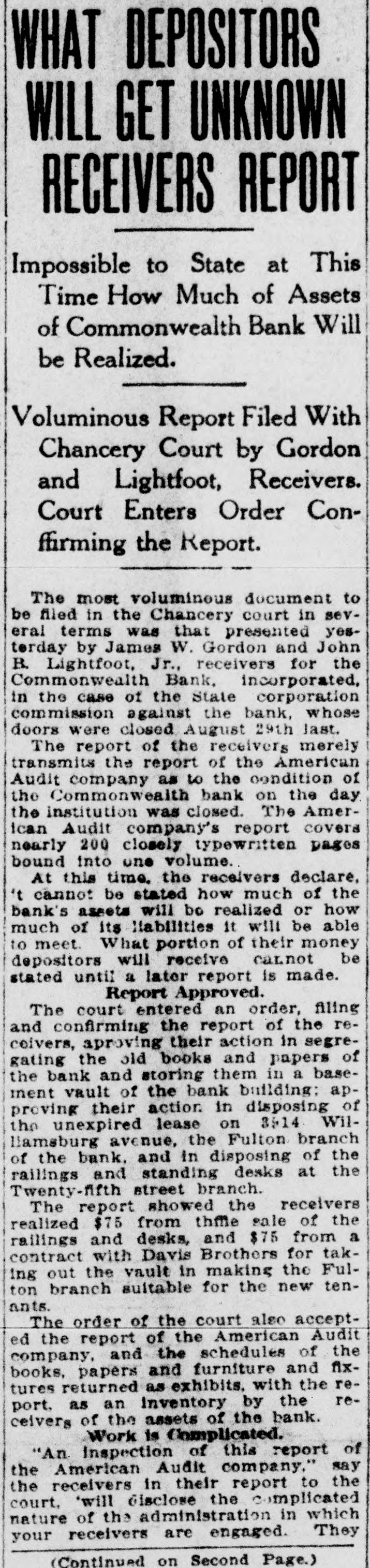
WHAT DEPOSITORS WILL GET UNKNOWN RECEIVERS REPORT Impossible to State at This Time How Much of Assets of Commonwealth Bank Will be Realized. Voluminous Report Filed With Chancery Court by Gordon and Lightfoot, Receivers. Court Enters Order Conffirming the Report. The most voluminous document to be filed in the Chancery court in several terms was that presented yesterday by James W. Gordon and John B. Lightfoot, Jr., receivers for the Commonwealth Bank, incorporated, in the case of the State corporation commission against the bank, whose doors were closed August 29th last. The report of the receivers merely transmits the report of the American Audit company as to the condition of the Commonwealth bank on the day the institution was closed. The American Audit company's report covers nearly 200 closely typewritten pages bound into one volume. At this time. the receivers declare, 't cannot be stated how much of the bank's assets will be realized or how much of its liabilities It will be able to meet. What portion of their money depositors will receive cannot be stated until a later report is made. Report Approved. The court entered an order, filing and confirming the report of the receivers, aproving their action in segregating the old books and papers of the bank and storing them in a basement vault of the bank building: approving their action in disposing of the unexpired lease on 3914 Williamsburg avenue, the Fulton branch of the bank. and in disposing of the railings and standing desks at the Twenty-fifth street branch. The report showed the receivers realized $75 from the sale of the railings and desks, and $75 from a contract with Davis Brothers for taking out the vault in making the Fulton branch suitable for the new tenants. The order of the court also accepted the report of the American Audit company, and the schedules of the books, papers and furniture and fixtures returned as exhibits. with the report, as an Inventory by the receivers of the assets of the bank. Work is Complicated. "An Inspection of this report of the American Audit company." say the receivers in their report to the court, 'will disclose the complicated nature of the administration in which your receivers are engaged. They (Continued on Second Page.)
14.January 10, 1914The Richmond VirginianRichmond, VA
Click image to open full size in new tab
Article Text
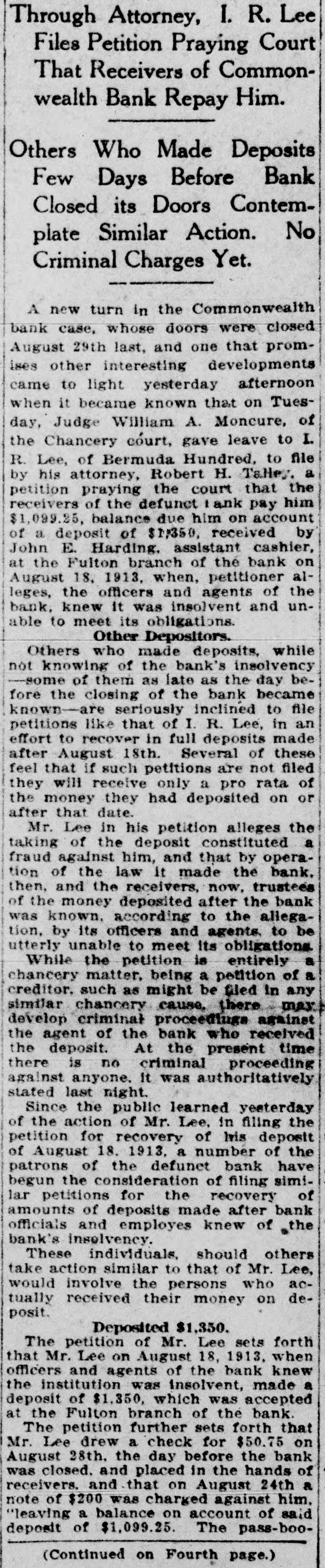
Through Attorney, I. R. Lee Files Petition Praying Court That Receivers of Commonwealth Bank Repay Him. Others Who Made Deposits Few Days Before Bank Closed its Doors Contemplate Similar Action. No Criminal Charges Yet. A new turn in the Commonwealth bank case, whose doors were closed August 29th last, and one that promises other interesting developments came to light yesterday afternoon when it became known that on Tuesday, Judge William A. Moncure, of the Chancery court, gave leave to I. R. Lee, of Bermuda Hundred, to file by his attorney, Robert H. Talley. a petition praying the court that the receivers of the defunct 1 tank pay him $1,099.25, balance due him on account of a deposit of $1,350, received by John E. Harding. assistant cashier, at the Fulton branch of the bank on August 18, 1913, when, petitioner alleges, the officers and agents of the bank, knew It was insolvent and unable to meet its obligations. Other Depositors. Others who made deposits, while not knowing of the bank's insolvency -some of them as late as the day before the closing of the bank became known-are seriously inclined to file petitions like that of I. R. Lee, in an effort to recover in full deposits made after August 18th. Several of these feel that if such petitions are not filed they will receive only a pro rata of the money they had deposited on or after that date. Mr. Lee in his petition alleges the taking of the deposit constituted a fraud against him, and that by operation of the law it made the bank. then, and the receivers, now, trustees of the money deposited after the bank was known, according to the allegation, by its officers and agents, to be utterly unable to meet its obligations. While the petition is entirely a chancery matter. being a petition of a creditor. such as might be filed in any similar chancery cause, there may develop criminal proceedings against the agent of the bank who received the deposit. At the present time there is no criminal proceeding against anyone. It was authoritatively stated last night. Since the public learned yesterday of the action of Mr. Lee, in filing the petition for recovery of lvis deposit of August 18. 1913, a number of the patrons of the defunet bank have begun the consideration of filing similar petitions for the recovery of amounts of deposits made after bank officials and employes knew of the bank's insolvency. These individuals, should others take action similar to that of Mr. Lee, would involve the persons who actually received their money on deposit. Deposited $1,350. The petition of Mr. Lee sets forth that Mr. Lee on August 18, 1913, when officers and agents of the bank knew the institution was insolvent, made a deposit of $1,350, which was accepted at the Fulton branch of the bank. The petition further sets forth that Mr. Lee drew a check for $50.75 on August 28th. the day before the bank was closed. and placed in the hands of receivers. and that on August 24th a note of $200 wes charved goinst him
15.July 11, 1914The Times DispatchRichmond, VA
Click image to open full size in new tab
Article Text
Commonwealth Receivers Will Mail Checks for 25 Cents on Dollar. BANK HAS $162,630 IN CASH Further Payments Depend on Collection of Outstanding Loans and Discounts. On or about July 20, every person who has money on deposit in the de funct Commonwealth Bank will re celve a check for 25 per cent of the amount of his deposit an a first in stallment towards the settlement of his claim by the bank's receivers. The 25 per cent dividend has not as yet been authorized but an order directing :1 will be entered by Judge Moneure, of the Chancery Court. within the next ten days. unless some contingency not now expected prevents The prospective dividend because a practical certainty yesterday with the filing of a report by Commissioner in Chancery Overton Howard who was directed under it decree entered by Judge Moncure on January 7. 1914. to prepare a statement of the Common wealth Bank's condition with proper IV attested schedules showing indi vidual depositors and complete tables of the bank's assets and liabilities The report covers many typewritten pages. and sets the information before the court. accompanied by depositions from the bank's officers and account ants explaining the significance of the major items. A revised statement of the bank's condition is submitted and shows that on June 15. 1914. the total assets were $979,412.25 and the lia bilities $651,805.39 The statement shows that the bank has now cash on depozit to the amount of $162,630.11 HAVE SEFFICIENT FOR ONE-FOURTH PAYMENT In the same statement it is shown that the deposits in excess of 32 :mount to $540,030.15 A 25 per cent dividend on this total would amount to $135,007.53 and its disbursement would still leave the bank a cash bal. once of 327,622.61 This balance would be somewhat reduced by the dividend on the deposits that are smaller than 52. which do not appear in the statement. The statement filed by Commissioner Howard will be held in the Chancery Court for a period of ten days to await the filing of possible exceptions. If no exceptions are offered-and none are expected- the receivers. it is expected. will file : condensed statement of the bank's condition setting forth substantially the name information that is contained in lite ccommissioner's report now on file With this information before him Judge Moneure, it is expected, will enter an order directing the payment of a 25 per cent dividend to all depositors as a first installment. The dividend check will be a welcome visitor to approximately 6,500 depositors large and small, who were caught in the crash when the Commonwealth Bank at the close of business on August 29. posted a notice on its doors conveying the information that it had been compelled to close because of its temporary inability to meet the demand of creditor banks for the repayment of money borrowed to take care of its customers. FIRST DEPOSITORS WELCOME RAY of ENCOURAGEMENT Most of the depositors belong to the industrial and working classes. and were hard hit by the bank's failure The practical assurance of an initial 25 per cent dividend is the first ray of encouragement that has penetrated the gloom of the 6,500 or more depositors since the affairs of the institution were taken in charge by the receivers. John B. Lightfoot. Jr. and James W. Gordon, ten months ago Although Commissioner Howard's statement of the bank's condition on June 15. 1914. shows that the assets exceed the liabilities by $327,606.90. the ratio between the two is modified by the fact that $599,179.16 of the total assets consists of loans and discounts which are not readily convertible. No one was willing to predict yesterday how much will eventually be realized from this big item. Upon the amount of cash the discounts and loans will eventually produce hinges the probability of further dividends to depositors. A gradual liquidation has enabled the receivers accumulate a cash balance of $162. 630.14. which will be largely dissipated in the distribution of the 25 per cent dividend. When the size of the cash balance will permit another dividend is a matter of pure conjecture. When the bank closed its doors last August the officers of the institution united with State Bank Examiner Barksdale in statements expressing the belief that depositors would reThe celve 100 cents on the dollar weight of the data placed before the Chancery Court by the receivers would appear to indicate that the ultimate return to the depositors will be at a ratio considerably less. COMMISSIONER HOWARD REPORTS BANK'S CONDITION Commissioner Howard's statement of the assets and liabilities of the Commonwealth Bank. as of June 15, 1914. exclusive of stock liability and certain small balances of $2 or less due depositors, follows: Assets. $599,179.16 Loans and discounts 12,681.26 Suspended debt account 1,661.91 Overdrafts 161,858.88 Stocks and bonds 3,173.70 Real estate owned 257.37 Due from banks 10,622.71 Receivers' investments 13,400.89 J. H. Harding (shortage) 11,946.22 Furniture, fixtures and vault 2.000,00 Notes guaranteed Cash on deposit (receivers) 162,630.14 Total $979,412.29 Liabilities. $540,030.15 Deposits over $2 216.00 Dividends unpaid
16.October 1, 1914The Richmond VirginianRichmond, VA
Click image to open full size in new tab
Article Text
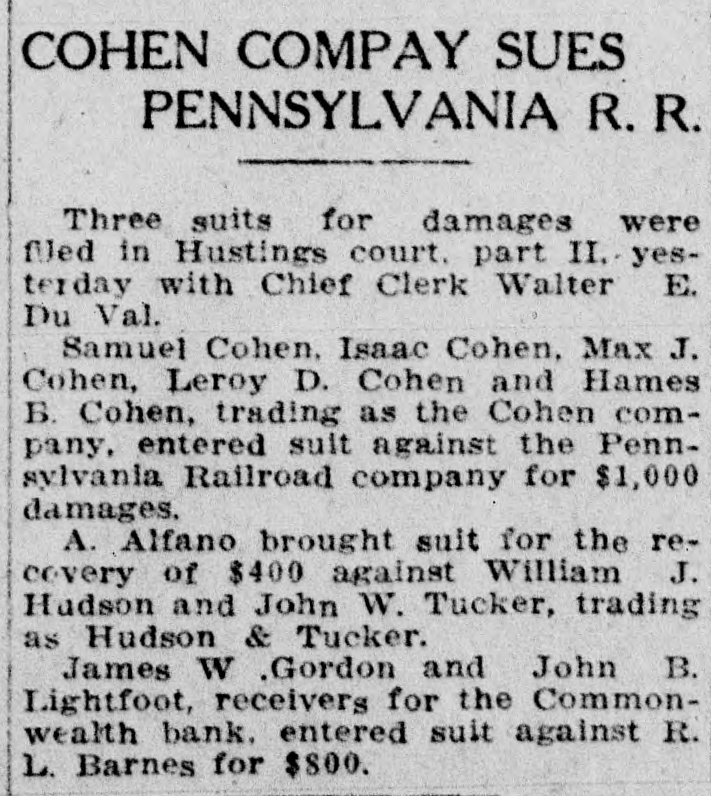
COHEN COMPAY SUES PENNSYLVANIA R
R. Three suits for damages were filed in Hustings court. part II. yesterday with Chief Clerk Walter E. Du Val. Samuel Cohen. Isaac Cohen, Max J. Cohen, Leroy D. Cohen and Hames B. Cohen, trading as the Cohen company, entered suit against the Pennsylvania Railroad company for $1,000 damages. A. Alfano brought suit for the recovery of $400 against William J. Hudson and John W. Tucker, trading as Hudson & Tucker. James W .Gordon and John B. Lightfoot, receivers for the Commonwealth bank. entered suit against R. L. Barnes for $800.
17.April 23, 1915The Richmond VirginianRichmond, VA
Click image to open full size in new tab
Article Text
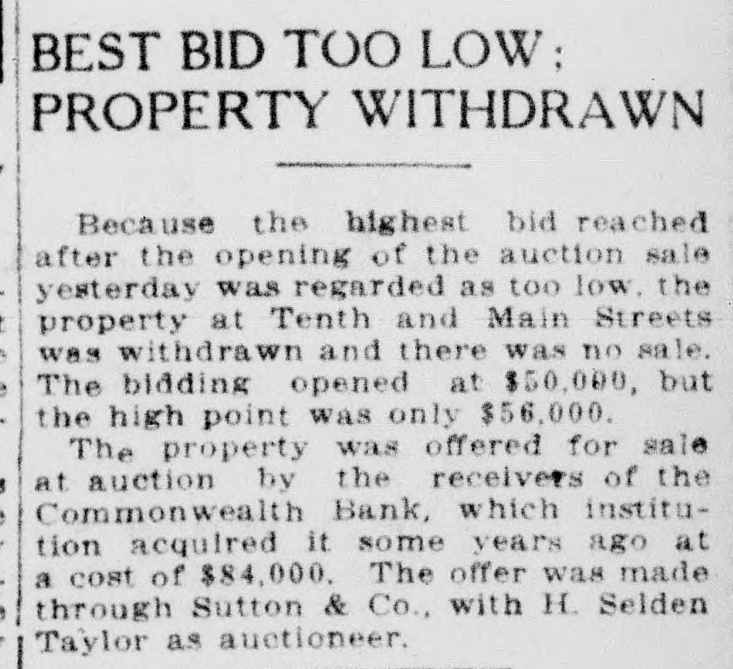
BEST BID TOO LOW
PROPERTY WITHDRAWN Because the highest bid reached after the opening of the auction sale yesterday was regarded as too low, the property at Tenth and Main Streets was withdrawn and there was no sale. The bidding opened at $50,000, but the high point was only $56,000. The property was offered for sale at auction by the receivers of the Commonwealth Bank, which institution acquired it some years ago at a cost of $84,000. The offer was made through Sutton & Co., with H. Selden Taylor as auctioneer.
18.June 26, 1915The Richmond VirginianRichmond, VA
Click image to open full size in new tab
Article Text
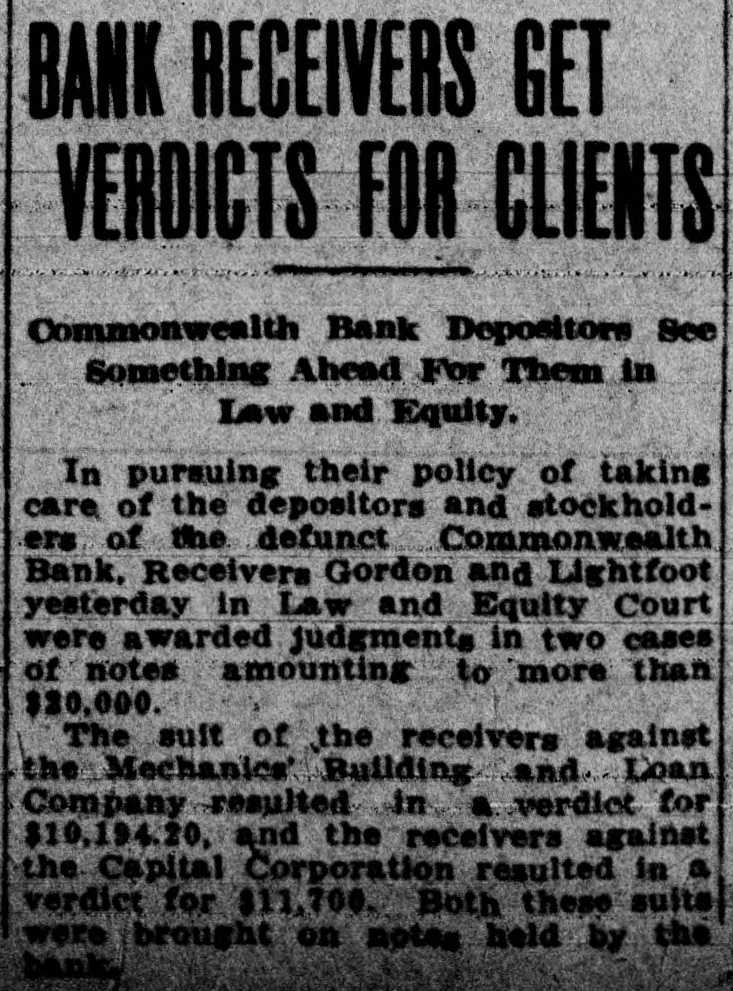
BANK RECEIVERS GET VERDICTS FOR CLIENTS Commonwealth Bank Depositors See Something Ahead For Them in Law and Equity. In pursuing their policy of taking care of the depositors and stockholders of the defunct Commonwealth Bank, Receivers Gordon and Lightfoot yesterday in Law and Equity Court were awarded judgments in two cases of notes amounting to more than $20,000. The suit of the receivers against the Mechanics' Building and Loan Company resulted in a verdict for $10,194.20, and the receivers against the Capital Corporation resulted in a verdict for $11,700. Both these suite were brought on notes held by the
19.December 22, 1915The Richmond VirginianRichmond, VA
Click image to open full size in new tab
Article Text
10 PER CENT DIVIDEND BY COMMONWEALTH BANK By this Christmas those who were depositors in the defunct Commonwealth Bank will have received 35 per cent of the sums they had on deposit in that bank when the doors of the institution were closed some two years ago. Today or tomorrow James W. Gordon and John B. Lightfoot, receivers for the Commonwealth Bank, under appointment of the Chancery Court, will mail out to all on the depositors' list checks for 10 per cent of what they had on deposit at the time the bank closed. There has already been declared one dividend of 25 per cent, this having been mailed out some months ago. The amount of the present 10 per cent dividend will be about $63,000.
20.January 15, 1916The Richmond VirginianRichmond, VA
Click image to open full size in new tab
Article Text
Law and Equity Court
Judge Crump sitting in this court yesterday. a verdict was brought in the case of Gordon Metal Company against the Southern Railway Company and Kingan Company, for the defendant. The plaintiff wanted the defendant to remove a spur track across the corner of Fourteenth and Dock Streets. The suit of Gordon & Lightfoot, receivers for the Commonwealth Bank, against R. J. Shepperson for $500 (a note). is on trial in this court.
21.July 30, 1916Richmond Times-DispatchRichmond, VA
Click image to open full size in new tab
Article Text
TENTH AND MAIN CORNER IS SOLD TO WOODWARD Pays $70,000 for Twenty Feet to Old Dominion Building Corporation. AMOUNT LESS THAN MORTGAGES Property Was Once Acquired as Home for Now Defunct Commonwealth Bank-Will Be Renovated Under Temporary Lease. Deeds will be placed on record this week in the Chancery Court recording the sale of the valuable property at the southwest corner of Main and Tenth Streets to Stewart M. Woodward for $70,000. The lot fronts twenty feet on Main Street and runs back seventy feet on Tenth. It is one of the few remaining corners in the downtown banking district not improved with a modern office building. The old building now on this site. it is understood, will be renovated and rented for business purposes under a temporary lease pending the permanent improvement of the property with a modern structure. In recent years the property has undergone many vicissitudes, It was acquired several years ago by the Old Dominion Building Corporation, an organization in which most of the stock was held by the defunct Commonwealth Bank and individuals connected with that institution. Tt was understood that It was the ultimate intention to erect a modern banking house on the property, In which the Commonwealth Bank, then located on Ninth Street, was to be established. PRICE PAID IS LESS THAN MORTGAGES Soon afterwards there followed the business depression and other complications which brought about the failure of the Commonwealth Bank. The plans for the improvement of the Main and Tenth Street corner were never realized, and for several years the property has been on the market. The price paid by Mr. Woodward is understood to be considerably less than the amount of the three mortgages with which the property is burdened. It will be applied to the satisfaction of these liens. The sale of the property will not benefit those who hold unsatisfied claims against the defunet Commonwealth Bank, because there will be no balance from the proceeds to apply to any of the notes held by the receivers of the bank as evidence of loans made on this property. The sale was made through the real estate firm of C. L. & H. L. Denoon.
Bank runs are almost always and everywhere a deterioration of bank fundamentals.
But not for you.
You are the measure-zero exception: great fundamentals, solid bank, and yet the Diamond Dybvig fairy spread its rumor. Depositors woke up. Your collateral was not prepositioned. The Clearinghouse had it for you.
Do not pass Go. Do not collect $200. Go directly to jail… or worse.