Peoples Bank (Covington, VA)

Episode Information

Episode UID
68016271573
Episode Type
Run โ†’ Suspension โ†’ Closure
Bank Type
state
Bank ID
6801627 routing
Routing Number
68-0162
Start Date
January 2, 1931
Location
Covington, Virginia (37.778, -79.986)

Metadata

Model
gpt-5-mini (chosen from majority vote of a three-model LLM ensemble)
Short Digest
27bd5e287069ce0e

Response Measures

None

Description

Sources show closure by directors after a 10-day run in Jan 1931 and later references to receivers and dividend payments; some dates in later reports conflict (one says failure in Jan 1930).

Events (4)

1. January 2, 1931 Run
Cause Details
Extensive withdrawals over a ten-day period; contemporary commentary mentions rumors but no single discrete misinformation event is cited.
Measures
Bank posted notice and board voted to close temporarily to protect depositors.
Newspaper Excerpt
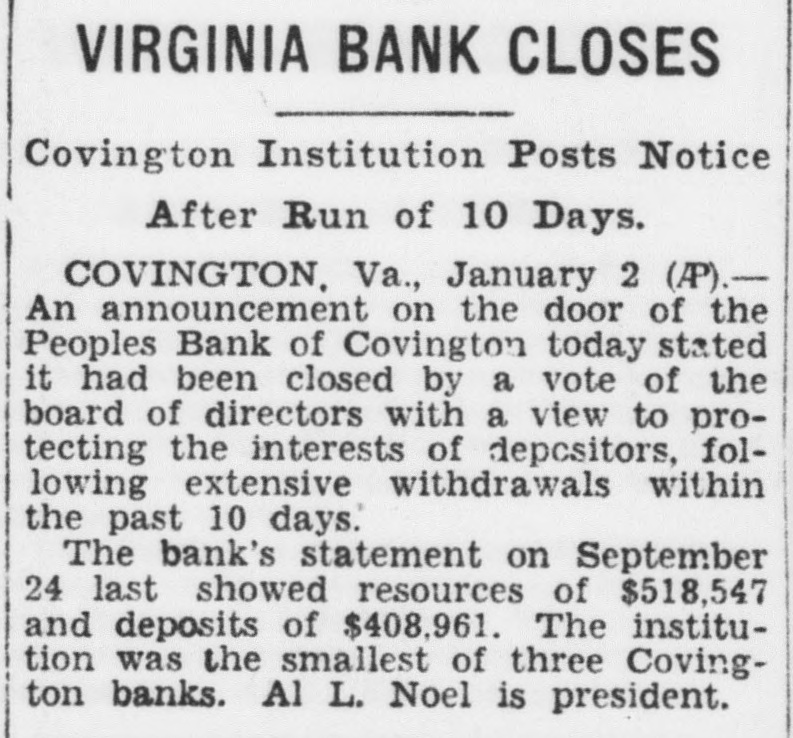
announcement on the door of the Peoples Bank of Covington today stated it had been closed by a vote of the board of directors with a view to protecting the interests of depositors, following extensive withdrawals within the past 10 days.
Source
newspapers
2. January 2, 1931 Suspension
Cause Details
Closed by vote of the board to protect depositors after extensive withdrawals (suspension by directors rather than government action).
Newspaper Excerpt
announcement on the door of the Peoples Bank of Covington today stated it had been closed by a vote of the board of directors
Source
newspapers
3. March 3, 1933 Receivership
Newspaper Excerpt
PEOPLES BANK RECEIVERS TO PAY DIVIDEND ... receivers of the Peoples Bank announced today that they ... preparing cent dividend to be paid within few days.
Source
newspapers
4. December 19, 1934 Other
Newspaper Excerpt
dividend of 2 1-2 per cent on all deposits over 85 in the defunct Peoples Bank was declared Tuesday by the receivers The bank which failed January 1930, had paid out approximately 60 per cent.
Source
newspapers

Newspaper Articles (6)

Article from Evening Star, January 2, 1931

Click image to open full size in new tab

Article Text

VIRGINIA BANK CLOSES Covington Institution Posts Notice After Run of 10 Days. COVINGTON, Va., January 2 (P).An announcement on the door of the Peoples Bank of Covington today stated it had been closed by a vote of the board of directors with a view to protecting the interests of depositors, following extensive withdrawals within the past 10 days. The bank's statement on September 24 last showed resources of $518,547 and deposits of $408,961. The institution was the smallest of three Covington banks. Al L. Noel is president.


Article Text

RUN ON BANK LEADS TO CLOSING BY DIRECTORS VA., announcement on the door the of Peoples Bank of Covington today stated had been closed the by of board with view protecting the interest of followdepositors ing extensive withdrawals within the past ten days. The bank's statement on last September 24 showed resources of $518,547 and deposits of $408,691. Noel president.


Article Text

COUNTY IN ARKANSAS LEFT WITHOUT BANK Ark The bank. the in failed posted the door for the tection of depositors until of arrival bank examiner The and Planters affiliated A. B. of Rock. closed November folsuspension of the American hange Company in Little Rock. and deposithe Phillips Na bank but date of its opening was considered uncertain. The bank of which H. Howe president and H. had of with deposits of about Bank said they expected to arrive today. They made no The after the Interstate Phillips county without The Bank Marvell had de approximately said FIVE MISSISSIPPI BANKS TAKEN OVER by today ssippi banks to close affected in the one closed banks were the First NaBank of with deposand stock of of deposits capital stock $100,000 Bank of of $179 000 and $10,000 deposits $50,000 and COVINGTON VIRGINIA. Va Jan. An on the door of the Peoples Covington today it been closed vote the of directors with view to protecting the extensive within the past The statement on of 547.13 and the three Noel and Charles R. Karnes


Article Text

STAND BY THE BANKS. Roger W. Babson, who is a recognized authority when it comes to matters of finance, had published over his signature a few days ago a copyrighted article dealing with the banking situation in America at this time, and one of the chief points he advanced was in the nature of a suggestion to the people to curb the gossip mongers and spike in the beginning any maliclous rumors relating to the banks individually. Mr. Babson gives the assurance that there is no cause for alarm in this country as result of the bank failures that have taken place, and he predicts that in the course of time many of these frozen assets will thaw out and that the business of the nation will move along as though nothing out of the ordinary had happened In proof of this he cited other years when conditions were nothing like as favorable as at present. In reading the article from the pen of Mr. Babson, which we would reproduce if not copyrighted, we find that he lays great deal stress on confidence. That, in our opinion, is the one thing lacking in America in the present emergency. To be sure, bank failures are regrettable, but as general proposition they do not create the same excitement as formerly by reason of fact that way is usually found out of these misfortunes when they occur. We have in mind the Bank of Vinton in a suburb of Roanoke. That institution remained closed only few days and then reopened in better shape than before. The same is true of the situation in Arkansas, where many of the closed banks have resumed business. In Covington, where the People's Bank found it necessary to suspend, the people have been offidially advised that the depositors will not lose single dollar. For these and other reasons all of us need to sit tight and avoid doing those things to weaken confidence in either the banks or our fellow citizens. Below we quote few of the fine points brought out by Mr. Babson and commend them to our readers: "The pity of it is that most of these bank closings are now due to temporary causes and, under normal conditions the closing would be unnecessary. Many small independent banks find their loans temporality frozen due to the abnormal decline in prices for bonds, wheat, cotton, land, etc. Such loans, in most cases, will be perfectly good given time Prices always recover from the extreme lows and as they loans will thaw out. recover, frozen shame to close banks which have been honestly run. as 99 per cent of these country banks have been, simply because quotations are temporarily low. "Although these Eskimo banks are now covered with snow and festooned with icicles in this winter of depression, most of themgiven emerge vigorous and active when the springtime of improving business again melts the congealed assets. It is up to every community to give support and encouragement to its banks in these times of stress. To let them freeze to death by withdrawal of deposits is simply cutting away the foundation of returning good business in the community. The small independent bank is very importinstitution and, in the great majority of cases, every community is poorer when any ever small-is allowed to close its doors. "There are ways in which every citizen can help the situation. First, we can avoid spreading rumors and we can rebuke the What would happen if the bank officials. like many thoughtless citizens. listened to every rumor about bank customers who are borrowing from them? A man who helps to start a run on bank. or repeats any rumor about bank, is not only very foolish citizen, but also very bad citizen. that the strongest bank in the United States depends

Article Text

PEOPLES BANK RECEIVERS TO PAY DIVIDEND Look Out For Their Notice in Next Few Days receivers of the Peoples The Bank announced today that they checks for preparing cent dividend to be paid within few days. Further notice will appear in The Virginian shortly.


Article Text

DIVIDEND DECLARED BY COVINGTON RECEIVERS Covington, Dec 19 (Special) dividend of 2 1-2 per cent on all deposits over 85 in the defunct Peoples Bank was declared Tuesday by the receivers The bank which failed January 1930, had paid out approximately 60 per cent.