Chestnut Street Trust & Savings Fund Company (Philadelphia, PA)

Episode Information

Episode UID
69380791176
Episode Type
Run โ†’ Suspension โ†’ Closure
Bank Type
trust
Bank ID
6938079 hash
Start Date
December 23, 1897
Location
Philadelphia, Pennsylvania (39.952, -75.164)

Metadata

Model
gpt-5-mini (chosen from majority vote of a three-model LLM ensemble)
Short Digest
f6bb7e261045fcfa

Response Measures

None

Description

Trust company made a formal assignment; the allied national bank was taken in charge by examiners and later a receiver was appointed.

Events (4)

1. December 23, 1897 Run
Cause
Bank Specific Adverse Info
Cause Details
Withdrawals driven by losses tied to Singerly's pulp & paper mill securities and the bank's resulting weakened condition.
Newspaper Excerpt
It is said there have been quiet but steady runs on both banks for several days past.
Source
newspapers
2. December 23, 1897 Suspension
Cause
Bank Specific Adverse Info
Cause Details
Institutions closed after deterioration in value of Singerly Pulp & Paper Mill securities and insufficient reserves; national examiner posted notice and took charge.
Newspaper Excerpt
The Chestnut Street Trust and Savings Fund company were obliged to suspend business yesterday.
Source
newspapers
3. December 24, 1897 Other
Newspaper Excerpt
The Chestnut Street Trust and Savings Fund company ... made an assignment today for the benefit of its creditors to George H. Earle, Jr., and Richard Y. Cook, the assignees of the trust company.
Source
newspapers
4. January 1, 1898* Receivership
Newspaper Excerpt
Since then a receiver has been appointed for the bank, and the affairs of it and the trust company are in process of settlement.
Source
newspapers

Newspaper Articles (25)

Article from The Wichita Daily Eagle, December 24, 1897

Click image to open full size in new tab

Article Text

Philadelphia, Dec. 23.-A sensation was created in this city this morning by the announcement of the suspension of the Chestnut Street National bank, regarded as one of the strongest financial institutions in the city. The suspension carried with it the closing of the Chestnut Street Trust and Savings Fund company, doing business under the state banking laws. William M. Singerly, publisher of the Philadelphia Record, is president of both companies and the same men, with one exception, act as officers and directors. The first intimation the public received that the bank was in trouble was in the form of a notice posted this morning on the door of the building, by nominal Bank Examiner William Hart to the effect that the Chestnut Street bank had closed its door, pending an investigation of its affairs. No statement of assets and liabilities is available but it is stated that the deposits of the Chestnut Street bank amounted to $1,700,000 and of the Trust company to $1,300,000. President Singerly gave out a brief statement tonight in which he said: "We are working to secure the indebtedness of the two banks SO that they can go into voluntary liquidation and thus avoid a receivership." In this connection Deputy Comptroller of the Treasury George M. Coffin, who was sent here from Washington by Comptroller Eckels today, said: "The matter of putting the Chestnut Street National bank into voluntary liquidation has been taken up by Philadelphia gentlemen of great financial ability. Their first step will be to ascertain the value of the assets of the bank. They must first be sure that they have a value sufficient to warrant them in assuming the indebtedness." Mr. Coffin will remain here several days, aiding the men who have taken upon themselves the task of extricating Mr. Singerly from this financial difficulties. These gentlemen are in consultation tonight and the belief is strong that they will provide the funds necessary for voluntary liquidation of the two banks. It was known for some time in bankIng circles that Mr. Singerly's banks were in trobule, and the national bank examiner, it is said, was aware of the condition of affairs. Last night a numher the leading bank officials held a conference regarding the matter of raising the money to relieve Mr. Singerly's banks of their distressed condition. Now it is hoped the committee will succeed in adjusting the finances and thus permit the banks to pay depositors dollar for dollar. The net earnings of the Record last year are said to have been $249,000, more than sufficient to pay dividends on a sum sufficient to pay all of Mr. Singerly's indebtedness to the banks. The statements of the cause of the failure current here agree with that made by Comptroller Eckels at Washington today, that it was primarily due to the loss of much money by Mr. Singerly in his unproductive paper mill at Elkton, Md., one of the largest in the country. One statement placed the sum thus involved at nearly a million dollars. Mr. Singerly also has much money invested in other enterprises in this and other cities. Rumors were current to the effect that the ownership of the Record would pass from Mr. Singerly but this he denied, stating positively thait he is in absolute control of the paper and will continue at its head. On Monday of this week the Chestnut Street bank made the following report to the Philadelphia clearing house: Loans and discounts $2,261,000; legal reserve $396,000: deposits $1,789,000; due from banks $355,000: due to banks $686.000; circulation $43.000. The reserve has been below the legal requirements for several weeks. The deposits on October 5, when the bank reported to the comptroller of the treasury, amounted to $2,035,856. The shrinkage in this item, therefore, has been more than $300,000 in a little over two months. It is said there have been quiet but steady runs on both banks for several days past. On the deposits in the bank, the city is represented by $289,554; the state by $225,000 and the national government by a large sum, but all of these creditors are believed to be protected. A meeting of the directors of the Trust company will be held at 10 o'clock tomorrow to decide upon a course of procedure. It is believed the state bank examiner will take informal possession of the banks. Much sympathy is expressed on all sides for Mr. Singerly. He has occupied such a prominent place in the affairs of the city and the state for years past that the news of his financial difficulties now created a sensation. Mr. Singerly stated tonight that he had received hundreds of telegrams from all over the country. expressing the sympathy 0 fhis friends. He has borne the strain very well, although the fully shows in his face and manner the deep concern his troubles are causing him. Crowds were gathered in front of the big granite banking building all day but all was quiet. A line of policemen keep the people moving. A greaa number of small accounts were carried by the Trust company, and apprehension was expressed that some distress might follow failure

Article from The Record-Union, December 24, 1897

Click image to open full size in new tab

Article Text

BANK FAILURES AT PHILADELPHIA. Doors of One of the Leading Institutions of the City Closed. Carries With it Another Big Concern Under tbe Same Management. The Chestnut - Street National Bank in the Hands of the National Bank Examiner, and the Doors of the Chestnut-Strcet Trust and Savings Fund Company Closed-The Announce= ment of the Suspension Causes a Sensation.


Article from Richmond Dispatch, December 24, 1897

Click image to open full size in new tab

Article Text

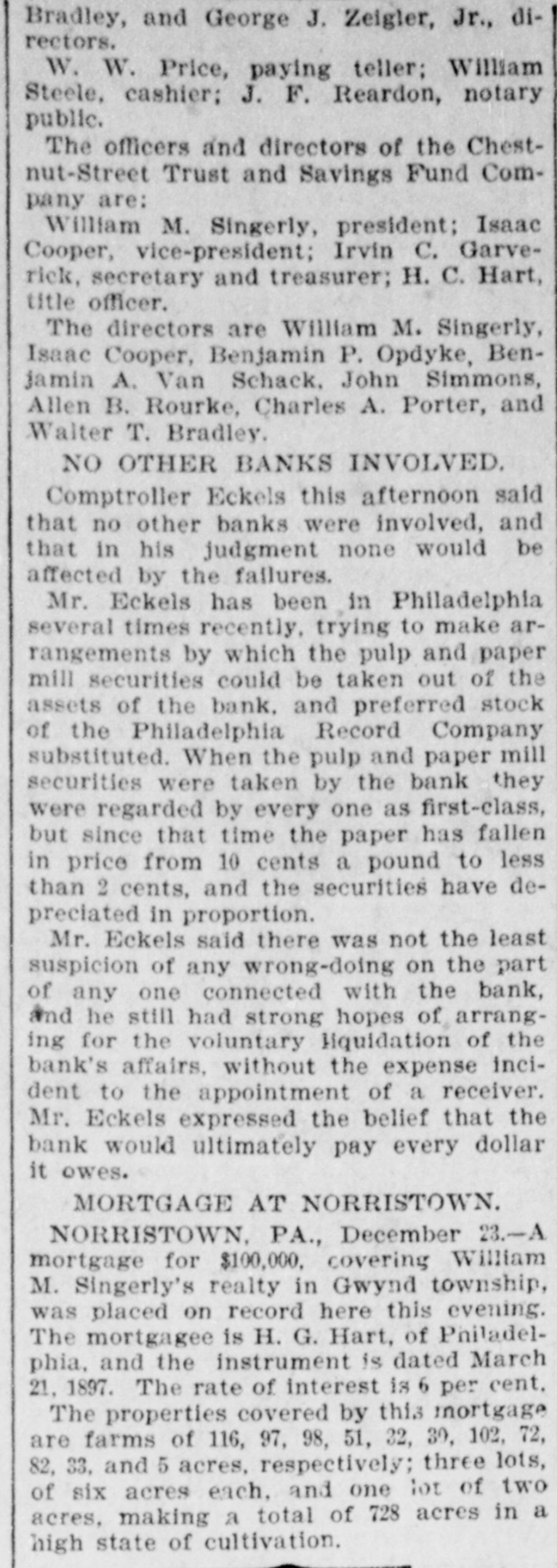
Bradley, and George J. Zeigler, Jr., directors. W. W. Price, paying teller; William Steele, cashier: J. F. Reardon, notary public. The officers and directors of the Chestnut-Street Trust and Savings Fund Company are: William M. Singerly, president; Isaac Cooper, vice-president; Irvin C. Garverick, secretary and treasurer; H. C. Hart, title officer. The directors are William M. Singerly, Isaac Cooper, Benjamin P. Opdyke, Benjamin A. Van Schack, John Simmons, Allen B. Rourke, Charles A. Porter, and Walter T. Bradley. NO OTHER BANKS INVOLVED. Comptroller Eckels this afternoon said that no other banks were involved, and that in his judgment none would be affected by the failures. Mr. Eckels has been in Philadelphia several times recently, trying to make arrangements by which the pulp and paper mill securities could be taken out of the assets of the bank. and preferred stock of the Philadelphia Record Company substituted. When the pulp and paper mill securities were taken by the bank they were regarded by every one as first-class, but since that time the paper has fallen in price from 10 cents a pound to less than 2 cents, and the securities have depreciated in proportion. Mr. Eckels said there was not the least suspicion of any wrong-doing on the part of any one connected with the bank, and he still had strong hopes of arranging for the voluntary liquidation of the bank's affairs. without the expense incident to the appointment of a receiver. Mr. Eckels expressed the belief that the bank would ultimately pay every dollar it owes. MORTGAGE AT NORRISTOWN. NORRISTOWN. PA., December 23.-A mortgage for $100,000. covering William M. Singerly's realty in Gwynd township, was placed on record here this evening. The mortgagee is H. G. Hart, of Philadelphia, and the instrument is dated March 21, 1897. The rate of interest is 6 per cent. The properties covered by this mortgage are farms of 116, 97, 98, 51, 32, 30, 102, 72, 82, 33, and 5 acres, respectively; three lots, of six acres each. and one lot of two acres, making a total of 728 acres in a high state of cultivation.


Article from Richmond Dispatch, December 24, 1897

Click image to open full size in new tab

Article Text

NATLBANK THE CHESTNUT-STREET, OF PHILADELPHIA, GOES TO THE WALL. FAILURE CAUSES A SENSATION. It Carries With It Closing of Allied Trust Company's Business-Editor Singerly President of Beth Concerns. PHILADELPHIA, December 23.-A sensation was created in this city to-day by the announcement of the suspension of the Chestnut Street National Bank, regarded as one of the strongest financial institutions in the city, The suspension carried with it the closing of the Chest nut-Street Trust and Savings Fund Company, doing business under the State banking laws. William M. Singerly, publisher of the Philadelphia Record is president of both companies, and the same men, with one exception, act as officers and directors. The first information the public recelved that the banks were in trouble was in the form of a notice posted this morning on the door of the building occupled jointly by the two concerns, signed by National-Bank-Examiner William M. Hardt, to the effect that the Chestnut-Street National Bank had closed its doors, pending an examination of its affairs. No statement of assets and lia bilities is available but it is stated that the deposits of the Chestnut-Street Bank amounted to $1,700,000. and those of the Trust Company, to $1,300,000. President Singerly gave out a brief statement to-night, in which be said: "We are working to secure thd indebtedness of the two banks, so that they can go into voluntary liquidation and thus avoid receivership. VOLUNTARY LIQUIDATION. In this connection Deputy-Comptrollerof-the-Treasury George M. Coffin, who was sent here from Washington by Comptroller Eckels, to-day said: 'The matter of putting the Chestnut-Street National Bank into voluntary liquidation has been taken up by Philadelphia men of good financial ability Their first step will be ascertain the value of the assets of the bank. They must first be satisfied that they have value sufficient to warrant them in assuming the indebtedness. Mr. Coffin has had great experience in resuscitating troubled banks, and he will remain here several days aiding the men who have taken upon themselves the task of extricating Mr. Singerly from his financial difficuities These gentlemen are in consultation to-night. and the beliet is strong that they will provide the funds necessary for a voluntary liquidation of the two banks. It had been known for some time in banking circles that Mr. Singerly's banks were in trouble. and National-Bank-Ex aminer Hardt, it is said, was aware of a the condition of affairs. Last night number of the leading bank officials of the city had a conference, lasting until nearly o'clock this morning considering the matter of raising the money to relieve Mr. Singerly's banks of their distress. It is understood that proposition to float $2,000,000 of preferred stock of the Philadelphia Record had been practically agreed to when the discovery was made that because of the involved condition of the Trust Company's finances this sum would not be within several hundred thous dollars of the amount required. The negotiations were therefore declared off. and the banks were forced to the wall. Now it is hoped that the committee which began to-night where the former committee left off will in satisfactorily adjusting the finances, and thus permit the banks to pay depositors dollar for dollar. The net earnings of the Record last year are said to have been $249,000-more a than sufficient to pay dividends on sum sufficient to pay all of Mr. Singerly's indebtedness to the banks. LOSSES BY MR. SINGERLY The statements of the cause of the fallwith made that here agree current ure by Comptroller Eckels Washington to-day, that it was primaril due to the loss of much money by Mr. Singerly in his unproductive paper-mill at Elkton, Md. one of the largest in the country One statement placed the sum thus involved at nearly $1,000,000. Mr. Singerly also has much money invested in other enterprises in this and other cities. Rumors were current the effect that the from ownership of the Record would pass Mr. Singerly, but this he denied stating positively that he is in absolute control of the paper, and will continue at its head. On Monday of this week the Chestnutstreet National Bank made the following report to the Philadelphia ClearingHouse reLoans and discounts. $2,261 000: legal serve $396,000; deposits $1,789,000; due from banks $355 000: due to banks, $686.00 circulation. $43,000. The reserve has been below the legal requirements for several weeks The deposits on October 5th. when the bank reported to the Comptroller of the Currency. amounted to $2,035,856. The shrinkage in this item, therefore has been more than $300,000 in a little over two months. It is said there have been steady runs on both banks for several days past Of the deposits in the bank. the city is represented by $289,554 the State by $225.000, and the National Government by a large sum, but all of these creditors are believed to be protected. When the Trust Company made its last report to the State authorities on November 16th. the deposits amounted to $1,492,253 meeting of the directors of the Trust Company will be held at 10 o'clock a to-morrow morning, to decide upon course of procedure. It is believed the State Bank examiner will then take formal possession of the Institution State-Bank-Commissi er Gilkeson was in the office of the company short while to-day and it is stated that he has had the books of the institution under inspection for some time past. SYMPATHY FOR SINGERLY. Much sympathy is expressed on all sides for Mr. Singerly He has occupied such prominent place in the affairs of the city and the State for years past that the news of his financial difficulty naturally created sation. Mr. Singerly stated to-night that he had received hundreds of telegra from all over the country, expre ssing the sympathy of the senders He has borne the strain well, although he naturally shows in his face and manner the deep concern his troubles are causing him. Crowds were gathered in front of the big granite banking building all day, but all was quiet. line of policemen kept the people moving. great number of small accounts were carried by the trust


Article from The Providence News, December 24, 1897

Click image to open full size in new tab

Article Text

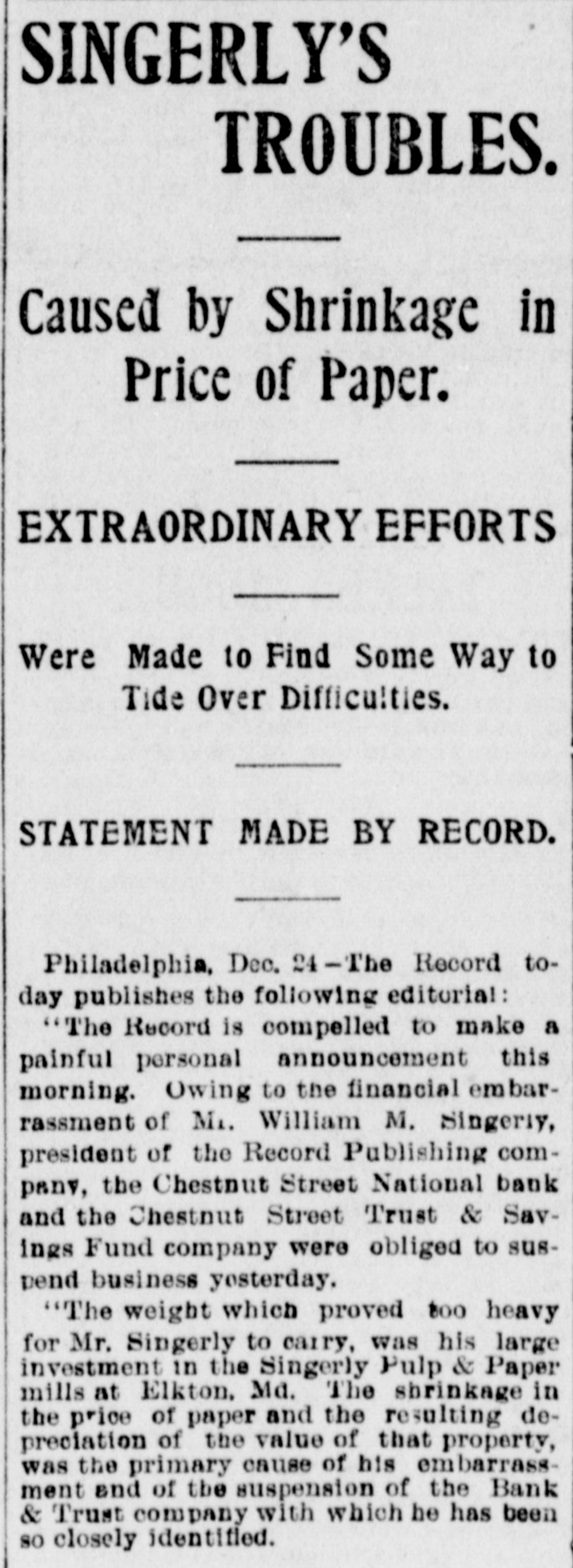
SINGERLY'S TROUBLES. Caused by Shrinkage in Price of Paper. EXTRAORDINARY EFFORTS Were Made to Find Some Way to Tide Over Difficulties. STATEMENT MADE BY RECORD. Philadelphia, Dec. 24-The Record today publishes the following editorial: "The Record is compelled to make a painful personal announcement this morning. Owing to the financial embarrassment of Mr. William M. Singerly, president of the Record Publishing companv, the Chestnut Street National bank and the Chestnut Street Trust & Savings Fund company were obliged to suspend business yesterday. "The weight which proved too heavy for Mr. Singerly to carry, was his large investment in the Singerly Pulp & Paper mills at Elkton. Md. The shrinkage in the price of paper and the resulting depreciation of the value of that property, was the primary cause of his embarrassment and of the suspension of the Bank & Trust company with which he has been so closely identified.


Article from The Salt Lake Herald, December 24, 1897

Click image to open full size in new tab

Article Text

as one of the strongest financial institutions in the city. The suspension carried with it the closing of the Chestnut Street Trust and Savings Fund company, doing business under the state banking laws. William M. Singerly, publisher of the Philadelphia Record, is president of both companies, and the same men, with one exception, act as officers and directors. The first information the public received that the banks were in trouble was in the form of a notice posted this morning on the door of the building occupied jointly by the two concerns, signed by National Bank Examiner William M. Hart, to the effect that the Chestnut Street National bank had closed its doors pending an investigation of its affairs. No statement of assets and liabilities is available, but it is stated that the deposits of the Chestnut Street bank amounted to $1,700,000, and of the trust company to $1,300,000. President Singerly gave out a brief statement tonight in which he said: "We are working to secure the indebtedness of the two banks, SO that they can go into voluntary liquidation, and thus avoid a receivership." ASSISTED BY FINANCIERS. In this connection Deputy Comptroller of the Treasury George M. Coffin, who was sent here from Washington by Comptroller Eckles, today said: "The matter of putting the Chestnut street National bank into voluntary liquidation has been taken up by Philadelphia men of great financial ability. Their first step will be to ascertain the value of the assets of the bank. They must first be satisfied that they have a value sufficient to warrant them in assuming the indebtedness. Mr. Coffin will remain here several days, aiding the men who have taken upon themselves the task of extricating Mr. Singerly from his financial difficulties. These gentlemen are in consultation tonight. and the belief is strong that they will provide the funds necessary for voluntary liquidation of the two banks. KNOWN FOR SOME TIME. It was known for some time in banking circles that Mr. Singerly's banks were in trouble. and the national examiner, it is said, was aware of the condition of the affairs. Last night a number of the leading bank officials of the city held a conference lasting until nearly 3 o'clock this morning, considering the matters of raising sufficient money to relieve Mr. Singerly's banks of their distress. It is understood that a proposition to float $2,000,000 preferred stock of the Philedalphia Record had been practically agreed to when the discoverv was made that because of the involved condition of the trust company's finances this sum would not be within several thousand dollars of the amount required. Negotiations were therefore declared off and the banks were forced to the wall. Now it is hoped that the committee which began where the former committee left off will succeed in successfully adjusting the finances and thus permit the banks to pay depositors dollar for dollar. The net earnings of the Record last year are said to have been $249,000, more than sufficient to pay dividends on a sum sufficient to pay all of Mr. Singerly's indebtedness to the banks. CAUSE OF FAILURE. The statements of the cause of the failure current here agree with those made by Comptroller Eckels at Washington today, that it was primarily due to the loss of much money by Mr. Singerly in his unproductive paper mill at Elkton, Md., one of the largest in the country. One statement placed the sum thus involved at nearly a million dollars. Mr. Singerly also has much money invested in other enterprises in this and other cities. Rumors were current to the effect that the ownership of the Record would pass from Mr. Singerly, but this he denied, his friends stating positively that he is in absolute control of the paper, and will continue at its head. On Monday of this week the Chestnut Street National bank made the following report to the clearing house: Loans and discounts, $2,261,000; legal reserve. $396,000: deposits, $1,789,000; due from banks. $355,000; due to banks, $686,000; circulation, $43,000. The reserve has been below the legal requirements for several weeks. The deposits on Oct. 5, when the bank reported to the comptroller of the treasury, amounted to $2,239,955. The shrinkage in this item. therefore, has been more than $300,000 in a little over two months. STEADY RUNS. It is said that there have been quiet but steady runs on both banks for several days past. Of the deposits in the bank, the city is represented by $289,554; the state by $225,000, and the national government by a large sum, but all of these creditors are believed to be protected. Much sympathy is expressed on all sides for Mr. Singerly. He has occupied such a prominent place in the affairs of the state and city for years past that the news of his financial difficulties naturally created a sensation. SYMPATHY FOR SINGERLY. Mr. Singerly stated tonight that he received hundreds of telegrams from all over the country expressing the sympathy of his friends. He has stood the strain very well, though he naturally shows in his face and manner the deep concern his troubles are causing him. Crowds were gathered in front of the big granite bank building all day. but all was quiet. A line of policement kept the people moving. A great number of small accounts were carried by the trust company, and apprehension was expressed that some distress might follow the failure. If the hopes of a quick settlement are realized, however. all depositors will be paid in full within a short time. Counterfeiter Surprised. Chicago, Dec. 23.-Captain Porter of the United States secret service and


Article from The Seattle Post-Intelligencer, December 24, 1897

Click image to open full size in new tab

Article Text

Total Voluntary Liquidation Probable. WASHINGTON Dec. 23.-Comptroller of the Currency Eckels said today. In regard to the failure of the Chestnut Street National bank, of Philadelphia, that the suspension was primarily due to a shrinkage in the value of the bonds and notes of the Singerly Pulp and Paper Mills. located at Elkton, Md. The capital of the bank le $500,000; the deposits aggregate about $1,750,000. and Its surplus is about $150,000. Mr. Eckels said there was not the least suspicion of wrong-doing on the part of the bank, and he still had strong hopes of arranging for a voluntary liquidation of the bank affairs without the expense incident to the appointment of a receiver. Mr. Eckels said this afternoon that no other banks were involved, and that in his judgment none would be affected by the failure. Mr. Eckels and Mr. Hart, the bank examiner in charge, had a conversation late this afternoon over the longdistance telephone. Mr. Hart said that a joint meeting of the directors of the two failed concerns, with Mr. John S. Bullitt, who is acting as counsel for the department: Mr. Goffin, the deputy comptroller. and himself. was then in progress, and that they were working on a plan to bring about voluntary liquidation with reasonable hope of success. Among the directors present were several men of large means, and It was hoped that a final settlement on this basis ultimately would be secured. Boston Banks Will Lose Nothing. BOSTON, Dec. 23.-At the Third National bank the correspondent of the Chestnut Street National bank. of Philadelphia, which failed today. it was said that the Philadelphia institution has sufficient balances here to cover any outstanding liabilities, and that none of the Boston banks would lose anything on account of the fallure. Depositors to Be Paid in Full. A great number of small accounts were carried by the trust company and apprehension was expressed that some distress might follow the failure. If the hopes of a quick settlement are realized, however, all depositors will be paid in full within a short time. It is said that there have been quiet, but steady, runs on both banks for several days past. Of the deposits in the bank the city is represented by $289,554; the state by $225,0000, and the national government by a large sum, but all of these creditors are believed to be protected. When the trust company made its last report to the state authorities on November 16, the deposits amounted to $1,492,353. A meeting of the directors of the trust company will be held tomorrow to decide upon a course of procedure. It is believed the state bank examiner will then take formal possession of the institution. State Bank Commissioner Gilkeson was in the office of the company a short while today, and said that he had the books of the institution under inspection for some time past. Much sympathy is expressed on all sides for Mr. Singerly. He has occupied such a prominent place in the affairs of the state and city for years past that the news of his financial difficulties naturally created a sensation. Mr. Singerly stated tonight that he received hundreds of telegrams from all over the country expressing the sympathy of his friends. He has borne the strain very well, though he naturally shows In his face and manner the deep concern his troubles are causing him. The Chestnut Street National bank was established in June, 1877. but was not incorporated until July 5, of the same year. Hon. Robert E. Pattison was Its first president, assuming the office when he retired from the governorship. When he again became governor. in 1891. Mr. Singerly succeeded him. The present officers and directors of the bank are: President, Willfam M. Singerly: vice president. Isaac Cooper: directors, Benjamin P. Obdyke, Benjamin A. Vanschaack, John Simmons, Charles A. Porter, Walter T. Bradley and George J. Zeigler, jr.: paying teller, W. W. Price: cashier, William Steele: notary pubItc. J. F. Reardon. The officers and directors of the Chestnut Street Trust and Savings Fund Company are: President. William M. Singerly: vice president. Isaac Cooper: secretary and treasurer, Irvin C. Carverick: title officer, H. C. Hart: directors. William M. Singerly, Issac Cooper. Benjamin Obdyke, BenJamin A. Vanschaack, John Simmons, A1-


Article from The Houston Daily Post, December 25, 1897

Click image to open full size in new tab

Article Text

FAILURES IN PHILADELPHIA The Chestnut Street Trust Company Piles an Assignment. NO STATEMENT HAS YET BEEN MADE The Chestnut Street National Bank May Be Able to Go Into Voluntary Liquidation and Settle in Full. Philadelphia, December 24.-The Chestnut Street Trust and Savings Fund company, which closed its doors yesterday, made an assigument today for the benefit of its creditors, to George H. Earle, Jr., president of the Tradesmen National bank, and Richard Y. Cook, president of the Guarantee Trust and Safe Deposit company. The Chestnut Street company is closely allied with the Chestnut Street National bank, which was taken in charge by the National bank examiner. William Singerly is president of both companies and the boards of directors of the two companies are the same, with the exception that in each board there is one member who is not a director in the other. The deed of assignment is signed by William M. Singerly, as president, and there is no reserve in the conveyance of the property of the company to the assignees. The directors of the trust company held a meeting this morning and the assignment to Mr. Earle and Mr. Cook was the outcome of a discussion of the troubles of the institution. It was announced that a statement would be published in a day or two showing the exact condition of the company's affairs. An assignment was made today by the Philadelphia Binding and Mailing company. This is a small organization which was incorporated in Maine. The assignment is said to have been forced on the company through the failure yesterday of the Chestnut Street National bank. | Philadelphia, December 24.-The bank examiner and his assistants were busily engaged today in going over the books and accounts of the Chestnut Street National bank. The examiner declines to make any statement regarding the assets and liabilities of the institution, but says he will furnish a complete statement when his investigation shall have been completed. Every effort is being made by President Singerly and the directors of the bank to adjust the accounts of the bank in such a manner that the creditors will get their just dues. Following the meeting of the directors of the Trust company which terminated in an assignment, there was a conference of


Article from The Brunswick Times, December 25, 1897

Click image to open full size in new tab

Article Text

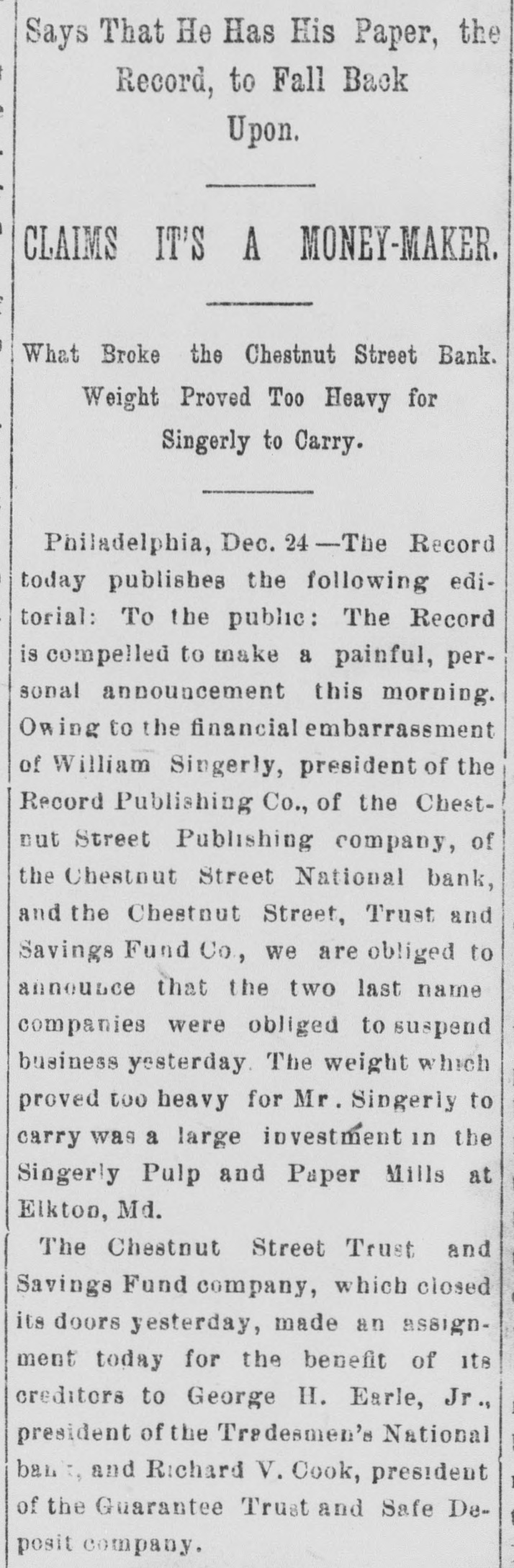
Says That He Has His Paper, the Record, to Fall Back Upon. CLAIMS IT'S A MONEY-MAKER. What Broke the Chestnut Street Bank. Weight Proved Too Heavy for Singerly to Carry. Philadelphia, Dec. 24 -The Record today publishes the following editorial: To the public: The Record is compelled to make a painful, personal announcement this morning. Owing to the financial embarrassment of William Singerly, president of the Record Publishing Co., of the Chestnut Street Publishing company, of the Chestnut Street National bank, and the Chestnut Street, Trust and Savings Fund Co, we are obliged to annousce that the two last name companies were obliged to suspend business yesterday. The weight which proved too heavy for Mr. Singerly to carry was a large investment in the Singerly Pulp and Paper Mills at Elkton, Md. The Chestnut Street Trust and Savings Fund company, which closed its doors yesterday, made an assignment today for the benefit of its creditors to George H. Earle, Jr., president of the Tradesmen's National ban is and Richard V. Cook, president of the Guarantee Trust and Safe Deposit company.


Article from The Salt Lake Herald, December 25, 1897

Click image to open full size in new tab

Article Text

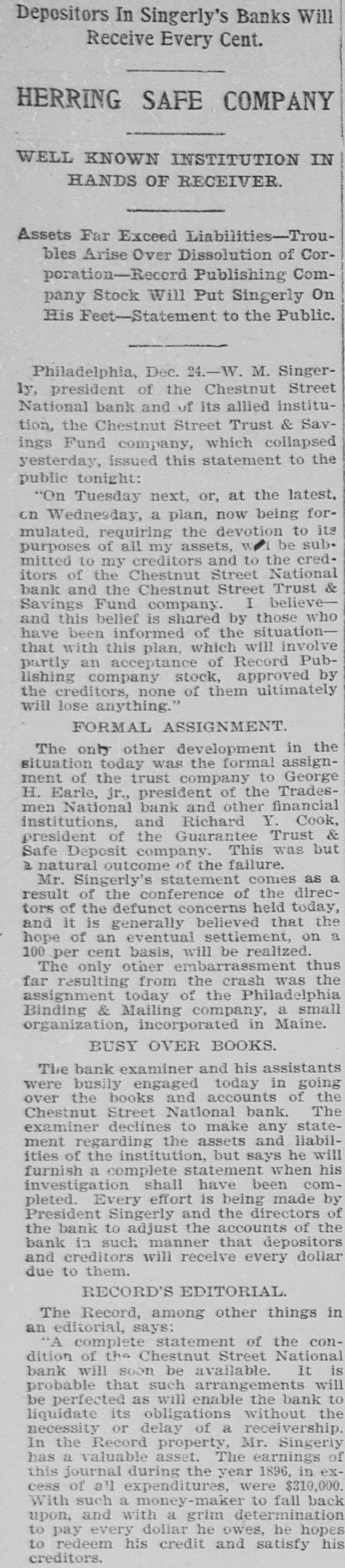
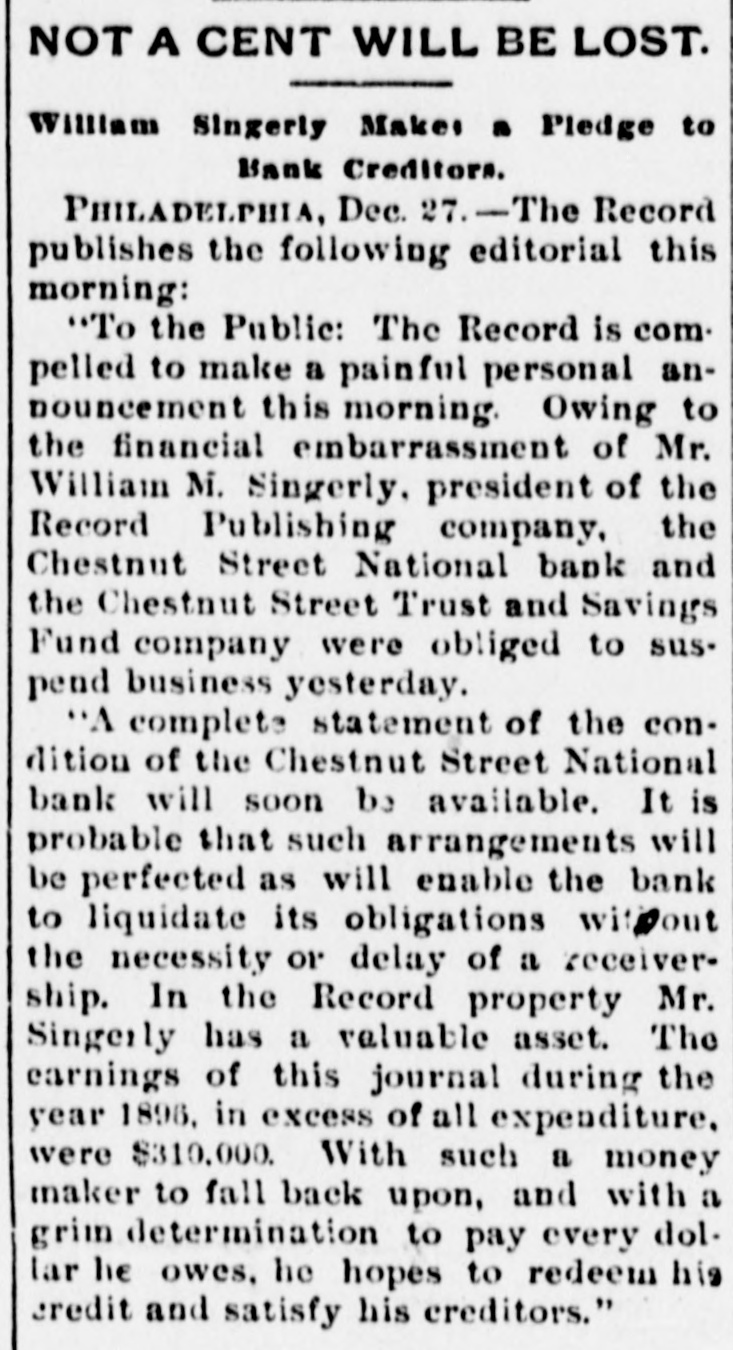
Depositors In Singerly's Banks Will Receive Every Cent. HERRING SAFE COMPANY WELL KNOWN INSTITUTION IN HANDS OF RECEIVER. Assets Far Exceed Liabilities-Troubles Arise Over Dissolution of Corporation-Record Publishing Company Stock Will Put Singerly On His Feet-Statement to the Public. Philadelphia, Dec. 24.-W. M. Singerly, president of the Chestnut Street National bank and of its allied institution, the Chestnut Street Trust & Savings Fund company, which collapsed yesterday, issued this statement to the public tonight: "On Tuesday next, or, at the latest, on Wednesday, a plan, now being formulated, requiring the devotion to its purposes of all my assets, w/l be sub. mitted to my creditors and to the creditors of the Chestnut Street National bank and the Chestnut Street Trust & Savings Fund company. I believeand this belief is shared by those who have been informed of the situationthat with this plan, which will involve partly an acceptance of Record Publishing company stock, approved by the creditors, none of them ultimately will lose anything." FORMAL ASSIGNMENT. The only other development in the situation today was the formal assignment of the trust company to George H. Earle, jr., president of the Tradesmen National bank and other financial institutions, and Richard Y. Cook, president of the Guarantee Trust & Safe Deposit company. This was but a natural outcome of the failure. Mr. Singerly's statement comes as a result of the conference of the directors of the defunct concerns held today, and it is generally believed that the hope of an eventual settlement, on a 100 per cent basis, will be realized. The only other embarrassment thus far resulting from the crash was the assignment today of the Philadelphia Binding & Mailing company, a small organization, incorporated in Maine. BUSY OVER BOOKS. The bank examiner and his assistants were busily engaged today in going over the books and accounts of the Chestnut Street National bank. The examiner declines to make any statement regarding the assets and liabilities of the institution, but says he will furnish a complete statement when his investigation shall have been completed. Every effort is being made by President Singerly and the directors of the bank to adjust the accounts of the bank in such manner that depositors and creditors will receive every dollar due to them. RECORD'S EDITORIAL. The Record, among other things in an editorial, says: "A complete statement of the condition of the Chestnut Street National bank will soon be available. It is probable that such arrangements will be perfected as will enable the bank to liquidate its obligations without the necessity or delay of a receivership. In the Record property, Mr. Singerly has a valuable asset. The earnings of this journal during the year 1896, in excess of all expenditures, were $310,000. With such a money-maker to fall back upon, and with a grim determination to pay every dollar he owes, he hopes to redeem his credit and satisfy his creditors.


Article from The Times, December 28, 1897

Click image to open full size in new tab

Article Text

PLANS OF COL. SINGERLY Aiming to Reorganize the Suspended Philadelphia Bank. Creditors to Be Divided Into Three Classes-Points of the Arrangement Decided Upon. Philadelphia, Dec. 27.-A plan of reorganization and adjustment of the affairs of the Chestnut Street Trust and Savings Fund Company, of the Chestnut Street National Bank. and of the affiliated busi ness interests of William M. Singerly, was made public tonight. and will be submitted to the creditors of those institutions and of Mr. Singerly, by George N. Earle, jr., and Richard Y. Cook, the assignees of the trust company. The assignees werein conference with Mr. Singerly, Assistant Comptroller Coffin, of 'the Treasurv Department, and counsel this afternoon. When they adjourned late this evening they had adopted a formal plan of reorganization, to be submitted to the creditors. The plan aims to place all the assets of Mr. Singerly and of the Bank and Trust Company in the bands of reorganiza tion managers. It divides the creditorsinto three classes: first. those who assent to the plan to the extent to which they may hold lieus against the Record Publishing Company, orpreferredor city claimsagainst the bank of trust company, or persons, or corporations willing to advance money in furtherance of the plan. Second. Holders of claims against the Record, or claims secured by its stock, the managers reserving to themselves the right to determine without liability the amount or existence of such claims. Third. All creditors other than those specified who may have an interest in the success of the reorganization. The plan then provides for the issue of capital stock of the Record Publishing Compan to an amount sufficient to pay the creditors of the first-class par for their claims, in a 6 per cent cumulative pieferred stock. The Creditors of the second class, par in a 6 per cent cumulative second preferred stock, and the creditors of the third class, par in common stock. No incumbrance against the property of the Record Publishing Company is to be created without the assent of the tolders of two-thirds of the preferred stock of both classes. The plan says: "There now exists $1,000,000 of common stock of the Record Publishing Company, to the prior lien of $700,000 of mortgages. After a full examination of the property, it was recommended to a syndicate recently formed that this stock issue be increased by the issuance of


Article from The Saint Paul Globe, December 28, 1897

Click image to open full size in new tab

Article Text

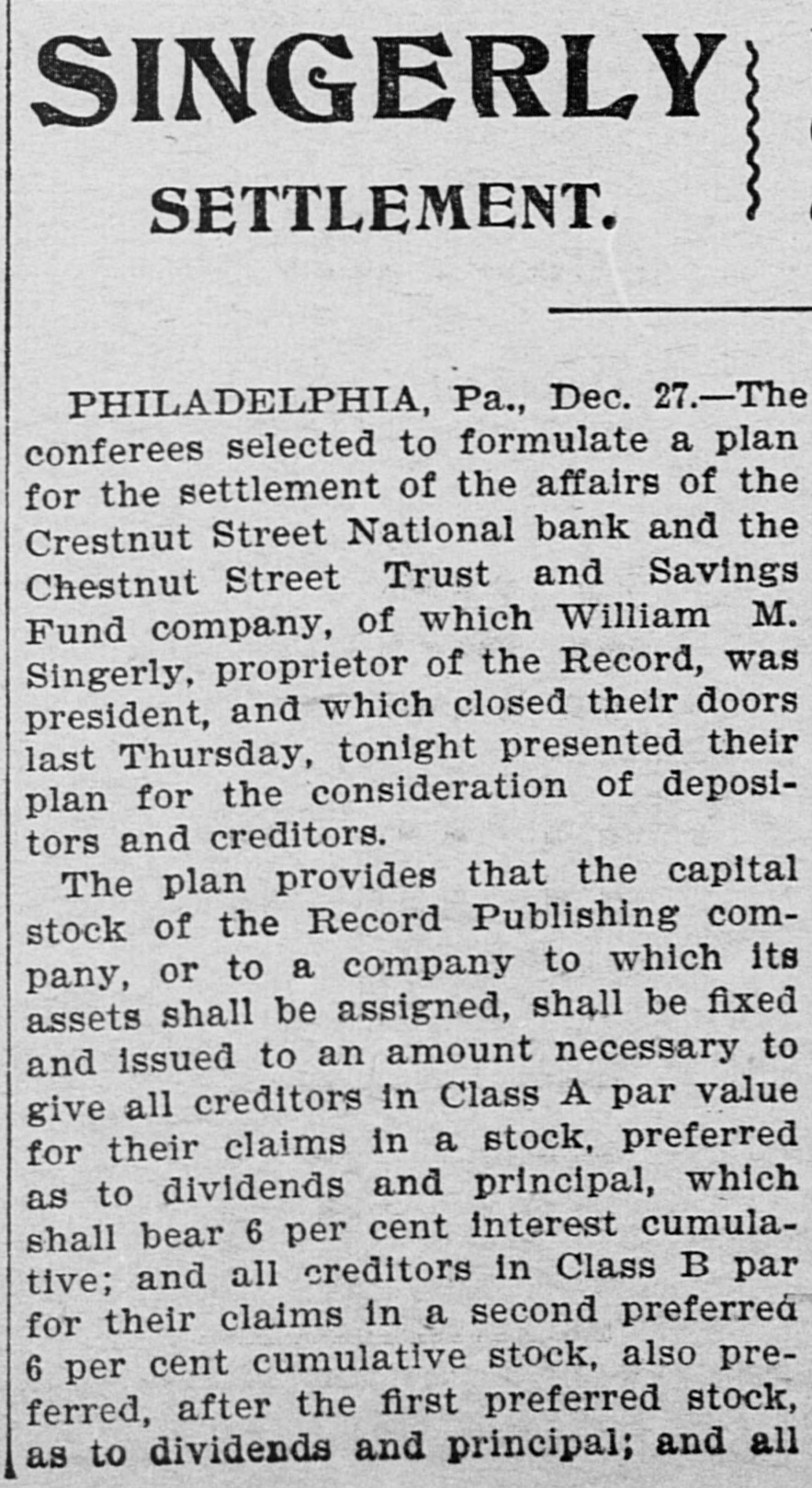
SINGERLY SETTLEMENT. PHILADELPHIA, Pa., Dec. 27. -The conferees selected to formulate a plan for the settlement of the affairs of the Crestnut Street National bank and the Chestnut Street Trust and Savings Fund company, of which William M. Singerly, proprietor of the Record, was president, and which closed their doors last Thursday, tonight presented their plan for the consideration of depositors and creditors. The plan provides that the capital stock of the Record Publishing company, or to a company to which its assets shall be assigned, shall be fixed and issued to an amount necessary to give all creditors in Class A par value for their claims in a stock, preferred as to dividends and principal, which shall bear 6 per cent interest cumulative; and all creditors in Class B par for their claims in a second preferred 6 per cent cumulative stock, also preferred, after the first preferred stock, as to dividends and principal; and all


Article from The Indianapolis Journal, December 29, 1897

Click image to open full size in new tab

Article Text

DENTIST Dr. A. E. BUCHANAN 32-33 When Building. CREDITORS MAY ACCEPT SINGERLY'S PLAN FOR PAYING HIS DEBTS FAVORABLY RECEIVED. Denial from Controller Eckels that Politics Had Anything to Do with Philadelphia Bank Failures. PHILADELPHIA, Dec. 28.-The plan for the liquidation of all claims against the Chestnut-street National Bank and Chestnut-street Trust and Savings Fund Company, were, as far as could be learned today, quite acceptable to the general body of depositors of both of those institutions. The plan providing for turning over to the bank and trust company the entire property of the Record Publishing Company, of which William M. Singerly is the owner, it is believed, will suffice to pay all the claims of depositors. While a few depositors felt they should receive their money at an earlier date than can be done under the plan of liquidation, over one hundred depositors called at the bank to-day and informed Mr. Singerly, who is the president of both the bank and the trust company, that they are fully satisfied with the proposed plan. Controller of the Currency Eckels made the following statement at Washington today: "I have instructed the deputy controller, George M. Coffin, to at once call a meeting of the directors of the Chestnutstreet National Bank to pass the necessary resolution and issue notice to the shareholders for a meeting to vote to go into voluntary liquidation. In addition I have requested him to have the directors obtain at once the signatures of representatives holding two-thirds of the bank's stock agreeing to vote for liquidation, which matter will be presented at the meeting to be called. Having done this, I have stated that the controller would then permit the bank to go into voluntary liquidation, after the vote is had, on evidence being furnished that the creditors of the bank have accepted the plan proposed by the committee in place of the evidences of indebtedness from the bank. By having this arranged before voting it will enable the public to understand that immediately on the consent of the creditors being obtained the bank will avoid the appointment of a receiver and the expenses and delay attendant upon a receivership. "I have studied the plan submitted with care and am of the opinion that the creditors of the bank, the trust company and Mr. Singerly will be better cared for than by any method which can be devised in which all t) assets represented by his various inter are handled under different agencies. in a division of responsibility and of as would necessarily entail disputes and ult in expensive litigation as to the ri of this or that one in the property rests represented by him. It would all opardize the value of the assets. whi S the most to be looked for for the pa. ent of the obligations due from the institutions with which he was connected, and from himself. The importance of whatever action the creditors take being quickly determined arises from the wisdom of not permitting any asset to be unnecessarily dissipated or any of the good will of any valuable property in which Mr. Singerly is interested lost. The situation is now in the hands of the creditors. and I believe that in following the plan outlined the end will fully justify their relying upon conservative management of those who have heretofore been successful in undertaking large financial matters.' Controller of the Currency Eckels wired 2. statement to this city to-night in relation to the published articles intimating that political feeling had something to do with the failure of the Chestnut-street National Bank and the Chestnut-street Trust and Savings Fund Company, of which William M. Singerly, proprietor of the Record, was president. The controller says: "I have read with deep interest the statement in a New York paper on this date relative to the affairs of the Chestnut-street National Bank of Philadelphia, its president, William M. Singerry, and the acts of the controller of the currency in connection with the bank's failure. I have no objection to any criticism which may be made of any of my offi-


Article from Daily Kennebec Journal, December 29, 1897

Click image to open full size in new tab

Article Text

SINGERLY'S OFFER. Will Make Philadelphia Record Pay Off the Indebtedness OI Chestnut Street Bank and the Trust Co., Recently Assigned. Philadelphia, Dec. 27.-The conferees selected to formulate a plan of settlement of the affairs of the Chestnut Street National Bank an the Chestnut Street Trust and Savings Fund Co., of which William M. Singerly, proprietor of the Record, was president and which closed their doors last Thursday, presented the plan for the consideration of depositors and creditors, Monday night. The chief measures suggested is the issuance of Record stock to secure the creditors. The plan is prefaced by a statement that "it must be clear to all concerned that in no case can creditors of the bank, of the Trust Co., of the Pulp and Paper of Mr. Singere than the total ly himself


Article from Abilene Weekly Reflector, December 30, 1897

Click image to open full size in new tab

Article Text

Big Philadelphia Banks Suspend. Phila DELPHIA, Dec. 24.--The Chestnut Street national bank and Chestnut Street Trust & Savings Fund company, of both of which William M. Singerly, proprietor of the Record and democratic leader is president, were not opened for business this morning. The bank had at all times held a good reputation, but it had been known for some time that its business, and necessarily its profits, had fallen off considerably. The suspension, however, was a great surprise, especially in view of the high standing of its officers.


Article from Phillipsburg Herald, December 30, 1897

Click image to open full size in new tab

Article Text

Big Philadelphia Banks Suspend. PHILADELPHIA, Dec. 24.-The Chestnut Street national bank and Chestnut Street Trust & Savings Fund company, of both of which William M. Singerly, proprietor of the Record and democratic leader is president, were not opened for business this morning. The bank had at all times held a good reputation, but it had been known for some time that its business, and necessarily its profits, had fallen off considerably. The suspension, however, was a great surprise, especially in view of the high standing of its officers.


Article from The Red Cloud Chief, December 31, 1897

Click image to open full size in new tab

Article Text

NOT A CENT WILL BE LOST. William Singerly Make: a Pledge to Bank Creditors. PHILADELPHIA, Dec. 27.-The Record publishes the following editorial this morning: "To the Public: The Record is compelled to make a painful personal announcement this morning. Owing to the financial embarrassment of Mr. William M. Singerly, president of the Record Publishing company, the Chestnut Street National bank and the Chestnut Street Trust and Savings Fund company were obliged to suspend business yesterday. "A complete statement of the condition of the Chestnut Street National bank will soon be available. It is probable that such arrangements will be perfected as will enable the bank to liquidate its obligations without the necessity or delay of a receivership. In the Record property Mr. Singerly has a valuable asset. The earnings of this journal during the year 1896, in excess of all expenditure, were $310,000. With such a money maker to fall back upon, and with a grim determination to pay every dollar he owes, he hopes to redeem his credit and satisfy his creditors."


Article from The State Herald, December 31, 1897

Click image to open full size in new tab

Article Text

BIG BANK FAILURES. PHILADELPHIA CONCERNS COLLAPSE, Chestnut Street National and a State Savings Bank-President Singerly Owner of the Record Responsible for the Smash. Philadelphia, Dec. 23.-A sensation the created in. this city to-day by the announcement was of the suspension of Chestnut Street National Bank, regarded as one of the strongest financial institutions In the city. The sus- of pension carried with it the closing the Chestnut Street Trust and Savings Fund Company, doing business under M. the state banking laws. William Singerly, publisher of the Philadelphia Record, is president of both companies, and the same men, with one exception, act as officers and directors. The first information the public received that the banks were in trouble this in the form of a notice posted morning was on the door of the building, occupied jointly by the two concerns, signed by National Bank Examiner the William M. Hart, to the effect that Chestnut Street National Bank had closed its doors pending an investigation of its affairs. No statement of asand liabilities is available, Chest- but it sets stated that the deposits of the is Street National Bank amounted to $1,700,000, nut and of the trust company to $1,300,000. President Singerly gave out a said: brief statement to-night in which he 'We are working to secure the indebt- they edness of the two banks, so that and can go into voluntary liquidation, thus avoid a receivership.' In this connection Deputy Comptrol- Coffin. of the Treasury George M. ler who was sent here from Washington said: Comptroller Eckels, to-day by The matter of putting the Chestnut National Bank into voluntary has been taken up men of great liquidation delphia Street financial ascertain by ability. PhilaTheir first step will be to the value of the assets of the bank. must first be satisfied that they have They n value sufficient to warfant them in assuming the indebtedness." Coffin will remain here several aiding the men who the task of days. upon Mr. themselves financial have extricat- taken difing Mr. Singerly from his ficulties. These gentlemen are in con- is sultation to-night. and the belief strong that they will provide the funds of necessary for voluntary liquidation the two banks. known for some time in bankthat Mr. ing and the It was circles in trouble. Singerly's national of banks bank the were examiner. it is said. was aware condition of the affairs. The statements of the cause of the current here agree with that Comptroller made failure by pekels primarily at Washington to-day. that it was Mr. due to the loss of much money by Singerly in his unproductive paper the mill at Elkton. Maryland. one of in the country. One statement placed largest the sum thus involved at nearly a million dollars. Mr. Singerly also has much money this invested in other enterprises In cities. Rumors were effect that the and the other ownership Singerly, current of the to would pass from Mr. this he denled. stating the is in absolute but Record that he control positively head. of and will continue at its paper Monday of this week the Chest- the On Street National Bank made nut following report to the Philadelphia clearing horse: $2,261,000 Loans and discounts 396,000 Legal reserve Deposits 1,789,000 355,000 Due from banks 680,000 Due to banks 43,000 Circulation The reserve has been below the legal The requirements for several weeks. the bank deposits on October 5th. when of the to the comptroller trensury. reported amounted to $2,035,856. shrinkage in this item. therefore. little has The been more than $300,000 in n over two said months. there have been quiet but of the It is runs on both banks for several the days is represented by steady past. the city deposits the In $289. bank by $225,000. and but nnby a large to creditors are com554. tional of the government these state believed sum. all protected. When the trust state be made its last report to the the deauthorities pany on November 16th posits amounted to $1,492,253. not Eckels said there was doing the on Mr. of any wrong the of any one of he still had strong least the part suspicion and connected liquidation hopes with bank. for the voluntary exarranging bank's affairs. without the of a of the incident to the appointment the bepense Mr. Fekels expressed would pay receiver. that the bank ultimately Philadelphia lief dollar It owes. The President every which Is owned by very Singerly. Record. Mr. Fekels said. about Is a 5 per valuable property. paying cent. annually on about $5,000,000.


Article from The Yale Expositor, December 31, 1897

Click image to open full size in new tab

Article Text

TWO BIG BANKS SUSPEND. Philadelphia Financial Institutions Embarrassed. LARGE SUMS ARE INVOLVED. William M. Singerly's Banks Caught by the Shrinkage of Securities-Federal, State and City Funds Involved to an Enormous Amount. The Chestnut Street National Bank, regarded as one of the strongest financial institutions in Philadelphia, suspended Dec. 23. The suspension carried with it the closing of the Chestnut Street Trust and Savings Fund Company. William M. Singerly, publisher of the Philadelphia Record, is president of both companies, and the same men, with one exception, act as officers and directors. It is stated that the deposits of the Chestnut street bank amounted to $1,700,000 and of the trust company to $1,300,000. The failure was primarily due to the loss of much money by Mr. Singerly in his unproductive paper mill at Elkton, Md., one of the largest in the country. Of the deposits in the bank, the city is represented by $289,554, the state by $225,000 and the national government by a large sum.


Article from Marshall County Independent, December 31, 1897

Click image to open full size in new tab

Article Text

TWO BIG BANKS SUSPEND. Philadelphia Financial Institutions Embarrassed. LARGE SUMS ARE INVOLVED. William M. Singerly's Banks Caught by the Shrinkage of Securities-Federal, State and City Funds Involved to an Enormous Amount. The Chestnut Street National Bank, regarded as one of the strongest financial institutions in Philadelphia, suspended Dec. 23. The suspension carried with it the closing of the Chestnut Street Trust and Savings Fund Company. William M. Singerly, publisher of the Philadelphia Record, is president of both companies, and the same men, with one exception, act as officers and directors. It is stated that the deposits of the Chestnut street bank amounted to $1,700,000 and of the trust company to $1,300,000. The failure was primarily due to the loss of much money by Mr. Singerly in his unproductive paper mill at Elkton, Md., one of the largest in the country. Of the deposits in the bank, the city is represented by $289,554, the state by $225,000 and the national government by a large sum.


Article from The Sun, January 23, 1898

Click image to open full size in new tab

Article Text

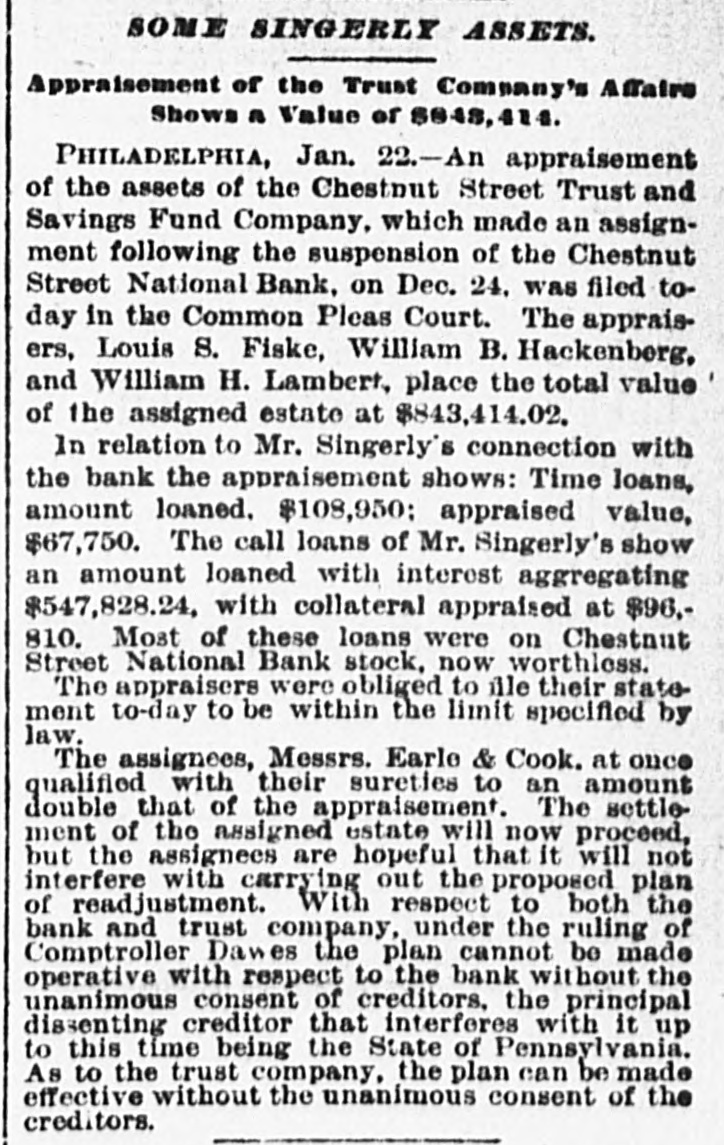
SOME SINGERLY ASSETS. Appraisement of the Trust Company's Affairs Shows n Value or $848,414. PHILADELPHIA, Jan. 22.-An appraisement of the assets of the Chestnut Street Trust and Savings Fund Company, which made an assignment following the suspension of the Chestnut Street National Bank, on Dec. 24. was filed today in the Common Pleas Court. The appraisers, Louis S. Fiske, William B. Hackenberg, and William H. Lambert, place the total value of the assigned estate at $843,414.02. In relation to Mr. Singerly's connection with the bank the appraisement shows: Time loans, amount loaned. $108,950; appraised value, $67,750. The call loans of Mr. Singerly's show an amount loaned with interest aggregating $547,828.24. with collateral appraised at $96.810. Most of these loans were on Chestnut Street National Bank stock, now worthless. The appraisers were obliged to file their statement to-day to be within the limit specified by law. The assignees, Messrs. Earle & Cook. at once qualified with their sureties to an amount double that of the appraisement. The settlement of the assigned estate will now proceed, but the assignees are hopeful that it will not interfere with carrying out the proposed plan of readjustment. With respect to both the bank and trust company, under the ruling of Comptroller Dawes the plan cannot be made operative with respect to the bank without the unanimous consent of creditors. the principal dissenting creditor that interferes with it up to this time being the State of Pennsylvania. As to the trust company, the plan can be made effective without the unanimous consent of the creditors.


Article from Richmond Planet, January 29, 1898

Click image to open full size in new tab

Article Text

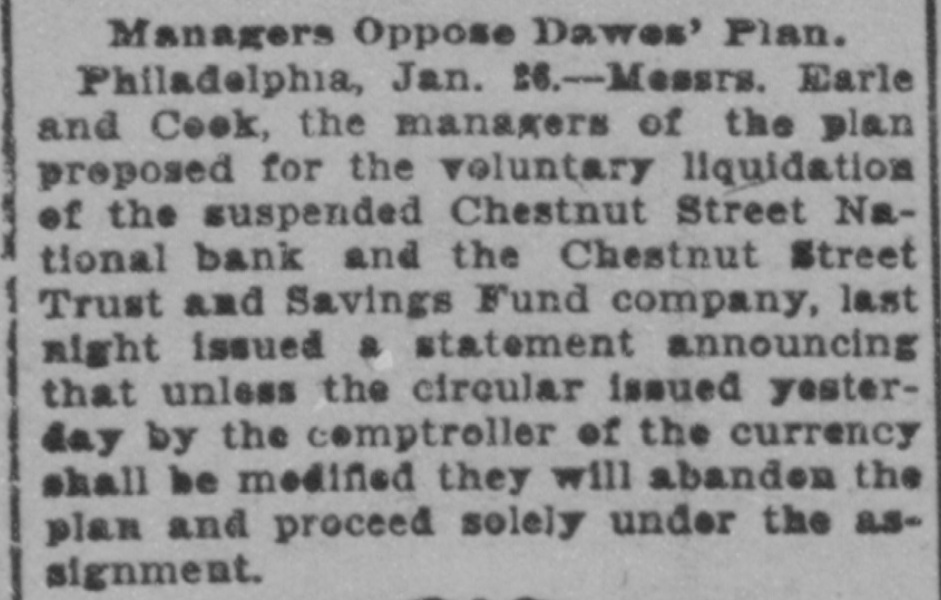
Managers Oppose Dawes' Plan. Philadelphia, Jan. 26.-Measrs. Earle and Cook, the managers of the plan preposed for the voluntary liquidation of the suspended Chestnut Street National bank and the Chestnut Street Trust and Savings Fund company, last night issued a statement announcing that unless the circular issued yesterday by the comptroller of the currency shall be modified they will abanden the plan and proceed solely under the assignment.


Article from The Wilmington Daily Republican, February 28, 1898

Click image to open full size in new tab

Article Text

THE LATE WM. M. SINGERLY. bank and the Chestnut Street Savings Fund and Trust company, which recently collapsed, and persident of the Singerly pulp and paper mill. He was a member of the Fairmount Park commission, and until lately its treasurer, and a trustee of the Philadelphia Commercial Museum. Mr. Singerly was born in this city on Dec. 27, 1832, and, with the exception of a brief period in his early manhood, when he canducted a commission business in Chicago, has lived here ever since. His father, Joseph Singerly, was one of the originators of the street railway system of Philadelphia, and William returned here to assume the management of the Germantown Passenger Railway company. In 1877 he bought The Record, then a comparatively feeble journal, and brought it to its present standard. In 1877, upon the retirement of Governor Pattison from office, Mr. Singerly took an active part in establishing the Chestnut Street National bank, of which the ex-governor became the first president. Upon Mr. Pattison being called for a second time to the governoship of Pennsylvania Mr. Singerly succeeded him as president of the bank, and also became president of the Chestnut Street Trust and Savings Fund company. In seeking relaxation from the cares of business Mr. Singerly had for many years taken a keen interest in farming and stock raising. His herds of Holstein cattle at his large farm at Gwnedd, in Montgomery county, were famous for years, and he was also owner of the Elkton stock farm, near Elkton, Md. Mr. Singerly was always an active Democrat. In 1891 he was unanimously made the Democratic candidate for governor of Pennsylvania, and entered with great energy into the canvass, speaking in nearly every county in the state. In all he made over 70 speeches in upholding the cause of the Democracy. The natural Republican majority of Pennsylvania was too great to be overcome, however, and his competitor, Daniel H. Hastings, carried off the prize. During the last national campaign Mr. Singerly supported the Paimer and Buckner ticket, making a number of speeches in its behalf in Pennsylvania, Delaware and Maryland, and organizing a local association in aid of the movement. He also took an active part in forming the Pennsylvania Bankers' association. Financial misfortune overtook Mr. Singerly during the last few months of his life, when, on Dec. 23 last, the Chestnut Street National bank and Trust company were compelled to close their doors. Messrs. Earle and Cook were made assignees of the Trust company and managers of a plan looking to the liquidation of the affairs of both institutions. Since then a receiver has been appointed for the bank, and the affairs of it and the trust company are In process of settlement.


Article from New-York Tribune, June 11, 1901

Click image to open full size in new tab

Article Text

TO SELL SINGERLY INTERESTS. Philadelphia, June 10.-Judge McPherson, in the United States Circuit Court to-day, handed down an opinion authorizing the sale of the securities of The Record Publishing Company, formerly owned by the late William M. Singerly. Mr. Singerly had been president of the Chestnut Street National Bank and the Chestnut Street Trust and Savings Fund Company, which failed. and suit was brought by George H. Earle, jr., receiver. against James S. McCartney, administrator of the Singerly estate, looking to the sale of Mr. Singerly's interests in "The Record" to satisfy the claims of the creditors of the defunct banking institutions. Assistant United States Attorney-General James M. Buck was appointed master, and his report was favorable to the receiver. Judge McPherson sustained this decision. The court will fix the date of the sale.


Article from Martinsburg Herald, June 15, 1901

Click image to open full size in new tab

Article Text

To Sell Singerly's Record Stock. Philadelphia, June 11.-Judge McPherson, in the United States circuit court, yesterday handed down an opinion authorizing the sale of the securities of the Record Publishing company, formerly owned by the late William M. Singerly. Mr. Singerly had been president of the Chestnut Street National bank and the Chestnut Street Trust and Savings Fund company, which failed, and suit was brought by George H. Earle, Jr., receiver, against James S. McCartney, administrator of the Singerly estate, looking to the sale of Mr. Singerly's interests in The Record to satisfy the claims of the creditors of the defunct banking institutions. The court will fix the date of the sale.