Article Text
NORTH FORK
Mrs. Hattie Green spent several days the first of the week in Kinmundy with her mother, Mrs. Icy Garrett. Miss Norma Dell Garrett spent the week end with her brother, Carroll Garrett and wife. Mr. and Mrs. Bob Green and sons visited Sunday at George Cole's. Other guests were Mr. and Mrs. Charles Ford and son. Mrs. Etta Jones and Misses Bertha, Laura Jean and Louese Green spent Saturday afternoon with Mrs. Nancy Green, it being Mrs. Green's birthday. Mr. and Mrs. Carroll Garrett spent Monday at Bert Garrett's Miss Alta Cox spent the week end with her sister, Mrs. Jesse Jones. Theodore Moeller was a business visitor in Vandalia Monday. Ralph Feather and family visited at the Orie Arnold's Sunday P. M. Miss Irma Moeller spent the week end with her grandparents, Henry Moeller and wife. Several from here attended the sale of Orie Green Tuesday Mrs. Ed Moeller and Mrs. Orie Arnold assisted Mrs. Guy Arnold in getting dinner for wood sawers last Friday. Mrs. Minnie Atkins visited Tuesday with Mrs. Willie Garrett.
Charles Ford and family spent last Friday at Bob Green's. The men were cut.ing wood. Dick Feather spent two nights last week at Ralph Feather's. Mr. and Mrs. Glenn Robb and son, Richard, spent last Tuesday eve at Bob Green's. They were accompanied home by Mrs. Gertrude Wade, wao had been visiting in the Green home.
LIQUOR CONTROL BILL The state liquor control bill, the exact contents of which are still a mystery, will come up for further amending in the senate on Tuesday, is expected to be passed Wednesday and sent to the house for concurrence. The house passed the measure with 102 votes some time ago. But no one in the house will recognize the bill. It covered 44 pages when it went to the senate. More than 200 amendments were offered there and more than 100 of the amendments were amended, and still more amending is to be done Tuesday. As the bill stood when the senate adjourned over the weekend, Mayor Kelly had won his fight to keep the profitable political control of 10, 000 Chicago saloons in the hands of the Nash Kelly machine. Gov. Horner had struck his colors and downstate Democrats went with him under the Tammany steam roller. Gov. Horner and Mayor Kelly were far apart when the latter and Boss Pat Nash came to Springfield Thursday. Horner wanted a state commission to control all liquor sales. Kelly would not permit any interference in Chicago. There were eight persons in the nference in the governor's office. Kelly is reported to have told Horner that unless the latter backed down he, Kelly, would take advantage of an old law and have Chicago vote itself out from under the state commerce commission. This would be a staggering blow to Ben. F. Lindheimer, commerce director and Horner's political manager. Then it was agreed that there should be a separate liquor commission for Chicago and that the chairman of the governor's state commission would be a member. A second member would be named by Kelly through the city council. "That's fine, boys," spoke up Nash. "I'm glad you're getting together. Let's make the secretary of state the third member." This caused a spontaneous laugh, but it carried. Secretary of State Hughes is a nephew of Nash. Sen. N. M. Mason of Oglesby later suggested. to the senate that the state auditor be added to the Chicago liquor board, "to give all Democratic factions representation." It was then agreed that the people and even President Roosevelt were to be "kidded" into believing that saloons would be abolished. The effort to abolish them by calling them "taverns" had failed, but Kelly insisted that "bars" could be eliminated by calling them "counters." So an amend ment was put through barring "bars", but allowing the selling of liquor over "counters" where food is served. Even a peanut is food and many a meal has consisted of a pretzel. A telegram was sent by seven senators to President Roosevelt asking his aid against any bill that would accentuate the evils of pre-prohibition days. His secretary replied that he was "opposed to the return of the saloon in any guise." It is admitted by the administration that the bill will bring in about $50,000,000 a year in gallonage and other state taxes Spokesmen for Gov. Horner answered demands that all this money be appropriated to the school districts by saying something of the kind would be done at the next special session.
A d ministration spokesmen said the governor is willing for a part of the money to go to the schools, but will insist on 15 to 25 per cent of it being
BIRTHS EXCEEDED DEATHS Births in Illinois during 1933 1933. exceeded deaths by a bare 16, 000, the narrowest margin ever recorded, while mortality from epidemic diseases fell far below any past experience according to a summary report of health conditions issued by Dr. Frank J. Jirka state health director. The radical change in the rate of population increase from reproduction is indicated, the report points out, by the fact that ten years ago in 1923, births exceeded deaths by no less than 54,739. Preliminary figures indicate that the birth rate in 1933 was 13 to 1000 tate, population, much the lowest on record, while the death rate of 10.7, a figure lower than for any other year except 1932. "Most remarkable of all achievements in health work during 1933," Dr. Jirka said, "was the almost complete eradication of diphtheria. This disease caused only 131 deaths and 1900 cases of illness compared with 811 deaths and 10, 683 cases in 1923, ten years ago. Never before in this state has a dangerous and widespread disease come under more complete and rapid control. "Five other diseases, tuberculosis, typhoid fever, diarrhea pneumonia and h 0 0 ing cough, also were charged with much lower death rates than ever before. These five diseases combined caused an ag gregate mortality of 122 deaths per 100,000 people in 1933, a figure lower than the death rate from pneumonia alone in 1920, which was 134. "The infant death also was the lowest ever registered, 49 deaths per 1,000 births, falling for the first time below 5 deaths per 100 births." Heart disease and cancer, on the other hand, caused highest mortality ever attributed to these maladies. This is the result partly of an aging population and partly neglect of adult health. All of the records show that children and young adults are growing more and more healthy while fatal illness is shifting more and more rapidly to people in the upper age levels.
During 1933 the state department of public health succeeded in supressing four epidemics that otherwise might have reached serious proportions. Three of these were of typhoid fever and one of diphtheria. Prompt control measures prevented the outbreak and spreading in each case. During 1933 the state department of public health also began the manufacture of vaccines and other biological products which heretofore had been purchased. The department is now preparing silver nitrate solution used to prevent blindness in babies and typhoid fever vaccine. Making these two products effects savings of from $8,000 to $10,000 annually. The manufacture of other vaccines and serums is to be undertaken as facilities permit. contracts and payrolls. He followed this policy when he got from $10,000,000 to $17, 000,000 more for political purposes by substituting the sales for the state property tax. House members predicted that the house may lay the present liquor bill on the table and pass the Sol Handy Canadian commission control bill now
MASTER'S SALE State of Illinois, Marion County, To the September Term, A. The Kinmundy Building & Loan Association of Kinmundy, Illinois, a Corporation
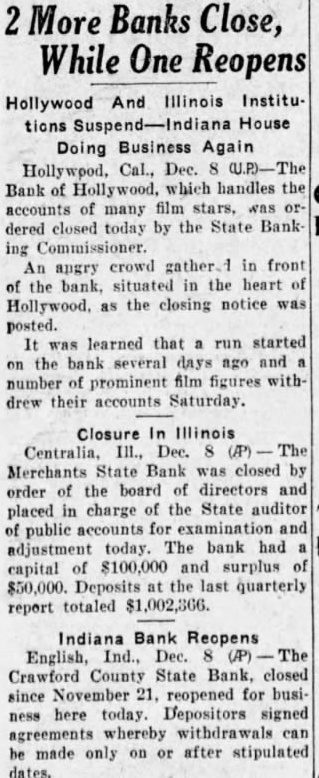
Charles W. Hall, Elizabeth Hall, Floyd B. Cain, Earl D. Amsler, Receiver for the Merchants State Bank of Centralia, Illinois, the First National Bank of Sandoval, Illinois, and the First National Bank of Vandalia,
FORECLOSURE BY VIRTUE OF A DECREE of the Marion County Circuit Court, made and entered at September Term A. D. 1933, in the above entitled cause, will offer for sale at the South front door of the Court House in the City of Salem, in the said County and State on Saturday, the 13th day of January, A. D. 1934, at :30 o'clock in the afternoon of said day, the following described Real Esto-wit: Lot Eleven (11) in Block One (1) Second Melrose Place, Centralia, except four (4) feet off of the South side, the same being a subdiv of part of the Northwest Quarter (%) of the Southwest Quarter (14) Section Seventeen (17), Town One (1) North, Range One (1) East of the Third Principal Meridian, Situated in the County of Marion and State of Illinois, on the following terms, to-wit: CASH IN HAND. John L. Kagy Master in Chancery of Marion County, Illinois. Dated this 15th day of December, 1933. Earl C. Huggins, Solicitor for Complainant.
Mr. and Mrs. W. T. Wilkinson and daughter, Mrs. Roy Telford, were in Centralia recently visiting Mr. and Mrs. Will kinson's son and wife, Mr. and Mrs. Claude Wilkinson. o. W. George, accompanied by his son, Ray, motored to Olney on business Tuesday.
Francis Alexander returned to his work in St. Louis Tuesday morning after a few days visit here with homefolks.
Mr. and Mrs. W. F. Harvey and Mrs. Ellsworth Harvey of Ridgefarm, Ill., spent Saturday and Sunday here.