Chesapeake Bank (Baltimore, MD)

Episode Information

Episode UID
7008471572
Episode Type
Run โ†’ Suspension โ†’ Closure
Bank Type
state
Bank ID
700847 routing
Routing Number
7-0084
Start Date
December 9, 1930
Location
Baltimore, Maryland (39.290, -76.612)

Metadata

Model
gpt-5-mini (chosen from majority vote of a three-model LLM ensemble)
Short Digest
1989a8bb696d3d2c

Response Measures

None

Description

Bank was placed in the State Bank Commissioner's hands after a run; receiver later appointed and assets sold.

Events (3)

1. December 9, 1930 Run
Cause
Rumor Or Misinformation
Cause Details
Newspaper and commissioner statements reference a run and later blame persons spreading false reports about bank conditions.
Measures
Directors requested State Bank Commissioner take charge; cashiers told to tally figures and secure money in vaults.
Newspaper Excerpt
There has been something of a run and the bank was unable to pay.
Source
newspapers
2. December 9, 1930 Suspension
Cause
Government Action
Cause Details
Board of directors asked the State Bank Commissioner to take over the institution and he assumed control, closing main bank and two branches.
Newspaper Excerpt
This institution is in the hands of the State bank commissioner.
Source
newspapers
3. January 17, 1931 Receivership
Newspaper Excerpt
George W. Page, State bank commissioner, was appointed receiver. Mr. Page yesterday filed a petition asking authority to enter into an agreement with the Union Trust Co. whereby the latter would take over all assets and pay 40 per cent on every dollar without delay.
Source
newspapers

Newspaper Articles (22)

Article from The Evening Sun, December 9, 1930

Click image to open full size in new tab

Article Text

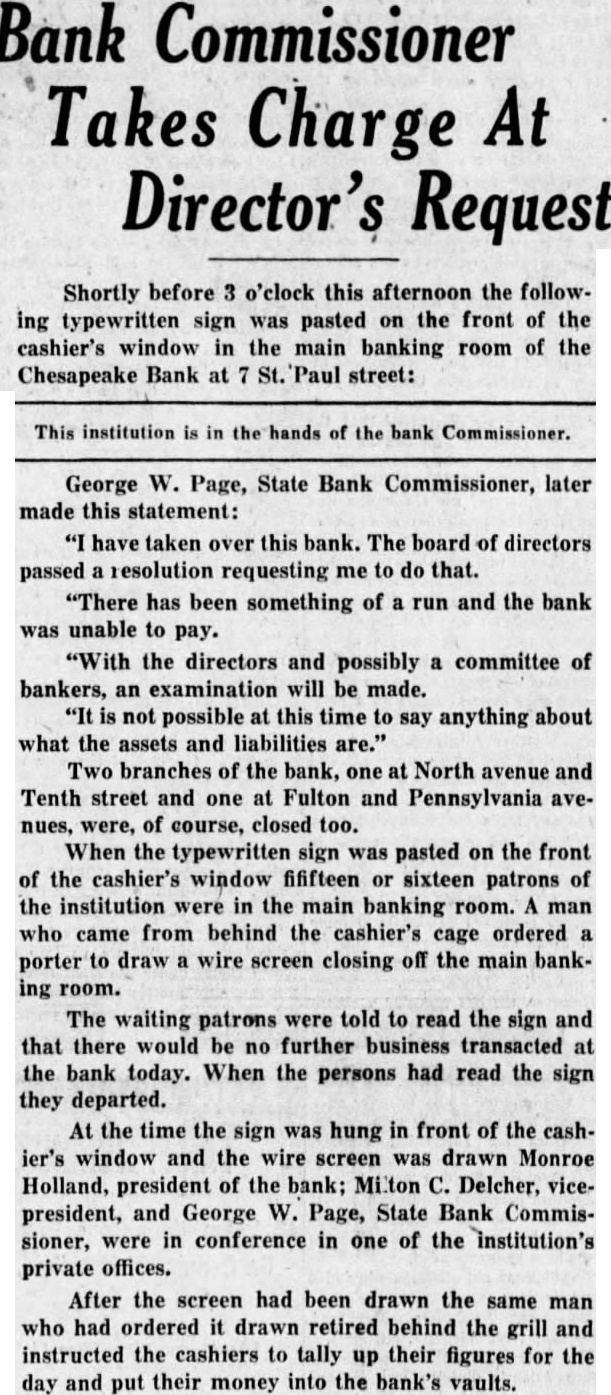
Bank Commissioner Takes Charge At Director's Request Shortly before 3 o'clock this afternoon the following typewritten sign was pasted on the front of the cashier's window in the main banking room of the Chesapeake Bank at street: This institution is in the hands of the bank Commissioner. George W. Page, State Bank Commissioner, later made this statement: have taken over this bank. The board of directors passed a resolution requesting me to do that. "There has been something of a run and the bank was unable to pay. "With the directors and possibly a committee of bankers, an examination will be made. is not possible at this time to say anything about what the assets and liabilities are." Two branches of the bank, one at North avenue and Tenth street and one at Fulton and avenues, were, of course, closed too. When the typewritten sign was pasted on the front of the cashier's window fififteen or sixteen patrons of the institution were in the main banking room. A man who came from behind the cashier's cage ordered a porter to draw a wire screen closing off the main banking room. The waiting patrons were told to read the sign and that there would be no further business transacted at the bank today. When the persons had read the sign they departed. At the time the sign was hung in front of the cashier's window and the wire screen was drawn Monroe Holland, president of the bank; Milton C. Delcher, vicepresident, and George W. Page, State Bank Commissioner, were in conference in one of the institution's private offices. After the screen had been drawn the same man who had ordered it drawn retired behind the grill and instructed the cashiers to tally up their figures for the day and put their money into the bank's vaults.


Article from Joplin Globe, December 10, 1930

Click image to open full size in new tab

Article Text

BANK AT BALTIMORE, MD. IS CLOSED BY DIRECTORS Baltimore, Dec. 9.-(P)-Shortly before 3 o'clock this afternoon the Chesapeake bank of Baltimore placed the following notice on its doors: "This institution is in the hands of the bank commissioner.' George W. Page, state bank commissioner, later said: have taken over this bank. The


Article from The Times Leader, December 10, 1930

Click image to open full size in new tab

Article Text

Commissioner Takes Over Baltimore Bank Baltimore, Dec. 9 (P).-The Chesapeake Bank of Baltimore today placed the following notice on its door: "This institution the hands of the bank commissioner.' George W. Page, State bank commissioner later said: have taken over the bank The board of directors passed tion me do that. There has been something of run and the bank was unable to pay. With the directors and possibly committee of bankers an examination will be made. not possible at this time to say what the assets and liabilities


Article from The Republican, December 10, 1930

Click image to open full size in new tab

Article Text

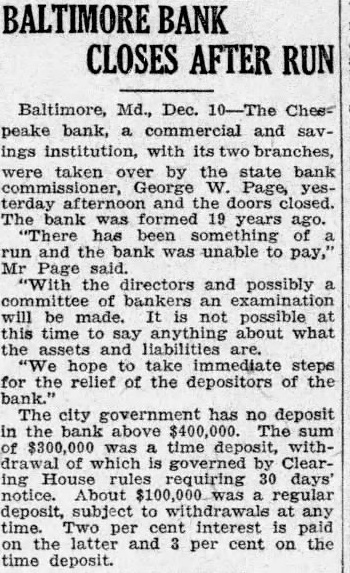
BALTIMORE BANK CLOSES AFTER RUN Baltimore, Md., Dec. Chespeake bank, commercial and savings institution, with its two branches, were taken over by the state bank commissioner, George Page, yes. terday afternoon and the doors closed. The bank was 19 years ago. "There been run and bank was unable to pay,' Mr Page "With the directors and possibly committee bankers an will be made. It not possible this time to say anything about what the assets and liabilities hope take immediate steps for the relief of the depositors of the bank." The city government has no deposit in the bank above $300,000 was time deposit, withdrawal which is governed by Clearing House rules requiring 30 days' notice. About $100,000 was regular deposit, subject to withdrawals at any time. Two cent paid on the latter and per cent on the time deposit.


Article from The Springfield Daily Republican, December 10, 1930

Click image to open full size in new tab

Article Text

BALTIMORE BANK IN STATE'S CHARGE $400,000 City Government Account in Chesapeake Bank of Baltimore Baltimore, state bank late today took charge of the Chesapeake bank of Baltimore. typewritten notice the door announced, "This institution in the hands of the state bank comTwo branches in other parts of the closed 19 years ago, and was of the house In most Sep. tember deposits subject demand George Page, bank had the "There something of the bank unable, pay Included in the funds on deposit in the Of sum $300. was mediate per cent terest the latter and on the time deposit.


Article from Evening Star, December 10, 1930

Click image to open full size in new tab

Article Text

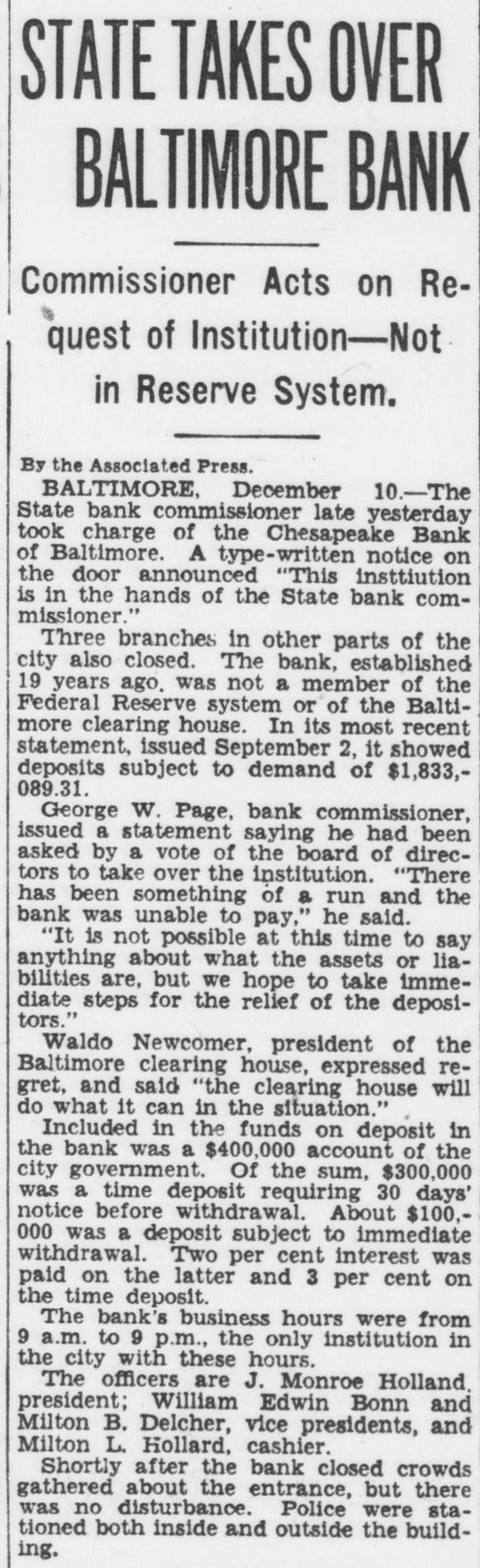
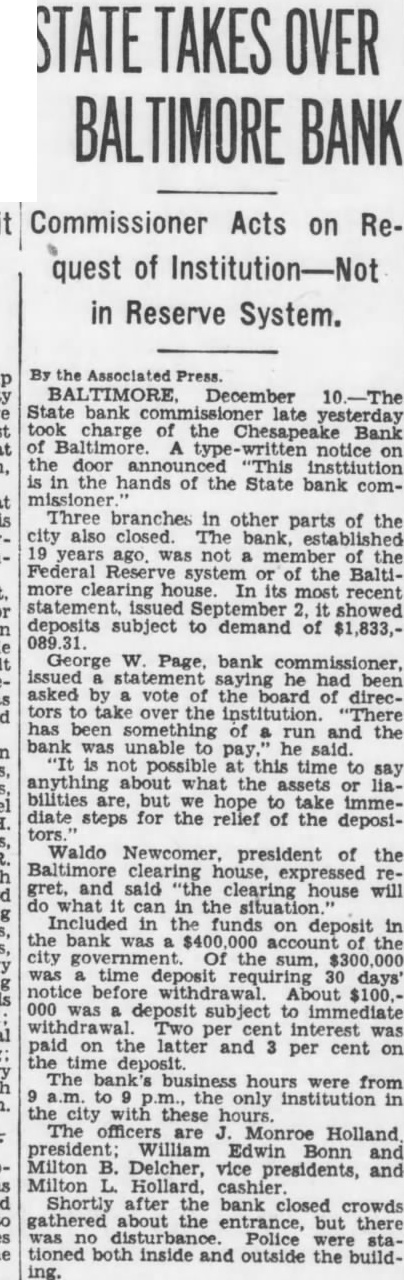
STATE TAKES OVER BALTIMORE BANK Commissioner Acts on Request of Institution-Not in Reserve System. By the Associated Press. BALTIMORE, December 10.-The State bank commissioner late yesterday took charge of the Chesapeake Bank of Baltimore. A type-written notice on the door announced "This insttiution is in the hands of the State bank commissioner." Three branches in other parts of the city also closed. The bank, established 19 years ago. was not a member of the Federal Reserve system or of the Baltimore clearing house. In its most recent statement, issued September 2, it showed deposits subject to demand of $1,833,089.31. George W. Page, bank commissioner, issued a statement saying he had been asked by a vote of the board of directors to take over the institution. "There has been something of a run and the bank was unable to pay," he said. "It is not possible at this time to say anything about what the assets or liabilities are, but we hope to take immediate steps for the relief of the depositors." Waldo Newcomer, president of the Baltimore clearing house, expressed regret, and said "the clearing house will do what it can in the situation." Included in the funds on deposit in the bank was a $400,000 account of the city government. Of the sum, $300,000 was a time deposit requiring 30 days' notice before withdrawal. About $100,000 was a deposit subject to immediate withdrawal. Two per cent interest was paid on the latter and 3 per cent on the time deposit. The bank's business hours were from 9 a.m. to 9 p.m., the only institution in the city with these hours. The officers are J. Monroe Holland. president; William Edwin Bonn and Milton B. Delcher, vice presidents, and Milton L. Hollard, cashier. Shortly after the bank closed crowds gathered about the entrance, but there was no disturbance. Police were stationed both inside and outside the building.


Article from Lincoln Journal Star, December 10, 1930

Click image to open full size in new tab

Article Text

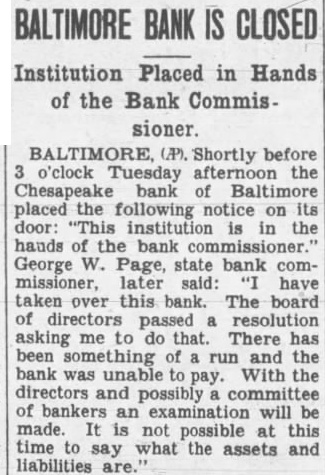
BALTIMORE BANK IS CLOSED Institution Placed in Hands of the Bank Commissioner. BALTIMORE (AP). Shortly before 3 o'clock Tuesday afternoon the Chesapeake bank of Baltimore placed the following notice on its door: "This institution is in the hands of the bank George W. Page, state bank commissioner, later said: have taken over this bank. The board of directors passed resolution asking me to do that. There has been something of a run and the bank was unable to pay. With the directors and possibly a committee of bankers an examination will be made. It is not possible at this time to say what the assets and liabilities are.


Article from The Evening Sun, December 10, 1930

Click image to open full size in new tab

Article Text

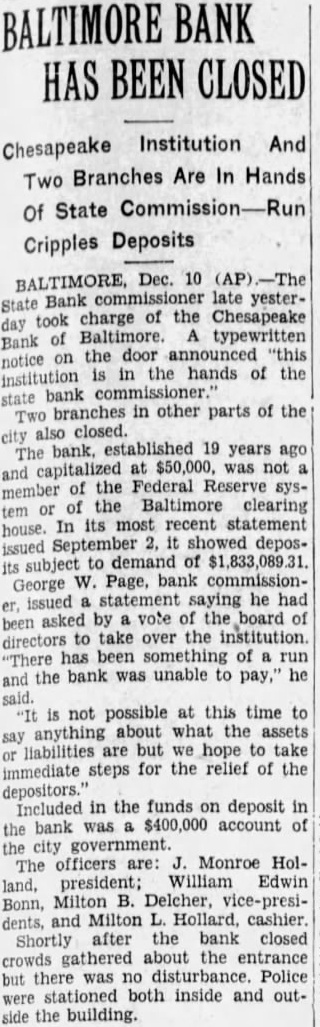
BALTIMORE BANK HAS BEEN CLOSED Chesapeake Institution And Two Branches Are In Hands Of State Commission-Run Cripples Deposits BALTIMORE, Dec. 10 (AP)-The State Bank commissioner late yesterday took charge of the Chesapeake Bank of Baltimore. A typewritten notice on the door announced "this institution is in the hands of the state bank commissioner. Two branches in other parts of the also closed. city The bank, established 19 years ago and capitalized at $50,000, was not a member of the Federal Reserve system or of the Baltimore clearing house. In its most recent statement issued September it showed deposits subject to demand of $1,833,089.31. George W. Page, bank commissioner, issued statement saying he had been asked by vote of the board of directors to take over the institution "There has been something of run and the bank was unable to pay," he said. 'It is not possible at this time to say anything about what the assets or liabilities are but we hope to take immediate steps for the relief of the depositors. Included in the funds on deposit in the bank was a $400,000 account of the city government. The officers are: J. Monroe Holland, president; William Edwin Bonn, Milton B. Delcher, vice-presidents, and Milton L. Hollard, cashier. Shortly after the bank closed crowds gathered about the entrance but there was no disturbance. Police were stationed both inside and outside the building.


Article from Evening star, December 10, 1930

Click image to open full size in new tab

Article Text

STATE TAKES BALTIMORE BANK Commissioner Acts on Request of Institution-Not in Reserve System. By the Associated Press BALTIMORE December State bank yesterday charge of the Chesapeake Bank notice the door "This insttiution the hands of the bank commissioner Three branches in other parts of the city also The established the Baltimore house In its recent showed deposits subject to demand $1,833,W Page, bank issued he had been asked by vote of the board directors take the institution. "There has something of run and the was unable he this time to are, but hope take immediate steps for the relief of the deposiWaldo Newcomer president of the and said clearing house will what can in the Included in the funds on deposit was account the time deposit days 000 was subject withdrawal. Two cent interest was on the latter and per cent hours were from the city with officers are Monroe Holland president; William Edwin Bonn Milton B. Delcher, vice presidents, Milton Hollard. Shortly the bank closed crowds gathered but there Police were both inside and outside the build-


Article from Springfield Weekly Republican, December 11, 1930

Click image to open full size in new tab

Article Text

BANK STATE'S CHARGE Government City in Chesapeake Bank of Baltimore Dec. today the Chesapeake bank typewritten notice institution hands the state bank in other parts established subject Page, bank bank unable pay, in funds deposit the and time deposit


Article from The Evening Sun, December 11, 1930

Click image to open full size in new tab

Article Text

PLANS TO CLEAR CHESAPEAKE BANK AFFAIRS BALTIMORE DEC. 11. to straighten out the affairs the Chesapeake bank. whose affairs were placed in the state banking commissioner's hands taken today and announcement was made that might paid on pro rata basis in the near future. Banking said other might buy the Chesapeake assets, although no offer had been received. The clearing house committee was to assist in evaluating the assets.


Article from The Evening Sun, December 17, 1930

Click image to open full size in new tab

Article Text

BANK RUMOR CARRIERS DEC. spread false reports about the conditions banks hit today in statement George Page, bank commissioner, in which he declared banking conditions turned to normal and expressed the opinion that all Maryland banking institutions are safe. The statement based on state wide survey started last Tuesday when the Chesapeake Bank, small Baltimore institution with the clearing house, closed its doors. He blamed persons" for starting rumors about banks and pointed out that such an criminal offense.


Article from Evening Star, January 18, 1931

Click image to open full size in new tab

Article Text

BANK REVIEW PLANNED Chesapeake Institution to Be Studied by Grand Jury. BALTIMORE, Md., January 17 (A). -Announcement that the grand jury will review the affairs of the Chesapeake Bank, which closed December 9, was made here today by Herbert R. O'Conor, State's attorney. The bank had resources as of last June 30 of $5,859,344. J. Monroe Holland was president. George W. Page, State bank commissioner, was appointed receiver. Mr. Page yesterday filed a petition asking authority to enter into an agreement with the Union Trust Co. whereby the latter would take over all assets and pay 40 per cent on every dollar without delay.


Article Text

NEW PROTEST FILED PROSECUTORS O'CONOR PLAN Walbrook Of Chesapeake Object To Union Trust Offer An additional formal protest and series of informal objections proposed Union Trust Company agreement in the Bank ship were filed in Circuit Court No. yesterday, the last day on which action could be taken. The protest made by more than depositors of the Walbrook branch the closed bank. There cessity, the group asserted, accept the Union Trust offer for forty per immediate payment depositors who would surrender their claims against the Chesapeake the face report that the closed bank could liquidate at per cent. Sale Of Branch Protested The group protested the the Walbrook branch to the Union Trust book value approximately $79,000. In addition, the said the company should not be given the right use the main bank of Chesapeake and the Fulton avenue branch for six months free of charge. the provides. Other groups depositors protested the agreement last week. Their jections were similar to those yesterday. Protests Made Informal protests have been made letters sent by individual depositors to Chief Judge Samuel K. Dennis, presiding in the court, and Judge Charles Stein, will hold hearing the proposed agreement week. All have been filed with the records the case. The grand jury yesterday its investigation to ascertain there any "criminal wrongdoing" previous the Chesapeake's closing December Milton B. Delchar, president the bank, with the jurors for several hours. The investigation was begun January 19 when affairs the bank cially were called to the attention the jury by Herbert R. O'Conor, State's Attorney. Organization Of State's Attorneys Indorsed In Twenty Counties State's Attorneys of twenty of counties of the State have indorsed Herbert R. O'Conor's proposal to form State's Attorneys' Association of Maryland, assuring ganization the group, the prosecutor said yesterday. The letters indorsement, Mr. said, outspoken in support the plan. meeting formulate plans association has set February 14 Baltimore, Mr. asserted, and definite arrangements and program for the gathering drawn up within the next weeks. Cites Needs of Group prosecutors' association needaccording to Mr. for interchange technical information and special data pertaining the criminal courts. The group also watch closely than individuals legislation pertaining to criminal and procedure originating lay Deputy and Assistant State's torneys would be admitted to the associate members, but would no vote, according to present plans.


Article from Evening Star, February 14, 1931

Click image to open full size in new tab

Article Text

Chesapeake Bank. BALTIMORE, February 14 (Special).-A priority suit against the assets of the Chesapeake Bank was filed in Circuit Court by the Public Indemnity Co. The petition alleges the company held a depository bond of $20,000 covering a deposit of $40,153 of State funds in the bank when it was forced to close December 9, 1930. When notified by John M. Dennis, State treasurer, that the bank was in a receiver's hands the indemnity company paid the State of Maryland the sum of $20,066. it was pointed out.


Article Text

BANKER GUILTY IN FRAUD CASE BALTIMORE Mar. B. Delcher. of the defunct Chesapeake bank, was convicted today by criminal court jury of nine of twenty-eight charges of fraud and speculation totaling more than $94,000. Sentence was postponed, and he was released on $20,000 bail. The charges were that Delcher bought stock for his personal use with bank funds and approved loans and honored overdrafts for two Baltimore concerns with which he was connected. The bank with assets of approximately $5,000,000 closed its doors December 9. Loss to depositors was estimated at 700,000 by William Curran, attorney for Delcher.


Article from Evening Star, April 7, 1931

Click image to open full size in new tab

Article Text

BANK SALE APPROVED. BASTIMORE, April 7 (Special).Following a recommendation made by George W. Page, receiver for the Chesapeake Bank, Judge Dennis late yesterday signed an order in Circuit Court approving sale of the Walbrook branch of the Chesapeake Bank to the Union Trust Co. for $95,000 unless cause to the contrary was shown by May 8. Page stated a similar offer of $95,000 made by a group represented by Milton L. Holland had not revealed required financial responsibility. The fight for the branch bank has been between the Holland group and the Union Trust Co. since the Chesapeake Bank closed last December. Holland several weeks ago offered $105,000 for, the branch bank, but this was turned down by Judge Stein.


Article from Evening Star, May 11, 1931

Click image to open full size in new tab

Article Text

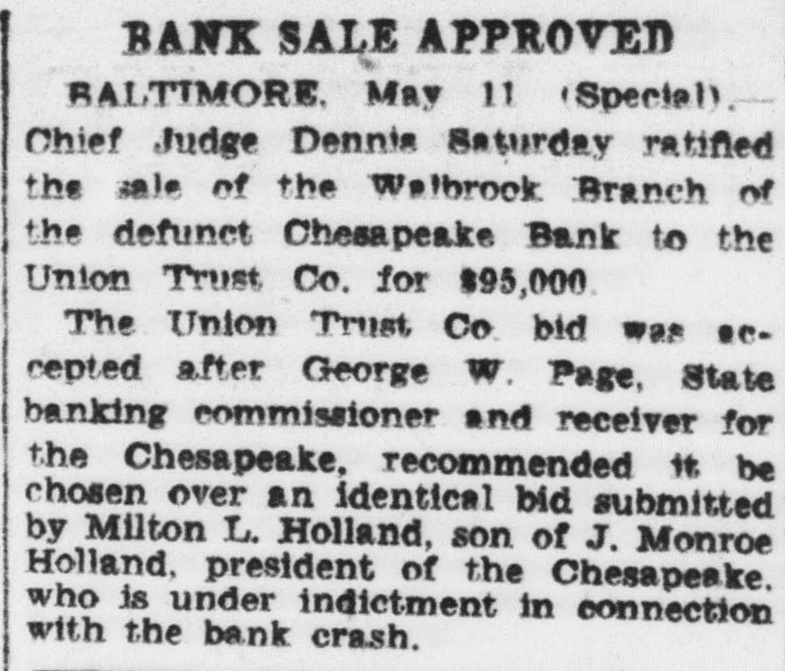
BANK SALE APPROVED BALTIMORE May 11 (Special) Chief Judge Dennis Saturday ratified the sale of the Walbrook Branch of the defunct Chesapeake Bank to the Union Trust Co. for $95,000 The Union Trust Co bid was accepted after George W. Page, State banking commissioner and receiver for the Chesapeake, recommended it be chosen over an identical bid submitted by Milton L. Holland, son of J. Monroe Holland, president of the Chesapeake. who is under indictment in connection with the bank crash.


Article from Evening Star, May 24, 1931

Click image to open full size in new tab

Article Text

HEAD OF MARYLAND BANKERS IS VETERAN OF LONG EXPERIENCE Webster Bell, Now 55, Began Carser at Age of 19 Years. Was Credited With Halting Serious Baltimore Run Last Fall. Special Dispatch to The Star. BALTIMORE, May 23.-Webster Bell, who was elected president of the Maryland Bankers' Association at the annual meeting in Atlantic City Thursday, is one of the best known bank prasidents in Baltimore, being president of the Park Bank, which was the first bank here to initiate Christmas saving funds. Mr. Bell, who is 55 years old, is a naWEBSTER BELL. tive Baltimorean and started his banking career with the National Union Bank when he was 19 years old, and remained with the National Union until he accepted the presidency of the Park DEMAND GROWING Bank in 1903. Bank's Expansion Rapid. The Park Bank was started in 1901 with a capital and surplus of approxiFOR MORTGAGES mately $100,000 and under Mr. Bell's guidance has rapidly expanded, the total resources as of December 31, last, being $8,039,229, with a capital stock of Dealers Say Investors Are $700,000 and surplus and undivided profits of $690,658. Mr. Bell has always taken an active Turning Away From Cominterest in national banking affairs. Following the collapse of the Chesamercial Banks. peake Bank last December, while rumors started a two-day run on the Park Bank, all depositors were given their money as demanded, many of them By the Associated Press. walking out of one door and into anNEW YORK, May 23.-Officers of other door of the bank where they redeposited the money they had just prominent mortgage companies said todrawn. day investors, discouraged by the low The credit for having stopped the return being paid by commercial banks run is given to Mr. Bell, who not only on deposits, are displaying revived inposted a notice on the bank door that terest in guaranteed mortgages and cerall depositors would be paid in full on tificates. proper identification and on the first Several reported that the demand exday even went so far as to keep the ceeds the supply and predicted that the bank open for two hours after the legal closing hour. In this way he restored mortgage market may come down by confidence in the bank and on the secMidsummer to 4ยฝ per cent. They said ond day less than 50 depositors drew out the prevailing rate is from 5ยฝ to 6 per cent. their money and approximately half of Mortgage companies officials said that them redeposited. they have uncomfortably large supplies Other Officers Also Elected. of cash and that they cannot get suffiJ. A. Walton, president of the Ancient mortgages to sell or deposit against sales of certificates. While the demand napolis Banking & Trust Co., was elected vice president. Other officers named is insatiable, they said that the business at the closing session of the bankers' depression has operated to restrict the annual convention were: supply of new mortgages. Some of the William Marriott. Baltimore, Western large companies report they have not National Bank, re-elected treasurer; been encouraging new projects in New James W. McElroy, Baltimore, First NaYork, believing it to be overbuilt. tional Bank, re-elected secretary; memThose who were interviewed were virbers of the Administrative Committee, tually unanimous in attributing the inTasker G. Lowndes, J. H. Cunningham, satiable demand for mortgages from inIrving T. Kepler, William S. Hill, W. B. dividuals to the vagaries of the stock Cooper, William S. Gordy, jr., and L. S. market. They said that presumably the Zimmerman. inquiry came from persons who in more normal times would be huving shares or


Article from The Washington Times, November 28, 1931

Click image to open full size in new tab

Article Text

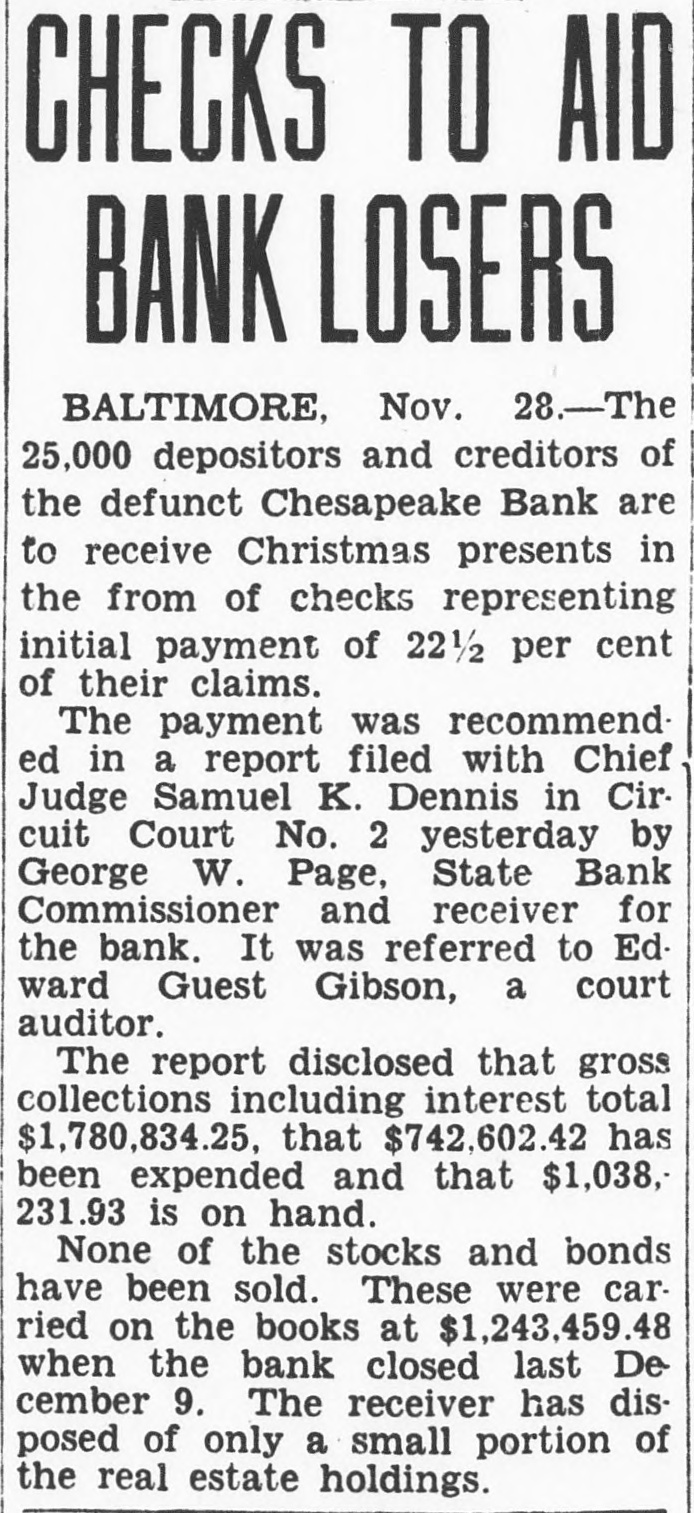
CHECKS TO AID BANK LOSERS BALTIMORE, Nov. 28.-The 25,000 depositors and creditors of the defunct Chesapeake Bank are to receive Christmas presents in the from of checks representing initial payment of 22 1/2 per cent of their claims. The payment was recommended in a report filed with Chief Judge Samuel K. Dennis in Circuit Court No. 2 yesterday by George W. Page, State Bank Commissioner and receiver for the bank. It was referred to Edward Guest Gibson, a court auditor. The report disclosed that gross collections including interest total $1,780,834.25, that $742,602.42 has been expended and that $1,038, 231.93 is on hand. None of the stocks and bonds have been sold. These were carried on the books at $1,243,459.48 when the bank closed last De cember 9. The receiver has disposed of only a small portion of the real estate holdings.


Article Text

Politicana Annapolis, Nov. 1 (P)-Confidence for Governor Ritchie and the entire Democratic ticket. that Governor Ritchie would be re- elected by majority as great or larger than the 66,000 he received in 1930 was expressed tonight by Daniel S. Sullivan, who managed Dr. Charles Conley's primary campaign at an Anne Arundel county Democratic rally held at Crystal Beach. Approximately 3,000 persons, from every section of the county, gathered in and around the auditorium to hear local candidates speak. It was one of the largest rallies ever held in the county. Sullivan, who is chairman of the Democratic campaign speakers' committee, declared the attendance showed that Anne Arundel county was safe inefficient executive. Still nothing was done to remedy this situation or to take steps to protect the money of the many thousands of depositors. [Mr. Nice here read extracts from an address by Isaac Lobe Straus relating to the banking situation.] Questions Raised "I ask you, am right when I say there must be searching, thorough and impartial investigation? Am right when say that believe that if the true facts can disclosed, there may result some additional relief to the many thousands of unfortunate depositors, through salvaging and distribution of additional sums? "Are the people of Maryland to be forever kept in ignorance of the true facts, or are we, the people of Maryland, going to find out what became of our money? Are we not entitled to know, so that at least we may be able to profit by our sad experiences and provide against such condition in the future? Much has been said and written about this matter by worthy and respectable members of the Governor's own party. Criticism Is Cited "No denunciation I can make can be more severe than that of the Governor's opponent in the late primary and other prominent members of his own party. submit to you, the present Democratic dynasty to be continued in control, at sacrifice of the people's interest, and their right to know the conditions, so that, so far as it is humanly possible, these ditions may be rectified, or at least prevented in the future? "I propose searching, thorough and impartial investigation. propose that this shall be made by commission of three distinguished outstanding citizens to be appointed by me, regardless of their party affiliations, to whom shall delegate power equal to that of legislative inquisitorial investigators, and who shall report to me, so that may report to you. ask you, whose responsibility is it that at the close of business on April 29, 1933, there was total of State funds on deposit in various institutions to $7,112,759.42, of which more than two millions had been deposited by Mr Dennis, the State Treasurer, in the Union Trust Company, of which he was the president. Points To Deposits "Over one-half million was on deposit in the Baltimore Trust Company, and approximately $200,000.00 in the Title Guarantee and Trust Company, aggregating over $3,000,000 of the State's in these three banks, practically half of the total amount of the deposits of the State. "Upon the other hand, in the five national banks-the First National Bank, the Canton National Bank, the National Marine Bank, the National Central Bank and the Western National Bank-all of unquestionable solvency, there was less than $250,000 of the State's money on deposit. "I charge that the Governor of the State of Maryland knew the condition of these failing institutions. He could not have helped knowing it. His own appointee was Bank Commissioner of the State of Maryland. It was the latter's duty to keep the Chief Magistrate of this State advised. If he failed in this duty, then the Governor was Approximately For Nice thousand persons jammed into the Baltimore Talmud Torah Hall, 22 North Broadway last night to hear Harry W. Nice, Republican candidate for Governor and other members of the State-wide ticket. The rally was held under auspices of the East End Republican Club of which Samuel G. Lipman is president. Joseph Davis presided at the meeting. Harry F. Klinefelter, For Phelps vice-president of the Twenty-seventh Ward Republican Organization, went on record last night as indorsing John Phelps, independent candidate for judge of the Supreme Bench. derelict in his duty in not compelling him to keep him advised. "For months and months, however, running into years, it was common knowledge there was something wrong. Runs were being made upon these banks. Emergency meetings were being held, calls for aid were being sent to the Reconstruction Finance Corporation and large sums were secured from this source. "Why, under such circumstances. was this condition in the banking system of Maryland permitted to go on? There is only one answer. The political connections of the officers of these banks with the Democratic administration and the Chief Executive of the State were too close. The responsibility is on him and him alone. But this was not all. Long before the red flag of danger was waving over the Union Trust Company and the Baltimore Trust Company there had been two other failures in Baltimore city, to which have already referred. Way back in 1930 the Chesapeake Bank; then the Park Bank, with 80,000 or more depositors, working people, whose savings represented their all to them. "Nor were the depositors the only sufferers. Stockholders Hit, Claim "There were innocent, unsuspecting stockholders who had been led to believe that their investments in the stock of these institutions were safe. Stockholders who were induced to purchase stock of the Baltimore Trust Company within the last few weeks before its collapse, all of whose investments in this stock were wiped out completely. [At this point Mr. Nice referred at length to a description of the banking situation by Dr. Charles H. Conley an address at Hagerstown on June 19, 1934.] "Under the law of this State no stockholder be sued for double liability, save and except through receiver. It is pertinent, therefore, to inquire why the caused to be passed at the recent special session of the Legislature law preventing the appointment of receivers for these political banks, thus prohibiting the State Bank Examiner, under penalty of the law, from giving out information in connection with these political banks, safeguarding the large stockholders of such banks from being subject to double liability, and thus preventing the depositor from profiting from such action, while the stockholders of the smaller banks throughout the State were compelled to meet this obligation. This law has been extended for another year by executive proclamation. Calls Hold Too Strong "This political machine, however, built up with the people's money, was too powerful to overcome, and today the Democratic party, regard- shall not be selected for office merely less of the views of those thoughtful as reward for political favors. citizens who realized that the best "I have assured the people of this interests of their State and party State that the office of Insurance Comwould have been best served by missioner shall be filled by man of change of administration, finds itself in experience in insurance, competent and capable of fulfilling the duties the strangle hold of this Democratic which the office imposes upon him, machine. "Do those gentlemen who officered who will give his entire time to the discharge of his responsibilities. these banks and who are now straining every nerve and sinew to hold "I solemnly promise that when am elected Governor there shall be control of the State government. desire such an investigation? No. They no one appointed to fill public office have no love for the present Chief merely because of his political activiExecutive of this State, but to them ties. Appointees shall and must be he is safe. They are interested in men and women of high character and themselves, not in him. Their interest ability. is in maintaining the status quo, Refers To Auto Commissioner keeping the lid on, so that you and "What justification or excuse can the people of the State will never there be for the present automobile know the truth about these banks. who recently was ediWill Seek Advice torially called upon by The Evening "I have been questioned concerning appointments which I may make when am elected Governor. have stated, not once. but many times, that when am elected Governor, shall. in making my appointments, expect the assistance and advice of all associations which may be interested in the particular subject matter of the board or commission to be appointed. "I have laid down, as a primary principle, that there shall be minority representation on all boards and commissions. have criticized, and still criticize, the Public Service Commission as now composed. This Commission is of semi-judicial character. and, as such, its members should be and remain free from all political activities which might affect or tend to influence the exercise of their free will and judgement. "I am opposed to the practice of State Executive appointing. during the terms for which they are elected, members of the Legislature to public office or employment. Not Based On Favors "I have pledged myself that the police magistrates shall be men of high character and principle, and that they Sun to resign? For the present conservation commissioner, who has permitted an industry which, in 1919 was worth over $7,000,000 to the people of this State, to fall to such low level that today it is worth, according to the Governor's own statement, $2,000,000, and requires an expenditure of half million dollars to save it? "How can the Governor justify the appointment of an insurance sioner who lacked experience in insurance matters and who has failed to enforce the law providing for reserves to be put up by foreign insurance and casualty companies doing business in Maryland. which has caused great loss and suffering to those who have been so unfortunate as to have carried in such panies, relying upon the State insurance department to afford them
Article from Evening Star, March 18, 1935

Click image to open full size in new tab

Article Text

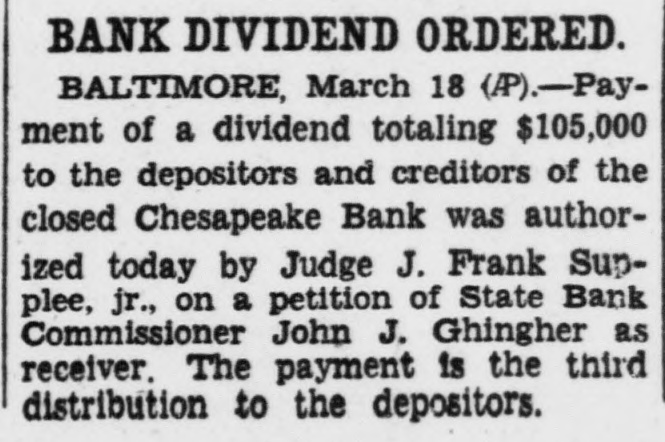
BANK DIVIDEND ORDERED. BALTIMORE, March 18 (AP).-Payment of a dividend totaling $105,000 to the depositors and creditors of the closed Chesapeake Bank was authorized today by Judge J. Frank Supplee, jr., on a petition of State Bank Commissioner John J. Ghingher as receiver. The payment is the third distribution to the depositors.