Article Text
Bits OF Knowledge
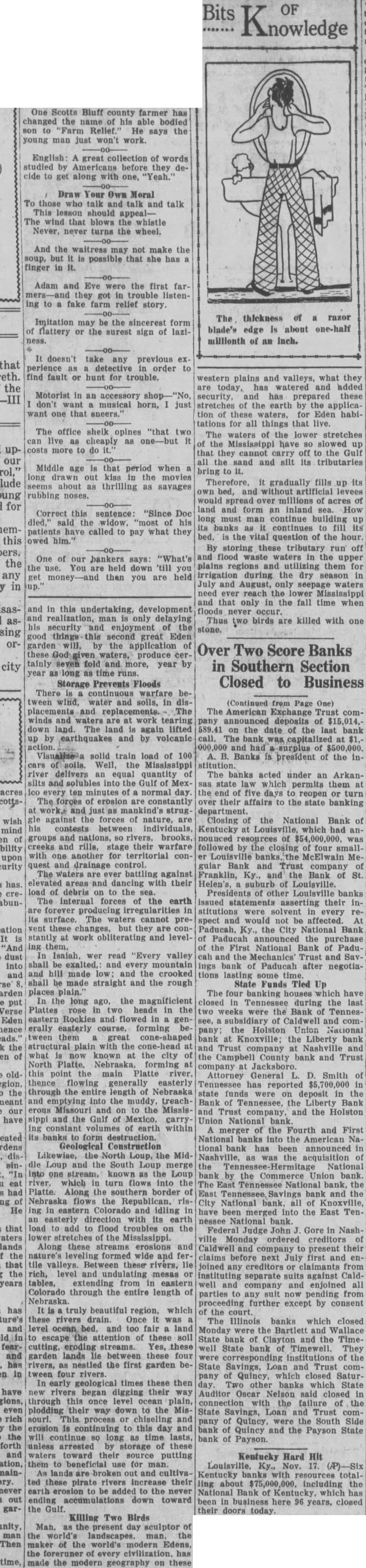
The thickness of a razor blade's edge is about one-half millionth of an inch.
One Scotts Bluff county farmer has changed the name of his able bodied son to "Farm Relief." He says the young man just won't work.
English: A great collection of words studied by Americans before they decide to get along with one, "Yeah."
Draw Your Own Moral To those who talk and talk and talk This lesson should appeal— The wind that blows the whistle Never, never turns the wheel.
And the waitress may not make the soup, but it is possible that she has a finger in it.
Adam and Eve were the first farmers—and they got in trouble listening to a fake farm relief story.
Imitation may be the sincerest form of flattery or the surest sign of laziness.
It doesn't take any previous experience as a detective in order to find fault or hunt for trouble.
Motorist in an accessory shop—"No, I don't want a musical horn, I just want one that sneers."
The office sheik opines "that two can live as cheaply as one—but it costs more to do it."
Middle age is that period when a long drawn out kiss in the movies seems about as thrilling as savages rubbing noses.
Correct this sentence: "Since Doc died," said the widow, "most of his patients have called to pay what they owed him."
One of our bankers says: "What's the use. You are held down 'till you get money—and then you are held up."
Storage Prevents Floods There is a continuous warfare between wind, water and soils, in displacements and replacements. The winds and waters are at work tearing down land. The land is again lifted up by earthquakes and by volcanic action.
Visualize a solid train load of 100 cars of soils. Well, the Mississippi river delivers an equal quantity of silts and solubles into the Gulf of Mexico every ten minutes of a normal day. The forces of erosion are constantly at work, and just as mankind's struggle against the forces of nature, are his contests between individuals, groups and nations, so rivers, brooks, creeks and rills, stage their warfare with one another for territorial conquest and drainage control.
The waters are ever battling against elevated areas and dancing with their load of debris on to the sea.
The internal forces of the earth are forever producing irregularities in its surface. The waters cannot prevent these changes, but they are constantly at work obliterating and leveling them.
In Isaiah, we read "Every valley shall be exalted, and every mountain and hill made low; and the crooked shall be made straight and the rough places plain."
In the long ago, the magnificent Platte rose in two heads in the eastern Rockies and flowed in a generally easterly course, forming between them a great cone-shaped structural plain with the cone-head at what is now known at the city of North Platte, Nebraska, forming at this point the main Platte river, thence flowing generally easterly through the entire length of Nebraska and emptying into the muddy, treacherous Missouri and on to the Mississippi and the Gulf of Mexico, carrying constant volumes of earth within its banks to form destruction.
Geological Construction Likewise, the North Loup, the Middle Loup and the South Loup merge into one stream, known as the Loup river, which in turn flows into the Platte. Along the southern border of Nebraska flows the Republican, rising in eastern Colorado and idling in an easterly direction with its earth load to add to flood troubles on the lower stretches of the Mississippi.
Along these streams erosions and nature's leveling formed wide and fertile valleys. Between these rivers, lie the rich, level and undulating mesas or tables, extending from in eastern Colorado through the entire length of Nebraska.
It is a truly beautiful region, which these rivers drain. Once it was a level ocean bed, and too fair a land to escape the attention of these soil cutting, eroding streams. Yes, these garden lands lie between these four rivers, as nestled the first garden between four rivers.
In early geological times these then new rivers began digging their way through this once level ocean plain, plodding their way down to the Missouri. This process of chiseling and erosion is continuing to this day and will continue so long as time lasts, unless arrested by storage of these waters toward their source putting them to beneficial use for man.
As lands are broken out and cultivated these pirate rivers increase their earth erosion to be added to the never ending accumulations down toward the Gulf.
Killing Two Birds Man, as the present day sculptor of the world's landscapes, man, the maker of the world's modern Edens, the forerunner of every civilization, has made the modern geography on these western plains and valleys, what they are today, has watered and added security, and has prepared these stretches of the earth by the application of these waters, for Eden habitations for all things that live.
The waters of the lower stretches of the Mississippi have so slowed up that they cannot carry off to the Gulf all the sand and silt its tributaries bring to it.
Therefore, it gradually fills up its own bed, and without artificial levees would spread over millions of acres of land and form an inland sea. How long must man continue building up its banks as it continues to fill its bed, is the vital question of the hour.
By storing these tributary run off and flood waste waters in the upper plains regions and utilizing them for irrigation during the dry season in July and August, only seepage waters need ever reach the lower Mississippi and that only in the fall time when floods never occur.
Thus two birds are killed with one stone, and in this undertaking, development and realization, man is only delaying his security and enjoyment of the good things this second great Eden garden will, by the application of these God given waters, produce certainly seven fold and more, year by year as long as time runs.
Over Two Score Banks in Southern Section Closed to Business
(Continued from Page One) The American Exchange Trust company announced deposits of $15,014,589.41 on the date of the last bank call. The bank was capitalized at $1,000,000 and had a surplus of $500,000. A. B. Banks is president of the institution.
The banks acted under an Arkansas state law which permits them at the end of five days to reopen or turn over their affairs to the state banking department.
Closing of the National Bank of Kentucky at Louisville, which had announced resources of $54,000,000, was followed by the closing of four smaller Louisville banks, the McElwain Meguiar Bank and Trust company of Franklin, Ky., and the Bank of St. Helen's, a suburb of Louisville.
Presidents of other Louisville banks issued statements asserting their institutions were solvent in every respect and would not be affected. At Paducah, Ky., the City National Bank of Paducah announced the purchase of the First National Bank of Paducah and the Mechanics' Trust and Savings bank of Paducah after negotiations lasting some time.
State Funds Tied Up The four banking houses which have closed in Tennessee during the last two weeks were the Bank of Tennessee, a subsidiary of Caldwell and company; the Holston Union National bank at Knoxville; the Liberty bank and Trust company at Nashville and the Campbell County bank and Trust company at Jacksboro.
Attorney General L. D. Smith of Tennessee has reported $5,700,000 in state funds were on deposit in the Bank of Tennessee, the Liberty Bank and Trust company, and the Holston Union National bank.
A merger of the Fourth and First National banks into the American National bank has been announced in Nashville, as was the acquisition of the Tennessee-Hermitage National bank by the Commerce Union bank. The East Tennessee National bank, the East Tennessee Savings bank and the City National bank, all of Knoxville, have been merged into the East Tennessee National bank.
Federal Judge John J. Gore in Nashville Monday ordered creditors of Caldwell and company to present their claims before next July first and enjoined any creditors or claimants from instituting separate suits against Caldwell and company and enjoined all parties to any suit now pending from proceeding further except by consent of the court.
The Illinois banks which closed Monday were the Bartlett and Wallace State bank of Clayton and the Timewell State bank of Timewell. They were corresponding institutions of the State Savings, Loan and Trust company of Quincy, which closed Saturday. Two other banks which State Auditor Oscar Nelson said closed in connection with the failure of the State Savings, Loan and Trust company of Quincy, were the South Side bank of Quincy and the Payson State bank of Payson.
Kentucky Hard Hit Louisville, Ky., Nov. 17. (AP)—Six Kentucky banks with resources totaling about $75,000,000, including the National Bank of Kentucky, which has been in business here 96 years, closed their doors today.