Bank of the State of Georgia (Savannah, GA)

Episode Information

Episode UID
7022075590685
Episode Type
Suspension โ†’ Closure
Bank Type
private
Bank ID
702207559 hash
Start Date
January 1, 1857*
Location
Savannah, Georgia (32.084, -81.100)

Metadata

Model
gpt-5-mini (chosen from majority vote of a three-model LLM ensemble)
Short Digest
cc959f216afbeff3

Response Measures

None

Events (3)

1. January 1, 1857* Suspension
Cause
Macro News
Cause Details
Suspension of specie payments coinciding with the nationwide financial disturbances of 1857; suspension legalized by Georgia legislature.
Newspaper Excerpt
It suspended specle payment, as did other banks through the United States, in 1857, which suspension was legalized by the Legislature of Georgia.
Source
newspapers
2. September 8, 1862 Other
Newspaper Excerpt
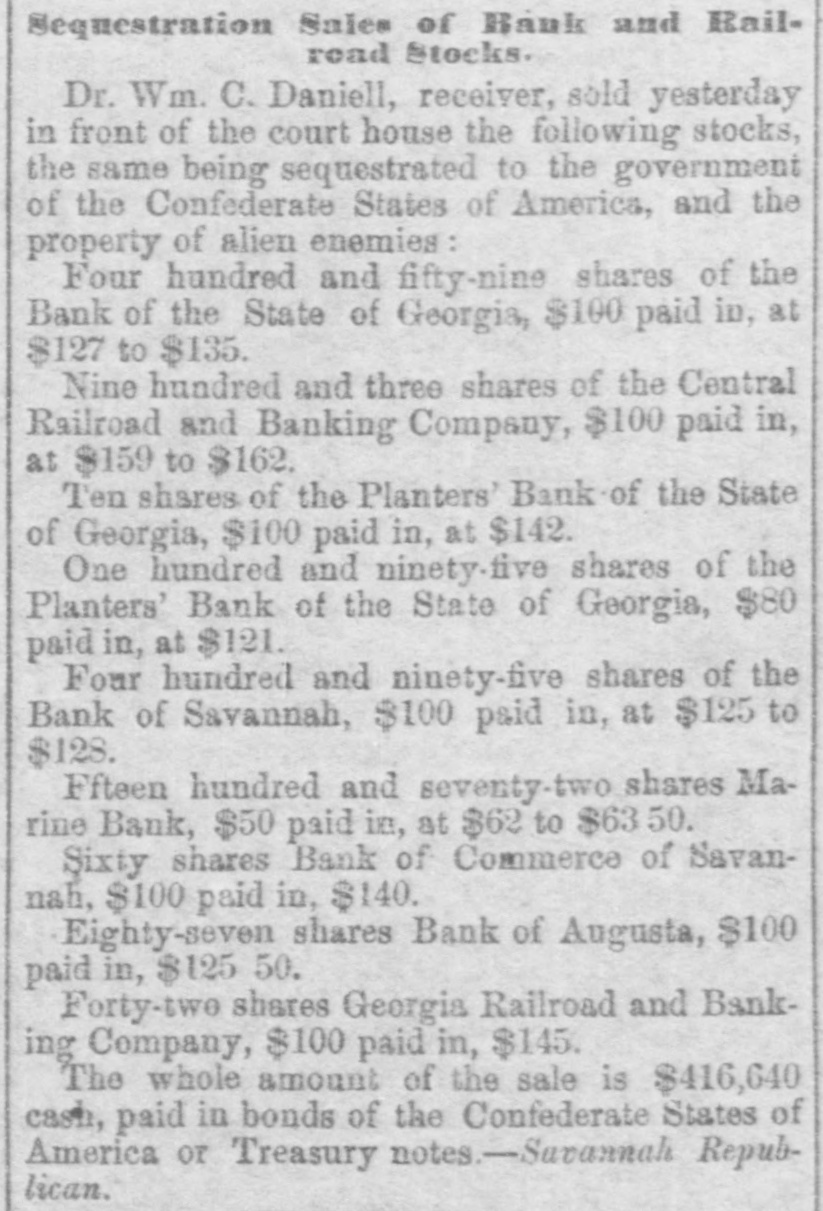
Four hundred and fifty-nine shares of the Bank of the State of Georgia, $100 paid in, at $127 to $135. ... The whole amount of the sale is $416,640 cash, paid in bonds of the Confederate States of America or Treasury notes.-Surannah Republican.
Source
newspapers
3. January 1, 1865* Receivership
Newspaper Excerpt
The old bank gave the Confederate States in 1861, and on through the war, the benefit of its resources to a great extent. This depleted Its coffers, and when the end came in 1865 the corporation sold out Its property, realized what it could out of its assets, and was wound up.
Source
newspapers

Newspaper Articles (3)

Article from Memphis Daily Appeal, September 8, 1862

Click image to open full size in new tab

Article Text

Sequestration Sales of Bank and Railroad Stocks. Dr. Wm. C. Daniell, receiver, sold yesterday in front of the court house the following stocks, the same being sequestrated to the government of the Confederate States of America, and the property of alien enemies: Four hundred and fifty-nine shares of the Bank of the State of Georgia, $100 paid in, at $127 to $135. Nine hundred and three shares of the Central Railroad and Banking Company, $100 paid in, at $159 to $162. Ten shares of the Planters' Bank of the State of Georgia, $100 paid in, at $142. One hundred and ninety.five shares of the Planters' Bank of the State of Georgia, $80 paid at $121. Four hundred and ninety-five shares of the Bank of Savannah, $100 paid in, at $125 to $128. Ffteen hundred and seventy-two shares Marine Bank, $50 paid in, at $62 to $63 50. Sixty shares Bank of Commerce of Savannah, $100 paid in, $140. Eighty-seven shares Bank of Augusta, $100 paid in, $125 50. Forty-two shares Georgia Railroad and Banking Company, $100 paid in, $145. The whole amount of the sale is $416,640 cash, paid in bonds of the Confederate States of America or Treasury notes.-Surannah Republican.

Article from The Morning News, May 22, 1893

Click image to open full size in new tab

Article Text

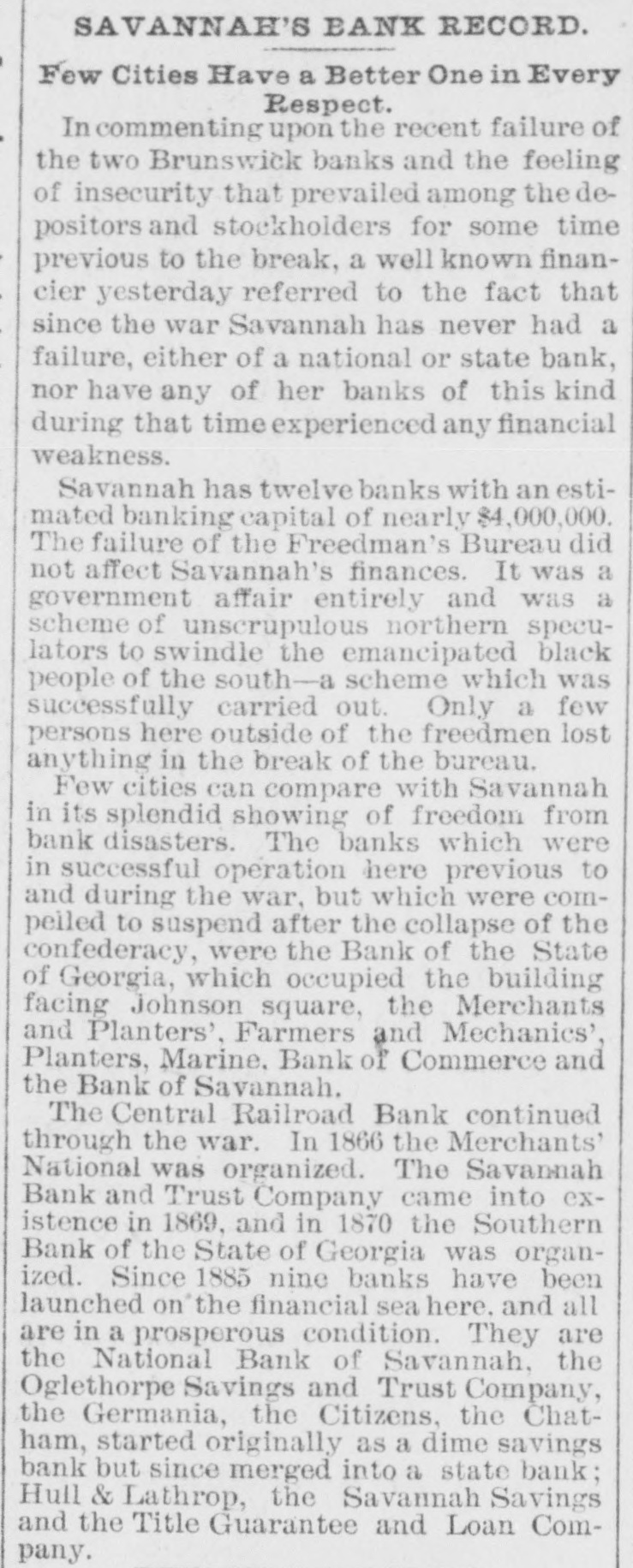
SAVANNAH'S BANK RECORD. Few Cities Have a Better One in Every Respect. In commenting upon the recent failure of the two Brunswick banks and the feeling of insecurity that prevailed among the depositors and stockholders for some time previous to the break, a well known financier yesterday referred to the fact that since the war Savannah has never had a failure, either of a national or state bank, nor have any of her banks of this kind during that time experienced any financial weakness. Savannah has twelve banks with an estimated banking capital of nearly $4,000,000. The failure of the Freedman's Bureau did not affect Savannah's finances. It was a government affair entirely and was a scheme of unscrupulous northern speculators to swindle the emancipated black people of the south-a scheme which was successfully carried out. Only a few persons here outside of the freedmen lost anything in the break of the bureau. Few cities can compare with Savannah in its splendid showing of freedom from bank disasters. The banks which were in successful operation here previous to and during the war, but which were compeiled to suspend after the collapse of the confederacy, were the Bank of the State of Georgia, which occupied the building facing Johnson square, the Merchants and Planters', Farmers and Mechanics' Planters, Marine, Bank of Commerce and the Bank of Savannah. The Central Railroad Bank continued through the war. In 1866 the Merchants' National was organized. The Savannah Bank and Trust Company came into existence in 1869, and in 1870 the Southern Bank of the State of Georgia was organized. Since 1885 nine banks have been launched on the financial sea here. and all are in a prosperous condition. They are the National Bank of Savannah, the Oglethorpe Savings and Trust Company, the Germania, the Citizens, the Chatham, started originally as a dime savings bank but since merged into a state bank; Hull & Lathrop, the Savannah Savings and the Title Guarantee and Loan Company.


Article from The Sun, January 14, 1897

Click image to open full size in new tab

Article Text

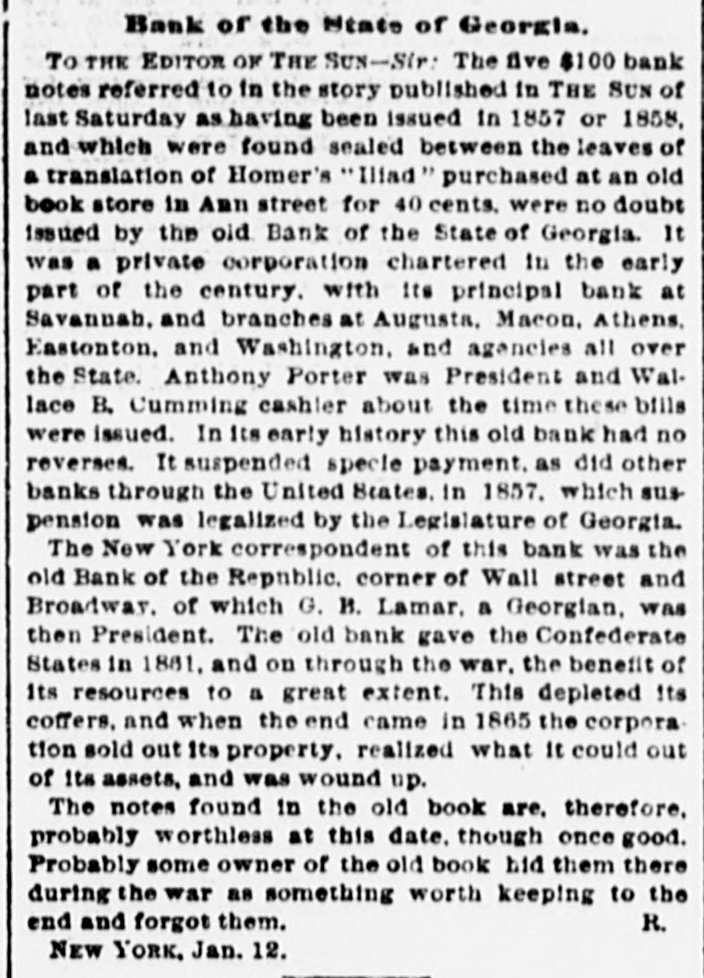
Bank of the State of Georgia. To THE EDITOR OF THE SUN-Sir: The five $100 bank notes referred to in the story published in THE SUN of last Saturday as having been issued In 1857 or 1858, and which were found sealed between the leaves of a translation of Homer's "Illiad" purchased at an old book store in Ann street for 40 cents. were no doubt issued by the old Bank of the State of Georgia. It was a private corporation chartered in the early part of the century. with its principal bank at Savanuah. and branches at Augusta. Macon, Athens. Eastonton. and Washington, and agencies all over the State. Anthony Porter was President and Wallace B. Cumming cashier about the time these bills were issued. In its early history this old bank had no reverses. It suspended specle payment. as did other banks through the United States. in 1857. which suspension was legalized by the Legislature of Georgia. The New York correspondent of this bank was the old Bank of the Republic. corner of Wall street and Broadway. of which G. B. Lamar, a Georgian, was then President. The old bank gave the Confederate States in 1881, and on through the war, the benefit of its resources to a great extent. This depleted Its coffers, and when the end came in 1865 the corpora. tion sold out Its property. realized what it could out of its assets, and was wound up. The notes found in the old book are, therefore, probably worthless at this date. though once good. Probably some owner of the old book hid them there during the war as something worth keeping to the R. end and forgot them. NEW YORK. Jan. 12.