First National Bank (Scotland, SD)

Episode Information

Episode UID
704801286
Episode Type
Run โ†’ Suspension โ†’ Closure
Bank Type
national
Bank ID
70480 national
Charter Number
7048
Start Date
February 4, 1907
Location
Scotland, South Dakota (43.150, -97.718)

Metadata

Model
gpt-5-mini (chosen from majority vote of a three-model LLM ensemble)
Short Digest
b2ee9cd4b3271fae

Response Measures

Full suspension, Books examined

Receivership Details

Depositor recovery rate
20.3%
Date receivership started
1907-02-04
Date receivership terminated
1909-09-30
OCC cause of failure
Fraud
Share of assets assessed as good
25.8%
Share of assets assessed as doubtful
33.6%
Share of assets assessed as worthless
40.6%

Description

Some articles give Feb. 2 as closing date while Washington dispatches list Feb. 4; receiver appointment then transferred to local receiver.

Events (6)

1. November 28, 1903 Chartered
Source
historical_nic
2. February 4, 1907 Receivership
Source
historical_nic
3. February 4, 1907 Receivership
Newspaper Excerpt
The examiner is now in charge as temporary receiver. ... The examiner is now in charge as temporary receiver. ... Paul Landmann ... has been appointed receiver of the First National bank of Scotland, which recently was closed by Geo. A. Silsby, national bank examiner for South Dakota.
Source
newspapers
4. February 4, 1907 Run
Cause
Bank Specific Adverse Info
Cause Details
Publication of a judgment against stockholders of the predecessor Bank of Scotland caused suspicion and heavy withdrawals
Measures
Bank examiner called in; examiner took charge to protect depositors; temporary receiver appointed
Newspaper Excerpt
the publication of a dispatch from Sioux Falls ... caused heavy withdrawals
Source
newspapers
5. February 4, 1907 Suspension
Cause
Government Action
Cause Details
Closed by National Bank Examiner Silsby (at request of officers) and examiner took charge as temporary receiver
Newspaper Excerpt
National Bank Examiner George A. Silsby has advised the Comptroller ... that he has closed the First National Bank of Scotland
Source
newspapers
6. April 23, 1907 Other
Newspaper Excerpt
Charles King ... was arrested here by Federal officers ... charged with misappropriation ... He left Scotland, after which a run on the bank followed and the bank failed.
Source
newspapers

Newspaper Articles (25)

Article from Evening Journal, February 4, 1907

Click image to open full size in new tab

Article Text

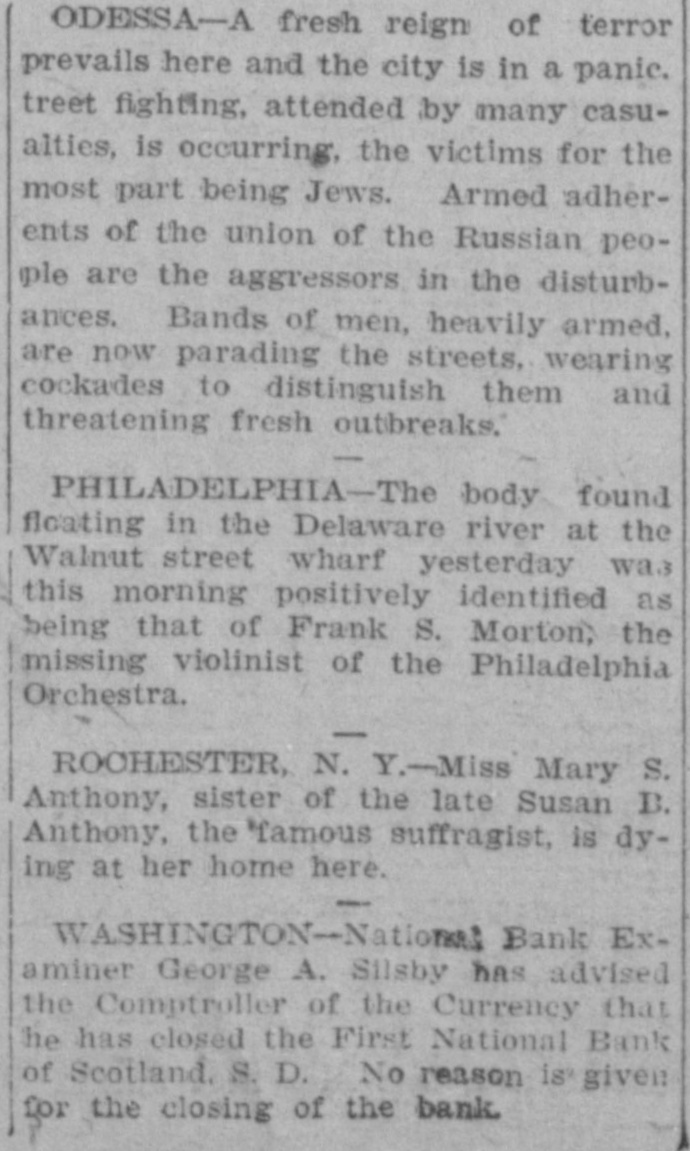
ODESSA-A fresh reign of terror prevails here and the city is in a panic. treet fighting, attended by many casualties, is occurring, the victims for the most part being Jews. Armed adherents of the union of the Russian people are the aggressors in the disturbances. Bands of men, heavily armed. are now parading the streets, wearing cockades to distinguish them and threatening fresh outbreaks. PHILADELPHIA-The body found floating in the Delaware river at the Walnut street wharf yesterday was this morning positively identified as being that of Frank S. Morton, the missing violinist of the Philadelphia Orchestra. ROCHESTER, N. Y.-Miss Mary S. Anthony, sister of the late Susan B. Anthony, the *famous suffragist, is dying at her home here. WASHINGTON-Nationss Bank Examiner George A. Silsby has advised the Comptroller of the Currency that he has closed the First National Bank of Scotland, S. D. No reason is given for the closing of the bank.


Article from Omaha Daily Bee, February 5, 1907

Click image to open full size in new tab

Article Text

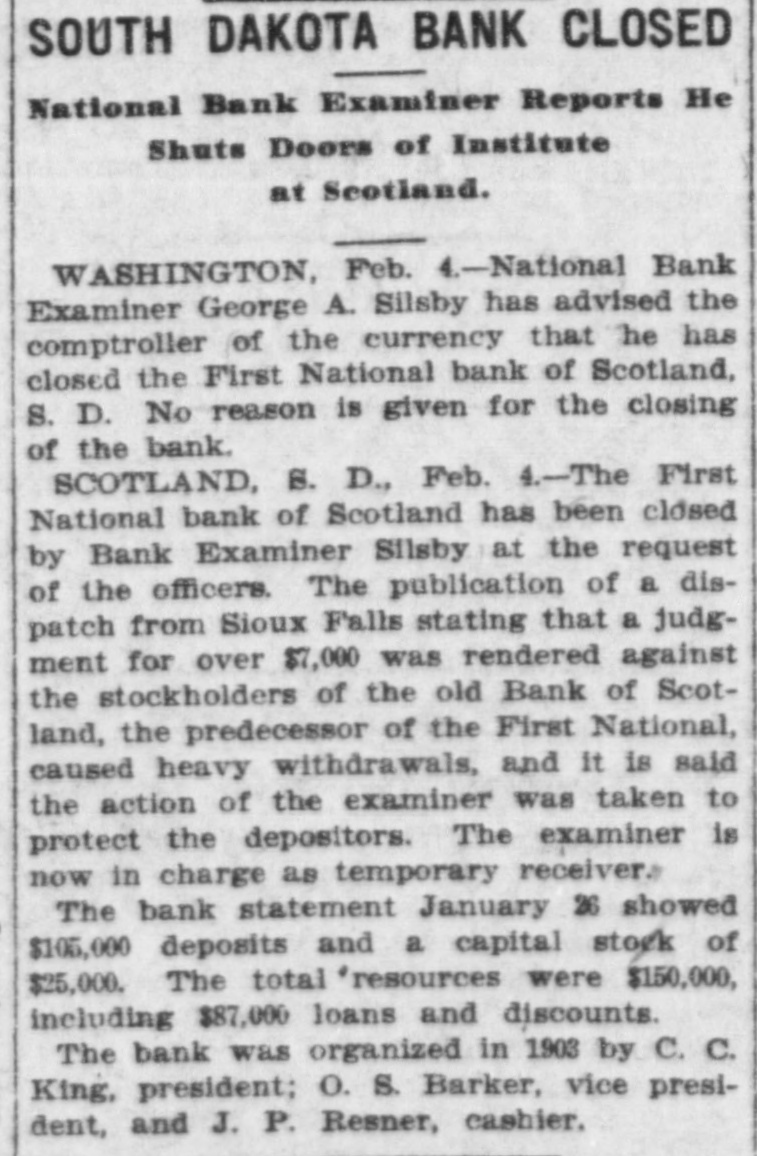
SOUTH DAKOTA BANK CLOSED National Bank Examiner Reports He Shuts Doors of Institute at Scotland. WASHINGTON, Feb. 4.-National Bank Examiner George A. Silsby has advised the comptroller of the currency that he has closed the First National bank of Scotland, S. D. No reason is given for the closing of the bank. SCOTLAND, B. D., Feb. 4.-The First National bank of Scotland has been closed by Bank Examiner Silsby at the request of the officers. The publication of a dispatch from Sioux Falls stating that a judgment for over $7,000 was rendered against the stockholders of the old Bank of Scotland, the predecessor of the First National, caused heavy withdrawals, and it is said the action of the examiner was taken to protect the depositors. The examiner is now in charge as temporary receiver. The bank statement January 26 showed $105,000 deposits and a capital stock of $25,000. The total *resources were $150,000, including $87,000 loans and discounts. The bank was organized in 1903 by C. C. King, president; O. S. Barker, vice president, and J. P. Resner, cashier.


Article from The Citizen-Republican, February 7, 1907

Click image to open full size in new tab

Article Text

First National Bank Closed The First National Bank of Scotland was closed last Saturday at noon, by National Bank Examiner Silsby who is now in charge as temporary receiver. A statement of the bank published the day before it closed, showing condition on January 26, 1907, showed that the bank was apparently in very fair condition, but of course the value of the securities given can not Fe told until the investigation by the examiner is completed. The First National Bank was organized Jan. 1st 1904, succeeding the Bank of Scotland which was organized under an old territorial charter, and run for many years by C. C. King. Mr. King also owned a controlling interest in the stock of the new bank and was its president, and J. P. Resner, cashier. A short time ago the bank was re-organized Mr. King having contracted to sell his stock to Mr. Andrew Resner, but it appears that this deal had not been completed at the time of the failure and that considerable of the stock is still held by Mr. King. In the new organization V. S. Barker was made president and J. P. Resner cashier. Last week a report from Sioux Falls appeared in the daily papers to the effect that a judgment of over $7,000 had been rendered against the stock holders of the old Bank of Scotland, but though Mr. King promptly settled the judgment the suspicion aroused by this report, together with rumors of other matters pending against the Bank of Scotland, caused heavy withdrawals by the depositors of the First National which it was feared, though perhaps without reason, might be held for the obligations of the old bank. Realizing that the bank could not stand a run the examiner was called and after consultation with the officers he decided to take charge of the bank. The last bank statement showed deposits aggregating over $105,000. Of these about half were time deposits and the other half deposits subject to check. In the bank were over fifteen hundred dollars of school money, Mr. Resner being school treasurer; about $1,800 of county funds, and a large amount of government money belonging to the Indian fund. It is hoped that a satisfactory settlement can be made 80 that the bank can be reopened, but if not a permanent receiver will be appointed and the affairs closed up to the best possible advantage to the creditors. Mr. and Mrs. Jac. Hoffman returned on Wednesday from their wedding trip to Gettysburg and


Article from The Mitchell Capital, February 22, 1907

Click image to open full size in new tab

Article Text

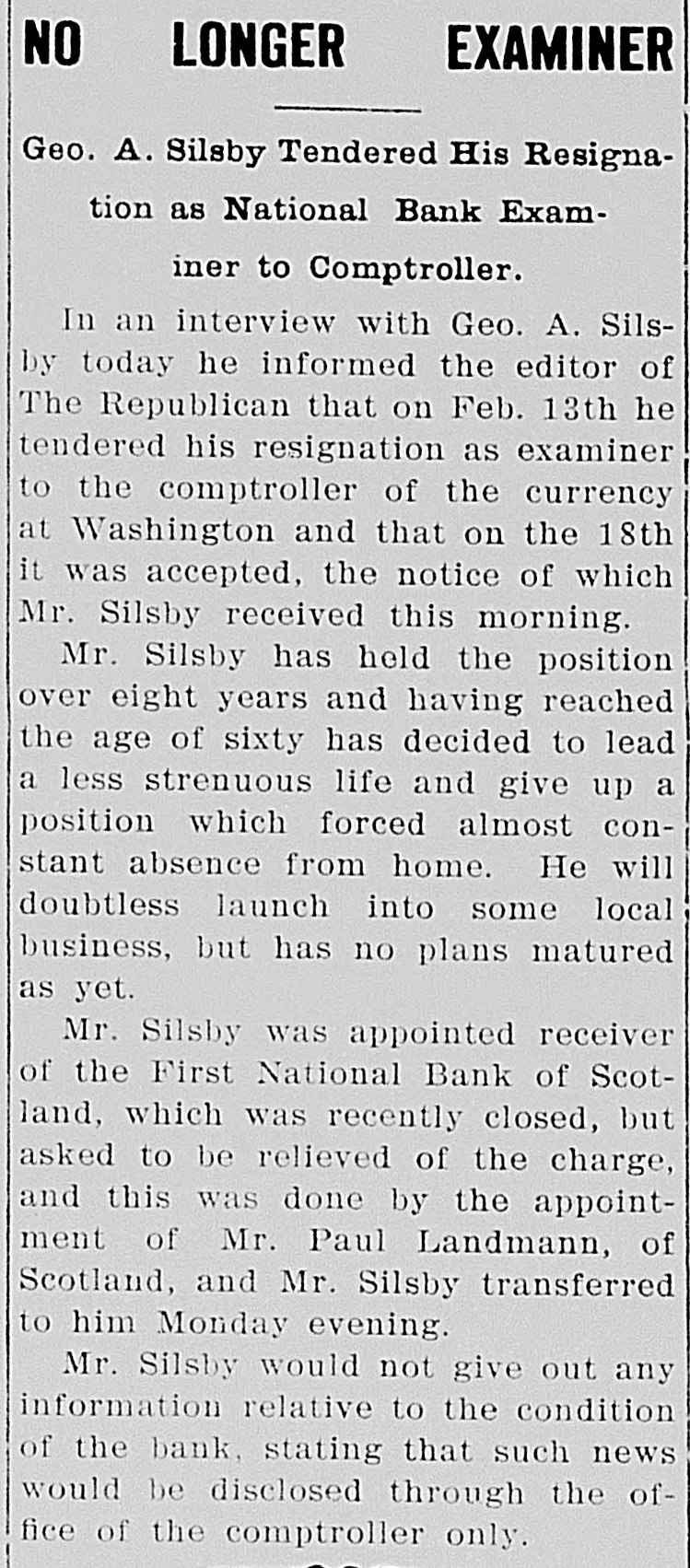
NO LONGER EXAMINER Geo. A. Silsby Tendered His Resignation as National Bank Examiner to Comptroller. In an interview with Geo. A. Silsby today he informed the editor of The Republican that on Feb. 13th he tendered his resignation as examiner to the comptroller of the currency at Washington and that on the 18th it was accepted, the notice of which Mr. Silsby received this morning. Mr. Silsby has held the position over eight years and having reached the age of sixty has decided to lead a less strenuous life and give up a position which forced almost constant absence from home. He will doubtless launch into some local business, but has no plans matured as yet. Mr. Silsby was appointed receiver of the First National Bank of Scotland, which was recently closed, but asked to be relieved of the charge, and this was done by the appointment of Mr. Paul Landmann, of Scotland, and Mr. Silsby transferred to him Monday evening. Mr. Silsby would not give out any information relative to the condition of the bank, stating that such news would be disclosed through the office of the comptroller only.


Article from The Miller Sun, March 2, 1907

Click image to open full size in new tab

Article Text

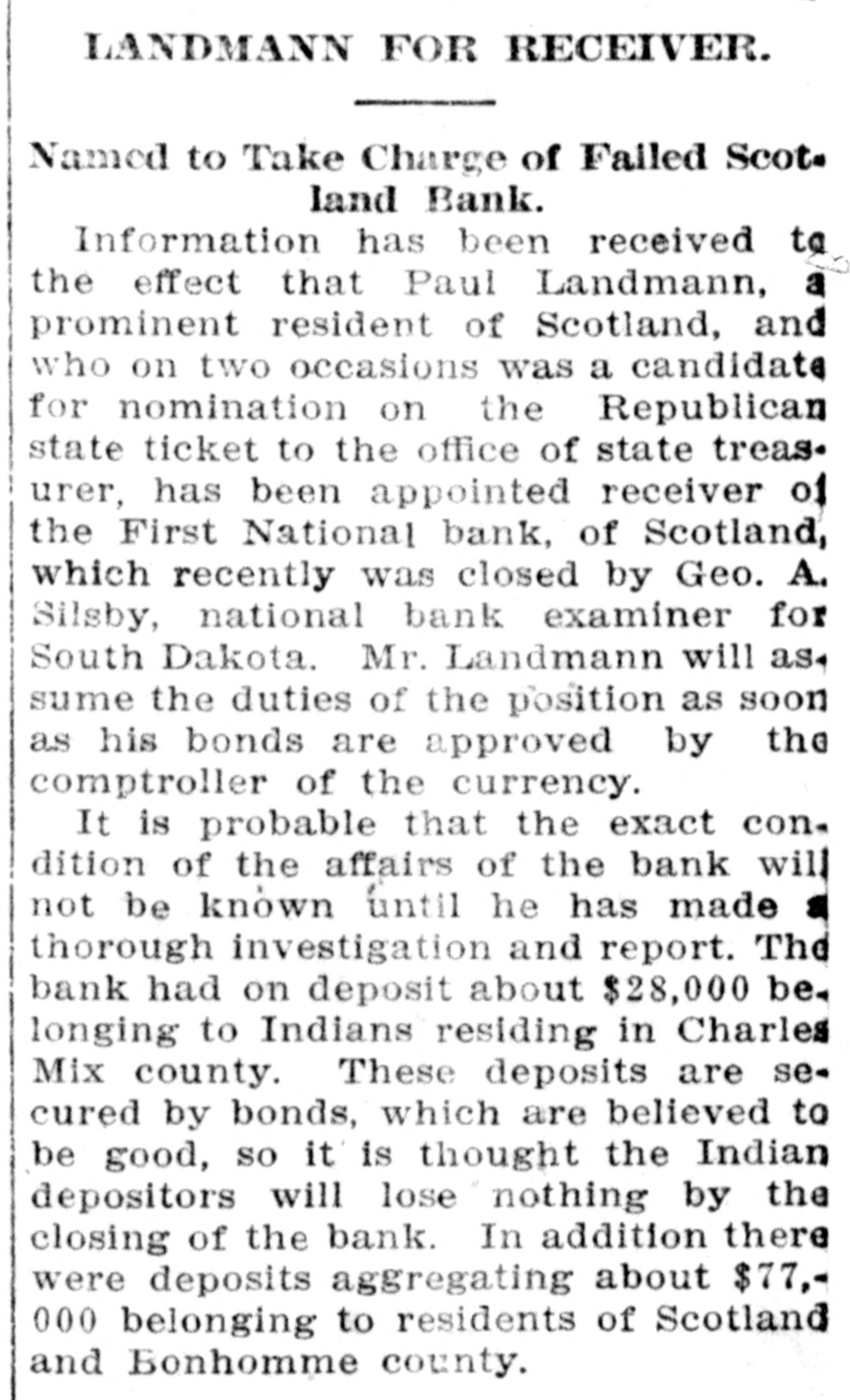
LANDMANN FOR RECEIVER. Named to Take Charge of Failed Scot. land Bank. Information has been received to the effect that Paul Landmann, a prominent resident of Scotland, and who on two occasions was a candidate for nomination on the Republican state ticket to the office of state treas. urer, has been appointed receiver 01 the First National bank, of Scotland, which recently was closed by Geo. A. Silsby, national bank examiner for South Dakota. Mr. Landmann will as. sume the duties of the position as soon as his bonds are approved by the comptroller of the currency. It is probable that the exact condition of the affairs of the bank will not be known until he has made n thorough investigation and report. The bank had on deposit about $28,000 be. longing to Indians residing in Charles Mix county. These deposits are secured by bonds, which are believed to be good, so it is thought the Indian depositors will lose nothing by the closing of the bank. In addition there were deposits aggregating about $77,000 belonging to residents of Scotland and Bonhomme county.


Article from Los Angeles Herald, April 24, 1907

Click image to open full size in new tab

Article Text

Bank Badly Crippled By Associated Press. SCOTLAND, S. D., April 3.-Receiver Landmann of the failed First National bank of Scotland said today that President King will be brought to Yankton for hearing. He said the bank will not pay more than 20 per cent upon $107,000 liabilities.


Article from The Washington Herald, April 24, 1907

Click image to open full size in new tab

Article Text

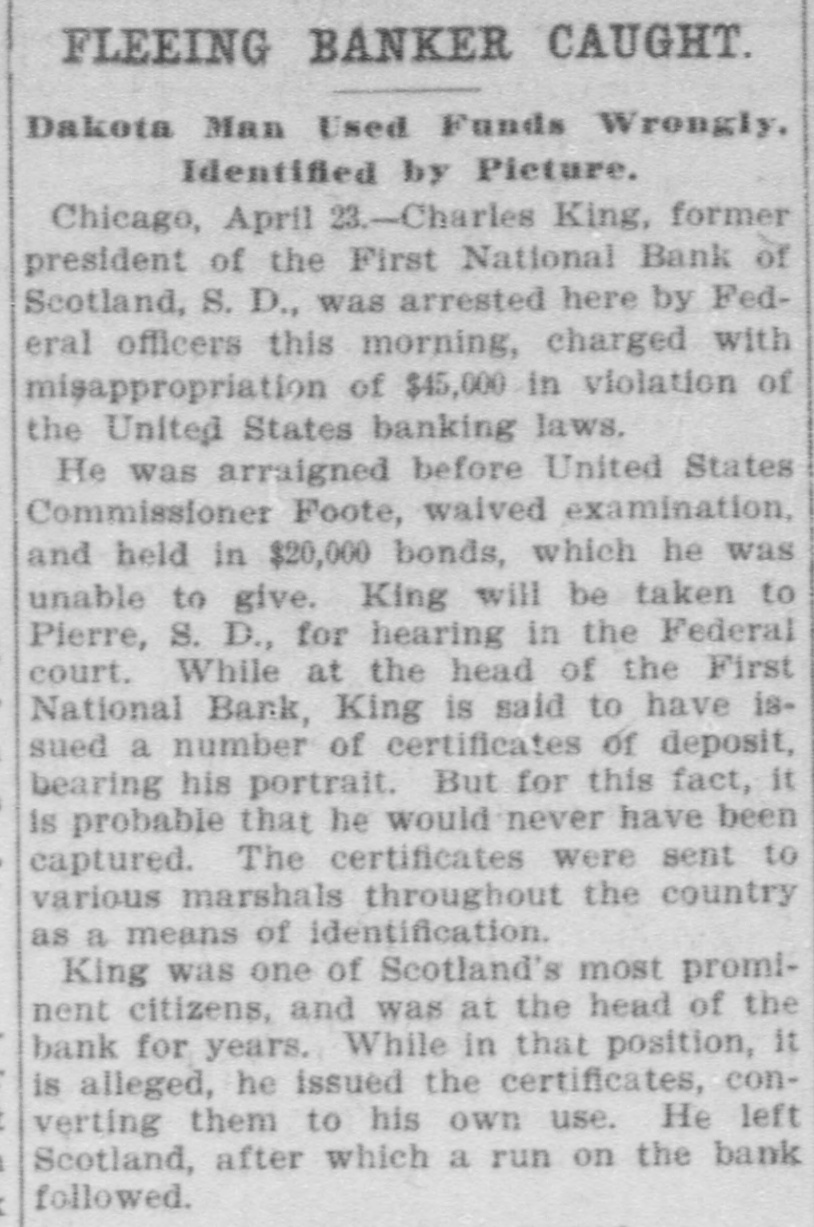
# FLEEING BANKER CAUGHT. Dakota Man Used Funds Wrongly, Identified by Picture. Chicago, April 23.-Charles King, former president of the First National Bank of Scotland, S. D., was arrested here by Federal officers this morning, charged with misappropriation of $45,000 in violation of the United States banking laws. He was arraigned before United States Commissioner Foote, waived examination, and held in $20,000 bonds, which he was unable to give. King will be taken to Pierre, S. D., for hearing in the Federal court. While at the head of the First National Bank, King is said to have issued a number of certificates of deposit, bearing his portrait. But for this fact, it is probable that he would never have been captured. The certificates were sent to various marshals throughout the country as a means of identification. King was one of Scotland's most prominent citizens, and was at the head of the bank for years. While in that position, it is alleged, he issued the certificates, converting them to his own use. He left Scotland, after which a run on the bank followed.


Article from The Mitchell Capital, April 26, 1907

Click image to open full size in new tab

Article Text

BANK IN VERY BAD SHAPE; PAY ONLY 20 PER CENT. Scotlend, S. D., April 25.-The arrest in Chicago of President C. C. King of the First National bank, of Scotland, caused general surprise to all except Receiver Paul Landmann, who has charge of the bank. It is expected that King will be brought back tomorrow and will be given a hearing before a United States commissioner at Yankton. Receiver Landmann denies the Chicago report that King has all andy been indicted, although there were three secret indictments returned by the federal grand jury at Slous Falls about ten days ago. Fearing that King contemplated fleeing from the country. Receiver Landmann advised the federal officials of Chicago and a United States marshal caught the banker today. Dank in Bad Shape. The receiver would not disclose the exact nature f the charges to be brought against Mr. King, but denied that the specific charge would be the issuance of $45,000 of certificates of deposit to himself, as the Chicago story reports. "There is Ro doubt the bank is in very bad shape," said the receiver to The Tribune. "It is not likely that it will pay out more than 20 per cent. on its liabiliti pef $107,000." At the tin of the closing of the bank by work Exariner Silsby, of Mitchell, bruary 3, it was said that the general belief was that funds of the bards had beei. used extensively to nance the electric lighting enterprise in Mit S. D., at the head of which was Mr. King. The Mitchell city council recently voted to extend the franchise to Mr. King, but the referendum petition was showing up so strongly against the proposition that he did not allow it to go to a vote, but refused the extension. King is very well known throughout the state.


Article from Twice-A-Week Plain Dealer, April 30, 1907

Click image to open full size in new tab

Article Text

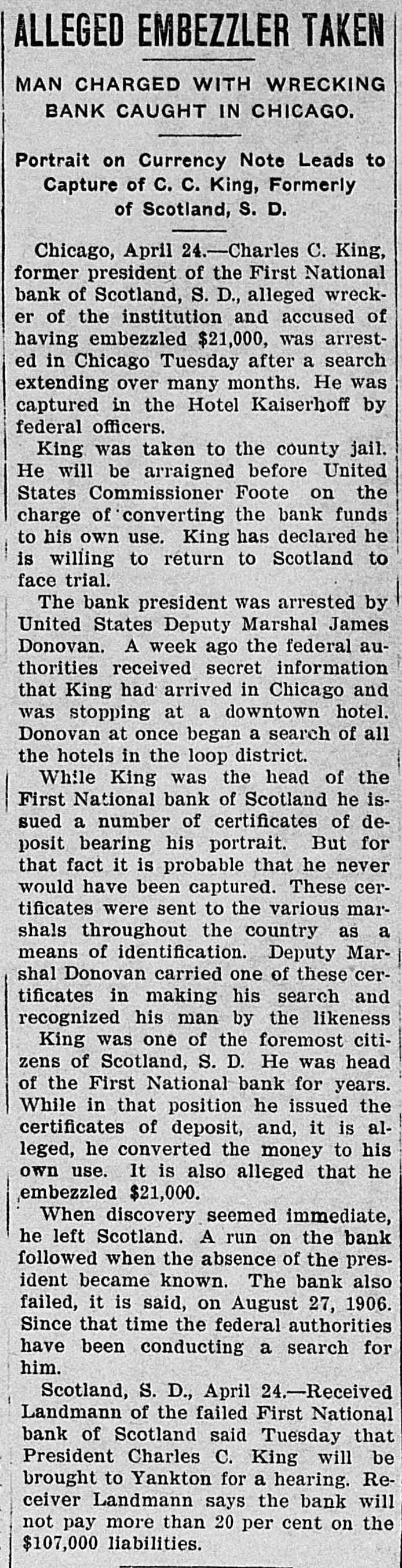
ALLEGED EMBEZZLER TAKEN MAN CHARGED WITH WRECKING BANK CAUGHT IN CHICAGO. Portrait on Currency Note Leads to Capture of c. c. King, Formerly of Scotland, S. D. Chicago, April 24.-Charles C. King, former president of the First National bank of Scotland, S. D., alleged wrecker of the institution and accused of having embezzled $21,000, was arrested in Chicago Tuesday after a search extending over many months. He was captured in the Hotel Kaiserhoff by federal officers. King was taken to the county jail. He will be arraigned before United States Commissioner Foote on the charge of converting the bank funds to his own use. King has declared he is willing to return to Scotland to face trial. The bank president was arrested by United States Deputy Marshal James Donovan. A week ago the federal authorities received secret information that King had arrived in Chicago and was stopping at a downtown hotel. Donovan at once began a search of all the hotels in the loop district. While King was the head of the First National bank of Scotland he issued a number of certificates of deposit bearing his portrait. But for that fact it is probable that he never would have been captured. These certificates were sent to the various marshals throughout the country as a means of identification. Deputy Marshal Donovan carried one of these certificates in making his search and recognized his man by the likeness King was one of the foremost citizens of Scotland, S. D. He was head of the First National bank for years. While in that position he issued the certificates of deposit, and, it is alleged, he converted the money to his own use. It is also alleged that he embezzled $21,000. When discovery seemed immediate, he left Scotland. A run on the bank followed when the absence of the president became known. The bank also failed, it is said, on August 27, 1906. Since that time the federal authorities have been conducting a search for him. Scotland, S. D., April 24.-Received Landmann of the failed First National bank of Scotland said Tuesday that President Charles C. King will be brought to Yankton for a hearing. Receiver Landmann says the bank will not pay more than 20 per cent on the $107,000 liabilities.


Article from Forest City Press, May 2, 1907

Click image to open full size in new tab

Article Text

BANK IN VERY BAD SHAPE: PAY ONLY 20 PER CENT. Scotland, S. D., April 25.-The arrest in Chicago of President C. C. King of the First National bank, of Scotland, caused general surprise to all except Receiver Paul Landmann, who has charge of the bank. It is expected that King will be brought back tomorrow and will be given a hearing before a United States commissioner at Yankton. Receiver Landmann denies the Chicago report that King has already been indicted, although there were three secret indictments returned by the federal grand jury at Sioux Falls about ten days ago. Fearing that King contemplated fleeing from the country. Receiver Landmann advised the federal officials of Chicago and a United States marshal caught the banker today. Bank in Bad Shape. The receiver would not disclose the exact nature of the charges to be brought against Mr. King. but denied that the specific charge would be the issuance of $45,000 of certificates of deposit to himself, as the Chicago story reports. "There is no doubt the bank is in very bad shape," said the receiver to The Tribune. "It is not likely that it. will pay out more than 20 per cent. on its liabilities of $107,000." At the time of the closing of the bank by Bank Examiner Silsby. of Mitchell, February 2, it was said that the general belief was that funds of the bank had been used extensively to finance the electric lighting enterprise in Mitchell, S. D., at the head of which was Mr. King. The Mitchell city council recently voted to extend the franchise to Mr. King. but the referendum petition was showing up so strongly against the proposition that he did not allow it to go to a vote, but refused the extension. King is very well known throughout the state.


Article from The Ordway New Era, May 3, 1907

Click image to open full size in new tab

Article Text

a freight engine drawing a was year the emboose O'Fallon, Mo., running boller rapidly of the engine exploded, kiling three trainmen, injurink two others, and wrecking the engine and cabooke. There is a serious lack of farm hands in the Northwest according to reports received by the Great Northern rallroad. Two thousand prairie dogs at $3 each have been contracted for in South Dakota by English lords who have the on their shooting reserves in exterminate rabbits and England hares and are languishing for sport. The Russo-Japanese negotiations b on the fisheries question are reported to have resulted in a satisfactory agreement. , e A lawsuit that has been in the courts 32 years was recently again argued in the Supreme court of Missourl. The motermen and conductors on e the Salt Lake City, Utah, street car lines to the number of 450 have struck I following a refusal of the company officials to arbitrate their differences. A new schedule to become effective b July 1, increases the pay of the rural free delivery carries from 9 to 25 per cent, based upon the number of miles traveled. of Binger Herman former of the general commissioner The trial land office reon of continuing 12 records a charge after destroying weeks, public sulted in a verdict of acquittal. Mo., asThe Sedalla, Busines contract Men's sociation has signed a with a shoe company a will be built at branch St. Louis factory by which Sedalia. six is being formed in of the wheat growing A principal plan wheat states for by the farmers to hold their one dollar per bushel. 3 A sensation was created in Joplin, the discovery that Mo., by luxuriously the police force were enjoying a furnished lounging room which had been donated by saloon keepers, dissolute women and gamblers of the city. Public sentiment was thoroughly aroused and the grand jury will investigate. In a letter written by President to the chairman of the Chicago Roosevelt Moyer-Haywood conference former the aspresident stands by his sertions and declares that the actions of the friends of the accused men are flagrantly improper, in that they are trying to influence judge and jury in the coming trial. Charge C. King. president of the First National bank of Scotland, S. D., has been arrested in Chicago charged with having misapplied the funds of the bank, which recently failed. The Zoeller packing plant at Pittsburg. Pa., was recently destroyed by fire. Five hundred thousand pounds of lard in one building was entirely consumed. The loss was placed at $300.000. The supreme court of Kansas has appointed Judge S. H. Allen, G. all H. Whitcourt and Judge T. F. Garver, of Topeka, as receivers for the Kan- A sas property of various breweries. joint bond of $45,000 was required. Secretary Wilson, by executive and order, has created the board of food drug inspection, whose duty it shall be to adminiter the national pure food law. The president heartily approves the plan. Frank H. Butler, a steamer deckhand, has been arrested charged with the murder of the four-year-old dis- son of Dr. Horace N. Marvin, who appeared from his home in Dover, Del., March 4. A recent bulletin issued by the secretary of the Oklahoma board of agriculture states that the wheat crop is only 60.8 per cent and the oats crop 30 per cent. A movement has been started in Milwaukee, Wis., to set aside a day the in May on which every union in country is to protest against Presi- that dent Roosevelt's assertion Moyer, Haywood and Debs are unde sirable citizens. Four million bushels of coal from were shipped down the Ohio river Pittsburg in one day recently, break- the ing all records for this time of year. The suit of the Copper Range Consolidated Mining company Colbert oth- C. Burrage, Thomas W. Lawson and has been settled out of court. ers, government forestry service


Article from The Citizen-Republican, June 27, 1907

Click image to open full size in new tab

Article Text

13 OTHER BANKERS TO KEEP c. C. KING COMPANY IN PRISON Scotland Bank Wrecker Joins Colony of His Kind in Leavenworth. Scotland, S. D., June 26.-Charles C. King, president of the defunct First National bank of Scotland is now in prison at Leavenworth under five years sentence. He is the fourteenth banker under sentence at this time to arrive at the Kansas penitentiary. The others are: Frank G. Bigelow, president First National bank, Milwaukee, Wis.: 58 years old: sentenced for 10 years from June, 10, 1905, "good time" term expires on February 10 1912. Henry G. Goll, cashier First National bank. Milwaukee: 38 years old; sentenced for 10 years from May 5, 1906: "good time" term expires on January 5, 1913. Justus L. Broderick, president First National bank, Elkhart, Ind.: 57 years old: 10 years from April 21, 1904: "good time" rerm expires December 21, 1910. Wilson L. Collins, cashier First National bank. Elkhart. Ind.: 45 years old: six years from April 24, 1904; "good time" expires September 15. 1908. Walter Brown director First National bank, Elkhart, Ind.: 48 years old; eight rears from April 21, 1904; "good time" ex. pires March 8. 1916. John P. Cooper, president First National bank, McGregor, Tex.: 47 years old: fivo rears from March 8. 1904: "good time" term expires November 3, 1907. Gustave A. Conzman, president Vigo county (Ind.) National bank: 50 years old. Mght years from January 29, 1906; "good time" term expires December 11, 1911. Alfred C. Parker. cashier First National bank. Bedford. Ind.: 38 years old: five years from May 28. 1904: "good time" term expires on January 28, 1908. Cyrus E. McCrady, cashier First National bank, Seymour, Ind.; 41 years old: six years from May 28, 1904; "good time" term expires October 22. 1908. John H. Wood, cashier First National bank, Matthews, Ind.; 44 years old: six years from January 9, 1905; "good time" term expores June 3. 1909. Robert B. Taylor, banker-forger, St. Louis, Mo.: 50 years old: five years from August 12. 1904; "good time" term ex. pires April 12, 1908. Herman Haass, Chicago. (Transferred from Joliet.) Francis B. Wright, Kane county, III. Statement of Scotland Bank. Following is a report of King's transaction published by the Citizens Republican, whose editor had free access to the bank books for nearly two months when clerk under Receiver Landmann: When the First National bank was closed by the examiner February 2, 1907. the total assets of the institution were listed at $104,980.94. Of these more than half were listed as worthless and about pne-third as doubtful. Among the worthless list was included a bunch of certiScates of deposit issued by the old Bank of Scotland which went out of existence when the First National was organized. These certificates to the amount of $21,177.84 had been redeemed by the First National, and were being carried as bills receivable. There were school warrants amounting to $1,946.19 that had been sold to a bank in Sloux City but still carried LS assets; notes to the amount of $6,433.18 held as collateral by a bank in Sioux City to secure a loan of $2,500 and also to secure the payment of over $11,000 worth Df notes that had been sold with guarantee of payment. Unsecured notes signed ( by Mr. King, his wife and his mother o amounting to $7,800, and his notes signed โ‚ฌ by J. P. Resner, his wife and son amounting to $2,715. besides a bunch of fictitious notes amounting to many thousands of fiollars. In the doubtful list were shares t of stock in the Mitchell Gas company, care


Article from Forest City Press, July 4, 1907

Click image to open full size in new tab

Article Text

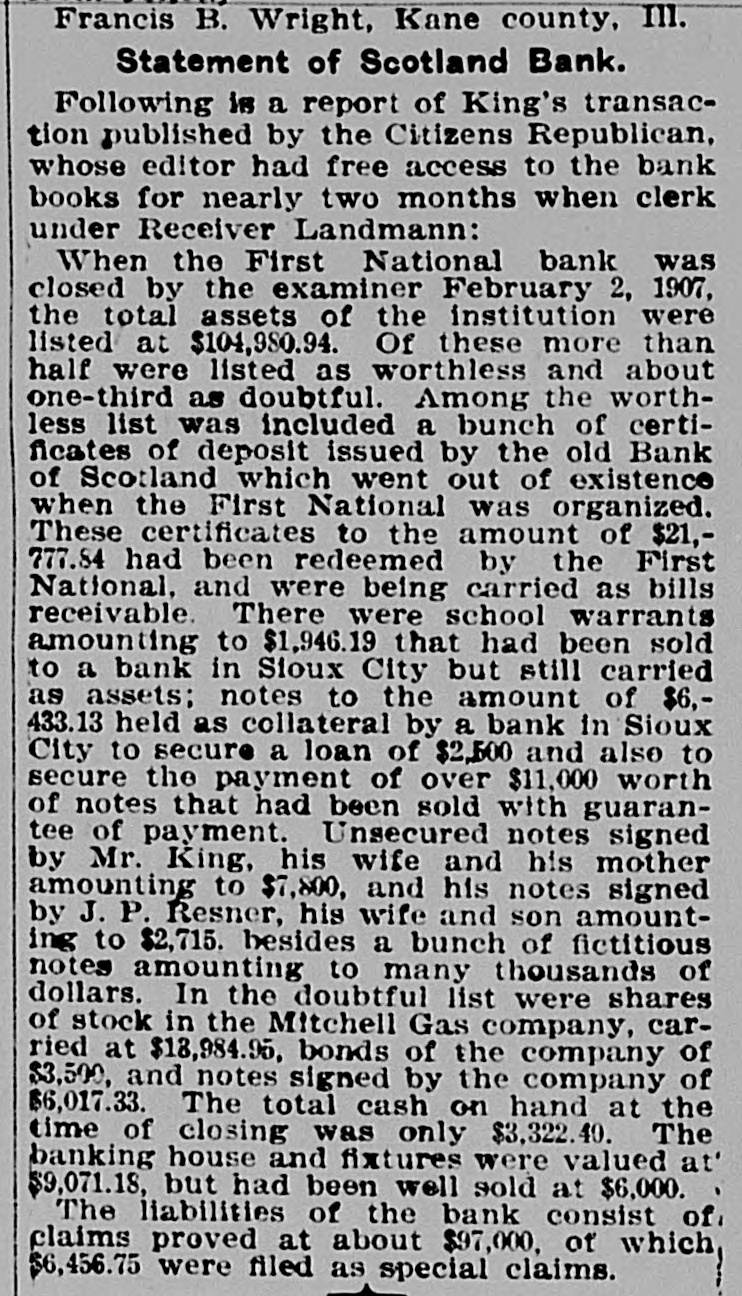
13 OTHER BANKERS TO KEEP C. C, KING COMPANY IN PRISON Scotland Bank Wrecker Joi Colony of His Kind in Leavenworth. Scotland, S. D., June 26.-Charles C. King, president of the defunct First National bank of Scotland is now in prison at Leavenworth under five years sentence. He is the fourteenth banker under sentence at this time to arrive at the Kansas penitentiary. The others are: Frank G. Bigelow, president First National bank, Milwaukee, Wis.: 58 years old; sentenced for 10 years from June, 10, 1905; "good time" term expires on February 10, 1912. Henry G. Goll, cashier First National bank, Milwaukee: 38 years old; sentenced for 10 years from May 5, 1906; "good time' term expires on January 5, 1913. Justus L. Broderick, president First National bank, Elkhart. Ind.: 57 years old; 10 years from April 21, 1904: "good time" term expires December 21. 1910. Wilson L. Collins, cashier First National bank, Elkhart. Ind.: 45 years old; six years from April 24, 1904; "good time" expires September 15, 1908. Walter Brown, director First National bank, Elkhart, Ind.: 43 years old: eight years from April 21, 1904; "good time" expires March 3. 1910. John P. Cooper, president First National bank. McGregor. Tex.: 47 years old: five years from March 3, 1904: "good time" term expires November 3, 1907. Gustave A. Conzman, president Vigo county (Ind.) National bank: 50 years old; eight years from January 29. 1906; "good time" term expires December 11, 1911. Alfred C. Parker, cashier First National bank. Bedford, Ind.: 38 years old; five years from May 28, 1904; "good time" term expires on January 28, 1908. Cyrus E. McCrady cashier First National bank, Seymour, Ind.: 41 years old: six years from May 2s, 1904; "good time" term expires October 22, 1908. John H. Wood, cashier First National bank. Matthews, Ind.: 44 years old: six years from January 9, 1905; "good time" term expores June 3, 1909. Robert B. Taylor, banker-forger, St. Louis, Mo.: 50 years old; five years from August 12, 1904; "good time" term expires April 12, 1908. Herman Haass, Chicago. (Transferred from Joliet.) Francis B. Wright, Kane county, III. Statement of Scotland Bank. Following is a report of King's transaction published by the Citizens Republican, whose editor had free access to the bank books for nearly two months when clerk under Receiver Landmann: When the First National bank was closed by the examiner February 2, 1907, the total assets of the institution were listed at $104,980.94. Of these more than half were listed as worthless and about one-third as doubtful. Among the worthless list was included a bunch of certificates of deposit issued by the old Bank of Scotland which went out of existence when the First National was organized. These certificates to the amount of $21,777.84 had been redeemed by the First National, and were being carried as bills receivable There were school warrants amounting to $1,946.19 that had been sold to a bank in Stoux City but still carried as assets; notes to the amount of $6,433.13 held as collateral by a bank in Sioux City to secure a loan of $2,500 and also to secure the payment of over $11,000 worth of notes that had been sold with guarantee of payment. Unsecured notes signed by Mr. King, his wife and his mother amounting to $7,800, and his notes signed by J. P. Resner, his wife and son amounting to $2,715. besides a bunch of fictitious notes amounting to many thousands of dollars. In the doubtful list were shares of stock in the Mitchell Gas company, carried at $13,984.95, bonds of the company of $3,500, and notes signed by the company of $6,017.33. The total cash on hand at the time of closing was only $3,322.40. The banking house and fixtures were valued at' $9,071.18, but had been well sold at $6,000. The liabilities of the bank consist of claims proved at about $97 of which


Article from Forest City Press, July 4, 1907

Click image to open full size in new tab

Article Text

Francis B. Wright, Kane county, Ill. # Statement of Scotland Bank. Following is a report of King's transaction published by the Citizens Republican, whose editor had free access to the bank books for nearly two months when clerk under Receiver Landmann: When the First National bank was closed by the examiner February 2, 1907, the total assets of the institution were listed at $104,980.94. Of these more than half were listed as worthless and about one-third as doubtful. Among the worthless list was included a bunch of certificates of deposit issued by the old Bank of Scotland which went out of existence when the First National was organized. These certificates to the amount of $21,777.54 had been redeemed by the First National, and were being carried as bills receivable. There were school warrants amounting to $1,946.19 that had been sold to a bank in Sioux City but still carried as assets; notes to the amount of $6,433.13 held as collateral by a bank in Sioux City to secure a loan of $2,500 and also to secure the payment of over $11,000 worth of notes that had been sold with guarantee of payment. Unsecured notes signed by Mr. King, his wife and his mother amounting to $7,800, and his notes signed by J. P. Resner, his wife and son amounting to $2,715. besides a bunch of fictitious notes amounting to many thousands of dollars. In the doubtful list were shares of stock in the Mitchell Gas company, carried at $18,984.95, bonds of the company of $3,500, and notes signed by the company of $6,017.33. The total cash on hand at the time of closing was only $3,322.40. The banking house and fixtures were valued at' $9,071.18, but had been well sold at $6,000. The liabilities of the bank consist of claims proved at about $97,000, of which, $6,456.75 were filed as special claims.


Article from The Citizen-Republican, July 25, 1907

Click image to open full size in new tab

Article Text

For Sale. Lot 1, Block 21, Lawler's Addition to Scotland, together with building thereon, known as the Resner blacksmith shop. Also lots 1, 2, 3, 4, 5,6,7,8, 9, in Block 11, Grant's Addition to Scotland, S. D. For further information address or call on PAUL LANDMANN, Receiver First National Bank, Scotland, S. D.


Article from The Citizen-Republican, August 8, 1907

Click image to open full size in new tab

Article Text

For Sale. Lot 1, Block 21, Lawler's Addition to Scotland, together with building thereon, known 98 the Resner blacksmith shop. Also lots 1, 2, 3, 4, 5, 6, 7,8,9, in Block 11, Stafford's Addition to South Scotland, S.D. For further information address or call on PAUL LANDMANN, Receiver First National Bank, Scotland, S. D.


Article from The Citizen-Republican, August 15, 1907

Click image to open full size in new tab

Article Text

For Sale. Lot 1, Block 21, Lawler's Addition to Scotland, together with building thereon, known as the Resner blacksmith shop. Also lots 1,2,3, 4, 5,6,7,8,9,in Block 11, Stafford's Addition to South Scotland, S. D. For further information address or call on PAUL LANDMANN, Receiver First National Bank, Scotland, S. D.


Article from The Citizen-Republican, August 22, 1907

Click image to open full size in new tab

Article Text

For Sale. Lot 1, Block 21, Lawler's Addition to Scotland, together with building thereon, known as the Resner blacksmith shop, Alsolots 1,2, 3, 4, 5, 6,7,8,9, in Block 11, Stafford's Addition to South Scotland, S.D. For further information address or call on PAUL LANDMANN, Receiver First National Bank, Scotland, S. D.


Article from The Citizen-Republican, September 19, 1907

Click image to open full size in new tab

Article Text

For Sale. Lot 1, Block 21, Lawler's Addition to Scotland, together with building thereon, known as the Resner blacksmith shop. Also lots 1, 2, 3, 4, 5, 6, 7,8, 9, in Block 11, Stafford's Addition to South Scotland, S. D. For further information address or call on PAUL LANDMANN, Receiver First National Bank, Scotland, S. D.


Article from The Citizen-Republican, September 26, 1907

Click image to open full size in new tab

Article Text

For Sale. Lot 1, Block 21, Lawler's Addition to Scotland, together with building thereon, known as the Resner blacksmith shop. Also lots 1, 2, 3, 4, 5, 6,7,8, 9, in Block 11, Stafford's Addition to South Scotland, S. D. For further information address or call on PAUL LANDMANN, Receiver First National Bank, Scotland, S. D.


Article from The Citizen-Republican, December 19, 1907

Click image to open full size in new tab

Article Text

Paul Landmann. as Receiver of the First National Bank of Scotland, South Dakota, Plaintiff,


Article from The Citizen-Republican, December 26, 1907

Click image to open full size in new tab

Article Text

Paul Landmann. as Receiver of the First National Bank of Scotland, South Dakota, Plaintiff, vs


Article from The Commonwealth, January 10, 1908

Click image to open full size in new tab

Article Text

FINANCIAL Jan. 21-Merchants' and Farmers' bank of Fairmont, Minn., suspended. Feb. 2-F. D. Gilman, former president suspended Home bank of Goodland, Ind., found guiltv of embezzlement. -First National bank of Scotland, S. D., close by bank examiner. 8-F. D. Gilman, Indiana banker, sentenced to term of one to three years in state prison. 5-Disappearance of $173,000 from subtreasury at Chicago made public. Mar. 14-Virtual panic in Wall street: Secretary Cortelyou relieved the situa19-Citizens' tion. State bank of Firth, Neb., closed by state. 28-Corbin Banking company of New York, assigned; assets, $3,000,000; liabilities, $1,700,000. Apr. 2-Maj, H. W. Salmon of Warsaw, Mo., convicted of illegal banking, sentenced three years in penitentiary. 11-Bank of Conception, at Clyde, Mo., ordered closed. 19-Ex-Judge Smith of Chicago, found guilty of conspiring to defraud stockholders and depositors of Bank of America, of which he was president; penalty, imprisonment and $1,000 fine. Jul. 1-Citizens' bank of Eureka Springs, Ark., suspended. 2-First National bank of Hicksville, O., closed by comptroner of currency 5-Fort Dallas National bank of Miami, Fla., clรณsed. 20-Farmers' National bank of Boyertown, Pa., ordered closed. Aug. 3-People's State bank of Brownstown, Ind., closed by state authorities. 14-Receivers appointed for Pope Mfg. Co., of Hartford, Conn.: failure ascribed to stringency of money market. Sep. 5-Watson & Co., members of New York stock and produce exchanges and of Chicago board of trade, failed. Oct. 9-Union bank of Richland, and Bowman bank of Kalamazoo, Mich., both private institutions, closed doors. 10-H. D. Reynolds' bank of Valdez, Alaska, closed doors. 16-First National bank of Dresden, O., failed. 16-Collapse of Heinze corner in copper caused violent slump in stocks in New York; firm of Otto Heinze & Co., suspended from stock exchange. 19--New York clearing house committee declared that the Heinze, Morse and Thomas interests had been eliminated from banking organizations of New York. 12-Knickerbocker Trust Co., New York's second largest financial institution, forced to suspend: great slump in securities; call money at 70 per cent. 3-Secretary of treasury ordered deposit of $25,000,000 of government funds in New York banks Four Westinghouse companies at Pittsburg and one trust company forced into hands of receivers because of financial stringency State Bank and TraNt Co., of Carson, Nevada, failed. 24-Three minor banks in New York forced to close Southern Steel Co., of Birmingham, Ala., filed involuntary petition in bankruptcy. 25-Six more minor banking institutions in New York closed doors. Union Trust Co., of Providence, R. I., sus6-Banks pended. In New York and Chicago and many other cities ellopted Maring house loan certificate system to prevent draining of supplies of currency and made withdrawal of savings deposits subject to legal notice. 10--California Safe Deposit & Trust Co. bank, at San Francisco, closed Financial conditions in New York practically normal again. Nov. 4-Three small banks in Kansas closed United States Steel corporation secured controlling interest in Tennessee Coal & Iron Co. -Receiver appointed for Arnold Print works of North Adams, Mass., one of largest textile concerns in country. 12-Merchants' National bank of Portland, Ore,, California bank of Oakland, Cal., and Farmers' & Merchants' bank of Sapulpa, I. T., suspended. 18-Secretary of Treasury Cortelyou ordered issue of $50,000,000 of Panama bonds and $100,000,000 certificates of indebtedness as means of relieving financial situation City National bank of Frederick, Okla., failed. 27-American Silk Co. capital stock, $11.000,000, which operated mills in several cities placed in hands of receiver.


Article from The Citizen-Republican, January 16, 1908

Click image to open full size in new tab

Article Text

Paul Landmann. as Receiver of the First National Bank of Scotland, South Dakota, Plaintiff, vs.


Article from The Detroit Times, November 1, 1912

Click image to open full size in new tab

Article Text

YELP OF PANIC RIDICULED BY JOHN T. WINSHIP Shows Last Period of Depression Was Under G. O. P. High Tariff in 1907 PROVES CONTENTION BY NEWSPAPER STORIES Says Country is Prosperous Now Under Prospect of Democratic Victory "It is interesting to compare what the Republican party is saying today about a Wilson panic with the headlines and dispatches in the newspapers in 1907, under Roosevelt's Republican high-tariff administration, says John T. Winship, of the Democratic state committee. Mr. Winship has had collected a number of headlines and items that appeared during that Republican panic. Here are some samples: New York, Jan. 2, 1907: "Great industrial crisis, says Stuyvesant Fish.' Cleveland, Jan. 3: "The private bank of Colorado, Denko, on the west side, closed last night." Pittsburgh, Jan. 31: "Production to be curtailed. Window glass manufacturers to lay off an army of employes soon." Washington, Feb. 13: "The First National bank, of Scotland, S. D., closed its doors today." Detroit, Feb. 13: "Miles of empty