Commercial Bank (Russiaville, IN)

Episode Information

Episode UID
7081226891121
Episode Type
Suspension → Closure
Bank Type
state
Bank ID
708122689 hash
Start Date
May 1, 1893*
Location
Russiaville, Indiana (40.418, -86.271)

Metadata

Model
gpt-5-mini (chosen from majority vote of a three-model LLM ensemble)
Short Digest
ae7ba07c63a76b80

Response Measures

None

Description

Articles refer to it as the Commercial State Bank of Russiaville; receiver testimony confirms permanent failure.

Events (2)

1. May 1, 1893* Receivership
Newspaper Excerpt
C. E. Waddell, receiver of the Commercial Bank of Russiaville, testified that the bank suspended in May, 1893.
Source
newspapers
2. May 12, 1893 Suspension
Cause
Correspondent
Cause Details
Immediate collapse followed suspension/failure of the Columbia National Bank of Chicago, which was a correspondent/controlling interest.
Newspaper Excerpt
Commercial State Bank of Russiaville could not meet its demands, owing to the suspension of the Columbia National Bank of Chicago.
Source
newspapers

Newspaper Articles (18)

Article from The Wheeling Daily Intelligencer, May 13, 1893

Click image to open full size in new tab

Article Text

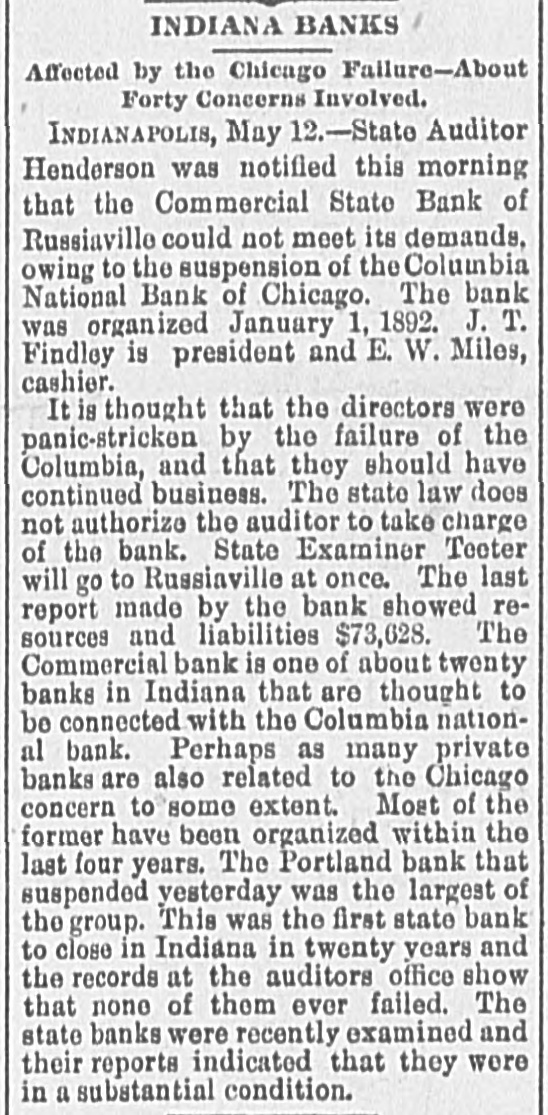
INDIANA BANKS Affected by the Chicago Failure-About Forty Concerns Involved. INDIANAPOLIS, May 12.-State Auditor Henderson was notified this morning that the Commercial State Bank of Russiaville could not meet its demands, owing to the suspension of the Columbia National Bank of Chicago. The bank was organized January 1, 1892. J. T. Findley is president and E. W. Miles, cashier. It is thought that the directors were panic-stricken by the failure of the Columbia, and that they should have continued business. The state law does not authorize the auditor to take charge of the bank. State Examiner Teeter will go to Russiaville at once. The last report made by the bank showed resources and liabilities $73,628. The Commercial bank is one of about twenty banks in Indiana that are thought to be connected with the Columbia national bank. Perhaps as many private banks are also related to the Chicago concern to some extent. Most of the former have been organized within the last four years. The Portland bank that suspended yesterday was the largest of the group. This was the first state bank to close in Indiana in twenty years and the records at the auditors office show that none of them ever failed. The state banks were recently examined and their reports indicated that they were in a substantial condition.


Article from Wheeling Register, May 13, 1893

Click image to open full size in new tab

Article Text

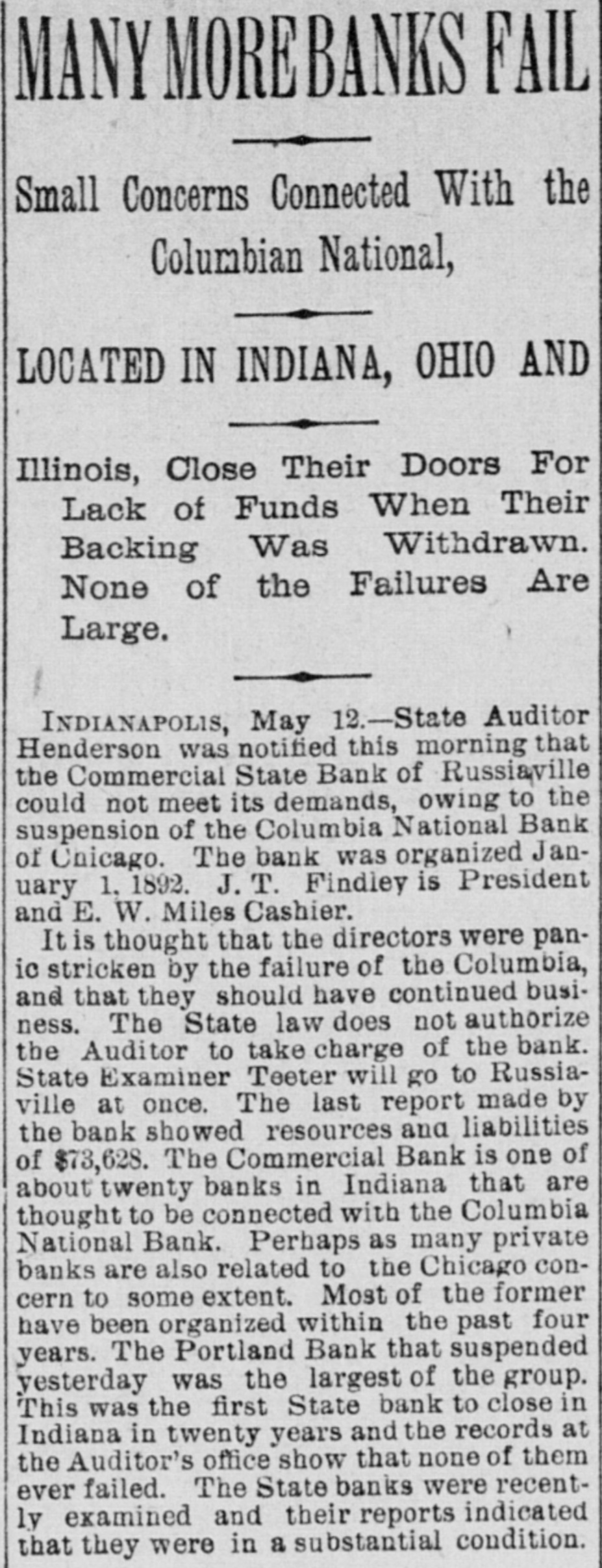
MANY MOREBANKS FAIL Small Concerns Connected With the Columbian National, LOCATED IN INDIANA, OHIO AND Illinois, Close Their Doors For Lack of Funds When Their Backing Was Withdrawn. None of the Failures Are Large. INDIANAPOLIS, May 12.-State Auditor Henderson was notified this morning that the Commercial State Bank of Russiaville could not meet its demands, owing to the suspension of the Columbia National Bank of Chicago. The bank was organized January 1. 1892. J. T. Findley is President and E. W. Miles Cashier. It is thought that the directors were panic stricken by the failure of the Columbia, and that they should have continued business. The State law does not authorize the Auditor to take charge of the bank. State Examiner Teeter will go to Russiaville at once. The last report made by the bank showed resources and liabilities of $73,628. The Commercial Bank is one of about twenty banks in Indiana that are thought to be connected with the Columbia National Bank. Perhaps as many private banks are also related to the Chicago concern to some extent. Most of the former have been organized within the past four years. The Portland Bank that suspended yesterday was the largest of the group. This was the first State bank to close in Indiana in twenty years and the records at the Auditor's office show that none of them ever failed. The State banks were recently examined and their reports indicated that they were in a substantial condition.


Article from The Wilmington Daily Republican, May 13, 1893

Click image to open full size in new tab

Article Text

MANY BANK FAILURES. Panic Stricken Bankers in Indiana Country Towns. DRAGGED DOWN BY THE COLUMBIA. The Panic Spreads to Michigan and Ohio Banks, and Several Suspensions Are Added to the List in These States-Pecullar Methods of the Columbia Bank. May 13.-The failure of the a Columbia CHICAGO, National bank has disclosed of shystering without a parallel and in system American banking. The president to of the Columbia is shown have manager organized about fifty small concerns and insignificant points in Indiana of at all of which were correspondents likely Ohio, broken bank, and it is scarcely the the that of them will survive. But litany were at places where there was be banks business the moral effect is likely to The tle serious than the actual business losses. in Columbia more had very little chiefly Chicago, and such as it had was were with customers who, like the bank, the without commercial standing. Hence business was not felt in reputable other failure and had it occurred at any half circles, time it would have been forgotten in an hour. PORTLAND, Ind., May 13.-A courier the Dunkirk announces the failure of confrom Dunkirk bank, which is owned and by Dwiggins, Starbuck & Co., filed of trolled Chicago. Attachments were at once to and deputy sheriff left immediately The a all the available property. the levy on has failed for at least $75,000, and bank may reach $100,000. The firm con- of trolling amount this bank owns a number and these are reported to havegone enothers, to the wall. The Geneva bank of their terprise also has failed. INDIANAPOLIS, Ind. May 13.-State Audi- ComHenderson was notified that the could tor mercial State bank, of Russiaville, its demands. The Commercial in not meet is one of about twenty banks Indiana bank that are thought to be connected as with the Columbia National. Perhaps to the private banks are also related many Chicago concern to some extent. Reports show other small places in the state banks. that from a panic has seized the smaller county, bank at Brookston, White (o statesuspended The yesterday afternoon. made. It of its condition has been ment controlled by the Columbia National. was banks of the Columbia Nationalstring said to The Moreystown and Greenwood are liabilities at have also failed, the latter with amounting to $60,000. The Moreystown bank is of considerable importance, having a capital addition of $75,000. to the above the following bank, In are reported: Citizens' suspensions Ind. Bank of Spiceland, SpiceHebron, Ind.; Monroeville bank, Monroeville, Ind., land, Commercial bank, Norristown, these Ind.; Citizens' bank, Knox, Ind. All of were and branches of the Columbia National Chicago. INDIANAPOLIS, May B.-The directors that the Capital National bank claim and of has been no loss on discounts, dollar. there not a department has lost a that bank, they say, is more than solvent. The will ask the examiner to permit They resumption after an examination. FORT WAYNE, Ind., May 13, -News Mer- of suspension of the Farmers' and reached chants' the bank at Geneva, Ind., has the here. It was the oldest institution of kind in the town. CINCINNATI, O., May 13. -The private & firm of Dwiggins, Starbuck failed. banking at Williamsburgh, O., has of the Co., failure is due to the failure Mr. The Columbia bank, of Chicago, of which is was cashier. About $8,000 the Dwiggins the Williamsburg bank from will due Columbia, all of which, it is thought, Williamslost. The postmaster at be ordered the arrest, for alleged burgh, embezzlement, of Lawrence G. Good, cusexpert accountant. He was taken in tody. O., May 13.-The Farmers' CONVOY, of this place, has closed its doors, bank caused by its relations with the Columbia National. EDWARDSBURG, Mich., May 13. -The Cit- its bank, of this place, has closed izens' About $25,000 of local deposits, todoors. gether with township and school funds, Chiare re affected. It was a branch of the cago Columbia. RICHLAND, Mich., May 13. -The Union a branch of the Columbia National bank, bank, of Chicago, has closed its doors. Cashier Watts says that the depositors will be paid in full and the bank running again in two or three days. CHARLEVOIX, Mich., May 13.-W. P. & Co., bankers, doing business unBrown the name of the Bank of Charlevoix, Kane. have der made an assignment to R. W. PAW PAW, Mich., May 13. Great excitement prevails at Lawton. The managers the in of a local bank there did not open town stitution yesterday, having left Thursday night. Citizens have about$18,000 deposited in the bank. LAWTON, Mich., May 13.-The American It of this city has closed its doors. bank controlled by the Columbia National business bank is of Chicago. Nearly every in the city is involved, besides depositors. many farmers man and others who were The deposits amount to about $30,000. SAN JOSE, Cal., May -The liabilities to the Santa Clara bank are now stated by of $300,000. Assurances had been given the be officers of the bank that the depositors would be paid in full


Article from Daily Independent, May 13, 1893

Click image to open full size in new tab

Article Text

BANK FAILURES. Dispatches from the east report the following bank failures yesterday: The Commercial State Bank of Russiaville and the Farmer's Bank of Greentown, Indiana, both under one management, failed for $60,000; the Commercial Bank of Brookston and the bank at Greenwood, Ind., closed their doors. The private bank of Dwiggins, Starbuck & Co. at Williamsburg, Ohio, the Citizens Bank of Edwardsburg, and the Bank at Lawton, Mich., and Richard J. Horner banker, merchant and speculator of Grand Ridge, Ill., also closed their doors yesterday. The liabilities of the R. R. Robinson & Co., the suspended bankers of Wilmington, Del., are $323,000, assets $200,000. 'The Knights of Pythias had a large amount of money in the bank, which is understood to be about $70,000. There must be something radically wrong in our financial system or there would not be so many bank failures. A system of finance that makes the property of the rich more valuable while it depreciates that of the masses by increasing the purchasing power of gold, thereby depreciating silver and driving it out of circulation, should not be tolerated by a free people. Their voices should be heard in the next Congress and Vtailing there the masses should arise in their manhood, shake off party ties and when the congressional elections occur again, see to it that all who vote for the gold standard be relegated to private life and a Congress elected that will stand between the people and the money sharks. Free coinage of silver cannot be an injury to the masses. It would put more money into circulation, furnish labor for thousands now idle, set the machinery of factories in motic n, start the tires in deserted furnaces, make the mountains and canyons of the mining States ring with the hum of industry and cast its blessings broadcast throughout the land. The farmer would receive higher prices for his produce, the mechanic, laborer and professional man would be better paid, and homes now blighted by poverty would be radiant with the light of better times.


Article from Waterbury Evening Democrat, May 13, 1893

Click image to open full size in new tab

Article Text

BANK FAILURES INDIANAPOLIS, May 13.-State Auditor Henderson was notified at noon that the Commercial State Bank of Russiaville could not meet its demands owing to the suspension of the Columbia National Bank of Chicago. It is thought that the directors were panie-stricken by the failure of the Columbia and that they should have continued business. The State law does not authorize the Auditor to take charge of the bank. Bank Examiner Tooter will go to Russiaville at once. The last report made by the bank showed resources and liab ities $73,628. The Commercial bank is one of about 20 banks in Indiana that are thought to be connected with the Columbia National. Perhaps as many private banks are also related to the Chicago concern to some extent. Most of the former have been organized within the last four years. This has been the first State bank to close in Indiana in 20 years, and the records at the Auditor's office show that none of them ever failed.


Article from Morning Journal and Courier, May 13, 1893

Click image to open full size in new tab

Article Text

MANY BANKS CLOSED. Great Excitement Prevails in Several Towns-Managers of Some Banks Have Left Town. DETROIT, May 12.-A Journal special from Edwardsburg, Mich., says: The Citizens' bank of this place displayed a notice on its door this morning which reads as follows: "Out of town on business; back at noon." Dwiggins, Starbuck & Co. of the Columbia National bank of Chieago held a large share of the stock in the Citizens' bank. Citizens of this place are interested to the extent of $25,000. Township and school funds are also tied up. It is impossible to say how matters will turn out until Banker Kleckoner returns,but it is believed depositors will be paid in full. KOKOMO, Ind., May 12.-The Commercial State bank of Russiaville and the Farmers' bank at Greentown, both under one management, closed their doors this morning with deposits of $60,000. CHARLEVOIX, Mich., May 12.-W. P. Brown & Co., bankers, doing business under the name of the Bank of Charlevoix, have made an assignment to R. W. Kane. Paw Paw, Mich., May 12.-Great excitement prevails at Lawton. The managers of a local bank there did not open the institution this morning, havi left town last night. Citizens have some $18,000 deposited in the bank. GENEVA, Ind., May 2.-The Farmers' and Merchants' bank closed its doors today. No statement has been given out. CONVOY, O., May - The Farmers' bank here closed its doors to-day. The failure was caused by its relations with the Columbian bank of Chicago. No state. ment of the bank's condition has been made. CASEY, Ill., May 12.-The Columbian bank is the principal stockholder in the Farmers' and Merchants' bank of this city. The Farmers' and Merchants' assigned today. The assets are probably $16,000. Liabilities $25,000, or over. INDIANAPOLIS, Ind., May 12.-Reports from various small places in the state show that a panic has seized the smaller banks. The bank at Moreystown is said to have failed. It had a capital of $75,000. The bank of Greenwood, Ind., has closed its doors on account of the failure of the Columbia bank of Chicago, Ill. No statement is obtainable. Knox, Ind., May 12.-The banks at Walkerton, Arcadia and India have suspended. All depended upon the Columbia. CHICAGO, May 12.-About forty country banks in Indiana, Illinois, Michigan and Ohio have connected with the Columbia bank combination.


Article from Morning Appeal, May 13, 1893

Click image to open full size in new tab

Article Text

GOLD BUG FINANCE. The Money Pressure Causes an Avalanche of Bank Failures. 3 Cincinnati, May 12,-Tha private bank of Dwiggins, Starbuck & Co., at Williamsburg, closed its doors this morning ou the orders from h Dwiggins, President of the Columbia Bank at Chicago. It was a branch of that bank. Its assets are $35,000 and liabilities $60,000. An expert accountant employed at the bank yesterday came here early this morning and was arrested, charged with embezzlement. It is suspected that he was employed to conceal some of the funds of the bank. Indianapolis, May 12.-The Commercial Bank of Brookston has failed. No statement of its assets or liabilities have been made. It was controlled by the Columbia Bank at Chicago Ottawa, III., May 12.-Richard J. Hornick, banker, merchant and speculator of Grand Ridge failed, owing to a run on the bank caused by financial entanglement with his brother, John Hornick of Sioux City. Edwardsburg, Mich., May 12. The Citizens' Bank displayed a notice on the door this morning as follows: "Out of town on business. Will be back at roon." Dwiggins, Starbuck & Co., of the Columbia National Bank at Chicago held a large share of stock in the Citizens' Bank. The citizens of this place are interested to the extent of $25,000. The tewnship and school funds are also tied up. The manager of the local bank at Lawton, Michigan, has left town and the bank is closed. Its liabilities are small, Indianapolis, May, 12.-The bank of Greenwood, Ind., has closed its doors on account of the failure of the Columbus Bank at Chicago. No statement. Kokomo, Ind., May 12-TheCom mercial State Bank of Russiaville and the Farmers' Bank at Greentown, both under one management, failed this morning for $60,000. The failure of the Columbia Bank at Chicago was responsible for the collapse. About twenty other banks in Indiana are connected to some extent with the Columbia Bank, and a like number of private banks, mostly small concerns. Wilmington, Del., May 12-The liabilities of R. R. Robinson & Co., the suspended bankers, are $323,000; assets $200,000. The Knights of Pythias had a large amount of money in the bank; it is understood to be about $70,000. London, May 12.-The advance in the rate of discount by the Bank of England yesterday to 3 per cent, rendered the regular fortnightly settlement of accounts on the Stock Exchange very difficult, and five small banks have failed. A better feeling prevails in the market for American securities. New York, May 12.-A report is current in Wall Street that the Comptroller of the Currency has ordered an immediate examination into the condition of four city banks. Inquiry failed to show any foundation for the report. All the city banks are believed to be solid.


Article from New-York Tribune, May 13, 1893

Click image to open full size in new tab

Article Text

STOCKS IGNORE BAD NEWS. A SMALL SHIPMENT OF GOLD. GLOOMY LONDON ADVICES CAUSE LITTLE DEPRERSION-BANKS IN THE WEST. Affairs mained quiet in Wall Street yesterday. and the security markets showed a considerable degree of steadiness in the face of adverse influences and unfavorable news. At the Stock Exchange the cessation of compulsory liquidation on a large scale encouraged the bull traders to work for raily. but the long stocks came out improvement and sales imparted an Irreg aspect to the stock market. Although no local Voubles were developed. the Incidents of the day were not of a cheering character, and the sentiment among conservative bankers remained strongly conservative. The monetary situation abroad 14 assuming fresh Importance as It relates to home affairs. The cables announced that the Imperial Bank of Germany had advanced its discount rate from 3 per cent to 4 per cent. This Is accepted as a positive Indica ion of a determination of the Continental European banks to withhold their gold from London, and hence the Bank of England will be forced to turn to the American market for supplies. Private discount rates in London rose to 3 3-4 per cent. an excess of 1-4 per cent over the bank's rate of discount. The Bank of England lost nearly £500,000 bullion on balance, representing shipments of gold to Anstralia. London advices were gloomy, seven jobbing" brokers having been in default on the fortnightly settlement. These failures are comparatively unimportant, but they were accompanied by reports that two leading houses were compelled to carry through some of the bills in the American all shares department, and there were rumors affecting a house which has been dealing in Greek securities. Amazement is shown here at the comparative strength of American stocks in London amid the gloomy atmosphere at that financial centre. to The foreign exchanges here are about back the rates which ruled in the Importers' panic in the latter part of April. Posted rates for sterling exchange advanced to 81 86@$4 90, and actual business is done within a close range to these figures. The lates on sterling bills now show a margin of profit on gold shipments to London of about 12 cent to the pound sterling. There is a strong demand for both sixty-day bills and sight drafts. Bankers do not believe that these rates will be maintained without leading to heavy exports of gold by London houses. These houses have heretofore thrown the onus of gold exports upon foms with close Count nental connections. but the French and German banks are protecting their stores of gold with higher rates for money. so that it is impracticable to make ex change transactions that permit London to draw from the Continent specie which had been received from the United States. The bankers here are fighting off as long as possible the necessity of shipping the yellow metal directly to England, but it is feared that the strength of sterling exchange will compel large shipments next week. There will be shipped to-day $300,000 gold on the French steamer La Gascogne, but this sum has been in the hands of bankers. and therefore its export represents Do new loss to the Sub Treasury. If the gold movement reaches large proportions next week the Treasury will lose unless the city banks consent to a partial depletion of their reserves. Disquieting rumors came from Washington yesterday respecting a proposed examination of four NewYork banks, which, it was said. had been ordered ty James H. Eckels, Controller of the Currency The reports were subsequently denied. William H. Kimball. National Bank Examiner for this district, said that he had received no instructions from the Controller. and had no reason to expect any. Mr. Kimball said that he bolleved the New-York banks were in an unusually sound and strong condition. Prominent members of the Clearing House emphatIcally denied that there was any reason for suspecting weakness among any of the city banks. The conservative course of these Institutions has forti fied them to an extent that they are not likely to suffer, even should there be further bank suspensions at the West. Bankers say they are not building up any false hopes or delusions, but are satisfied from personal knowledge of the strength and soundness of the financial institutions of the city. The advices from Chicago, however, indicate that the collapse of the Columbia National Bank of that city will have far reaching results at the West. This is because of the reprehensible method of Zimri Dwiggins, president of the Columbia, and his associates, which were described In The Tribune yesterday. The chain of country banks which the Dwiggins syndicate built up around the Columbia has been badly broken by the failure of the central institution. How far the methods of manipulating the stocks and deposits of these related concerns have impaired their real strength may only be revealed by Investigation and further disclosures, but bankers here fear that there will be widely distributed losses in the little country towns of Indiana Illinois, Michigan and Ohio. As the peculiar style of the Dwiggins banking syndicate created many fictitious assets it is believed that most of the failures resulting from the collapse The of the Columbia National will be bad ones. East. however, will not suffer from the exposures The damage will fall upon the Western communities that may have been deluded by the Dwiggins schemes of manufacturing cash and credit out of stationers and painted signs. Bankers say that the failures of this sort may do comparatively little injury to the legitimate business interests at the West. but general regret is felt at the hurt to confidence which may be caused by the tumb down of the Dwiggins houses of cards. Up to the close of business yesterday news had been received of the suspension of seven small State banks at the West as the consequence of the ChiIn cago suspension. Four of these concerns were Indiana, two in Michigan and one in Ohio, the latter being a private banking house run under the name of Dwiggins, Starbuck & Co. Some bankers here yesterday had a list compiled of the State banks or banking houses in the West which had connections with the Columbia National Bank of Chicago, the majority of which were started directly by the Dwiggins syndicate. The result was astonishing There are forty-nine concerns of this sort in Indiana. sixteen in Illinois, eleven in Michigan and nine in Ohio, a total of eighty-five in the four States, The financial mortality among these. it is feared. will be heavy. The concerns that went up yesterday sequel to the Dwiggins collapse in Chicago were the Dunkirk Bank, of Dunkirk, Ind.: the Commercial State Bank of Russiaville, Ind.: the Farmers' Bank, of Greentown, Ind. the Geneva Bank, of Geneva, Ind Dwiggins, Starbuck & Co., of Williamsburg. Ohio: the Bank of Charlevoix, of Charlevoix, Mich., and the Lawton Bank, of Lawton, Mich. The stock market at the Stock Exchange was far less active than on the previous days of the week, only 264,720 shares being traded in. London quota tions came above yesterday* New-York parity, to the surprise the of most persons. The contrast of prices with depressing advices from London created the home picion of manipulation from New York. The susshowed market and some early declines, but soon rallied made general advance. But were virtually the Instances first prices in the majority of day. There was quiet the count selling credited to London through the day, acIrregularity increased and the speculation developed to the mon stock near the close. St. Paul comcontinued activity and opening 7-8 be leader point of Rock ceded 7034871 up per cent at 715-8, reChicago, 107278 and declined Island rose 1-2 per cent and Quiney Burangton Pacitle preferred sold gained but later Northern at opened Western but sagged gained 34 Thursday night, ending cent to 84 1-4. dropped Union rose fell Lackawanna about gossip Cattle Feeding, 12.10137. Distilling and from fell and then to rallied ship, 17 5-8


Article from Rock Island Daily Argus, May 13, 1893

Click image to open full size in new tab

Article Text

BANKING ON WIND. Alleged Facts About the Columbia Concern. DIRECTORS TALK OF RESUMPTION, But Matters Are In a Much Mixed Condition-Development of Financier Dwig-Operations of His County Bank Scheme-Connections That Have Gone Inder-Correspondents in Illinois-Im tators at Indianapolis-An Epidemic of Failures. CHICAGO,May 3.-Interesting disclosures are promised in connection with the investigation into the Columbia National bank failure. The directors have held a meeting to discuss the practiciability of resuming, but the result of their affairs of the bank are in such deliberations was not given out. The a thorough mix that it is not known just how matters stand. Zimri Dwiggins. president of the Columbia bank, was a banker at Attica, Ind., ten or twelve years ago and at that ti e established close relations with G. W. Wiggs and J. M. Starbuck, who were running a system of bucket shops under the name of Wiley, Strawbridge & Co. Sunk $300,000 in a Silver Mine. They determined to start a bank and organized the United States National bank with a capital of $50,000. The bucket shop business was subsequently broken up un der the bucket shop law, the bank being left in Dwiggins' control while Wiggs went to New Mexico. The stock of the United States bank was swelled to $500,000 and Wiggs, who had discovered an alleged gilt-edged mine, drew $300,000 to pay for it. The mine was to be sold to English investors. The mine was a "dead horse" and never panned out. Took Up a Country Bank Scheme. Nothing daunted by the failure of the New Mexican scheme, Dwiggins and Starbuck undertook the establishment of a chain of country banks. It is not own how many were then organized, but after the Columbia was established they went it with vim, and their connections are now more extensive than before. The scheme was to visit some well-known and well-todo farmer in a town and secure his services s cashier of a branch, the farmer taking a large block of stock. The money was advanced by the Columbia and some one put in control whom they could manipulate The country bank stock thus acquired was either used as collateral for loans by the Columbia National or bought outright. As the money sent out into the country soon came back to the reserve center the bank was not out of cash long, and practically no capital was required in the promotion business, Got on Too Heavy a Load. The Columbia, however, finally got load ed up with country bank stock for which it had no special use, and then it was de termined to organize a company to take stock, issue debenture bondson them and sell the bonds, The United States Loan and Trust company was according ly put in the field, with Zimri Dwiggins as president, and incorporated under the laws of Indiana, The company represented that upon the basis of country bank stocks yielding 8, 10 and 12 per cent. dividends and 6 per cent debenture bonds would be issued. Who Is Good for the Loan Company? To make the bond good the United States Loan and Trust company guaranteed the payment of principal and interest. The scheme caught on in good style and it is known that at one financial concern's office $250,000 of the United States Loan and Trust company's debentures had been registered. The approximate amount of bank stock held for this is 8450,000 and President Dwiggins.ha $500,000 more on hand. The nited States Loan and Trust company has no visible assets except about $1,000 in office furniture. Country Concerns That Failed. The following banks connected with the Dwiggins-Starbuck-Columbia bank combination, have closed: Commercial bank of Brookston, Ind.: bank of Dunkirk, Ind.: Commercial bank of Morristown, Ind.; Commercial bank of Russiaville, Ind.: Citizens' bank of Edwardsburg, Mich.: Union bank of Richland, Mich., Others in Indiana: Bank of Spiceland, at Spiceland, capital $36,000, Dwiggins subscribing $13,000 thereof; Citizens Bank of Hebron; Citizens' State Bank, of Knox (Dwiggins): Bank of Orleans at Orleans (Paris & Nave); banks at Walkerton, Arcadia, Oxford and Boswell. Correspondents in Illinois. There are a good many correspondents in Indiana and the following in Illinois: Byon's bank,of Byron (Dwiggins, Starbuck & Co.); Farmers' and Merchants bank of Casey; Bank of Lynn, East Lynn (O. A. Ross); Georgetown bank (Dwiggins, Starbuck & Co); First National bank of Hoopestown, capital $50,000; People's bank of Martinsville; Farmers' and Merchants' Carmel; State Bank of Farmers' Bank of Boyden & Son's of capital farm; Sheffield; Mount A. $25,000; W. bank, Ridge- Orian, of Spring Valley National bank, capital $50,000. Creditors Assured of Their Money. Crowds of people congregated around the offices of the Columbia National bank, but who were assured from notices posted by those had drawn on the bank that they themselves would see to the liquidation all given such drafts, and other assurances were of by officials that all would get their money. DID A DWIGGINS BUSINESS.


Article from The Salt Lake Herald, May 13, 1893

Click image to open full size in new tab

Article Text

INDIANA BANKS GO UP. Two Private Banks Fail with Liabilities of $60,000. KOKOMO, Ind., May 2.-The - Commercial State bank of Russiaville and the Farmers' bank at Greentown, both under one management, failed this morning for $60,000. The failure of the Columbia bank, Chicago, is responsible for the collapse. About twenty other banks in Indiana are connected to some extent with the Columbia bank, and a like number of private banks, mostly small concerns. The stockholders of the collapsed bank at Greentown held a meeting, with a view of taking legal steps to protect themselves. The Commercial bank at Walkerton, owned and controlled by the Columbia National bank, of Chicago, has closed. At Geneva the Farmers' and Merchants' bank suspended today, at noon. It was connected with the Columbia National, of Chicago.


Article from St. Paul Daily Globe, May 13, 1893

Click image to open full size in new tab

Article Text

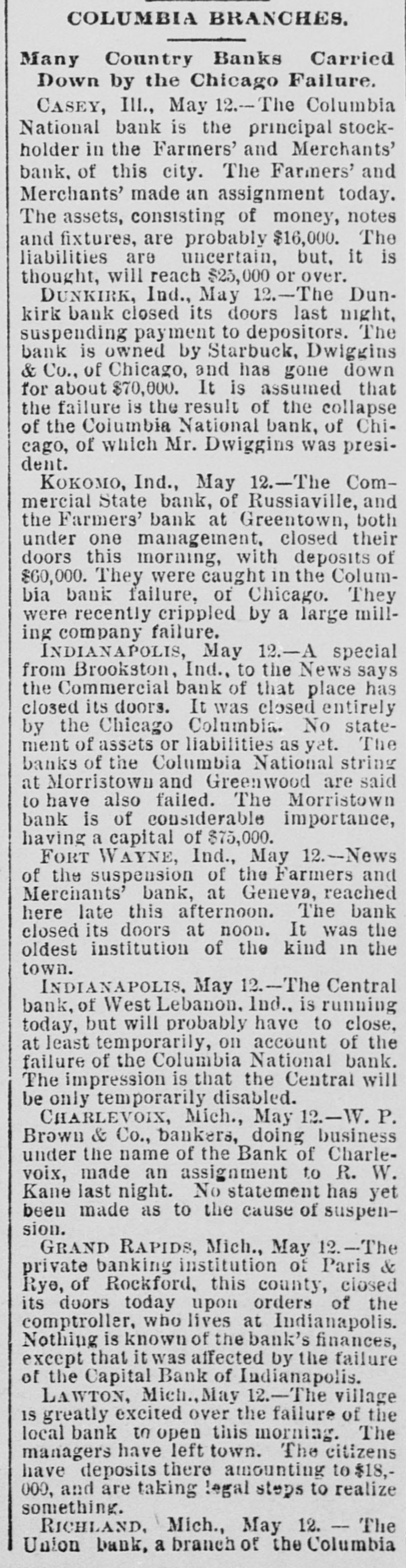
COLUMBIA BRANCHES. Many Country Banks Carried Down by the Chicago Failure. CASEY, III., May 12.--The Columbia National bank is the principal stockholder in the Farmers' and Merchants' bank. of this city. The Farmers' and Merchants' made an assignment today. The assets, consisting of money, notes are are uncertain, and liabilities fixtures, probably $16,000. but, it The is thought, will reach $23,000 or over. DUNKIRK, Ind., May 12.-The Dunkirk bank closed its doors last night, suspending payment to depositors. The bank is owned by Starbuck, Dwiggins & Co., of Chicago, and has gone down for about $70,000. It is assumed that the failure is the result of the collapse of the Columbia National bank, of Chicago, of which Mr. Dwiggins was president. KOKOMO, Ind., May 2.-The Commercial State bank, of Russiaville, and the Farmers' bank at Greentown, both under one management, closed their were in $60,000. doors this They morning, caught with deposits the Colum- of bia bank failure, of Chicago. They were recently crippled by a large milling company failure. INDIANAPOLIS, May 12.-A special from Brookston, Ind., to the News says the Commercial bank of that place has closed its doors. It was closed entirely by the Chicago Columbia. No statement of assets or liabilities as yet. The banks of the Columbia National string at Morristown and Greenwood are said to have also failed. The Morristown bank is of considerable importance, having a capital of $75,000. FORT WAYNE, Ind., May 12.-News of the suspension of the Farmers and Merchants' bank, at Geneva, reached here late this afternoon. The bank closed its doors at noon. It was the oldest institution of the kind in the town. INDIANAPOLIS. May 12.-The Central bank, of West Lebanon. Ind., is running today, but will probably have to close, at least temporarily, on account of the failure of the Columbia National bank. The impression is that the Central will be only temporarily disabled. CHARLEVOIX, Mich., May 12.-W. P. Brown & Co., bankers, doing business under the name of the Bank of Charlevoix, made an assignment to R. W. Kane last night. No statement has yet been made as to the cause of suspension. GRAND RAPIDS, Mich., May 12.-The private banking institution of Paris & Rye, of Rockford, this county, closed its doors today upon orders of the comptroller, who lives at Indianapolis. Nothing is known of the bank's finances, except that it was affected by the failure of the Capital Bank of Indianapolis. LAWTON, Mich., May -The village IS greatly excited over the failure of the local bank to open this morning. The managers have left town. The citizens have deposits there amounting to $18,000, and are taking legal steps to realize something. RICHLAND, Mich., May 12. -- The Union bank, a branch of the Columbia


Article from The Record-Union, May 13, 1893

Click image to open full size in new tab

Article Text

tions Also Suffer. Special to the RECORD-UNION. NEW YORK, May -The fact that commercial is although very paper slowly, beginning is leading to move, to the belief that bankers think the crisis past, as far as New York is concerned. The idea is that the stringency has been sufficient to uncover weak spots and bring rottenness to light wherever it exists. This, however, is little more than a "pious opinion" on the part of a few bankers, and as far as the largest and conservative banks are concerned, there is no relaxation to restrictions on commercial paper. Some time loans have been made at 6 per cent. on good mixed collateral, but only to substantial houses. OUT OF TOWN ON BUSINESS. EDWARDSBURG (Mich.), May 12.-The Citizens' Bank displayed a notice on its door this morning as follows: "Out of town on business; back at noon." Dwiggins, Starouck & Co. of the Columbia National Bank of Chicago held a large share of the stock in the Citizens' Bank. The citizens of this place are interested to the extent of $25,000. The township and school funds are also tied up. The manager of the local bank at Lawton, Mich., has left town. His bank is closed. The liabilities are small. IN THE SHERIFF'S HANDS. MILWAUKEE, May 12.-The stores of Frank A. Lappen & Co. and the Lappen Furniture Company, doing an immense business in dry goods and house furnishing, are in the hands of the Sheriff on executions aggregating over $65,000. ANOTHER BANK GOES. INDIANAPOLIS, May 12.-The Commercial Bank of Brookston has failed. There is no statement of assets or liabilities. It was controlled by the Columbia Bank of Chicago. TWO SMALL CONCERNS. KOKOMO (Ind.), May 12.-The Commercial State Bank of Russiaville and the Farmers' Bank of Greentown, both under one management, failed this morning for The failure of the Columbia is About twenty in Indiana some collapse. Bank $60,000. at are Chicago connected responsible to other banks extent for the with the Columbia Bank, and like a number of private banks, are mostly small concerns. THE WILMINGTON FAILURE. WILMINGTON (Del.). May 12.-The liabilities of R. R. Robinson & Co., the suspended bankers, are $325,000; assets, $200,000. The Order of the Knights of Pythias had a large amount of money in the bank. It is understood to be about $70,000. CINCINNATI BANKERS GO UNDER. CINCINNATI, May 12.-The private bank of Dwiggins, Starbuck & Co., at Williamsburg, O., closed its doors this morning on orders from Dwiggins, President of the Columbia Bank at Chicago. It was a branch of that bank. The assets are $35,000; liabilities, $60,000. The expert accountant employed at the bank yesterday came here early this morning and was and ment. It is arrested suspected charged that with he embezzle- has been employed to conceal some funds of the bank. AN OTTAWA FAILURE. OTTAWA (111.), May 12. - Richard J. Hornick, banker, merchant and speculator of Grand Ridge, has failed, owing to the run on his bank, caused by financial entanglement with his brother, John Hornick of Sioux City. CLOSED ITS DOORS. INDIANAPOLIS, May 12.-The bank of Greenwood, Ind., has closed its doors on account of the failure of the Columbia Bank at Chicago. There is no statement. CITY BANKS TO BE EXAMINED. NEW YORK, May 12.-A report is current in Wall street that the Comptroller of the Currency has ordered an immediate examination into the condition of four city banks. An inquiry failed to show any foundation for the report. All the city banks are believed to be solid. AN EXECUTION FILED. MILWAUKEE, May 12.-Plankington this afternoon filed an execution against Lappen & Co. for $319,000. The liabilities of the firm, so far as known, are $300,000. FAILURES AT LONDON. LONDON, May 12.-The advance in the rate of discount by the Bank of England yesterday to 31 per cent. rendered the regular fortnightly settlement of accounts on the stock exchange very difficult, and seven small banks have failed. A better feeling prevails in the market for American securities. The exchange members who failed are: Willis, Evitt, Neruda, Davis, Perceval, Seymour and Wilkinson. They are mostly small fry, two are brokers and five ar jobbers. The account of another member was He was long on American generally shares, closed. including consider 5,000 St. Paul. to-day's rid of advance stocks Traders left in prices is made to get with houses in a weak position, as was disclosed yesterday. This is likely to choke the revival of business. 1 POLITICAL GOSSIP.


Article from Morris Tribune, May 17, 1893

Click image to open full size in new tab

Article Text

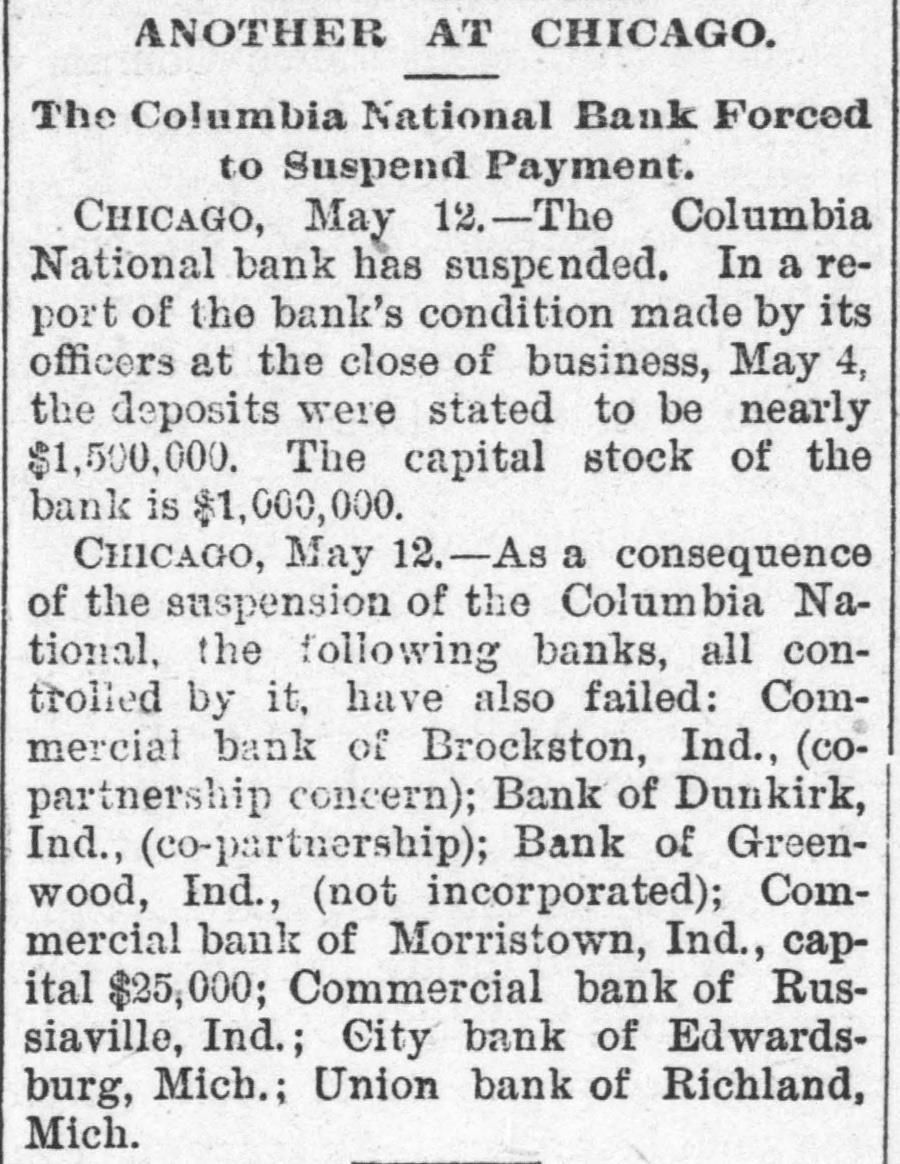
ANOTHER AT CHICAGO. The Columbia National Bank Forced to Suspend Payment. CHICAGO, May 12.-The Columbia National bank has suspended. In a report of the bank's condition made by its officers at the close of business, May 4, the deposits were stated to be nearly $1,500,000. The capital stock of the bank is $1,000,000. CHICAGO, May 12.-As a consequence of the suspension of the Columbia National, the following banks, all controlled by it, have also failed: Commercial bank of Brockston, Ind., (copartnership concern); Bank of Dunkirk, Ind., (co-partnership); Bank of Greenwood, Ind., (not incorporated); Commercial bank of Morristown, Ind., capital $25,000; Commercial bank of Russiaville, Ind.; City bank of Edwardsburg, Mich.; Union bank of Richland, Mich.


Article from The Star, May 17, 1893

Click image to open full size in new tab

Article Text

A LONG LIST OF FAILURES MANY SMALL BANKS GO UNDER. The Failure of the Columbia National Bank of Chicago had a Far-Reaching Effect. Most of the Suspended Institutions in Country Towns Where the Farmer Will Be the Loser. The officials of the Capitol National Bank (Indianapolis, Ind., which closed its doors Friday say they will be able to resume business within a few days providing the Chemical National Bank, of Chicago, is able to open its doors. The failure of the Columbian National Bank, of Chicago caused banking institutions throughout Indiana to close their doors Friday. Most of them are small concerns, and the majority of their stock was owned by Dwiggins & Starbuck, of the Columbia National. Their capital stock ranged from $20,000 to $50,000. The Columbia National controlled about 27 banks in this State and more failures are anticipated. The failures were: the Commercial State Bank, of Russiaville; Bank at Dunkirk; Farmers', of Greentown; Commercial Bank of Morristown; Commercial Bank, of Walkerton; Bank of Greenwood, of Greenwood; Farmers' and Merchants', of Geneva. The failure at Dunkirk was the heaviest. The liabilities are $700,000 and the assets are reported about two-thirds that amount. The Indianapolis banks claim to be not affected by these failures. FAILURES IN OTHER STATES. CHARLEVOIX, MICH.—W. P. Brown & Co., bankers, doing business under the name of the Bank of Charlevoix, have made an assignment. TOLEDO, O.—The Ottawa County Bank at Elmore, a branch of the Chicago Columbia, has closed its doors. CONVOY, O.—The Farmers Bank of Convoy, O., closed its doors, caused by its relations with the Columbia National Bank of Chicago. PAWPAW, MICH.—Great excitement prevails at Lawton. The managers of a local bank there did not open up the institution Friday morning, having left town the previous night. Citizens have some $18,000 deposited in the bank and are taking legal steps in the hope of realizing something. RICHLAND, MICH.—The Union Bank, a branch of the Columbia National, of Chicago is closed. The cashier says that the depositors will be paid in full. GRAND RAPIDS, MICH.—The private banking institution of Paris & Nove, at Rockford, Kent county, closed its doors upon order of the proprietors who live at Indianapolis. The bank did a lively business among the farmers. EDWARDSBURG, MICH.—The Citizen's Bank, of this place, closed its doors. About $25,000 of local deposits together with township and school funds are affected. It was a branch of the Chicago Columbia. CINCINNATI, O.—The private banking firm of Dwiggins, Starbuck & Co., of Williamsburg, O., has failed. About $8,000 is due the Williamsburg bank by the Columbia, of Chicago, all of which it is thought will be lost. The postmaster at Williamsburg ordered the arrest of Lawrence P. Good, expert accountant, who had started for Cincinnati. Good was taken in custody on his arrival here. He is charged with embezzlement. OTTAWA, ILL.—Richard J. Hornick, banker, merchant and speculator, of Grand Ridge, made an assignment. The cause is given as a run on his bank, caused by the financial entanglement of his brother and backer, John Hornick, of Sioux City, Ia. OTHER THAN BANK FAILURES. TRENTON, N. J.—Colonel A. R. Kuser, principal stockholder and creditor of the Hygerian Ice Company applied for the appointment of a receiver for that company. The total liabilities are said to be $150,000 and the assets about the same. MILWAUKEE, WIS.—The big house furnishing house of Frank A. Lappen & Co., and the Lappen Furniture Company, are in financial straits. Judgments were entered by the Wisconsin National Bank for $44,000, and by A. Landauer & Co. for $10,000. The Plankinton Bank has filed an attachment for $219,000. The sheriff is in possession. PARKERSBURG, W. VA.—J. S. Sorrell, for years one of the largest pork packers in West Virginia, but recently in the meat and grocery business, made an assignment to W. F. Atkinson. The liabilities are several times the assets, Cincinnati, Pittsburg, Baltimore and Philadelphia parties are caught. The Citizens' National Bank, of this city is a large creditor. LOUISVILLE, KY.—The wholesale whiskey firm of W. H. Thomas & Sons suspended payment. The different bankers with which the firm has done business place the excess of assets over liabilities at from $150,000 to $400,000.

Article from The Advocate and Topeka Tribune, May 17, 1893

Click image to open full size in new tab

Article Text

The Columbia was not a member of the clearing house. Lyman J. Gage says it made application for membership a year ago, but after examination e of the bank's affairs, it was denied. President Viggins has issued a statement that all the depositors will be paid in full. DUNKIRK, IND., May 12.-The Dunkirk bank closed its doors last night, suspending payment to depositors. A crowd of several hundred excited people surrounded the bank this morning. The concern is owned by Starbuck, Dwiggins & Co., of Chicago, and has gone down for about $70,000. It is assumed the failure is the result of the collapse of the Columbian National bank, of Chicago, of which Dwiggins was president. KOKOMO,IND. May 12.-The Commercial State bank, of Russiaville, and the Farmer's bank, at Greentown, both under one management, closed their doors this morning with deposits of $60,000. They were caught in the Columbia bank failure of Chicago. The Commercial bank is one of about twenty banks in Indiana that are thought to be connected with the Columbia National bank, of Chicago. Perhaps as many private banks were also related to the Chicago concern to some extent. CINCINNATI, O., May 12.-The private bank of Dwiggins, Starbuck & Co., at Williamsburg, O.' assigned last night in compliance with instructions from Dwiggins, of Chicago. Assets, $35,000; liabilities, $60,000. It was one of the branches of the Columbia bank, of Chicago. An expert accountant who has been employed at the bank has been arrested. The charge seems to be based on the suspicion that he was employed to conceal some of the funds of the bank. OTTAWA, ILL., May 12.-Richard J. Hornick, banker, assigned this morning. The cause of his assignment is given as a run on his bank caused by financial entanglement of his brother and backer, John Hornich, Sioux City Iowa. INDIANAPOLIS. IND., May 12.-A special from Brookston, Ind., says the Commercial bank of that place closed its doors to-day. It was controlled entirely by the Columbia bank, of Chicago. CHICAGO, ILL, May 12.-The tight money scare has had a disastrous effect on the World's Fair attendance. The total attendance to date is 285,000, and the money taken in at the gate will not 80 far pay the running expenses. Interest on $5,000,000 bonds is about due, and it looks as if the directors must borrow $300,000 to take up the coupons. MINNEAPOLIS, May 15.-The Northwestern Guarantee Loan Company is now in an embarrassed condition owing to the financial stringency. L. F. Menage, the president of the company, this morning declined to say anything. The capital stock of the company is $1,250,000. It owns the $2,000,000 building in which its offices are located, and a large amount of real property here, in Chicago and elsewhere. Its business has been the floating of commercial paper on sufficient collateral and the guaranteeing of the paper. It has some three millions of this paper and the refusal of its patrons to take up or renew their notes has precipitated the trouble. If the company suspends it will not do so for several days. MINNNAPOLIS, May 15.-The Farmers' and Merchants' State bank has suspended payment pending a run. The cashier states that the bank expected to resume in a few days. The bank is a very small one, its paid up capital being but $60,000, and its surplus about $7,000. t should be noted that this is not the Farmers' and Merchants's Savings bank, which is perfectly solvent. TROY, N. Y., May 15.-Nehr & Carpenter, eastern managers for the Northwestern Guarantee Loan Company, of Minneapolis, this morning made a general assignment and closed their doors. Two million dollars of $16,000,000 worth of debenture bonds recently issued by the Northwestern Guarantee Loan company has been disposed of to people in this city and vicinity through the eastern managers. CHICAGO, May 15.-Godfrey Clark & Co., pa-


Article from Grant County Herald, May 18, 1893

Click image to open full size in new tab

Article Text

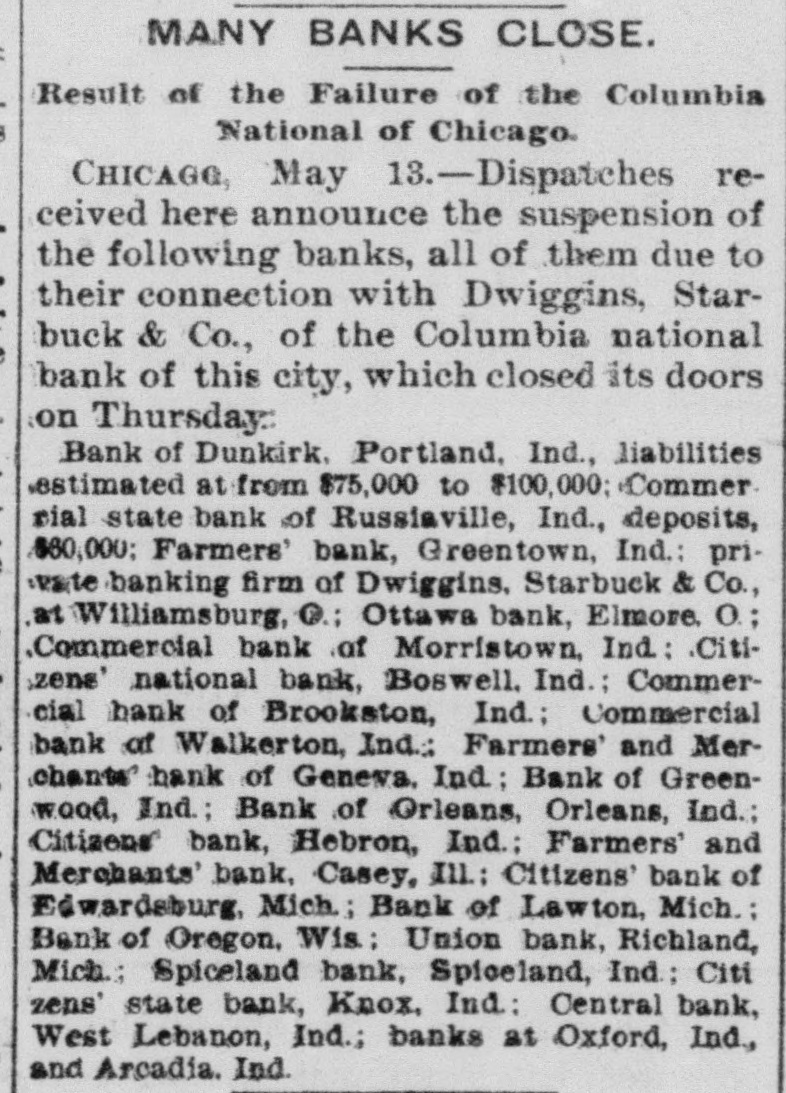
MANY BANKS CLOSE. Result of the Failure of the Columbia National of Chicago. CHICAGO, May 13.-Dispatches received here announce the suspension of the following banks, all of them due to their connection with Dwiggins, Starbuck & Co., of the Columbia national bank of this city, which closed its doors on Thursday: Bank of Dunkirk, Portland, Ind., liabilities estimated at from $75,000 to $100,000; Commer rial state bank of Russiaville, Ind., deposits, 560,000; Farmers' bank, Greentown, Ind.: priwater banking firm of Dwiggins, Starbuck & Co., at Williamsburg, O.; Ottawa bank, Elmore. O: Commercial bank of Morristown, Ind: Citizens' national bank, Boswell. Ind.: Commercial bank of Brookston, Ind.; Commercial bank at Walkerton, Ind.: Farmers' and Merchante bank of Genewa. Ind : Bank of Greenwood, Ind.; Bank of Orleans, Orleans, Ind.: Citizens bank, Hebron, Ind.: Farmers' and Merchants' bank, Casey, Ill.: Citizens' bank of Edwardsburg, Mich Bank of Lawton, Mich.: Bank of Oregon. Wis: Union bank, Richland, Mich: Spiceland bank, Spiceland, Ind : Citi zens' state bank, Knox, Ind: Central bank, West Lebanon, Ind.; banks at Oxford, Ind, and Arcadia. Ind.


Article from Idaho County Free Press, May 19, 1893

Click image to open full size in new tab

Article Text

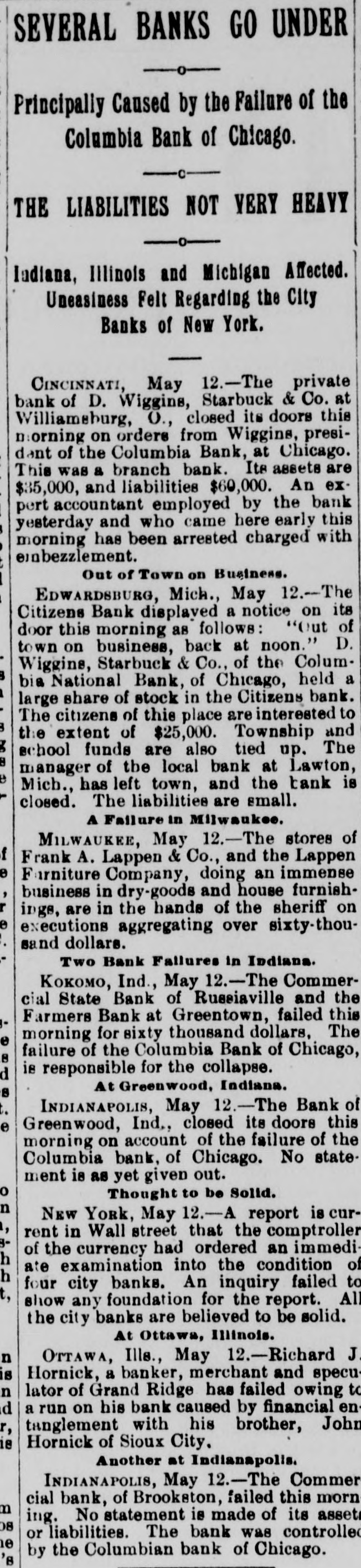
SEVERAL BANKS GO UNDER Principally Caused by the Failure of the Columbia Bank of Chicago. THE LIABILITIES NOT VERY HEAVY Iadiana, Illinois and Michigan Affected. Uneasiness Felt Regarding the City Banks of New York. CINCINNATI, May 12.-The private bank of D. Wiggins, Starbuck & Co. at Williamsburg, O., closed its doors this nooning on orders from Wiggins, presidant of the Columbia Bank, at Chicago. This was a branch bank. Its assets are $35,000, and liabilities $60,000. An expert accountant employed by the bank yesterday and who came here early this morning has been arrested charged with enbezzlement. Out of Town on Business. EDWARDSBURG, Mich., May 12.-The Citizens Bank displayed a notice on its door this morning as follows: "Out of town on business, back at noon." D. Wiggine, Starbuck & Co., of the Columof of stock in the large bia National share Bank, Chicago, Citizens held bank. a The citizens of this place are interested to the extent of $25,000. Township and school funds are also tied up. The manager of the local bank at Lawton, Mich., has left town, and the tank is closed. The liabilities are email. A Failure in Milwaukee, MILWAUKEE, May 12.-The stores of f Frank A. Lappen & Co., and the Lappen e Farniture Company, doing an immense business in dry-goods and house furnishr ings, are in the hands of the sheriff on e executions aggregating over sixty-thousand dollars. Two Bank Failures in Indiana. KOKOMO, Ind., May 12.-The Commercial State Bank of Russiaville and the Farmers Bank at Greentown, failed this morning for sixty thousand dollars, The e failure of the Columbia Bank of Chicago, 8 is responsible for the collapse. d At Greenwood, Indiana. 8 t. INDIANAPOLIS, May 12.-The Bank of e Greenwood, Ind., closed its doors this morning on account of the failure of the Columbia bank, of Chicago. No state. ment is as yet given out. o Thought to be Solid. n NEW York, May 12.-A report is cur, rent in Wall street that the comptroller of the currency had ordered an immedih ate examination into the condition of h four city banks. An inquiry failed to t, show any foundation for the report. All the city banks are believed to be solid. At Ottawa, Illinois. n OTTAWA, Ills., May 12.-Richard J. is Hornick, a banker, merchant and specun lator of Grand Ridge has failed owing to d a run on his bank caused by financial en r, tanglement with his brother, John is Hornick of Sioux City. Another at Indianapolis. INDIANAPOLIS, May 12.-The Commer cial bank, of Brookston, failed this morn m No statement ing. is made of its asset 08 or liabilities. The bank was controlled e by the Columbian bank of Chicago. '8


Article from The Indianapolis Journal, June 22, 1894

Click image to open full size in new tab

Article Text

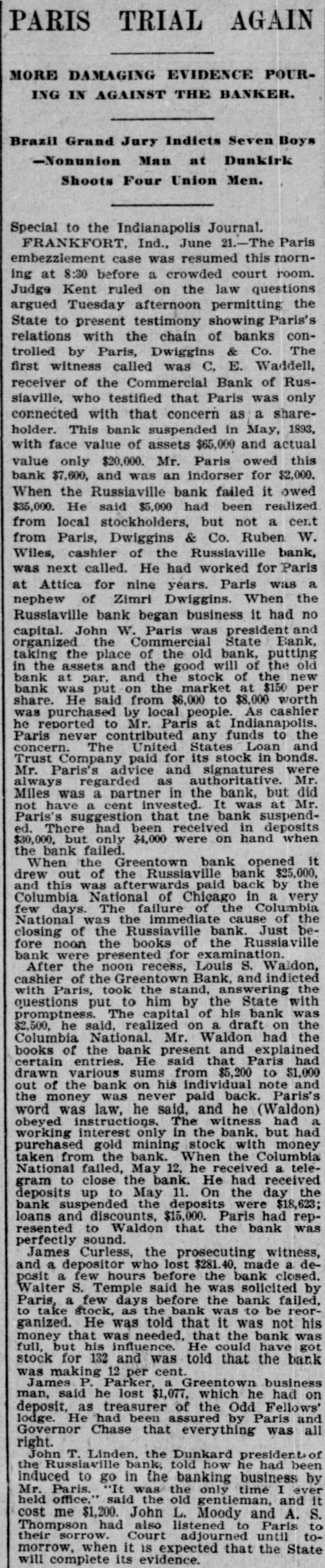
PARIS TRIAL AGAIN MORE DAMAGING EVIDENCE POURING IN AGAINST THE BANKER. Brazil Grand Jury Indicts Seven Boys -Nonunion Man at Dunkirk Shoots Four Union Men. Special to the Indianapolis Journal. FRANKFORT, Ind., June 21.-The Paris embezzlement case was resumed this morning at 8:30 before a crowded court room. Judge Kent ruled on the law questions argued Tuesday afternoon permitting the State to present testimony showing Paris's relations with the chain of banks controlled by Paris, Dwiggins & Co. The first witness called was C, E. Waddell, receiver of the Commercial Bank of Russiaville, who testified that Paris was only connected with that concern as a shareholder. This bank suspended in May, 1893, with face value of assets $65,000 and actual value only $20,000. Mr. Paris owed this bank $7,600, and was an indorser for $2,000. When the Russiaville bank failed it owed $35,000. He said $5,000 had been realized from local stockholders, but not a cent from Paris, Dwiggins & Co. Ruben W. Wiles, cashier of the Russiaville bank, was next called. He had worked for Paris at Attica for nine years. Paris was a nephew of Zimri Dwiggins. When the Russiaville bank began business it had no capital. John W. Paris was president and organized the Commercial State Bank, taking the place of the old bank, putting in the assets and the good will of the old bank at par, and the stock of the new bank was put on the market at $150 per share. He said from $6,000 to $8,000 worth was purchased by local people. As cashier he reported to Mr. Paris at Indianapolis. Paris never contributed any funds to the concern. The United States Loan and Trust Company paid for its stock in bonds. Mr. Paris's advice and signatures were always regarded as authoritative. Mr. Miles was a partner in the bank, but did not have a cent invested. It was at Mr. Paris's suggestion that tne bank suspended. There had been received in deposits $30,000, but only $4,000 were on hand when the bank failed. When the Greentown bank opened it drew out of the Russiaville bank $25,000, and this was afterwards paid back by the Columbia National of Chicago in a very few days. The failure of the Columbia National was the immediate cause of the closing of the Russiaville bank. Just before noon the books of the Russiaville bank were presented for examination. After the noon recess, Louis S. Waldon, cashier of the Greentown Bank, and indicted with Paris, took the stand, answering the questions put to him by the State with promptness. The capital of his bank was $2,500, he said, realized on a draft on the Columbia National. Mr. Waldon had the books of the bank present and explained certain entries. He said that Paris had drawn various sums from $5,200 to $1,000 out of the bank on his individual note and the money was never paid back. Paris's word was law, he said, and he (Waldon) obeyed instructions. The witness had a working interest only in the bank, but had purchased gold mining stock with money taken from the bank. When the Columbia National failed, May 12, he received a telegram to close the bank. He had received deposits up to May 11. On the day the bank suspended the deposits were $18,623; loans and discounts, $15,000. Paris had represented to Waldon that the bank was perfectly sound. James Curless, the prosecuting witness, and a depositor who lost $281.40, made a. deposit a few hours before the bank closed. Walter S. Temple said he was solicited by Paris, a few days before the bank failed, to take stock, as the bank was to be reorganized. He was told that it was not his money that was needed, that the bank was full, but his influence. He could have got stock for 132 and was told that the bank was making 12 per cent. James P. Parker, a Greentown business man, said he lost $1,077, which he had on deposit, as treasurer of the Odd Fellows' lodge. He had been assured by Paris and Governor Chase that everything was all right. John T. Linden, the Dunkard president of the Russiaville bank, told how he had been induced to go in the banking business by Mr. Paris. "It was the only time I ever held office," said the old gentleman, and it cost me $1,200. John L. Moody and A. S. Thompson had also listened to Paris to their sorrow. Court adiourned until to-