American Trust Company (South Bend, IN)

Episode Information

Episode UID
71005471578
Episode Type
Run โ†’ Suspension โ†’ Reopening
Bank Type
trust
Bank ID
7100547 routing
Routing Number
71-0054
Start Date
June 13, 1931
Location
South Bend, Indiana (41.683, -86.250)

Metadata

Model
gpt-5-mini (chosen from majority vote of a three-model LLM ensemble)
Short Digest
dc0f9d23013e70ef

Response Measures

None

Description

Closure in June 1931 followed by multi-year reorganization; reopening July 17, 1935.

Events (3)

1. June 13, 1931 Run
Cause
Rumor Or Misinformation
Cause Details
Malicious and unwarranted rumors caused depositors to become hysterical and withdraw funds, precipitating a run.
Measures
None specified beyond depositor withdrawals and ensuing closure by authorities.
Newspaper Excerpt
the bank closed its doors last week... caused by depositors who became hysterical after the spread of malicious and unwarranted rumors.
Source
newspapers
2. June 13, 1931 Suspension
Cause
Government Action
Cause Details
State bank commissioner took charge and the bank closed citing frozen assets after heavy withdrawals.
Newspaper Excerpt
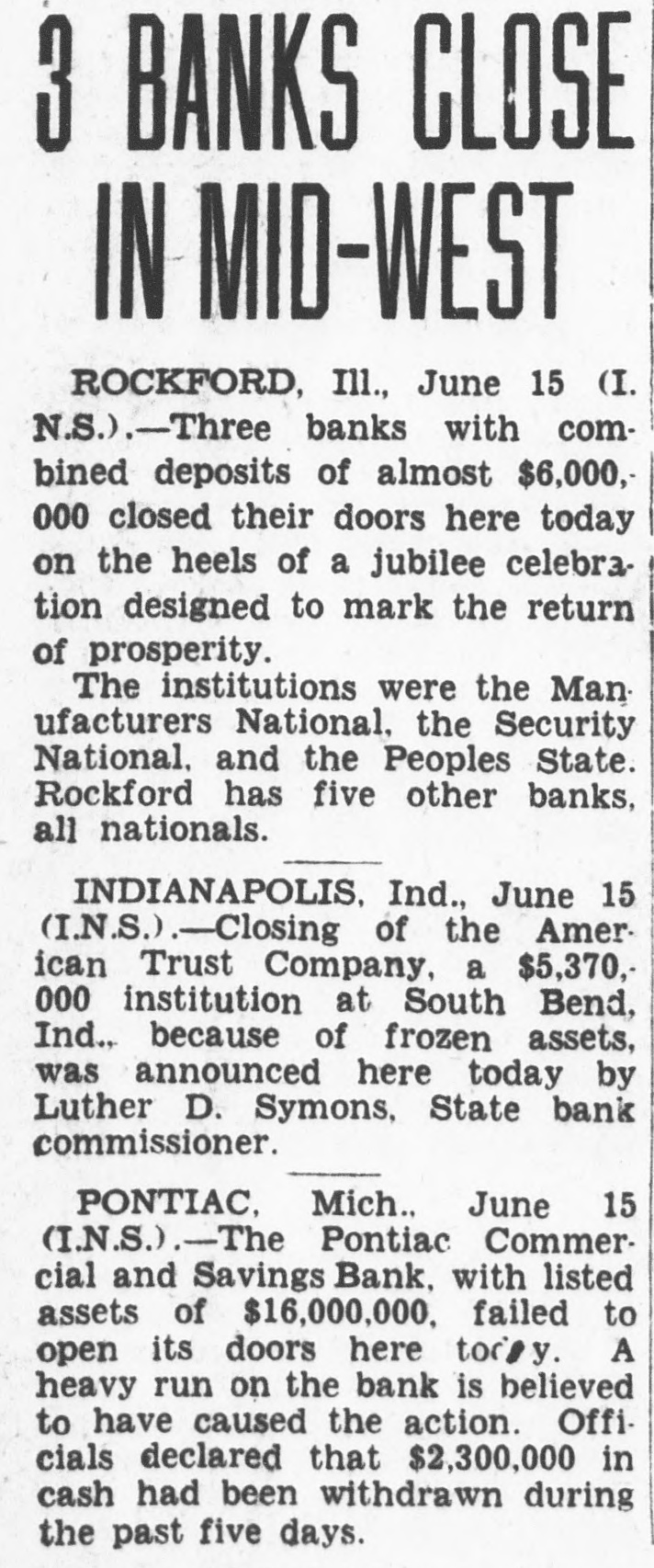
Closing of the American Trust Company... because of frozen assets, was announced here today by Luther D. Symons, State bank commissioner.
Source
newspapers
3. July 17, 1935 Reopening
Newspaper Excerpt
The American Trust company reopened its doors for business this morning... resumed business at 9 o'clock this morning on an unrestricted basis with all deposits insured up to $5,000 by the FDIC.
Source
newspapers

Newspaper Articles (18)

Article Text

3 BANKS CLOSE MID-WEST ROCKFORD, III., June 15 (I. N.S.).-Three banks with combined deposits of almost $6,000. 000 closed their doors here today on the heels of a jubilee celebration designed to mark the return of prosperity. The institutions were the Man ufacturers National. the Security National and the Peoples State Rockford has five other banks. all nationals. INDIANAPOLIS Ind. June 15 (I.N.S. .-Closing of the Amer ican Trust Company $5,370. 000 institution at South Bend. Ind.. because of frozen assets. was announced here today by Luther D. Symons. State bank commissioner PONTIAC Mich. June 15 (I.N.S.) The Pontiac Commer cial and Savings Bank. with listed assets of $16,000,000. failed to open its doors here today A heavy run on the bank is believed to have caused the action Officials declared that $2,300,000 in cash had been withdrawn during the past five days.


Article from The Washington Times, June 15, 1931

Click image to open full size in new tab

Article Text

3 BANKS CLOSE IN MID-WEST ROCKFORD, Ill., June 15 (I. S.).-Three banks with combined deposits of almost $6,000, 000 closed their doors here today on the heels of a jubilee celebration designed to mark the return of prosperity. The institutions were the Man ufacturers National. the Security National. and the Peoples State. Rockford has five other banks, all nationals. INDIANAPOLIS, Ind., June 15 (IN.S.).-Closing of the Amer ican Trust Company, a $5,370,000 institution at South Bend, Ind. because of frozen assets, was announced here today by Luther D. Symons, State bank commissioner. PONTIAC, Mich.. June 15 (I.N.S.) . - -The Pontiac Commercial and Savings Bank. with listed assets of $16,000,000. failed to open its doors here tory y. A heavy run on the bank is believed to have caused the action. Officials declared that $2,300,000 in cash had been withdrawn during the past five days.


Article Text

Rural Women Meet State Takes Charge 3 Who Reached Peak DEFICIT HANDICAPS For U. Of M. Course Of South Bend Bank Resting In Juneau CHILDREN'S HOME Gather For Annual Five-Day Sea. Suspension Of American Trust First To Ascend To Top Of Mount Happy Hills Institution Maintaining 50 Beds On Budget For 20 Still facing deficit of about $3,000 on their operations for the current year, the Happy Hills Convalescent Home for Children is maintaining fifty beds on a budget adjusted to twenty beds. Mrs. Louis Eliasburg. the secretary of the home, is the authority for that The home started the year with the prospect of an $8,000 deficit. Contributions by members of the board of the institution reduced it by about $3,000. A part of the Community Fund. the home is not permitted to make public campaign, says Mrs. Eliasburg. but it is permitted to receive checks which its friends send to the treasurer, W. W. Lanahan, Baltimore city. The home. which is devoted entirely to children, is located at Rogers ave nue and the Cross Country Boulevard sion On Varied Phases Of Farm Life College Park, Md., June 15 (P)Women from rural districts in all of parts of the State gathered at the University of Maryland here today for the annual rural women's short course conducted under direction of the ex tension department of the school. The five-day program of classes and lectures embraces practically every phase of rural life, from canning to how to keep the farm home. The course was arranged by groups, including the required courses and those elective. with certificates to be awarded at the close of the meeting. Last year more than 700 women at. tended the sessions, and officials of the extension department estimated that this summer's meeting, the ninth one. would be more widely attended than those in the past. Company Attributed To Frozen Assets Indianapolis, June 15 (U.P)-Closing the American Trust Company, South Bend, one of the largest banks in the Middle West, was announced today by Thomas D. Barr, deupty State bank commissioner, who took charge of the institution. E. H. Miller, president of the bank. said frozen assets were responsible for the closing. Financial standing of the bank is listed as Deposits, $5,370,000: undivided profits, $170,000: loans, $4,670.000: capitalization, $500,000, and surplus, $160,000. Pontiac Bank Suspends Pontiac, Mich.. June 15 (P)-The Pontiac Commercial and Savings Bank, the city's largest financial institution, was closed today by order of its directors. A notice stated the closing was ordered to conserve assets and preserve the interests of depositors. Fairweather-Report Trip Was Difficult Juneau, Alaska, June 15 (AP)-The first ascent of Mount Fairweather, 15,292-foot peak, has been made and the three climbers, two of whom were baffied by the peak seven years ago, were here today resting from their labors. The men are Dr. W. S. Ladd and A. Carpe, both of New York, and Ter- ris Moore, Boston. Ladd and Carpe 1. tempted the ascent in 1924 too late in the season and were forced to abandon the trip. The party left here in April and the climb to the summit of Mount Fairweather was made after several days of preparation at base camp. They returned here Saturday, reporting hard trip. northtwenty miles mountain is The west of Cape Spencer.


Article Text

Three Rockford Illinois Banks Close Doors Today ROCKFORD Ill., June 15-Three banks with combined deposits of $6,000,000 closed their doors here most the heels of celetoday on of prosperity The institutions were the manufacturers National the Security National and the Peoples State Rockford has five other banks, all nationals INDIANAPOLIS Ind June Closing of the American Trust company, $5,370 institution at South Bend, Indiana. because of frozen sets, was announced here today by Luther D. state bank com-


Article Text

3 ROCKFORD BANKS CLOSE DOORS TODAY Three banks with combined deposits almost closed their doors here today the heels of jubilee celebration designed to mark the turn prosperity. The institutions were the manufacturers National. the Security tional and the Peoples State. Rockford has five other banks, all tionals. INDIANAPOLIS, Ind., June of the American Trust company, $5,370,000 institution, at South Bend, Indiana, because frozen assets, was announced here today by Luther Symons, state bank commissioner. PONTIAC. Mich. June Pontiac Commercial Savings bank. with listed assets of $16,000,000 failed to open its doors here today. heavy run on the bank believed to have caused the Officials declared that $2,300,000 cash had been withdrawn from the bank during the past five days.


Article Text

THE NEWS-PALLADIUM COMPRISING THE EVENING NEWS Vol. 33. No. 230 THE DAILY PALLADIUM Vol. 51. No. 43 BUSYBODIES AND THE BANKS An impressive demonstration in what gossip and rumor will do to responsible banking institutions is afforded in the case of the American Trust company of South Bend, one of the large financial institutions of that nearby Indiana city. This South Bend financial house closed its doors last week, but shortly is to reopen for business Accord, ing to the deputy banking commissioner of Indiana the institution should never have been closed Its closing,' comments the state official. "was caused by depositors who became hysterical after the spread of malicious and unwarranted rumors. Efforts are now being made by the South Bend authorities to seek out some of those who circulated the stories which resulted in run on the bank and eventually caused its closing. with view to prosecuting them. Little, however. will be gained from such action. The harm has already been done and the work of years in building up public confidence in the institution has doubtless been seriously impaired It would be silly to argue that the banking business has not had its troubles ever since the depression started. Many banks have closed and both depositors and stockholders of such institutions have been the losers. However, where one bank has closed its doors scores have continued to do business. Banking mergers have prevented other failures and thus pro(tected all depositors. The banking departments, both state and national, have doubled their vigilance and are insisting that steps be taken to increase the security behind the public's cash. In many communities the larger banks have played the role of big brother and have gone to the assistance of smaller institutions. The thuth is that greater precautions are being taken today in the banking business generally to protect the public's deposits than have ever been taken before. What the banking business needs more than anything else at the present time is the assistance of its customers in helping to restore general confidence in the banking situation. At Indianapolis this week President Hoover said that frozen confidence was worse than frozen securities. This is everlastingly true in the case of the banks. Banking depends upon confidence good will more than any other industry. One untrue story about bank's condition can start a run against bank that is absolutely able to pay its depositors 100 cents on the dollar and if that run continues such bank will have to close its doors. Idle rumor and malicious gossip will ruin the finest and the safest financial institution in the world. Not long ago in New York an eminent banker, asked what he wanted most to strengthen his institution, replied: "Confidence. would rather have man say good word about my bank today than appear at the teller's window with a bag of gold. We have more money than we can wisely and safely invest. What I'm looking for is deposits of good will and not deposits of dollars." He spoke volumes as every banker in the country so well Many years ago Benton Harbor had a bank failure, the old First National bank. To this day business men of that time say the First National should never have been closed. But street gossip and baseless rumor sent depositors hurrying to its doors and eventually the bank was closed When the receiver had cleaned up the bank's affairs it was found that the depositors got every dollar of their money and even the stockholders had something to divide It was another case of frozen confidence. Sometimes we think frank discussion of the banking situation, especially when times are hard and the banker is having his troubles the same as any other business man, would help mightily to dissipate frozen confidence. Too often the public is left guessing when publication of the actual facts would much to allay fear and apprehen sion. If twin city bank depositors, as an example, could know the measures that have been taken in the last year and a half by twin city banking institutions to bring to these financial houses larger measure of security we believe they would have a great degree of confidence in the local banks. Certainly they would be happier in the knowledge that nothing has been neglected which should have been done, to bring added strength to the resources of our banks, that depositors might have the fullest possible measure of protection and security But no matter what the bankers and the banking departments do to strengthen the banks the greatest enemy that banking has-the gossipis an ever present peril The slightest rumor sends the gossip on his destructive way He not only repeats what he has heard but usually colors it. The most innocent incident in con nection with the banking business is twisted and exaggerated and misconstrued until, when the innocent depositor gets the yarn. it's tale that would set the redoubtable Capt. Kidd quaking in his bloody boots. The wonder is that bank runs are not more So long as there are banks there are going to be bank failures and in difficult times of business stress banks that should never have been started and banks that have been mismanaged are going to close their doors The average banker is no different than the business man-both are subject to the same laws of mortality when they run into But the public must never for moment lose sight of the fact that it has larger stake in the banking business than in almost any other commercial venture and if it insists upon lending a willing ear to every idle rumor that depression breezes bring it must take the consequences-and those consequences are always fearfully destructive. It isn't the civic booster who can do the most good today. It's the person who will say something good about his bank to neighbor and friend.


Article Text

BLACKSTONE ON BLOCK MONDAY The Blackstone theater property South Michigan street, now by the State theater, will cupied be offered for sale at public auction Monday morning o'clock Citizens' Trust & Savings bank, receiver. The sale will be held under an order signed by Judge Elmer Peak superior court No. when George and July Reuben Miller, the $51,000 second mortgage on the in in property, their claim. This was done to facilitate of the first bonds by the CitiTrust company. first mortgage bonds the building amount to about $250,000 to satisfy these that the will held. The thepublic ater building located 212-218 South Michigan street. The property occupied by the building 99 year leases.


Article Text

COUNTY TO SUE THREE BANKS FOR $262,000 Martin Reveals Plan After Board of Finance Asks Legal Steps. DELAY ACTION IN TWO CASES American Trust, Toth State and Franklin Institutions to be Targets. County Attorney Alfred E. Martin announced to-day that suits will filed in the county courts immediately to collect $262,000 in public funds tied up in the closing of three South Bend banks. The announcement of the county attorney followed special meeting of the county board of finance late Monday at which resolution was adopted calling for force the funds, part of which have tied up for two years. The county has total of about in public tied up in five closed banks of the county but the suits for recovery will be filed against only The fourth bank has started payment of the county deposits and the board finance is awaiting word from the auditor before beginning tion against the fifth institution the fact that $60,000 in state funds is on deposit in bank Priority in Doubt. The court action to recover the county's deposits is liable to fraught with legal entanglements, however. because of matter before the state supreme court regards to claims in the stances bank The matwas carried to the high court six ago to termine public funds have priority after banking institution. No ruling has been handed down on the question and bank receivers throughout the state withholding the payments of any pending the decision. The banks against which the action will be started are the American Trust company, now in the process of reorganization. the Toth State bank and the Franklin Trust are operating for the Toth State and Franklin Trust and the county's funds in both are surety bonds signed by former officials of the the Toth State bank closed the county had $28,000 on deposit there and yesterday's meeting of the board finance several former bank officials who signed the surety bonds held by the county auditor appeared and said they were unable to make reimbursement from the liquidated Cash Reported on Hand. When the Franklin Trust company nearly years ago on orders of the state banking department the county had approximately $50,000 on deposit but the receiver recently paid dividend of $6,000 the county reducing the total $44,000. The former officials of the bank who were on Franklin Trust personal sureties have appeared before the board of finance on several stated that attempt was being made to raise county money from liquidation. It was reported to-day, however, that the receiver of the Franklin Trust company has considerable cash on hand but refuses to make any pending ruling on the question before the supreme court. The largest of the three suits will be against the American Trust company and the United States Fidelity Finance company bonders of the $190,000 in county funds on deposit there. Of the $90,000 protected by collateral bonds held by Continued on Page Two. Column Two.


Article Text

Post Holiday Auto Accidents Claim Lives of 3; Snow Blamed for Wrecks [Special to The Indianapolis Star.] VALPARAISO, Ind., Nov. Nick Marros, 35 years old, Hammond, killed, and John Napraton, Hammond, was injured critically today when their auto was struck by Chesapeake and Ohio freight train seven miles south of VICTIM OF HIT-RUN DRIVER. TERRE HAUTE, Ind., Nov. Small, 45 years was injured fatally last night when struck and run found the street. She died while being taken pital. SNOW BLAMED FOR DEATH. Ind., Nov. Fred M. Allen, 39 years was killed last night by an automobile while walking along United States highway No. here. The car struck Allen was driven Cary, said that snow his windshield his vision. survived by the widow and three daughters. CAR, TRUCK HIT IN STORM. LEBANON, Ind., Nov. Shaver, 23 years old, of Frankfort, injured probably fatally today when the which he riding with Gerald Miller collided headon with cattle truck front of Witham hospital here. Shaver suffered fractured skull. hospital attaches Miller said vision was which collected on the windshield. CHILD INJURED IN CRASH. Ind., Nov. Betty Havens, years old, daughter of Mr. and Mrs. Walter Havens, was and seriously today when the car in which she was riding with father hit truck driven Wilbur Atchison, 1641 College avenue, Indianapolis. The accident occurred four miles east of here on the child was taken to her home for HURT AVOIDING ACCIDENT. Ind., Nov. George son of ness Robert Conant. son of local cut badly today which were riding was ditched headon collision with machine coming from the opposite direction. Twenty stitches quired the wounds of was cut by broken window glass. WOMAN WRITER INJURED. SOUTH BEND. Ind., Nov. -Mrs. Eugene H. Miller Sr., wife of the president the American Trust Company, which was closed some time ago, was hurt critically today when automobile driven by her husband skidded overturned on the pavement of South pinning the couple beneath the Passing motorists freed the couple from the wreckage and brought them hospital. Mrs. Miller has possible fracture and other critical injuries. blood transfusion be to her life. She literary circles. being author of several books for children. CAR HITS BRIDGE, HURT. LINTON. Ind., Nov. and Mrs. Ova Sapp of Terre Haute. both 51 years old. in Freeman Greene county hospital with injuries suffered accident near Jasonville They were blinded by the lights an approaching automobile struck bridge severe scalp wounds. Mr. Sapp also suffered a dislocated hip.


Article Text

FOR DIVIDEND DEPOSITORS 10 Per Cent Distribution, Same as Union, Planned if Plea Succeeds. EMMONS MADE PRESIDENT Succeeds E. H. Miller, Sr., Who Resigned; Haberle is Board Chairman. The American Trust company, which closed last June 13, will apply to the Reconstruction Finance corporation for loan sufficient to distribute per cent dividend all depositors, was announced day. Such dividend, based on $3,044,in deposits on March would release $304,425.06 to local persons whose funds been tied up in the institution. The closed Union Trust company also seeking Reconstruction Finance loan for per cent dividend amounting to $276,000 and these projected dividends, together $41,376.12 distribution already declared Union Trust savings investors' accounts, makes total which may be released depositors. Announcement of the preparation an application the Finance corporation by the American Trust nection the election Emmons of the bank to M. Miller, resigned Mr. agent the institution since the closing. John B. Haberle has been elected the board succeed Mr. Miller and Albert named vice Rerick elected Albert McGann secretary and Titus trust officer. Mr. Emmons, Mr. Mr. Rerick, Mr. McGann M. Sanders, who represents the stockholders' and depositors' committee. Other members of the stockholders' and depositors' committee George Harrop and Herman Ries. the Haberle, Mr. Emmons, Fulk, Mr. Rerick. Alexis Coquillard, Adler, K. Vitus Jones and Herbert Sharlock. The were meeting Monday Takes Time for Results. Referring to the application to the Finance corpoMr. "It proposed to present an application loan to Reconcorporation which to pay dividend positors approximately cent. The application and supplemental forms are in process and will be ready to file with within time. difficult this money available for ment depositors but the the officials release the fund can procured. should borne mind, however, that take time and efto obtain desired Emmons said that the stockholders presented with reports Monday's meeting covering all phases the liquidation. Chief among these reoprts was ing net reduction assets since the closing. Deposits have transfer of posit by assignments, Surplus Reduced. Surplus and undivided profits show reduction, according to Emmons, since the closthe difference tween the earnings the since closing and losses sustained on the sale securities held banks as collateral for loans. The collateral was sold


Article Text

Other business men, who accept depositors' accounts at 10 cents on the dollar and upward, or more than a broker would pay in cash for the accounts, pocket the loss and gain in good will and reduction of inventories. The tenant of a building, whose landlord is indebted to closed banks, accept depositors' accounts for whatever service he renders them, pays his rent with these accounts, and the landlord, in turn, sets off his bank debt. Physicians, dentists, and other professional people of South Bend are participating in the plan. Donald Eldredge, executive vice president of one of the largest department stores in South Bend, has the following to say concerning the idea: "The barter plan stimulates sales for us because people who can buy goods with their accounts, are more than willing to make purchases than if they had the cash." J. D. Emmons, liquidating agent for the American Trust company, of South Bend, which closed last year (Continued on Page Eleven)


Article Text

Other business men, who accept depositors' accounts at 10 cents on the dollar and upward, or more than a broker would pay in cash for the accounts, pocket the loss and gain in good will and reduction of inventories. The tenant of a building, whose landlord is indebted to closed banks, accept depositors' accounts for whatever service he renders them, pays his rent with these accounts, and the landlord, in turn, sets off his bank debt. Physicians, dentists, and other professional people of South Bend are participating in the plan. Donald Eldredge, executive vice president of one of the largest department stores in South Bend, has the following to say concerning the idea: "The barter plan stimulates sales for us because people who can buy goods with their accounts, are more than willing to make purchases than if they had the cash." J. D. Emmons, liquidating agent for the American Trust company, of South Bend, which closed last year (Continued on Page Eleven)


Article Text

Irving Chayken, president of the Merchants' association, is completing plans for the round table conference. He said Hammond merchants are eager to ascertain whether or not the plan can be adopted in Hammond. Under the South Bend plan, merchants who owe closed banks money, give depositors 100 cents on the dollar in trade. The merchants then retransfer these accounts to the closed banks and have their obligations set off in proportionate amounts. Other business men, who accept depositors' accounts at 10 cents on the dollar and upward, or more than a broker would pay in cash for the accounts, pocket the loss and gain in good will and reduction of inventories. The tenant of a building, whose landlord is indebted to closed banks, accept depositors' accounts for whatever service he renders them, pays his rent with these accounts, and the landlord, in turn, sets off his bank debt. Physicians, dentists, and other professional people of South Bend are participating in the plan. Donald Eldredge, executive vice president of one of the largest department stores in South Bend, has the following to say concerning the idea: "The barter plan stimulates sales for us because people who can buy goods with their accounts, are more than willing to make purchases than if they had the cash." J. D. Emmons, liquidating agent for the American Trust company, of South Bend, which closed last year


Article Text

SOUTH BEND PLANS FURTHER DISCUSSED Various Interests Will Meet Tuesday to Take Up the Plan If Possible The South Bend plan for stimulating business and hastening the liquidation of closed banks will be discussed at length next Tuesday by various Hammond interests who are desirous of installing it in this city. Those who will attend the meeting include judges of Superior courts, bank receivers, depositors' committees, officers of the Chamber of Commerce, and an executive committee representing the Hammond Merchants' association. Irving Chayken, president of the Merchants' association, is completing plans for the round table conference. He said Hammond merchants are eager to ascertain whether or not the plan can be adopted in Hammond. Under the South Bend plan, merchants who owe closed banks money, give depositors 100 cents on the dollar in trade. The merchants then retransfer these accounts to the closed banks and have their obligations set off in proportionate amounts. Other business men, who accept depositors' accounts at 10 cents on the dollar and upward, or more than a broker would pay in cash for the accounts, pocket the loss and gain in good will and reduction of inventories. The tenant of a building, whose landlord is indebted to closed banks, accept depositors' accounts for whatever service he renders them, pays his rent with these accounts, and the landlord, in turn, sets off his bank debt. Physicians, dentists, and other professional people of South Bend are participating in the plan. Donald Eldredge, executive vice president of one of the largest department stores in South Bend, has the following to say concerning the idea: "The barter plan stimulates sales for us because people who can buy goods with their accounts, are more than willing to make purchases than if they had the cash." J. D. Emmons, liquidating agent for the American Trust company, of South Bend, which closed last year (Continued on Page Eleven)


Article Text

SOUTH BEND PLANS FURTHER DISCUSSED Various Interests Will Meet Tuesday to Take Up the Plan If Possible The South Bend plan for stimulating business and hastening the liquidation of closed banks will be discussed at length next Tuesday by various Hammond interests who are desirous of installing it in this city. Those who will attend the meeting include judges of Superior courts, bank receivers, depositors' committees, officers of the Chamber of Commerce, and an executive committee representing the Hammond Merchants' association. Irving Chayken, president of the Merchants' association, is completing plans for the round table conference. He said Hammond merchants are eager to ascertain whether or not the plan can be adopted in Hammond. Under the South Bend plan, merchants who owe closed banks money, give depositors 100 cents on the dollar in trade. The merchants then retransfer these accounts to the closed banks and have their obligations set off in proportionate amounts. Other business men, who accept depositors' accounts at 10 cents on the dollar and upward, or more than a broker would pay in cash for the accounts, pocket the loss and gain in good will and reduction of inventories. The tenant of a building, whose landlord is indebted to closed banks, accept depositors' accounts for whatever service he renders them, pays his rent with these accounts, and the landlord, in turn, sets off his bank debt. Physicians, dentists, and other professional people of South Bend are participating in the plan. Donald Eldredge, executive vice president of one of the largest department stores in South Bend, has the following to say concerning the idea: "The barter plan stimulates sales for us because people who can buy goods with their accounts, are more than willing to make purchases than if they had the cash." J. D. Emmons, liquidating agent for the American Trust company, of South Bend, which closed last year (Continued on Page Eleven)


Article Text

SOUTH BEND PLAN IS BOOSTED AT MEETING (Continued from Page One) sidered virtually worthless," Mr. Robinson declared. "Furthermore, it has reduced the number of depositors on our books from 10,000 to 4,500 at the present time. "Our assets, as a result of its operation, have become more valuable and our liabilities have been reduced $925,000. "It is an extra-legal measure, inasmuch as it will not be sanctioned or condemned by the state banking department; but our experience with it proves it to be a wise, sound, and business-like method of meeting a desperate emergency. "We have succeeded in saving numerous business enterprises which otherwise would have gone to the wall. Furthermore, we have drawn more actual cash into circulation than before the plan was introduced." Mr. Robinson then went into the details of operation. He said his bank had adopted an arbitrary valuation of 50 per cent of the face value of each account affected by the plan. In other words, if an account was worth $100 while the bank was in operation, it was discounted 50 per cent in the new plan and the bank, therefore, traded it in at $50. Stores and professional people, on the other hand, accepted the account at from 50 to 100 per cent of its face value, depending on the type of purchase made or service rendered. Then they used the account at 50 per cent of its face value to offset an obligation which they owed the bank. Thus, according to Mr. Robinson, everybody benefited. The bank's worthless assets became more valuable with liquidation, depositors found a means to use their impounded monies, and business, in general, enjoyed the stimulating effect of a more rapid turnover. Albert McGann, liquidating agent for the American Trust company of South Bend, was the next to explain the plan. He said his bank handled more commercial accounts than did the Union Trust company and that, therefore, a better measure of its value could be obtained from his experience with the plan. He declared that liquidation first was started on the worst loans in the bank. Gradually, these loans became more valuable with liquidation until, today, most of the lower grade loans have been advanced to higher classifications and, thus, the bank's assets have been made more valuable with a corresponding beneficial result accruing to depositors and creditors alike. The two bankers asserted that they are showing surplus earnings every month over the cost of liquidation, that liabilities have been reduced one-third, and that actual distress among indigent depositors has been relieved substantially. Business, too, has benefited proportionately, they declared. Virtually the same opinion was

Article Text

STATE COURT'S DELAY IN BANK RULING SCORED "Pathetic," Says One Receiver; "Dilatory" Second Charges. AFFECTED Public Funds Held Up; Also Prevents Distribution of $20,000 in County. More than $20,000 is lying dormant in St. Joseph county bank vaults awaiting decision by the Indiana supreme court that will provide for the distribution of the money by receivers for three defunct banks in the county. The same decision will directly effect nearly $1,000,000 in public funds tied up in three other closed South Bend which are now in the liquidation. Definite action by the higher court has been for nearly since the test case was transferred to that court from the Indiana court, where on file nearly two years before justices of that court disagreed decision. Since the Cound its way to the supreme court, several similar appeals have been taken from every section of the state. estimated that throughout the state effected by court's delay in handing down ruling. Calls Delay Attorney Orie Parker, who represents Miss Ethel receivfor the Franklin Trust company, declared: pathetic the way the court delays action on an important issue of that kind.' Schurz, receiver for the North Liberty State bank said: supreme court has the reputation being dilatory. or years making decision and, from past experiences, another five years before the ruling is made. The Franklin company has about $8,000 for the question the priority claims on public funds blocks the payment the money to depositThis question must be setin the higher Mr. Schurz said today that he could distribute about $8,000 if the priority claim dispute was The blocking the payment $5,000 ready the hands of Citizens' Trust Savings bank. receiver for Lakeville State bank Three Banks Affected. Three other large South Bend closed and in the process liquidation, are also hampered by the dispute to priority. They are Union Trust company half million dollars being held in public funds. The bank about $100,000 public funds tied up, of which $85,000 belongs to Bend school Over $100,000 school funds being held the American Trust comSeveral townships also have pany. funds in the closed South Bend banks. was pointed out that suits against surety bond signers coverthe money these banks have ing but determination been priority claims would exonerate the bond signers in event the public funds are given priority. Only recently the Union ship the town of this county, awarded in superior court No. against bond covering in Lakeville State the amounting to bank, $20,000. Will Be Appealed. This decision to be appealed the supreme court Attorney Walter Arnold, was said Saturday. petition by the receiver of the following the judgment, distribute blocked by town and until the higher court rules on the claims. The Washington State bank has one payment of 10 per but time that sufficient addithe tional funds were available to meet claims in the event the priority court ruled their favor. higher Continued Page Six. Column


Article Text

AMERICAN TRUST BANK REOPENED Reorganized Concern Resumes Business; Congratulated. The American Trust company reopened its doors for business this morning, making available to 12,000 depositors approximately $1,000,000 in cash. The banking house, one of the oldest in the city, resumed business at 9 o'clock this morning on an unrestricted basis with all deposits insured up to $5,000 by the Federal Deposit Insurance corporation. While the bank was prepared to meet demand payment of its accounts, tied up during reorganization, only a handful of the several hundred customers who entered the bank withdrew funds. Withdrawals, officials announced, were unusually few and small, most of them ostensibly for personal use. Old customers flocked to the bank to congratulate the old and Continued on Page 10, Column Three.