Article Text
of the theft of bonds as charged by William Abbott, former Sullivan man, now a resident of Texas.
Following Lang's disappearance in 1928, Abbott filed a claim against the bank for the bonds, which he asserted had been placed in safe keeping there with Lang.
Victim of Circumstances
Abbott had withdrawn the bonds before he left Sullivan, Lang contended today, declaring also that he could show a receipt for the withdrawal.
The Abbott claim and the resultant suit were the immediate causes of the closing of the bank.
Belief that Lang will defend himself as a "victim of circumstances" and the problematical defense that will involve other men is seen, as preparations are made to bring the grand jury out of recess to hear the story of the man who was urged to return to Sullivan by his friends and "clear it all up."
Released on Bond
Released on a bond signed by his friends, the aged banker told today of his wanderings in Ohio, North and South Carolina, and his return here from Spartanburg, S. C. There he was employed as a hotel clerk. He told how at one time, destitute, he took employment as a filling station attendant at Florence, S. C.
Importuned by friends he met in Knoxville, Tenn., he agreed to return to "face the music." Monday night he arrived in Vincennes and completed the trip by auto to Sullivan.
He was met by Wesley Williams, Sullivan county sheriff, and Richard Bailey, former president of the Citizens Trust Company.
Lang was questioned at length throughout the trip, but the result of the questioning was not revealed.
Key to Series of Crashes
The alleged irregularities in the trust company, which was closed Feb. 23, 1928, and thrown into receivership, were said to total $15,000 in forged notes and possibly $5,000 in cash.
With the return of Lang, state banking officials hope to lift the lid off of a mystery box that holds the key to a series of bank crashes in Sullivan county.
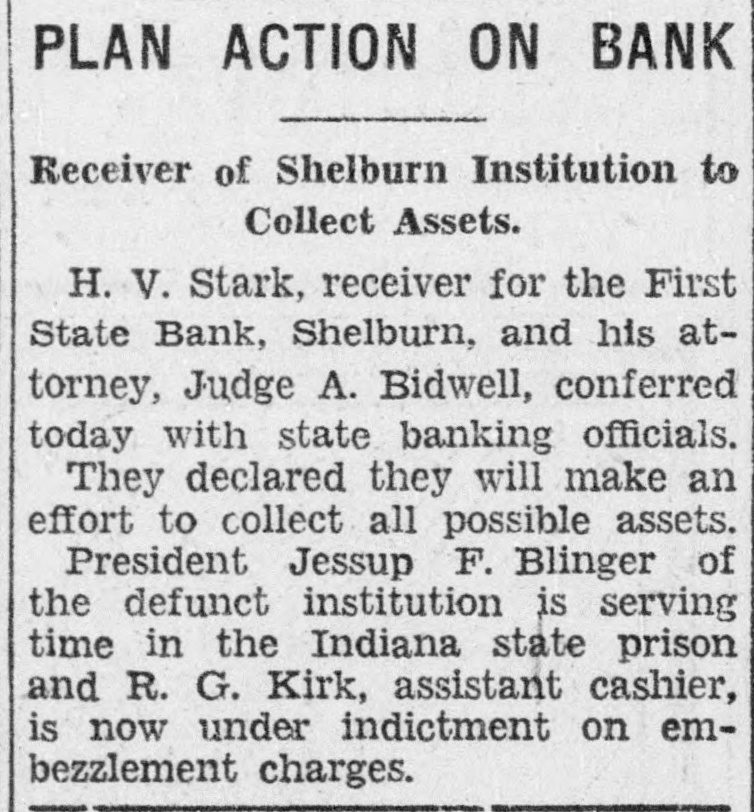
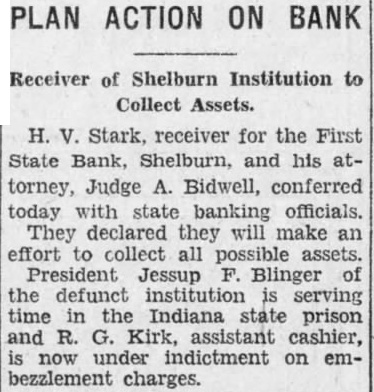
It is believed that Lang can open the doors to deals that involve the defunct First State Bank of Shelburn and the episodes that tripped over themselves in the death of Edgar D. Maple, vice-president of the People's National Bank and Trust Company, and the conviction as an embezzler of Jessup P. Bolinger, president of the First State Bank of Shelburn.
Florida Fiasco in Tangle
In the tangled skein of oil, real estate and bonds, which involves these Sullivan county bankers, there is twisted, too, the snarl of a Florida land fiasco.
Three figures prominent in Indiana politics are said to be involved in this welter of oil deals, bank closings, and bursting land bubbles, through two notes, said to be for $5,000 and $2,500, signed by a United States senator, an Indiana representative in congress, and a Terre Haute politician, given for shares in a Florida land development company, which shows no further signs of life.
These two notes, it is expected, will be listed among the assets of Bolinger, by his attorney, Lee F. Bays of Sullivan, in the bankruptcy proceedings brought by the former bank president's creditors.
This list of assets was due to have been filed March 8 with Everett Davisson of Clinton, federal referee in bankruptcy for southwestern Indiana.
Bolinger Confessed
Bays obtained a ten-day extension because of the manner in which Bolinger's assets were involved and was due to file the list Monday morning at 10 a. m.
He failed to do so and explained that he had not completed the total listing.
Among the claimants are three banks, who are holding notes totaling about $200,000 which were forged by Bolinger.
Within a few hours after his arrest, Jan. 16, Bolinger confessed to the forgeries, and a week later was on his way to the state prison to serve a term of from two to fourteen years.
Bolinger declared when brought before bank examiners and officials of the Shelburn bank to explain his forgeries that he began his forgery after dropping $35,000 on a "hot tip" in 1923 to buy Sinclair Oil.