State Bank (St Paul, MN)

Episode Information

Episode UID
7206572591123
Episode Type
Suspension → Closure
Bank Type
state
Bank ID
720657259 hash
Start Date
July 23, 1893
Location
St Paul, Minnesota (44.944, -93.093)

Metadata

Model
gpt-5-mini (chosen from majority vote of a three-model LLM ensemble)
Short Digest
6dee5553be69ef60

Response Measures

None

Description

Multiple articles report the State Bank closed/failed and reference an assignee/receiver.

Events (3)

1. July 23, 1893 Receivership
Newspaper Excerpt
Three Petitions Filed in Contest of Disposition of Securities... assignee of the bank pay over $75,000 of the state's money. This was resisted by the creditors, ... will be heard before the full bench.
Source
newspapers
2. December 13, 1896 Other
Newspaper Excerpt
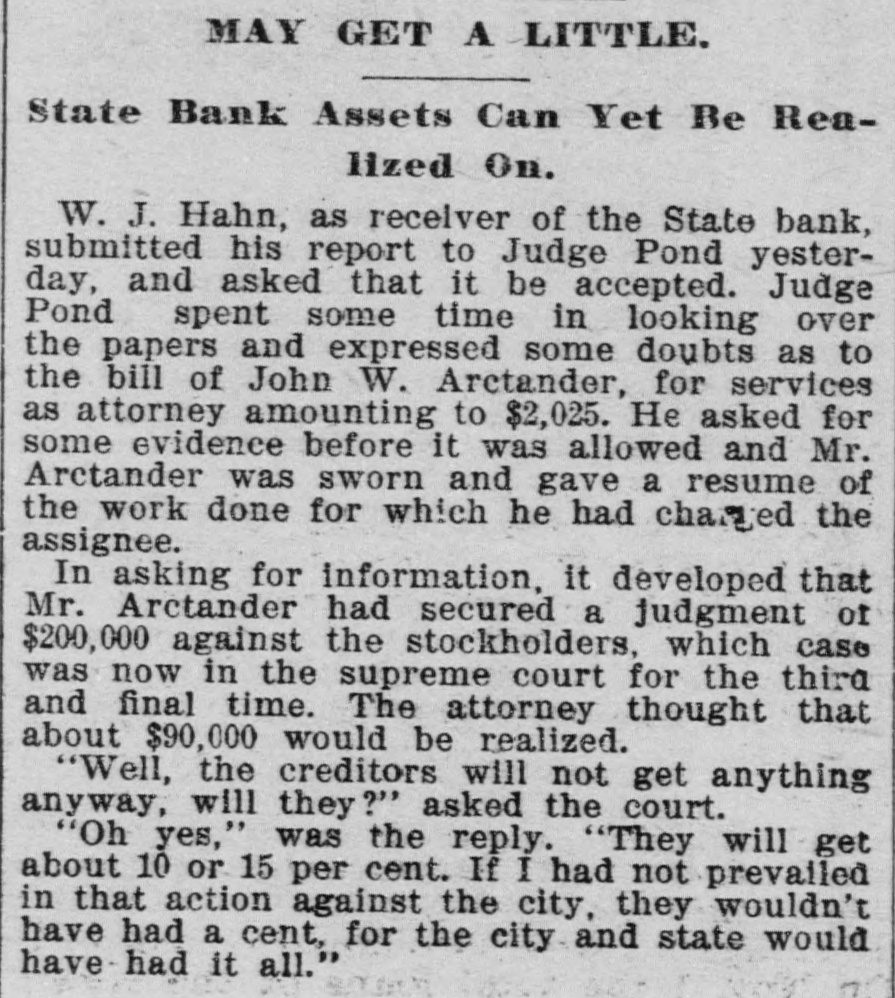
W. J. Hahn, as receiver of the State bank, submitted his report to Judge Pond yesterday, and asked that it be accepted.
Source
newspapers
3. December 22, 1896 Suspension
Cause
Local Banks
Cause Details
Suspension of the Bank of Minnesota and related western bank failures precipitated lack of ready money, leading the State Bank to close.
Newspaper Excerpt
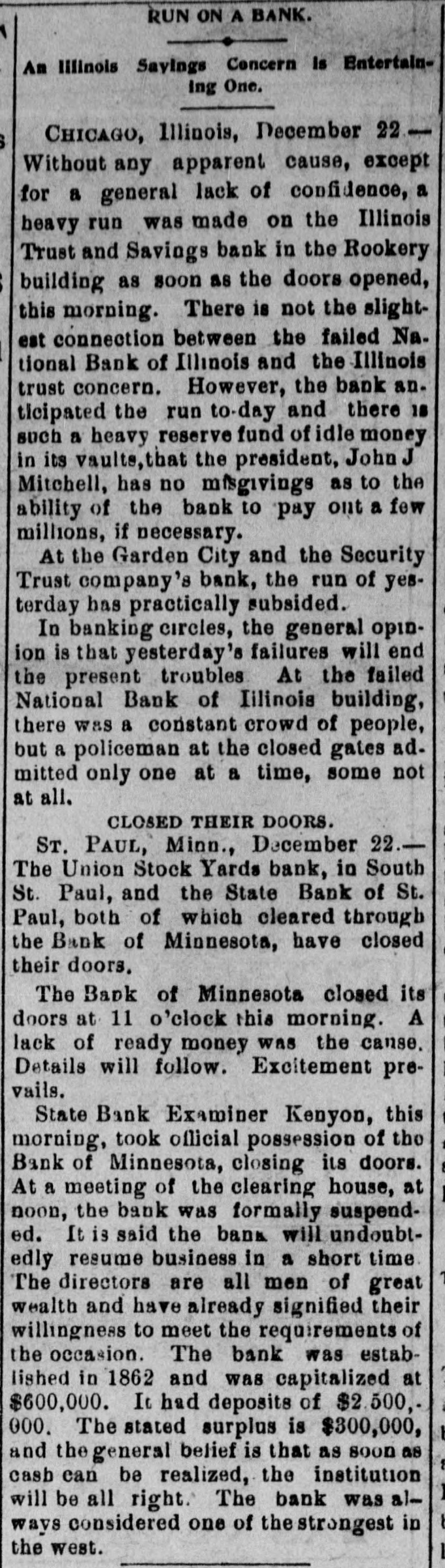
THE Bank of Minnesota closed its doors at 11 o'clock this morning. ... The Union Stock Yards bank, in South St. Paul, and the State Bank of St. Paul, both of which cleared through the Bank of Minnesota, have closed their doors.
Source
newspapers

Newspaper Articles (11)

Article from St. Paul Daily Globe, July 23, 1893

Click image to open full size in new tab

Article Text

STATE BANK TROUBLES. Three Petitions Filed in Contest of Disposition of Securities. A contest has begun in the district court over the disposition of State bank securities. Three petitions were filed in the district court yesterday morning by John W. Arctander, which involve the securities of the bank. The attorney represents about $50,000 of the depositors. The petitions state that less than ninety days before the assignment the bank delivered to the Security bank se curities worth $51,436.39, which is shown in one of the items in the schedule. These securities, it is asserted, are to secure a debt of $25,000. Itis further stated thatsecurities to the amount of $38,037.36 were given to the American Exchange bank, when, as a matter of fact, the officers of the receiving bank knew that the State bank was in an insolvent condition. Besides this $100,080.89 worth of securities given to A. C. Haugan, city treasurer, to secure money on deposit, are also involved. The attorney states that this last was given after the bank had assigned for the purpose of relieving the bondsmen from liability in that quarter. The state of Minnesota also made an application, which was heard before Judge Smith, to have the assignee of the bank pay over $75,000 of the state's money. This was resisted by the creditors, and the point was made that the liability of the bondsmen should be drawn on first before any other money could be taken. It was shown that if the money were paid over It would be virtually making depositors bondsmen for the state deposit. The matter was considered SO important that it will be heard before the full bench.

Article from St. Paul Daily Globe, November 14, 1893

Click image to open full size in new tab

Article Text

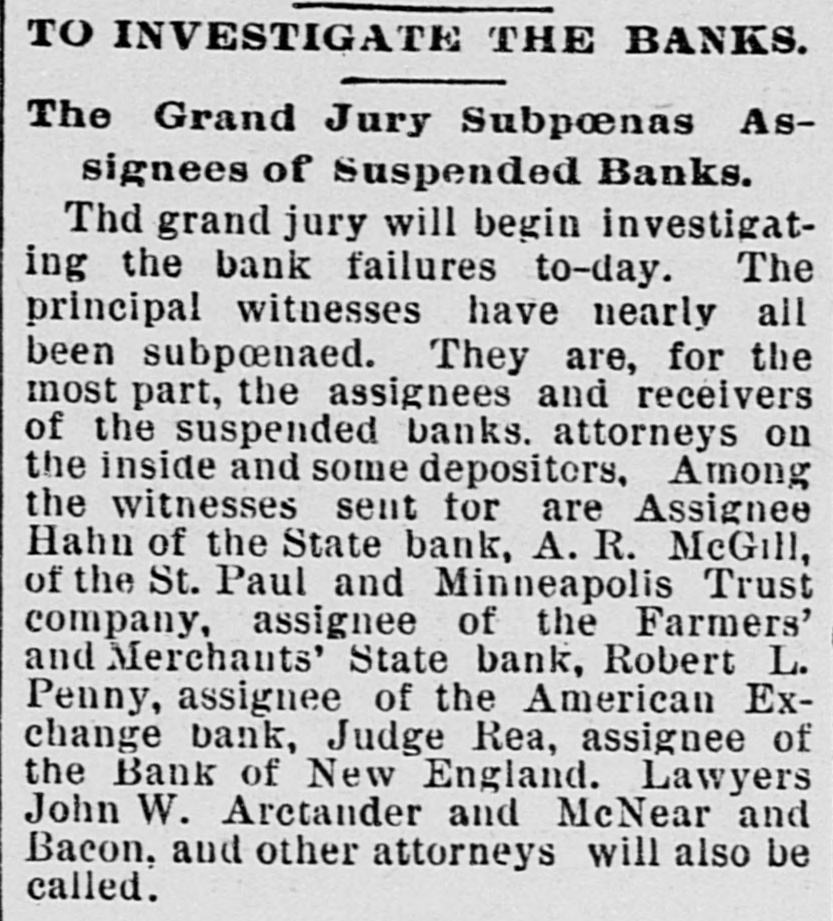
TO INVESTIGATE THE BANKS. The Grand Jury Subpœnas Assignees of Suspended Banks. Thd grand jury will begin investigating the bank failures to-day. The principal witnesses have nearly all been subpœnaed. They are, for the most part, the assignees and receivers of the suspended banks. attorneys on the inside and some depositors, Among the witnesses sent for are Assignee Hahn of the State bank, A. R. McGill, of the St. Paul and Minneapolis Trust company, assignee of the Farmers' and Merchants' State bank, Robert L. Penny, assignee of the American Exchange bank, Judge Rea, assignee of the Bank of New England. Lawyers John W. Arctander and McNear and Bacon, and other attorneys will also be called.


Article from St. Paul Daily Globe, November 30, 1893

Click image to open full size in new tab

Article Text

DID KORTGAARD DEFAULT? EX-CITY TREASURER CHARGED WITH EMBEZZLING CITY FUNDS. ARCTANDER HIS ACCUSER. The Lawyer Files Objections to the Claim of City Treasurer Haugan Against the State Bank-Says None of the City's Funds Were in the Bank-Assignee Hahn Denies the Claim. Ex-City Treasurer Kristian Kortgaard is now charged with an offense more serious than that for which the grand jury indicted him. He is accused of having betrayed his trust while city treasurer, and of being unable to account for over $100,000 of the city's funds. Lawyer Arclander makes the charge. The affair came to light yesterday when Assignee Hahn, of the State bank, refused to allow the claim of City Treasurer A. C. Haugan for $106,655. Mr. Haugan claimed that this amount of the city's funds was in the bank at the time it suspended. The claim was disputed by Lawyer Arctander on behalf of himself and other creditors. In his objections filed with the assignee, Arctander makes this grave charge, viz. That the amount ($106,655) did not represent a sum due from the State bank, but was a debt due Haugan personally from Kortgaard. who was the president of the bank. Mr. Arctander also asserts that this amount represented a shortage in Kortgaard's accounts as city treasurer at the expiration of his term of office, and that the State bank never received any consideration for the amount in question. City Treasurer Haugan will appeal to the district court from the decision of the assignee. Mr. Arctander said to a GLOBE representative yesterday: "Tbis revelation explains certain actions on the part of Kortgaard during the last campaign that 1 could not account for then. Before election day Kortgaard exerted all the influence he could to elect Haugan and knife Scanlan. the Democratic candidate for city treasurer. He even came to me and asked me to vote for Haugan. I expect to prove that a secret agreement existed, whereby Haugan, if he should be elected, would keep a certain amount of money on deposit in the State bank. When Koortgard went out of office last January he was credited by Haugan with having $116,000 of the city funds on deposit in his bank. Kortgaard gave Haugan a check on the bank for $150,000, with the understanding that the money was not to be withdraw. within 9. certain time


Article from The Saint Paul Globe, December 13, 1896

Click image to open full size in new tab

Article Text

MAY GET A LITTLE. State Bank Assets Can Yet Be Realized On. W. J. Hahn, as receiver of the State bank, submitted his report to Judge Pond yesterday, and asked that it be accepted. Judge Pond spent some time in looking over the papers and expressed some doubts as to the bill of John W. Arctander, for services as attorney amounting to $2,025. He asked for some evidence before it was allowed and Mr. Arctander was sworn and gave a resume of the work done for which he had changed the assignee. In asking for information, it developed that Mr. Arctander had secured a judgment of $200,000 against the stockholders, which case was now in the supreme court for the thira and final time. The attorney thought that about $90,000 would be realized. "Well, the creditors will not get anything anyway, will they?" asked the court. "Oh yes," was the reply. "They will get about 10 or 15 per cent. If I had not prevailed in that action against the city, they wouldn't have had a cent, for the city and state would have had it all."


Article from Las Vegas Daily Optic, December 22, 1896

Click image to open full size in new tab

Article Text

RUN ON A BANK. An Illinois Sayings Concern is EntertainIng One. CHICAGO, Illinois, December 22. Without any apparent cause, except for a general lack of confidence, a heavy run was made on the Illinois Trust and Savings bank in the Rookery : building as soon as the doors opened, this morning. There is not the slightest connection between the failed Na. tional Bank of Illinois and the Illinois trust concern. However, the bank an. ticipated the run to-day and there 18 such a heavy reserve fund of idle money in its vaults, that the president, John J Mitchell, has no mfsgivings as to the ability of the bank to pay out a few millions, if necessary. At the Garden City and the Security Trust company's bank, the run of yesterday has practically subsided. In banking circles, the general opinion is that yesterday's failures will end the present troubles At the failed National Bank of Illinois building, there was a constant crowd of people, but a policeman at the closed gates ad. mitted only one at a time, some not at all. CLOSED THEIR DOORS. ST. PAUL, Minn., December 22.The Union Stock Yards bank, in South St. Paul, and the State Bank of St. Paul, both of which cleared through the Bank of Minnesota, have closed their doors. The Bank of Minnesota closed its doors at 11 o'clock this morning. A lack of ready money was the cause. Details will follow. Excitement prevails. State Bank Examiner Kenyon, this morning, took official possession of the Bank of Minnesota, closing its doors. At a meeting of the clearing house, at noon, the bank was formally suspended. It is said the bank will undoubtedly resume business in a short time The directors are all men of great wealth and have already signified their willingness to meet the requirements of the occasion. The bank was established in 1862 and was capitalized at $600,000. It had deposits of $2.500,000. The stated surplus is $300,000, and the general belief is that as soon as cash can be realized, the institution will be all right The bank was always considered one of the strongest in the west. 1


Article from Birmingham State Herald, December 23, 1896

Click image to open full size in new tab

Article Text

New York, Dec. 22.-After a weak opening and a fractional decline in prices stocks improved on covering of short contracts. The advance outside of Sugar, which moved up about a point was insignificant. The declaration of the usual dividends by the Lake Shore, Michigan Central and New York Central failed to exert any influence on the market. The reduction of the dividend on Canada Southern, however, started a selling movement, which gathered force as the day advančed. The bank failures at the west also had a disturbing effect and timid holders cut down their lines. The suspension of the Bank of Minnesota, the oldest bank in St. Paul, announced shortly after 1 o'clock, was followed by the failure of the State bank of St. Paul and the Union Stock Yarks bank of South St. Paul. The fact that the last two institutions had been compelled to close up was not generally known on the street until after 3 o'clock. The bearish feeling on the market was aggravated by rumors of a reduction in the dividend of the Delaware and Hudson during the coming year and to rumórs that the Long Island company will pass payments on its stock. In the past the Delaware and Hudson has distributed 7 per cent. per annum and the Long Island 4 per cent. Manhattan's weakness was attributed to liquidations and the decline in Sugar to the aggressiveness of the Arbuckles. Delaware and Hudson scored the heaviest loss and dropped 5% to 1175/8. Long Island fell 5, New Jersey Central 41/8, Sugar 1%, Canada Southern 2½, Burlington and Quincy 17/8, Chicago Gas 11/4, St. Paul 1%, Rock Island 1½, Consolidated Gas 1½, Louisville and Nashville 1½, Manhattan 23/4, Reading 1, Tennessee Coal 11/4. Rubber 15/8 and Western Union 11/1. Speculation closed weak in tone. Net changes show declines of 4@1% per cent. outside of Delaware and Hudson, Jersey Central and Long Island, which lost 3½ per cent. Tobacco made an exceptional gain of 1 per cent. Considering the shrinkage in prices the dealings were comparatively small, footing up only 156,478 shares, in which Burlington and Quincy figured for 25,000, Sugar for 23,600 and St. Paul for 19,000 shares. Bonds were quiet and steady; sales aggregated $765,000. Money on call easy at 1½2 per cent; last loan at 2 and closing offered at 2. Prime mercantile paper, 31/2@4 per cent. Bar silver, 651/gc. Sterling exchange steady with actual bustiness in bankers' bills at $4.83%@4.84 for sixty days, and $4.87@4.87% for demand. Posted rates, $4.83@4.88. Commercial bills, $4.82@4.83. Government bonds firm. State bonds dull. Railroad bonds easter. Silver at the board was steady. Closing stocks:


Article from The Times, December 23, 1896

Click image to open full size in new tab

Article Text

FINANCEAND COMMERCE HE CLOSING QUOTATIONS OF MONEY. Offerings and Sales at the Richmond Tobaceo Exchange-Internal Revenue Collections Foreign Advances. NEW YORK, Dec. 22.-After a weak opening and a fractional decline in prices stocks improved on covering of short contracts. The advance, outside of Sugar, which moved up about a point, was insignificant. The declaration of the usual dividends by the Lake Shore, Michigan, and New York Central failed to exert any influence on the market. The reduction of the dividend on Canada Southern, however, started a selling movement, which thered force as the ,day advanced. The bank failures at the West also had disturbing effect, and timid holders cut a down their lines. The suspension of the Bank of Minnesota, the oldest bank in St. Paul. announced shortly after 1 o'clock, was followed by the failure of the State Bank of St. Paul, and the Union Stock Yards Bank of St. Paul. The fact that the last two institutions had been compelled to close up was not generally known on the street until after 3 o'clock. The bearish feeling on the market was aggravated by rumors of a reduction in the dividend of the Delaware and Hudson during the coming year, and to rumors that the Long Island Company will pass payments on its stock. In the past the Delaware and Hudson has distributed T per cent. per annum and the Long Island 4 per cent. Manhattan's weakness was attributed to liquidations and the decline in Sugar to the aggressiveness of the Arbuckles. Delaware and Hudson scored the heaviest loss and dropped 5% per cent. to 117%. Long Island fell 5, New Jersey Central 4%, Sugar 1%, Canada Southern 21/20 Burlington and Quincy 1½, Chicago Gas 1½, St. Paul 1%, Rock Island 1%, Consolidated Gas 1½ Louisville and Nashville 1½, Manhattan 2%, Reading 1, Tennessee Coal 1½, Rubber 1%. and Western Union 1½. Speculation closed weak in tone. Net changes show declines of 401% per cent., outside of Delaware and Hudson. Jersey Central and Long Island, which lost 3405 per cent. Tobacco made an exceptional gain of 1 per cent. Considering the shrinkage in prices, the dealings were comparatively small, footing up only 156,478 shares, in which Burlington and Quincy figured for 25,000, Sugar for 23,600, and St. Paul for 19,000 shares. Bonds were quiet and steady. Sales aggregated $765,000. MONEY AND EXCHANGE: Money on call easy at 11/202 per cent., last loan at 2 per cent., and closing offered at = per cent.; prime mercantile paper, 3½@4 per cent. Bar silver, 65% Sterling exchange weak, with actual business in bankers' bills at 48344483% for sixty days and 487@487.4 for demand; posted rates. 4841/2@488; commercial bills, 482@483. Government bonds firm. State bonds dull. Railroad bonds easier. Silver at the board was steady. TREASURY BALANCES: Coin, $121,273,016; currency, $50,524,766.


Article from Richmond Dispatch, December 23, 1896

Click image to open full size in new tab

Article Text

MARKET QUOTATIONS. REPORTS FROM ALL GREAT BUSINESS CENTRES OF THE WORLD. Prices of Money, Bonds, Stocks, Grain, Tobacco, Cotton, Cattle, Country Produce, &e., Foreign and Domestic. NEW YORK, December 22.--After a weak opening and a fractional decline in prices, stocks improved on covering of short contracts. The advance, outside of Sugar, which moved up about a point, was insignificant. The declaration of the usual dividends by the Lake Shore, Michigan Central, and New York Central failed to exert any influence on the market. The reduction of the dividend on Canada Southern, however, started a selling movement, which gathered force as the day advanced. The bank failures at the West also had a disturbing effect, and timid holders cut down their lines. The suspension of the Bank of Minnesota, the oldest bank in St. Paul, announced shortly after 1 o'clock, was followed by the failure of the State Bank of St. Paul and the Union Stock-Yards Bank, of St. Paul. The fact that the last two institutions had been compelled to close up was not generally known on the street until after 3 o'clock. The bearish feeling on the market was aggravated by rumors of a reduction in the dividend of the Delaware and Hudson during the coming year, and to rumors that the Long Island Company will pass payments on its stock. In the past the Delaware and Hudson has distributed 7 per cent. per annum, and the Long Island 4 per cent. Manhattan's weakness was attributed to liquidations, and the decline in Sugar to the aggressiveness of the Arbuckles. Delaware and Hudson scored the heaviest loss, and dropped 55-8 per cent., to 117 5-8. Long Island fell 5; New Jersey Central, 41-8; Sugar, 13-4; Canada Southern, 2 1-2; Burlington and Quincy, 17-8; Chicago Gas, 11-4; St. Paul, 13-8; Rock Island, 13-8; Consolidated Gas, 11-2; Louisville and Nashville, 11-8; Manhattan, 23-4; Reading, 1; Tennessee Coal, 11-4; Rubber, 15-8, and Western Union, 11-4. Speculation closed weak in tone. Net changes show declines of 1-4@17-8 per cent., outside of Delaware and Hudson, Jersey Central, and Long Island, which lost 3 1-8@5 per cent. Tobacco made an exceptional gain of 1 per cent. Considering the shrinkage in prices, the dealings were comparatively small, footing up only 156,478 shares, in which Burlington and Quincy figured for 25,000, Sugar for 23,600, and St. Paul for 19,000 shares. Bonds were quiet and steady. The sales aggregated $765,000. Treasury balances: Coin, $121,273,016; currency, $50,524,766. MONEY AND EXCHANGE. Money on call easy, at 11-2@2 per cent.; last loan at 2, and closing offered at 2 per cent. Prime mercantile paper, 31-2@4 per cent. Bar silver, 65 1-8. Silver at the board steady. Sterling exchange weak, with actual business in bankers' bills at $4.83 1-2@ $4.83 3-4 for sixty days, and $4.87@$4.87 1-4 for demand. Posted rates, $4.841-2@$4.88. Commercial bills, $4.82@$4.83. Government bonds firm. State bonds dull. Railroad bonds easier. STOCK QUOTATIONS. Clostaz Stocks, 10 American Cotton Oil 501/


Article from The Daily Morning Journal and Courier, December 23, 1896

Click image to open full size in new tab

Article Text

Financial. After a Weak Opening Stocks Improved Yesterday. New York, Dec. 22.-After a weak opening and a fractional decline in prices stocks improved on covering of short contracts. The advance outside of Sugar, which moved up about a point, was insignificant. The declaration of the usual dividends by the Lake Shore, Michigan Central and New York Central failed to exert any influence on the market. The reduction of the dividend on Canada Southern, however, started a selling movement, which gathered force as the day advanced. The bank failures at the west also had a disturbing effect and timid holders cut down their lines. The suspension of the Bank of Minnesota, the oldest bank in St. Paul, announced shortly after 1 o'clock, was followed by the failure of the State Bank of St. Paul and the Union Stock Yards bank of South St. Paul. The fact that the last two institutions had been compelled to close up was not generally known on the street until after 3 o'clock. The bearish feeling on the market was aggravated by rumors of a reduction in the dividend of the Delaware and Hudson during the coming year and to rumors that the Long Island Co. will pass payments on its stock. In the past the Delaware and Hudson has distributed 7 per cent. per annum, and the Long Island 4 per cent. Manhattan's weakness was attributed to liquidations and the decline in Sugar to the aggressiveness of the Arbuckles. Delaware and Hudson scored the heaviest loss and dropped 5% per cent., to.117%; Long Island fell 5, to 45; New Jersey Central 41/8, to 99%; Sugar 13/4, to 1091/2; Canada Southern 2½, to 45½; Burlington and Quincy 17/8, to 701/2; Chicago Gas 11/4, to 721/4; St. Paul 1%, to 72%; Rock Island 1%, to 651/2; Consolidated Gas 1½, to 145; Louisville and Nashville 1½, to 47½; Manhattan 23/4, to 863/4; Reading 1, to 25; Tennessee Coal 11/4, to 241/2; Rubber 15, to 24,and Western Union 11/1, to 821/4. Speculation closed weak in tone. Net changes show declines of 1/4@1% per cent., outside of Delaware and Hudson, Jersey Central and Long Island, which lost 31/s@5%. Tobacco made an exceptional gain of 1 per cent. Considering the shrinkage in prices, the dealings were comparatively small. Bonds were quiet and steady. Sales were $765,000. Following are the closing prices reported by Prince & Whitely, bankers and brokers, 46 Broadway, New York, and 15 Center street, New Haven:


Article from The Norfolk Virginian, December 23, 1896

Click image to open full size in new tab

Article Text

THE BANK FAILURE At the West Had a Distressing Effect and Timid Holders Cut Down Their Lines. THE D. & H. SCORED THE HEAVIEST LOSS The Bearish Feeling on the Market Was Aggravated by Rumors of n Reduction in the Dividend of the Delaware and Hudson During the Coming Year. New York, Dec. 22.-After a weak opening and a fractional decline in prices stock moved up slightly on covering of short contracts. The advance outside of Sugar, which moved up about 1 point, was insignificant. A selling movement soon began, however, which gathered force as the day advanced. The bank failures at the West also had a disturbing effect, and timid holders cut down their lines. The suspension of the Bank of Minnesota, the oldest bank in St. Paul, announced shortly after 1 o'clock, was followed by the fallure of the State Bank of St. Paul and the Union Stock Yards Bank of South St. Paul. The fact that the last two institutions had been compelled to close up was not generally known on the street until after 3 o'clock. The bearish feeling on the market was aggravated by rumors of a reduction in the dividend of the Delaware and Hudson during the coming year, and to rumors that Long Island company will pass payments on its stock. In the past Delaware and Hudson has distributed 7 per cent. per annum and the Long Island 4 per cent. Manhattan's weakness was attributed to liquidations and the decline in Sugar to the aggressiveness of the Arbuckles. Delaware and Hudson scored the heaviest loss and dropped 5% per cent. to 117%. Long Island fell 5. New Jersey Central,4% Sugar,1%; Burlington and Quincy, 1%; Chicago Gas, 11/4; St. Paul, 1%; Rock Island, 1%; Consolidated Gas. 1½; Louisville and Nashville, 1½; Manhattan, 23/4; Reading, 1; Tennessee Coal, 1½; Rubber, 1%, and Western Union, 1½. Speculation closed weak in tone. Net changes show declines of 1/4@1% per cent. Considering the shrinkage in prices the dealings were comparatively small, footing up only 156,478 shares, in which Burlington and Quincy figured for 25,000, Sugar for 23,600, and St. Paul for 19,000 shares. Bonds were quiet and steady. Sales aggregated $765,000.


Article from Barton County Democrat, January 14, 1897

Click image to open full size in new tab

Article Text

idea-that build a house you should first put up the parlors and receptions rooms, and afterwards the foundation, the cellar and the kitchen? Is the gold-standard theory of adopting a system of finances that the bankers and monied men want, regardless of what the PRODUCERS, the LABORERS-the foundation of all national prosperity-needs, thus far proving a good thing for the country? Here is a record of failures for the 15 days ending January 4, 1897: Dec. 21-National Bank of Illinois, Chicago. Dec. 21-Roseland Bank, Chicago. Dec. 21-E.S Dreyer & Co. Chicago. Dec. 21 -Wusmansdorff & Heinemann, Chicago. Dec. 22-Bank of Minnesota. St. Paul. Dec. 22-State Bank of St. Paul. Dec. 22-Union Stock Yards Bank, St. Paul. Dec. 23-Chicago Bank, West Superior, Wis. Dec. 23-Bank of West Superior, West Superior, Wis, Dec. 23-American Banking and Trust Co., Auburn, Me. Dec. 28-Dime Savings Bank, Chicago. Dec. 28--Atlas National Bank, Chicago. Dec. 28-Scandia Bank, Minneapolis. Dec. 28-Bank of Superior, Supe rior, Wis. Dec. 29-Columbia Bank, Minneapolis. Dec. 29--Washington Bank, Min8 neapolis. i Dec.29--Commercial National Bank, D Va. Dec. 30-Northern Trust Company, r Minneapolis. Dec. 30 Bankers' Exchange Bank, 1 Minneapolis. . Dec. 30 Northwestern Loan and e Building Association, Minneapolis. Dec. 30 Commercial Bank, Selma, Al. Dec. 30 Farmers' Trust Company, Sioux City, Iowa, y t Jan. 4 Germania Bank, St. Paul. y Jan, 4 Allemania Bank, St. Paul. r Jan. 4 West Side Bank, St. Paul. it Jan. 4 Minnesota State Savings e Bank, St, Paul. Jan. 4 Citizens' National Bank, r. Fargo, N. D. d Jan. 4 City Bank, Nora Springs, If Iowa, a Total amount reported, $21,354,779 c OTHER HOUSES DRAGGED DOWN BY THE e CRASH, of Dec, 22 Angus & Giudele, contract rors, Chicago. of Dec. 23 American Brewing and Y, Malting Co., Chicago, Dec. 23 George A. Weiss Malting Co., Chicago. Dec. 23 George A. Weiss, Chicago r. Dec. 28 Excelsior Machinery an t, Belting Co., Chicago, st Dec. 29 Western Paper Bag Co. iBatavia, III. a Dec. 29 Appleton Manufacturing be Co., Van Nortwick, III, ch Jan. 4 Snow & Earl Co., druggist ct supplies, Providence, R. I IJan. 4 L. W. Alet & Co., wholesal ojewelers, Chicago, Ill. SUICIDES CAUSED BY THE BANK FAILURES if Otto Wasmandorff, head of th " banking firm of Wasmandorff & Heine of mann, of Chicago, shot himself in tha of city. Suicide due to worry over th I's failure of his firm, which occurred o December 21. ry George A. Wilkins, vice president o the suspended Commercial Bank, o ds Selma, Ala., shot himself on Decembe 31, in front of the altar of St. Paul'