Manufacturers National Bank (Chicago, IL)

Episode Information

Episode UID
72400885
Episode Type
Suspension โ†’ Closure
Bank Type
national
Bank ID
7240 national
Charter Number
724
Start Date
September 26, 1873
Location
Chicago, Illinois (41.850, -87.650)

Metadata

Model
gpt-5-mini (chosen from majority vote of a three-model LLM ensemble)
Short Digest
deb408fedcf465cf

Response Measures

None

Description

Bank suspended during the Panic of 1873 and elected to go into liquidation rather than resume.

Events (5)

1. January 18, 1865 Chartered
Source
historical_nic
2. September 25, 1873 Voluntary Liquidation
Source
historical_nic
3. September 26, 1873 Suspension
Cause
Macro News
Cause Details
Suspended amid the broad financial panic of September 1873 affecting Chicago banks.
Newspaper Excerpt
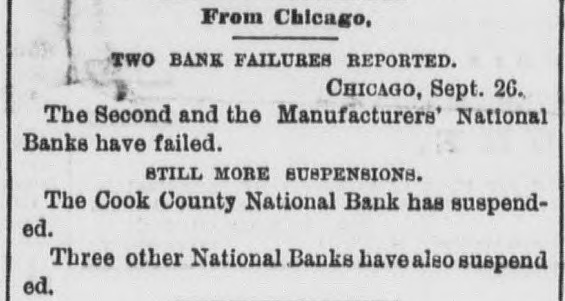
The Second and the Manufacturers' National Banks have failed. STILL MORE SUSPENSIONS.
Source
newspapers
4. September 27, 1873 Other
Newspaper Excerpt
Manufacturers' and Second National banks had decided to go into liquidation. (reports of Sept. 27-28).
Source
newspapers
5. October 1, 1876* Receivership
Newspaper Excerpt
Amended bill filed in October, 1876 (proceedings relating to liquidation/receivership and creditor suits).
Source
newspapers

Newspaper Articles (24)

Article from The New York Herald, January 11, 1871

Click image to open full size in new tab

Article Text

UNITED STATES CIRCUIT COURT. Important Question RS to Receiverships and the Right to Sue by n Foreign Corporation. Before Judge Blatchford. The Manufacturers National Bank of Chicago vs. Ethorard Baach and Edward Baach, Jr.-The bill in this case describes the plaintiffs as the Manufacsurers' National Bank of Chicago, Illinois, a banking corporation incorporated and existing under an act of Congress of the United States, and having capacity to sue under the above title the same as a citizen of the State of Illinois, doing basiness in Chicago, in that State. The defendants are citizens of the State of New York. The plaintiffs moved for the appointment of a receiver in the case and au injunction. The citizenship of the defendants was not denied and the question was Whether the court has jurisdiction of the suit. Under the decision in the case of Osborn vs. The Bank of the United States (9th Wheaten. 738), such a suit 18 a case arising under a law of the United States within the meaning of the constitution, the bank being incorporated by a law of the United States, and it is comperent for Congress to confer jurisdiction over it in the federal courts. After a lengthened opinion the Judge holds that the averments of the bill are suillcient to shew that the court has jurisdiction of this suit, and that the plaintiffs are entitled to the receivership and injunction asked for III their bill. Before Judge Woodraft. Eliza We's Administrative, d.c., vs. Henry H. Janques, al.- Verdict of jury for the plaintiff in the sum of $7,500.


Article from The Daily State Journal, October 16, 1871

Click image to open full size in new tab

Article Text

ACCIDENT TO STEAMERS A FLOOD IN CHINA A TERRIBLE TYPHOON &c. &c. &c. &c. From Chicago. A FURIOUS GALE-THE BANKS RESUMING BUSINESS, &C. Chicago, October 16.-A urious gale prevailed here Saturday night, blowing firebrands in all directions and prostrating walls. Fortunately, however, the rain, which had previously fallen, prevented any damage from fire. The supply of food now on hand is ample. The banks pay 15 per cent. at once, and will resume regular business on the 17th inst. R. H. Hurlbert, comptroller of currency, certifies to the solvency of the Chicago National bank. The Fires in the Northwest. PREVIOUS REPORTS CONFIRMED-FEARFUL LOSS OF LIFE, &C. Chicago, October 16.--Advices from the Northwest, in relation to the fircs prevailing here, grow hourly worse. Milwaukie, October 16.-Later accounts corfirm previous disastrous reports. The loss of life in the neighborhood of Pishtego will reach 1,200. Fifteen per cent of the injured will die. The only escape was the water, where maddened cattle and horses drowned many. The population of Pishtego was two thousand; a third of whom perished. New York Items. New York, Oct. 13.-The Manhattan Insurance Company has resolved to suspend. It's losses are stated to be a million and a quarter dollars. The company possesses a large surplus besides capital. It is not expected that the assured will sustain any loss. The President of the Empire City Company, which was reported yesterday to have lost a quarter of a million of dollars, states that it has sustained no loss. It is reported that the Western Union Telegraph has effected a loan in Europe and will cancell four million dollars worth of stock. Douglas, of Sappho, has challenged Samuels, of Dreadnaught, to race 25 miles windward and back in a 10 knot breeze. Bennett's Dauntless offers Dreadnought a similar match. Dispatches from Vienna, Paris, Brussels, Berlin and London represent that active subscriptions are going on to aid Chicago. The Council of Political Reform last evening elected Wm. M. Evarts president, and Eugene Kelly, Wm. H. Aspinwall, James W. Beekman and Oscar Zollicoffer, vice presidents. Destructive Whirlwind. Porlland, Me., Oct. 15.-A dispatch from Halifax says that the heaviest hurricane known for the last twenty years occurred there last evening. The tide rose two feet over the wharves. Many vessels were injured and several lost. The Fever in Charleston. Charleston, Oct, 15.-One fever death reported yesterday and one to-day.


Article from The Daily State Journal, October 18, 1871

Click image to open full size in new tab

Article Text

# THE WRIT OF HABEAS CORPUS SUSPENDED IN SOUTH CAROLINA, &C. Washington, October 17.--The President to-day, after reciting the causes and quoting the laws under which he acts, issued a proclamation in which he suspends the writ of habeas corpus in Spartanburg, York, Marion, Chester, Laurens, Newberry, Fairfield, Lancaster, and Chesterfield counties, of South Carolina. The suspension extends to the arrest by the United States marshal, his deputies, any military officer of the United States, or any soldier or citizen acting under the orders of said marshal, deputy, or such military officer within said counties, of persons charged with any violation of the Ku-Klux act of Congress during the continuance of the "rebellion" in said counties. The Attorney-General has a dispatch from North Mississippi that five Ku-Klux with disguises complete have been captured. Seven hundred and fifty thousand dollars in revenue stamps were found safe in the government vault in Chicago. Secretary Boutwell has received the following dispatch from Chicago: "The Chicago banks are saved, and are paying every dollar on demand. A good feeling prevails. [Signed] H. R. Hurlbut, Comptroller of Currency." Mexican Affairs. Havana, October 17.-A steamer just arrived from Vera Cruz brings late dates from the Mexican capital. Juarez had been re-elected President by Congress, receiving 108 votes-all that were cast. The opposition abstained from voting. Everything was quiet in the city. The telegraph wire between the capital and Matamoras had been cut by Trevina. Telegraphic Summary. Eighty Catholic children have arrived at Cincinnati from Chicago, and have been committed to the care of the bishop. The cholera has again appeared in an epidemie form in Constantinople. Sixty deaths have occurred in two days, nine of whom are Englishmen. Hon. James McNab, Governor of Nova Scotia, is dead. The preparations for the exposition of the Industrial Association of Georgia, to be held in Savannah on the 21st of November, are nearly complete. A suit has been instituted in the Federal Court at Memphis, Tenn., against Gen. Forrest and others, by Capt. Houston, of the steamer Hester, for arms destroyed some years ago by disguised men. A dispatch from Raleigh states that the exhibition of the North Carolina State Fair at that place is unsurpassed in every respect. The sub-Ku-Klux Committee has been investigating at Montgomery, Ala., whence they go to Demopolis, in the same State, and thence return to Washington. Four deaths from yellow fever have occurred in Charleston during the past two days. The Security Insurance Company has suspended. Fires are raging in Deer and Harrison Creek Valley; extending to Jefferson county, Nebraska. The loss is estimated at $50,000. A later dispatch from Glocester, Canada, says an American fleet of four vessels is outside, and that any attempt to seize the "Horton" will meat with disastrious defeat. The vessels spoke the "Horton," but did not see the British gunboats.


Article from Litchfield Enquirer, October 26, 1871

Click image to open full size in new tab

Article Text

Money is extremely scarce in Paris, and the Bank of France is issuing notes of small denominations. Favorable reports have been received from Algeria. Prince Napoleon has been mobbed in Valence. Germany.-A labor riot has occurred at Mayence. The new treaty with France has been approved by the Emperor William. ; Switzerland.-An international Workingmen's Congressis in session at Geneva. Turkey.-The deaths from cholera in Constantinople average 30 per day. China.-It is reported that 3,000 lives have been lost by the floods in China. Persia.-A terrible state of affairs pre) vails. The whole country is in a state of an arcby, and the capita! in posession of a band of insurgents. Southern America.-The Spanish Consul at Port-au-Priuce has demanded the surrender of the steamer Hornet, but the Haytian Government has refused to comply with the request. Juarez has been re elected President of Mexico. The Brazilian Senate has passed the Abolition bill. . Cabral's victory over Gen. Baez in San to Domingo is confirmed. North Pole.-The reports of the last German Expedition claim the discovery of an open Polar Sea, free from ice and swarming with whales. DOMESTIC. A fishing schooner which had been arrested by the Canadian authorities was cut out by the Americans and brought into Glouscester, Mass. last week. One prominent Mormon has been arres. ted for adultery and another for murder. Brigham Young's trial has not yet commenced. The Chicago banks have resumed business. A large number of shipwrecks have occurred on the lakes. The President has declared martial law and suspended the writ of habeas corpus in nine counties of South Carolina. Five Ku Klux have been arrested in Mississipbi while in disguise. Destructive forest fires have occurred in Kansas. One man has been killed and several injured, in New Orleans, by the explosion of a wagon-load of Union torpedoes. A church was blown down in Malone, N. Y., on Sunday. A steamer has foundered in Saginaw Bay, several lives being lost. The local insurance companies of Chicago are charged with fraud. Hawkins, the Mormon Elder, has been found guilty of adultery. A daring robbery has occurred on the Mobile and Ohio Railway. A committee of the National Police Convention has endorsed the St. Louis system of treating the Social Evil. Asteamboat's crew has been fired on near Mulatto Bayon, Red River, and seval of them wounded. Serious forests fires are reported in Nsw York and Kentucky. Active operations have been commenced against the South Carolina Ku-Klux, a large number of whom have been arrested.


Article from New-York Tribune, December 2, 1872

Click image to open full size in new tab

Article Text

THE CURRENCY. We complete to-day our extracts from the annual report of the Controller of the Currency, of which we printed a portion on Saturday. The limit of the National Bank issues in each State and Territory is fixed on the basis of population. resources, businees, and bank capital, as ascertained by the census. The last census required a new apportionment, as it showed a total increase in the population of the Union of more than 7,000,000 persons, and in wealth of nearly $14,000,000,000. An act was accordingly passed providing for an additional issue of $54,000,000. Of this the largest sum, $8,400,000, apportioned to any State, went to Illinois; Ohio and Kentucky each got over $5,000,000; Indiana, $4,000,000; Michigan and Louisiana each over $3,000,000; the distribution being made one-half on the population and one-half on the wealth of the country. It will be noticed that the increase all goes to the South and West, and more is yet needed to give those sections their due apportionment; to accomplish this, $25,000,000 is to be withdrawn and redeemed from the circulation of banks in New-York and New-England, and a corresponding amount authorized to banks in States that have not now their quota. It is a commonly received but somewhat erroneous opinon that the amount of currency in the hands of each individual member of the community has been on the average largely increased by the National Bank system; but this report only gives it now as, for the whole United States, $9 18 per capita, against $7 59 before National Banks existed: but the circulation of U. S. Treasury notes should be added before any conclusion is reached from these figures. The State of Rhode Island has the largest per capita circulation: $61 56; Mississippi the least:-one centexcept Florida and California, which have none. New-York has but $14 08. The National Banks have paid in the last eight years some $40,000,000 taxes to the United States; their State and national taxes for four specified years together amount to $71,000,000. The bank dividends are not so large on the average as is generally supposed: they do not exceed in the aggregate those of the old State banks; for the whole Union they but slightly exceed five per cent on invested capital. The great question of the proper reserve to be held by the National Banks is discussed in this report, and the conclusion reached that it is only the smaller and weaker banks that want to go below the present limit. Their necessities arise from putting out their funds at interest on deposit with Eastern banks-a condition which has more than once given riso to the most serious financial convulsions, as in 1857 - and a remedy proposed by the Controller is the issue of a new security by Government which will afford these banks the needful investment at interest. Not the least interesting feature of this report is the announcement that the Chicago banks, 80 far from being crippled as was anticipated after the fire by losses on discounted paper and the withdrawal of their balances, in point of fact steadily increased in business and profit, after resuming without embarrassment as soon as their safes were cool. There is a similar prospect in Boston, where the aggregate losses since the fire on bills receivable are estimated at less than three millions of dollars, which the bank surpluses will cover without touching capital or reserve. The question of usury is discussed. It appears that the penalty for its practice by National Banks is not clearly defined, and the Controller therefore declines to institute proceedings concerning it. A general law for the establishment of Savings Banks in the District of Columbia seems desirable. Locking up greenbacks is reprehended, and the New-York Stock Board and Clearing House are asked to discourage it. A table of the specie kept on hand by the banks shows it as less in October last than in many years before; as $10,000,000 against a usual average of $25,000,000. In the few cases of failure among the National Banks, the unfortunate institutions seem to be wound up with less ruinous loss to depositors and stockholders than has ever been re-


Article from The Rock Island Daily Argus, September 25, 1873

Click image to open full size in new tab

Article Text

# Banks In Chicago all Suspended. Telegrams received here this afternoon, announce that all the Chicago banks have suspended. This is probably by a united agreement to suspend until some plan of action can be agreed on. Things look blue, and there is great probability that the panic will become general and extend all over the country.


Article from Wilmington Daily Commercial, September 26, 1873

Click image to open full size in new tab

Article Text

From Chicago, TWO BANK FAILURES REPORTED. CHICAGO, Sept. 26. The Second and the Manufacturers' National Banks have failed. STILL MORE SUSPENSIONS. The Cook County National Bank has suspended. Three other National Banks havealso suspend ed.


Article from The Rutland Daily Globe, September 27, 1873

Click image to open full size in new tab

Article Text

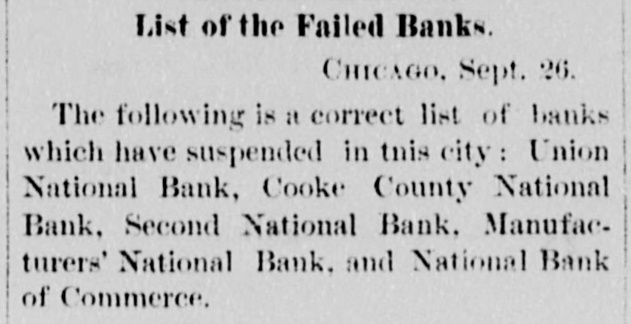
List of the Failed Banks. CHICAGO, Sept. 26. The following is it correct list of banks which have suspended in this city: Union National Bank, Cooke County National Bank, Second National Bank. Manufacturers' National Bank. and National Bank of Commerce.


Article from New-York Tribune, September 29, 1873

Click image to open full size in new tab

Article Text

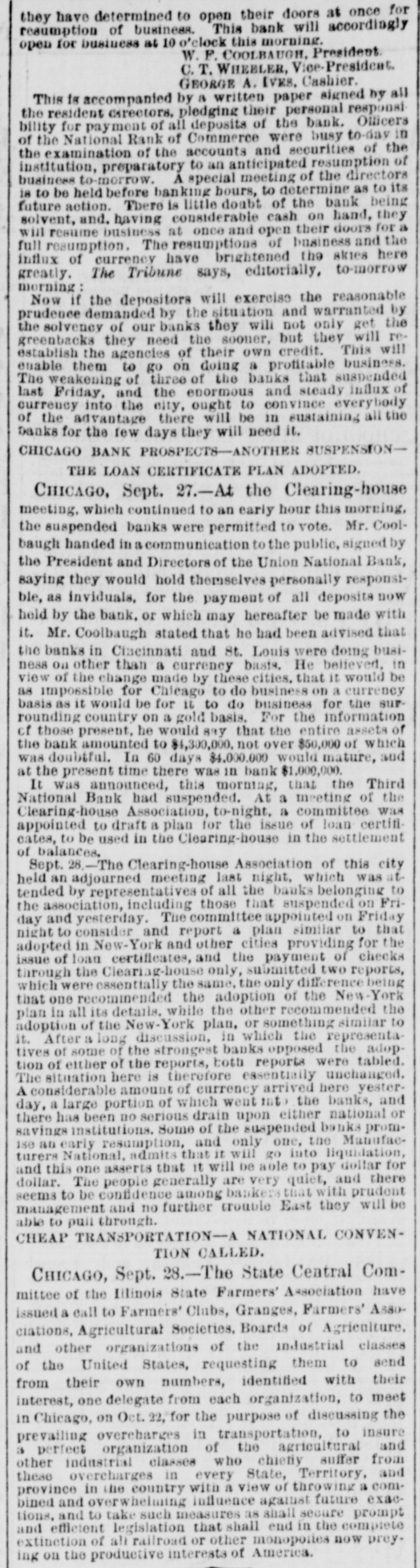
they have determined to open their doors at once for resumption of business. This bank will accordingly open for business at 10 o'clock this morning. W. F. COOLBAUGH, President C. T. WHEELER, Vice-President. GEORGE A. IVES. Cashier. This is accompanied by a written paper signed by all the resident directors, pledging their personal responsibility for payment of all deposits of the bank. Officers of the National Rank of Commerce were busy to-day in the examination of the accounts and securities of the institution, preparatory to an anticipated resumption of business to-morrow. A special meeting of the directors is to be held before banking hours, to determine as to its future action. There is little doubt of the bank being solvent, and. having considerable cash on hand, they will resume business at once and open their doors for a full resumption. The resumptions of business and the influx of currency have brightened the skies here greatly. The Tribune says, editorially, to-morrow morning : Now if the depositors will exercise the reasonable prudence demanded by the situation and warranted by the solvency of our banks they will not only get the greenbacks they need the sooner, but they will reestablish the agencies of their own credit. This will enable them to go on doing a profitable business. The weakening of three of the banks that suspended last Friday, and the enormous and steady influx of currency into the city, ought to convince everybody of the advantage there will be in sustaining all the banks for the few days they will need it. CHICAGO BANK PROSPECTS--ANOTHER SUSPENSIONTHE LOAN CERTIFICATE PLAN ADOPTED. CHICAGO. Sept. 27.-At the Clearing-house meeting, which continued to an early hour this morning, the suspended banks were permitted to vote. Mr. Coolbaugh handed communication to the public, signed by the President and Directors of the Union National Bank, saying they would hold themselves personally responsible, as inviduals, for the payment of all deposits now held by the bank. or which may hereafter be made with it. Mr. Coolbaugh stated that he had been advised that the banks in Ciacinnati and St. Louis were doing business on other than a currency basis. He believed, in view of the change made by these cities. that it would be as impossible for Chicago to do business on a currency basis as it would be for it to do business for the surrounding country on a gold basis. For the information of those present, he would say that the entire assets of the bank amounted to $4,300,000, not over $50,000 of which was doubtful. In 60 days $4,000.000 would mature, and at the present time there was in bank $1,000,000. It was announced, this morning, that the Third National Bank had suspended. At a meeting of the Clearing-house Association, to-night. a committee was appointed to draft a plan for the issue of loan certificates, to be used in the Clearing-house in the settlement of balances. Sept. 8.-The Clearing-house Association of this city held an adjourned meeting last night, which was at tended by representatives of all the banks belonging to the association, including those that suspended on Friday and yesterday. The committee appointed on Friday night to consider and report a plan similar to that adopted in New-York and other cities providing for the issue of loan certificates, and the payment of checks through the Cleariag-house only, submitted two reports, which were essentially the same. the only difference being that one recommended the adoption of the New-York plan in all its details. while the other recommended the adoption of the New-York plan, or something similar to it. After a long discussion, in which the representatives of some of the strongest banks opposed the adoption of either of the reports, both reports were tabled. The situation here is therefore essentially unchanged. A considerable amount of currency arrived here yesterday, a large portion of which went: into the banks, and there has been no serious drain upon either national or savings institutions. Some of the suspended banks prom180 an early resumption, and only one, the Manufacturers National, admits that it will go into liquidation, and this one asserts that it will be aole to pay dollar for dollar. The people generally are very quiet, and there seems to be confidence among bankers that with prudent management and no further crouble East they will be able to pull through. CHEAP TRANSPORTATION-A NATIONAL CONVENTION CALLED. CHICAGO, Sept. 28.-The State Central Committee of the Illinois State Farmers' Association have issued a call to Farmers' Clubs, Granges, Farmers' Associations, Agricultural Societies, Boards of Agrieulture, and other organizations of the industrial classes of the United States, requesting them to send from their own numbers, identified with their interest, one delegate from each organization, to meet in Chicago, on Oct. 22, for the purpose of discussing the prevailing overcharges in transportation, to insure a perfect organization of the agricultural and other industrial classes who chiefiy suffer from these overcharges in every State, Territory, and province in the country with a view or throwing a combined and overwhelming influence against future exactions, and to take such measures as shall secure prompt and efficient legislation that shall end in the complete extinction of all railroad or other monopolies now preying on the productive interests of America.


Article from The Middlebury Register, September 30, 1873

Click image to open full size in new tab

Article Text

LIST OF FAILED BANKS.-Chicago. Sept. 26.-The following is a correct list of banks which have suspended in this city; Union National Bank, Cooke Couny National Bank, Second National Bank, Manufacturers' National Bank of Com. merce.


Article from Chicago Daily Tribune, September 30, 1873

Click image to open full size in new tab

Article Text

LAWRENCE, KS. Special Dispatch to The Chicago Tribune. LAWRENCE, Ks., Sept. 20.-Financial matters are looking brighter. The news of resumption by the Chicago banks is hailed with delight. Our banks have paid without suspension through the panic.


Article from Chicago Daily Tribune, September 30, 1873

Click image to open full size in new tab

Article Text

SAN FRANCISCO. Special Dispatch to The Chicago Tribune. SAN FRANCISCO, Sept. 20.-To-day was devoted almost exclusively to collections and legitimate channels, and the result inspirod confidence. Tho resumption of business by the Chicago banks was the subject of much congratulation, showing the panic had no serious effects on Western finance and stability. This, with the promptness with which to-day's matured obliga- tions were mot, has reopened the current of exchange, which resumed with some briskness. Coin drafts on New York sold at ยพ to 1 por cent; telegraphic transfers at 2 por cent. The panic has fully demonstrated the unadvisability of stock speculations. Capitalists are more unwilling than ever to invest in outside real estate, preferring legitimate enter- prises and staple products. The panic is charged


Article from The Redwood Gazette, October 9, 1873

Click image to open full size in new tab

Article Text

Federal, State, county or musicipal governments; opposes the present tariffs; favors taking solvent debts: favors the eight-hour law; opposed to Chinese immigration, and also opposed to the election of the President more than one term of four years. The last resolution indorses the stand taken by Governor Booth in behalf of popular rights against the encroachments of politicians and railway corporations. A dispatch from Deaver, Col., states that over vo-thirds of the mining town of Fairplay, Col., had been consumed on he 26th. All the stores, printing offices, the United States land office, post office, express office, als and other business places, three exceptions, had been utterly destroyed. The Right Rev. Geo. M. Randall, Episcopal Bishop of Colorado New Mexico and Wyoming, died at Denver, Colorado, on the 28th, of typhold pneumonia. The Third National Bank, of Chicago, closed its doors on the 27th. The Cook County National, one of the suspended banks of that city, had announced its resumption. The Manufacturers' and Second National banks had decided to go into liquidation. The Union National, the first of the Chicago banks that closed its doors, had announced its assets at $5,600,000, and its liabilities at $4,300,000. and given notice of its speedy resumption of business. The Clearing-Ho Association met on the evening of the 27th, and after an animated discussion resolved not to issue ClearHouse certificates. A dispatch from St. Louis of the 27th says that the rear wall of the five-story warehouse, on the corner of Second and Chestnut streets, had fallen, opening gap in the building fifty feet wide from the ground to the roof. One man had been killed and two seriously injured. In Chicago, on the 29th, business had resumed very nearly its normal condition. Three of the suspended banks had resumed business and were receiving deposits and paying out on checks as before the panic. Over $3,000,000 currency had been received during the preceding forty-eight hours. Traffic had fallen off on the various lines of railroad, and a large number of trains had been drawn off, and many men discharged. A St. Louis dispatch of the 29th says that while Joseph H. Fore, who attempted to kill his wife, on the 4th of June last, was being tried in that city on the 29th for that offense, hethrew heavy cut glass inkstand at his wife as she was giving in her testimony. The missile missed her, but struck her counsel full in the forehead, inflicting an ugly and danger wound. At a late hour on the night of the 29th the Union National Bank of Chicago, which had resumed business on that morning, and during the day had paid out $400,000, decided to go into liquidation, under the provisions of Sec. 42 of the National Currency Act. A call has been issued for a Northwestern Farmers' Convention, to meet at Chicago on the 22d of October, to consist of delegates from Granges and farmers' organizations. The South. A dispatch from Richmond, Va., of the 23d, says that the Merchants' National, the Planters', the Mechanics', the Peoples', the First National, and the Citizens' banks, of Petersburg, had suspended. A Baltimere telegram of the 24th announced that all the banks of that city had stopped currency payment. Brown, Lancaster & Cowell, agents of the Chesapeak and Ohio Railway, having houses in Baltimore, New York and Richmond, had also suspended. A Little Rock, Ark., dispatch of the 24th says the money panic in that city continued, caused not 80 much by Eastern financial complications as by the refusal of the city banks to take the shinplasters that have been current there. A dispatch from Richmond, Va., says that the Richmond Dollar Savings Bank had suspended, and that Taylor & Williams, bankers, had failed. A dispatch to the Associated Press, from Brownsville, Texas, of September 24, says that a series of butcheries and robberies had recently been committed in Mexico, the victime every case being Americans. The perpetrators of these crimes were arrested, and their guilt fully established, yet not one of them had been punished, the authorities being either indifferent or powerless. The facts had been reported by the Consuls to Washington, in the hopes that redress would be demanded. A Memphis dispatch of the 25th says that the First National and De Soto banks, of that city, had closed their doors. A dispatch from Nashville Tenn., says that the National Banks of that city had suspended currency payments on all balances exceeding $200. A dispatch from Selma, Ala., of the 25th. says the Savings Bank of Selma had suspended in consequence of an extraordinary run by depositors. All the banks of New Orleans partially suspended payment on the 25th, according to a dispatch from that city. The suspension was to remain in force for thirty days. Telegrams from various cities in Georgia, of the 25th, say the following banks had suspended: National Exchange, the Merchants' and Planters' National, the Planters' Loan and Savings Banks, of Augusta, Ga.; the Dollar Savings Bank, of Atlanta, Ga.: Savannah Bank and Trust Company, and the South ern Bank of Georgia. A dispatch from Shreveport, La., of the 25th, says the fever, which seemed to have abated on the preceding day, had broken out with renewed violence. The interments numbered twenty-two. A dispatch from Shreveport, La., of the 29th says that within the last four days sever al of the most prominent and useful citizens of that city had fallen victims to the epidemic. The dispatch adds: "The population has been fearfully thinned out by sickness and death We no longer have funerals. The hearses, followed by one or two carriages, dash through the streets like a section of artillery in a battle seeking position. A few men are drummed up, the coffins shoved into the hearse, and driven rapidly to the cemetery. This is the case even with the most prominent citizens. The Howards have opened an orphan asylum, and are feeding about two-thirds of the resident population. There are fewer deaths and new cases, because there are fewer people.' A Jackson, Miss., dispatch of the 29th says Governor Powers, acting under the advice of Attorney-General Morris, had issued proclamation postponing the State election. The Governor says that he will convene the Legislature in extraordinary session as soon as possible. The Pilot, the State organ, has pronounced the Governor's movement incendiary, and calculated to lead to revolution and anarchy.
Article from Ottumwa Weekly Courier, October 16, 1873

Click image to open full size in new tab

Article Text

At last it turns out that of the twenty-one National banks of Chicago before the panic, three have gone into liquidation, viz: the Union, the Second National, and the Manufacturers'. The three other banks which suspended have all opened again, and are moving along as usual. Rapidly currency is coming into Chicago, and the best and most hopeful teeling prevails. It is confidently expected that the three banks which have gone into liquidation, will pay everybody, depositors and all.


Article from Wilmington Daily Gazette, November 28, 1873

Click image to open full size in new tab

Article Text

CAN A NATION AL BANK BE PUTINTO BANK RUPTCY.-The - Chicago Tribune on the 23d reports the following case as pending, on arguinent, in that city : A week ago Saturday, J. R. Smith & Co. filed a petition against the Manufacters' National Bank, to throw it into bankruptcy, alleging that the bank was then a debtor of the petitioners to the amount of $1,500, on account of money deposited, which it had failed to pay for fourteen days after request for the same, and charging that the bank had committed acts of bankruptcy in suspending payment of said deposit, and, also, by giving numerous preferential assignments to various persons, by turning over paper and securities in payment of sundry creditors. The usual rule to show cause was not issued, but was deferred until an argumentcould be heard on the question as to whether a national bank could be put into bankruptcy.


Article from Evening Star, December 1, 1873

Click image to open full size in new tab

Article Text

CAN A NATIONAL BANK BE PUT INTO BANKRUPTCY?-The Chicago Tribune of the 23d reports the following case as pending, on argument, in that city:-A week ago Saturday J. R. Smith & Co. filed a petition against the Manufacturers' National Bank, to throw it into bankruptcy, alleging that the bank was then a debtor of the petitionersto the amount of $1,500, on account of money deposited, which it had failed to pay for fourteen days after revuest for the same, and charging that the bank had committed actsof bankruptcy in suspending paymeet of said deposit, and, also, by giving numerous preferential assignments to various persons, by turning over paper and securities in payment of sundry creditors. The usual rule to FOOW cause was Lot issued, but was deferred until an argument could be heard on the question as to whether a national bank could be put into bankruptcy.


Article from The Wheeling Daily Intelligencer, December 15, 1873

Click image to open full size in new tab

Article Text

Another Man Short in his Accounts. CHICAGO, Dec. 14.-It is stated that David Gage, City Treasnrer, is short in his accounts with the city to an amount which will reach nearly or quite four hundred thousand dollars. A portion of this amount is locked up in the suspended Second National and Manufacturer's National Banks. It is said that Mr. Gage will be able to obtain security from any ultimate loss.


Article from Alexandria Gazette, December 15, 1873

Click image to open full size in new tab

Article Text

It is stated that David A. Gage, city treasurer, of Chicago, is short in his accounts to an amount which will reach nearly or quite $400,000. A portion of this amount is locked up in the suspended Second National and the Manufacturers' National Banks. It is said that Gage will be able to secure the city from any ultimate loss.


Article from The Portland Daily Press, December 15, 1873

Click image to open full size in new tab

Article Text

CHICAGO, Dec. 14.-It is stated that David A. Gage, City Treasurer, is short in his accounts with the city nearly or quite $400,000. A portion of this amount is locked up in suspends ed National and Manufacturers N ational Banks. It is said that Gage will be able to secure his bondsmen from any ultimate loss.


Article from The Daily Gazette, April 22, 1875

Click image to open full size in new tab

Article Text

"FAST BANKING.-The Chicago Tri. bune says; The Cook County National Bank paid the highest rates known in this city for deposits. The history of banking here and elsewhere dces not encourage the idea that placing deposts where they will draw the highest interest is putting them where they will do the most good to the depositor. When the extinguished financier under whose auspices the Manufacturers' National Bank of thiscity we tinto liquidations became its president, he outbid all the other bankers in the city in interest on deposits. He paid 5 and 6 per cent., and even more. "How can you afford to pay such rates?" he was asked one day by a fellow-financier. "Pay!" said he, "I don't care what rates I pay. I am going to build up the business of this bank, no matter what it costs!" Whatit costs, the report of the Receiver, lately published, showed to the full satisfaction, it is to be hoped, of the depositors.


Article from Chicago Daily Tribune, April 25, 1875

Click image to open full size in new tab

Article Text

MONEY AND COMMERCE. FINANCIAL. A rapid advance in the price of exchange was the only change in the financial situation. Sales were made at 25@50c premium between banks for $1,000. The sudden fall in price the day before is to be attributed to the large amounts simultaneously offered by the banks upon discovering that they had run down their stocks of currency lower than they wanted to see them. The amount of exchange made by the cattle trade here has been very large. During the past week fully $2,000,000 of exchange has been made at the StockYards. It is worth noticing that the cattle trade of the West and Northwest now centres at this point. The cattle, instead of being shipped as in earlier days, through Chicago on Eastern account, are purchased here and shipped on Western account, The discount market remains without any noticeable new features. Merchants are borrowing largely on account of the retardation of collections, and business in the country on account of the cold, unseasonable weather. Rates at the banks are 8@10 per cent. On the street there is less good paper offering than could be taken. Rates are 7@18 per cent. The clearings Saturday were $3,096,275.05; for the week the clearings were $18,998,852.21; and the baiances $1,995,489.41: for the corresponding week of last year the figures were respectively $17,180,770.79 and $1,937,000.40. 5-20 BONDS. The seventeenth call for the redemption of 5-20 bonds of 1862 states that the principal and interest of the following bonds will be paid July 20, 1875, and intercet will cease after that date: Coupon bonds, known as the Fourth Series, Act of Feb. 23, 1852, dated May 1, 1862, ns follows: COUPON BONDS. $30-No. 15,401 to No. 17,100, both inclusive. $500No 20,001 to 22,400, both inclusive. $100-No. 40,001 to No. 44,200, both inclusive. $1,000-No. 66,001 to No. 70,950, both inclusive. $5,000,000. The amount outstanding (embraced in the numbers as above) is $5,000,000. United States securities, forwarded for redemption, should be addressed to the Loan Division of the Sacretary's Office." THE ERIE HAILROAD IN THE LONDON STOCK MARKET. The London Times of the 10th inst., in its financial article, says: A correspondent writes complaining very bitterly of the way in which pamphiets and circulars are kept flying about filled with extremely damaging statements as to the present position of the Erie Railway. He says bons fide investors are disturbed, frightened, and induced to sell on terms by which they are nearly ruined, and gives a number of figures to prove that the line is not FO bad as these publications assert. Probably he is right. The winter has been a very bad one for Erie, there is no doubt; but by latest accounts traffic has been recovering, and working expenses have been so reduced that the line may fairly be held to be better off than it was some time ago. At the same time, this cannot be asserted positively, and until the traffic receipts are again issued month by month it is impossible to prevent the evil rumors from doing harm, however false they may be. The shareholders ought to know the state of receipts in any case, and, although we can quite understand the desire of the President of the line to lat the bad time go by without saying anything, 80 that his work might appear all the greater when it is revealed, we think it is time secrecy W38 discarded. Even bad traffics, if honestly explained, would at once put an end to the disgraceful running-down system that has been in progress for some time now, and which has unquestionably resulted in the recuperative capacity of the line being grossly underestimated. RECEIVERS FOR INSOLVENT NATIONAL BANKS. The scandalous results of the voluntary liquidation of the Manufacturers' National Bank of this city have evoked considerable discussion of the defects in the National Banking act, which renders such things possible, Comptroller Knox sends the New York Daily Bulletin the following extract from a bill authorized to be reported by the Bank Committee of the last Congress, and intended to cure this defect in the law. The following is the section of the Bank Committee bill to which the Comptroller alludes SEC. 2. That whenever any association shall be dissolved, and its rights, privileges and franchises declared forfeited, as prescribed in Sec. 5,239 of said statutes, or whenever any creditor of any such association shall have obtained a judgment against it,and execution thereon shall have been returned unsatisfied, the Comptroller of the Currency may, on the application of such judgment-creditor, accompanied by a certificate from the Clerk of the court in which such judgment may have been rendered, stating that such judgment has been rendered, and execution thereon has been issued and returned unsatisfied, appoint a Receiver, who shall proceed to close up such association, and enforce the personal liability of the shareholders, as provided in Sec. 5,234 of said statutes. The Bulletin thinks that this clause, if adopted, would undoubtedly have given the creditors of an insolvent bank a remedy through the Banking Department. But the thing needed is that it shall be impossible for an insolvent bank to undertake its own liquidation simply at its own option. The law should provide that, when a bank proposes to go into liquidation, the Comptroller of the Currency shall institute an examination into its affairs, and upon such examination determine whether, in the interests of its greditors, the bank shall be liquidated under & Rebeiver, or may be safely allowed to wind up its own affairs," GOVERNMENT BONDS. Bid. 1.Asked.


Article from Chicago Daily Tribune, December 28, 1877

Click image to open full size in new tab

Article Text

Total $5,464,108 $2,784,835 2,070,303 Deficiency Here is a loss to the poor depositors of over $2,679,000. the accumulation of months and years of toll, all squaudered by a system of banking which never has, and never can, produce a sufficient margin of prodt to give to the business that stability which is 60 Imperatively demanded in the interest of the working classes. Then add to this vaulabed capital the Interest on what the depositors will ultimately receive, but not for some years-it will certainly be $100,000. Then add to this $500,000, the callmated capital on which these four banks were doing business, and there is dgured up a loss of nearly $3,200,000, swept away forever from the earnings and accumulations of our city. If to this sum be added the losses resulting from the failures of other banks, the Scandinavisu, Cook County, Second, Manufacturers', Commercial Loan. mid others which now-escape recollection, It will be found that there have beeu frittered away In glittering land and other speculations, fully $5,000,000 of the capital of our citizens. AS A. MATTER OF CURIOSITY, and for future reference, the following statistics, showlug the condition of all the savings banks in the city on July 1 last, is submitted. The figures for the Dime and Chicago Savings are estimated, and, It is believed, are sufficiently accurate for this purpose. The reported capItal of the " Bee-live " includes the " contingent fund," the grandiloquent appellation bestowed upon the surplus by the roly-polv manager, Syd Myers. During the run, which began about the middle of July and ceased only when the banks closed their doors, the depositors succeeded in withdrawing nearly if not fully $5,000,000, or a little over 56 per cent of the amount due them In the aggregate. It is indeed very questionable If there be to. day $1,000,000 on deposit In the four savings banks now running. The confidence of the people to these Institutions is at A very low ebb, and will remain so for some years to come. In fact, it seems not hazarding too much to say that, when the Government shall have resumed specie payment, there will not be & savings bank in the city, as those which are now in existence will be forced to retire for lack of business. [Enaur L. Bananted


Article from Evening Star, March 29, 1887

Click image to open full size in new tab

Article Text

A BANK CASE DECIDED.-In the insolvent bank case of Alonzo Richmond and others against Agnes F. Irons and others, on appeal, a decision was rendered in the United States Supreme Court yesterday, holding the stockholders of the insolvent Manufacturers' National Bank, of Chicago, liable for its indebtedness. The Supreme Court heid that the stockholders were not bound to contribute to a fund to pay the expense of the receivership, but that they were liable for the bank's debts.


Article from Omaha Daily Bee, March 29, 1887

Click image to open full size in new tab

Article Text

IMPORT NT DECISION. The Highest Tribunal On the Insolvent Mann facturers Bank Case. WASHINGTON. March 28.-A decision was rendered by the United States supreme court to-day in the insolvent bank case of Alonzo Richmond, Charles Comstock and others against Agnes F. Irons and Andrew H. Foskett, executor and executrix of James Irons, deceased, and others, an appeal from the United States circuit court for the northern district of Illinois. This was a suit to enforce the personal liabilities of stockholders for the debts of the insolvent Manufacturers' National bank of Chicago. A master, anpointed by the court below to ascertain the amount of the debts and assets of the bank, reported on the 25th day of May, 1886, that the indebtedness of the bank at that time was $346,733; that $69,346 should be added to that sum for the expenses of the receivership, making a total of $416,079 and that the necessary assessment which should be made on the stockholder to pay said indebtedness was 83.2 per cent upon the capital stock of $500,000. Many exceptions were made to the master's report, but they were overruled and the decree was entered against each stockholder severally for the amount computed to be due from him according to the amount of his stock. From this decree Richmond, Comstock and others appealed. This court holds: 1. That the action of the circuit court in permitting amendments to the original pleadings is justified by the rules on that subject as stated by this court in the case of Neale vs Neale (9 Wallace 1) and in the Tremolo patent (23 Wallace 518), etc. 2. That the statute of limitations, even if applicable as a bar to this proceeding, ceased to run against the creditors of the bank entitied to the benefit of the decree from the time when the amended bill was filed in October, 1876. It had not then taken effect. 3. That the obligation of the deceased stockholder survives as against his personal representatives. 4. That Comstock is liable on stock sold by him in good faith but not transferred by him on the books, as well as on stock sold with a knowledge of the bank's insolvency. 5. That the stockholders are by law exonerated from obligation to contribute to the payment of all claims in class D, amounting in the aggregate to $18,500. 6. That the creditors are entitled to interest on the dates of the bank as against the stockholders. 7. That the stockholders are not bound to' contribute as a debt due from the bank or themselves to a fund for the payment of the expenses of the receivership. The decree of the circuit court, in so far as it is inconsistent with the foregoing decision, is reversed and the cause remanded with directions to proceed therein as justice and equity may require in conformity with this opinion. Opinion by Justice Matthews.