Article Text
DECIDES TO CLOSE ST
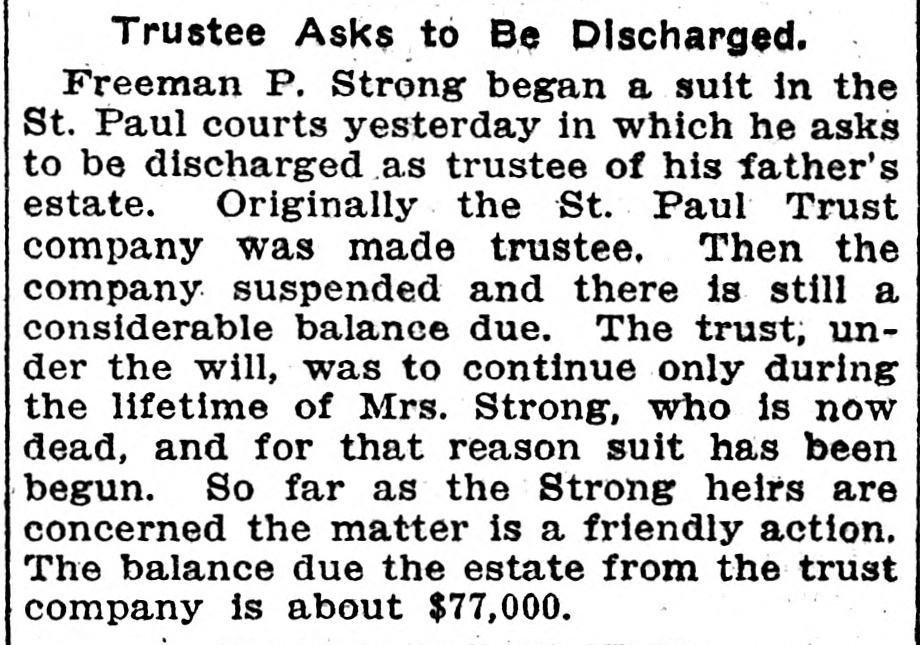
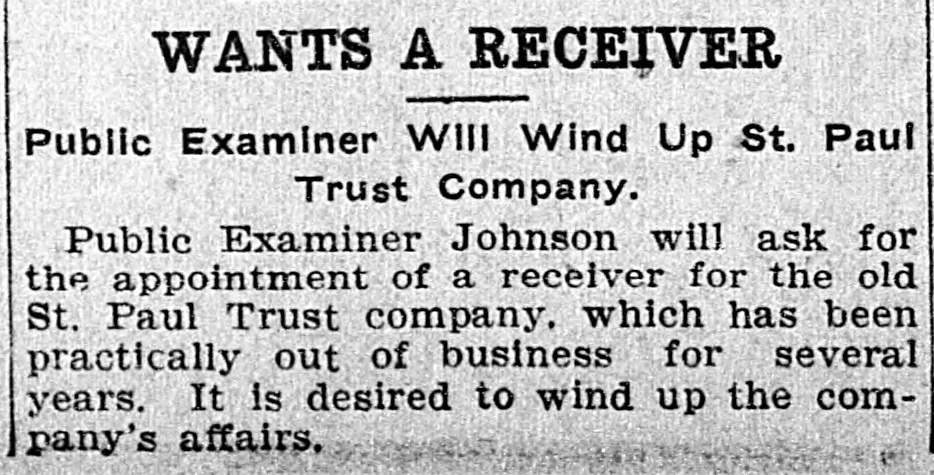
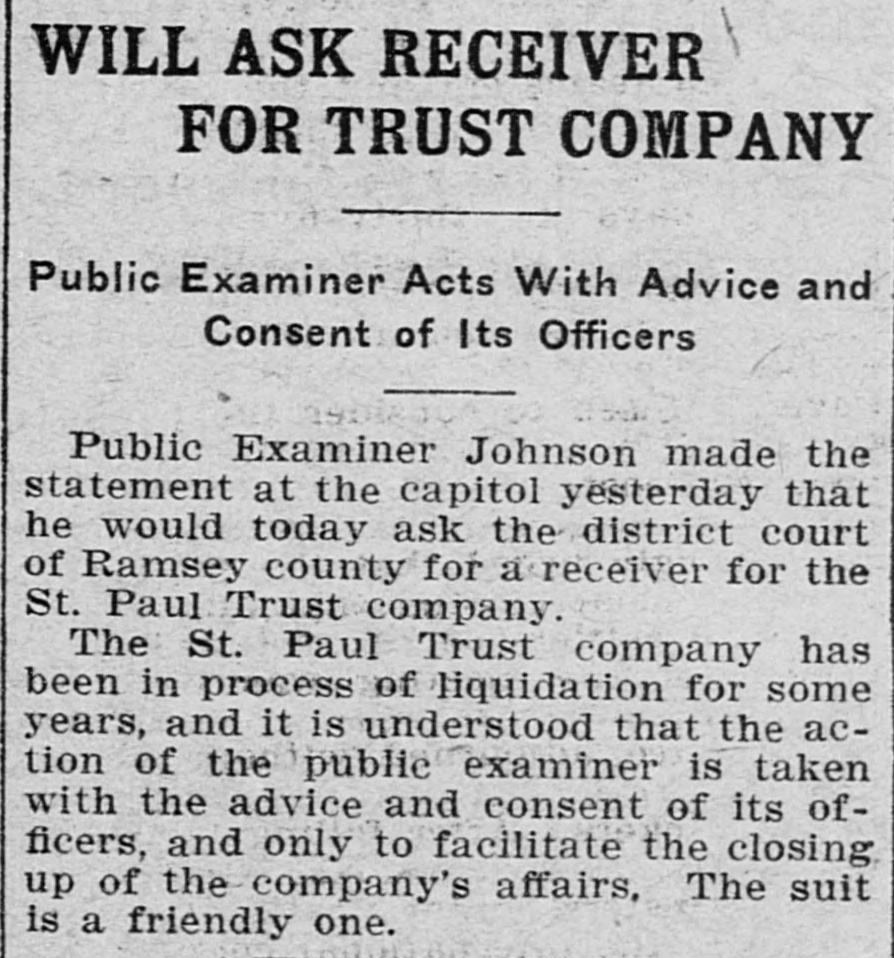
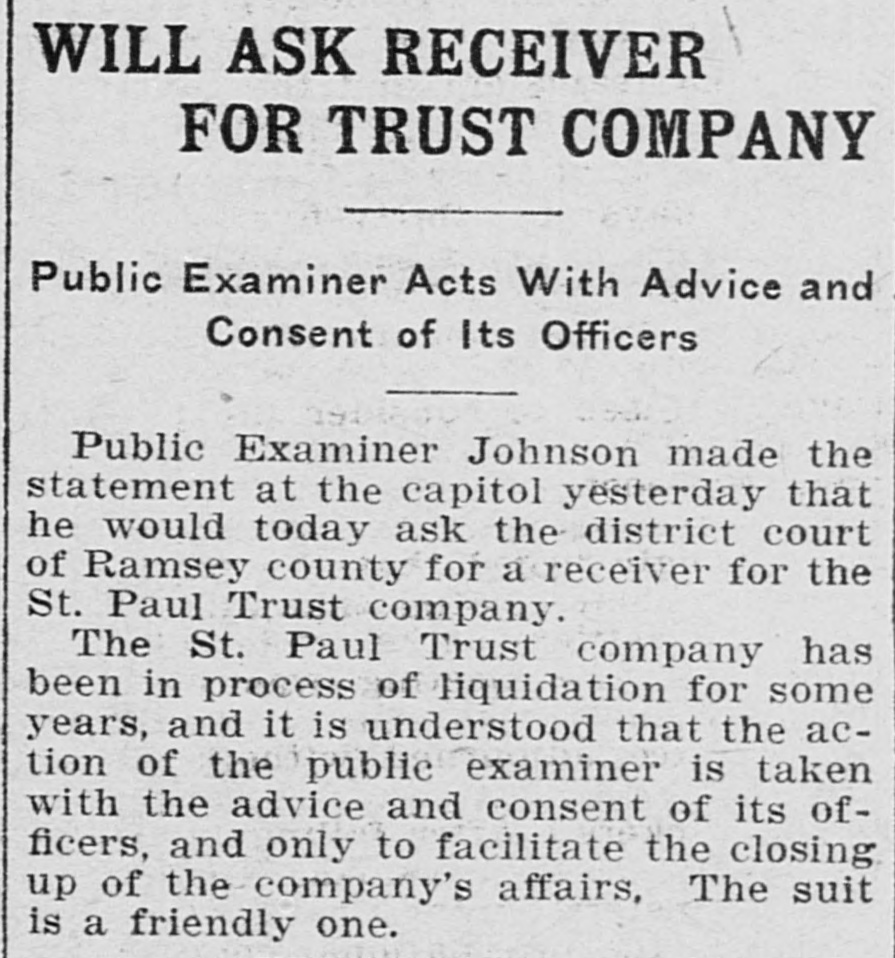
PAUL TRUST COMPANY GOES INTO VOLUNTARY LIQUIDATION BUSINESS IS UNPROFITABLE Supreme Court Decision in the Strong Case Causes Board of Directors to Take This Step. The St. Paul Trust company, after a commercial existence of eighteen years in this city, yesterday notified the bank examiner that it was going into voluntary liquidation. This decision was arrived at after a lengthy meeting of the board of directors, who say that within the next two years all the business affairs of the company will be settled dollar for dollar, and the company will go out of existence, It is expected that it will be reorganiz. ed within a short time, and all the present officers will resign their positions. The immediate cause for this decision on the part of the stockholders of the concern is the judgment handed down by the supreme court, Dec. 13, making the company liable to the heirs of C. D. Strong to the amount of $78,000, with interest for the past ten years, making the total amount nearly $125,000. In the decision the court exonerates the trust company completely, but the judgment is SO large that it will seriously affect all the stockholders, and this added to the fact that the business of the company for the past year has not been particularly profitable, decided the directors to wind up its affairs. President J. W. Bishop, of the Trust company, issued the following letters, setting forth the reasons for the action taken by the directors of the company: J. W. Bishop's Statement. Referring to misleading announcements published in the noon editions of our city papers, I beg to say that the public examiner is not. and has not been, in charge of the office or business of the St. Paul Trust company, that it has not made any assignment, that no receiver has been appointed, and that none of these things is likely to be true in the future. After an experience of some eighteen years, the St. Paul Trust company has found that the conduct of trust business under conditions and restrictions existing here has been unprofitable, and has decided to liquidate its affairs, to accept no new business, and within the next two years to retire from the field entirely. All of the funds to the credit of trust accounts, including all agency business, have long been set aside as required by law, in deposits separate and apart from our own moneys, SO that any or all of them can be paid on demand at any time. With its other creditors it has arranged to go into voluntary liquidation, and undertakes within two years to convert its assets, which are largely real estate, now beginning to be salable, and to satisfy all claims against it, and expects to thus wind up its affairs full, amicably and honorably. In the recent decision in the so-called "Strong case' the supreme court says, it assumes to be the fact. "as believed by the trial court, that the company exercised good faith in each of these transactions, and with a conviction that it was complying strictly with the law in respect to the investment of the trust funds." Yet this decision makes the company liable to refund, in cash, with legal interest from their date, a large amount of investments, made ten years ago, in mortgage loans, which, by the depreciation of real estate in this city, have necessarily been foreclosed. The company assumes the responsibility of meeting those conditions, but requires, and has obtained, the time necessary for the conversion of its assets, and for the preservation of the interests of all parties, including its stockholders There need be no excitement or sensation about the matter: all will be conducted and consummated in an orderly and businesslike manner, and to the satisfaction of all persons having accounts or trust relations with the company. -J. W. Bishop, President. The St. Paul Trust company has a capital stock of $200,000. Up until last summer it was $250,000, when the amount was reduced. Under the will of the late Freeman P. Strong the St. Paul Trust company was trustee, and had invested a large sum of money in mortgages on city property which were owned by the company. The value of the property depreciated, although at the time the investment was made, it was considered to be good. The estate objected to a settlement with the trust company based on the depreciated values, and the matter was brought into court where the estate presented the claim that the trust company had no right to dispose of the trust fund by selling it to its mortgagees. The court sustained the claim of the estate, and handed down the decision mentioned above. Will Be No Loss. The officials of the company all state that the creditors of the company will not suffer any loss whatever, and that all will be paid dollar for dollar. The outstanding obligations of the company exclusive of the amount due to the Strong estate is estimated to be about $30,000. It is said that the creditors of the company have asked the present officials to resign their positions, which they have agreed to do. Gen. Bishop, it is said, will soon retire and allow the affairs of the company to be wound up without his assistance. Hayden S. Cole, of the law firm of Stevens. o Brien, Cole & Albrecht, is supposed to be slated to succeeded Gen. Bishop. The following is the report of the St. Paul Trust company to Public Examiner