Dollar Savings Bank (Richmond, VA)

Episode Information

Episode UID
7336944390885
Episode Type
Run โ†’ Suspension โ†’ Closure
Bank Type
savings
Bank ID
733694439 hash
Start Date
September 23, 1873
Location
Richmond, Virginia (37.554, -77.460)

Metadata

Model
gemini-3-flash-preview (chosen from majority vote of a three-model LLM ensemble)
Short Digest
8efd0b42c9e2b800

Response Measures

None

Description

The bank initially attempted to reopen after the September 1873 panic but failed to maintain vitality and was eventually adjudicated bankrupt in early 1874.

Events (4)

1. September 23, 1873 Run
Cause
Macro News
Cause Details
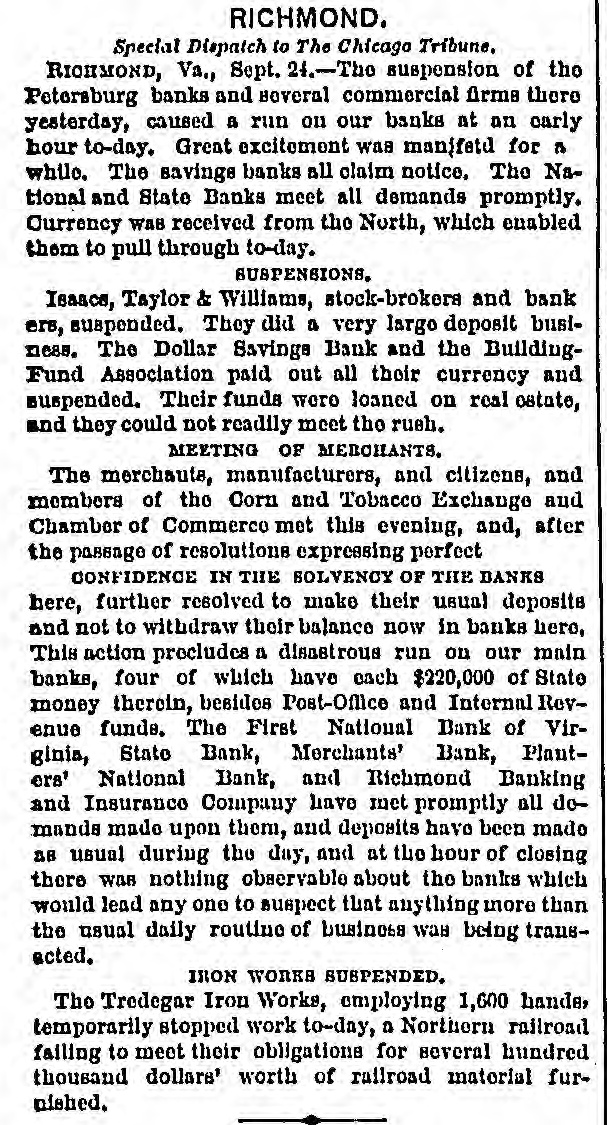
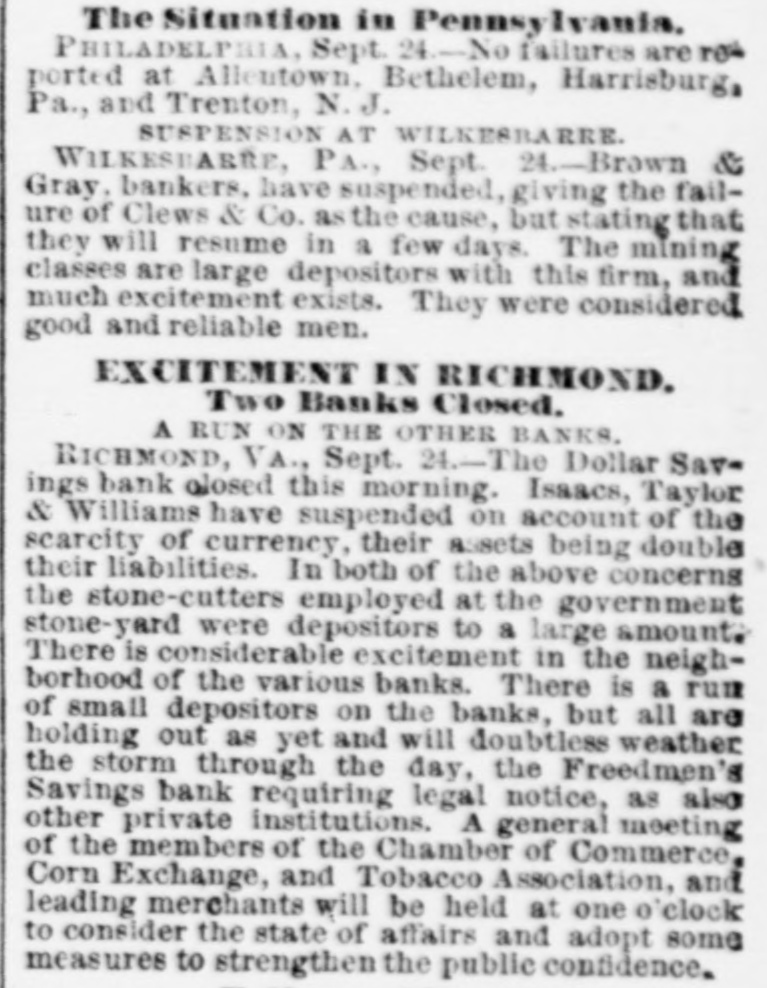
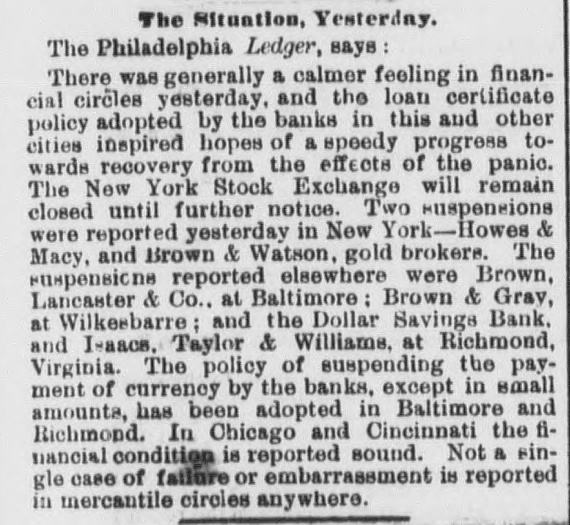
The Panic of 1873 caused heavy withdrawals and systemic financial distress.
Measures
The bank initially suspended payments and later attempted to resume by soliciting 'special' new deposits.
Newspaper Excerpt
This savings bank suspended payments over its counter on the 230 of September, 1878- memorable day among bankers.
Source
newspapers
2. September 23, 1873 Suspension
Cause
Macro News
Cause Details
Suspended payments during the September 1873 financial crisis.
Newspaper Excerpt
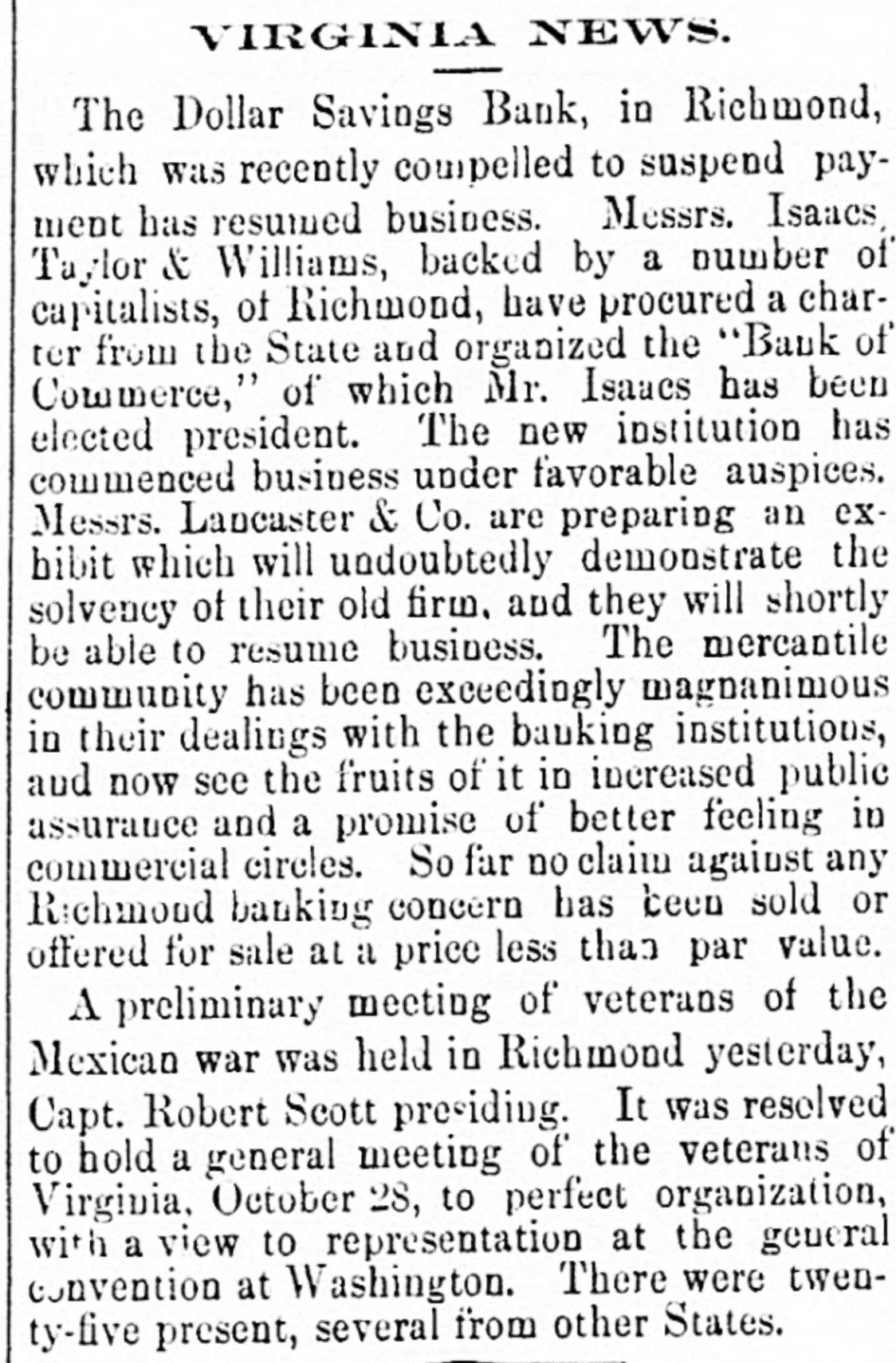
The Dollar Savings Bank, in Richmond, which was recently courpelled to suspend payment
Source
newspapers
3. October 6, 1873 Reopening
Newspaper Excerpt
The Dollar Savings Bank, in Richmond... has resumed business. ... Resolved That this bank resinne business Monday October 6th. by receiving special separat the trust bank new account, pledging use these deposits only in of checks against that new account and as fast the bank can collect and realize from the loans and to pay pro rata instalments on its present indebtedness until the whole shall be liquidated. the same drawing the usual interest as heretofore. until JOHN E. paid. President BOSSIEUX, Thomas S. Armistead, Cashier. Deposits to an inconsiderable amount were made under this call by a few menone of whom was this petitioner- the bank very soon found itself unable to go on, and closed its doors. In February, 1874. proceedings were taken against it by creditors, and it was duly adjudicated an involuntary bankrupt by this Court. There is no evidence that THE NEW DEPOSITS were marked and kept separate as special deposits; and the fact seems to be that they were received over the counter in the same manner as general deposits are received The advertisement itself virtually announced that the new deposits would be treated as a common fund as to the new de positors, and not treated as special separate deposits, except as against the old depositors. dividend has been declared and paid, without prejudice to the claim of the petitioner, John Beatty, and the other depositors under the advertisement of October 3, 1873, to be paid in full, according to the tenor of the advertisement, as preferred creditors. It is claimed on the part of the petitioner that his deposit under the dvertisement of the 3d of October was special deposit and that the advertisement was contract which this Court is bound equo et bono to specifically execute as a court of equity, I do not concur in either of THESE PROPOSITIONS 1. The deposit of the petitioner was not a special deposit; for it is only where the special money or thing deposited is received by the bank to be kept to itself and returned in corpore on demand that the deposit can be claimed to be special True, the advertisement held out that the lank would receive special separate deposits,' but calling a thing what it is not does not make it what is not. 2. It is claimed for the petitioner that he has a higher equity than the former depositors of the bank created by the advertisement of the 3d of October. I do not think so. The former depositors made their deposits on precisely the same terms in all essential respects (save one) as those on which the petitioner made his deposit, those terms being implied in their case, while in his they were expressed In the exceptional respect to which I al lude the case of the petitioner.is weaker in point of equity than that of the former depositors The contract under the advertisement was virtually that all . THE OLD RESOURCES of the bank, as well as the new deposits, would be first used for paying the checks of the new depositors. The bank proposed to go on with its banking business, and the new deposits were of course intended in the regular course of that banking business to be used for the purpose of making new discounts. As the new deposits were to be loaned out for this purpose, the checks of the new depositors would have to be paid in whole or in part from the moneys taken in on notes already discounted, and which would be falling due, SO that the operation of the new arrangement would be as follows Let the old deposits be known as Class D. They had been loaned out in discounting old paper, which we shall call Class X. Let the new deposits be known as Class B. They were to be loaned out in discounting new paper The advertisement of October 3d was virtually a promise to use THE FUNDS COLLECTED on maturing paper of Class X in paying the checks of the new depositors of Class Bthat is to say, the contract required money belonging ex equo et bono to Class D to be paid to Class B. I think such a contract, so far as it was to operate in that way, was ultra vires. The bank had no power to make it. and the contract when made was contrary to equity, and so far as it had the unjust operation described ought not to be enforced in equity But even if it were a contract free from the two objections of being illegal and contrary to equity, and were such a contract as a court of equity dealing with solvent parties should specifically execute, still this court, as a court of bankruptcy, would be unable to decree specific performance. In its nature this court has little to do with the specific execution of contracts. It has to deal with bankrupts who have broken all contracts, and are unable to perform any of them. It is court whose primary duty is the distribution of assets gathered from the wreck of the estates of bankrupts who themselves have already rifled them of every resource available for the execution of contracts. THE POLICY OF THE LAW under which the Court acts is to avoid preferences, and divide the assets orata, share and share alike, among creditors The (business of the Court in this case is to distribute assets under the terms of the law which, except in favor of liens, requires pro rata distribution. If the new deposits which have been spoken of had in fact been special deposits, duly ear-marked and set aside and held as such. the bank would have been a simple bailee of them, and would have been obliged to return them in kind. But they not
Source
newspapers
4. March 9, 1874 Receivership
Newspaper Excerpt
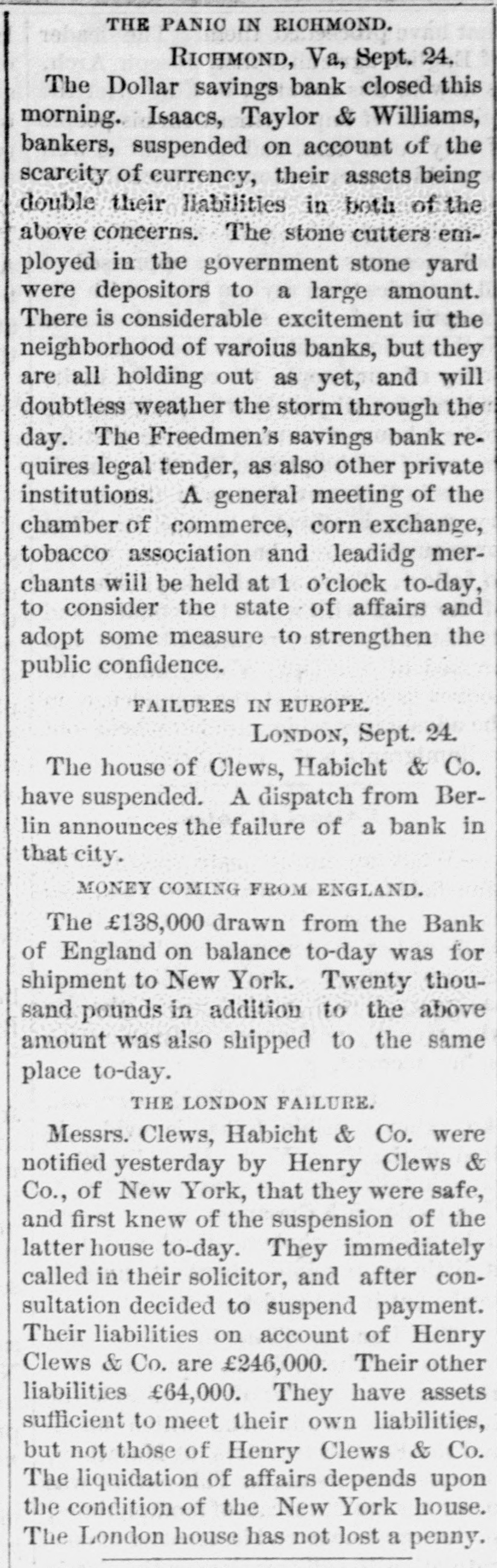
The Dollar Savings bank, of Richmond Va., which suspended during the recent tinancial crisis, has been adjudged bankrupt in the United States court.
Source
newspapers

Newspaper Articles (22)

Article from Alexandria Gazette, October 8, 1873

Click image to open full size in new tab

Article Text

VIRGINIA NEWS. The Dollar Savings Bank, in Richmond, which was recently courpelled to suspend payment has resumed business. Messrs. Isaacs Taylor & Williams, backed by a number of capitalists, of Richmond, have procured a charter from the State and organized the "Bauk of Commerce," of which Mr. Isaacs has been elected president. The new institution has commenced business under favorable auspices. Messrs. Lancaster & Co. are preparing an exbibit which will undoubtedly demonstrate the solvency of their old firm. and they will shortly be able to resume business. The mercantile community has been exceedingly magnanimous in their dealings with the banking institutions, and now see the fruits of it in increased public assurance and a promise of better feeling in commercial circles. So far no claim against any Richmond banking concern has been sold or offered for sale at a price less than par value. A preliminary meeting of veterans of the Mexican war was held in Richmond yesterday, Capt. Robert Scott presiding. It was resolved to hold a general meeting of the veterans of Virginia, October 28, to perfect organization, with a view to representation at the general convention at Washington. There were twenty-five present, several from other States.


Article from The Daily State Journal, February 20, 1874

Click image to open full size in new tab

Article Text

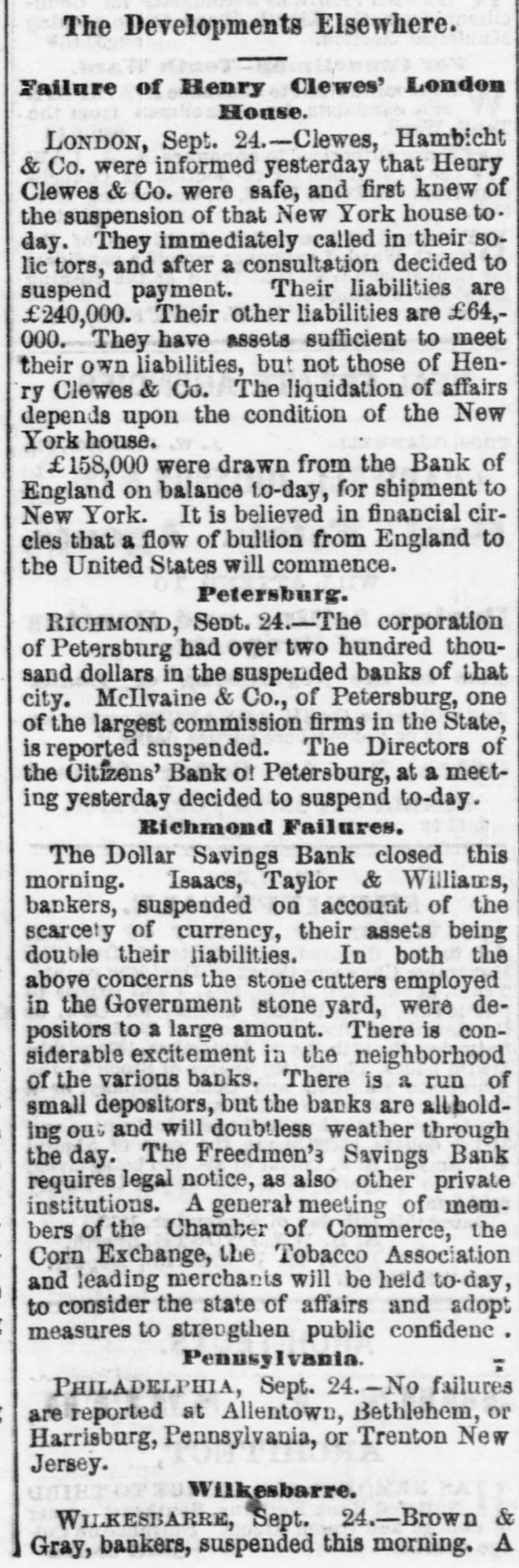
Items. THE spring lamb moveth up this way, Next Sunday will be Pater Patrie day. COLEMAN'S DEFALCATION was $16,000 in bonds, and he is in bonds for it. IT IS MUCH HARDER to climb the Jungfrau and Mitterhorn than a whisky horn. THE fierce blasts of March are anticipated with feelings of dread by the average citizen. FORTY car loads of freight, destined for New York, arrived via Chesapeake and Ohio railroad yesterday. MR. ROBERT H. MAURY has been appointed as expert to unravel the mysterious sinking fund disaster. VIRGINIA members of Congress are hammering away on that body for a reduction of duty on leaf tobacco. THE Chesapeake and Ohio railroad company are having a large track scale put in near the depot at Hinton. CALVIN DAVIS has been elected to represent Danville in the Virginia penitentiary for five years, for stealing a horse. SLEEPING CARS as at present managed, are productive of celibacy. No girl will marry after seeing an unwashed man in his sock-feet. WHAT A JOLLY GIRL to spark would be one of those nychatopians who cannot see in the daylight, but do wonderfully well in the dark. AN OLD MAID in Massachusetts has twenty-eight pet rabbits, and with these for pets and a hot brick for comfort she manages to get along very nicely. GEO. B. DEETON, a conductor on the Chesapeake and Ohio railroad, had his hand badly mashed while coupling cars at Gordonsville, on the morning of the 16th. THE NORFOLK VIRGINIAN is in a quandary to know "whether Governor Kemper has really accepted the position of Grant's Lieutenant and Fugleman." A MANCHESTER WIFE thus manages to secure for herself a quiet day. She notifies her husband in the morning that her mother is coming to spend the day with her. OUR NEW RESERVOIR is expected to cost $300,000. If a City Hall is ordered to be constructed, it will not cost less than that amount, and may be will go as high as $500,000, THE INVITATIONS to some entertainments in this city are printed on large boards, so that in case of the happening of an accident one could be carried home on his admission ticket. IT MAY BE ASSUMED as a postulate susceptible of easy demonstration, that that it is no more right in law to legislate about Sunday than any other day. All the days are equal before the law, or should be. IT IS STATED as one reason why a recent marriage here should be placed in the category of swell-head affairs that the minister got twenty dollars for his part of the job. A good woman is cheap at that price, we think. CAPTAIN CLAYTON, stevedore, was seriously injured yesterday by a bale of cotton which struck him in coming down a hatchway at the wharves of the Chesapeake and Ohio railroad. He was bruised about the head and face, and it is thought internally injured. DR. W. LEIGH BURTON'S poetical description of the skedaddle of the Senators on Thursday, has been printed on slips by Captain C. F. Johnston, newsdealer, 918 Main street, and was sold at the Capitol like hot cakes to-day. It is published in extenso in the Petersburg News of yesterday. A PARTY writing from Little Rock, Arkansas, says, "there are very few Virginians here. I have only met twoโ€”Mr. John W. Rison, formerly of Richmond, and Mr. Charles A. Ginnochio. The latter is an enterprising Italian, who formerly lived in Petersburg, where he has a host of friends." IT IS STATED that the affairs of the "Dollar Savings Bank" of this city are being investigated. During the late panic it incontinently "busted," and has not since shown any signs of vitality. It is alleged that the perspiration of many a poor man's eye-brow has been swallowed up in its financial chasm. THE PETERSBURG GUARD, Capt Hill, the colored company who will the be guest of the Attucks Guard and others in this city on the 23rd, are highly spoken of by the papers of the Cockade City. The News says: "We are betting our pile on the Guards, for they are equal to the best colored company in the State or elsewhere." WEDNESDAY NIGHT a passenger from the South on the Northern bound, got out at the Eighth street depot, in this city, to wet his whistle. Meanwhile the engine blowed its whistle and started and he was left behind. Procuring the aid of Policeman Pryde he was shown to the telegraph office, where he telegraphed for his baggage. He lost his ride on the sleeping car, however. AN EVENING CONTEMPORARY favors a municipal legislature, with two branches for Richmond, for the reason that they "would afford checks upon each other." Checks are good. We have many a time invested our last red in a stack. But, seriously, our idea is that the people favor the two-branched council because the single one they have had heretofore have dealt too much in checks, for whose payment they were responsible.
Article from Evening Star, March 10, 1874

Click image to open full size in new tab

Article Text

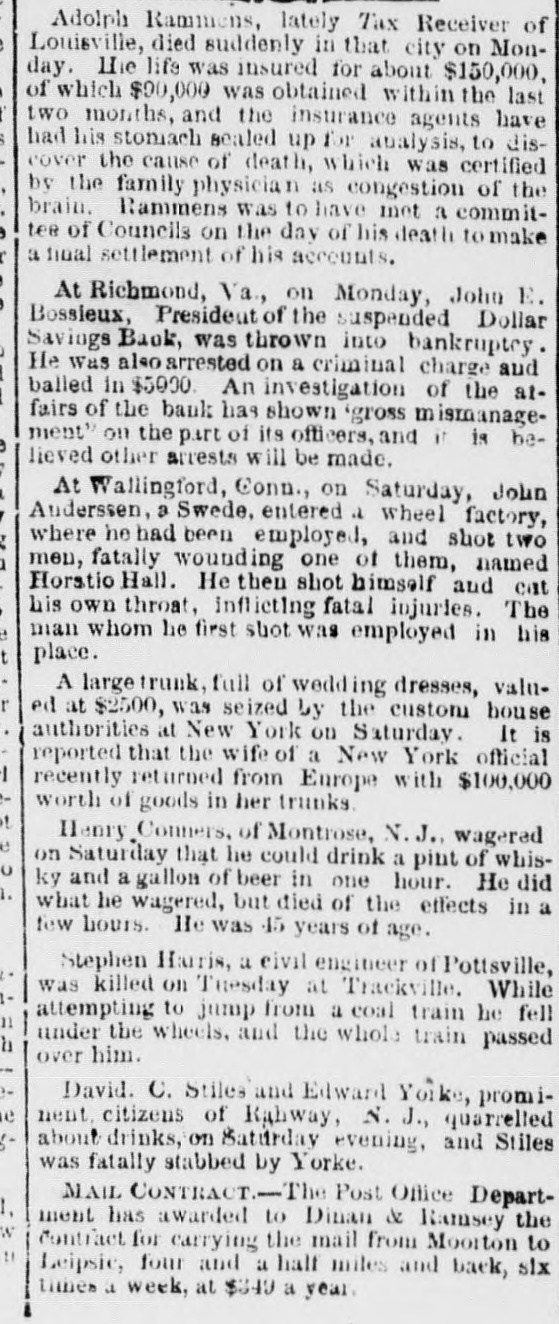
# PRESIDENT OF A SUSPENDED BANK ARRESTED John E. Boissieux, president of the Dollar savings bank, of Richmond, Va., which suspended during the financial crisis, was yesterday thrown into bankruptcy, and arrested on a criminal charge in connection with the management of that institution. An investigation has been progressing for some time past on the part of the trustees, which has brought to light facts showing gross mismanagement of affairs. It is stated that the stockholders and depositors will lose about $200,000. Boissieux was bailed in $5,000. Other arrests will probably follow.


Article from The Daily State Journal, March 10, 1874

Click image to open full size in new tab

Article Text

CITY NEWS THE DOLLAR SAVINGS BANK.-Upon pecition, signed by the trustees of the Mutual Building Fund and Dollar Savings Bank, " Judge Hughes, of the United States district court, yesterday issued a warrant for Mr. John E. Bossieux, president of the Dollar Savings bank. This was placed in the hands of Deputy Marshal Nye, who arrested Mr. Bossieux, and carried him before United States Commissioner Adkins, by whom he was bailed in the sum of $5,000 for his appearance at the next term of the United States strict court, which commences next Thursday, Mr. L. J. Bossieux surety, to answer charge as set forth in the petition of the trustees to the effect that their demands against the said John E. Bossieux are: First. $11,983.17, exclusive of interest, overdrawn by him from said bank. Second. A very large amount of money, the exact amount of which can not now he ascertained, received by him for said bank and appropriated by him for his own uses and purposes. Third, fourth, and fifth. certain promissory notes. specifically described in the petition. The petitioners further represent that within the past six months the said Bossieux did, with intent to hinder, defraud and delay his creditors, convey and transfer certain specified real estate in trust to secure Bossieux & Brother the payment of certain promissory notes. It is further charged that Bossieux, on 21st of February, 1874, did fraudulently stop or suspend, and has not resumed the payment of his commercial paper within a period of fourteen days. The petitioners therefore pray that he may be declared a bankrupt, and that his property betaken possession of by the court The specifications and details are too voluminous for publication in this journal The above summary presents a statement of the case in its most important aspeets. We KNOW little of the merits of this case, but the circumstances would indicate that the Dollar Savings bank, like other monetary institutions of this and other places, had not put its money 'where it would do the most good, consequently when the September panic struck it, it was unable to pay all of its depositors. The "shortness" would appear to be about $40,000. There should, however, be a practicable bridge between this sum (due mostly to laboring people in small sums), and perfect pecuniary happiness to all concerned in those deeds of trust on real estate and good notes which the bank was said to possess, and we hope it will so be found in the wind up. That John E. Bossieux has either done anything wrong in the premises, or contemplated doing so, we shall not believe until the same is made manifest by proof. He is a native of this city, a member of the city council, noted in business circles for his honesty, activity and enterprise, and socially for an urbane courteousness that has attached to him many friends That such a man should damn himself by a wilful act of wrongdoing in a community where he is so well known is not easy to believe. THE POLICE FORCE.-Mayor Keiley's message says more system has been infused in the conduct of the department of the correctional police than formerly existed-a pleasing assurance. He adds, firstly, in respect to the spring sickness which so often attack our Knights of the Billy, and secondly as to kindred matters, as follows: "I am unable to report any material improvement to the loss of time from sickness. l'his amounted during the past year to eleven hundred and thirtytwo days. As the compensation of the force is unaffected by sickness, this amount of lost time represents an outlay by the city of nearly $3,000, for which she received no aquivalent I have communicated with the authorities of four Northern and four Southern cities and find our proportion of sickness in the force considerably in excess of the most unhealthy of the eight cities. In every other respect the council will find the report of the chief reflecting the highest credit on the force, he arrests made during the year were 6,393 those of the preceeding year 6,121. The large number of arrests is supposed by the chief of police to be accounted for in part by the fondness of the colored people for this means of redressing their wrongs among themselves, but this cause can have affected but slightly the result, inasmuch as the colored arrests number but 41 more than the whites in this large aggregate of nearly 6,500. Indeed it must be said to the credit of the colored people, that while the white arrests for 1872 exhibit an increase of 441 over the arrests for 1873, the colored arrests for 1873 exhibit a decrease of 169 from those of 1872. One reason of this decline is the fact that I believe I have succeeded in breaking up most vicious and unlawful practice, for many years prevalent, of arresting whole companies of colored people on general warrants. During the year but one instance of this sort was reported to me, and as I required the money taken from the negroes on this occasion, under color of law, to be refunded to them, the experiment was, so far as I know, not repeated. "I regarded this matter as a flagrant outrage, and should feel it to be my duty to bring it to the notice of the grand jury if less stringent remedies should fail in reforming it. KATIE PUTNAM.-This charming, fascinating, and bewitching little artist, of real, modest, true naturalistic genius, was greeted at the Theatre last night with an other good house, but not such an one as her merit demanded. The play of 'Lorle, with Katie in the title role, supported by Brown as Christoph Balder, and Nugent as Reinhardt, and the remainder of the company, passed off very agreeably. To-night Sans Souci" will be produced. We doubt not the piece will sparkle with pleasantry, and that Katie will shine forth in all her brilliancy THE CAPITOL.-Donn Piatt's celeentitled above anneared


Article from Daily Kennebec Journal, March 10, 1874

Click image to open full size in new tab

Article Text

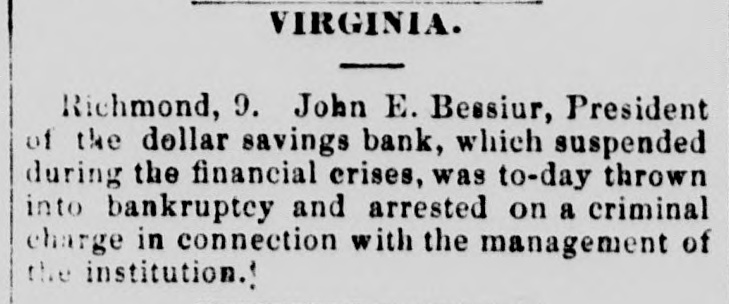
virginia. Richmond, 9. John E. Bessiur, President of the dollar savings bank, which suspended during the financial crises, was to-day thrown into bankruptcy and arrested on a criminal charge in connection with the management of the institution.


Article from The New York Herald, March 10, 1874

Click image to open full size in new tab

Article Text

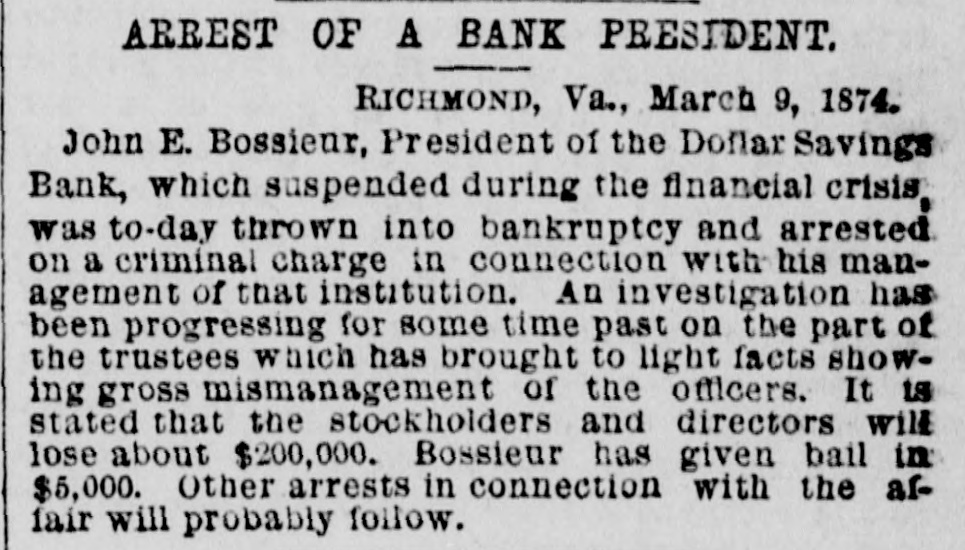
ARREST OF A BANK PRESIDENT. RICHMOND, Va., March 9, 1874. John E. Bossieur, President of the Dollar Savings Bank, which suspended during the financial crisis was to-day thrown into bankruptcy and arrested on a criminal charge in connection with his management of that institution. An investigation has been progressing for some time past on the part of the trustees which has brought to light facts showing gross mismanagement of the officers. It is stated that the stockholders and directors will lose about $200,000. Bossieur has given bail in $5,000. Other arrests in connection with the affair will probably follow.


Article from Evening Star, March 31, 1874

Click image to open full size in new tab

Article Text

When a street car conductor quits the road now they call him a "retired packer." The Dollar Savings bank, of Richmond Va., which suspended during the recent tinancial crisis, has been adjudged bankrupt in the United States court.


Article from The New York Herald, April 4, 1875

Click image to open full size in new tab

Article Text

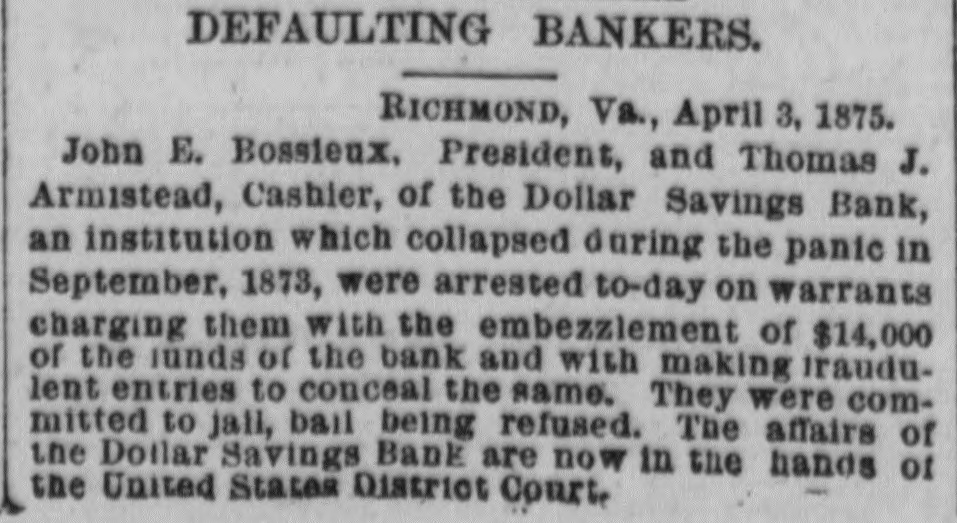
DEFAULTING BANKERS. RICHMOND, Va., April 3, 1875. John E. Bossieux, President, and Thomas J. Armistead, Cashier, of the Dollar Savings Bank, an institution which collapsed during the panic in September, 1873, were arrested to-day on warrants charging them with the embezzlement of $14,000 of the lunds or the bank and with making traudulent entries to conceal the same. They were committed to jail, bail being refused. The affairs of the Dollar Savings Bank are now in the hands of the United States District Court.


Article from Nashville Union and American, April 4, 1875

Click image to open full size in new tab

Article Text

Arrested on a Charge of Embezzlement. RICHMOND, VA., April 3.-Jno. E. Bossieux, President, and Thos. S. Armstead, Cashier, of the Dollar Savings Bank, which collapsed during the panic in 1873, were arrested to-day charged with embezzling$4,000 of the funds of the bank and with making fraudulent entries. They were committed to jail, bail having been refused.


Article from Evening Star, April 5, 1875

Click image to open full size in new tab

Article Text

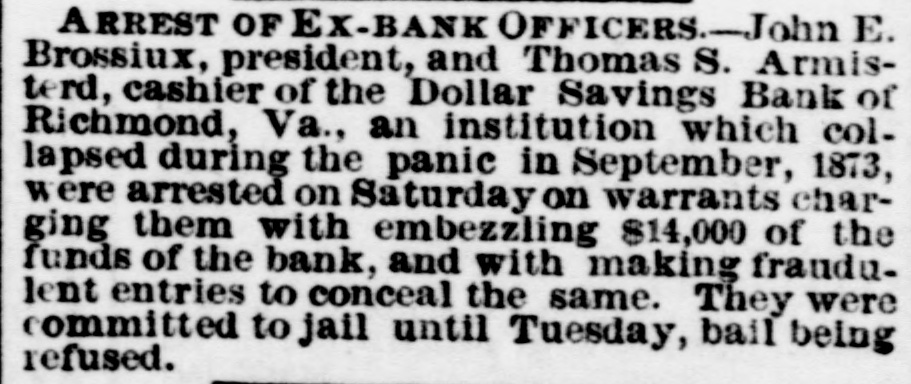
ARREST OF EX-BANK OFFICERS.-John E. Brossiux, president, and Thomas S. Armisterd, cashier of the Dollar Savings Bank of Richmond, Va., an institution which collapsed during the panic in September, 1873, were arrested on Saturday on warrants charging them with embezzling $14,000 of the funds of the bank, and with making fraudulent entries to conceal the same. They were committed refused. to jail until Tuesday, bail being


Article from The Wheeling Daily Intelligencer, April 5, 1875

Click image to open full size in new tab

Article Text

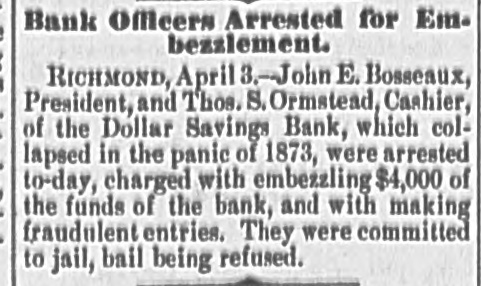
Bank Officers Arrested for Em. bessiement. RICHMOND, A pril 3.-John E. Bosseaux, President, and Thos. S. Ormstead, Cashier, of the Dollar Savings Bank, which collapsed in the panic of 1873, were arrested today, charged with embezzling $4,000 of the funds of the bank, and with making fraudulententries. They were committed to jail, bail being refused.


Article from The Wheeling Daily Register, April 5, 1875

Click image to open full size in new tab

Article Text

Bank Officers Arrested. RICHMOND, A pril 4.-J. Bossieux, President. and Thomas S. Amirstead, Cashier, of the Dollar Savings Bank, which collapsed during the panic of 1873, werearrested to-day, charged with embezzling fourteen thousand dollars of the funds of the bank. and with making fraudulent entries. They were committed to jail until Tuesday, bail being refused.


Article from Daily Kennebec Journal, April 5, 1875

Click image to open full size in new tab

Article Text

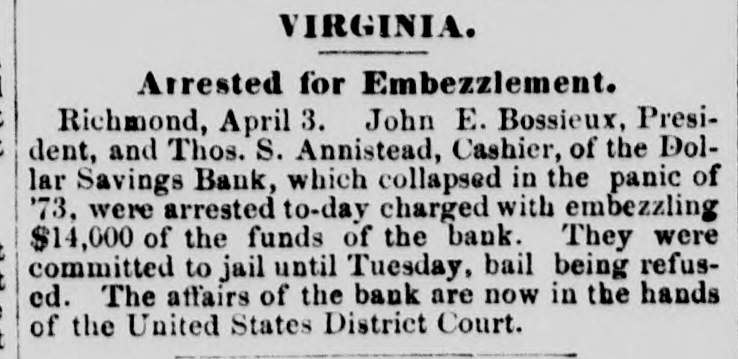
virginia. Arrested for Embezzlement. Richmond, April 3. John E. Bossieux, President, and Thos. S. Annistead, Cashier, of the Dollar Savings Bank, which collapsed in the panic of 73, were arrested to-day charged with embezzling $14,000 of the funds of the bank. They were committed to jail until Tuesday, bail being refused. The affairs of the bank are now in the hands of the United States District Court.


Article from Chicago Daily Tribune, April 5, 1875

Click image to open full size in new tab

Article Text

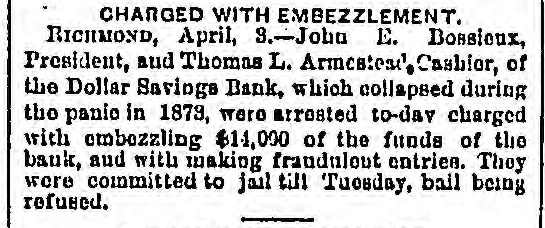
CHARGED WITH EMBEZZLEMENT. RICHMOND, April, 3.-John E. Bossieux, President, and Thomas L. Armestead, Cashier, of the Dollar Savings Bank, which collapsed during the panic in 1873, were arrested to-day charged with embezzling $14,000 of the funds of the bank, and with making fraudulent entries. They were committed to jail till Tuesday, bail being refused.


Article from The True Northerner, April 9, 1875

Click image to open full size in new tab

Article Text

The South. Pete McCartney, George Rankin, Mike Rogers, Joe Rittenhouse and John Hall, the notorious counterfeiters who some time ago escaped from the St. Louis jail, have been recaptured in Texas. John E. Bassieut, President, and Thomas L. Armstead, Cashier, of the Dollar Savings Bank, of Richmond, Va., which collapsed during the panic of 1873, have been arrested, charged with embezzling $14,000 of the bank funds. George Drury, a member of the Louisiana Legislature, has been indicted for participation in the forgery of the General Appropriation 11. Goldsmith's stallion Abdallah was instantly killed at Paris, Ky., on Monday, by collision with another horse while going around the track. He was valued at $80,000. The steamer Bruno was fined $500 at Little Rock, the other day, for violating the navigation laws in not flying the United States flag.


Article from Martinsburg Independent, April 10, 1875

Click image to open full size in new tab

Article Text

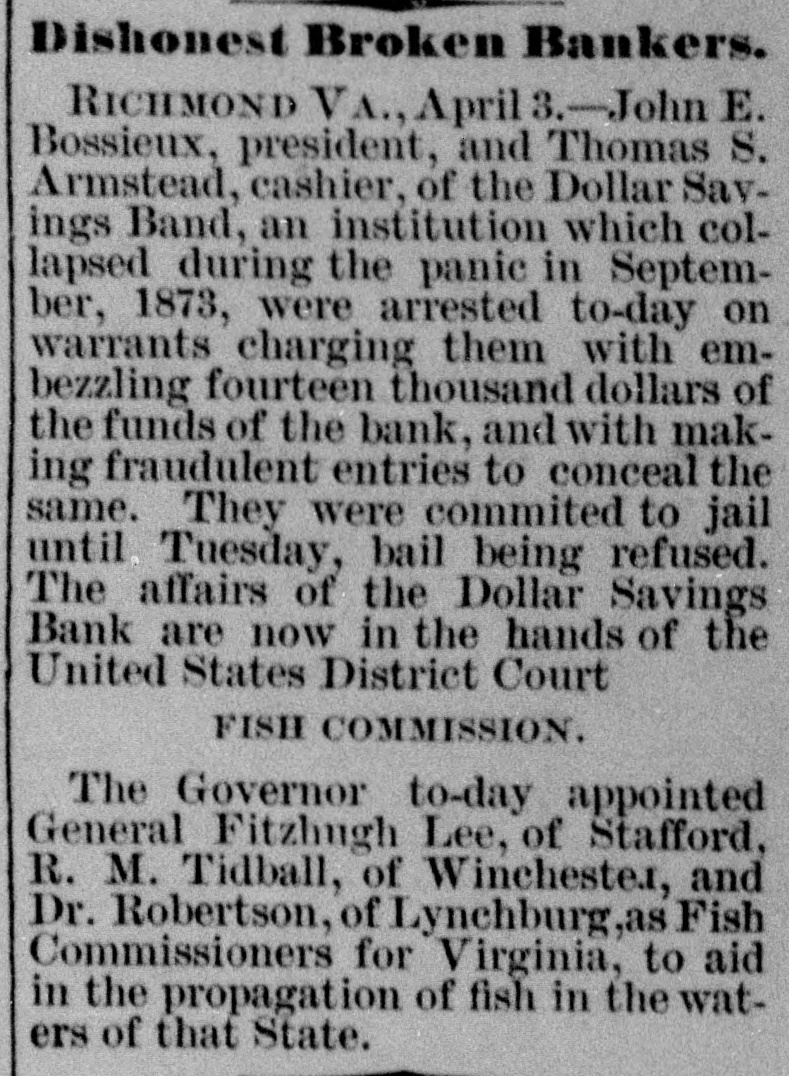
Dishonest Broken Bankers. RICHMOND Va., April 3.-John E. Bossieux, president, and Thomas S. Armstead, cashier, of the Dollar Savings Band, an institution which collapsed during the panic in September, 1873, were arrested to-day on warrants charging them with embezzling fourteen thousand dollars of the funds of the bank, and with making fraudulent entries to conceal the same. They were commited to jail until Tuesday, bail being refused. The affairs of the Dollar Savings Bank are now in the hands of the United States District Court FISH COMMISSION. The Governor to-day appointed General Fitzhugh Lee, of Stafford, R. M. Tidball, of Wincheste,, and Dr. Robertson, of Lynchburg,as Fish Commissioners for Virginia, to aid in the propagation of fish in the waters of that State.


Article from Alexandria Gazette, May 28, 1875

Click image to open full size in new tab

Article Text

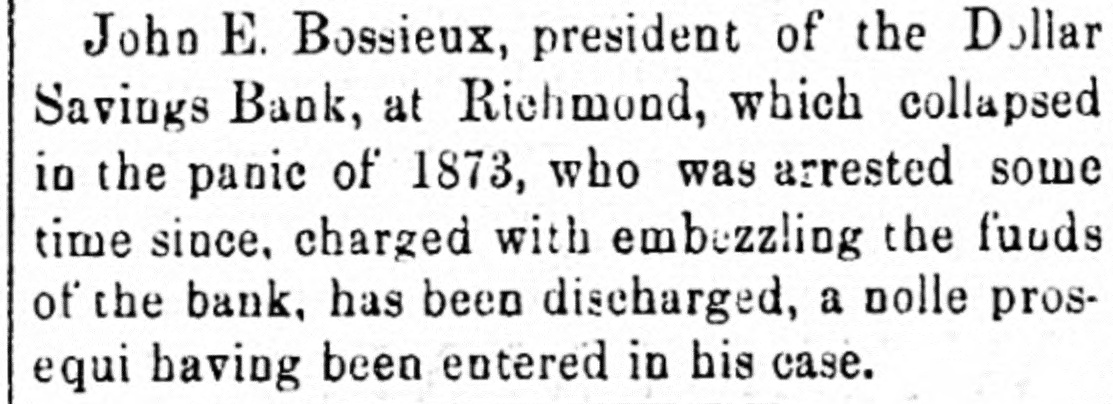
John E. Bossieux, president of the Dollar Savings Bank, at Richmond, which collapsed in the panic of 1873, who was arrested some time since, charged with embezzling the fuods of the bank. has been discharged, a nolle prosequi having been entered in his case.


Article from Martinsburg Independent, June 5, 1875

Click image to open full size in new tab

Article Text

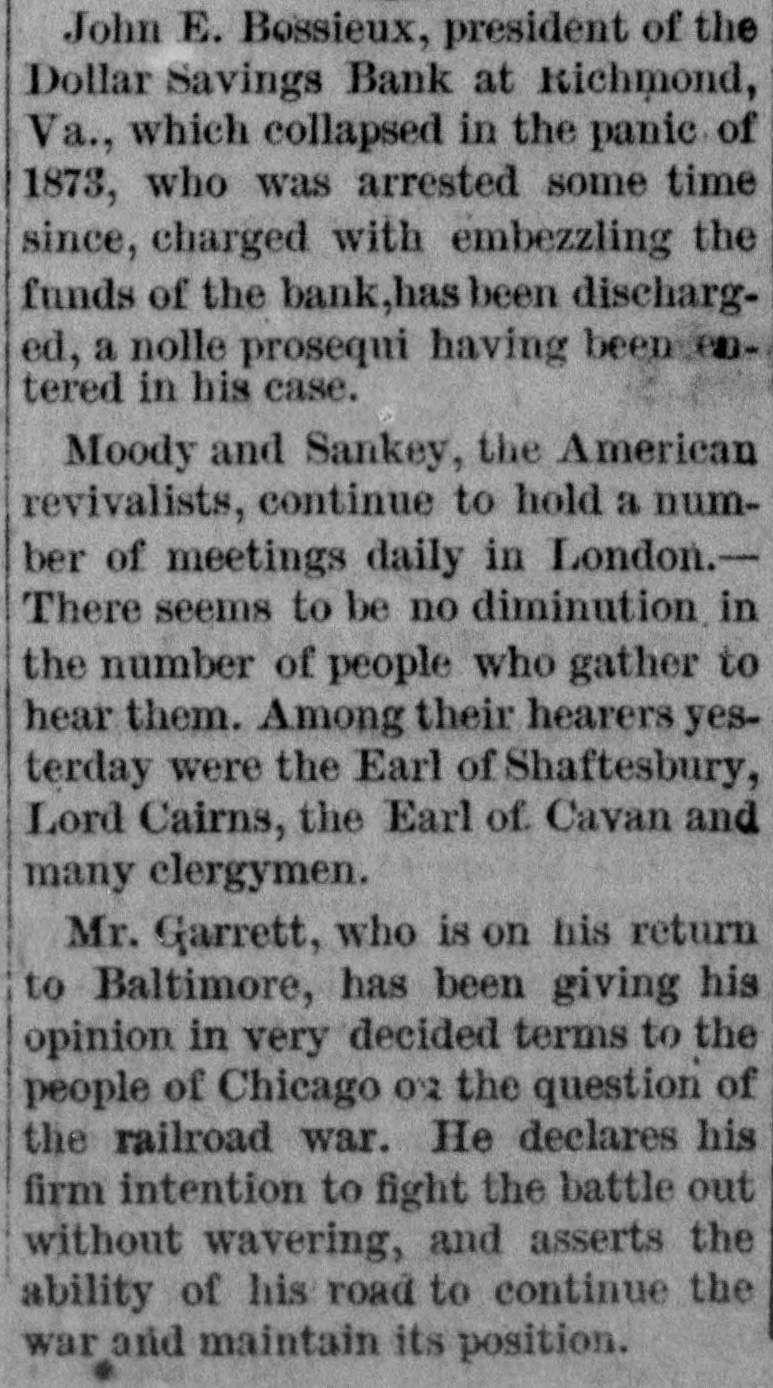
John E. Bossieux, president of the Dollar Savings Bank at Richmond, Va., which collapsed in the panic of 1873, who was arrested some time since, charged with embezzling the funds of the bank, has been discharged, a nolle prosequi having been entered in his case. Moody and Sankey, the American revivalists, continue to hold a number of meetings daily in London.There seems to be no diminution in the number of people who gather to hear them. Among their hearers yesterday were the Earl of Shaftesbury, Lord Cairns, the Earl of. Cavan and many clergymen. Mr. Garrett, who is on his return to Baltimore, has been giving his opinion in very decided terms to the people of Chicago 02 the question of the railroad war. He declares his firm intention to fight the battle out without wavering, and asserts the ability of his road to continue the war and maintain its position.


Article from The Daily Dispatch, October 9, 1876

Click image to open full size in new tab

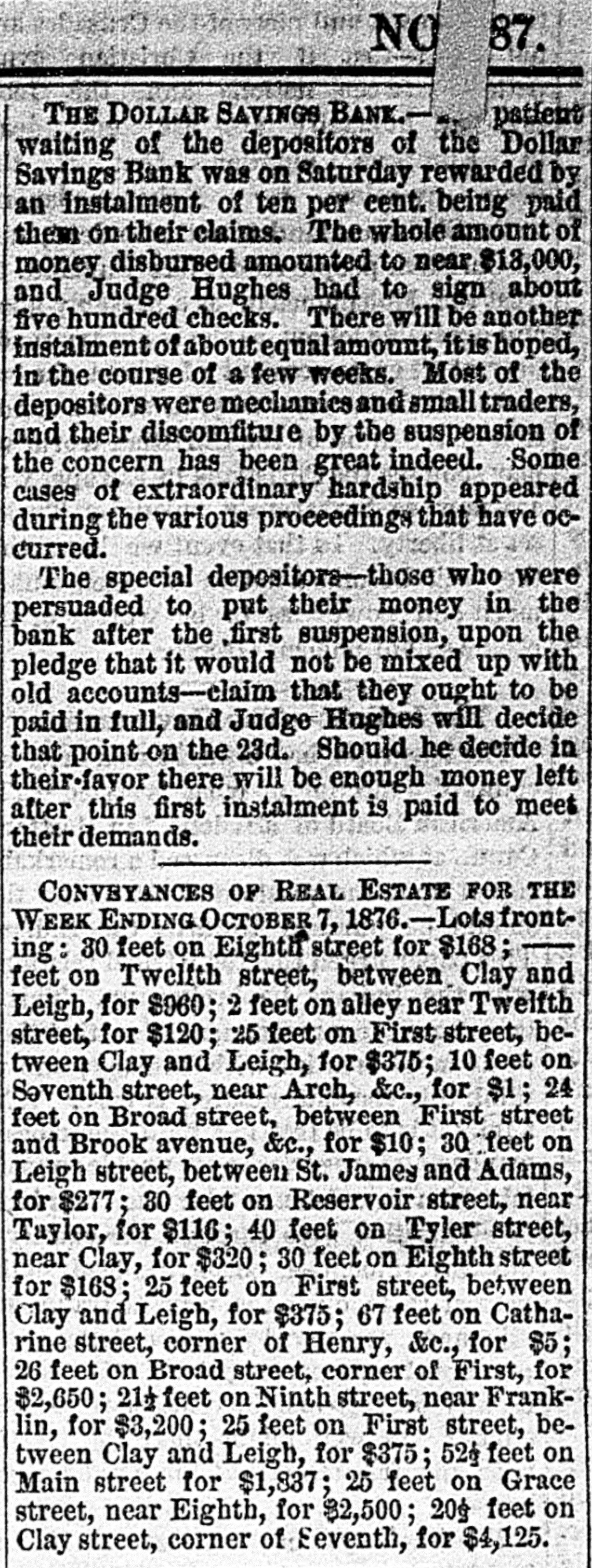
Article Text

NO 87. THE DOLLAR SAVINGS BANK.waiting of the depositors of the Dollar Savings Bank was on Saturday rewarded by an instalment of ten per cent. being paid them on their claims. The whole amount of money disbursed amounted to near $13,000, and Judge Hughes had to sign about five hundred checks. There will be another instalment of about equal amount, itis hoped, in the course of a few weeks. Most of the depositors were mechanics and small traders, and their discomfiture by the suspension of the concern has been great indeed. Some cases of extraordinary hardship appeared during the various proceedings that have 00curred. The special depositors-those who were persuaded to put their money in the bank after the first suspension, upon the pledge that it would not be mixed up with old accounts-claim that they ought to be paid in full, and Judge Hughes will decide that point on the 23d. Should he decide in their-favor there will be enough money left after this first instalment is paid to meet their demands. CONVEYANCES OF REAL ESTATE FOR THE W EEK ENDING OCTOBER 7, 1876.-Lots fronting: 30 feet on Eighth street for $168; feet on Twelfth street, between Clay and Leigh, for $960; 2 feet on alley near Twelfth street, for $120; 25 feet on First street, between Clay and Leigh, for $375; 10 feet on Seventh street, near Arch, &c., for $1; 24 feet on Broad street, between First street and Brook avenue, &c., for $10; 30 feet on Leigh street, between St. James and A dams, for $277; 30 feet on Reservoir street, near Taylor, for $116; 40 feet on Tyler street, near Clay, for $320; 30 feet on Eighth street for $168; 25 feet on First street, between Clay and Leigh, for $375; 67 feet on Catharine street, corner of Henry, &c., for $5; 26 feet on Broad street, corner of First, for $2,650; 21 feet on Ninth street, near Franklin, for $3,200; 25 feet on First street, between Clay and Leigh, for $375; 52 feet on Main street for $1,837; 25 feet on Grace street, near Eighth, for $2,500; 20$ feet on Clay street, corner of Seventh, for $4,125.


Article from The Daily Dispatch, October 11, 1876

Click image to open full size in new tab

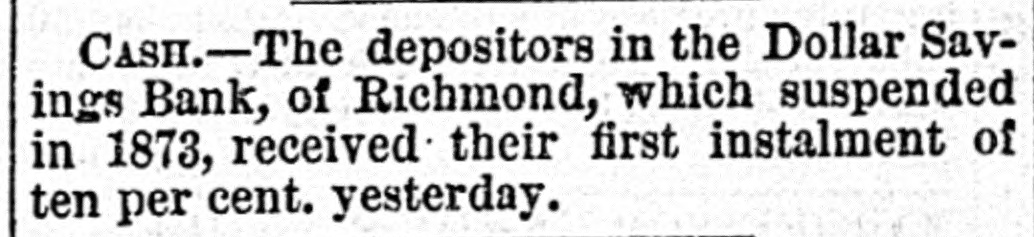
Article Text

CASH.-The depositors in the Dollar Savings Bank, of Richmond, which suspended in 1873, received . their first instalment of ten per cent. yesterday.


Article from The Daily Dispatch, December 19, 1876

Click image to open full size in new tab

Article Text

DOLLAR SAVINGS BANK. DECISION AGAINST THE SPECIAL DEPOSITORS. JUDGE HUGHES THINKS THAT THOSE WHO DEPOSITED UNDER THE RESOLUTION THE BOARD OF DIRECTORS GUARANTEE ING SAFETY TO THE MONEY NOT ENTITLED TO BE CONSIDERED PREFERRED CREDITORS-THECASESTATED AND THE REASONS FOR THE JUDGE'S OPINIONS. In the United States District Court yes terday JudgeHughesdeliveredhis decision in re The Mutual Building Fund and Dollar Savings Bank-ex parta John Beatty. He said: This savings bank suspended payments over its counter on the 230 of September, 1878- memorable day among bank ers. Its managers, in the belief that the failure would be temporary, invited, a few days after, new deposits by means of and as described in the following advertisement which they published in the Richmond newspapers: DOLLAR SAVINGS BANK This bank will resume solution herewith adopted by the Board of Directors on Resolved That this bank resinne business Monday October 6th. by receiving special separat the trust bank new account, pledging use these deposits only in of checks against that new account and as fast the bank can collect and realize from the loans and to pay pro rata instalments on its present indebteduntil the whole shall be liquidated. the same drawing the usual interest as heretofore. until JOHN E. paid. President BOSSIEUX, Thomas S. Armistead, Cashier. Deposits to an inconsiderable amount were made under this call by a few menone of whom was this petitioner- the bank very soon found itself unable to go on, and closed its doors. In February, 1874. proceedings were taken against it by creditors, and it was duly adjudicated an involuntary bankrupt by this Court. There is no evidence that THE NEW DEPOSITS were marked and kept separate as special deposits; and the fact seems to be that they were received over the counter in the same manner as general deposits are received The advertisement itself virtually announced that the new deposits would be treated as a common fund as to the new de positors, and not treated as special separate deposits, except as against the old depositors. dividend has been declared and paid, without prejudice to the claim of the petitioner, John Beatty, and the other depositors under the advertisement of October 3, 1873, to be paid in full, according to the tenor of the advertisement, as preferred creditors. It is claimed on the part of the petitioner that his deposit under the dvertisement of the 3d of October was special deposit and that the advertisement was contract which this Court is bound equo et bono to specifically execute as a court of equity, I do not concur in either of THESE PROPOSITIONS 1. The deposit of the petitioner was not a special deposit; for it is only where the special money or thing deposited is received by the bank to be kept to itself and returned in corpore on demand that the deposit can be claimed to be special True, the advertisement held out that the lank would receive special separate deposits,' but calling a thing what it is not does not make it what is not. 2. It is claimed for the petitioner that he has a higher equity than the former depositors of the bank created by the advertisement of the 3d of October. I do not think so. The former depositors made their deposits on precisely the same terms in all essential respects (save one) as those on which the petitioner made his deposit, those terms being implied in their case, while in his they were expressed In the exceptional respect to which I al lude the case of the petitioner.is weaker in point of equity than that of the former depositors The contract under the advertisement was virtually that all . THE OLD RESOURCES of the bank, as well as the new deposits, would be first used for paying the checks of the new depositors. The bank proposed to go on with its banking business, and the new deposits were of course intended in the regular course of that banking business to be used for the purpose of making new discounts. As the new deposits were to be loaned out for this purpose, the checks of the new depositors would have to be paid in whole or in part from the moneys taken in on notes already discounted, and which would be falling due, SO that the operation of the new arrangement would be as follows Let the old deposits be known as Class D. They had been loaned out in discounting old paper, which we shall call Class X. Let the new deposits be known as Class B. They were to be loaned out in discounting new paper The advertisement of October 3d was virtually a promise to use THE FUNDS COLLECTED on maturing paper of Class X in paying the checks of the new depositors of Class Bthat is to say, the contract required money belonging ex equo et bono to Class D to be paid to Class B. I think such a contract, so far as it was to operate in that way, was ultra vires. The bank had no power to make it. and the contract when made was contrary to equity, and so far as it had the unjust operation described ought not to be enforced in equity But even if it were a contract free from the two objections of being illegal and contrary to equity, and were such a contract as a court of equity dealing with solvent parties should specifically execute, still this court, as a court of bankruptcy, would be unable to decree specific performance. In its nature this court has little to do with the specific execution of contracts. It has to deal with bankrupts who have broken all contracts, and are unable to perform any of them. It is court whose primary duty is the distribution of assets gathered from the wreck of the estates of bankrupts who themselves have already rifled them of every resource available for the execution of contracts. THE POLICY OF THE LAW under which the Court acts is to avoid preferences, and divide the assets orata, share and share alike, among creditors The (business of the Court in this case is to distribute assets under the terms of the law which, except in favor of liens, requires pro rata distribution. If the new deposits which have been spoken of had in fact been special deposits, duly ear-marked and set aside and held as such. the bank would have been a simple bailee of them, and would have been obliged to return them in kind. But they not


Article from The Daily Dispatch, July 5, 1878

Click image to open full size in new tab

Article Text

. DOLLAR SAVINGS BANK.-A dividend of five per cent. will be paid the depositors of the Dollar Savings Bank on Monday. The bank suspended in 1873, and two or three years ago the first dividend (ten per cent.) was paid. The dividend now about to be paid is the second one.