Planters Bank (Nashville, TN)

Episode Information

Episode UID
7368090694
Episode Type
Suspension → Reopening
Bank Type
state
Bank ID
736809 hash
Start Date
October 16, 1857
Location
Nashville, Tennessee (36.166, -86.784)

Metadata

Model
gpt-5-mini (chosen from majority vote of a three-model LLM ensemble)
Short Digest
618a90a4b30b41bc

Response Measures

None

Events (2)

1. October 16, 1857 Suspension
Cause
Macro News
Cause Details
Temporarily suspended in consequence of the late general suspensions of banks throughout the Union and prevailing money-market pressure.
Newspaper Excerpt
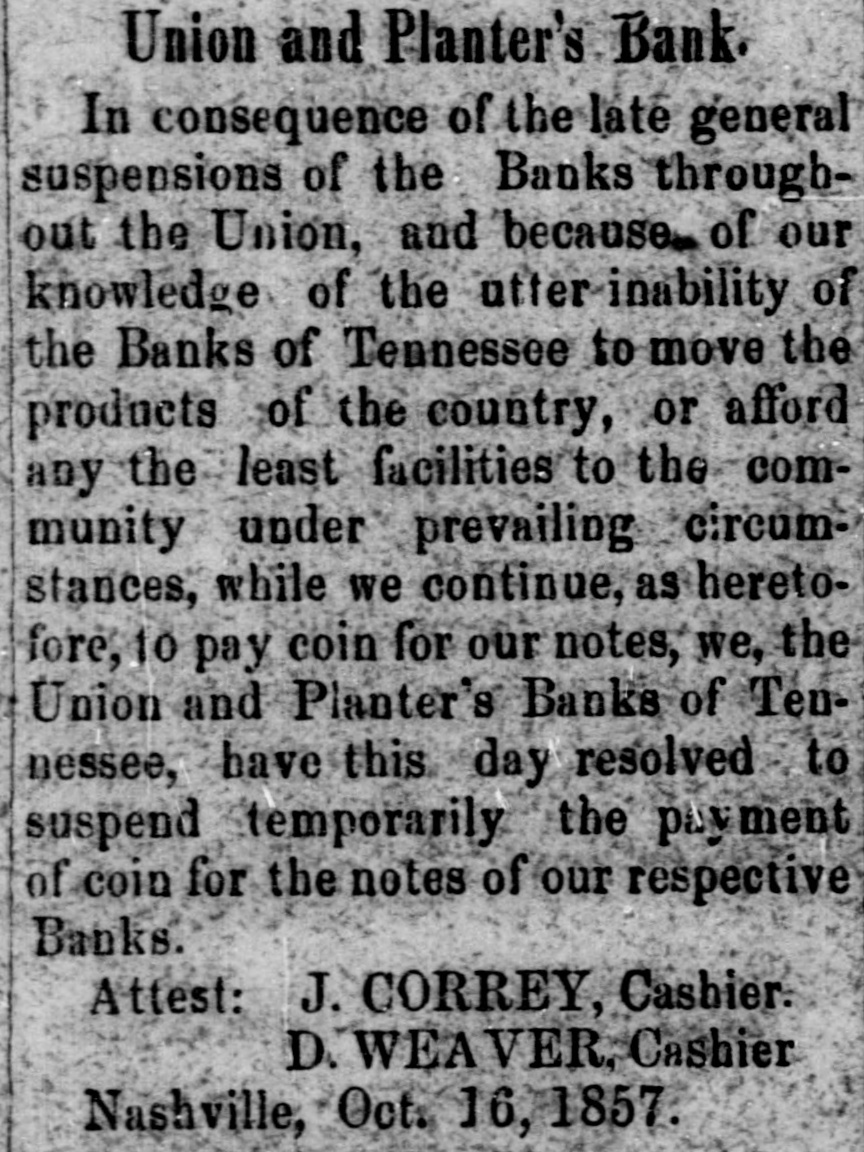
the Union and Planters' Banks of Tennessee, have this day resolved to suspend temporarily the payment of coin for the notes of our respective Banks.
Source
newspapers
2. June 17, 1858 Reopening
Newspaper Excerpt
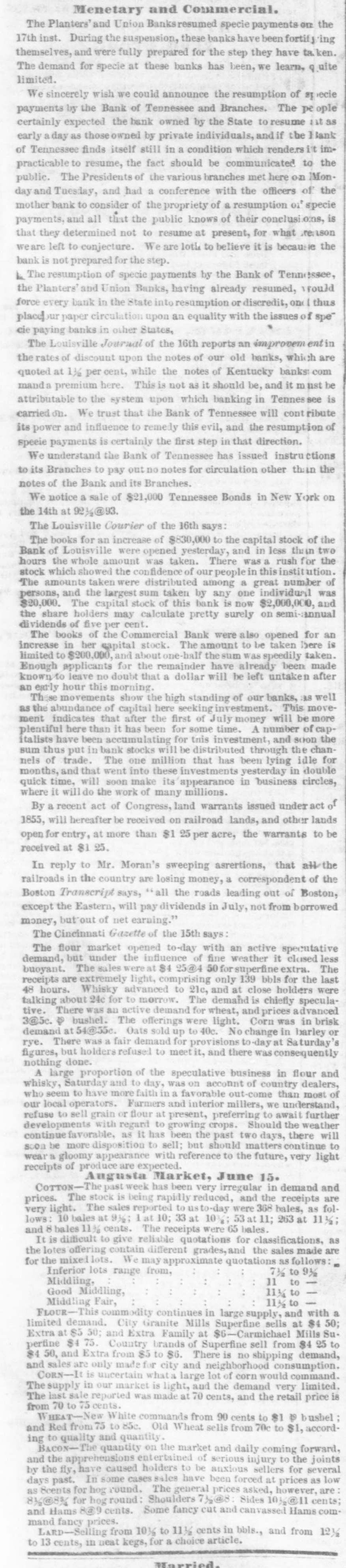
The Planters' and Union Banks resumed specie payments on the 17th inst.
Source
newspapers

Newspaper Articles (11)

Article from Weekly Clarksville Chronicle, October 2, 1857

Click image to open full size in new tab

Article Text

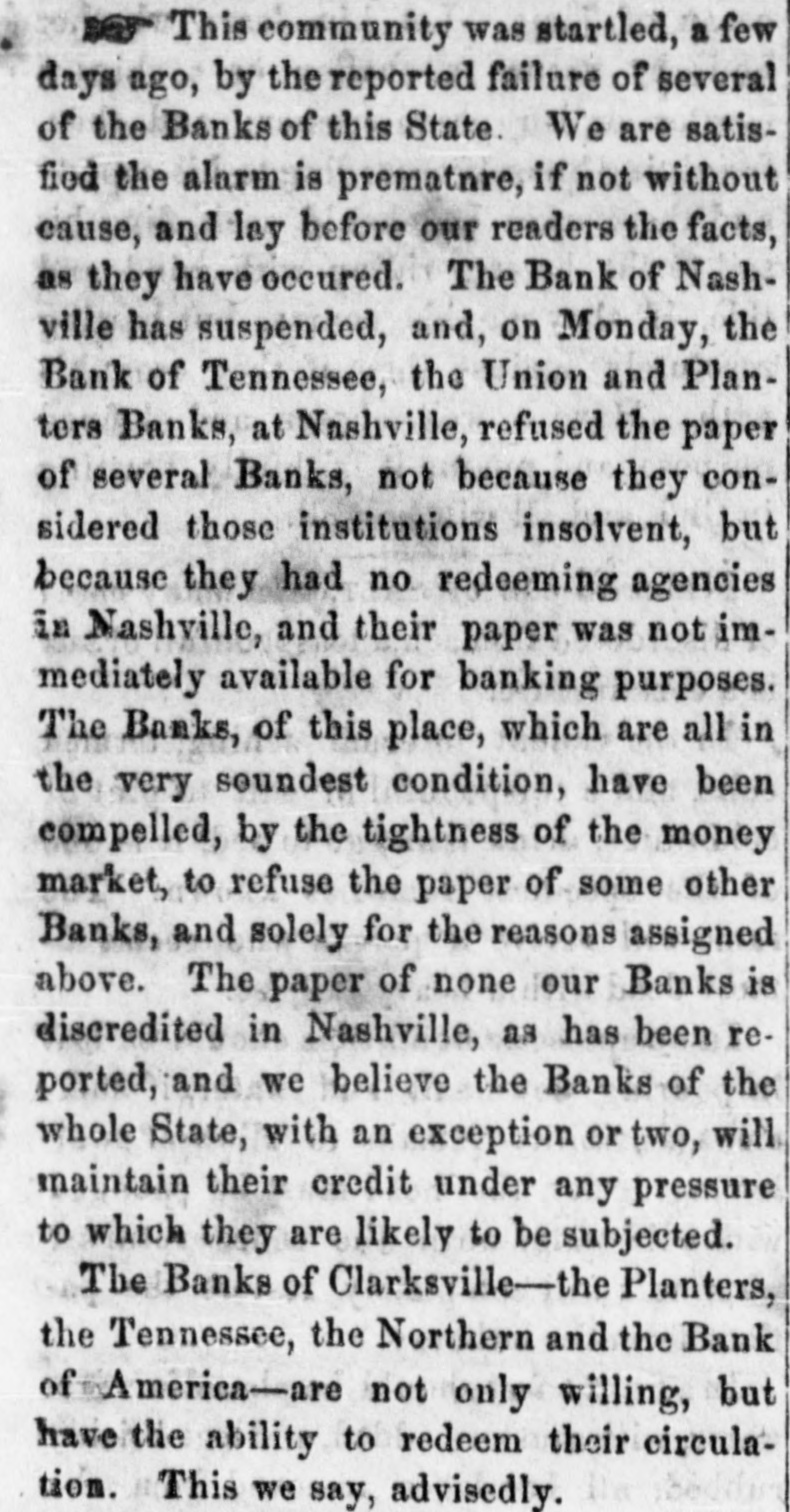
This community was startled, a few days ago, by the reported failure of several of the Banks of this State. We are satisfied the alarm is prematnre, if not without cause, and lay before our readers the facts, as they have occured. The Bank of Nashville has suspended, and, on Monday, the Bank of Tennessee, the Union and Planters Banks, at Nashville, refused the paper of several Banks, not because they considered those institutions insolvent, but because they had no redeeming agencies in Nashville, and their paper was not immediately available for banking purposes. The Banks, of this place, which are all in the very soundest condition, have been compelled, by the tightness of the money market, to refuse the paper of some other Banks, and solely for the reasons assigned above. The paper of none our Banks is discredited in Nashville, as has been reported, and we believe the Banks of the whole State, with an exception or two, will maintain their credit under any pressure to which they are likely to be subjected. The Banks of Clarksville-the Planters, the Tennessee, the Northern and the Bank of America-are not only willing, but have the ability to redeem their circulation. This we say, advisedly.


Article from Fayetteville Observer, October 8, 1857

Click image to open full size in new tab

Article Text

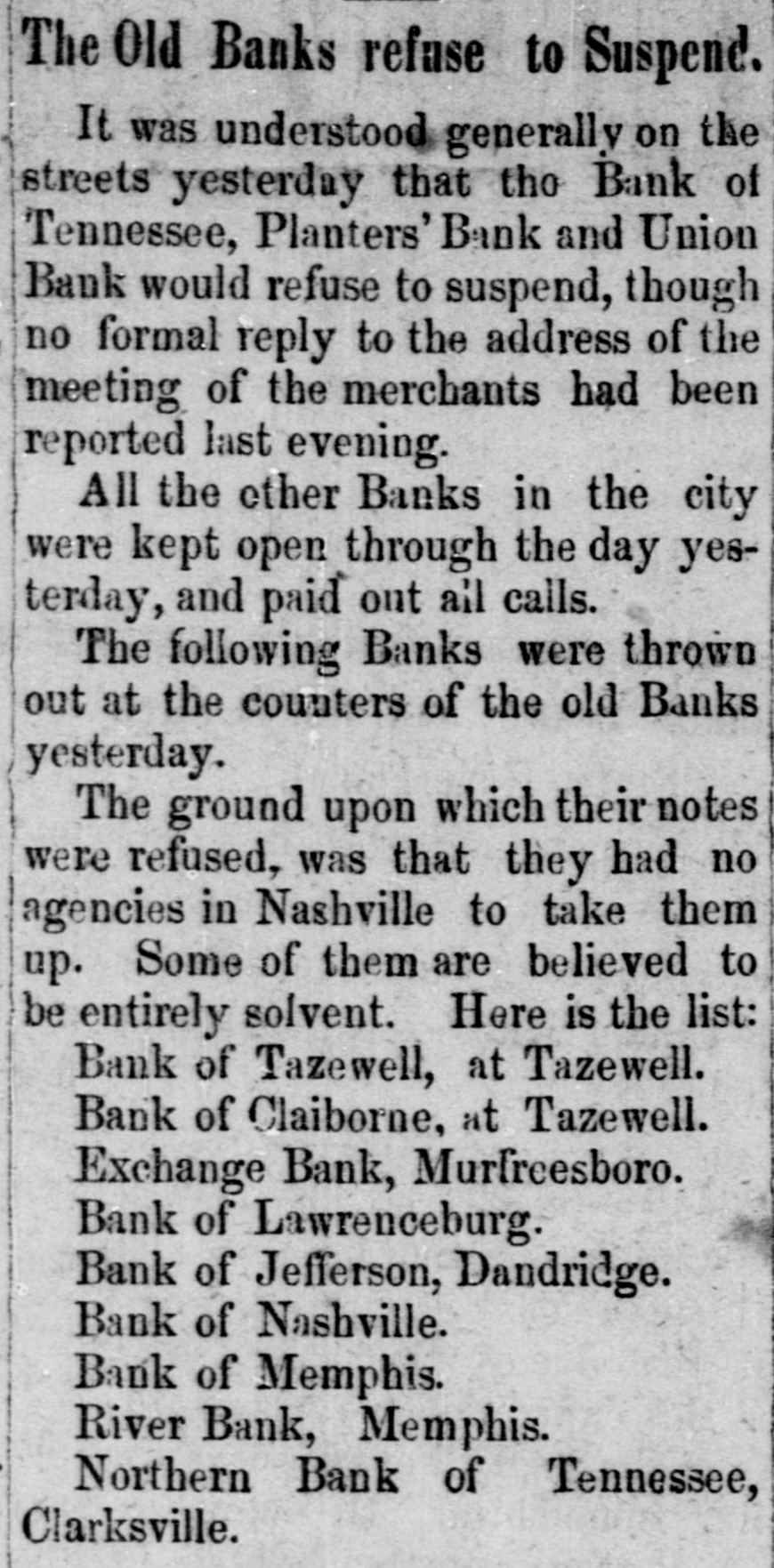
The Old Banks refuse to Suspend. It was understood generally on the streets yesterday that the Bank of Tennessee, Planters' Bank and Union Bank would refuse to suspend, though no formal reply to the address of the meeting of the merchants had been reported last evening. All the other Banks in the city were kept open through the day yesterday, and paid out all calls. The following Banks were thrown out at the counters of the old Banks yesterday. The ground upon which their notes were refused, was that they had no agencies in Nashville to take them up. Some of them are believed to be entirely solvent. Here is the list: Bank of Tazewell, at Tazewell. Bank of Claiborne, at Tazewell. Exchange Bank, Murfreesboro. Bank of Lawrenceburg. Bank of Jefferson, Dandridge. Bank of Nashville. Bank of Memphis. River Bank, Memphis. Northern Bank of Tennessee, Clarksville.


Article from Daily Nashville Patriot, October 17, 1857

Click image to open full size in new tab

Article Text

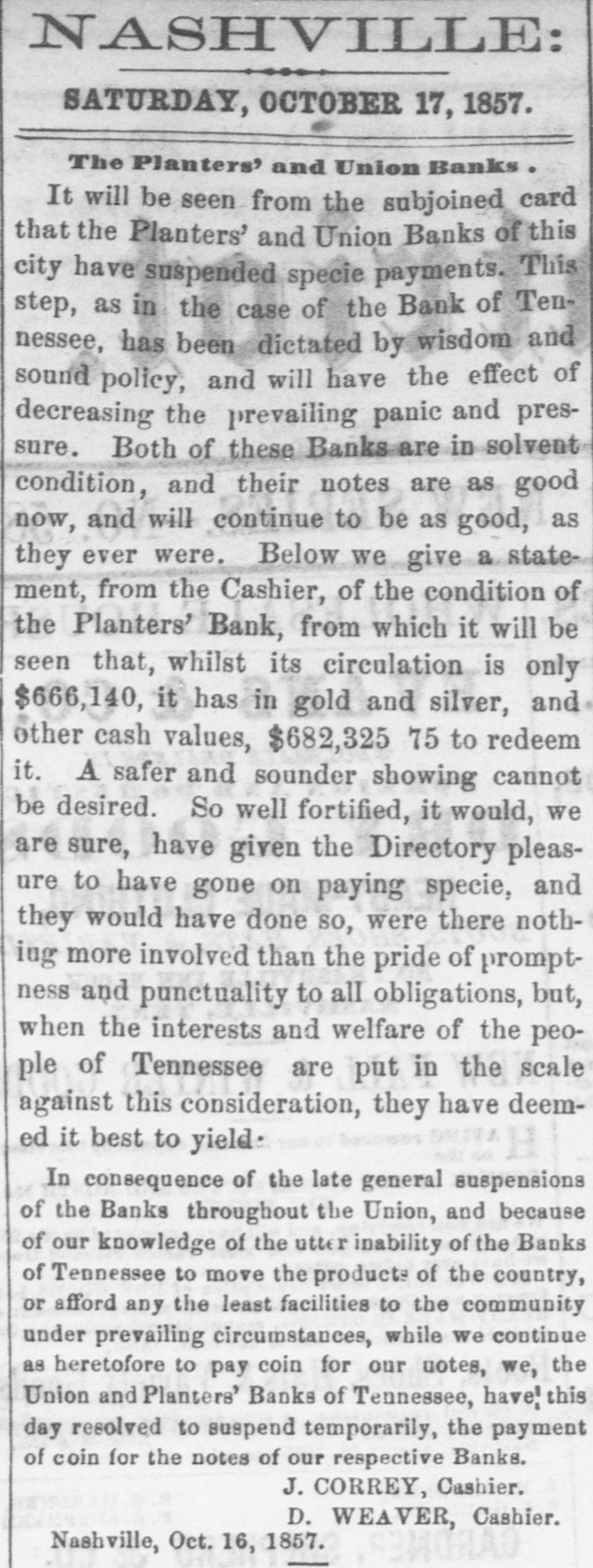
NASHVILLE: SATURDAY, OCTOBER 17, 1857. The Planters' and Union Banks It will be seen from the subjoined card that the Planters' and Union Banks of this city have suspended specie payments. This step, as in the case of the Bank of Tennessee, has been dictated by wisdom and sound policy, and will have the effect of decreasing the prevailing panic and pressure. Both of these Banks are in solvent condition, and their notes are as good now, and will continue to be as good, as they ever were. Below we give a statement, from the Cashier, of the condition of the Planters' Bank, from which it will be seen that, whilst its circulation is only $666,140, it has in gold and silver, and other cash values, $682,325 75 to redeem it. A safer and sounder showing cannot be desired. So well fortified, it would, we are sure, have given the Directory pleasure to have gone on paying specie, and they would have done so, were there nothiug more involved than the pride of promptness and punctuality to all obligations, but, when the interests and welfare of the people of Tennessee are put in the scale against this consideration, they have deemed it best to yield: In consequence of the late general suspensions of the Banks throughout the Union, and because of our knowledge of the utter inability of the Banks of Tennessee to move the products of the country, or afford any the least facilities to the community under prevailing circumstances, while we continue as heretofore to pay coin for our uotes, we, the Union and Planters' Banks of Tennessee, have this day resolved to suspend temporarily, the payment of coin for the notes of our respective Banks. J. CORREY, Cashier. D. WEAVER, Cashier. Nashville, Oct. 16, 1857.


Article from Arkansas True Democrat, October 20, 1857

Click image to open full size in new tab

Article Text

ommander or The most valuable life lost by the recent disaster is probably that of Lieut. Wm. Lewis Herndon, U. S.N., late commander of the ill. starred Central America. Lieut Herndon was a man of gifted intellect and resolute will.Modest and retiring in manner, it required close observer or an intimate friend to discover all the rare qualities he possessed. His courage e calm, deliberate, enduring courage of a truly brave man-has been conspicuous on many occasions. He has been tried severely and was never found wanting. Those who knew him well want no assurance that he never quitted his ship while there was one fellowcreature to be saved-and that, as far as can be conjectured, he stood upon her deck as she reeled down into the depths of the ocean, unappailed himself by the calamnity that has so startled the nation. We are not using the language of empty adulation have Lieut. Herndon's past life before us, and the further fact that twenty-siz women and children were saved in boat proves conclusively that he did his duty right manfully, and to the last had control over himself as well as over We do not permit ourselves to hope that the gallant cammander has been saved; it were im possible, xcept by some such miraculous interposition of Providence, as that which rescued Capt. Luce after he sunk with the Arctic's wreck. Captain William Lewis Herndon was native of of Fredericksburg, Va., and was the son Dabuey Herndon, Esq., highly respected citizen of that place. H was born October 25, 1813, and was, therefore, at the time of his death, 43 years of age, twenty eight of whie he had spent in the service of his country. He entered the Navy as midshipman at the age of tifteen. His first voyage was to the Pacific, in the old frigate Guerriere. This cruise took three years. The next three he spent in the Mediterranean, in the Constellation, and afterwards made third cruise to the coast of Brazil. At this time he was tached to the Independence. About the time of his return the Florida war broke out, and number of officersing the Navy volunteered for theservice. Among them was young Herndon, who was placed in command of brig at In dian Key. With his men he often penetrated the Everglades in boats, driving the Indians from the recesses of the swamps into the arms of the troops on the shore. In tbis difficut service, and on the coast, he remained two years. On his return he was attached to the National Observatory at Washington, then under the charge of his rother-in-law, Lieutena Maury. Here he remained three years. This service he found more arduous than life at sea, as he often necessarily engaged all night in ma king astronomical observations. During the Mexican war he applied for orders, and was appointed to the frigate Cumberland. He proceeded to Norfolk, and had embarked, when destination changed Commodore Perry, then in the Gulf, had applied to the De. partment to send out to him active and intelligent officer, who could speak the Spanish language, to be placed in command of a small steamboat to pass betw the American squad ron and the troops on shore. The Secretary of the Navy immediately designated Lieut Herndon for the post, and he was transferred to the Iris, and sailed to join Commodore Perry. In this small vessel he remained till the close of the war, often performing tasks of much difficulty and danger, but with uniform skill and success. At the close of the war he returned to Washington, and spent another year at the Observatory. was in the exploration of the Amazon, during the years 1851 and 1852, that Lieut. or Herndon chiefly distinguished himself; rather, was the performance of this service that more known. He was select ed for this most important and delicate duty his letter of instructions -because would call for the exercise of all those high qualities and attainments that he object of the was obtain information relating to the valley and river of the Amazon, including the entire basin, or watershed, drained by and its Lieut. Herudo observations were to extend, to the present condition of that valcondition, both industr social, their inhabitants; trade products; and productions; mercial conded the the Lieutenaut the tance, of from It Para, his months; report ment, modest embodying of journey, by every terested the development of the unboun world. resources of the mightiest river in the On his return to the United States, Lieuten Herndon was for some months in Washington the engaged in the preparation of his work on Amazon, which was published by the Govern ment. After this labor was completed he was orderto the San Jacinto, then designed to cruise ed in the Baltic, during the presence there of the Allied fleets. But some accident occurring to her machinery, she put into Sout This ship was ordered to convey Mr Soule, who had been forbidden to pass through France, from Calais Spain. On the return of the San Jacinto to the United States, Lieut. Herndon transferred to the Potomac, under Com. Paulding, but was soon after placed in com mand of the George Law. This was about two years ago. These California steamers,carrying U.S. mails, are required by law to be under command of officers of the Navy, and Lieut Herndon was chosen for the responsible post. The name of the George Law was, only a few weeks ago changed to that of the Central America, the loss of which is now mourned b thousands of hearts. Lieut. Herndon was married .twenty years His since to an estimable lady of Virginia. wife and an only daughter survive He was of slight figure, but of an intrepid In spirit. He was a gentle as he was brave. the Navy he was universally beloved. In all quarrels between officers, he was known as For peacemaker. He never made an enemy fifteen years he had been member of the Episcopal Church. He often read the service was on board his ship, and the humblest sailor not committed to the deep without the barial read over his remains by his Captain.N. Y. Times. THE NASHVILLE BANKS.- The Nashville Gazette, of the 29th ult., noticing the run on the Bank of Nashville, remarks: We understand that portion of the com mercial men of the city held meeting, and re quested all the banks to suspend specie payments temporarily; and we are toid that the Union Bank, Pla ters' Bank, and Bank of Ten-


Article from Daily Nashville Patriot, October 21, 1857

Click image to open full size in new tab

Article Text

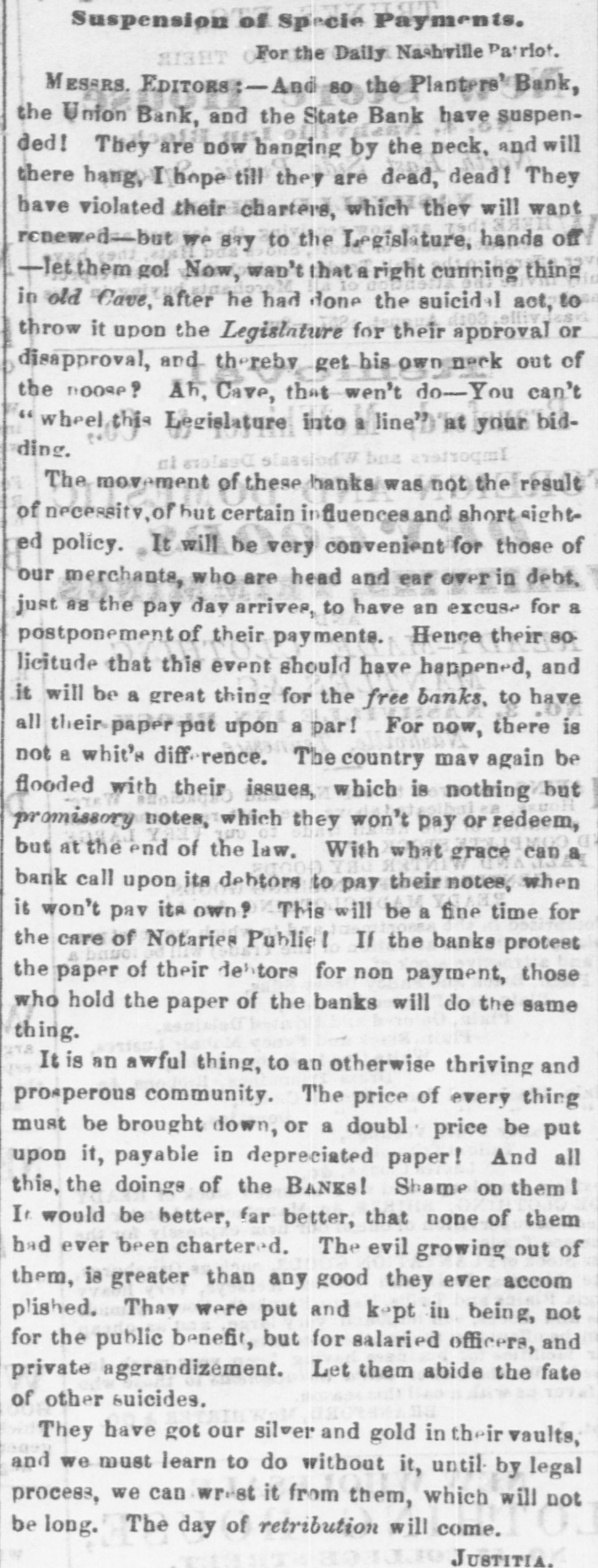
Suspension of Specie Payments, For the Daily Nashville Patriot. MESSRS. EDITORS:-And 80 the Planters' Bank, the Union Bank, and the State Bank have suspended! They are DOW banging by the neck, and will there hang, I hope till they are dead, dead! They have violated their charters, which thev will want renewed-but we say to the egislature, hands off -let them go! Now, wan't that a right cunning thing in old Cave, after he had done the suicidal act, to throw it upon the Legislature for their approval or disapproval, and thereby get his own neck out of the noose? Ah, Cave, that wen't do-You can't wheel this Legislature into a line" at your bidding. The movement of these hanks was not the result of necessity, of but certain in fluences and short sighted policy. It will be very convenient for those of our merchants, who are head and ear over in debt, just 88 the pay day arrives, to have an excuse for a postponement of their payments. Hence their 80licitude that this event should have happened, and it will be a great thing for the free banks, to have all their paper put upon a par! For now, there is not a whit's diff rence. The country mav again be flooded with their issues, which is nothing but promissory notes, which they won't pay or redeem, but at the end of the law. With what grace can a bank call upon its debtors to pay their notes, when it won't pav ita own? This will be a fine time for the care of Notaries Publiel If the banks protest the paper of their tors for non payment, those who hold the paper of the banks will do the same thing. It is an awful thing, to an otherwise thriving and prosperous community. The price of every thing must be brought down, or a doubl price be put upon it, payable in depreciated paper! And all this, the doings of the BANKS! Shame on them I It would be better, far better, that none of them bad ever been chartered. The evil growing out of them, is greater than any good they ever accom plished. Thav were put and kept in being, not for the public benefit, but for salaried officers, and private aggrandizement. Let them abide the fate of other suicides. They have got our silver and gold in their vaults, and we must learn to do without it, until by legal process, we can wrest it from them, which will not be long. The day of retribution will come. Justitia.


Article from Fayetteville Observer, October 22, 1857

Click image to open full size in new tab

Article Text

Union and Planter's Bank. In consequence of the late general suspensions of the Banks throughout the Union, and because... of our knowledge of the utter inability of the Banks of Tennessee to move the products of the country, or afford any the least facilities to the community under prevailing circumstances, while we continue, as heretofore, 10 pay coin for our notes, we, the Union and Planter's Banks of Tennessee, have this day resolved to suspend temporarily the payment of coin for the notes of our respective Banks. Attest: J. CORREY, Cashier. D. WEA VER, Cashier Nashville, Oct. 16, 1857.


Article from Nashville Union and American, June 19, 1858

Click image to open full size in new tab

Article Text

Menetary and Commercial. The Planters' and Union Banksresumed specie payments on the 17th inst. During the suspension, these banks have been fortify ing themselves, and were fully prepared for the step they have ta.ken. The demand for specie at these banks has been, we learn, uite limited. We sincerely wish we could announce the resumption of ecie payments by the Bank of Tennessee and Branches. The ople certainly expected the bank owned by the State to resume it as early a day as those owned by private individuals, and if the ] lank of Tennessee finds itself still in a condition which rende.rs it impracticable to resume, the fact should be communicated to the public. The Presidents of the various branches met here on Monday and Tuesday, and had a conference with the officers of the mother bank to consider of the propriety of a resumption of specie payments, and all that the public knows of their conclusion is that they determined not to resume at present, for what reason weare left to conjecture. We are loth to believe it is because the bank is not prepared for the step. his The resumption of specie payments by the Bank of Tennessee, the Planters' and Union Banks, having already resumed, would force every bank in the State into resumption or discredit, one I thus place| paper circulation upon an equality with the issues of spe" cie paying banks in other States, The Louisville Journal of the 16th reports an improvem ent in the rates of discount upon the notes of our old banks, which are quoted at 1½ per cent, while the notes of Kentucky banks com manda premium here. This is not as it should be, and it m ust be attributable to the system upon which banking in Tennessee is carried on. We trust that the Bank of Tennessee will cont ribute its power and influence to remedy this evil, and the resumption of speeie payments is certainly the first step in that direction. We understand the Bank of Tennessee has issued instru ctions to its Branches to pay out no notes for circulation other than the notes of the Bank and its Branches. We notice a sale of $21,000 Tennessee Bonds in New York on the 14th at 921,@93. The Louisville Courier of the 16th says: The books for an increase of $830,000 to the capital stock of the Bank of Louisville were opened yesterday, and in less than two hours the whole amount was taken. There was a rush for the stock which showed the confidence of our people in this instit ution. The amounts taken were distributed among a great number of persons, and the largest sum taken by any one individual was $20,000. The capital stock of this bank is now $2,000,000, and the share holders may calculate pretty surely on semi-:annual dividends of five per cent. The books of the Commercial Bank were also opened for an increase in her capital stock. The amount to be taken here is limited to $200,000, and about one-half the sum was speedily taken. Enough applicants for the remainder have already been made known to leave no doubt that a dollar will be left untaken after an early hour this morning. These movements show the high standing of our banks, as well as the abundance of capital here seeking investment. This movement indicates that after the first of July money will be more plentiful here than it has been for some time. A number of capitalists have been accumulating for this investment, and soon the sum thus put in bank stocks will be distributed through the channels of trade. The one million that has been lying idle for months, and that went into these investments yesterday in double quick time, will soon make its appearance in business circles, where it willdo the work of many millions. By a recent act of Congress, land warrants issued under act of 1855, will hereafter be received on railroad lands, and other lands open for entry, at more than $1 25 per acre, the warrants to be received at $1 25. In reply to Mr. Moran's sweeping asrertions, that all the railroads in the country are losing money, a correspondent of the Boston Transcript says, "all the roads leading out of Boston, except the Eastern, will pay dividends in July, not from borrowed money, but of net earning." The Cincinnati Gazette of the 15th says: The flour market opened to-day with an active specutative demand, but under the influence of fine weather it closed less buoyant. The sales were at $4 25@4 orsuperfine extra. The receipts are extremely light, comprising only 139 bbls for the last 48 hours. Whisky advanced to 21c, and at close holders were talking about 24c for to morrow. The demand is chiefly speculative. There was an active demand for wheat, and prices advanced 3@5c. $ bushel. The offerings were light. Corn was in brisk demand at 54@55c. Oats sold up to 40c. change in barley or rye. There was a fair demand for provisions to-day at Saturday's figures, but holders refused to meeti and there was consequently nothing done. A large proportion of the speculative business in flour and whisky, Saturday and to day, was on account of country dealers, who seem to have more faith in a favorable out-come than most of our local operators. Farmers and interior millers, we understand, refuse to sell grain or flour at present, preferring to await further developments with regard to growing crops. Should the weather continue favorable, as it has been the past two days, there will soon be more disposition to sell; but should matters continue to wear a gloomy appearance with reference to the future, very light receipts of produce are expected. Augusta Market, June 15. COTTON-The past week has been very irregular in demand and prices. The stock is being rapidly reduced, and the receipts are very light. The sales reported to us to-day were 368 bales, as follows: 10 bales at 932; at 10; 33 at 10%; 53 at 11; 263 at 11½; and 8 bales 11% cents. The receipts were 65 bales. It is difficult to give reliable quotations for classifications, as the lotes offering contain different grades,and the sales made are for the mixed lots. We may approximate quotations as follows: Inferior lots range from, 7½ to 9½ 11 to Middiing, Good Middling, 11½ to Middling Fair, 11½ to FLOUR-This commodity continues in large supply, and with a limited demand. City Granite Mills Superfine sells at $4 50; Extra at $5 50; and Extra Family at $6-Carmichael Mills Superfine 75. Country brands of Superfine sell from $4 25 to 84 50, and Extra from $5 to $6. There is no shipping demand, and sales are only made for city and neighborhood consumption. CORN-It is uncertain what: large lot of corn would command. The supply in our market is light, and the demand very limited. The last sale reported was made at 70 cents, and the retail price is from 70 to 75 cents. WHEAT-New White commands from 90 cents to $1 * bushel and Red from 75 to 85c. Old Wheat sells from 70c to $1, according to quality and quantity. BACON-Th quantity on the market and daily coming forward, and the apprehensions entertained of serious injury to the joints by the fly, have caused holders to be anxious sellers for several days past. In some cases sales have been forced at prices as low as Scents for hog round. The general prices asked, however, are 8½@8% for hog round: Shoulders 7%@8 Sides 10%@11 cents; and Hams 8@9 cents. Some fancy cut and canvassed Hams command fancy prices. LARD-Selling from 10½ to 11½ cents in bbls., and from 12½ to 13 cents, in neat kegs, for a choice article. Married


Article from Fayetteville Observer, July 15, 1858

Click image to open full size in new tab

Article Text

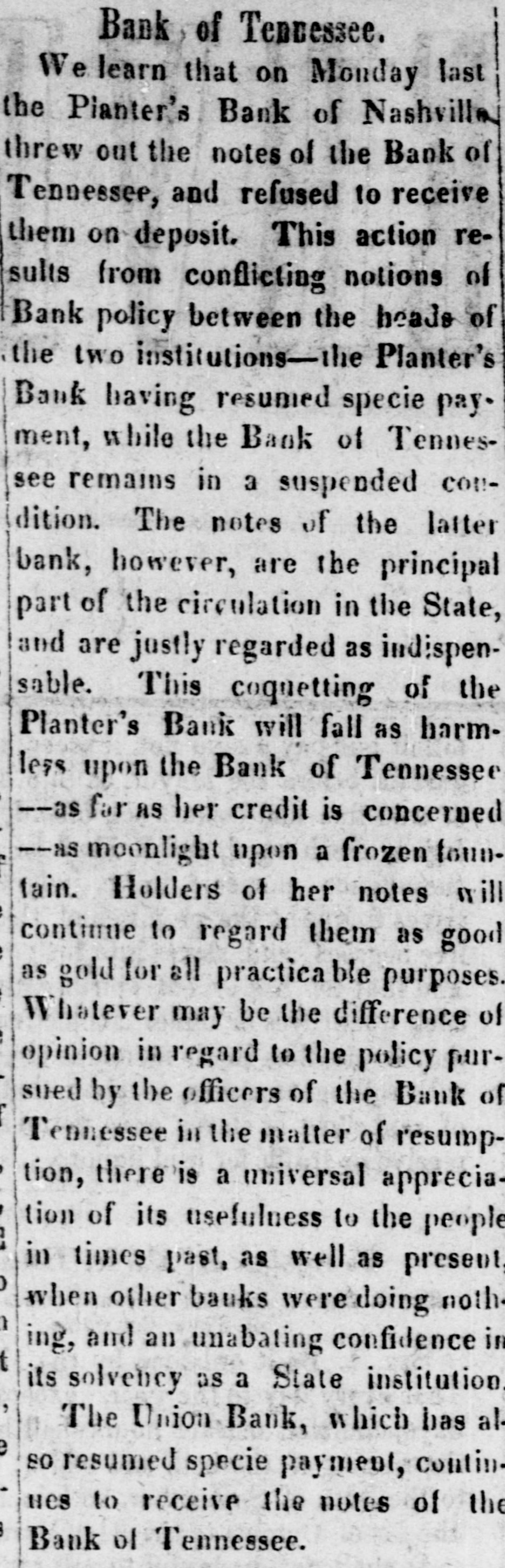
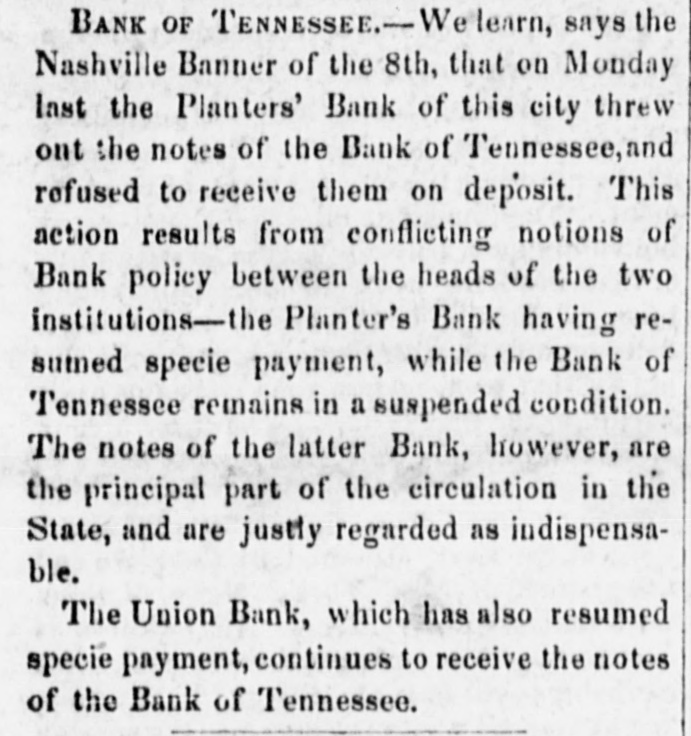
Bank of Tennessee. We learn that on Monday last the Planter's Bank of Nashville threw out the notes of the Bank of Tennessee, and refused to receive them on deposit. This action results from conflicting notions of Bank policy between the heads of the two institutions-the Planter's Bank having resumed specie pay. ment, while the Bank of Tennessee remains in a suspended condition. The notes of the latter bank, however, are the principal part of the circulation in the State, and are justly regarded as indispensable. This coquetting of the Planter's Bank will fall as harmless upon the Bank of Tennessee --as for AS her credit is concerned --as moonlight upon a frozen tountain. Holders of her notes will continue to regard them as good as gold for all practica ble purposes. Whatever may be the difference of opinion in regard to the policy pursued by the officers of the Bank of Tennessee in the matter of resumption, there is a universal appreciation of its usefulness to the people in times past, as well as present when other banks were doing noth. ing, and an unabating confidence in its solvency as a State institution The Union Bank, which bas alSO resumed specie payment, continuses to receive the notes of the Bank of Tennessee.


Article from The Athens Post, July 16, 1858

Click image to open full size in new tab

Article Text

BANK OF TENNESSEE.-Welearn, says the Nashville Banner of the 8th, that on Monday last the Planters' Bank of this city threw ont the notes of the Bank of Tennessee, and refused to receive them on deposit. This action results from conflicting notions of Bank policy between the heads of the two institutions-the Planter's Bank having resumed specie payment, while the Bank of Tennessee remains in a suspended condition. The notes of the latter Bank, however, are the principal part of the circulation in the State, and are justly regarded as indispensable. The Union Bank, which has also resumed specie payment, continues to receive the notes of the Bank of Tennessee.


Article from Nashville Patriot, November 13, 1858

Click image to open full size in new tab

Article Text

lic one, derives additional weight from the fact that the preference has been inflexibly persisted in, notwithstanding three general bank suspensions—in 1814, 1837 and 1857— and the bank failures which occurred at those periods, and which have now and then occur- red on other occasions. This fact shows that, in the settled judg- ment of the people of the United States, great as have been the inconveniences and losses sustained by them in consequence of occasional bank failures and suspensions, this inconvenience and these losses have not been so great, by a good deal, as the hard-money declaimers would make them out to be—not so great as to induce the people to abolish the system, or so great as even to shake their confidence in its utility. In regard to the extent and universality of the injuries inflicted by bank failures, very erroneous estimates and very incorrect state- ments are not unfrequently made. Of the entire population of Tennessee, for instance, the number is small, relatively speaking, who ever lost anything by bank failures! Similar errors prevail in regard to the class of persons who are the greatest sufferers by reason of the failures of insolvent banks. The poor laboring men, it is often said, are the greatest sufferers. This is as great a fallacy as ever was uttered. Are the pockets of the laboring poor ever stuffed with bank notes? Are they holders of bank stocks? Do they make deposits in banks? How, then, is it possible that they should be the greatest sufferers from bank failures? But it is said, that the loss of one dollar to a poor man, being all he has, is relatively as great as the loss of a thousand dollars is to a man a thousand times richer. Not so. The poor man can, by a day's work, make an- other dollar, but the thousand dollar man will have to labor long and industriously be- fore he can replace the thousand dollars he has lost. Clearly it is upon the monied classes of society, or those which from the nature of their business pursuits are compelled to keep considerable amounts of money always on hand, and for daily or frequent use—it is up- on these classes, which constitute but a small portion, relatively speaking, of the commun- ity, that the losses occasioned by the break- ing of banks chiefly fall. Money is too valuable to be kept long idle. You don't find the farmers and planters, as a general thing, keeping enough on hand ever to be seriously injured by a bank failure. It is the merchants and traders, and the monied men generally, that are the chief sufferers on these occasions. It may with truth be asserted, that but a small portion, compared with the whole pop- ulation, of the people of Tennessee, have ever sustained any loss whatever by a bank failure—that of that small portion, the loss to the greater part, has not been such as seri- ously to incommode them—and that the whole aggregate loss sustained in Tennessee, since the first bank was chartered, by bank fail- ures, has been, to the community generally, insignificant, compared with the vast and in- calculable benefits which every class of socie- ty, farmers and planters, manufacturers and mechanics, merchants and traders, and espe- cially the poor laboring classes, have derived from the paper currency, which has been in use among them—benefits, I mean, over and above all which a purely metallic currency could by any possibility have conferred. If the injuries, and I would not underrate them, which have been sustained by the coun- try by reason of the failures of insolvent banks, be, as I have shown, greatly exag- gerated by the anti-bank writers and speakers, much more are the inconvenience and losses which have resulted from the temporary sus- pensions of solvent banks. Take, for illus- tration, the late suspension by the solvent banks of this State, particularly of the three old banks of this place, whose issues consti- tute the bulk of our circulating medium. A continued drain of gold from Europe had caused a drain thither from New York and other importing points on the Atlantic. The demand for gold for shipment to Europe at New York, caused a flow of gold from the in- terior of this country to that city. We were in debt to New York, and the gold in the vaults of our banks was wanted at that period, to be sent to England and France, from those countries to be sent to others far away in the East. Now, suppose our banks had had in their vaults a dollar in specie for every paper dollar of theirs in circula- tion, and had gone on to redeem all their notes by paying in exchange for them all their specie, what would have been the conse- quence? Why, the gold thus drawn out of the banks would not have remained in the coun- try and taken the place, as a circulating medium, of the bank notes that had been previously in circulation. Instead of remain- ing here, it would have gone out of the State, and we should have been left literally without any circulating medium at all—without either gold or bank notes. And what would have been the result of that operation? Wide- spread ruin—the like of which the people of this State have never seen, and which Heaven forbid they ever should see. By suspending, therefore, under the cir- cumstances which existed, our banks were enabled, by means of their notes then in cir- culation, to prevent a great calamity, and to preserve for the people a circulating medium, which answered all the domestic purposes of a medium of exchange—the purposes, that is, of purchasing property, paying debts, &c. Except when gold or exchange was wanted to pay a debt out of the State, the notes of the State, Planters', and Union banks, during the suspension, were just as useful, just as good, as they were before the suspension, or since the resumption of specie payments. Their suspension, under the circumstances, was imperatively demanded by the best in- terests of the people. It prevented wide-spread ruin. The inconveniences and losses occa- sioned by the suspension, when composed with the disastrous results that would have followed a refusal to suspend, are not worth a moment's consideration. So that, though a general suspension by the banks of any country be confessedly a great evil, the governments, the statesmen.
Article from Nashville Union and American, August 2, 1859

Click image to open full size in new tab

Article Text

his principles, but we have certainly given him credit for more than his true share of discretion if he does. We certainly supposed that when he avowed his sentiments in favor of Banks with reasonable restrictions, he was using something more than a figure of speech, and did not mean "Binks without any restrictions at all." But we find that Mr. COOKE is for the freest and easiest Banking system in the world. So far from the existing banks, especially the Union and Planters', needing any restrictions, he thinks they have not been near sufficiently fostered and protected by the State; that they have attained their position of greatness and glory under the blighting blasts of State discouragements, and that should his party be successful, they will at last be justly appreciated by the State, and receive the assistance and protection which, poor weather-beaten innocents, they need. Well there is nothing like being in earnest in & cause. What in Heaven's name, do the Banks want, or their friends want for them, which they have not already? They have been allowed to issue promises to pay, which promises are only to be fulfilled on condition of your eeeking out some village with a mythological name in the mountains for the purpose of presenting your paper. They have been allewed to suspend specie payments for months at 8 time, thus borrowing the people's money, and making good interest upon it, while the people pay the piper: they have been allowed to drive the metallic currency out of the State by the substitution of worthless rags which no one outside of Tennessee will look at :-it would be worth while, if we could afford to gratify curiosity at such & cest, to let Mr. C. and his party try their hands at financial legislation for awhile to see what they would do for the Banks which has not yet been done for them. His political economy is original, we were going to say-but at least, he takes up old exploded fallacies and talks of them with such ardent freshness, advecates them with such an exuberance of volubility that they almost sound new agaic. He speaks of the currency of the State pretty much as follows: It consists of S0 much specie, and 80 much in Bank notes: now if wicked Democrats, he argued, shall offend these beneficial institutions by restricting them from issuing promises to pay, what they are going to pay when they like and hold back when they like, then the indignant banks will cease to make the magnanimous sacrifices by which they have hitherto supplied us with a circulating medium and withdraw their paper, and then we shall not have any money, and serve us right, Now weinsist upon the magnates of the Opposition sending this young gentleman to school where he can learn at least the A. B. C. of political economy, and when he shall have done that he will find that the more the conditions of issuing and redeeming paper are restricted the better is the credit of that paper, and therefore the more Ilin gly taken-in other words, the freer is its circulation. That instead of the amount of gold and silver in the State being a thing unalterably fixed, it depends upon the varying conditions of the paper currency;-that & bad, which is only another name for an unrestricted paper currency, drives it out of circulation and usurps its place, while restrictions upon paper issues always attract it and bring it into circulation, & principle which has been admirably illustrated in the retail trade of Nashville during the last few months, where men have handled more gold and silver than they had previously for as many years. If the Union and Planters' Banks were to retire from among us in virtuous indignation, which Mr. C. seems to anticipate, if Democracy bears rule, he thinks we could nowhere get a circulation to replace what we should lose, We are happy in believing that the good State of Tennessee has better resources to rely upon for her currency than this; her corn an l cotton, her tobacco, hemp and pork will always fetch some sort of a circulating medium &S long as there are hungry mouths and naked backs, which need to be fed and clothed with those indispensables. The idea with orators of this type is that Banks make money; one of the most childish fallacies in the world. Children indeed will say, "Pa, give us toys." have no money, my child." "Go to the bank and get some then Alas, how long will it be ere children of & larger growth find out that, Labor alone makes money? Banks well restricted facilitate exchange, but too often take money from the hands of labor which made it, and place it in the hands of speculation and feand which dissinateit Mr. C'a andience however,