City Bank (Buffalo, NY)

Episode Information

Episode UID
7428195590449
Episode Type
Suspension β†’ Closure
Bank Type
state
Bank ID
742819559 hash
Start Date
May 5, 1837
Location
Buffalo, New York (42.886, -78.878)

Metadata

Model
gpt-5-mini (chosen from majority vote of a three-model LLM ensemble)
Short Digest
696d4a3cf4d1eedf

Response Measures

None

Description

Bank operations were halted by injunction (bank commissioners/Chancellor) and later placed in receivership and wound up.

Events (4)

1. May 5, 1837 Suspension
Cause
Government Action
Cause Details
Temporary injunctions issued by New York Bank Commissioners/Chancellor restraining operations on grounds of alleged charter violations
Newspaper Excerpt
operations of all the banks at Buffalo will by this time have been suspended by injunction
Source
newspapers
2. February 3, 1840 Receivership
Newspaper Excerpt
The City Bank of Buffalo has been closed by an injunction, and Ex-Governor Marcy is appointed receiver.
Source
newspapers
3. June 6, 1845 Other
Newspaper Excerpt
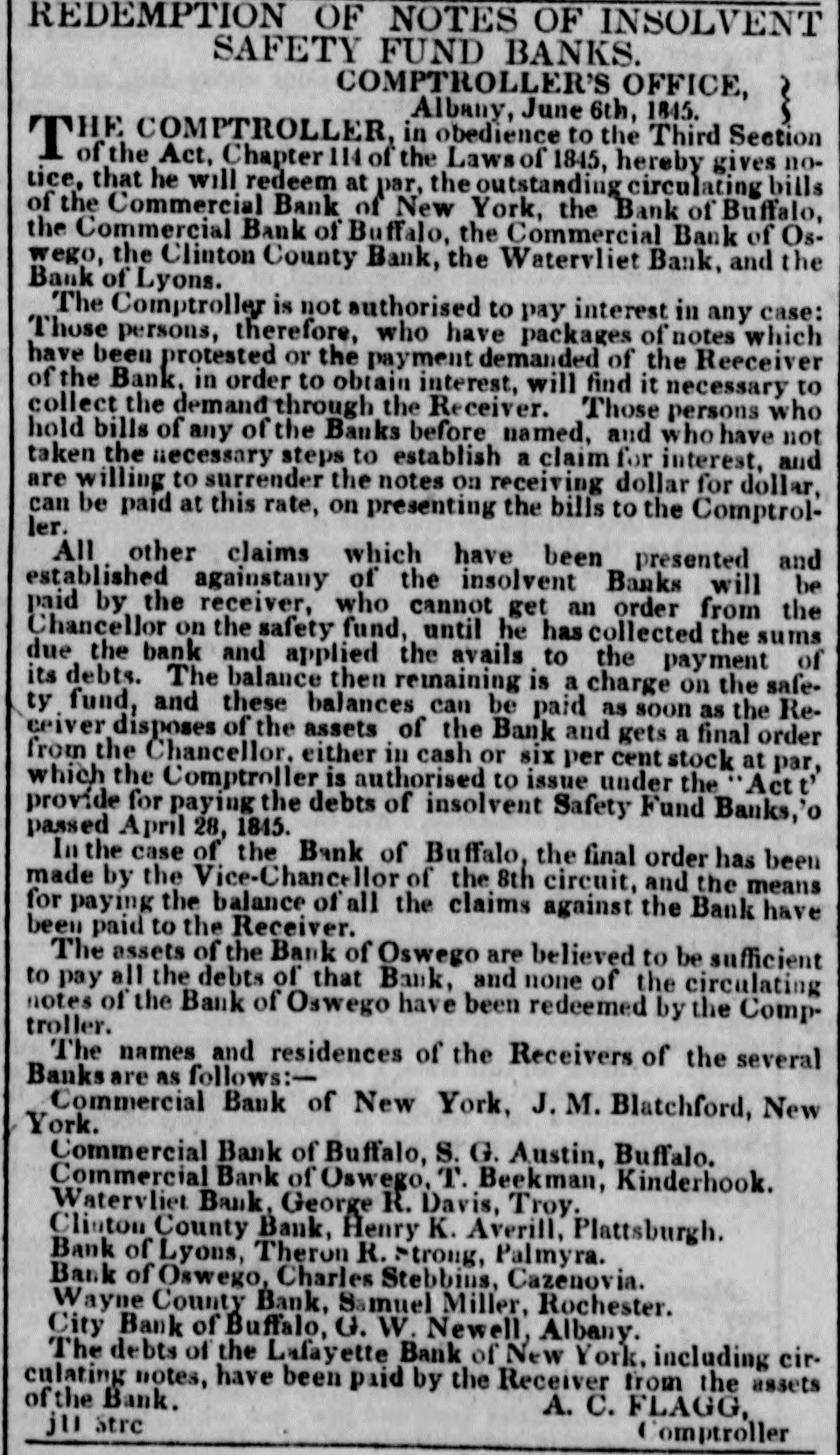
Comptroller ... will redeem at par, the outstanding circulating bills ... City Bank of Buffalo. G. W. Newell, Receiver, City Bank of Buffalo listed earlier as receiver's name in notices.
Source
newspapers
4. November 12, 1845 Other
Newspaper Excerpt
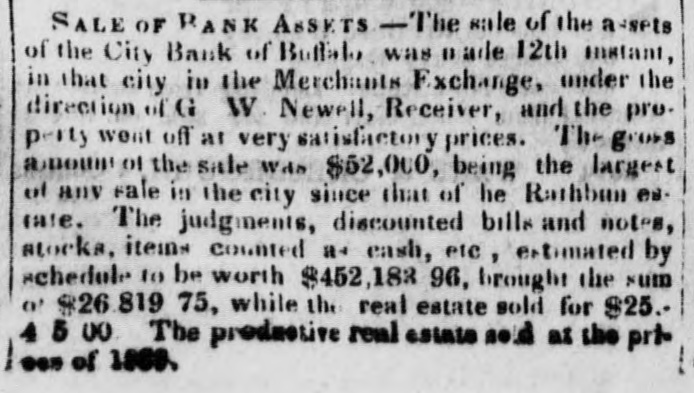
sale of the assets of the City Bank of Buffalo was made ... under the direction of G W Newell, Receiver; gross amount of the sale was $52,000
Source
newspapers

Newspaper Articles (21)

Article from Staunton Spectator, and General Advertiser, May 18, 1837

Click image to open full size in new tab

Article Text

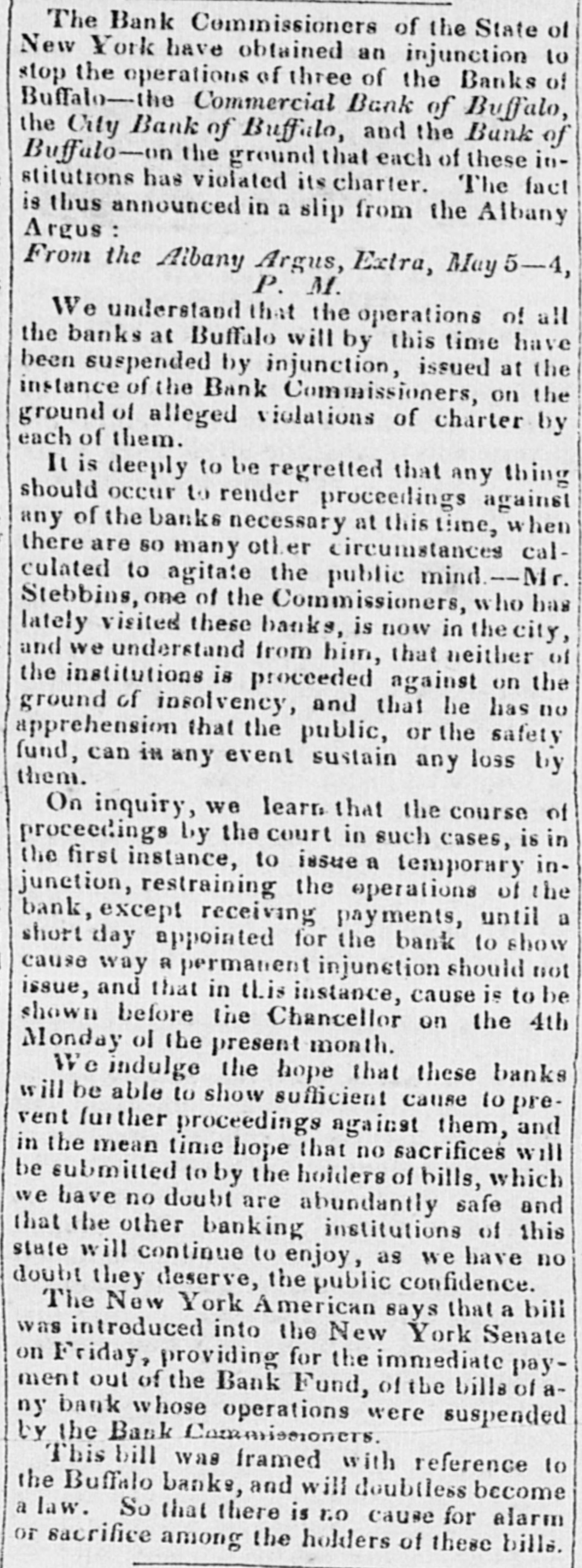
The Bank Commissioners of the State of New York have obtained an injunction to stop the operations of three of the Banks of Buffalo-the Commercial Bank of Buffalo, the City Bank of Buffalo, and the Bank of Buffalo-on the ground that each of these institutions has violated its charter. The fact is thus announced in a slip from the Albany Argus : From the Aibany Argus, Extra, May 5-4, P.M. We understand that the operations of all the banks at Buffalo will by this time have been suspended by injunction, issued at the instance of the Bank Commissioners, on the ground of alleged violations of charter by each of them. It is deeply to be regretted that any thing should occur to render proceedings against any of the banks necessary at this time, when there are so many other circumstances calculated to agitate the public mind.--Mr. Stebbins, one of the Commissioners, who has lately visited these banks, is now in the city, and we understand from him, that neither of the institutions is proceeded against on the ground of insolvency, and that he has no apprehension that the public, or the safety fund, can in any event sustain any loss by them. On inquiry, we learn that the course of proceedings by the court in such cases, is in the first instance, to issue a temporary injunction, restraining the operations of the bank, except receiving payments, until a short day appointed for the bank to show cause way a permanent injunction should not issue, and that in this instance, cause is to be shown before the Chancellor on the 4th Monday ol the present month. We indulge the hope that these banks will be able to show sufficient cause to prevent further proceedings against them, and in the mean time hope that no sacrifices will be submitted to by the holders of bills, which we have no doubt are abundantly safe and that the other banking institutions of this state will continue to enjoy, as we have no doubt they deserve, the public confidence. The New York American says that a bill was introduced into the New York Senate on Friday, providing for the immediate payment out of the Bank Fund, of the bills of any bank whose operations were suspended by the Bank Commissioners, This bill was framed with reference to the Buffalo banks, and will doubtless become a law. So that there is n.o cause for alarm OF sacrifice among the holders of these bills.


Article from Richmond Palladium, May 20, 1837

Click image to open full size in new tab

Article Text

ve atrocities as the following, which th we copy from the Louisville Journal, and the es increasing frequency of brutal outrage, fills y the mind with shame, regret and distressing r apprehensions of future evil. on We have derived from a respectable travoleller the particulars of one of the most attroat cious and horrible occurrences that ever disis graced the annals of human life, civilized or of savage. A feeble bodied man, whose name Id we did not learn, settled a few years ago on nthe Mississippi, a short distance below Ranct dolph, on the Tennessee side. He succeeded to in amassing property to the value of about e $14,000, and, like most of the settlers, made fa business of selling wood to the boats.r This sold at $2.50 a cord, while the neighet bors asked S3. One of them came to remonstrate against his underselling, and had a fight with his brother-in-law, Clark, in which he was beaten. He then went and obtained legal process against Clark, and returned with a deputy sheriff, attended by a posse of desperate villians. When they arrived at Clark's house he was seated among his children, and they instantly fired on him, wounding two children, and putting two or three balls through his body. Clark ran, was overtaken and knocked down in the midst of his cries for mercy, one of the villains fired a pistol in his mouth, killing him instantly. They then required the settler to sell his property to them and leave the country. He, fearing that they would otherwise take his life, sold them his valuable property for $300, land departed with his family.--The sherif was one of the purchasers. CURIOUS TRIAL.--The Southern Correspondent of the New York Evening Star writes a strange circumstance, which is the source of some excitement, is about to undergo investigation in Jones county, Georgia. It appears that some eight years ago, a lad of that county, about 13 years of age, left his home; his father died and left a large property, and he not being heard from, the estate was divided, and his share, some thirty thousand dollars, was divided among those left. Within a few months, he has appeared and laid claim to his property; his mother denies him, and says he is an impostor, as- the real person died some time ago in New Orleans, and she paid his funeral expenses. He is to be tried as an impostor. Opinion is equally divided in regard to his identity: some avow he is the man, and others as decidedly con tend he is no: He has the same marks as the individual-a scar on one supposed of his fingers amputa- of his legs and a joint of one ted. He relates numerous circumstances su connected with his leaving and early youth, b and there are many he cannot remember.n Balt. Chron. pe In BANK FAILURE.--The New York Dry ⑉ Dock Bank stopped business on the 3th inst. A run had been made upon the Bank on Satpr H urday previous, and about $100.000 in specie drawn from its vaults by depositors and pe billholders. The Dry Dock was a Deposite th Bank and had $130,000 of Government mon w ev in possession, which of course the said of Government must lose. No loss will be susup tained by those who hold the notes of this in solvent institution, as the Wall street banks have agreed to redeem them. So the 'experment' progresses. Much excitement prevailed in New York. th Runs and rumors of runs upon several of the ch Banks are mentioned in the papers, but noan hing serious was anticipated. ste The condition of things in New York grows vorse and worse. Three hundred failures cld ave occurred since the Josephs led the way Pro n "the road to ruin". All is dismay in the tio great commercial metropolis.-Dayton Jour. pra mo BATTLE BETWEEN A WEASEL AND SWALLOWS.-M err seasel was observed by some persons in the neighorhood of Garven, in Scotland, to attack some Jac ests of bank swallows hollowed in the sand. A number of the bravest swallows, placed themselves of h battle array pounced upon him, seized him by rev he tai!, raised his hind feet from the ground, and Mr ith great dexterity tumbled him down the declivy, at the top of which the nests were ranged in pul ow. The invader renewed the attack several for mes, but was asofien repulsed in the same manner pea s at firs:, and, being at length worn out by fatigue, ele ielded up the palm of victory to his vanquishers. cha THE FROSTS.-The late severe frosts are said to of ve done great injury to the peach orchards of pat Jew Jersev. To such an extent is the peach ultivated in that State that the Trenton Gazette stimates the damage at 'many hundred thousand ollars.' ca The names of the Buffilo Binks whose doors citi ve closed, are the Commercial Bank of Buffulo, his e City Bank of buffulo, and the Bunk of Buffa con A bill was introduced into the Senate yesterday oridine for the immediate mament out of alm stat


Article from Morning Herald, September 11, 1839

Click image to open full size in new tab

Article Text

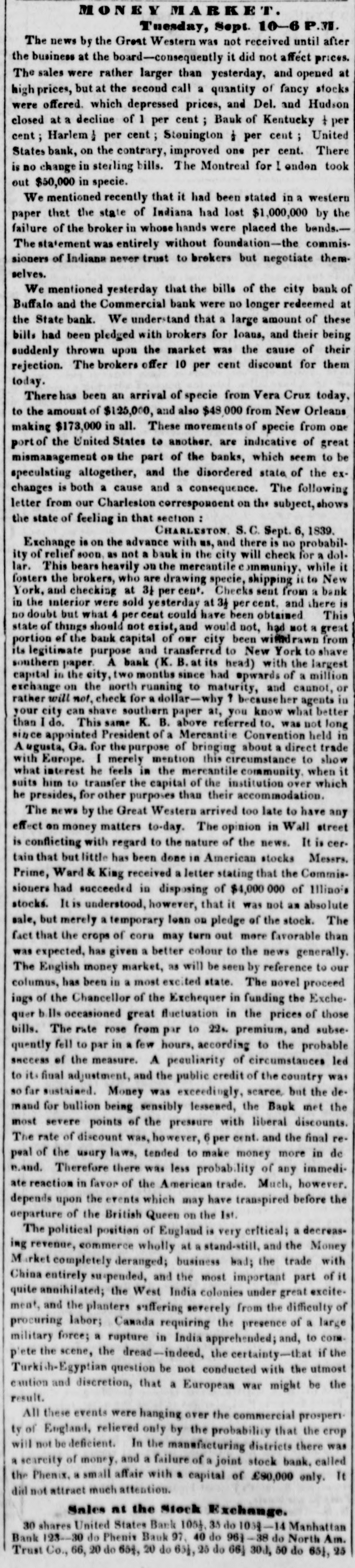
MONEY MARKET. Tuesday, Sept. 10-6 P.M. The news by the Great Western was not received until after the business at the board-consequently it did not affect prices. The sales were rather larger than yesterday, and opened at high prices, but at the second call a quantity of fancy stocks were offered. which depressed prices, and Del. and Hudson closed at a decline of 1 per cent; Bauk of Kentucky t per cent; Harlem } per cent; Stonington & per cent; United States bank, on the contrary, improved one per cent. There is no change in sterling bills. The Montreal for I onden took out $50,000 in specie. We mentioned recently that it had been stated in a western paper that the state of Indiana had lost $1,000,000 by the failure of the broker in whose hands were placed the bends.The statement was entirely without foundation-the commissioners of Indiana never trust to brokers but negotiate them. selves. We mentioned yesterday that the bills of the city bank of Buffalo and the Commercial bank were no longer redeemed at the State bank. We understand that a large amount of these bills had been pledged with brokers for loans, and their being suddenly thrown upon the market was the cause of their rejection. The brokers offer 10 per cent discount for them today. There has been an arrival of specie from Vera Cruz today. to the amount of $125,000, and also $49,000 from New Orleans making $173,000 in all. These movements of specie from one port the United States to another. are indicative of great mismanagement OR the part of the banks, which seem to be speculating altogether, and the disordered state of the exchanges is both a cause and a consequence. The following letter from our Charleston correspondent on the subject, shows the state of feeling in that section : CHARLESTON. S.C. Sept. 6, 1839. Exchange is on the advance with us, and there is no probability of relief soon, as not a bank in the city will check for a dollar. This bears heavily on the mercantile community, while it fosters the brokers, who are drawing specie, shipping it to New York, and checking at 31 percent. Checks sent from a bank in the interior were sold yesterday at 3) percent. and there is doubt but what 4 per cent could have been obtained This state of things should not exist, and would not, had not a great portion of the bauk capital of our city been withdrawn from its legitimate purpose and transferred to New York to shave southern paper. A bank (K. B. at its head) with the largest capital in the city, two months since had epwards of a million exchange on the north running to maturity, and cannot, or rather will not, check for a dollar-why 1 because her agents in your city can shave southern paper at, you know what better than do. This same K. B. above referred to. was not long since appointed President of a Mercantire Convention held in Augusta, Ga. for the purpose of bringing about a direct trade with Europe. I merely mention this circumstance to show what interest he feels in the mercantile community. when it suits him to transfer the capital of the institution over which he presides, for other purposes than their accommodation. The news by the Great Western arrived too late to have any effect on money matters to-day. The opinion in Wall street is conflicting with regard to the nature of the news. It is certain that but little has been done in American stocks Messrs. Prime, Ward & King received letter stating that the Commissioners had succeeded in disposing of $4,000 000 of Illinois stocks. It is understood, however, that it was not as absolute sale, but merely a temporary loan on pledge of the stock. The fact that the crops of corn may turn out more favorable than was expected, has given a better colour to the news generally. The English money market, as will be seen by reference to our has been in a most excited state. The novel proceed of the Chancellor of the Exchequer in bills occasioned great fluctuation in The rate rose from par to 22. bills. quer ings columus, premium, funding the prices the and of Exche- subse. those quently fell to par in a few hours, according to the probable success of the measure. A peouliarity of circumstances led to it final adjustment, and the public credit of the country was far sustained. Money was exceedingly, scarce, but the demand for bullion being sensibly lessened, the Bauk met the severe of the pressure with liberal discounts. rate of discount was, however, 6 per cent. remost The points and the final in de peal of the usury laws, tended to make money more n.and. Therefore there was less probability of any immediate reaction in favor of the American trade. Much, however. depends upon the events which may have transpired before the departure of the British Queen on the 1st. The political position of England is very critical; a decreasing revenue, commerce wholly at a stand-still, and the Money Market completely deranged; business bad; the trade with China entirely suspended, and the most important part of it quite annihilated; the West India colonies under great excite. ment, and the planters suffering severely from the difficulty of procuring labor; Canada requiring the presence of a large military force; a rupture in India apprehended; and, to COIN. plete the scene, the dread-indeed, the certainty-that if the Turkish-Egyptian question be not conducted with the utmost caution and discretion, that a European war might be the result. All these events were hanging over the commercial prosperiof relieved only by the probability that the crop deficient. In the manufacturing ty will not England, districts bank. there called was a scarcity of money. and a failure of a joint stock the Phenix. a small affair with a capital of Β£90,000 only. It did not attract much attention. Sales at the Stock Exchange. 30 shares United States Bank 105 35 do 1034-1 Manhattan Bank 123- 30 do Phenix Bauk 97. 40 do 961 North Am. Trust Co., 66, do 654, 20 do 651, 30d, do 651, 25


Article from Morning Herald, October 22, 1839

Click image to open full size in new tab

Article Text

The stock market presented but very little change from the prices of Saturday. Sales were not large. U. S. Bank closed the same as on Saturday. Del. & Hudson receded 1/4 per cent; Kentucky 1/4 per cent; Harlem 1/4 per cent; Utica & Schenectady 1/4 per cent. There was less demand for money today than on Saturday. For several days past, the State Bank has been discontinuing the redemption of certain of the safety fund bills. The following is a list of the banks, the bills of which have been thrown out, on Saturday and todayβ€” Chemung Canal Bank, Bank of Whitehall, Essex County Bank, Yates County Bank, Bank of Ithaca, Commercial Bank of Buffalo, Bank of Lyons, City Bank of Buffalo, Bank of Orleans, Commercial Bank of Oswego, Madison Co. Bank, Oswego Bank, Sackett's Harbor Bank, Chautauque County Bank. These are bought by the brokers at 5 per cent discount. The probability is, that all will be discontinued, with the exception of such few as have made arrangements for taking up their own paper. The Bank Commissioners are now here and have sent for the committee of the country banks, for the purpose of endeavoring to make an arrangement with the banks of this city, by which Safety Fund money shall be received at par in payment of their debts. Such a measure is very desirable if it can be entered into at this time. The present uncertain mode of redemption operates very much against the ability of the country banks to grant the necessary facilities in getting the crops to market. The policy of holding back produce for a rise laid the ground work early in the spring for the present difficulties. The banks were thereby prevented from remitting drafts against produce to meet their funds here. The same policy checked the export of grain, which would, if left to its natural prices, have formed the basis for a large amount of sterling bills. This led to the discontinuance of the redemption in this city at the expiration of the year, in June last. The committee of the country banks at that time effected a renewal on modified terms, which were, that a system of internal exchange should be adopted by which the amount thrown upon the city would be redeemed one half. At that time, however, a new cause of difficulty began to manifest itself in the circulation of the bills of the banks under the new system. They were the cheaper currency, and the public had more confidence in them than the Safety Fund. These facts were rapidly driving in the safety fund circulation to an extent which rendered nugatory the effect of the internal exchange, in reducing the amount in the city. The safety fund circulation was rendered much more rapid by the agents of the new banks, who exerted themselves in the interior to exchange the new bills for them and send the safety fund notes in for redemption. At the same time the old cause of difficulty, which was the holding of wheat, continued to operate, and prevented the western banks from sending funds here. The transaction with regard to a state loan and the canal funds, which we mentioned a few days since occurring about that time, caused a second sudden suspension of the redemption. The pernicious system of holding back the crop, is the grand evil, and one to which dealers and farmers adhere with a tenacity which amounts almost to a mania. The process of a reduction in prices is going forward with an irresistable force and cannot be prevented. The crops are immense, far greater than can be consumed in this country, and can find a market abroad only at low prices; holding it back from the market, therefore, has no other effect than to disorder the currency. The following is a table of the leading items of such of the banks as have been refused by the State Bank at their last return, as compared with the same items, at the period of suspension, May, 1837.


Article from Morning Herald, February 6, 1840

Click image to open full size in new tab

Article Text

[Correspondence of the Herald.] ALBANY, Feb. 3, 1840. City Bank of Buffalo shut up-New President of the Senate-Uniform Bankrupt Law-David Frost and Eveline his Wife-Office-Seekers, &.C. The emergency of which I spoke on Saturday, has come, sure enough. The City Bank of Buffalo has been closed by an injunction, and Ex-Governor Marcy is appointed receiver. The Bank Fund bill, which was drawn with reference to this emergency, was driven through the House today, and will probably pass the Senate on Wednesday. Nothing else done, except to re-elect Jacob Haight, Treasurer. Lieutenant-governor Bradish sent a letter to Mr. H. A. Livingston this morning, saying that he was indisposed, and asking Mr. L. to take the chair until the Senate should elect a President pro tempore. After the presentation of the usual quantum of petitions, Mr. Tallmadge, of your city, was elected President pro tem.. On being conducted to the chair, he acknowledged the honor conferred upon him in a few appropriate words. A report was made by the Judiciary Committee on the subject of a uniform bankrupt law, which concluded with some explicit and strong resolutions in its favor. The report will probably be accepted by the Senate, and 'the resolutions passed by the Legislature. After electing Mr. Haight, Treasurer, and disposing of two or three other small matters, the Senate went into Committee of the Whole and took up a bill for the relief of David Frost." This is the divorce case, that produced so much excitement last winter, the circumstances of which are, no doubt, familiar to you. The bill is in these words: "The marriage contract between David Frost and Eveline his wife is hereby dissolved." The whole matter was thoroughly discussed last winter, and the bill would have passed but for the press of business just at the heels of the session, and everybody supposed it would go through without any opposition. But Gen. Root, who is as fond of fun as in his electioneering days, seeing there was a pretty full attendance of ladies, affected profound ignorance of the whole matter, and called for the reading of the petitions and other documents. By all means, said Col. Young, and let us have David's first. Accordingly David's petition was read. He refers to his petition of last year, which contains some choice details, and says the marriage has not been consummated, and is never like to be; that the fault is not his; in fact, that he has never been in fault in the premises at all, and prays the Legislature to unmarry him as soon as may be; and he says he shall ever pray. So far, so good, said Col. Young. Now let us hear what Eveline has to say. Eveline says she wants the marriage tie dissolved, if any do exist between her and David. of which she has no knowledge, although she is disposed to believe that such may be the case. She says she was under a mental hallucination and delusion at the time the ceremony was said to have been performed; that the marriage had not been consummated, and never would be with her consent. Gen. Root enquired, if there were more documents? He could not suppose that a report had been made on the naked, unsupported declaration of the parties themselves. Col. Young said, if Eveline had been married without her knowledge or consent, and she had only made the discovery next morning, it was obviously a


Article from Morning Herald, February 6, 1840

Click image to open full size in new tab

Article Text

vulsion in the monetary system and mineral and of this curious and original country, goes ahead like a flash of lightning athwart the blue heaven, in chase of Satan, trying to make his escape from the sword of Raphael. In this state, the vast reduction of bank loans, equal $20,000,000 in a year, have begunthe reduction in prices, rents, real estate, produce, and 'every thing. The City Bank of Buffalo is shut up, and many more banks will follow. The legislature, at Albany, is deliberating on the best means of making bank money par over the state, which will only aid the progress of events. In Pennsylvania, they are in a worse condition. The banks have all suspended> and he who talks of honesty and good faith in that state, is stigmatised as a scoundrel. That broken state has just borrowed of her broken banks, a loan to pay the interest on her vast debt, a mode of finance that will only accelerate the utter destruction of both bank and state credit in Pennsylvania. In Maryland, and throughout the South and west, the same financial conflict goes on-the same effort to sustain extravagance and continue fraud and speculation, by borrowing today to pay the debt of yesterday. All the speculators connected with the rotten banks and rotten states, are endeavoring to hide their extravagance and folly, and to makea plausible appearance of things to their creditors in Europe. The country is on the verge of a revulsion and revolution, such as no civilized nation ever yet passed. The system of negotiating fresh loans to pay the interest of past debts, can only end in utter and final explosion. The great mass of the people will soon rouse themselves to indignation against the financiers, bankers and politicians of both parties-and a few short years-perchance months-will produce more decided civil revolution in half the states of the Union, than ever has been experienced in the bankrupt republics of South America. The states about Β£25,000,000 sterling, or $125,000,000, European capitalists alone-a great portion of which has been wasted and plundered by the bankers and politicians of both parties, under the name of commissions, contracts and public works. The interest cannot be paid without a resort to direct taxation. Will the people submit to pay for the extravagance of these men Will they not rebel at such exactions -review the whole policy of the last quarter of a century-and most likely repudiate these debts and the men who incurred them by some great organic revolution? Weare in the midst of the great crisis of the credit system. England is also in the same position, without possessing the means, in natural wealth and vast resources, to recover from her difficulties.What the result may be is difficult to foresee-but this much is certain, weare on the eve of vast social and political changes. There is one comfort, we can'tbeworse-wemay be better. REMEDIES AGAINST FIRES.-We call the atten. tion of the community to the proceedings of the citizens of the First Ward, published in another column, on the subject of providing remedies against conflagrations. The gross inefficiency, inattention, and weakness, of the present Corporation, from the Mayor down, have increased so much of late, that the citizens will absolutely have to organize themselves, in their own to provide those a good ought to provide. never government wards, remedies We and which will get rows, fires, plunderings, every of disorder, till we put an chief such as Aaron was, a species rid magistrate, of riots, public Clarke in efficient and body of aldermen and assistants, that will have the moral courage to act for the public good, and not party benefit. As EXPECTED.-The bankrupt, swindling, insol vent Bank of the United States at Philadelphia, have refused to pay the $1000 post note owned by me, which fell due last Saturday, and was then sent on for collection. They have taken my money to buy the Legislature of Pennsylvania, and to permit them longer to cheat the community. No matterI shall issue the following advertisement: INFORMATION WANTED. to the information underprivate Any person when the who Bank can of the United States in Philadelphia, has signed. funds either arriving at. or leaving specie this eity.so nato enable or other properly.or will amply an attachment rewarded for to the be same. issued and the property seized, JAMES GORDON BENNETT. FASHIONABLE PARTY, CORNER OF FOURTH ST AND BROADWAY.-On of the most graceful and balls got up in fashionable ing the season, was that prettiest present given, C., society, last the week, durby beautiful and interesting Miss at corner and Fourth street. was the of Broadway It equally and its recherchΓ© for its charming young women, choice old wines. Among the fair ones present were the two beautiful Miss N's of Fourth street, now preparing to to Washington. They were dressed in virgin go white, with ornaments of the most tasteful description. The eldest danced frequently with Mr. B. of Mississippi. but towards the close, the young Mr. H. of New York, entirely eclipsed the southerner. much as the specie-paying currency of New York as outdoes the mere paper money of Mississippi. The Miss E. also created a considerable A. a bud of the system, is attentive in this quarter, but sensation. very beautiful Young he auction has not made the he imagines. and taste; and the progress sweetness The hair-breath lady gentleman sings talks with everlastingly of his travels and escapes in Europe. He was twice nearly swallowed up by earthquakes-once OR the verge of falling into the crater Mount Vesuvius-suffered several six shipwrecks-was robbed in the Alps-and was actually a murdered and buried alive in the Appenines, by band of robbers. Mrs. K. the sister of Miss C., was most beautidressed in black velvet. Miss C., a elergyfair from Boston, a deal attention-also the two man's fully of daughter attracted Misses A., great the pretty daughters of a Water Commissioner. fashion- aslary $10 per day, have just come out in the able and bid fair to create a sensation the gentlemen present, none who Among world, remarkable, there Major was S. danced with almost every fair one presentvery unless it was short Cant.


Article from Morning Herald, February 7, 1840

Click image to open full size in new tab

Article Text

MONEY MARKET. THURSDAY, Feb. 6-6 P. M. The success of the non-resumption policy in Philadelphia, and the anticipation of favorable aews by the Liverpool, have imparted a great degree of buoyancy to the stock market this morning. The sales were not very extensive, but prices rose rapidly. Harlem improved 2 per cent; New Jersey Railroad 1 per cent; Stonington 1 per cent; V. S. Bank 3 per cent; North American Trust and Banking Company 2) per cent; Delaware and Hudson 1) per cent; Dry Dock 2 per cent; Farmers' Trust 1 per cent. Exchange on Philadelphia declined to 6) per cent discount. After the Board adjourned, a rumor of defalcation in the Dry Dock Bank became current. Nothing definite transpired. It was stated that forged drafts, to the amount of $80,000, had been paid; another, that large loans had been made on Kentucky stock, which had depreciated on their hands below what is sufficient to cover the loans. Out of this rumor grew the report, that there were difficulties in the Manhattan Bank, which is not the case. The windin; up of the City Bank of Buffalo, is a prelude to fresh explosions, and a further derangement of the state currency. The present difficulties are clearly the result of the mismanagement of the state finances. The improvidence of the state officers in the employment of the state funds, last sammer, was the cause of much embarrasement to the State Bank, in this city, and connected with other events, forced her twice to suspend the redemption of the country money, and entailed an immense loss upon the business community, in consequence of the heavy discount they had to pay, by reason of the non-redemption The state office appears, without any plausible reason, loaned to three of the Beffalo Banks, $400,000 of the state's money, belong - to the Cabil Feed This money was, by contract, to be paid over to the Star Bank in instalments The use of this money vold have emailed the State Bank to employ a larger capital 19 the cedric time of coantry money; but the loan to the Buffalo Bauki stips lated them to over issues, and cause that great inflax of Buffalo bank bills in this city, which depreciated Cheir Sale This unnatural action speedily involved the issuing banks in difficulty; and on the 11th of November, when the first in stalment fell due to the State Bank, by for City Bank of Buf falo, it was not paid. One of the Bank thank the time being. to Buffalo, and en arrangement was made donand certain of the papers of that city tradict the rumor, that an injunction had the sult of this patching up has been an state loges $400,000 of the Canal Famil Fund is nearly annibilated. $817,900 The Bank Fund was, on the 19th January The circulation to be paid out of it, is, for $123,408 the Bank of Buffalo, Commercial Bank of Buffalo, 104,914 " City


Article from Morning Herald, February 8, 1840

Click image to open full size in new tab

Article Text

# A FIFTY CENT PATCH.-EX- Governor Marcy is appointed receiver of the Buffalo City Bank. A good selection. The great X. has had a large experience in patching breeches and banks, cheap, too.


Article from Morning Herald, February 8, 1840

Click image to open full size in new tab

Article Text

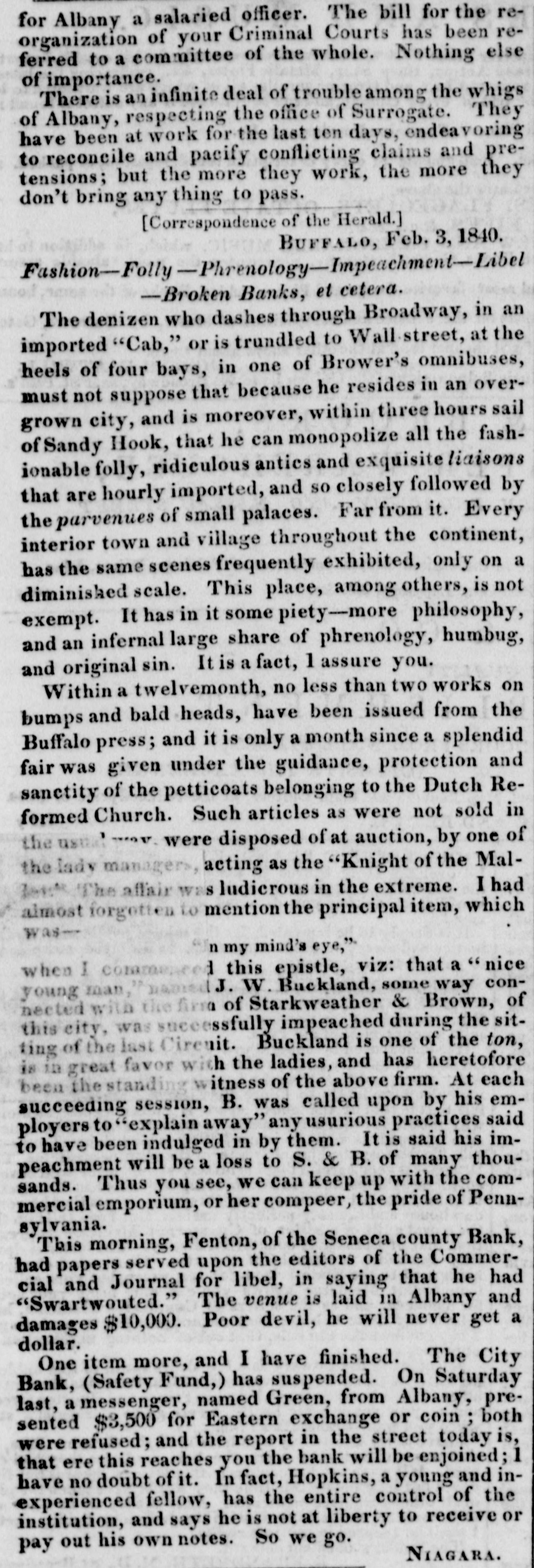
for Albany a salaried officer. The bill for the reorganization of your Criminal Courts has been referred to a committee of the whole. Nothing else of importance. There is an infinite deal of trouble among the whigs of Albany, respecting the office of Surrogate. They have been at work for the last ten days, endeavoring to reconcile and pacify conflicting claims and pretensions; but the more they work, the more they don't bring any thing to pass. [Correspondence of the Herald.] BUFFALO, Feb. 1840. Fashion-Folly - -Phrenology-Impeachment-Libee -Broken Banks, et cetera. The denizen who dashes through Broadway, in an imported "Cab," or is trundled to Wall's street, at the heels of four bays, in one of Brower's omnibuses, must not suppose that because he resides in an overgrown city, and is moreover, within three hours sail of Sandy Hook, that hΓ© can monopolize all the fashionable folly, ridiculous antics and exquisite liaisons that are hourly imported, and so closely followed by the parvenues of small palaces. Far from it. Every interior town and village throughout the continent, has the same scenes frequently exhibited, only on a diminished scale. This place, among others, is not exempt. It has in it some piety-mor philosophy, and an infernal large share of phrenology, humbug, and original sin. It is a fact, 1 assure you. Within a twelvemonth, no less than two works on bumps and bald heads, have been issued from the Buffalo press; and it is only a month since a splendid fair was given under the guidance, protection and sanctity of the petticoats belonging to the Dutch Reformed Church. Such articles as were not sold in were disposed of at auction, by one of the us the lady managers, acting as the "Knight of the Malletter The affair was Indicrous in the extreme. I had almost forgotten to mention the principal item, which wasn my mind's eye," d this epistle, viz: that a "nice when I young man, named J. W. Backland, some way conneeted with the firm of Starkweather & Brown, of this city, was successfully impeached during the sitting of the last Circuit. Buckland is one of the ton, is in great favor with the ladies, and has heretofore been the standing witness of the above firm. At each succeeding session, B. was called upon by his employers to explain away" any usurious practices said to have been indulged in by them. It is said his impeachment will be a loss to S. & B. of many thousands. Thus you see, we can keep up with the commercial emporium, or her compeer, the pride of Pennsylvania. This morning, Fenton, of the Seneca county Bank, had papers served upon the editors of the Commercial and Journal for libel, in saying that he had "Swartwouted." The venue is laid in Albany and damages $10,000. Poor devil, he will never get a dollar. One item more, and I have finished. The City Bank, (Safety Fund,) has suspended. On Saturday last, a messenger, named Green, from Albany, presented $3,500 for Eastern exchange or coin; both were refused; and the report in the street today is, that ere this reaches you the bank will be enjoined; 1 have no doubt of it. In fact, Hopkins, a young and inexperienced fellow, has the entire control of the institution, and says he is not at liberty to receive or pay out his own notes. So we go. NIAGARA.


Article from Morning Herald, February 21, 1840

Click image to open full size in new tab

Article Text

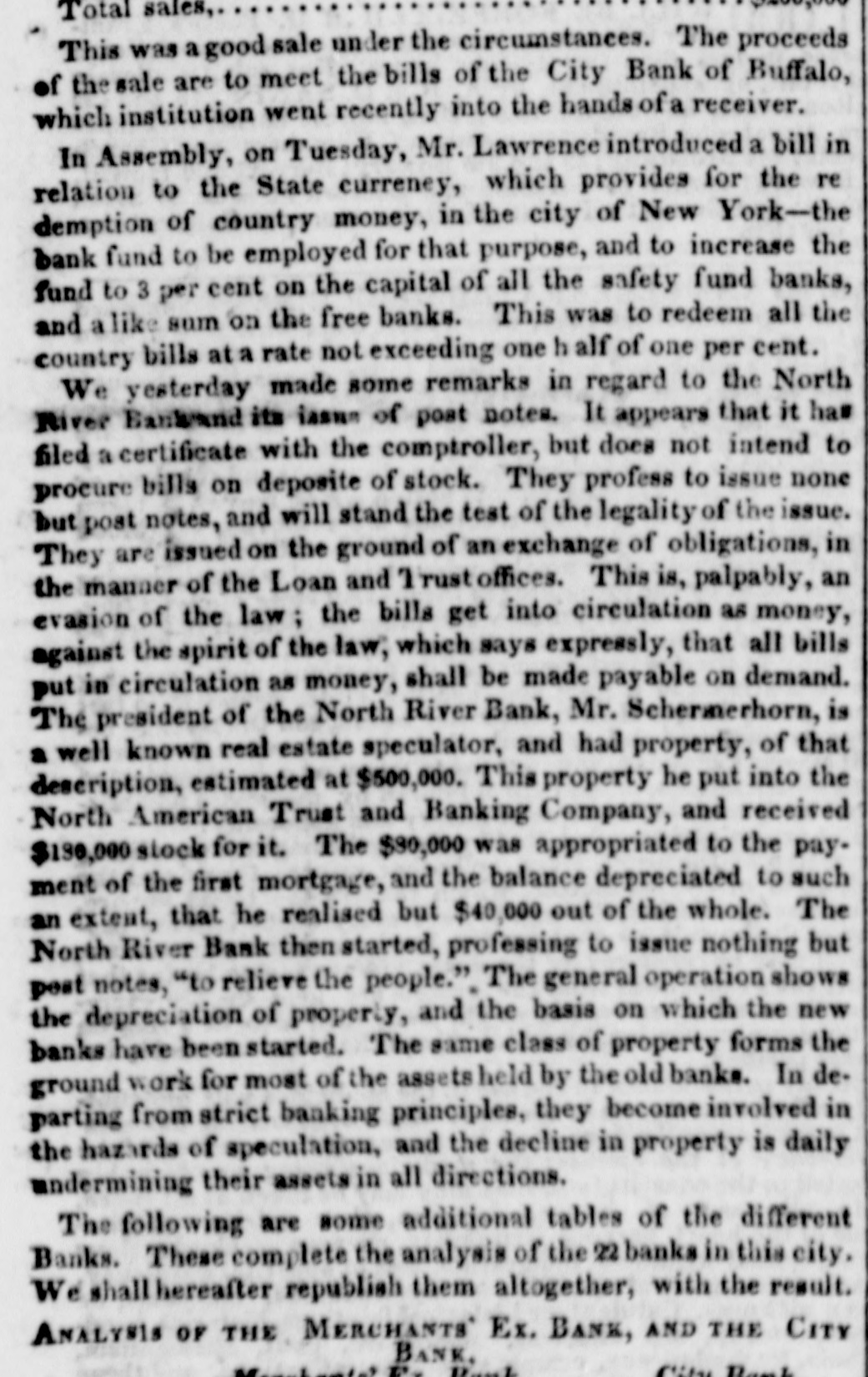
Total sales, This was a good sale under the circumstances. The proceeds of the sale are to meet the bills of the City Bank of Buffalo, which institution went recently into the hands of a receiver. In Assembly, on Tuesday, Mr. Lawrence introduced a bill in relation to the State curreney, which provides for the re demption of country money, in the city of New York-the bank fund to be employed for that purpose, and to increase the fund to 3 per cent on the capital of all the safety fund banks, and a like sum on the free banks. This was to redeem all the country bills at a rate not exceeding one h alf of one per cent. We yesterday made some remarks in regard to the North River Bankrand its issue of post notes. It appears that it has filed a certificate with the comptroller, but does not intend to procure bills on deposite of stock. They profess to issue none but post notes, and will stand the test of the legality of the issue. They are issued on the ground of an exchange of obligations, in the manner of the Loan and 1 rust offices. This is, palpably, an evasion of the law; the bills get into circulation as money, against the spirit of the law, which says expressly, that all bills put in circulation as money, shall be made payable on demand. The president of the North River Bank, Mr. Schermerhorn, is a well known real estate speculator, and had property, of that description, estimated at $500,000. This property he put into the North American Trust and Banking Company, and received $130,000 stock for it. The $30,000 was appropriated to the payment of the first mortgage, and the balance depreciated to such an extent, that he realised but $40,000 out of the whole. The North River Bank then started, professing to issue nothing but post notes, "to relieve the people.". The general operation shows the depreciation of property, and the basis on which the new banks have been started. The same class of property forms the ground work for most of the assets held by the old banks. In departing from strict banking principles, they become involved in the hazards of speculation, and the decline in property is daily undermining their assets in all directions. The following are some additional tables of the different Banks. These complete the analysis of the 22 banks in this city. We hereafter republish them altogether, with the result. ANALYSIS OF THE MERCHANTS' Ex. BANK, AND THE CITY BANK. Haul


Article from Morning Herald, December 4, 1840

Click image to open full size in new tab

Article Text

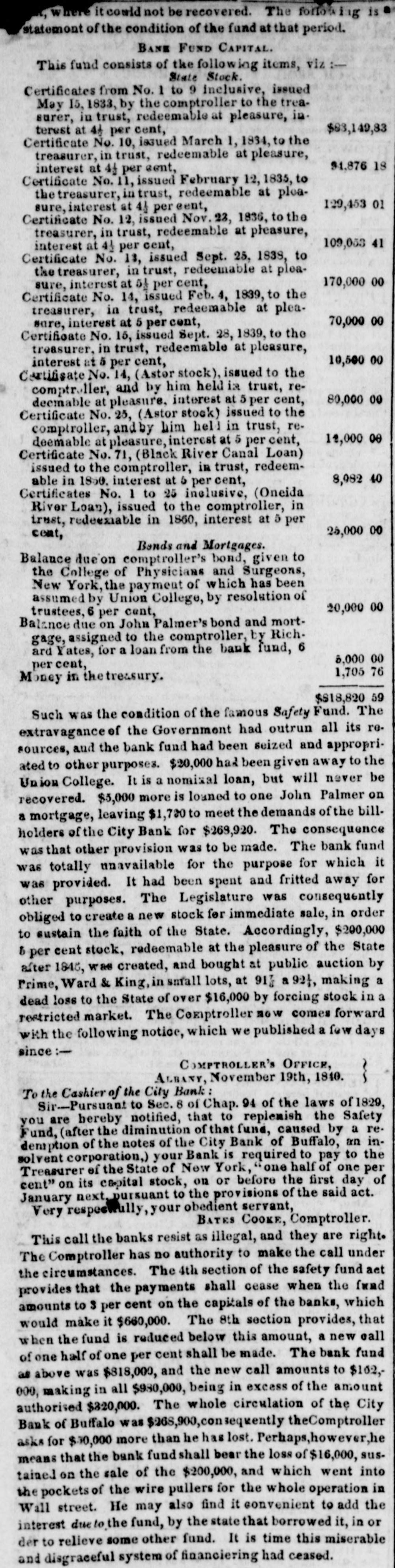
, where it could not be recovered. The following is a statement of the condition of the fund at that period. # BANK FUND CAPITAL. This fund consists of the following items, viz:- *State Stock.* Certificates from No. 1 to 9 inclusive, issued May 15, 1833, by the comptroller to the treasurer, in trust, redeemable at pleasure, interest at 4Β½ per cent, $83,149,83 Certificate No. 10, issued March 1, 1834, to the treasurer, in trust, redeemable at pleasure, interest at 4Β½ per cent, $91,876 18 Certificate No. 11, issued February 12, 1835, to the treasurer, in trust, redeemable at pleasure, interest at 4Β½ per cent, 129,453 01 Certificate No. 12, issued Nov. 23, 1836, to the treasurer, in trust, redeemable at pleasure, interest at 4Β½ per cent, 109,053 41 Certificate No. 13, issued Sept. 25, 1838, to the treasurer, in trust, redeemable at pleasure, interest at 5 per cent, 170,000 00 Certificate No. 14, issued Feb. 4, 1839, to the treasurer, in trust, redeemable at pleasure, interest at 5 per cent, 70,000 00 Certificate No. 15, issued Sept. 28, 1839, to the treasurer, in trust, redeemable at pleasure, interest at 5 per cent, 10,500 00 Certifisate No. 14, (Astor stock), issued to the comptroller, and by him held is trust, redeemable at pleasure, interest at 5 per cent, 80,000 00 Certificate No. 25, (Astor stock) issued to the comptroller, and by him held in trust, redeemable at pleasure, interest at 5 per cent, 12,000 00 Certificate No. 71, (Black River Canal Loan) issued to the comptroller, in trust, redeemable in 1860, interest at 5 per cent, 8,982 40 Certificates No. 1 to 25 inclusive, (Oneida River Loan), issued to the comptroller, in trust, redeeziable in 1860, interest at 5 per cent, 25,000 00 *Bonds and Mortgages.* Balance due on comptroller's bond, given to the College of Physicians and Surgeons, New York, the payment of which has been assumed by Union College, by resolution of trustees, 6 per cent, 20,000 00 Balance due on John Palmer's bond and mortgage, assigned to the comptroller, by Richard Yates, for a loan from the bank fund, 6 per cent, 5,000 00 Money in the treasury. 1,705 76 $818,820 59 Such was the condition of the famous Safety Fund. The extravagance of the Government had outrun all its resources, and the bank fund had been seized and appropriated to other purposes. $20,000 had been given away to the Union College. It is a nomixal loan, but will never be recovered. $5,000 more is loaned to one John Palmer on a mortgage, leaving $1,720 to meet the demands of the bill-holders of the City Bank for $269,920. The consequence was that other provision was to be made. The bank fund was totally unavailable for the purpose for which it was provided. It had been spent and fritted away for other purposes. The Legislature was consequently obliged to create a new stock fer immediate sale, in order to sustain the faith of the State. Accordingly, $200,000 5 per cent stock, redeemable at the pleasure of the State after 1845, was created, and bought at public auction by Prime, Ward & King, in small lots, at 91Β½ a 92Β½, making a dead loss to the State of over $16,000 by forcing stock in a restricted market. The Comptroller now comes forward with the following notice, which we published a few days since:- COMPTROLLER'S OFFICE, ALBANY, November 19th, 1840. To the Cashier of the City Bank: Sir-Pursuant to Sec. 8 of Chap. 94 of the laws of 1829, you are hereby notified, that to replenish the Safety Fund, (after the diminution of that fund, caused by a redemption of the notes of the City Bank of Buffalo, an insolvent corporation,) your Bank is required to pay to the Treasurer of the State of New York, "one half of one per cent" on its capital stock, on or before the first day of January next, pursuant to the provisions of the said act. Very respecwully, your obedient servant, BATES COOKE, Comptroller. This call the banks resist as illegal, and they are right. The Comptroller has no authority to make the call under the circumstances. The 4th section of the safety fund aet provides that the payments shall cease when the fund amounts to 3 per cent on the capitals of the banks, which would make it $660,000. The 8th section provides, that when the fund is reduced below this amount, a new call of one half of one per cent shall be made. The bank fund as above was $818,000, and the new call amounts to $162,000, making in all $930,000, being in excess of the amount authorised $320,000. The whole circulation of the City Bank of Buffalo was $268,900, consequently the Comptroller asks for $30,000 more than he has lost. Perhaps, however, he means that the bank fund shall bear the loss of $16,000, sustained on the sale of the $200,000, and which went into the pockets of the wire pullers for the whole operation in Wall street. He may also find it convenient to add the interest due to the fund, by the state that borrowed it, in order to relieve some other fund. It is time this miserable and disgraceful system of financiering had ceased.


Article from New-York Tribune, February 10, 1842

Click image to open full size in new tab

Article Text

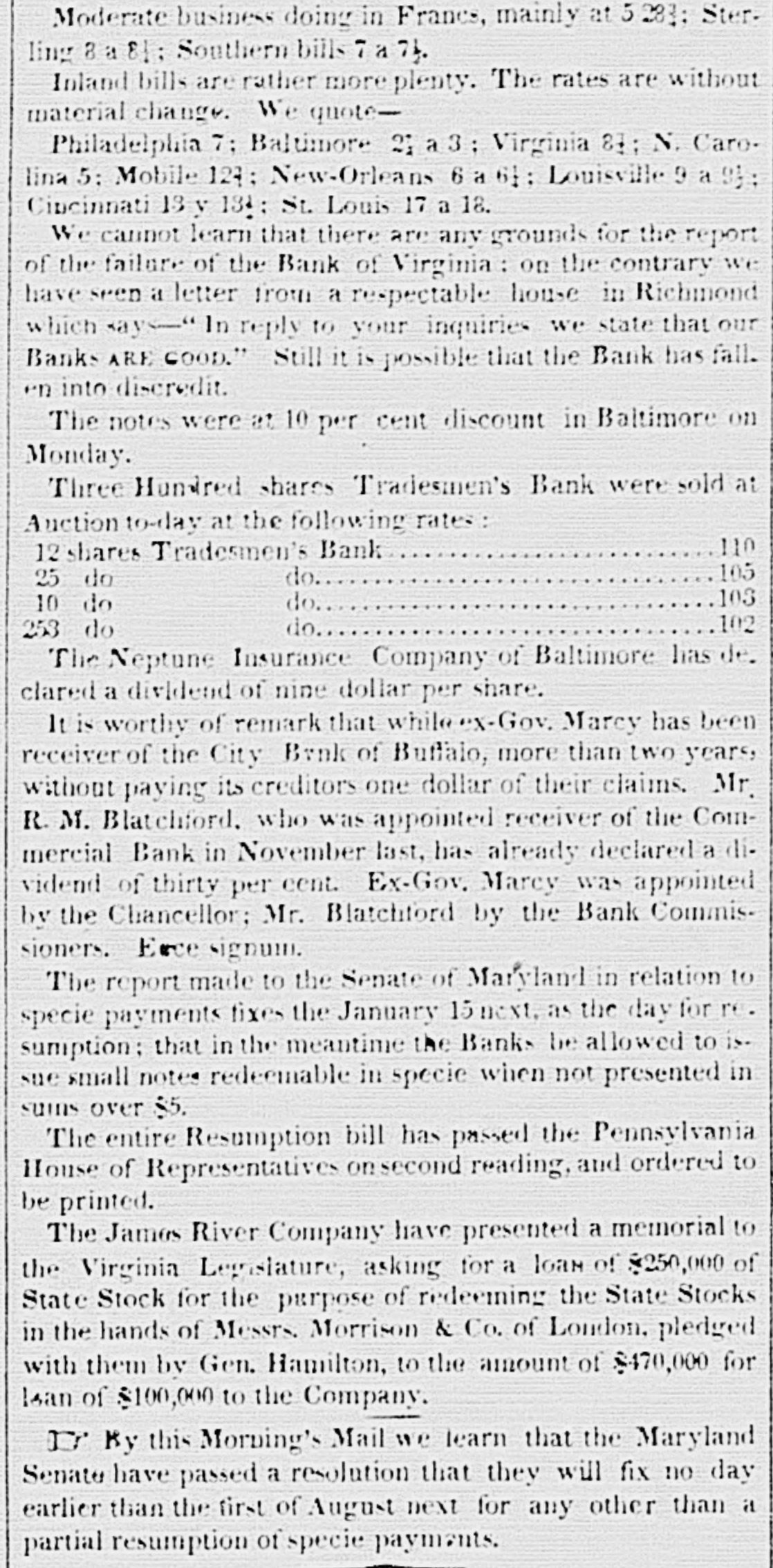
Moderate business doing in Francs, mainly at 5 283; Sterling 8 a 81; Southern bills 7 a 71. Inland bills are rather more plenty. The rates are without material change. We quote- Philadelphia 7; Baltimore 21 a 3; Virginia 81; N. Carolina 5: Mobile 124; New-Orleans 6 a 61; Louisville 9 a 95; Cincinnati 13 y 184: St. Louis 17 a 18. We cannot learn that there are any grounds for the report of the failure of the Bank of Virginia: on the contrary we have seen a letter from a respectable house in Richmond which says" In reply to your inquiries we state that our Banks ARE COoD." Still it is possible that the Bank has fallen into discredit. The notes were at 10 per cent discount in Baltimore on Monday. THREE HUNDRED SHARES TRADESMEN'S BANK WERE SOLD AT AUCTION TO-DAY AT THE FOLLOWING RATES: 12 shares Tradesmen's Bank 110 25 do do 105 10 do do 103 253 do do 102 The Neptune Insurance Company of Baltimore has declared a dividend of nine dollar per share. It is worthy of remark that while ex-Gov. Marcy has been receiver of the City Bank of Buffalo, more than two years, without paying its creditors one dollar of their claims. Mr. R. M. Blatchford, who was appointed receiver of the Commercial Bank in November last, has already declared a dividend of thirty per cent. Ex-Gov. Marcy was appointed by the Chancellor; Mr. Blatchford by the Bank Commissioners. Erce signum. The report made to the Senate of Maryland in relation to specie payments fixes the January 15 next, as the day for resumption; that in the meantime the Banks be allowed to issue small notes redeemable in specie when not presented in sums over $5. The entire Resumption bill has passed the Pennsylvania House of Representatives on second reading, and ordered to be printed. The James River Company have presented a memorial to the Virginia Legislature, asking for a loan of $250,000 of State Stock for the purpose of redeeming the State Stocks in the hands of Messrs. Morrison & Co. of London, pledged with them by Gen. Hamilton, to the amount of $470,000 for loan of $100,000 to the Company. By this Morning's Mail we learn that the Maryland Senate have passed a resolution that they will fix no day earlier than the first of August next for any other than a partial resumption of specie payments.


Article from New-York Tribune, February 15, 1842

Click image to open full size in new tab

Article Text

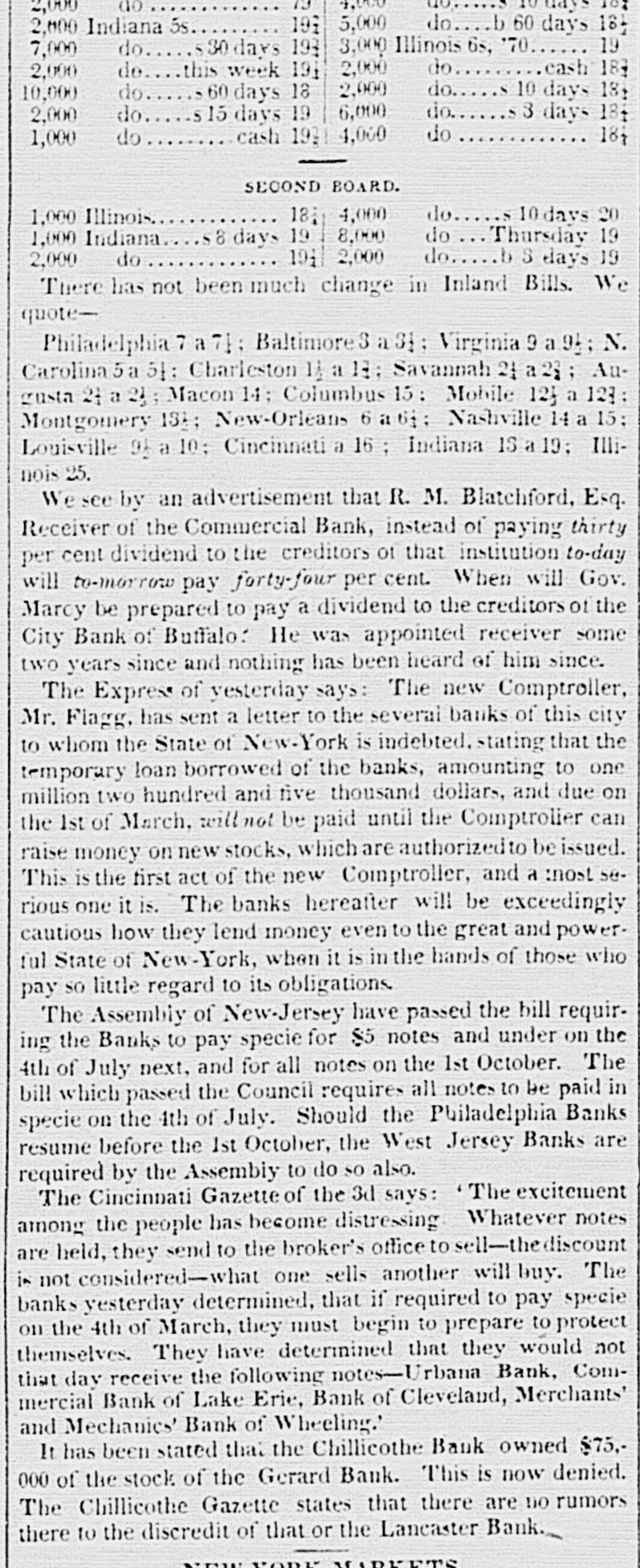
# SECOND BOARD. 1,000 Illinois.... 18 4,000 do..s 10 days 20 1,000 Indianas8 days 19 8,000 do... Thursday 19 2,000 do.... 19 2,000 dob 3 days 19 There has not been much change in Inland Bills. We quote- Philadelphia 7 a 71; Baltimore 3 a 31: Virginia 9 a 94; N. Carolina 5 a 51: Charleston 11 a 14; Savannah 24 a 2; Au- gusta 24 a 24; Macon 14; Columbus 15: Mobile 12 a 123: Montgomery 131; New-Orleans 6 a 61; Nashville 14 a 15; Louisville 9 a 10; Cincinnati a 16; Indiana 15 a 19; Illi- nois 25. We see by an advertisement that R. M. Blatchford, Esq. Receiver of the Commercial Bank, instead of paying thirty per cent dividend to the creditors of that institution to-day will to-morrow pay forty-four per cent. When will Gov. Marcy be prepared to pay a dividend to the creditors of the City Bank of Buffalo? He was appointed receiver some two years since and nothing has been heard of him since. The Express of yesterday says: The new Comptroller, Mr. Flagg, has sent a letter to the several banks of this city to whom the State of New-York is indebted, stating that the temporary loan borrowed of the banks, amounting to one million two hundred and five thousand dollars, and due on the 1st of March, will not be paid until the Comptrolier can raise money on new stocks, which are authorized to be issued. This is the first act of the new Comptroller, and a most se- rious one it is. The banks hereafter will be exceedingly cautious how they lend money even to the great and power- ful State of New-York, when it is in the hands of those who pay so little regard to its obligations. The Assembly of New-Jersey have passed the bill requir- ing the Banks to pay specie for $5 notes and under on the 4th of July next, and for all notes on the 1st October. The bill which passed the Council requires all notes to be paid in specie on the 4th of July. Should the Philadelphia Banks resume before the 1st October, the West Jersey Banks are required by the Assembly to do so also. The Cincinnati Gazette of the 3d says: 'The excitement among the people has become distressing. Whatever notes are held, they send to the broker's office to sell-the discount is not considered-what one sells another will buy. The banks yesterday determined, that if required to pay specie on the 4th of March, they must begin to prepare to protect themselves. They have determined that they would not that day receive the following notes-Urbana Bank, Com- mercial Bank of Lake Erie, Bank of Cleveland, Merchants' and Mechanics' Bank of Wheeling.' It has been stated that the Chillicothe Bank owned $75,- 000 of the stock of the Gerard Bank. This is now denied. The Chillicothe Gazette states that there are no rumors there to the discredit of that or the Lancaster Bank.


Article from The New York Herald, June 11, 1845

Click image to open full size in new tab

Article Text

REDEMPTION OF NOTES OF INSOLVENT SAFETY FUND BANKS. COMPTROLLER'S OFFICE, Albany, June 6th, 1845. COMPTROLLER, in obedience to the Third Section THE of the Act, Chapter 114 of the Laws of 1845, hereby gives notice, that he will redeem at par, the outstanding circulating bills of the Commercial Bank of New York, the Bank of Buffalo, the Commercial Bank of Buffalo, the Commercial Bank of Oswego, the Clinton County Bank, the Watervliet Bank, and the Bank of Lyons. The Comptroller is not authorised to pay interest in any case: Those persons, therefore, who have packages of notes which have been protested or the payment demanded of the Reeceiver of the Bank. in order to obtain interest, will find it necessary to collect the demand through the Receiver. Those persons who hold bills of any of the Banks before named, and who have not taken the necessary steps to establish a claim for interest, and are willing to surrender the notes on receiving dollar for dollar, can be paid at this rate, on presenting the bills to the Comptroller. All other claims which have been presented and established againstany of the insolvent Banks will be paid by the receiver, who cannot get an order from the Chancellor on the safety fund, until he has collected the sums due the bank and applied the avails to the payment of its debts. The balance then remaining is a charge on the safety fund, and these balances can be paid as soon as the Receiver disposes of the assets of the Bank and gets a final order from the Chancellor. either in cash or six per cent stock at par, which the Comptroller is authorised to issue under the 'Act t' provide for paying the debts of insolvent Safety Fund Banks,'o passed April 28, 1845. In the case of the Bank of Buffalo, the final order has been made by the Vice-Chancellor of the 8th circuit, and the means for paying the balance of all the claims against the Bank have been paid to the Receiver. The assets of the Bank of Oswego are believed to be sufficient to pay all the debts of that Bank, and none of the circulating notes of the Bank of Oswego have been redeemed by the Comptroller. The names and residences of the Receivers of the several Banks are as follows:Commercial Bank of New York, J. M. Blatchford, New York. Commercial Bank of Buffalo, S. G. Austin, Buffalo. Commercial Bank of Oswego, T. Beekman, Kinderhook. Watervliet Bank, George R. Davis, Troy. Clipton County Bank, Henry K. Averill, Plattsburgh. Bank of Lyons, Theron R. >trong, Palmyra. Bank of Oswego, Charles Stebbins, Cazenovia. Wayne County Bank, Samuel Miller, Rochester. City Bank of Buffalo, G. W. Newell, Albany. The debts of the Lafayette Bank of New York, including circulating notes, have been paid by the Receiver from the assets of the Bank. A. C. FLAGG, jll Stre Comptroller


Article from The New York Herald, October 26, 1845

Click image to open full size in new tab

Article Text

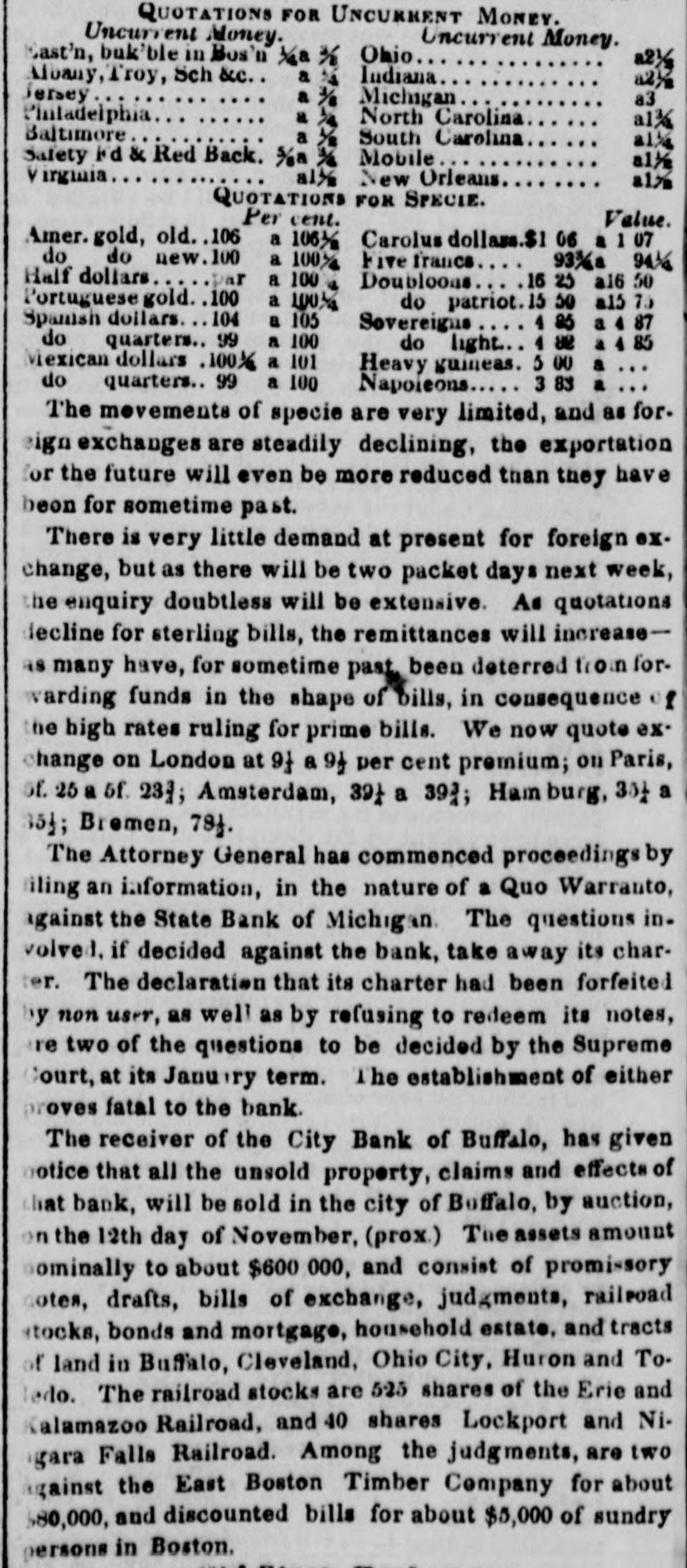
QUOTATIONS FOR UNCURRENT MONEY. Uncurrent Money. Uncurrent Money. Ohio Cast'n, buk'ble in Bos'n >a a21/4 a Indiana Albany, Troy, Sch &c. 54 a2% Jersey a3 az Michigan a Pintadelphia North Carolina al Baltimore a South Carolina Safety rd & Red Back. Mobile X al/ Virginia New Orleans al/ al/a QUOTATIONS FOR SPECIE. Per cent. Value. Amer. gold, old. 106 Carolus dollars.$1 06 a 07 a 1061/2 do do new.100 Five francs a 100% 93% 9414 Half dollars par a 100 16 50 25 Doubloods al6 Portuguese gold 100 a 100% do patriot. 15 50 a15 70 104 Spansh dollars a 105 4 85 a 4 87 Sovereigns a 100 do quarters 99 4 00 85 a do light a 101 Mexican dollars 100% a Heavy . 00 do 99 quarters. a 100 a 83 Napoleons The movements of specie are very limited, and as for. eign exchanges are steadily declining, the exportation or the future will even be more reduced than they have beon for sometime past. There is very little demand at present for foreign exchange, but as there will be two packet days next week, the enquiry doubtless will be extensive. As quotations lecline for sterling bills, the remittances will increaseis many have, for sometime past been deterred from forwarding funds in the shape of bills, in consequence of he high rates ruling for prime bills. We now quote exchange on London at 9} a 9) per cent premium; on Paris, of. 25 a 5f. 23g Amsterdam, 391 a 392; Ham burg, 351 a 351; Bremen, 79 The Attorney General has commenced proceedings by filing an information, in the nature of a Quo Warranto, against the State Bank of Michigan The questions in. volved if decided against the bank, take away its charter. The declaration that its charter had been forfeited y non user, as well as by refusing to redeem its notes, re two of the questions to be decided by the Supreme Court, at its January term. The establishment of either oves fatal to the bank. The receiver of the City Bank of Buffalo, has given otice that all the unsold property, claims and effects of hat bank, will be sold in the city of Buffalo, by auction, the 12th day of November, (prox.) The assets amount nominally to about $600 000, and consist of promissory notes, drafts, bills of exchange, judgements, railroad stocks, bonds and mortgage, household estate, and tracts of land in Buffalo, Cleveland, Ohio City, Huron and Toledo. The railroad stocks are 525 shares of the Erie and Kalamazoo Railroad, and 40 shares Lockport and Nigara Falls Railroad. Among the judgments, are two gainst the East Boston Timber Company for about $80,000, and discounted bills for about $5,000 of sundry persons in Boston.


Article from Mobile Register and Journal, November 25, 1845

Click image to open full size in new tab

Article Text

SALE OF BANK ASSETS - The sale of the a sets of the City Bank of Buffalo was 11 ade 12th instant, in that city in the Merchants Exchange, under the direction of G W Newell, Receiver, and the preparty went off at very satisfactory prices. Thegrous amount of the sale Was $52,000, being the largest of any rale in the city since that of he Rathban es. rate. The judgments, discounted bills and notes, stocks. items counted as cash, etc, estimated by schedule to be worth $452,188 96, brought the sum a $26.819 75, while the real estate sold for $25. 4 5 00 The predective real estate and as the prtlees of


Article from The New York Herald, May 27, 1846

Click image to open full size in new tab

Article Text

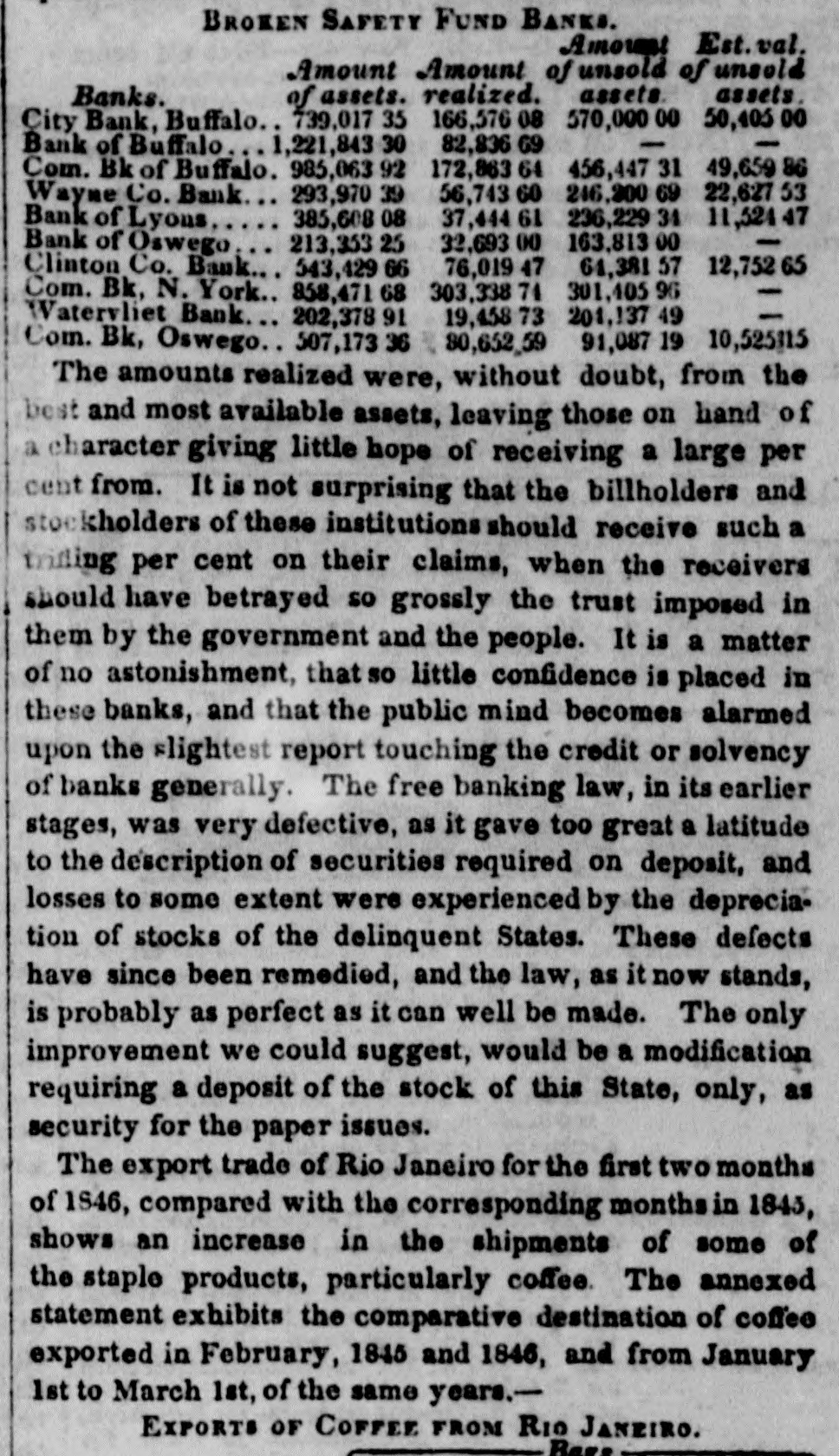
BROKEN SAFETY FUND BANKS. | Banks. | Amount of assets. | Amount realized. | Amount of unsold assets. | Est.val. of unsold assets. | | -------------------- | ----------------- | ----------------- | -------------------------- | -------------------------- | | City Bank, Buffalo.. | 739,017 35 | 166,576 08 | 570,000 00 | 50,405 00 | | Bank of Buffalo... | 1,221,843 30 | 82,836 69 | | | | Com. Bk of Buffalo. | 985,063 92 | 172,863 64 | 456,447 31 | 49,659 86 | | Wayne Co. Bank... | 293,970 39 | 56,743 60 | 246,200 69 | 22,627 53 | | Bank of Lyons. | 385,608 08 | 37,444 61 | 236,229 34 | 11,524 47 | | Bank of Oswego... | 213,353 25 | 32,693 00 | 163,813 00 | | | Clinton Co. Bank... | 543,429 66 | 76,019 47 | 64,381 57 | 12,752 65 | | Com. Bk, N. York.. | 858,471 68 | 303,338 74 | 301,405 96 | | | Watervliet Bank... | 202,378 91 | 19,458 73 | 201,137 49 | | | Com. Bk, Oswego.. | 507,173 36 | 80,652.59 | 91,087 19 | 10,525315 | The amounts realized were, without doubt, from the best and most available assets, leaving those on hand of a character giving little hope of receiving a large per cent from. It is not surprising that the billholders and stockholders of these institutions should receive such a trifling per cent on their claims, when the receivers should have betrayed so grossly the trust imposed in them by the government and the people. It is a matter of no astonishment, that so little confidence is placed in these banks, and that the public mind becomes alarmed upon the slightest report touching the credit or solvency of banks generally. The free banking law, in its earlier stages, was very defective, as it gave too great a latitude to the description of securities required on deposit, and losses to some extent were experienced by the deprecia-tion of stocks of the delinquent States. These defects have since been remedied, and the law, as it now stands, is probably as perfect as it can well be made. The only improvement we could suggest, would be a modification requiring a deposit of the stock of this State, only, as security for the paper issues. The export trade of Rio Janeiro for the first two months of 1846, compared with the corresponding months in 1845, shows an increase in the shipments of some of the staple products, particularly coffee. The annexed statement exhibits the comparative destination of coffee exported in February, 1845 and 1846, and from January 1st to March 1st, of the same years. EXPORTS OF COFFEE FROM RIO JANEIRO. Rare


Article from The New York Herald, August 19, 1846

Click image to open full size in new tab

Article Text

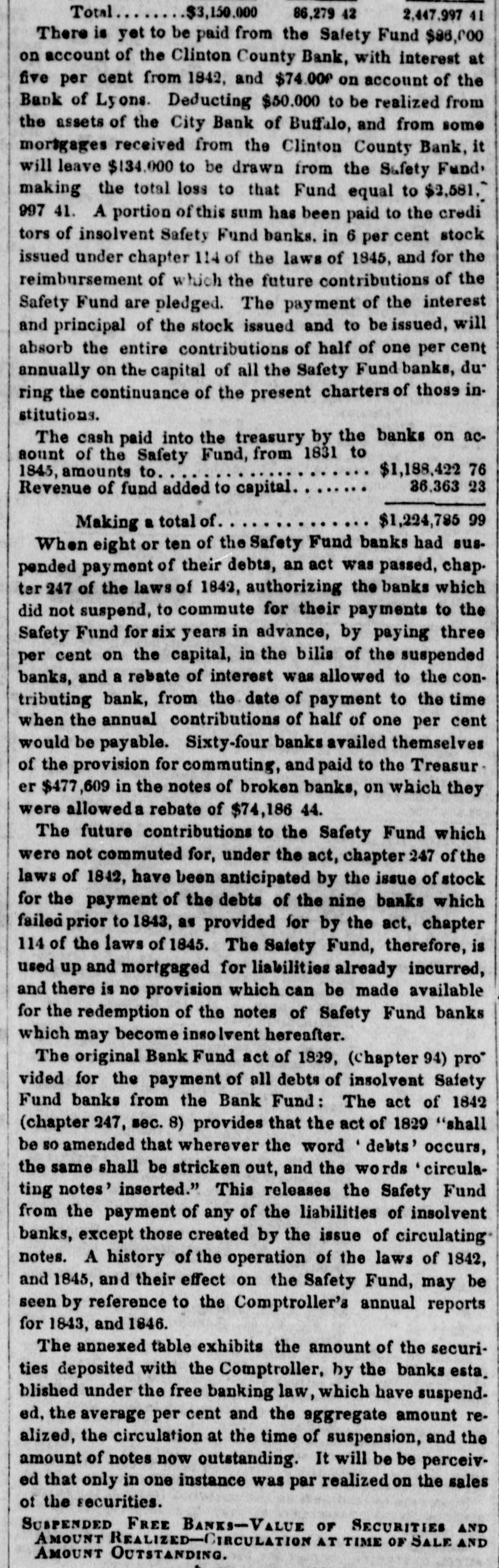
Total $3,150.000 86,279 42 2,447,997 41 There is yet to be paid from the Safety Fund $86,000 on account of the Clinton County Bank, with interest at five per cent from 1842, and $74.00 on account of the Bank of Lyons. Deducting $50.000 to be realized from the assets of the City Bank of Buffalo, and from some mortgages received from the Clinton County Bank, it will leave $134.000 to be drawn from the Safety Fund making the total loss to that Fund equal to $2,581, 997 41. A portion of this sum has been paid to the credi tors of insolvent Safety Fund banks. in 6 per cent stock issued under chapter 114 of the laws of 1845, and for the reimbursement of which the future contributions of the Safety Fund are pledged. The payment of the interest and principal of the stock issued and to be issued, will absorb the entire contributions of half of one per cent annually on the capital of all the Safety Fund banks, du ring the continuance of the present charters of those institutions. The cash paid into the treasury by the banks on acaount of the Safety Fund, from 1831 to $1,188,422 76 1845, amounts to 36.363 23 Revenue of fund added to capital $1,224,795 99 Making a total of When eight or ten of the Safety Fund banks had suspended payment of their debts, an act was passed, chap. ter 247 of the laws of 1842, authorizing the banks which did not suspend, to commute for their payments to the Safety Fund for six years in advance, by paying three per cent on the capital, in the bills of the suspended banks, and a rebate of interest was allowed to the contributing bank, from the date of payment to the time when the annual contributions of half of one per cent would be payable. Sixty-four banks availed themselves of the provision for commuting, and paid to the Treasur er $477,609 in the notes of broken banks, on which they were allowed a rebate of $74,186 44. The future contributions to the Safety Fund which were not commuted for, under the act, chapter 247 of the laws of 1842, have been anticipated by the issue of stock for the payment of the debts of the nine banks which failed prior to 1843, as provided for by the act, chapter 114 of the laws of 1845. The Safety Fund, therefore, is used up and mortgaged for liabilities already incurred, and there is no provision which can be made available for the redemption of the notes of Safety Fund banks which may become insolvent hereafter. The original Bank Fund act of 1829, (chapter 94) pro* vided for the payment of all debts of insolvent Safety Fund banks from the Bank Fund: The act of 1842 (chapter 247, sec. 8) provides that the act of 1829 "shall be so amended that wherever the word debts' occurs, the same shall be stricken out, and the words circulating notes' inserted." This releases the Safety Fund from the payment of any of the liabilities of insolvent banks, except those created by the issue of circulating notes. A history of the operation of the laws of 1842, and 1845, and their effect on the Safety Fund, may be seen by reference to the Comptroller's annual reports for 1843, and 1846. The annexed table exhibits the amount of the securities deposited with the Comptroller, by the banks esta. blished under the free banking law, which have suspended, the average per cent and the aggregate amount realized, the circulation at the time of suspension, and the amount of notes now outstanding. It will be be perceived that only in one instance was par realized on the sales of the securities. SUSPENDED FREE BANKS-VALUE OF SECURITIES AND AMOUNT REALIZED-CIRCULATION AT TIME OF SALE AND AMOUNT OUTSTANDING.


Article from Baltimore Commercial Journal, and Lyford's Price-Current, September 11, 1847

Click image to open full size in new tab

Article Text

20's. maud, 50's, let. ignette sailor seated on a bale of goods, with a flag in his left hand; on the left end figure of Liberty. Not countersigned. Bank of Watertown. [W.Ives, Pres., W. H. Angell, Cash.] 3's, a coarse imitation. Bank of Waterville. [J. Candee, Pres., D. B. Goodwin, Cash.] 5's, let. C. registered in red ink by G. Hanford. Bank of Whitehall. W mm. A. Moore, Pres. H. W. Palmer, Cash.] 3's, altered from I's of Hoboken Bank, N. J.; Bank of Whitehall stamp'd in large letters across top. 5's, let. A: the true bills have a steamboat on the bottom of the bill, between the names of the cashier and president, which is omitted in the counterfeit. 5's altered. "Bank of Whitehall," is at the top of the note. 10's, an alteration; Whitehall inserted. Bank of Whitestown. [J. Newton Dexter, Pres., J. S. Thomas, Cash.] l's, engraving is coarse, particularly the female o the right of the pres. Bullston Spa Bank. Ballston Spa. [James W Cook, Pres., Isaac Fowler, Cash.] Black River Bank, Watertown [L Paddock, Pres., G Gilbert, Cash.] 5's, altered from I's vig. a COW and country girl. Brooklyn Bank, Brooklyn. [W. J. Cornell, Pres., Abraham Haley, Cash.] 2's,let. C, dated July 9, 1839, pay Jas. Foster,jr Paper thin; engraying poor. 5's, altered from broken Michigan Bank 10's, altered from I's and 2' hold to light 10's, altered from the broken Monroe Bank, Mi chigan. Brotherton, cash., Adams, pres. Broome County Bank, Binghampton. Strong, President, T. R. Morgan, Cash.] I's, imitation of genuine; vignette, a man, horse boy and girl-on the right a female without a mouth; paper whitish. b's, let. B. Nov. 5, 1833. and some Jan 10. 1832, pay P. Pine, and some to R. Boy paper lighter vig. coarse There is small space between the first line, on which the name is written to whom the bill is payable, and the top of the D in the word 'demand. The D in genuine covers the line. 5's, let. C pay R. Boyd, of various dates, 5's, dated June 2.1832. pay to J. L. Bowne, C. Murdock, cash., V. Whitney, pres. 10's, vig blacksmith and implements Poor 20's, altered from 1's; there are a fe 20's out. ( anal Bank, Albany [John K. Paige, Pres. Theodore Olcott, Cash.] l's, the three signatures are written with bluish ink. while in the genuine two are in black and one the president's 15 of brownish hue. "Liberty" on the left around her head and near her staff are some scra ches intended rays. 3's, let. A. new plate; vignette, goddess of Liberty, &c. Poor paper; filling up and signing bad. 3's, altered from the broken Globe Bank, N.York, signed S. B. Day, cash 3'3, let. A, and some G various dates. well done. 5's, counterfeit E-D. Campbell, register, filling up and signatures very bad. 10's altered from one's goddess of liberty on the left end. Tin Dollars' slightly defective. 20's, altered from Canal Bank of Lockport, [Wm. O. Brown, Pres. C. W Rogers, Cash.] 5's, Sept.1 1841, pay E. Hurd. Engraving coarse 5's, altered fromone's. Catskill Bank Catskill [Thomas B. Cook, Pres. H. Hill, Jr. Cash.] 2's. let. B, dated Nov. 1, 1825, H. Hill, Jr., cash 2's,let. A dated Nov. 1. 1827, (date engraved,) No 2742. Paper of a whitish cast. 2's, let. B. Nov. 1, 1825. H.Hill, Jr. cash., Thos. B. Cooke, pres. New plate, late engraved, thick and yellow paper, engraving is coarse, K in Cutts kill, in upper part of note is below the other letters. 3's,vig. a woman seated, ship in the distance, H. Hill, Thomas B. Cook, president. 5's, let,C, pay E. Powers, June 5, 1830-vignette, Indian shooting a panther-face of Franklin light. 5's, let. C. Nov. 1. 1828, pay C. Hopkins. Vignette, an Indian shooting a panther, very well done II. Hill, cashier, Thomas B. Cook, president. 5's, let.C, pay to C. Hopkins, Nov. 1829. 10's. let A. Nov. 1, 1836-Carder, Durand, Ausin & Edmonds, engravers- close imitation of genuline-eng. rather coarse: the margins are broader. Cayuga County Bank, Auburn. [N. Beardsley Pres., J. N Starin, Cash.] 5's,pay Gershom Brower; G. B. Throop, cash. N. Garson, pres. Vig. an Indian. Eng. coarse & dark. 3's, let. B, engraving coarse, vignette blurred. 10's, letter A. paper thin, die work defective. Signatures written in same ink. Central Bank Cherry Valley. [D. H.Little, Pres., H. J. Olcott, Cash.] l's, old plate, the engraving is coarse and poor. 10's, let. B b, pay to S. Page, May 4, 1832. Champlain Bank, Ellenburgh 2's, altered from Clinton County Bank to 20. Chautauque Co. Bank, Jamestown [Sami. Barrett, Pres., Robert Newland, Cash. 5's, let. C, vig. an Indian with a bow; registered n the back: cashier's name is Robt. Newland on the genuine, and Rot. Newhuat" on counterfeit Filling 5's, let. D. pay C Gilbert, Jan. 1841. up and signatures bad. A poor imitation. 10's. let. B, Jamestown, Dec. 4, 1836, pay S. Hurd E. T. Foot, pres., A. D. Putchin, instead of Patchin. ch. Others, Jan. 14. 1837, pay H Pratt. 10's, let. A, Sept. 19. 1837, pay C. Weed- Arard Joy cash., C. T. Foote, pres. Paper thin. eng. coarse. C. Tappan & Co. eng. Phila. and N. York 10's, let. April 14, 1838, pay James Gray. 20's. altered. Vig. group of cattle. Chemung Canal Bank, Elmira. [Chas. Cook. Pres. John Arnot, Cash.] 5's. let. pay A. Bent. H. Maxwell, cash., J. G. M'Javell,pres. Poorly executed. 10's, dated June 4th, 1844, letter B, No. 3147, John Arnott. cashier, Charles Cook, president. Chester Bank, Chester. [Jas. heeler, Pres. Alex. Wright, Cash.] City Bank, Buffalo, closed. Clinton Co. Bank, Plattsburg, closed. [H.] K Averill, Receiver, Plattsburg.] 5's let. A, pay to J. Mad, Plattsburg, Oct. 1,1839, R. Yates, cash., H. Cady, pres. Vig. coarse. Commercial Bank, Troy. [Stephen W. Dana, Pres., Fred. Leak, Cash.] 3-Bills of all denominations, on this bank, altered from broken Comm. Bank, Millington, Md. Commercial Bank, Albany [J. Townsend, Pres. James Taylor, Cash.] (C-Bills of all denominations. on this bank, altered from broken Comm. Bank, Milington, md. l's, let. A, vig. several vessels under sail-T Tay lor, cash., Paul Grout, pres., April 3d, 1841pale. I's, Townsend, pres. Pale, and poor imitation. 1's, figure each side of the vignette very large, very light, J. Taylor, cash. John Townsend, pres. 3's. engraved by Durant & Co." from the spurious "Commercial of Poultney " which has been altered to "Commercial Bank of Albany." 3's,let. A, dated Nov. 27, 1841, J. Taylor. canh., John Thomson, pres. 3's, light, vig. ship at wharf, a schooner with her sails along side, a steamboat at a distance. On the left hand IS an Indian seated on rock 20's, let. D, Dec. 20, 1837, pay to bearer, Seth Hastings, pres., J. Taylor, cash.-vig. a steamboat and two vessels. Engraved by Durand & Co., N.Y. Commercial Bank, Friendship, Allegany Co. Commercial Bank, Buffalo, closed. [S.G. Austin, of Buffalo. Receiver.] DG-The most of the genuine bills of this bank have been redeemed, and those now in general circulation are mostly spurious. Commercial Bank, Rochester. [Asa, Sprague, Pres., Geo. R. Clark, Cash.] B-Bills of all denominations, on this bank, altered Comm Bank Millington, Md.

Article from The New York Herald, January 4, 1848

Click image to open full size in new tab

Article Text

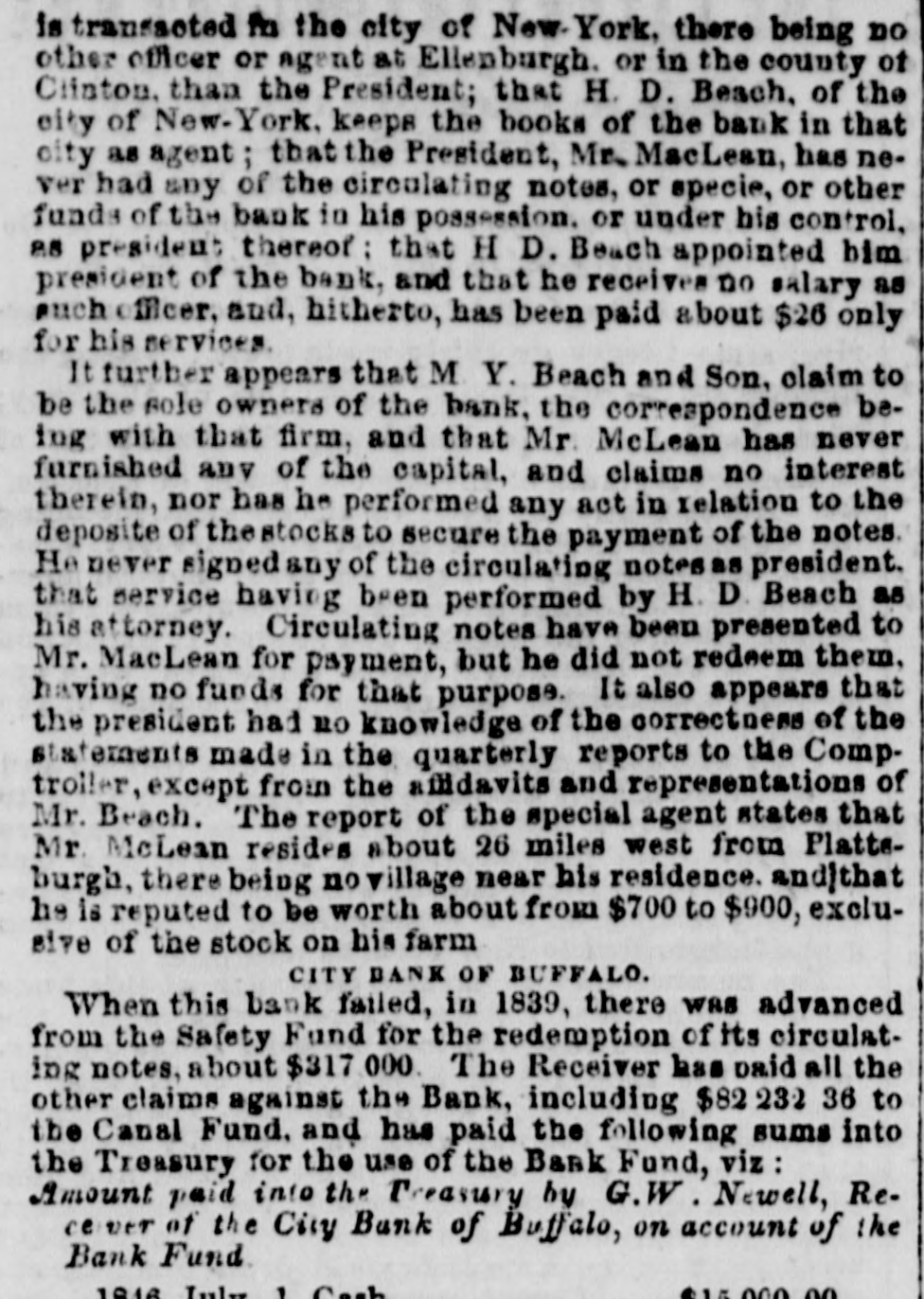
is transacted the the city of New- York, there being no other officer or agent at Ellenburgh. or in the county of Clinton, than the President; that H. D. Beach, of the city of New-York, keeps the books of the bank in that city as agent; that the President, Mr. MacLean, has never had any of the circulating notes, or specie, or other funds of the bank in his possession. or under his control, as president thereof: that H D. Beach appointed him president of the bank, and that he receives no salary as such filcer, and, hitherto, has been paid about $26 only for his services. It further appears that M Y. Beach and Son, claim to be the sole owners of the bank, the correspondence being with that firm, and that Mr. McLean has never furnished any of the capital, and claims no interest therein, nor has he performed any act in relation to the deposite of the stocks to secure the payment of the notes. He never signed any of the circulating notes as president. that service having been performed by H. D. Beach as his attorney. Circulating notes have been presented to Mr. MacLean for payment, but he did not redeem them. having no funds for that purpose. It also appears that the president had no knowledge of the correctness of the statements made in the quarterly reports to the Comptroller, except from the affidavits and representations of Mr. Beach. The report of the special agent states that Mr. McLean resides about 26 miles west from Plattsburgh, there being no village near his residence. and|that he is reputed to be worth about from $700 to $900, exclusive of the stock on his farm CITY BANK OF BUFFALO. When this bank failed, in 1839, there was advanced from the Safety Fund for the redemption of its circulating notes, about $317.000. The Receiver has paid all the other claims against the Bank, including $82 232 36 to the Canal Fund. and has paid the following sums into the Treasury for the use of the Bank Fund, viz: Amount paid into the Treasury by G.W. Newell, Recever of the City Bank of Buffalo, on account of the Bank Fund. 1816 Luly 1 Cash $15,000.00


Article Text

Pessimists of the Past OIR JOSIAH STAMP in an after-dinner speech in London recently. produced some specimens of past pessimism. He had been discussing world economy as calling for the utmost courage and enterprise at the World Economic conference. "In looking the facts seriously in the face, however, we need also to have historical perspective,' he declared. "William Pitt said: "There is scarcely anything around us but ruin and despair.' 'Wilberforce at one period said: dare not marry. the future is so dark and unsettled.' "Lord Grey in 1819 'believed everything was tending to a convulsion. "Disraeli in 1849 said: 'In industry. commerce and agriculture there no hope. "Lord Shaftesbury in 1848 said: "Nothing can save the British empire from ship"Similar comments were made exactly 100 years ago." City a Bulwark in Periods of Financial Stress - Hardest Hit by Panic That Began in 1837 and Lasted Nine YearsRallied From Depression of 1871 in Two Years and in 1893 and 1907 Suffered But Little. belief that it will never return. Here is: "The county (Erie) recovered very slowly from the terrible financial crisis and it was not until near 1845 that it could be considered to have fully regained healthy condition by which time moderate prosperity was the rule throughout its borders as distinguished from the feverish fortune-making of ten years before. That was a depression which lasted nine years. Conditions of 1931-1932 will have to persist until 1938 to beat that record. Americans who take pride in extremes and think they are enjoying the "worst depression" had better look further into history. There are more gems for them to consider. culled from the local histories of Senator Wayland Hill and J. N. Larned. MAY 6, 1837, Buffalo was shocked by the closing of its banks. They were the Bank of Buffalo, City Bank and Commercial Bank of Buffalo. The state banking chancellor issued injunctions against them. This shock was felt even in New York city where Phillip Hone, former mayor, made this entry in his diary for May 8, 1837 "Three banks of Buffalo, all safety fund bank are under injunction, and their doors closed. The Legislature immediately passed an act directing the bank commissioners to assume the payment of their notes. which will consequently be received and paid at the Manhattan bank. This will probably sweep away the famous safety fund The bubble will burst, and the public creditors of rotten banks will look in vain hereafter to that delusive hope for protection against loss. Where will it all end?-In ruin revolution perhaps civil war." Buffalo's banking problems became even more stringent and still they did not end in ruin, revolution or civil war. Mr. Larned writes that "the directory of 1841 names but two in its list of banks, the Bank of Buffalo and the Commercial bank (they resumed when the injunctions were lifted). In 1842 it reports the whole list of 1840 under the sinister caption Suspended Banks' with the names of the rereivers who are winding up their affairs." Now in 1933 there are many feeling the pinch who look back at the pre-1929 heyday and bemoan the present stringency. For those who reminesce and groan here is gem taken from The Buffalo Commercial Advertiser of Feb. 1836. Blissfully unaware the gathering storm, an editorial writer for that newspaper, protesting the difficulties of obtaining bank charters in Albany, wrote: our banking capital should be trebled There not another town in the United States which does so great amount of business with 80 limited banking facilities We reason to know that the banks here do all in their power to accommodate their customers. hut their means are but as drop in bucket wants of the community Their discount line is extended as far as consistent with safety; yet the notes of our best and safest men are frequently declined from absolute necessity of the case This state of things is unpleasant to the officers of the existing banks. as well as to the public and careful the banks may be possible for them to escape the charge of favoritism. Shortly after 1840 the city got its feet rock bottom. liquidated the debris left by the pre-1836 speculation and started the slow drive forward. In 1842 the Buffalo- Attica railroad was completed. In 1844 six banks were chartered. The flow of grain from the west increased rapidly and the city became established as the nation's most important grain forwarding port. How did Buffalo get into the depression of 1837? She was thrown in with the rest of the country by the collapse of inflated paper money and President Jackson's specie circular ordering that payment for all public lands made specie when nobody had enough specie of sufficient But Buffalo's collapse was aggra. vated by the failure of Benjamin Rathbun, the city's combination of Samuel Insull and Ivar Kreuger. Rathbun was speculative builder who operated on credit His schemes were in the millions He employed 3000 people Two assistants forged notes for large sums Payment was demanded He didn't have the money. His business was built on confidence. not cash. When he collapsed the whole city went with him into the chaos of 1837. OW did Buffalo get out of the depression 1837? The answer not She worked her way out in common with the rest of the country Futile remedies were tried. "panic meeting' was held May 1837. but Mr. Smith records laconically that it was "addressed by Millard Fillmore and others and resolutions were adopted but does not appear that any special good resulted. But if the methods by which the city recovered are not clear fact remains that she did revive slowly and surely. The citizens suffered patiently and sawed wood. Here is Mr. Smith's account of what happened Following the tardy recovery from the financial crash (there) was inaugurated an era of prosperity for the city of Buffalo the commerce of the growing West poured its profitable business into the city giving it wide reputation for prospective growth and thus to its population acwhich insured that growth. The surrounding country had reached position of tolerable independence: the farming community had in most cases wholly or in large part paid for their lands plank roads extended from Buffalo and its ready market, directly to the doors of the farms and over them were drawn the products which were turned into money in the city As Buffalo survived 1837 to forge ahead so the city survived 1857. Once again the pall of financial collapse descended So severe was the crash that Mr. Smith records "our oldest banker' saying Itseemed as the whole town was not worth dollar. Bank doors closed rapidly The Reciprocity bank suspended payment Aug 29, 1857. Hollister's bank followed Aug. 31. Oliver Lee & Co.'s bank followed few days later The Pratt bank ssupended Sept. 12. Reviewing this period Mr. Smith writes, referring to the prosperity of the early 1850's, this very tide of prosperity brought its own destruction: business of kinds gradually became excessively overdone: railroads and other great undertak ings were recklessly in all parts of the country the banks in many states inflated the currency beyond necessity prudence, and another crash followed. The climax was reached in the fall of 1857 and was precipitated by the suspension of specie payments in New money market had become more and more stringent if the New York banks had postponed their little longer, the failures in Buffalo would have been more numerous than they were. As was. two or three banks suspended and prices of real estate sank mere tithe of what they had been. For three years only the depression of 1857 continued. Mr. Smith re-