Knoxville Bank & Trust Company (Knoxville, TN)

Episode Information

Episode UID
7428916591357
Episode Type
Suspension โ†’ Closure
Bank Type
trust
Bank ID
742891659 hash
Start Date
January 10, 1913
Location
Knoxville, Tennessee (35.961, -83.921)

Metadata

Model
gpt-5-mini (chosen from majority vote of a three-model LLM ensemble)
Short Digest
cd528bf409144b9b

Response Measures

None

Events (3)

1. January 10, 1913 Suspension
Cause
Bank Specific Adverse Info
Cause Details
Bank suspended operations (institutional failure) causing local organizations' funds to be affected.
Newspaper Excerpt
Owing to the suspension of the Knoxville Bank and Trust Co.
Source
newspapers
2. May 12, 1915 Receivership
Newspaper Excerpt
Oliver ... made a proposition to John W. Green, receiver for the Knoxville Bank & Trust Co., to reduce the bonds ... and that the bonds in question were delivered to Mr. Green.
Source
newspapers
3. December 23, 1919 Other
Newspaper Excerpt
That was the sum allowed him for his services as receiver for the Knoxville Bank & Trust company. He voluntarily cut the amount to $15,000.
Source
newspapers

Newspaper Articles (3)

Article from The Nashville Globe, January 10, 1913

Click image to open full size in new tab

Article Text

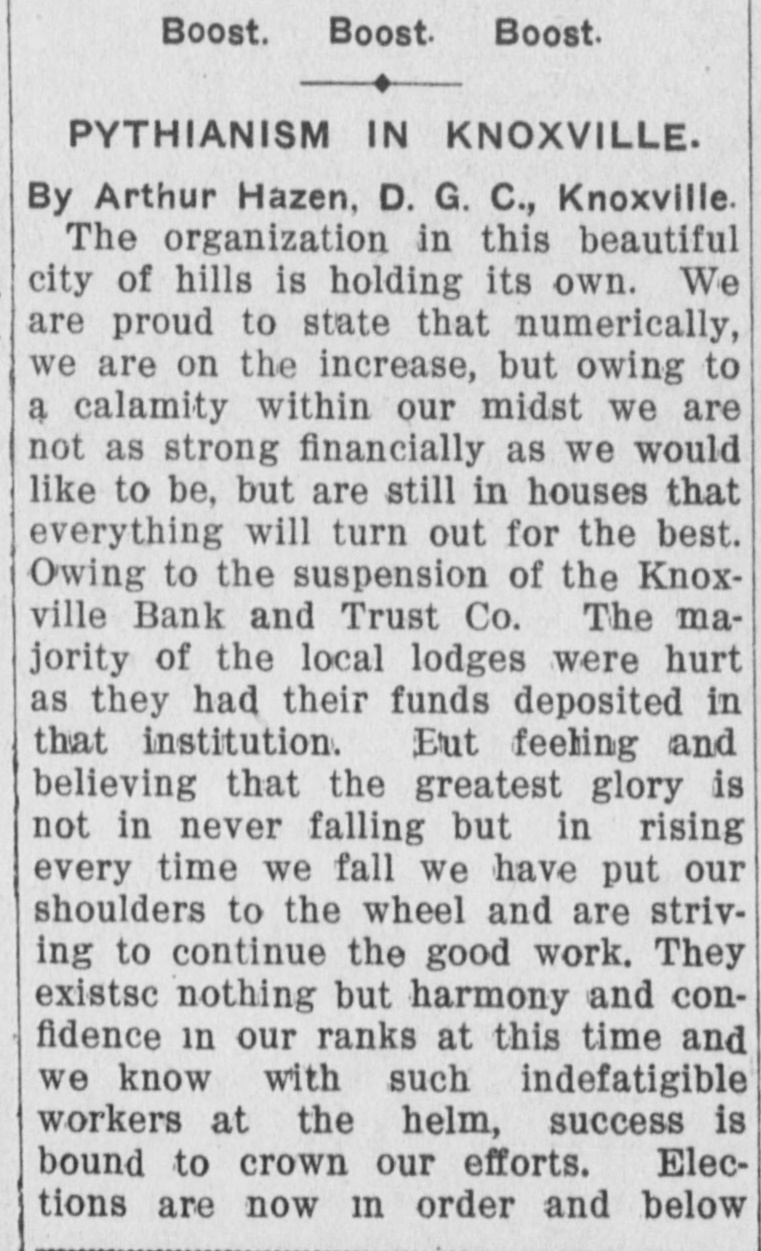
Boost. Boost. Boost. # PYTHIANISM IN KNOXVILLE. By Arthur Hazen, D. G. C., Knoxville. The organization in this beautiful city of hills is holding its own. We are proud to state that numerically, we are on the increase, but owing to a calamity within our midst we are not as strong financially as we would like to be, but are still in houses that everything will turn out for the best. Owing to the suspension of the Knoxville Bank and Trust Co. The majority of the local lodges were hurt as they had their funds deposited in that institution. But feeling and believing that the greatest glory is not in never falling but in rising every time we fall we have put our shoulders to the wheel and are striving to continue the good work. They existsc nothing but harmony and confidence in our ranks at this time and we know with such indefatigable workers at the helm, success is bound to crown our efforts. Elections are now in order and below
Article from The Columbia Herald, May 14, 1915

Click image to open full size in new tab

Article Text

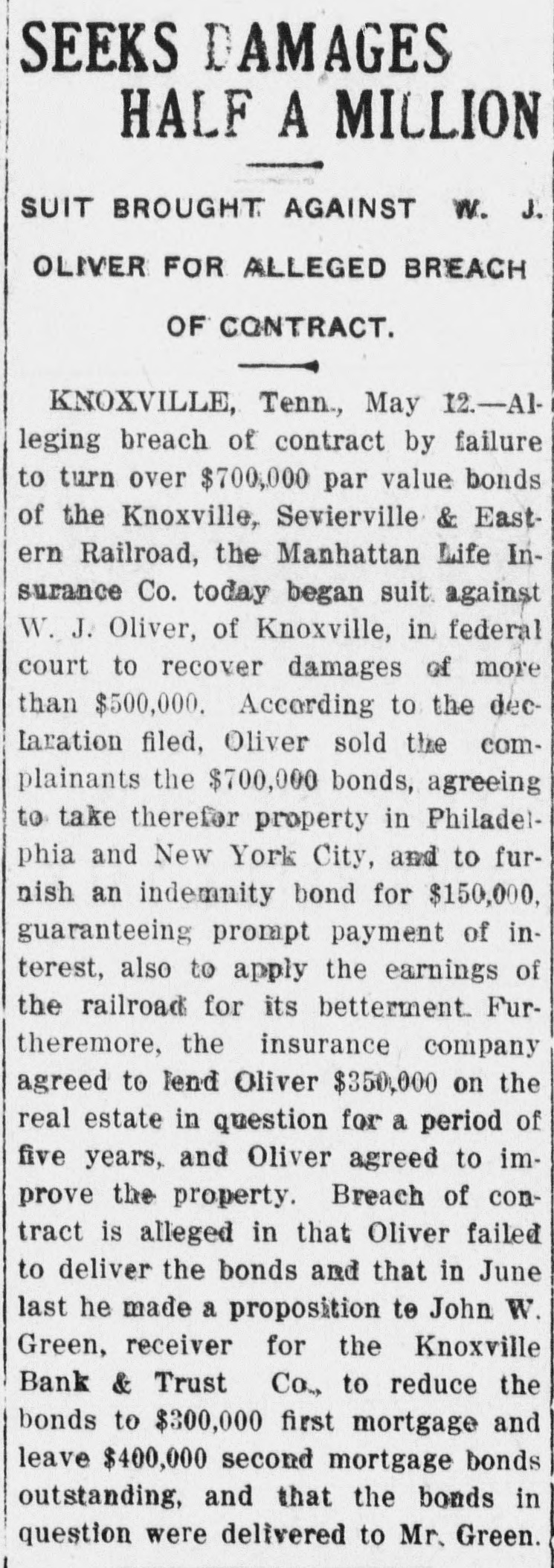
SEEKS DAMAGES HALF A MILLION SUIT BROUGHT AGAINST W. J. OLIVER FOR ALLEGED BREACH OF CONTRACT. 1 KNOXVILLE, Tenn., May 12.-A1leging breach of contract by failure to turn over $700,000 par value bonds of the Knoxville, Sevierville & Eastern Railroad, the Manhattan Life Insurance Co. today began suit against W. J. Oliver, of Knoxville, in federal court to recover damages of more than $500,000. According to the declaration filed, Oliver sold the complainants the $700,000 bonds, agreeing to take therefor property in Philadelphia and New York City, and to furnish an indemnity bond for $150,000, guaranteeing prompt payment of interest, also to apply the earnings of the railroad for its betterment. Furtheremore, the insurance company agreed to lend Oliver $350,000 on the real estate in question for a period of five years, and Oliver agreed to improve the property. Breach of contract is alleged in that Oliver failed to deliver the bonds and that in June last he made a proposition to John W. Green, receiver for the Knoxville Bank & Trust Co., to reduce the bonds to $300,000 first mortgage and leave $400,000 second mortgage bonds outstanding, and that the bonds in question were delivered to Mr. Green.


Article from The Chattanooga News, December 23, 1919

Click image to open full size in new tab

Article Text

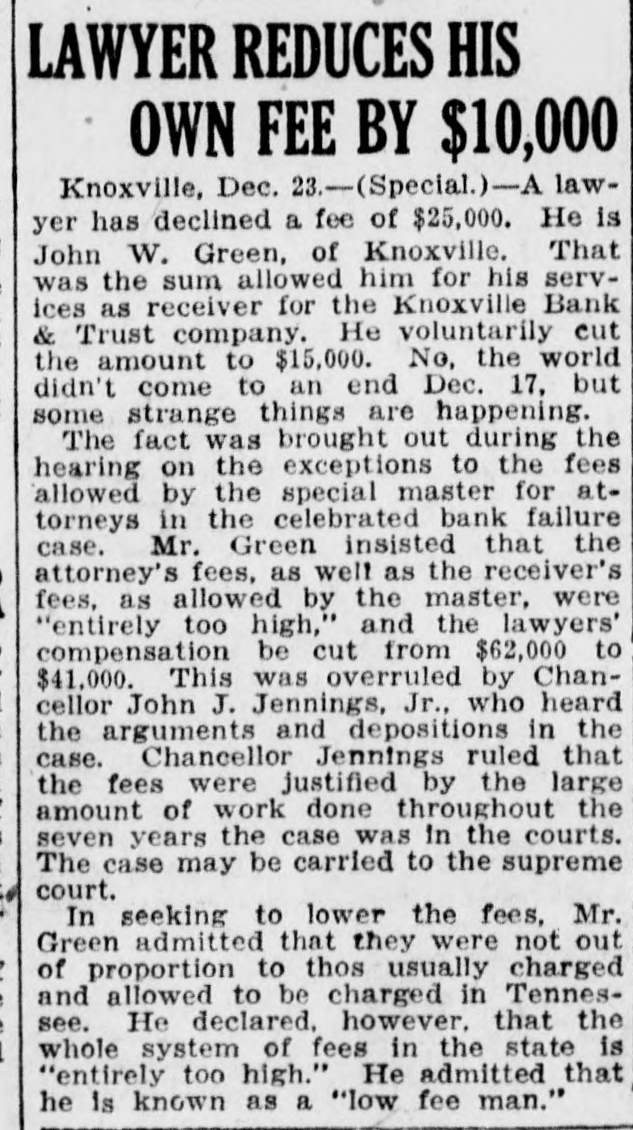
LAWYER REDUCES HIS OWN FEE BY $10,000 Knoxville, Dec. 23.-(Special.) - A lawyer has declined a fee of $25,000. He is John W. Green, of Knoxville. That was the sum allowed him for his services as receiver for the Knoxville Bank & Trust company. He voluntarily cut the amount to $15,000. No, the world didn't come to an end Dec. 17, but some strange things are happening. The fact was brought out during the hearing on the exceptions to the fees allowed by the special master for attorneys in the celebrated bank failure case. Mr. Green insisted that the attorney's fees, as well as the receiver's fees, as allowed by the master, were "entirely too high," and the lawyers' compensation be cut from $62,000 to $41,000. This was overruled by Chancellor John J. Jennings, Jr., who heard the arguments and depositions in the case. Chancellor Jennings ruled that the fees were justified by the large amount of work done throughout the seven years the case was In the courts. The case may be carried to the supreme court. In seeking to lower the fees, Mr. Green admitted that they were not out of proportion to thos usually charged and allowed to be charged in Tennessee. He declared, however, that the whole system of fees in the state is "entirely too high." He admitted that he is known as a "low fee man."