Mechanics & Traders Savings Institution (New York, NY)

Episode Information

Episode UID
7503380190912
Episode Type
Run โ†’ Suspension โ†’ Closure
Bank Type
savings
Bank ID
750338019 hash
Start Date
December 2, 1875
Location
New York, New York (40.714, -74.006)

Metadata

Model
gpt-5-mini (chosen from majority vote of a three-model LLM ensemble)
Short Digest
4e83522cd111ae95

Response Measures

None

Description

Receivership revealed large deficiency and alleged trustee fraud; bank ultimately dissolved in 1877.

Events (4)

1. December 2, 1875 Run
Cause
Rumor Or Misinformation
Cause Details
Depositors frightened by publicity and internal board disputes leading to loss of confidence; run of depositors assembling to withdraw funds.
Measures
Trustees enforced 60 days' notice for large withdrawals; paid small and pressing claims without delay.
Newspaper Excerpt
A number of the depositors of the Mechanics and Traders' Savings Institution, at No. 283 Bowery, applied for their money yesterday. The banking rooms were crowded and the payments were made slowly
Source
newspapers
2. June 11, 1876 Suspension
Cause
Government Action
Cause Details
State Superintendent of Banks obtained injunction to restrain bank from doing further business due to deficiency from depreciated Southern securities.
Newspaper Excerpt
An injunction ... was served upon the Mechanics and Traders' Savings Institution ... The effect of the order of injunction has been to close the doors of the bank
Source
newspapers
3. June 12, 1876 Receivership
Newspaper Excerpt
Bank Superintendent Ellis ... has begun proceedings for the appointment of a receiver to wind up the affairs of the Mechanics' and Traders' Savings Institution ... an injunction ... was served ... returnable at Albany to-morrow. The effect of the order ... has been to close the doors of the bank, and depositors will have to await the decision of a receiver to obtain the appointed percentage of their deposit.
Source
newspapers
4. December 26, 1877 Other
Newspaper Excerpt
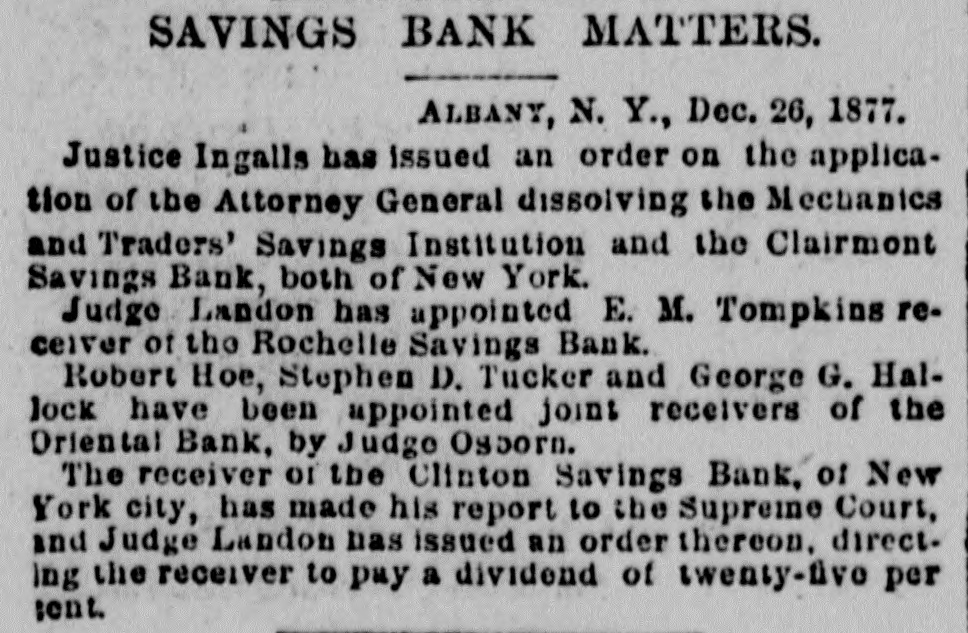
Justice Ingalls has issued an order ... dissolving the Mechanics and Traders' Savings Institution ... of New York.
Source
newspapers

Newspaper Articles (24)

Article from New-York Tribune, September 23, 1873

Click image to open full size in new tab

Article Text

THE SAVINGS BANKS UNHARMED. SEVERAL TEMPORARY RUNS-GENERAL RESTORATION OF CONFIDENCE. Among the savings banks there was little variation in yesterday's business as compared with that of Friday, Saturday, and many previous days. A few of them alone experience anything like a run upon their deposits, and these not to such an extent as to excite anyapprehension as to solvency. All were seemingly prepared for the worst, and were most agreeably disappointed as the day passed on without any invasion of moment upon their cash assets. In anticipation of a general run, members of the police force had been assigned to duty in the different savings banks, and most of them had an easy task. The German savings banks were particularly quiet, a president in one instance informing a reporter that his bank had money on hand for any of his neigh bors who might be pressed. At number of the banks the rule requiring notice of the withdrawal of deposits over a stated sum was strictly enforced, the amount varying, and it is a somewhat singular fact that those meeting all demands were the only ones, with one or two exceptions, upon which there was any considerable run. EAST RIVERSAVINGS BANK. At the East River Savings Bank, on Chambers-st there was no variation in the usual business of the day President Whitney stated that during the morning a number of deposits had been withdrawn. and likewise a large number received, in neither case to such an ex tent as to excite comment. He knew nothing of the action taken by some of the savings banks' officers Sunday evening, and could not agree with them that any particular distinction at this time should be made in the withdrawal of deposits. His bank was paying all demands without regard to notice given. EMIGRANT INDUSTRIAL SAVINGS BANK. At the Emigrant Industrial Savings Bank a considerable amount of money was withdrawn during the day. Soon after the opening of the bank a large number of the depositors assembled, and the line formed to the paying teller's windows found constant accessions during the day. Controller David Ledwith stated that they were meeting all demands without regard to amount or notice, and apprehended no difficulty in continuing to so. Indeed, the present run was not 80 extensive as they had anticipated and had made preparations for. They were led to believe that it would be of short duration. The bank statement of Jan. showed an excess over liabilities of $790,129 The majority of those closing their accounts had comparatively small deposits, 80 that the amount paid out was not large. ATLANTIC SAVINGS BANK. At the Atlantic Savings Bank, on Chatham-st. there was no excitement; still. as a precautionary move, the officers have adopted the plan of requiring sixty days' notice in the withdrawal of all sums of over $100. CITIZENS'(SAVINGS BANK. The Citizens' Savings Bank experienced something of a run during the earlier port of the day. but before closing this had almost entirely subsided. They are paying all demands under $1,000. requiring notices for larger amounts. Those in the line early in the day were mostly new depositors, the older and heavier ones having perfect confidence] in the bank. President Quintard remarked, as an evidence of the class now withdrawing their deposits, that up to p. m. probably not more than $25,000 or $30,000 had been paid over the counter. He was satisfied that no extensive run need be anticipated, but was well prepared to meet all demands. ORIENTAL SAVINGS BANK. Everything was as quiet as usual at the Oriental Savings Bank, on Grand-st. President Buckmaster stated that many had visited the bank during the day to make inquiries as to their deposits, and had departed satisfled of their security-many, perhaps, coming with the intention of drawing, and returning with only such as they required for use. In such cases no advantage was taken of the law requiring notice of such intention. As evineing a general confidence in the institution, the cashier stated that a number of new accounts had been opened during the day, and that no inconsiderable amount had been received on deposit. BOWERY SAVINGS BANK. Before the opening of the Bowery Savings Bank it was evident that a run was to be made, from the erowd of depositors that gathered around the doors. The trustees met and decided to pay all claimstor the present, believing that the run would not last long and not interfere with,the regular business. It was understood that should it continue, they should take advantage of the 60 days' notice, even then using their own discretion in the matter, and paying larger claims, to relieve suffering or inconvenience. Throughout the day and evening the steady run continued, the number at no time greatly crowding the bank. One by one they drew their deposits, losing nearly three months interest by doing 80, 80 that they alone are the losers and the bank is in no way inconvenienced. A very great many before long were convinced of this fact, returned to the bank and again deposited their money, begging that their interest might not be sacrificed. An instance of this kind was mentioned by the President. Early in the morning a woman drew about $3,000, the earning of many years. Her anxiety to withdraw it was hardly equaled by her anxiety to return it a little later, and the loss to her of the $85 interest affected her very much. The scene deterred many from following her example. The President further stated that the majority of the deposits drawn were of small amount, and that the smaller the amount the more auxious the owners seemed to be to get it, so that up to 2 o'clock in the afternoon not more than $200,000 had been paid out, and in the same proportion during the afternoon and evening. The bank had more tban 60,000 depositors. He did not anticipate any extensive run. NEW AMSTERDAM SAVINGS BANK. The New-Amsterdam Savings Bank has experienced no run from its depositors. Yesterday was a quiet day at the bank, though considerable deposits were received. President Frohwein stated that they are more fortunate than a majority of the banks in having an abandance of small bills. having $116,000 in the safe. They proposed to help the neighboring banks as far as they could, and had already done so by furnishing one that morning with $20,000 in bills on bond security. MECHANICS AND TRADERS SAVINGS' BANK. At the Mechanics' and Traders' Savings Bank it was stated that some accounts had been closed during the day. and perhaps $20,000 drawn while the average deposits had been received. There had been no run sufflclent to excite comment. NEW-YORK SAVINGS BANK. The New York Savings Bank on Bleccker-st. was surrounded by an anxious crowd of depositors from the opening of the doors in the morning. o'elock the doorewere closed, the officers deeming that there were then as many in the building as they could pay during banking hours. Probably nearly 100 were then in walt ing. Little information could be gained, further than that considerable money had been withdrawn, and also many deposits received. The officers anticipate DO trouble in meeting all demands. PEOPLE'S SAVINGS BANK. At the People's Savings Bank the cashier stated that one or two large demands had been made, in which cases they had taken advantage of the rule requiring notice. In small amounts, $3,000 or $1,000 had been drawn, and more than made up by deposits. MANHATTAN SAVINGS BANK. At the Manhattan Savings Bank a long line of depositors presented themselves in the morning desirous of drawing out their money, but the bank readily met Nee Fourth Page
Article from New-York Tribune, December 2, 1875

Click image to open full size in new tab

Article Text

THE SAVINGS BANKS. sOLVENCY OF THE MECHANICS AND TRADERS' SAVINGS INSTITUTION - CLEAR SURPLUS OF $50,000-OTHER BANKS. A number of the depositors of the Mechantes and Traders' Savings Institution, at No. 283 Bowery, applied for their money yesterday. The banking rooms were crowded and the payments were made slowly, and after a careful examination and comparison of the pass-books with the ledger accounts of the bank. Some of the trustees were present endeavoring to reason with the frightened depositors, and to convince them of the solvency of the institution. To & reporter of THE TRIBUNE were shown the books and accounts of the bank, with a statement of the market value of the assets. A. T. Conklin, the President, and Henry C. Fisher, the Secretary, declared that the bank was perfectly safe, and could pay dollar for dollar of liabilities without any difficulty. Mr. Conklin stated that the bank wasexamined on April 1, 1874, by theState bank examiners, who reported a surplus of $82,333 18* The bank property was appraised by appraisers em. ployed by the Bank Department, and was put down to its lowest market value. The market value of the stocks, bonds, and other securities was obtained by the examiners after consultation with leading brokers in Wall-st. The annual report, Jan. 1,1875, said Mr. Conklin, was an honest and true statement of the bank's condition. It showed a large surplus over liabilities, and was in every particular corroot. A8 to the item of suspense account, bankruptcy claim, worth $20,000," that claim was well known by the trustees to be good beyond all question, and would yield, principal and interest, at least $25,000 in a few months. The lawsuit pending in relation to it was merely to determine which of two very rich men was liable to the bank for the full amount. The total market value of the stocks and bonds owned by the bank at the present time was largely in excess of the figures reported by the bank examiners. A profit of $20,000 had been made last year on the sale of Government securities a few days before the examination, which did not appear in the figures of the examiners. This sum alone met all the charges of salaries, taxes, and incidental expenses. Salaries had been reduced $5,000 last year, and a considerable reduction made in advertising, stationery, &c. In every way, Mr. Conklin continued. the bank had economized and sought to merit the confidence of its customers and the public. After deducting this suspense account of $20,000, and making due allowance for any unexpected shrinkage, the bank had a clear surplus of at least $50,000. The trustees had decided to enforce the 60 days' rule in extreme cases, but would pay small amounts and pressing claims without delay. This action had been taken in order to protect depositors in the payment of interest due them at the end of this month. Mr. Conklin said, in conclusion that there had been a want of harmony in the Board of Direction some time ago, and the attack on the bank might have originated from that cause. The Mutual Benefit and the Security Savings Banks continued open yesterday, without transacting any business. The Security, it is understood, will resume in two or three days. A receiver for the People's Savings Bank had not arrived at the bank yesterday afternoon, but it is not doubted that an appointment was made yesterday.


Article from The Sun, December 2, 1875

Click image to open full size in new tab

Article Text

THE END OF THE FRIGHT. Yesterday in those of the Savings Banks that have Stood R Run. The run on the North River Savings Bank, at 478 Eighth avenue, and on the Franklin, at 658 Eighth avenue, ceased entirely yesterday, the depositors being apparently satisfied with the assurance in THE SUN that the banks named could pay dollar for dollar. At the Mechanics' and Traders' Savings Bank. 283 Bowery, a number of depositors assembled in the morning, seemingly anxious to get their money. There was also a line of persons who wished to deposit money. The clerks seemed more accustomed to their work than on Tuesday, and paid rapidly and promptly. Toward evening the demand for money diminished. and a number went away expressing confidence in the institution. The President, Mr. A. ฮ“. Conklin, said : ** The statement of last year does not apply to the bank now. The suspense account of $39,127 07 represented money in litigation, which h is been recovered, and is now an asset. The judgment secured by real estate. $5,178 48. is against a man who is very wealthy, and is entirely good. Our stocks and bonds were placed at the lowest m rket value, and we can get more for them now. We hold no town bonds. Our bonds are all State, city, and county. As for our real estate, we have been offered $147,619.27 for the site, but in our report we put it at only the cost. $126,646.77. We have a genuine surplus of $80,000, for, unlike some other banks. our de: 08118 have increased this year instead of decreasing." Mr. Conklin added that the bank had met with some losses during the Presidency of a former trustee, which had been fully repaired. The bank. he said, would not require any sixty days' notice. but would pay everybody that called. He had received offers from other banks to take up all his securities. He added, Although I don't like a run. I would rather have it now than pay interest in January." The trustees of the Mutual Benefit Savings Bank have been discussing whether they will put in enough money to start the bank again. They will probably resolve to do SO.


Article from The Rutland Daily Globe, December 2, 1875

Click image to open full size in new tab

Article Text

Run on a Bank. NEW York, Dec. 1. There was a run to-day on the Mechanics' and Traders' savings bank, but everybody was paid and the deposits were quite large.


Article from New-York Tribune, December 3, 1875

Click image to open full size in new tab

Article Text

WEAK BANKS TO BE WEEDED OUT. SUPERINTENDENT ELLIS determined TO ERADICATE UNSOUND SAVINGS INSTITUTIONS-A RECEIVER FOR TWO BANKS. A reporter of THE TRIBUNE called on D. C. Ellis, State Superintendent of Banks, at the Metropolitan Hotel, last evening, and had a long conversation with him in relation to the condition of the savings banks in his city. Among other things Mr. Ellis said The worst is now over. I shall act carefully, cautiously and prudently, but I am determined that every unsound savings bank in this city shall be closed by the end of this month. The Examiners of the Bank Department have been hard at work for several months. and only solvent banks will remain in operation at the beginning of the new year. Very few banks will be closed. I shall compel the trustees of the weak banks to secure the depositors fully by advances of cash or approved securities. A very few banks whose deposits will not yield sufficient income to meet expenses must retire from business. The monetary condition of the country is against them. They are struggling against fate, and it is impossible for them to gain strength as there is nothing from which they can support themselves. Early in the present year I examined with great care every annual report of the banks, and marked those whose affairs seemed to require immediate examination. I came to this city and consulted with the leading bankers and merchants, and guided by their advice, I felt my way quietly but surely, until I understood fully the condition of things. There were so many millions of dollars involved, and the interests of thousands of depositors to be cared for and protected, that it would have been highly improper for me to have acted rashly. I have not acted on my own unsupported judgment, but have been advised by the best men in all positions in society. I am now undoing the bad work of Legislatures of previous years. With the new Savings Bank law and the difficulties in the way of getting charters, new banks will be established only when and where the needs of the people demand them. The new law also limits investments within a narrow circle. Mr. Ellis stated that the Security Bank had been found by the examiners to be perfectly safe, and he supposed it would resume business early next week. He had no fault to find with the bank. As to the Mutual Benefit Savings Bank, he remarked that the trustees were men of spirit and energy, and they had asked for a week's delay in which to put the bank on a sound basis. He had given them time, and the result would be made known by Monday. There was nothing against the Mechanics' and Traders' Savings Bank, and he had been surprised to learn that a run had been made on it. It is understood that Mr. French, a lawyer, has been appointed receiver of the People's and the Central Park Savings Banks. He will probably enter upon his duties to-day. There is so small an amount to be handled in the last named bank, that it was not considered advisable to appoint a separate receiver for it.


Article from New-York Tribune, June 12, 1876

Click image to open full size in new tab

Article Text

The measures taken by Superintendent Ellis to place another of the small sayings banks in the hands of a receiver show the intention to prevent by prompt measures a repetition of such histories as that of the Third Avenue Savings Bank. The officers of the Mechanics' and Traders' Savings Institution think the proceedings for a receivership unnecessary, and hope to be able to prevent them by strengthening the bank so that it can go on again. They should have done this before.


Article from New-York Tribune, June 12, 1876

Click image to open full size in new tab

Article Text

A SAVINGS BANK SHAKEN. APPLICATION FOR A RECEIVER. DEFICIENCY IN THE MECHANICS' AND TRADERS' SAVINGS INSTITUTION-DEPRECIATION IN SOUTHKRN STATE BONDS THE CAUSE-SUPERINTENDENT ELLIS APPLIES FOR A RECEIVER-THE BANK TRUSTEES WISH TO GO ON. Bank Superintendent Ellis, through AttorneyGeneral Fairchild, has begun proceedings for the appointment of a receiver to wind up the affairs of the Mechanics' and Traders' Savings Institution at No. 283 Bowery. It has become embarrassed, in the judgment of the Bank Superintendent, by the depreciation of its Southern securities. Justice Landon of the Supreme Court in the Schenectady district has issued an injunction and an order to show cause why a receiver should not be appointed, returnable at Albany to-morrow. This order was served on the officers of the bank on Saturday mor: ing, and the few depositors who called to make deposits or to draw out money were put off until Wednesday. There was no excitement and no run on the bank as the action of the Bank Superintendent and the Attorney-General had not been made public. A run was made on this bank last Fall, but was stopped on the statement of the officers that the value of the bonds and securities showed a large surplus over the liabilities to depositors. It is believed that this statement was correct at that time, but the Southern securities, composing a large portion of the assets, have steadily depreciated in value. In April, 1876, the bank was examined by George W. Reid, Bank Examiner, as required by law, and he reported to the Bank Superintendent that the bank was behind about $90,000, growing out of the depreciated market value of the bonds of the Southern States. A conference was then held between the bank officers and the Superintendent as to the way in which this deficiency could be made up, and the depositors be protected from loss. It is understood that the trustees refused to make themselves personally liable for the depreciation of these bonds, on the ground that the securities had been purchased in good faith, and were legal obligations of the States issuing them. The trustees claimed that it was a question of market value which they could not control, and the bonds would at some time in the future be worth their face. It might take a year, possibly several years, but the States finally would be obliged to pay them. The President of the bank and other officers have held several consultations with Bank Superintendent Ellis since the report of the examiner, but nothing could be agreed upon, and the Superintendent determined last week to close up the bank. Following are the resources and liabilities as reported 60 the Bank Department, Jan. 1, 1876: RESOURCES AND LIABILITIES.


Article from New-York Tribune, June 12, 1876

Click image to open full size in new tab

Article Text

STATEMENT OF MR. ELLIS. als REASON FOR DECIDING TO CLOSE THE BANKCAUSE OF THE FAILURE-PERCENTAGE DEPOSITORS WILL PROBABLY RECEIVE. [BY TELEGRAPH TO THE TRIBUNE. ALBANY, June 11.-An injunction, issued by Judge Laudon of Schenectady on complaint of D. C. Ellis, Superintendent of the Banking Department, was served upon the Mechanics' and Traders' Savings Institution of New-York City, at No. 283 Bowery, on Saturday, and will be served to-day by Deputy Attorney-General Paige, to restrain that institution from doing any further business whatever. The injunction is returnable at the Special Term of the Supreme Court in this city on Tuesday next. The effect of the order of injunction has been to close the doors of the bank, and depositors will have to await the decision of a receiver to obtain the appointed percentage of their deposit. Upon inquiry of Mr. Ellis, the Superintendent, he said that the bank had been the victim of depreciated Southern securities and a continuing decrease of revenue. If not closed now, the assets of the bank would probably be used in a vain endeavor to regain its business, and, while 90 cents on the dollar by judicious management can easily be paid to depositors now, if allowed to continue business much longer not more than 30 or 50 per cent could be paid. Some of the city stock of the bank now in hand, such as its Rochester, Oswego and Brooklyn bonds, can be converted into cash within 30 days, and 50 per cent of the deposits could be paid almost at once; but the condition of the bank showed unmistakable evidence of dry rot, which was becoming worse every day. The only question, in Mr. Ellis's wind, when he began proceedings for this injunction, was the best interests of the depositors, and those he found could be served best only by an immediate cessation of business.


Article from The Sun, June 13, 1876

Click image to open full size in new tab

Article Text

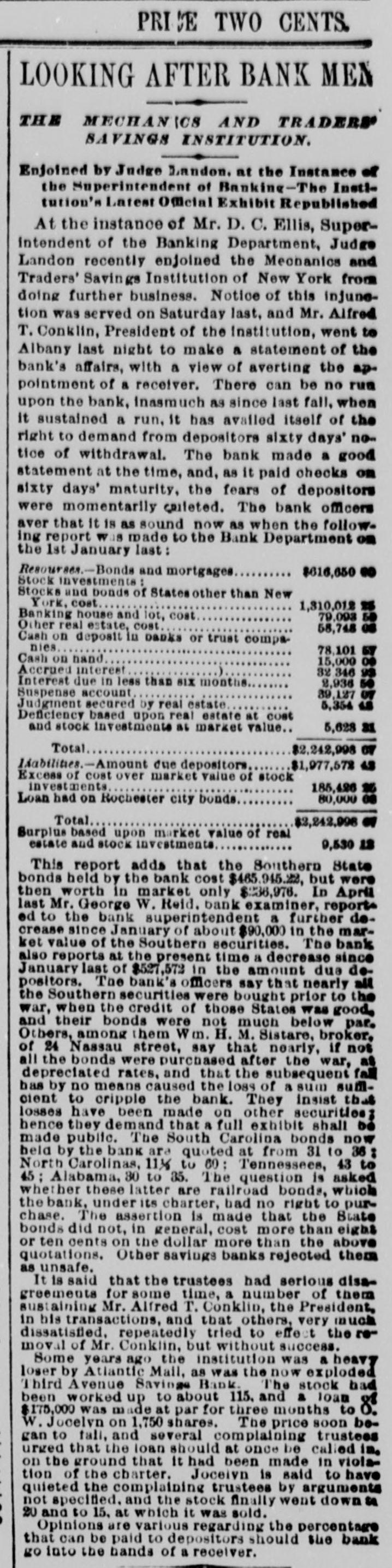
PRI E TWO CENTS. LOOKING AFTER BANK MEN THE MECHANI ICS AND TRADERS SAVINGS INSTITUTION. Enjoined by Judge Landon. at the Instance of the Superintendent of Bankine-The Institution's Latest Official Exhibit Republished At the instance of Mr. D. C. Ellis, SuperIntendent of the Banking Department, Judge Landon recently enjoined the Mechanics and Traders' Savings Institution of New York from doing further business. Notice of this injunetion was served on Saturday last, and Mr. Alfred T. Conklin, President of the Institution, went to Albany last night to make a statement of the bank's affairs, with a view of averting the appointment of a receiver. There can be no run upon the bank, Inasmuch as since last fall, when it sustained a run, it has availed itself of the right to demand from depositors sixty days' notice of withdrawal. The bank made a good statement at the time, and, as it paid checks on sixty days' maturity, the fears of depositors were momentarily calleted. The bank officers aver that it is as sound now as when the following report was made to the Bank Department on the 1st January last: Resources.-Bonds and mortgages $616,650 Stock investments: Stocks and bonds of States other than New York, cost 1,310,012 25 Banking house and lot, cost 79.093 50 Other real estate, cost. 58,748 08 Cash on deposit in Danks or trust companies 78.101 BY Cash on hand 15,000 00 Accrued interest 32 346 93 2,936 50 Interest due in less than SIX months Suspense account 89,127 or 5,354 as Judgment secured by real estate Deficiency based upon real estate at cost 5,628 31 and stock investments as market value Total $2,242,998 or $1,977,572 as Liabilities.-Amount due depositors Excess of cost over market value of stock investments 185,426 x 80,000 08 Loan had on Rochester city bonds Total $2,242,998 n Surplus based upon market value of real 9,530 is estate and stock investments This report adds that the Southern State bonds held by the bank cost $465,945.22, but were then worth in market only $236,976. In April last Mr. George W. Reid. bank examiner, reports ed to the bank superintendent a further decrease since January of about $90,000 in the market value of the Southern securities. The bank also reports at the present time a decrease since January last of $527,572 in the amount due dopositors. The bank's officers say that nearly all the Southern securities were bought prior to the war, when the credit of those States was good. and their bonds were not much below par. Others, among them Wm. H. M. Sistare, broker. of 24 Nassau street, say that nearly, if not all the bonds were purchased after the war, as depreciated rates, and that the subsequent fall has by no means caused the loss of a sum sumcient to cripple the bank. They insist that losses have been made on other securities; hence they demand that a full exhibit shall be made public. The South Carolina bonds now held by the bank are quoted at from 31 to 36 : North Carolinas, 111/6 to 60: Tennessees, 43 to 45: Alabama, 30 to 35. The question is asked whether these latter are railroad bonds, which the bank, under its charter, bad no right to purchase. The assertion is made that the State bonds did not, in general, cost more than eight or ten cents on the dollar more than the above quotations. Other savings banks rejected them as unsafe. It is said that the trustees had serious disagreements for some time, a number of them sustaining Mr. Alfred T. Conklin, the President, in his transactions, and that others, very much dissatisfied, repeatedly tried to effect the removal of Mr. Conklin, but without success. Some years ago the institution was a heavy loser by Atlantic Mall, as was the now exploded Third Avenue Savings Bank The stock had been worked up to about 115. and a loan of $175,000 was made at par for three months to O. W.Jocelvn on 1,750 shares. The price soon began to tali, and several complaining trustees urged that the loan should at once be called in. on the ground that it had been made in violation of the cbarter. Joceivn is said to have quieted the complaining trustees by arguments not specified. and the stock finally went down ta 20 and to 15. at which it was sold. Opinions are various regarding the percentage that can be paid to depositors should sue bank go into the bands of a receiver.


Article from The New York Herald, June 13, 1876

Click image to open full size in new tab

Article Text

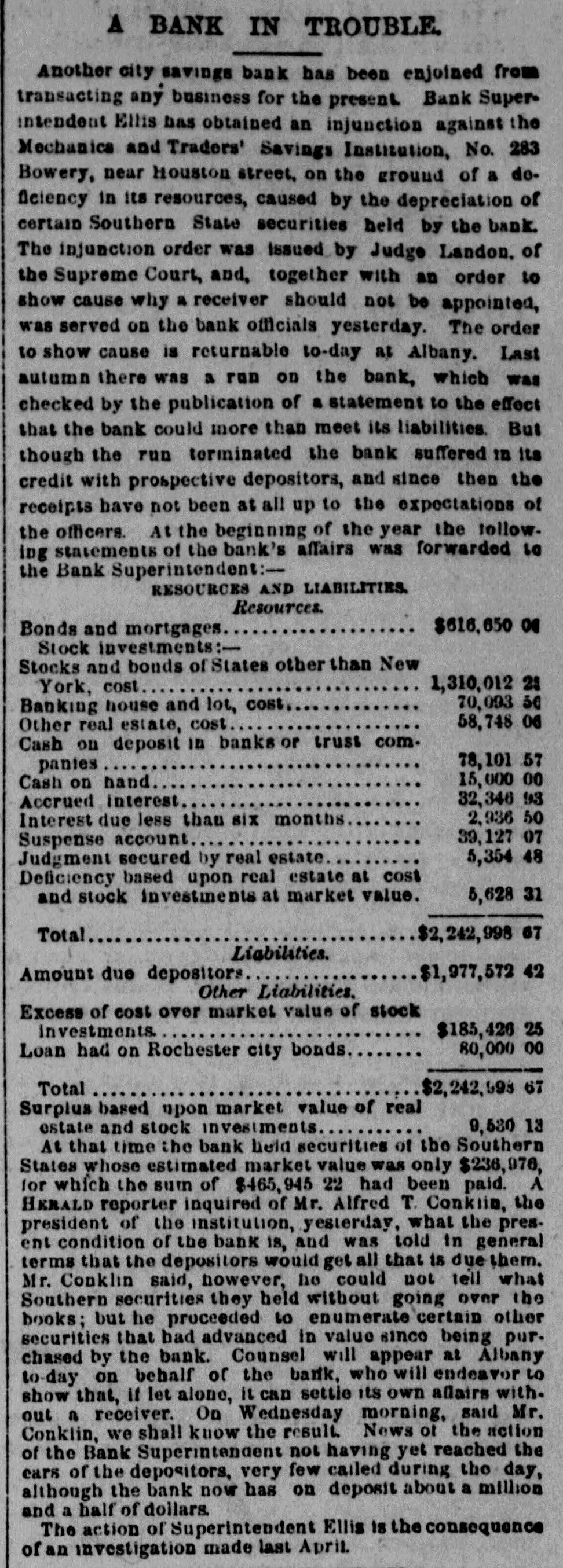
A BANK IN TROUBLE. Another city savings bank has been enjoined from transacting any business for the present Bank Superintendent Ellis has obtained an injunction against the Mechanics and Traders' Savings Institution, No. 283 Bowery, near Houston street, on the ground of a doficiency in its resources, caused by the depreciation of certain Southern State securities held by the bank. The injunction order was Issued by Judge Landon. of the Supreme Court, and, together with an order to show cause why a receiver should not be appointed, was served on the bank officials yesterday. The order to show cause is returnable to-day at Albany. Last autumn there was a run on the bank, which was checked by the publication of a statement to the effect that the bank could more than meet its liabilities. But though the run terminated the bank suffered in its credit with prospective depositors, and since then the receipts have not been at all up to the expectations of the officers. At the beginning of the year the following statements of the bank's affairs was forwarded to the Bank Superintendent:RESOURCES AND LIABILITIES. Resources. $616,650 of Bonds and mortgages Stock investments:Stocks and bonds of States other than New 1,310,012 25 York, cost 70,093.50 Banking house and lot, cost 58,748.06 Other real estate, cost Cash on deposit in banks or trust com78,101 57 panies 15,000 00 Cash on hand 32,346.93 Accrued interest 2,936 50 Interest due less than six months 39,127 07 Suspense account 5,354.48 Judgment secured by real estate Deficiency based upon real estate at cost and stock investments at market value. 5,628 31 Total $2,242,998 67 Liabilities. $1,977,572 42 Amount due depositors Other Liabilities. Excess of cost over market value of stock investments $185,426 25 80,000 00 Loan had on Rochester city bonds Total $2,242,995 67 Surplus based upon market value of real estate and stock investments 9,530 13 At that time the bank held securities of the Southern States whose estimated market value was only $236,976, for which the sum of $465,945 22 had been paid. A HERALD reporter inquired of Mr. Alfred T. Conklin, the president of the institution, yesterday, what the present condition of the bank is, and was told in general terms that the depositors would get all that is due them. Mr. Conklin said, however, he could not tell what Southern securities they held without going over the books; but he proceeded to enumerate certain other securities that bad advanced in value since being purchased by the bank. Counsel will appear at Albany to-day on behalf of the bank, who will endeavor to show that, if let alone, it can settle its own aflairs with. out n receiver. On Wednesday morning, said Mr. Conklin, we shall know the result. News of the action of the Bank Superintendent not having yet reached the ears of the depositors, very few called during the day, although the bank now has on deposit about a million and a half of dollars. The action of Superintendent Ellis is the consequence of an investigation made last April.


Article from The Sun, July 18, 1876

Click image to open full size in new tab

Article Text

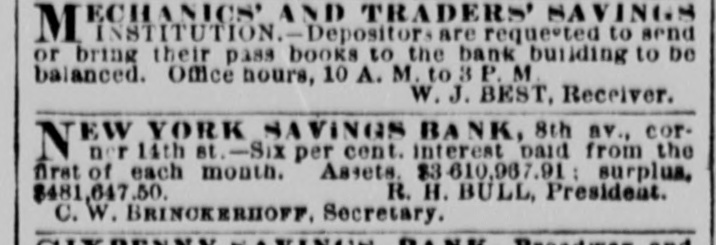
ECHANICS' AND TRADERS' SAVINGS M INSTITUTION.-Depositors: are requested to send or bring their pass books to the bank building to be balanced. Office hours, 10 A. M. to 3 P. M W. J. BEST, Receiver. EW YORK SAVINGS BANK, 8th av., corN ner 14th st.-Six per cent. interest paid from the first of each month. Assets. $3610,967.91 surplus. $481,647.50. R. H. BULL, President. C. W. BRINOKERHOFF. Secretary. BANK CE


Article from The Sun, August 10, 1876

Click image to open full size in new tab

Article Text

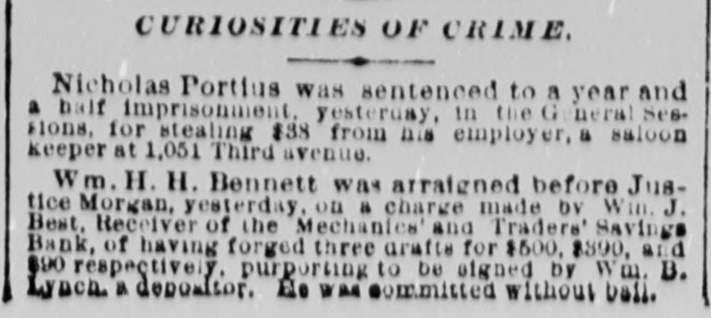
CURIOSITIES OF CRIME. Nicholas Portius was sentenced to a year and a half imprisonment. yesteroay, in the G heral SesFIONS, for stealing $38 from his employer, a saloon keeper at 1,051 Third avenue. W m. H. H. Bennett was arraigned before Justice Morgan, yesterday. on a charge made by Win. J. Best. Receiver of the Mechanics' and Traders' Savings Bank, of having forged three grafts for $500, $890, and $90 respectively. purporting to be signed by Wm. B. Lynch a depositor. E. was committed without ball.


Article from Public Ledger, September 23, 1876

Click image to open full size in new tab

Article Text

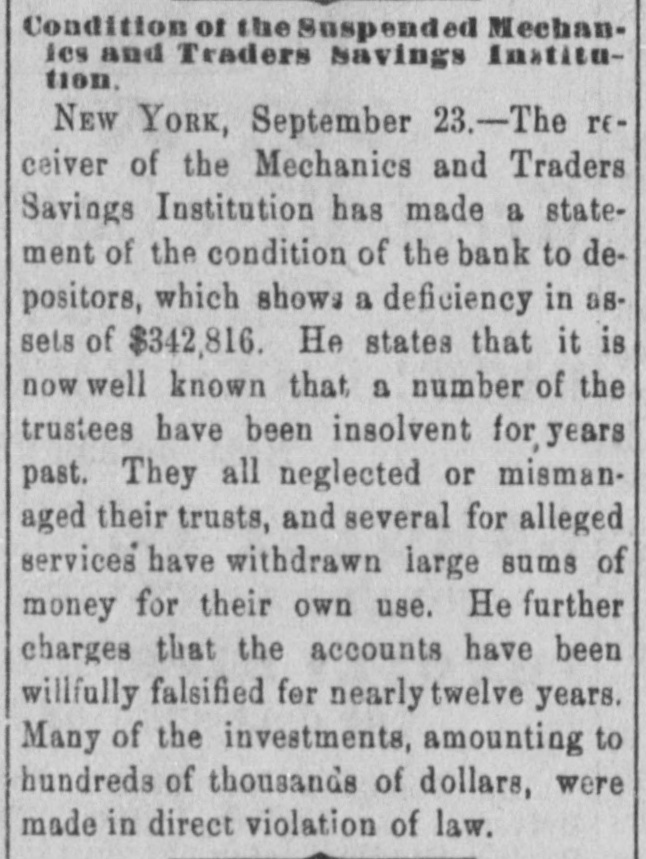
Condition of the Suspended Mechanles and Traders savings Institution. NEW York, September 23.-The receiver of the Mechanics and Traders Savings Institution has made a statement of the condition of the bank to depositors, which shows a deficiency in assets of $342,816. He states that it is now well known that a number of the trustees have been insolvent for years past. They all neglected or mismanaged their trusts, and several for alleged services have withdrawn large sums of money for their own use. He further charges that the accounts have been willfully falsified fer nearly twelve years. Many of the investments, amounting to hundreds of thousands of dollars, were made in direct violation of law.


Article from The Daily Argus, September 23, 1876

Click image to open full size in new tab

Article Text

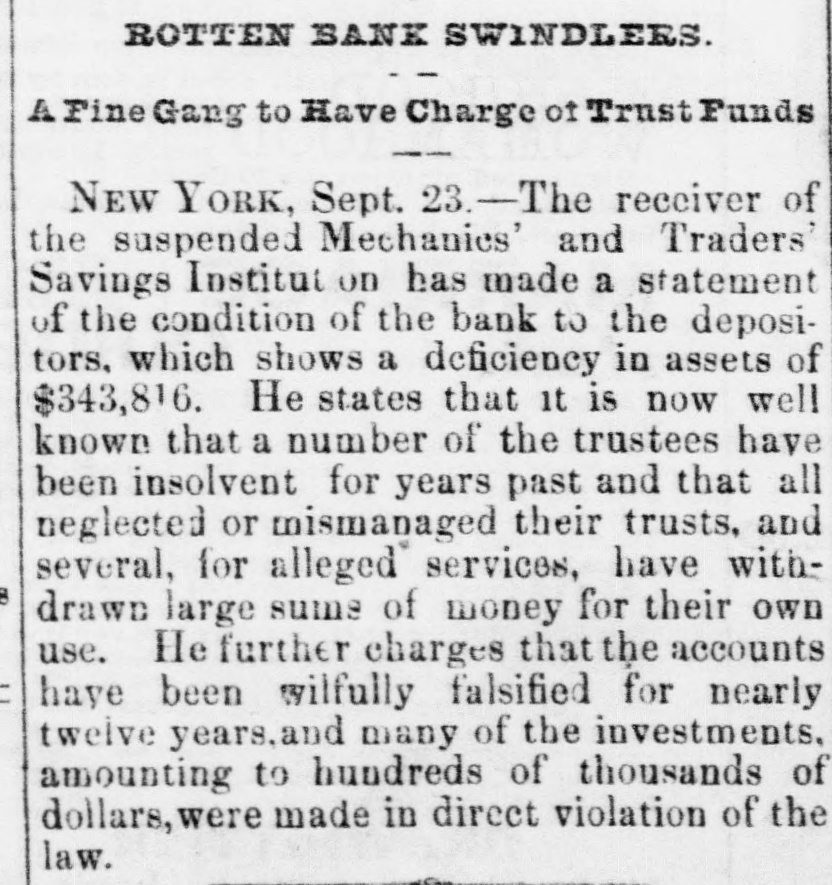
ROTTEN BANK SWINDLERS. A Fine Gang to Have Charge of Trust Funds NEW YORK, Sept. 23.-The - receiver of the suspended Mechanics' and Traders' Savings Institut on has made a statement of the condition of the bank to the depositors, which shows a deficiency in assets of $343,816. He states that it is now well known that a number of the trustees have been insolvent for years past and that all neglected or mismanaged their trusts, and several, for alleged services, have withdrawn large sums of money for their own use. He further charges that the accounts haye been wilfully falsified for nearly twelve years, and many of the investments. amounting to hundreds of thousands of dollars, were made in direct violation of the law.


Article from Gold Hill Daily News, September 23, 1876

Click image to open full size in new tab

Article Text

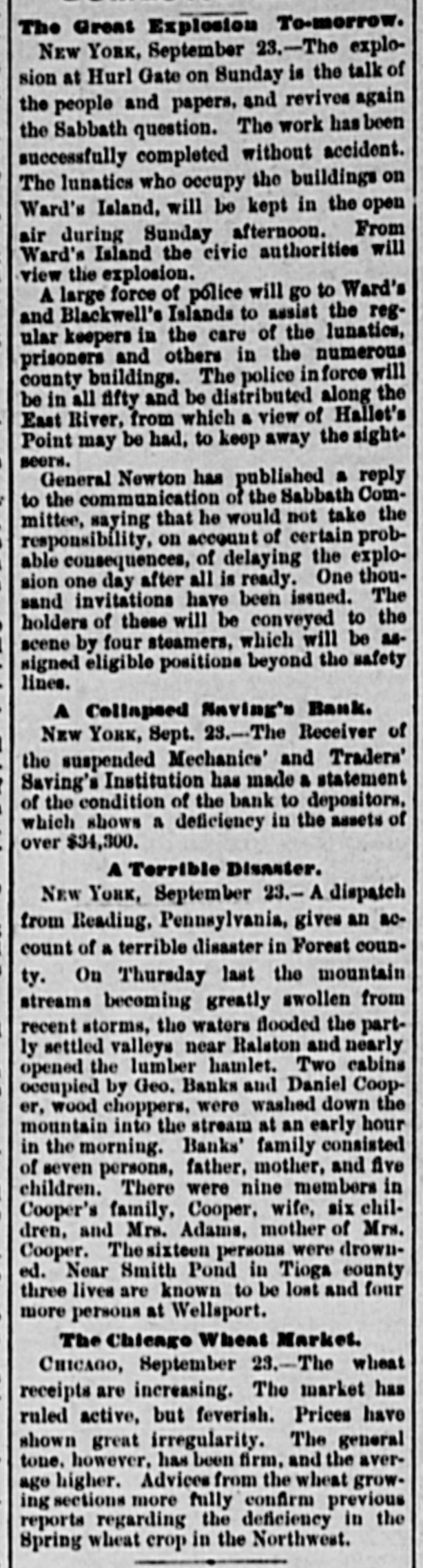
The Great Explosion To-morrow. NEW YORK, September 23.-The explosion at Hurl Gate on Sunday is the talk of the people and papers, and revives again the Sabbath question. The work has been successfully completed without accident. The lunatics who occupy the buildings on Ward's Island, will be kept in the open air during Sunday afternoon. From Ward's Island the civic authorities will view the explosion. A large force of police will go to Ward's and Blackwell's Islands to assist the regular keepers in the care of the lunatics, and others in The prisoners county buildings. police the inforce numerous will be in all fifty and be distributed along the East River, from which a view of Hallet's Point may be had, to keep away the sightseers. General Newton has published a reply to the communication of the Sabbath Committee, saying that he would not take the responsibility, on account of certain probable consequences, of delaying the explosion one day after all is ready. One thousand invitations have been issued. The holders of these will be conveyed to the scene by four steamers, which will be assigned eligible positions beyond the safety lines. A Collapsed Having's Bank. NEW YORK, Sept. 23.-The Receiver of the suspended Mechanics' and Traders' Saving's Institution has made & statement of the condition of the bank to depositors, which shows a deficiency in the assets of over $34,300. A Terrible Disaster. NEW YORK, September 23.- A dispatch from Reading, Pennsylvania, gives an account of a terrible disaster in Forest county. On Thursday last the mountain streams becoming greatly swollen from recent storms, the waters flooded the partly settled valleys near Ralston and nearly opened the lumber hamlet. Two cabins occupied by Geo. Banks and Daniel Cooper, wood choppers. were washed down the mountain into the stream at an early hour in the morning. Banks' family consisted of seven persons, father, mother, and five children. There were nine members in Cooper's family, Cooper. wife, six children. and Mrs. Adams. mother of Mrs. Cooper. The sixteen persons were drowned. Near Smith Pond in Tioga county three lives are known to be lost and four more persons at Wellsport. The Chicago Whens Market. CHICAGO, September 23.-The wheat receipts are increasing. The market has ruled active, but feverish. Prices have shown great irregularity. The general tone. however, has been firm. and the average higher. Advices from the wheat growing sections more fully confirm previous reports regarding the deficiency in the Spring wheat crop in the Northwest.


Article from Chicago Daily Tribune, September 24, 1876

Click image to open full size in new tab

Article Text

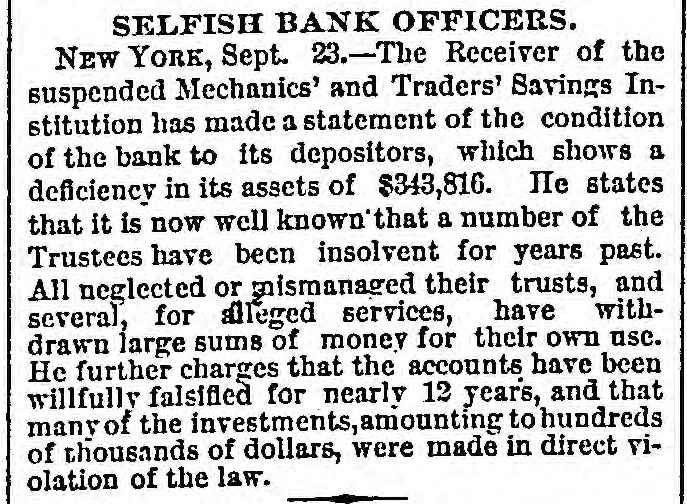
SELFISH BANK OFFICERS. NEW YORK, Sept. 23.-The Receiver of the suspended Mechanics' and Traders' Savings Institution has made a statement of the condition of the bank to its depositors, which shows a deficiency in its assets of $343,816. He states that it is now well known'that a number of the Trustees have been insolvent for years past. All neglected or mismanaged their trusts, and several, for alleged services, have withdrawn large sums of money for their own use. He further charges that the accounts have been willfully falsified for nearly 12 years, and that manyof the investments, amounting to hundreds of thousands of dollars, were made in direct violation of the law.


Article from The Wheeling Daily Register, September 25, 1876

Click image to open full size in new tab

Article Text

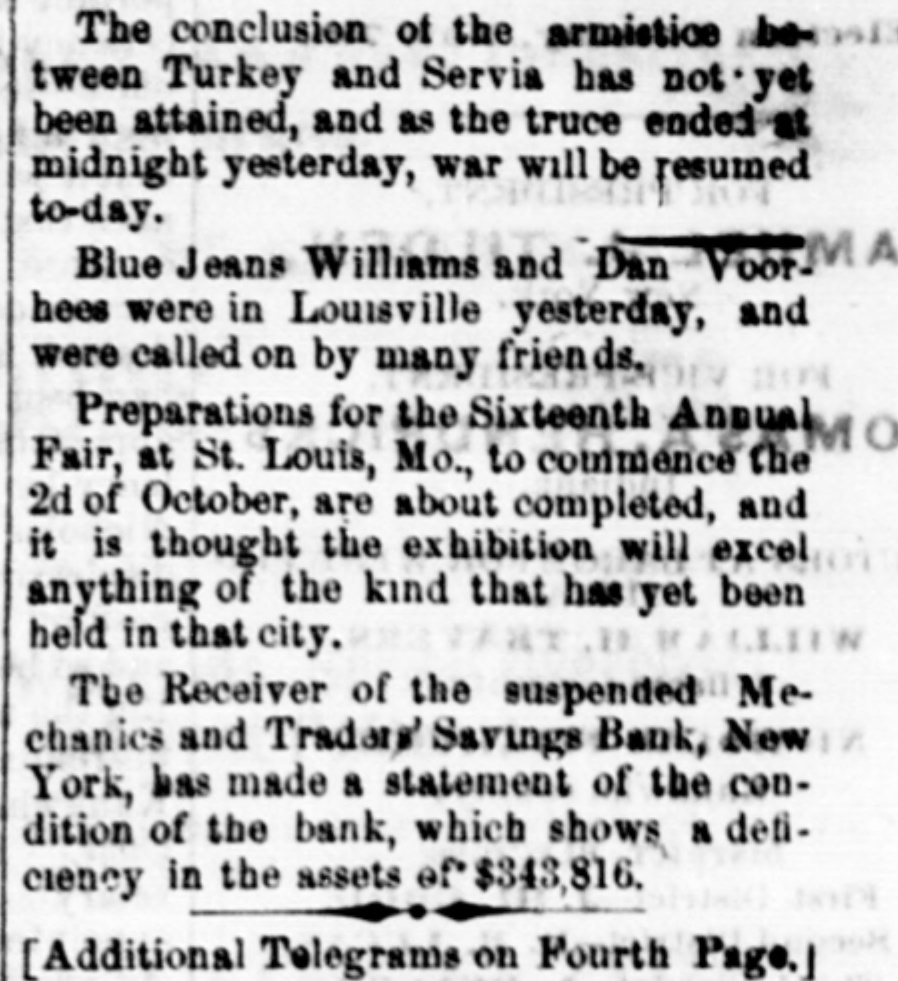
beThe conclusion of the armistics tween Turkey and Servia has not yet been attained, and as the truce ended at midnight yesterday, war will be resumed to-day. Blue Jeans Williams and Dan Voorhees were in Louisville yesterday, and were called on by many friends. Preparations for the Sixteenth Annual Fair, at St. Louis, Mo., to commence the 2d of October, are about completed, and it is thought the exhibition will excel anything of the kind that has yet been held in that city. The Receiver of the suspended Mechanics and Tradars' Savings Bank, New York, has made a statement of the condition of the bank, which shows a deticiency in the assets of $343,816. [Additional Telegrams on Fourth Page.


Article from Chicago Daily Tribune, September 29, 1876

Click image to open full size in new tab

Article Text

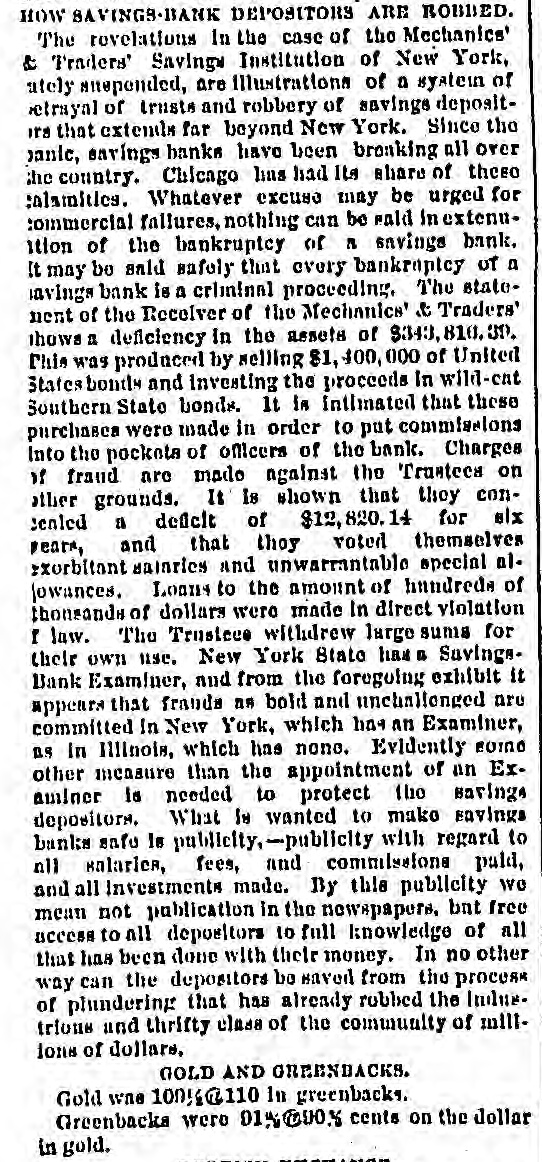
HOW SAVINGS-BANK DEPOSITORS ARE ROBBED. The revelations In the case of the Mechanics' & Traders' Savings Institution of New York, ately suppended, are Illustrations of a systein of etrayal of trusts and robbery of savings depositits that extends far beyond New York. Since the panic, savings banks have been breaking all over the country. Chicago has had Its share of these calamities. Whatever excuse may be urged for :ommercial failures, nothing can be paid Inextenuition of the bankruptcy of a savings bank. It may be said safely that every bankropley of a lavings bank is a criminal proceeding. The state. nent of the Receiver of the Mechanics' & Traders' shows a deficiency In the assets of $343,810.39. This was produced by selling $1,400,000 of United Statesbonds and investing the proceeds In wild-cat Southern State bonds. It is intimated that these purchases were made in order to put commissions Into the pockets of officers of the bank. Charges of fraud are made against the Trustees on other grounds. It Is shown that they consenled a deficit of $12,820.14 for six years, and that thoy voted themselves exorbitant sainries and unwarrantable special al. jowances. Loans to the amount of hundreds of thousands of dollars were made In direct violation I law. The Trustees withdrew large sums for their own use. New York State has a Savings. Bank Examiner, and from the foregoing exhibit it appears that frauds as bold and unchallenged are committed In New York, which ha+ an Examiner, as In Illinois, which has none. Evidently soine other measure than the appointment of an Ex. aminer is needed to protect the savings depositors. What is wanted to make savings banks safe Is pubilicity,-publicity with regard to nll salaries, fees, and commissions paid, and all Investments made. By this publicity we mean not publication in the newspapers, bnt free access to all depositors to full knowledge of all that has been done with their money. In no other way can the depositors be saved from the process of phindering that has already robbed the Indus. trioue and thrifty class of the community of milllons of dollars. GOLD AND GREENBACKS. Gold was In greenbacks. Greenbacks were 01/2000 cents on the dollar in gold.


Article from The New York Herald, October 5, 1876

Click image to open full size in new tab

Article Text

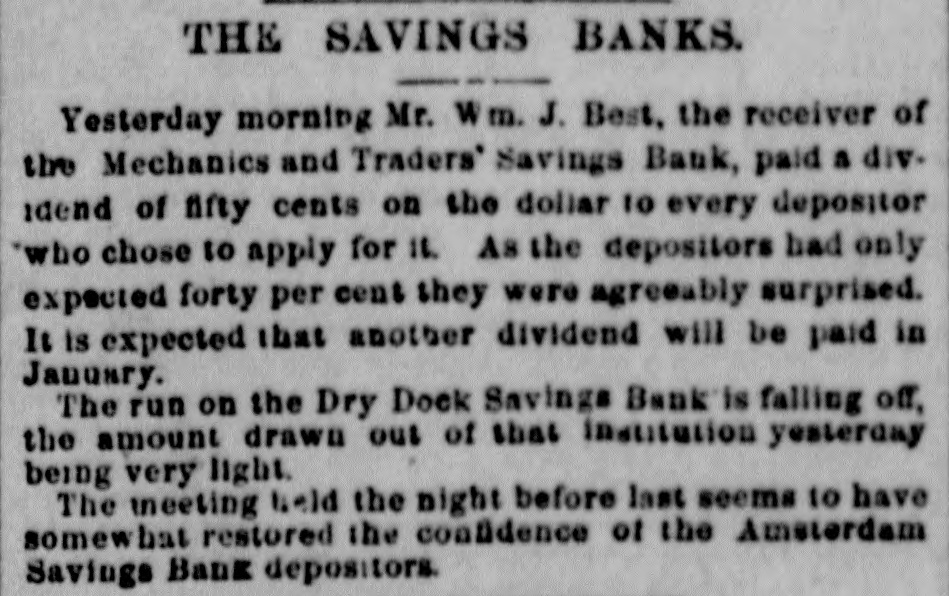
THE SAVINGS BANKS. Yesterday morning Mr. Wm. J. Best, the receiver of the Mechanics and Traders' Savings Bank, paid a dividend of fifty cents on the dollar to every depositor who chose to apply for 11. As the depositors had only expected forty per cent they were agreeably surprised. It is expected that another dividend will be paid in January. The run on the Dry Dock Savings Bank is falling off, the amount drawn out of that institution yesterday being very light. The meeting held the night before last seems to have somewhat restored the confidence of the Amsterdam Savings Bank depositors.


Article from New Orleans Republican, October 22, 1876

Click image to open full size in new tab

Article Text

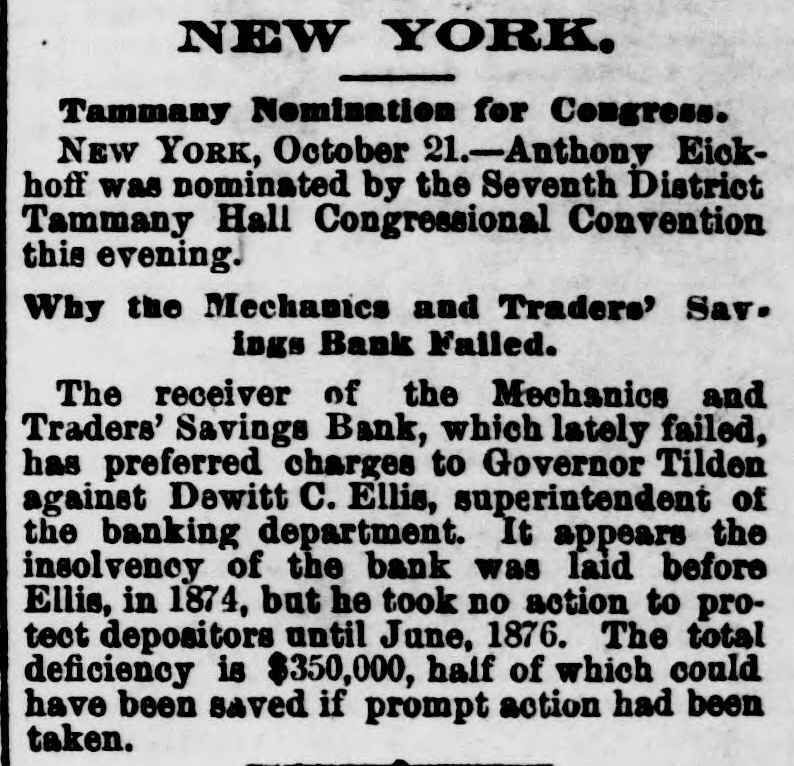
NEW YORK, Tammany Nomination for Congress. NEW YORK, October 21.-Anthony Eiokhoff was nominated by the Seventh District Tammany Hall Congressional Convention this evening. Why the Mechanics and Traders' Sav. ings Bank Failed. The receiver of the Mechanics and Traders' Savings Bank, which lately failed, has preferred charges to Governor Tilden against Dewitt C. Ellis, superintendent of the banking department. It appears the insolvency of the bank was laid before Ellis, in 1874, but he took no action to protect depositors until June, 1876. The total deficiency is $350,000, half of which could have been saved if prompt action had been taken.


Article from New-York Tribune, October 26, 1876

Click image to open full size in new tab

Article Text

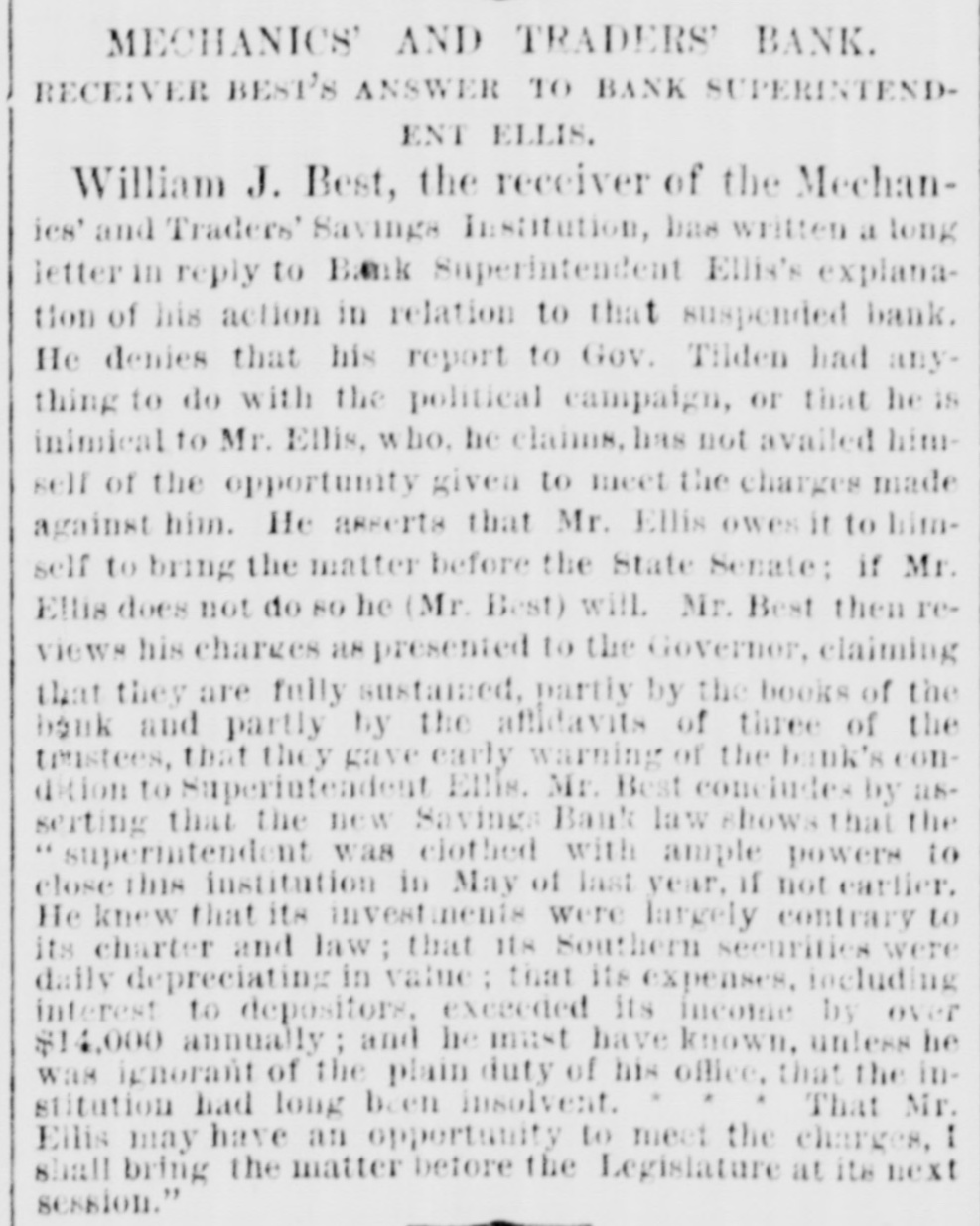
MECHANICS AND TRADERS' BANK. RECEIVER BEST'S ANSWER TO BANK SUPERINTENDENT ELLIS. William J. Best, the receiver of the Mechanies' and Traders' Savings Institution, has written a long letter in reply to Bank Superintendent Ellis's explanation of his action in relation to that suspended bank. He denies that his report to Gov. Tilden had anything to do with the political campaign, or that he is ininical to Mr. Ellis, who, he claims. has not availed himself of the opportunity given to meet the charges made against him. He asserts that Mr. Ellis owes it to himself to bring the matter before the State Senate: if Mr. Ellis does not do 80 he (Mr. Best) will. Mr. Best then reviews his charges as presented to the Governor, claiming that they are fully sustained partly by the books of the bank and partly by the attidavits of three of the trustees, that they gave early warning of the bank's condition to Superintendent Ellis. Mr. Best concludes by asserting that the new Savings Bank law shows that the "superintendent was clothed with ample powers to close this institution in May of last year. if not earlier. He knew that its investments were largely contrary to its charter and law; that its Southern securities were daily depreciating in value: that its expenses. including interest to depositors. exceeded its income by over $14,000 annually; and he must have known. unless he was ignorant of the plain duty of his office. that the inThat Mr. stitution had long been insolvent. Ellis may have an opportunity to meet the charges, : shall bring the matter before the Legislature at its next session."


Article from The New York Herald, December 9, 1876

Click image to open full size in new tab

Article Text

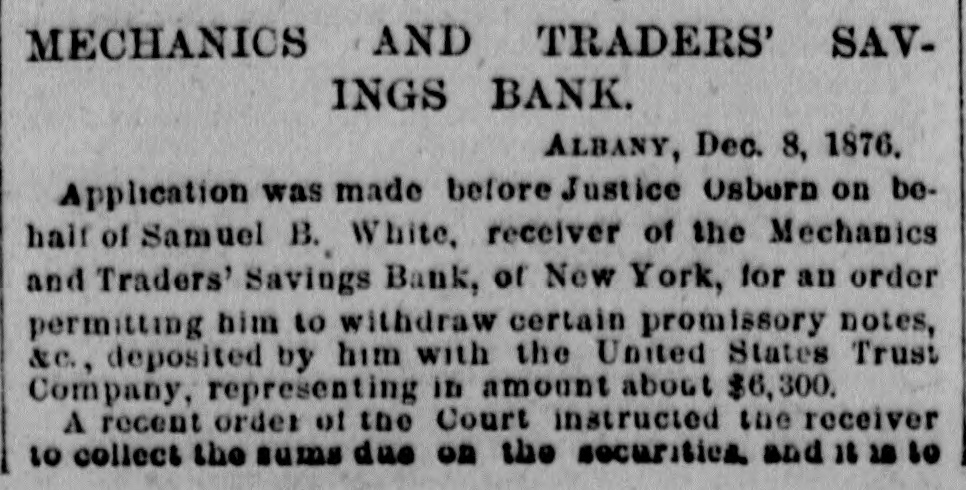
SAVMECHANICS AND TRADERS' INGS BANK. ALBANY, Dec. 8, 1876. Application was made before Justice Osboro on behair of Samuel B. White, receiver of the Mechanics and Traders' Savings Bank, of New York, for an order permitting him to withdraw certain promissory notes, &c., deposited by him with the United States Trust Company, representing in amount about $6,300. A recent order of the Court instructed the receiver 10 collect the sums due on the securities. and 16 is 10


Article from The Sun, December 27, 1877

Click image to open full size in new tab

Article Text

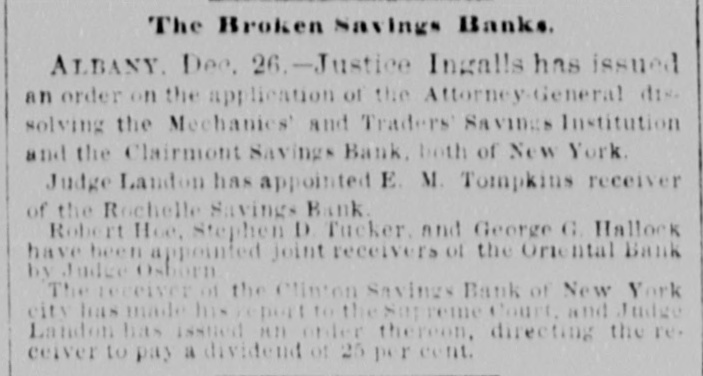
The Broken Savings Banks. ALBANY Dec. 26.-Justice Ingalls has issued an order on the application of the Attorney-General dissolving the Mechanics' and Traders' Savings Institution and the Clairmont Savings Bank, both of New York. Judge Landon has appointed E. M. Tompkins receiver of the Rochelle Savings Bank. Robert Hoe, Stephen D. Tucker. and George G. Hallock have been appointed joint receivers of the Oriental Bank by Judge Osborn The receiver of the Clinton Savings Bank of New York city has made his report to the Sur reme Court. and Judge Landon has issued an order thereon, directing the re. ceiver to pay a dividend of 25 per cent.


Article from The New York Herald, December 27, 1877

Click image to open full size in new tab

Article Text

SAVINGS BANK MATTERS. ALBANY, N. Y., Dec. 26, 1877. Justice Ingalls has issued an order on the application of the Attorney General dissolving the Mechanics and Traders' Savings Institution and the Clairmont Savings Bank, both of New York. Judge Landon has appointed E. M. Tompkins receiver of the Rochelle Savings Bank. Robert Hoe, Stephen D. Tucker and George G. Hallock have been appointed joint receivers of the Oriental Bank, by Judge Ossorn. The receiver or the Clinton Savings Bank, of New York city, has made his report to the Supreme Cours, and Judge Landon has issued an order thereon. direct. ing the receiver to pay a dividend of twenty-five per tent.