Farmers & Mechanics Bank of Michigan (Detroit, MI)

Episode Information

Episode UID
7505896790545
Episode Type
Run โ†’ Suspension โ†’ Reopening
Bank Type
state
Bank ID
750589679 hash
Start Date
May 4, 1845
Location
Detroit, Michigan (42.331, -83.046)

Metadata

Model
gpt-5-mini (chosen from majority vote of a three-model LLM ensemble)
Short Digest
30367a7186090075

Response Measures

None

Description

Legal injunctions (chancery) led to receivership in 1845; legislature then acted in 1846 to reinvest charter and enable resumption.

Events (6)

1. May 4, 1845 Run
Cause
Rumor Or Misinformation
Cause Details
Rumor of assignment/insolvency prompted expectations of a run; article denies assignment and asserts bank good.
Measures
Bank officers and local capitalists (S. S. Brown, Charles Seymour et al.) stated bank was able to redeem; drafts for redemption would be accepted.
Newspaper Excerpt
There is a rumor to-day in town that the Farmers and Mechanics Bank has assigned...The Banks will have and expect a run to morrow, but are able to meet all their demands.
Source
newspapers
2. July 2, 1845 Suspension
Cause
Government Action
Cause Details
Chancery proceedings and injunctions (court action) tied the bank and led to suspension and receivership.
Newspaper Excerpt
The Farmers' and Mechanics' Bank of Detroit has suspended.
Source
newspapers
3. August 5, 1845 Other
Newspaper Excerpt
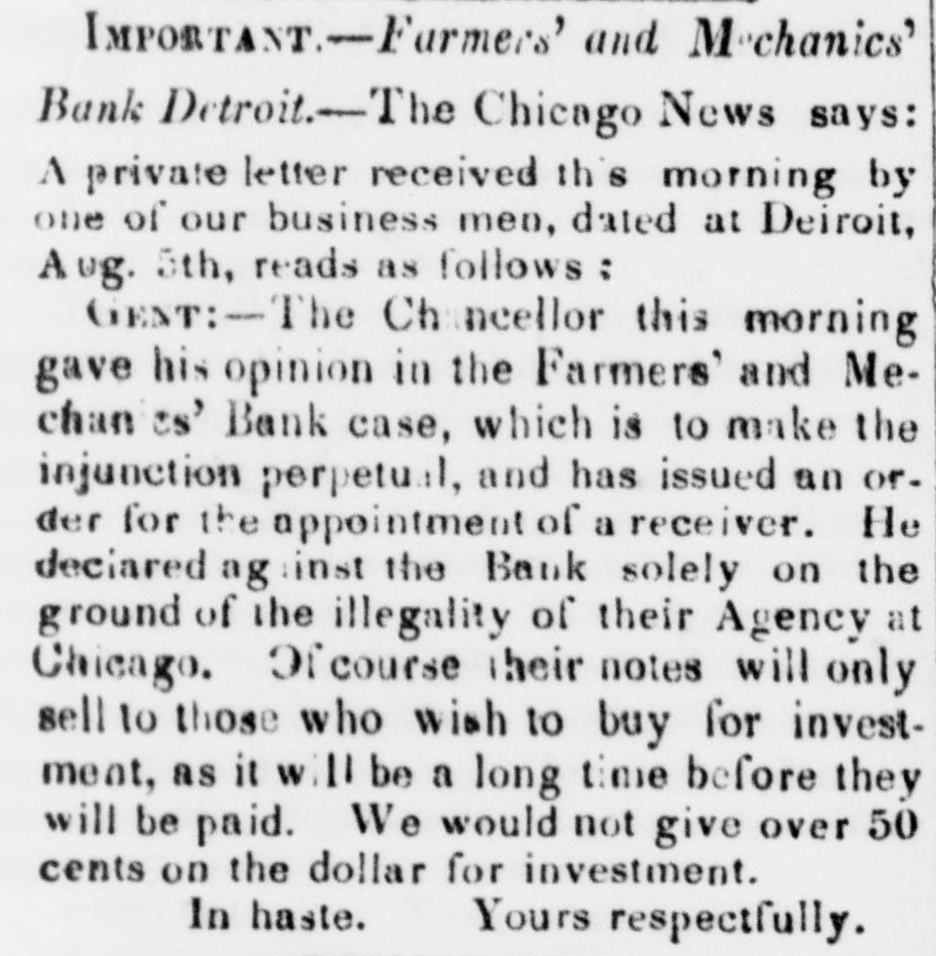
The Chancellor...has issued an order for the appointment of a receiver. He declared against the Bank solely on the ground of the illegality of their Agency at Chicago; notes will only sell to those who wish to buy for investment, as it will be a long time before they will be paid. (Reported Aug. 5 private letter.)
Source
newspapers
4. April 29, 1846 Reopening
Newspaper Excerpt
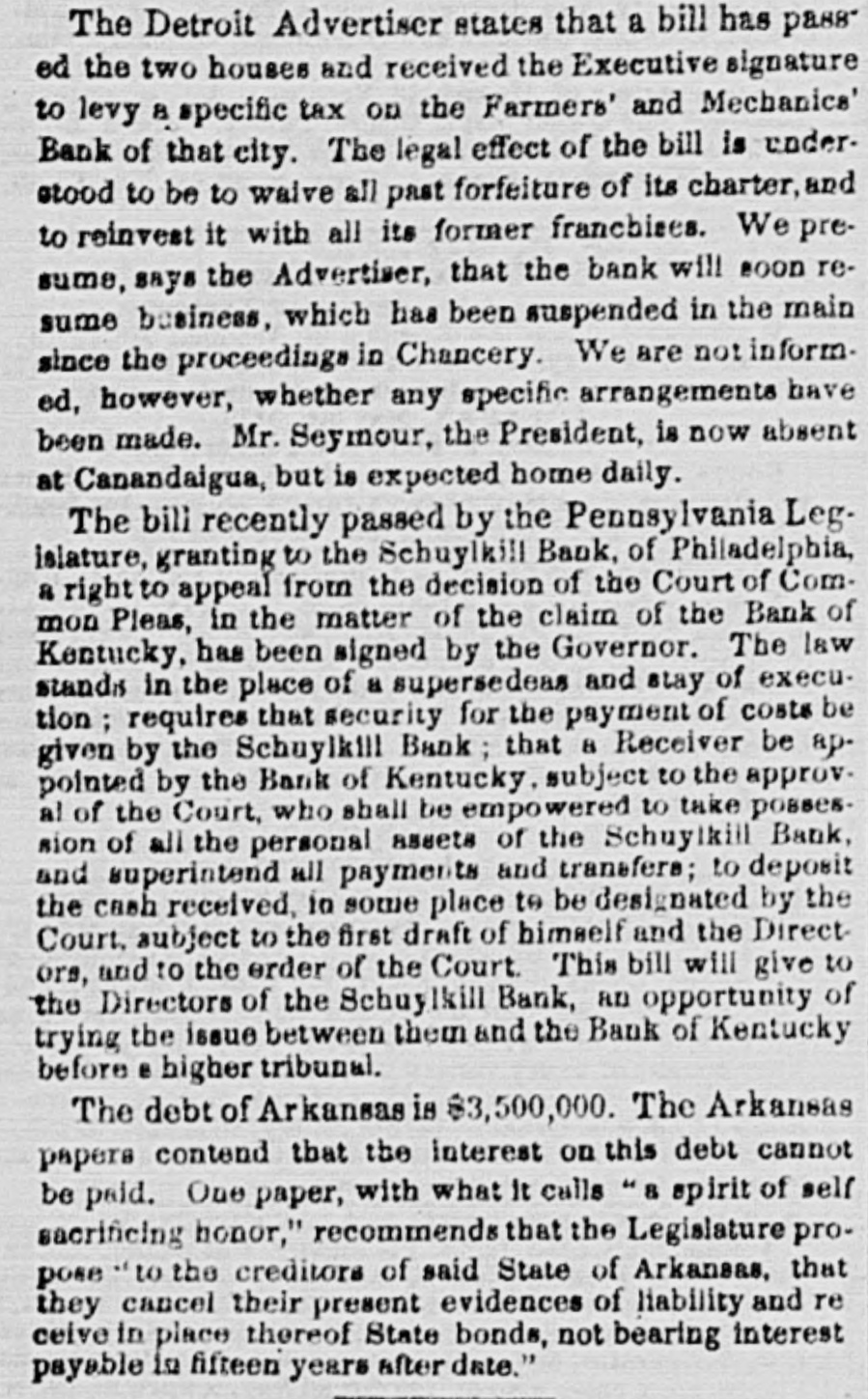
A bill has passed the two houses and received the Executive signature to waive all past forfeiture of its charter, and to reinvest it with all its former franchises...we presume the bank will soon resume business, which has been suspended in the main since the proceedings in Chancery.
Source
newspapers
5. March 21, 1851 Run
Cause Details
General local nervousness/excitement in 1851 caused heavy withdrawals but bank met demands.
Measures
Redeemed bills promptly; telegraphic assurances from capitalists that drafts for redemption would be accepted and paid.
Newspaper Excerpt
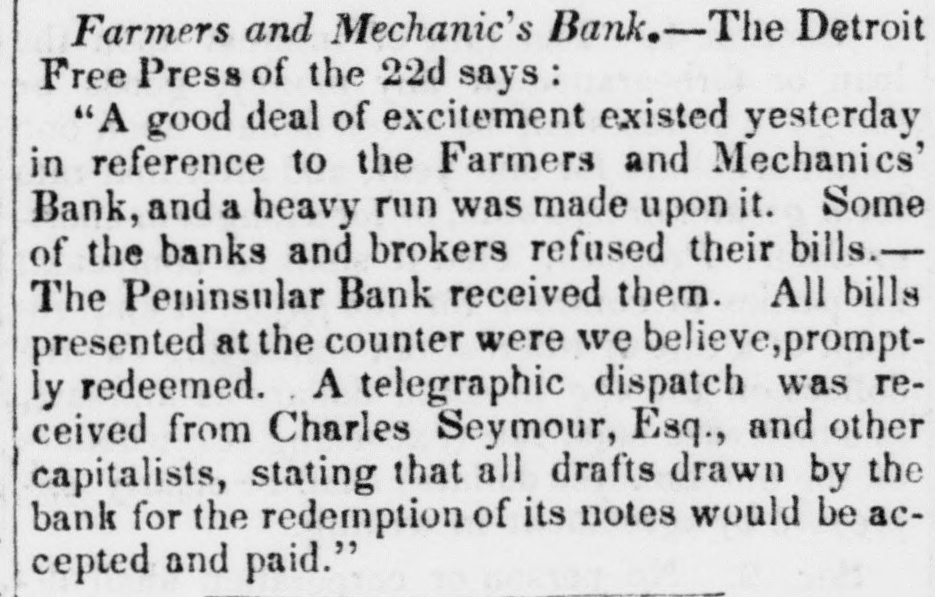
A good deal of excitement existed yesterday in reference to the Farmers and Mechanics' Bank, and a heavy run was made upon it...All bills presented at the counter were we believe, promptly redeemed.
Source
newspapers
6. October 6, 1857 Suspension
Cause
Government Action
Cause Details
Placed under injunction by Attorney General during the 1857 financial panic, effectively suspending operations.
Newspaper Excerpt
The Farmers' & Mechanics' Bank of this city has been placed under injunction by the Attorney General.
Source
newspapers

Newspaper Articles (23)

Article from Morning Herald, August 1, 1840

Click image to open full size in new tab

Article Text

Thistable shows that the course of the banks in sections of entirely different interests has been nearly the same. In the early part of the spring, when the fear that the suspended banks would be proceeded against was removed, the New Orleans banks showed a strong disposition to expand, a course which has since been altered by the force of public opinion, which is in favor of resumption, and now rendered imperative upon the solvent banks by the successful, although forced resumption of the Dis" trict of Columbia banks, and the voluntary resumption of the banks of Charleston, S.C. The latest returns of the banks, from all sections of the country, show a decrease of specie, which arises from the strong efforts of the United States Bank to collect its debts, and concentrate its means in Philadelphia. It is believed that the bank is now making strenuous efforts, not only to meet the heavy payments it has to make in this country and in England, between now and November, amounting to over $12,900,000, but also to resume specie payments if possible. This necessary measure has been delayed too long for the credit of the bank. Had it been taken last spring, her fall payments would have been go over much more easily. Within 3 few days judgment has been of tained against the Formers' and Mechanics' Bank of Detroit, M. T. in fi


Article from Southport Telegraph, May 13, 1845

Click image to open full size in new tab

Article Text

Letters received at Buffalo under date of May 4tb, from Detroit, says: There is a rumor to-day in town that the Farmers and Mechanics Bank has assign d. but this is not true. The Bank is good, and will redeem: so says S. S. Brown. The cause of this report was, that the Bank had a note with an endorser, which was about to be outlawed, and to make the endorser holden, they were obliged to assign the note to an Eastern friend to commence a suit in the United States' District Court, River Raisin good, and so is Oakland. There is great excitement here. The Banks will have and expect a run to morrow, but are able to meet all their demands. to


Article from The Cadiz Sentinel, July 2, 1845

Click image to open full size in new tab

Article Text

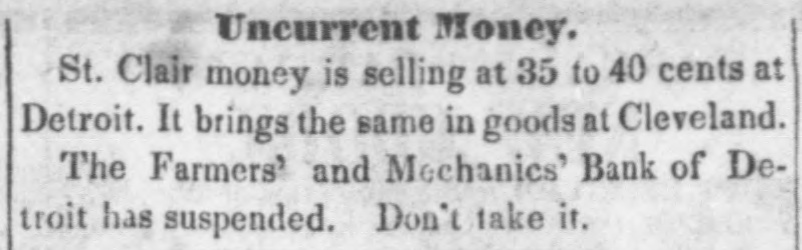
Uncurrent Money. St. Clair money is selling at 35 to 40 cents at Detroit. It brings the same in goods at Cleveland. The Farmers' and Mechanics' Bank of Detroit has suspended. Don't take it.


Article from Southport Telegraph, August 12, 1845

Click image to open full size in new tab

Article Text

IMPORTANT-Farmers and Mechanics' Bank Detroit.-The Chicago News says: A private letter received this morning by one of our business men, dated at Deiroit, Aug. 5th, reads as follows : GENT:- The Chancellor this morning gave his opinion in the Farmers' and Mechan is' Bank case, which is to make the injunction perpetual, and has issued an order for the appointment of a receiver. He declared ag inst the Bank solely on the ground of the illegality of their Agency at Chicago. Of course their notes will only sell to those who wish to buy for investment, as it will be a long time before they will be paid. We would not give over 50 cents on the dollar for investment. In haste. Yours respectfully.


Article from Carroll Free Press, August 22, 1845

Click image to open full size in new tab

Article Text

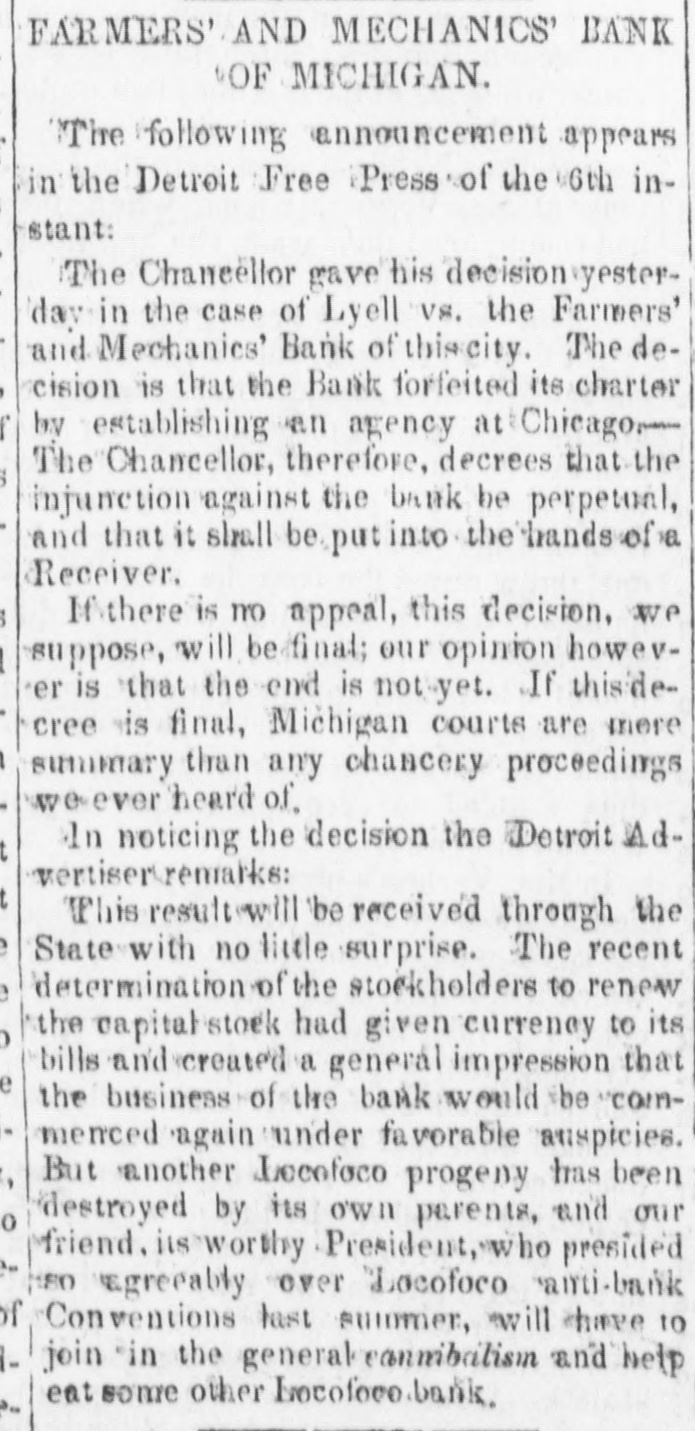
FARMERS' AND MECHANICS' BANK OF MICHIGAN. The following ennouncement appears in the Detroit Free iPress of the 6th instant: The Chancรชllor gave his decision yesterday in the case of Lyell vs. the Farmers' and Mechanics' Bank of thiscity. The decision is that the Bank forfeited its charter by establishing an agency at Chicago The Chancellor, therefore, decrees that the injurction against the bank be perpetual, and that it shall be putinto the hands of a Receiver. Mfthere is TYO appeal, this decision, we suppose, will be final; our opinion however is that the end is not-yet. If this/decree is final, Michigan courts are mere summary than any chancery proceedings we ever 'heard of In noticing the decision the Detroit Advertiser.remarks: This result-will be received through the State with no little surprise. The recent determination of the stockholders to renew the capital stock had given currency to its bills and created a general impression that the business of the bank would the commenced again under favorable auspicies. But another Locafaco progeny has been destroyed by its own parents, and our friend. its worthy President, who presided FO agreeably over Lacofoco airti-bank Conventions last sulmmer, will have to join in the generale connibatism and help eat some other brocofooo.bank.


Article from New-York Daily Tribune, April 29, 1846

Click image to open full size in new tab

Article Text

The Detroit Advertiser states that a bill has pass" ed the two houses and received the Executive signature to levy 8 specific tax on the Farmers' and Mechanics' Bank of that city. The legal effect of the bill is under. stood to be to waive all past forfeiture of its charter, and to reinvest it with all its former franchises. We presume, says the Advertiser, that the bank will soon resume business, which has been suspended in the main since the proceedings in Chancery. We are notinformed, however, whether any specific arrangements have been made. Mr. Seymour, the President, is now absent at Canandaigua, but is expected home daily. The bill recently passed by the Pennsylvania Leg. islature, granting to the Schuylkill Bank, of Philadelphia, a right to appeal from the decision of the Court of Common Pleas, in the matter of the claim of the Bank of Kentucky, has been signed by the Governor. The law stands in the place of a supersedeas and stay of execution requires that security for the payment of costs be given by the Schuylkill Bank: that 8 Receiver be ap. pointed by the Bank of Kentucky. subject to the approval of the Court, who shall be empowered to take possession of all the personal assets of the Schuyiki Bank, and superintend all payments and transfers; to deposit the cash received, in some place to be designated by the Court. subject to the first draft of himself and the Direct ors, and to the order of the Court. This bill will give to the Directors of the Schuy Ikill Bank, an opportunity of trying the issue between them and the Bank of Kentucky before e higher tribunal. The debt of Arkansas is $3,500,000. The Arkansas papers contend that the interest on this debt cannot be paid. One paper, with what It calls " 8 spirit of self sacrificing honor," recommends that the Legislature propose "to the creditors of said State of Arkansas, that they cancel their present evidences of liability and re celve in place thereof State bonds, not bearing interest payable in fifteen years after date."


Article from Kenosha Telegraph, March 28, 1851

Click image to open full size in new tab

Article Text

Farmers and Mechanic's Bank.-The Detroit Free Press of the 22d says : "A good deal of excitement existed yesterday in reference to the Farmers and Mechanics' Bank, and a heavy run was made upon it. Some of the banks and brokers refused their bills.The Peninsular Bank received them. All bills presented at the counter were we believe, promptly redeemed. A telegraphic dispatch was received from Charles Seymour, Esq., and other capitalists, stating that all drafts drawn by the bank for the redemption of its notes would be accepted and paid."


Article from The Kalida Venture, April 11, 1851

Click image to open full size in new tab

Article Text

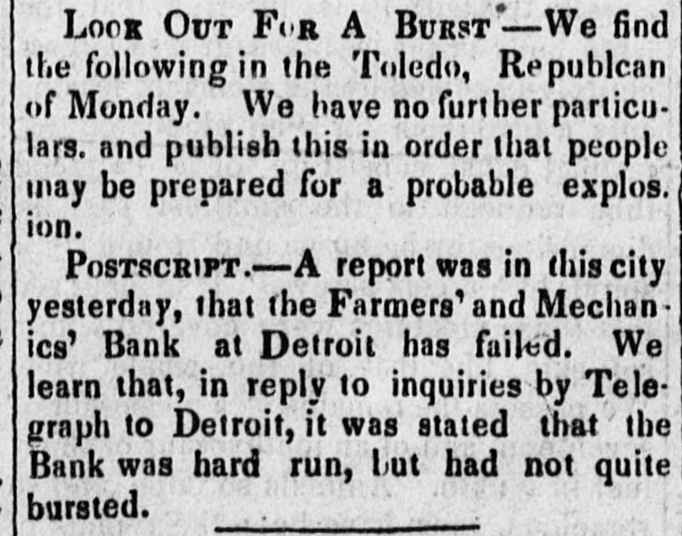
LOOK OUT FOR A BURST - We find the following in the Toledo, Republcan of Monday. We have no further particulars. and publish this in order that people may be prepared for a probable explos. ion. POSTSCRIPT.-A report was in this city yesterday, that the Farmers' and Mechan ics' Bank at Detroit has failed. We learn that, in reply to inquiries by Telegraph to Detroit, it was stated that the Bank was hard run, but had not quite bursted.


Article from The Evansville Daily Journal, October 7, 1857

Click image to open full size in new tab

Article Text

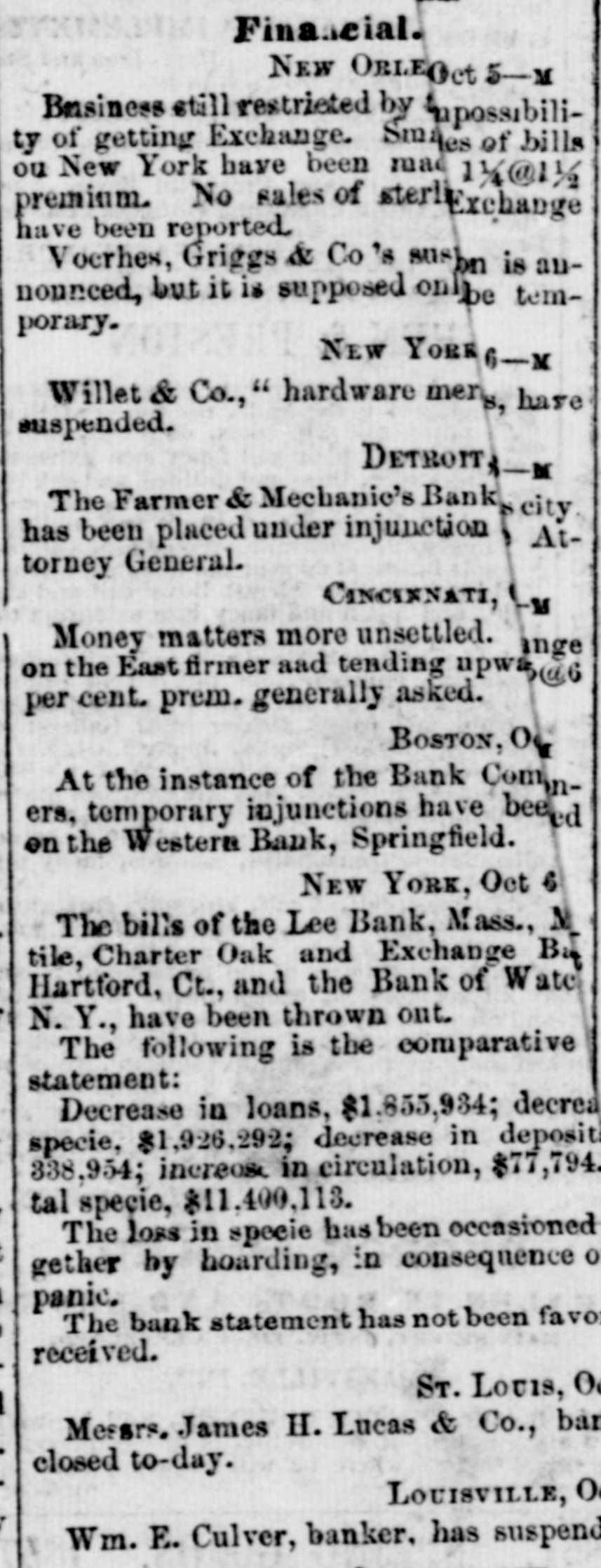
Financial. NEW ORLEOct 5-M Basiness still restricted by 4upossibility of getting Exchange. Smites of bills ou New York have been mad 134@1/2 premium. No sales of sterlexchange have been reported. Vocrhes, Griggs & Co 's susbn is annonnced, but it is supposed onlibe temporary. NEW YORKG-M Willet & Co.," hardware mers, have suspended. DETROITS_M The Farmer & Mechanic's Bank city Athas been placed under injunction torney General. CINCINNATI, M Money matters more unsettled. on the East firmer aad tending upwa ange @6 per cent. prem. generally asked. BOSTON, Of At the instance of the Bank Com,ners, temporary injunctions have beeed on the Western Bank, Springfield. NEW York, Oct 6 The bills of the Lee Bank, Mass., M tile, Charter Oak and Exchange Biq Hartford, Ct., and the Bank of Wate N. Y., have been thrown out. The following is the comparative statement: Decrease in loans, $1,855,934; decrea specie, $1,926,292; decrease in deposit 338,954; increose in circulation, $77,794. tal specie, $11,400,113. The loss in specie has been occasioned gether by hoarding, in consequence 0 panic. The bank statement has not been favo received. ST. Louis, O Messrs. James H. Lucas & Co., bar closed to-day. LOUISVILLE, O Wm. E. Culver, banker. has suspend


Article from Wheeling Daily Intelligencer, October 7, 1857

Click image to open full size in new tab

Article Text

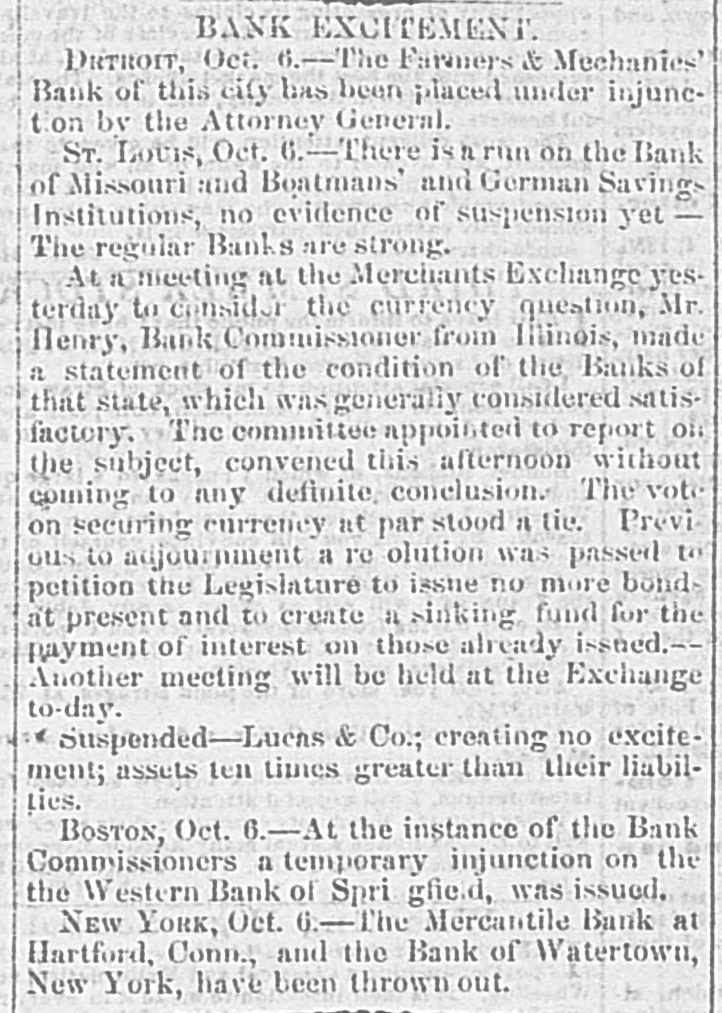
BANK EXCITEMENT. DRTHOIT, Oct. 6.-The Farmers & Mechanies' Bank of this city has been placed under injunetion by the Attorney General. ST. Louis, Oct. 6.-There is n run on the Bank of Missouri and Boatmans' and German Savings Institutions, no evidence of suspension yet el The regular Banks are strong. At a meeting at the Merchants Exchange yesterday to consider the currency question, Mr. Henry, Bank Commissioner from Illinois, made a statement of the condition of the Banks of that state, which was generally considered satisfactory. The committee appointed to report on the subject, convened this afternoon without coming to any definite. conclusions The vote on securing currency at par stood a tie. Previ ous to adjournment a re olution was passed to petition the Legislature to issue no more bonds at present and to create a sinking fund for the payment of interest on those already issued.-Another meeting will be held at the Exchange to-day. Suspended-Lucas & Co.; creating no excitement; assets ten times greater than their liabilties. BOSTON, Oct. 6.-At the instance of the Bank Commissioners a temporary injunction on the the Western Bank of Spri gfield, was issued. NEW YORK, Oct. 6.-The Mercantile Bank at Hartford, Conn., and the Bank of Watertown, New York, have been thrown out.


Article from New-York Daily Tribune, October 7, 1857

Click image to open full size in new tab

Article Text

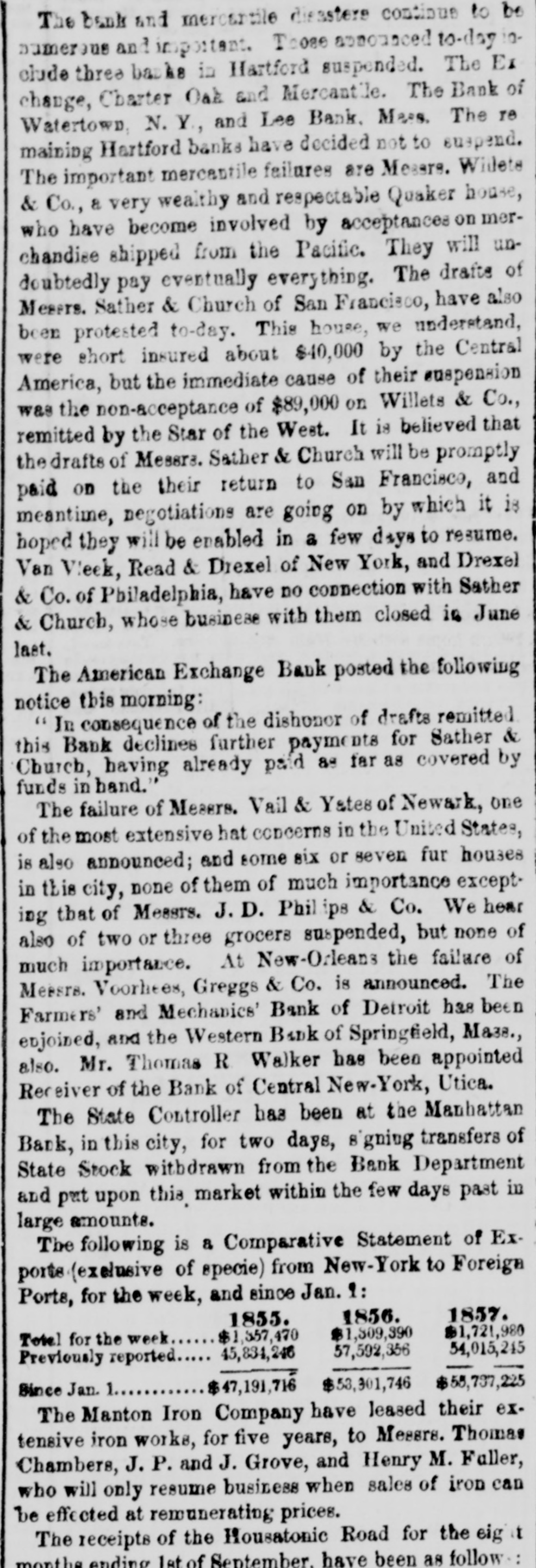
The bank and mercantile disasters continue to be numerous and important. Those ammounced to-day include three backs in Hartford suspended. The E1 change, Charter Oak and Mercantile. The Bank of Watertown N. Y., and Lee Bank. Mass. The re maining Hartford banks have decided not to suspend. The important mercantile failures are Messrs. Willets & Co., a very wealthy and respectable Quaker house, who have become involved by acceptances on merchandise shipped from the Pacific. They will undoubtedly pay eventually everything. The drafts of Measrs. Sather & Church of San Francisco, have also been protested to-day. This house, we understand, were short insured about $40,000 by the Central America, but the immediate cause of their suspension was the non-acceptance of $89,000 on Willets & Co., remitted by the Star of the West. It is believed that the drafts of Messrs. Sather & Church will be promptly paid on the their return to San Francisco, and meantime, negotiations are going on by which it is hoped they will be enabled in a few days to resume. Van Vieek, Read & Drexel of New York, and Drexel & Co. of Philadelphia, have no connection with Sather & Church, whose business with them closed in June last. The American Exchange Bank posted the following notice this morning: " In consequence of the dishoner of drafts remitted this Bank declines further payments for Sather & Church, having already paid as far as covered by funds in hand." The failure of Messrs. Vail & Yates of Newark, one of the most extensive hat concerns in the United States, is also announced; and some six or seven fur houses in this city, none of them of much importance excepting that of Messrs. J.D. Phil ips & Co. We hear also of two or three grocers suspended, but none of much importance. At New-Orleans the failure of Messrs. Voorhees, Greggs & Co. is announced. The Farmers' and Mechanics' Bank of Detroit has been enjoined, and the Western Bank of Springfield, Mass., also. Mr. Thomas R Walker has been appointed Receiver of the Bank of Central New-York, Utica. The State Controller has been at the Manhattan Bank, in this city, for two days, signing transfers of State Stock withdrawn from the Bank Department and put upon this market within the few days past in large amounts. The following is a Comparative Statement of Exports (exclusive of specie) from New-York to Foreign Ports, for the week, and since Jan. 1: 1857. 1856. 1855. $1,721,980 $1,309,390 $1,357,470 Total for the week 54,015,245 57,592,356 45,834,246 Previously reported $55,787,225 $53,301,746 $47,191,716 Since Jan. 1 The Manton Iron Company have leased their extensive iron works, for five years, to Messrs. Thomas Chambers, J. P. and J. Grove, and Henry M. Fuller, who will only resume business when sales of iron can be effected at remunerating prices. The receipts of the Housatonic Road for the eig it months ending 1st of Sentember. have been as follow


Article from The Daily Gate City, October 8, 1857

Click image to open full size in new tab

Article Text

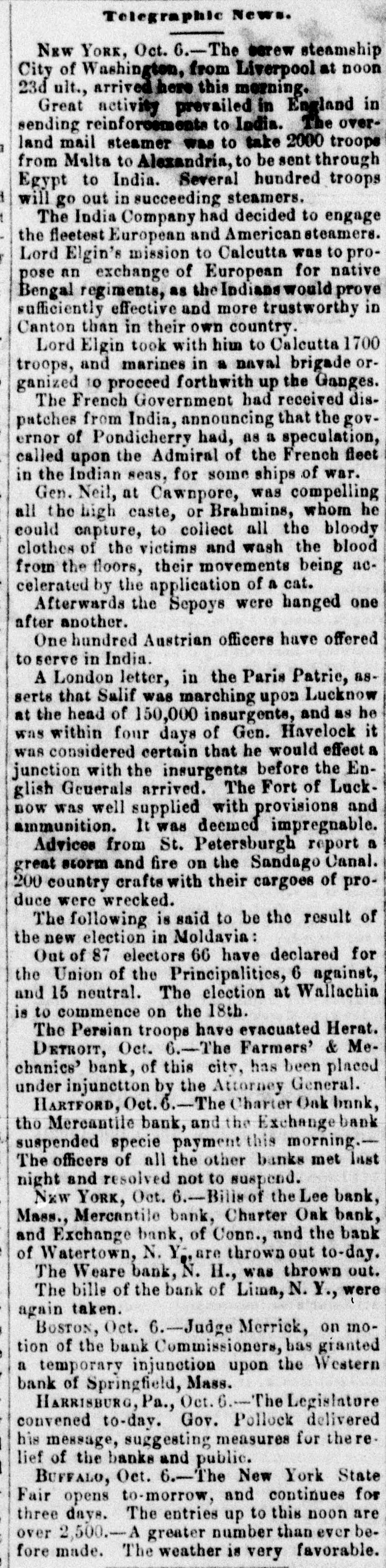
Telegraphic News. New YORK, Oct. 6.-The screw steamship City of Washington, from Liverpool at noon 23d ult., arrived here this morning. Great activity prevailed in England in sending reinforcements to India. The overland mail steamer was to take 2000 troops from Malta to Alexandria, to be sent through Egypt to India. Several hundred troops will go out in succeeding steamers. The India Company had decided to engage the fleetest European and American steamers. Lord Elgin's mission to Calcutta was to propose an exchange of European for native Bengal regiments, as the Indians would prove sufficiently effective and more trustworthy in Canton than in their own country. Lord Elgin took with him to Calcutta 1700 troops, and marines in a naval brigade organized 10 proceed forthwith up the Ganges. The French Government had received dispatches from India, announcing that the governor of Pondicherry had, as a speculation, called upon the Admiral of the French fleet in the Indian seas, for some ships of war. Gen. Neil, at Cawnpore, was compelling all the high caste, or Brahmins, whom he could enpture, to collect all the bloody clothes of the victims and wash the blood from the floors, their movements being accelerated by the application of a cat. Afterwards the Sepoys were hanged one after another. One hundred Austrian officers have offered to serve in India. A London letter, in the Paris Patrie, asserts that Salif was marching upon Lucknow at the head of 150,000 insurgents, and as be was within four days of Gen. Havelock it was considered certain that he would effect a junction with the insurgents before the English Generals arrived. The Fort of Lucknow was well supplied with provisions and ammunition. It was deemed impregnable. Advices from St. Petersburgh report a great storm and fire on the Sandago Canal. 200 country crafts with their cargoes of produce were wrecked. The following is said to be the result of the new election in Moldavia: Out of 87 electors 66 have declared for the Union of the Principalities, 6 against, and 15 neutral. The election at Wallachia is to commence on the 18th. The Persian troops have evacuated Herat. DETROIT, Oct. 6.-The Farmers' & Mechanics' bank, of this city, has been placed under injunetton by the Attorney General. HARTFORD, Oct. 6.-The Charter Oak bnnk, tho Mercantile bank, and the Exchange bank suspended specie payment this morning.The officers of all the other banks met last night and resolved not to suspend. NEW YORK, Oct. 6.-Bills of the Lee bank, Mass., Mercantile bank, Charter Oak bank, and Exchange bank, of Conn., and the bank of Watertown, N. Y;, are thrown out to-day. The Weare bank, N. H., was thrown out. The bille of the bank of Lima, N. Y., were again taken. BOSTON, Oct. 6.-Judge Merrick, on motion of the bank Commissioners, has granted a temporary injunction upon the Western bank of Springfield, Mass. HARRISBURG, Pa., Oct. 6.-The Legislatore convened to-day. Gov. Pollock delivered his message, suggesting measures for there. lief of the banks and public. BUFFALO, Oct. 6.-The New York State Fair opens to-morrow, and continues for three days. The entries up to this noon are over 2,500.-A greater number than ever before made. The weather is very favorable.


Article from The Evansville Daily Journal, October 9, 1857

Click image to open full size in new tab

Article Text

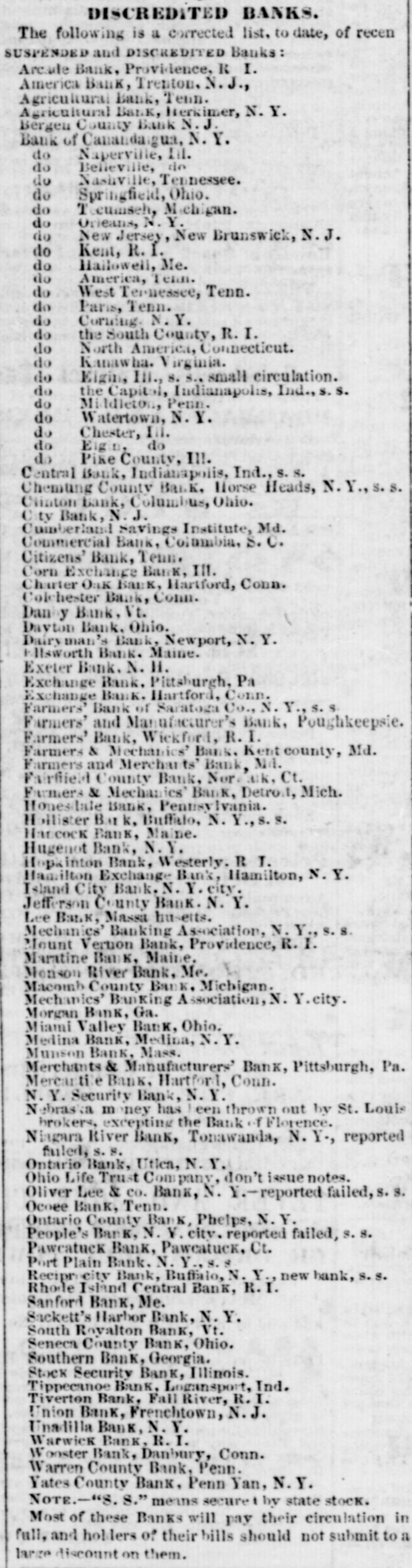
DISCREDITED BANKS. The following is a corrected list, to date, of recen SUSPENDED and DISCREDITED Banks: Arcade Bank, Providence, R I. America Bank, Trenton. N.J., Agricultural Bank, Tenn. Agricultural Bank, Herkimer, N. Y. Bergen County Bank N.J. Bank of Canandaigua, N. Y. do Naperville, III. do Believille, de do Nashville, Tennessee. do Springfield, Ohio. do Tecumsch, Michigan. do Orleans, N.Y. do New Jersey, New Brunswick, N.J. do Kent, R.I. do Hallowell, Me. do America, Tenn. do West Ternessee, Tenn. do Paris, Tenn. do Corning. N.Y. do the South County, R. I. do North America, Connecticut. do Kanawha. V Tirginia. do Eigin, III., S. S., small circulation. do the Capitol, Indianapolis, Ind., S. S. do Middleton, Penn. do Watertown, N.Y. do Chester, III. do Eigin, do do Pike County, III. Central Bank, Indianapolis, Ind., S.S. Chemting County Bank, Horse Heads, N.Y., S. S. Clinton bank, Columbus, Ohio. City Bank, N.J. Cumberland Savings Institute, Md. Commercial Bank, Columbia, S. C. Citizens' Bank, Tenn. Corn Exchange Bank, Ill. Charter Oak Bank, Hartford, Conn. Colchester Bank, Conn. Dan Bank, Vt. Dayton Bank. Ohio. Dairy Bank, Newport, N.Y. Ellsworth Bank. Maine. Exeter Bank. N. H. Exchange Bank, Pittsburgh, Pa Exchange Bank. Hartford, Conn. Farmers' Bank of Saratoga Co., N. Y.,s.s Farmers' and Manufacturer's Bank, Poughkeepsie. Farmers' Bank, Wickford, R.I. Farmers & Mechanics' Bank, Kent county, Md. Farmers and Merchants Bank, Md. Fairfield County Bank, Nor. alk, Ct. Farmers & Mechanics' Bank, Detroit, Mich. Honesitate Bank, Pennsylvania. Hollister Bar k, Buffalo, N. Y., S. Hancock Bank, Maine. Hugenot Bank, N.Y. Hopkinton Bank, Westerly. R T. Hamilton Exchange Bank, Hamilton, N.Y. Island City Bank, N. Y. city. Jefferson County Bank. N. Y. Lee Bank, Massa husetts. Mechanics' Banking Association, N. Y., S.S. Mount Vernon Bank, Providence, R. I. Maratine Bank, Maine. Monson River Bank, Me. Macomb County Bank, Michigan. Mechanics' Banking Association, N. Y.city. Morgan Bank, Ga. Miami Valley Bank, Ohio. Medina Bank, Medina, N.Y. Munson Bank, Mass. Merchants & Manufacturers' Bank, Pittsburgh, Pa. Mercar tile Bank, Hartford, Conn. N.Y. Security Bank, N.Y. Nebraska m ney has been thrown out by St. Louis brokers, excepting the Bank of Florence. Niagara River Bank, Tonawanda, N. Y., reported failed, S.S. Ontario Bank, Utica, N.Y. Ohio Life Trust Company, don't issue notes. Oliver Lee & co. Bank, N. Y.-reported failed, S. S. Ocoee Bank, Tenn. Ontario County Bank, Phelps, N.Y. People's Bank, N. V. city. reported failed, S. S. Pawcatuck Bank, Pawcatuck, Ct. Port Plain Bank. N. Y.,s.s Recipr city Bank, Buffalo, N. Y., new bank, S. S. Rhode Island Central Bank, R.I. Sanford Bank, Me. Sackett's Harbor Bank, N.Y. South Royalton Bank, Vt. Seneca County Bank, Ohio. Southern Bank, Georgia. Stock Security Bank, Illinois. Tippecanoe Bank, Logansport, Ind. Tiverton Bank, Fall River, R.I. Union Bank, Frenchtown, N.J. Unadilla Bank, N.Y. Warwick Bank, R. I. Wonster Bank, Danbury, Conn. Warren County Bank, Penn. Yates County Bank, Penn Yan, N.Y. NOTE.-"S. 8." means securet by state stock. Most of these Banks will pay their circulation in full, and holders of their bills should not submit to a large discount on them.
Article from The New York Herald, October 10, 1857

Click image to open full size in new tab

Article Text

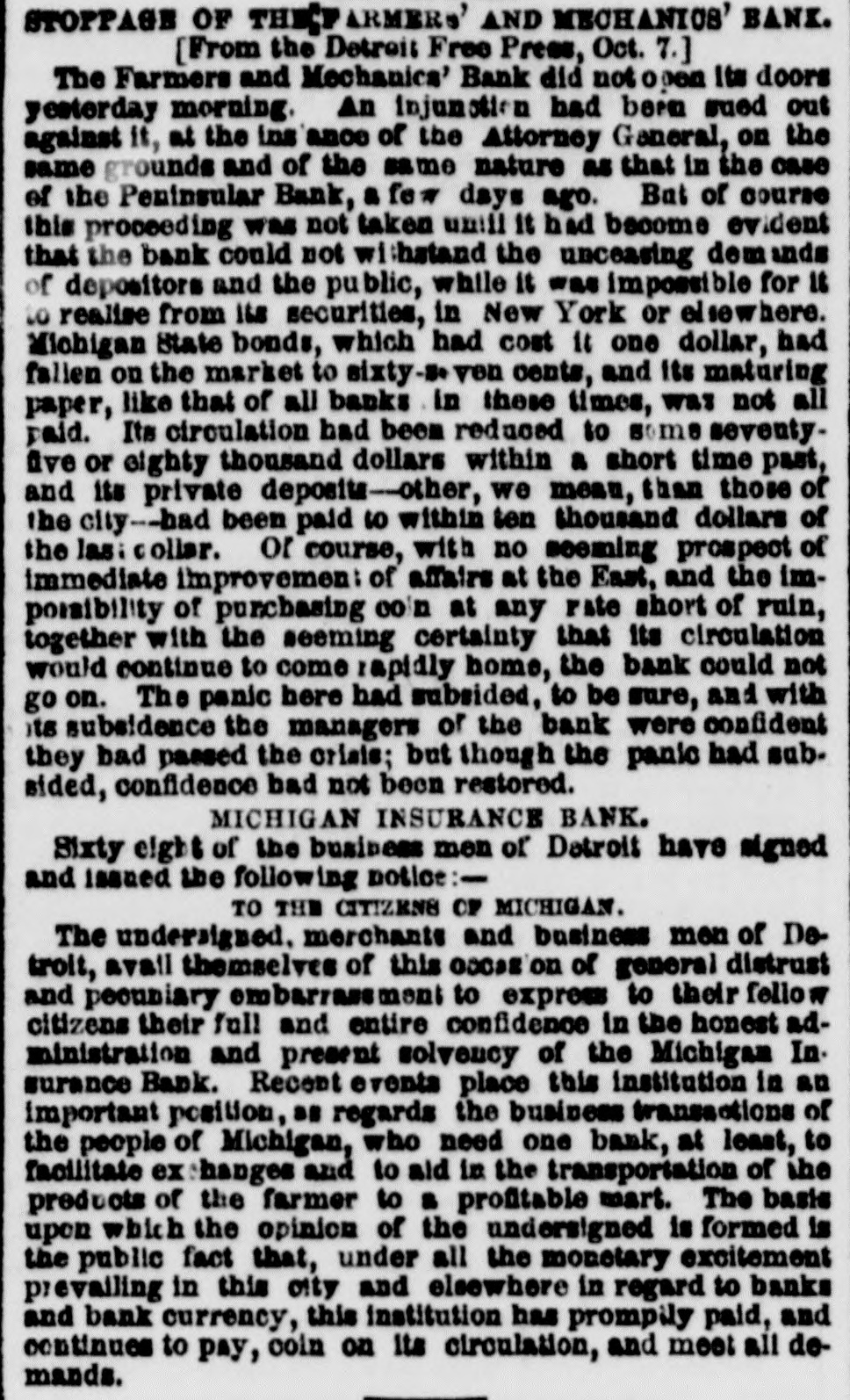
STOPPAGE OF THE'F ARMERS' AND MECHANICS' BANK. [From the Detroit Free Press, Oct. 7.] The Farmers and Mechanics' Bank did not open Its doors yesterday morning. An injunstion had been sued out against it, at the ins ance of the Attorney General, on the same grounds and of the same nature as that in the case of the Peninsular Bank, a few days ago. But of course this proceeding was not taken un!!! it had become evident that the bank could not withstand the unceasing ands of depositors and the public, while it was impossible for it to realise from its securities, in New York or elsewhere. Michigan State bonds, which had cost it one dollar, had fallen on the market to sixty-s+ ven cents, and its maturing paper, like that of all banks in these times, was not all paid. Its circulation had been reduced to some seventyfive or eighty thousand dollars within a short time past, and its private deposits-other, we meau, than those of the city-bad been paid to within ten thousand dollars of the las: collar. or course, with no seeming prospect of immediate improvement of affairs at the East, and the impossibility of purchasing coin at any rate short of ruin, together with the seeming certainty that its circulation would continue to come rapidly home, the bank could not go on. The panic here had subsided, to be sure, and with its subsidence the managers or the bank were confident they bad passed the crisis; but though the panic had subsided, confidence bad not been restored. MICHIGAN INSURANCE BANK. Sixty eight of the business men of Detroit have signed and issued the following notice:TO THE CITIZENS OF MICHIGAN. The undersigned, merchants and business men of Detroit, avail themselves of this occasion of general distrust and pecusiary embarrassment to express to their fellow citizens their full and entire confidence in the honest administration and present solvency of the Michigan Insurance Bank. Recent events place this institution in an important position, as regards the business transactions of the people of Michigan, who need one bank, at least, to facilitate ex hanges and to aid in the transportation of the preducts of the farmer to a profitable mart. The basis upon which the opinion of the undersigned is formed is the public fact that, under all the monetary excitement prevailing in this city and elsewhere in regard to banks and bank currency, this institution has promptly paid, and continues to pay, coin on its circulation, and meet all demands.


Article from Sunbury American, October 10, 1857

Click image to open full size in new tab

Article Text

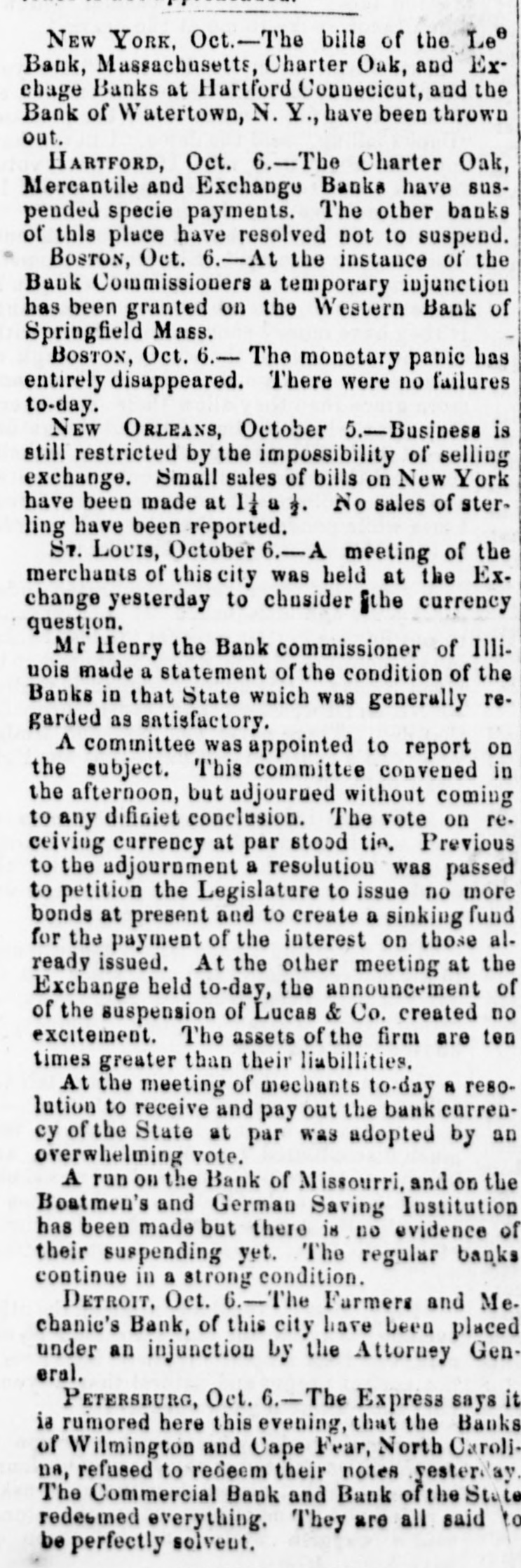
NEW YORK, Oct.-The bills of the Lee Bank, Massachusetts, Charter Oak, and Exchage Banks at Hartford Connecicut, and the Bank of Watertown, N. Y., have been thrown out. HARTFORD, Oct. 6.-The Charter Oak, Mercantile and Exchange Banks have suspended specie payments. The other banks of this place have resolved not to suspend. Bosron, Oct. 6.-At the instance of the Bank Commissioners a temporary injunction has been granted on the Western Bank of Springfield Mass. BOSTON, Oct. 6.- The monetary panic has entirely disappeared. There were no failures to-day. NEW ORLEANS, October 5.-Business is still restricted by the impossibility of selling exchange. Small sales of bills on New York have been made at 11 a 1. No sales of sterling have been reported. Sr. LOUIS, October 6.-A meeting of the merchants of this city was held at the Exchange yesterday to chusider [the currency question. Mr Henry the Bank commissioner of Illiuois made a statement of the condition of the Banks in that State which was generally regarded as satisfactory. A committee was appointed to report on the subject. This committee convened in the afternoon, but adjourned without coming to any difiniet conclusion. The vote on receiving currency at par stood tie. Previous to the adjournment a resolution was passed to petition the Legislature to issue no more bonds at present and to create a sinking fund for the payment of the interest on those already issued. At the other meeting at the Exchange held to-day, the announcement of of the suspension of Lucas & Co. created no excitement. The assets of the firm are ten times greater than their liabillities. At the meeting of mechants to-day a resolution to receive and pay out the bank currency of the State at par was adopted by an overwhelming vote. A run on the Bank of Missourri, and on the Boatmen's and German Saving Institution has been made but there is no evidence of their suspending yet. The regular banks continue in a strong condition. DETROIT, Oct. 6.-The Farmers and Me. chanic's Bank, of this city have been placed under an injunction by the Attorney General. PETERSBURG, Oct. 6.-The Express says it is rumored here this evening, that the Banks of Wilmington and Cape Fear, North Carolina, refused to redeem their notes yesterNay The Commercial Bank and Bank of the State redeemed everything. They are all said to be perfectly solvent.


Article from Anti-Slavery Bugle, October 10, 1857

Click image to open full size in new tab

Article Text

II. N. LEWIS, We much regret to hear of the death of Mr. II. N. Lewis, formerly junior editor of the Alliance Ledger, and more recently of the Wyandot Pioneer. He was, when he died, in the prime of life. May the turf rest lightly upon him. BOSTON. Oct. 6.-Among the bequests of the late John E. Thayer was $50,000 to Harvard College, the income of which is to be applied to the aid of the ten best under graduates who may be in need of pecuniary assistance. DETROIT, Oct. 6.-The Farmers' & Mechanics' Bank of this city has been placed under an injunetion by the Attorney Generul. WRONG IMPRESSION.-The New Haven Register corrects the erroncous impression that has obtain ed, that the whole forty-three signers of the noble memorial to President Buchanan are clergymen. Only five of them are clergymen, and the remainder, lawyers, doctors and other folks. The Cincinnati Commercial says that "the low price of whisky and the high price of corn is causing distillers in this section to suspend operations. In consequence of this fact stock hogs are becoming more abundant, and prices are declining. We learn that the hog cholera also prevails to a considerable extent in the pens attached to distillers in this vicinity." SAMUEL HOAR.--A monument has lately been erected in the cemetry at Concord, Mass, in memory of the Hon. Samuel Hoar, who died in november last. it is of Quincy granite, twelve feet high, six wide, and three deep and represents a door and window, the design being from the pilgrim's progress. The following forms the inscription on a white marble slab beneath the window. "The Pilgrim they laid in a chamber, whose window opened toward the sun-rising. The name of the chamber was Peace. There he lay till the break of day, and then he awoke and sang." Upon an other marble slab beneath is the epitaph. The sub-marine telegraph cable, connecting Europe with Africa. was successfully laid on the 9th ult., between Bona and Cape Tenlada, a distance of one hundred and forty miles. It was submerged more than two miles deep a part of the distance, The total population of Canada is now 2,271. 437. The increase in five years is 729,172. Capt. T. Kendrick, while on a scout on Fish Eating Creek, Florida, a short time ago, found a monster live oak tree, measuring 37 feet in circumference, which throws a shade at noon, 45 yards in diameter. Capt. K's whole company, 88 men, dined under the shade of this tree, at noon, e and hitched their horses to the limbs ! S COMMERCIAL Morals.-The Rev. James Martinau; the great English preacher, has recently published a discourse on "Commercial Morals,' in which he says that ,,in the rapid expansion of d relations and the haste of human affairs, practices 1. slide insensible into existence and get a footing as n usages, before any conscience has time to estimate them; and when they have won the sanction of e precription they soon shape consciences to suit se them, and laugh at the critic as a simpleton, and e hurry on the crash of social retribution." He adds: 1e The defences frequently put forth for the ques 10 tionable usages on which I have touched, seemยฎ to 8shed a painful light upon the inner ethics of mod 1e ern trade. Indicating as they do a wide-spread m confusion of sentiments, a drifting judgment with out moral compass to steer by in newly opening elatitudes of human affairs, they arc more startling re to the thoughtful observer' than the exceptiona ut cases of individual fraud which less corrupt the Id popular fancy, because they speak more plainly for themselves. There has not been an execution in Maine for twenty four years.


Article from The Burlington Weekly Hawk-Eye, October 14, 1857

Click image to open full size in new tab

Article Text

TELEGRAPHIC. 5. Philad liphing Un Much stockholders legislature discovery bonds the extending a individually liable for all the debts of the pany thereafter with provision use of include bonds which may be issued in He bonds alrea dy existing New York, Oct. 6. The screw unship City of from Liverpool noots:28-1 use. arrived here here morning this Great activity prevailed in zland in send ing. reinforce to India. The overland mail stramer Was 10 take 2000 troops from Malta to Alexandria, to be sent through Egy of to India. Several hundred iroops will go out in succeeding steamers. The India Company had decided to engag American and Europeas the fleetent Lord Elgin's mission to Calcutan was to propose exchange of European for native Bengal reg iments, as the Indiana would prove effective and more trustworthy is Cantos than in their own country. Lord Elgin took with him to Calentia 1700 troops, and marines in naral brigade organized to proceed forthwith up the Ganges received dishad Government French The patches from Indian. lag that the Gov ernor of Pondicherry ha called upon the Admiral of the French fleet in the Indian seas. for some ships of war. Gen. Neil at Cawnpere the high caste, or Brahmann, whom be could cap. ture, to collect all the bloody clothes of the victims and was the blood from the floors, their movements being accel rated by the ap plication of cat. Afterwards the Sapoys were hanged one after another. One hundred Austrians offi ers have offered to serve India. London letter in the Puris Patrie asserts that Salif was marching upon Lucknow at the head of 150,000 insurgents and as he was with. in four days of Gen. Havelock was considered certain that he would effect junction with the insurgents before the English General arrived. The Fort of Lucknow was well supplied with provisions and ammu mitious. It was deemed impregnable Advices from St. Petersburg report a great storm and fire on the Sandago Canal. 200 country crafts with their rgoes of produce recked. The following is said to be the result of the new election in Moldavi Out of 87 electors 66 have declared for the union of the Princi palities, against, a neutral. The election at Wallachia is to commence on the 18th. The Persian troops have evacuated Herat. Detroit, Oct. 6. The Farmers & Mechanics Bank, of this city. has been placed under in junction by the Attor ney General Hartford, Oct. 6 The Charter Oak Bank, the Mercantile Bauk and the Exchange Bank, suspended specie pay ment this morning The officers of all the other banks met last night and resolved not to suspend. New York, Oct. 6 Bills of the Lee Bank, Mass, Mercantile Bank Charter Oak Bank, and Exchange Bank, of Conn., and the Bank of W atertown, N.Y. are thrown out to day The Weare Bank N. H. was thrown out. The Bills of the Bank of Lima, N.Y., were again taken. convention, said to be composed of dele gates from the Working Men's Society, assem bled last night and adopte series of resolutions, strongly opposing State Prison Convic Labor, and endorsing the Democratic State Ticket, with the exception of Hiram Denio, Jr in whose place Hiram Ketchum was nominated The work on the sto pendioous Bergeu Tunnel which has for some time been partially stopped, wholly suspended yesterday morning, thus throwing out of employment about eight hun dred men. 6. Oct. Boston, Judge Merrick, on motion of the Bank Com missioners, has granted temporary injunction upon the Western Bank of Sp ringfield, Mase. Harrisburg, Pa Oct. 6. The Legislature courened to-day. Gov. Polmeasures lock delivered his message suggesting for the relief of the banks and public. Buffalo, Oct. 6. opens to-morrow The New York State Pair The entries up and continues for three days. greater number to this noon are over 2.500.than ever before made. The weather very favorable. Boston, Oct. 7 The royal mail steam ship Canada sailed from here at noon to-day, with 27 passengers for She takes out Halifax and 74 for Liverpool. $2,500 in specie. Augusta, Oct. 7 The returns in ddicate the re election to Congress of the Hon. James Seward in the First District. 7. Oct. New York, The attendance at the State Temperance Con vention small only 35 in all. great portion of time was taken up in discussing the merits of the Excise Low which was generally denounce in unmeasured to into enter It determined was terms any entangling alliance with existing parties but to urge prohibition, and the importance of supporting those only on their respective tick ets who were known to oppose the license principle. By the arrival of the City of Wash ington and Fulton there nothing later from India. Messra Harrison. Watson & Co., bank ers of Hull, had with failed large The Emperors of France and Russia met at ult the 27th St Ullgard Mexico accepts the mediation of France and England, and with Spain. The Emperors of Russia Austria were to Weimer on note The Liverpool Provision market sugar market was steady Consols closed 90 @ 901 Troy, Oct. 7 Colonel Richard J. Newelson, resident of Sand Lake in this county, and formerly an ex tensive and wealthy business man in Jersey City, committed suicide while in a fit of tempo rary insanity, at 4 o'clock this a.m. He first cut his throat and then threw himself before train cars on the Hudson Railroad. His body caused has event was dreadfully mangled. The profound sensation here. Harr burg. Oct. T to The Senate has adjourned till afternoon A allow the committees to propar business. bill was presented, authorizing a loan of $100, It occasioning 000 to the State Treasur much excitement, and there many enquiries made as to the necessity of such loan. Toronto, Oct. 7 E. Whitemore & Co., bankers, to-day Much BY mpathy manifested for them in consequence of their high character. 8. Oct. Buffalo, Third day New York State Fair. eather continues fine. It is estimated that there are 50,000 people on the ground to-day. The interest is of the most intease kind, and on the $8,000 had been received at the ticket office at 12 o'clock. Not an accident has hap the occasion. mar the to pened engine on the New York & Erie Railroad ran into the way Express East, the Buffalo & Erie this at crossing of the two in this city, seriously, but not fatally injuring seven persons. No one killed. The train was heavy loaded with passengers on their way to the State Fair. No through passengers on board. New York, Oct. 8. Messrs. Geo. Blies & Co., dry goods, ask an extension and will par with interest. The Hon. Le wis McLean died in Baltime a last evening. Bowen, Name & Co. hare failed. Amets


Article from The Weekly Pioneer and Democrat, October 15, 1857

Click image to open full size in new tab

Article Text

Bank Affairs. HARTFORD, Oct. 6.-The Charter Oak Bank, the Mercantile Bank, and the Exchange Bank suspended specie payments this morning. The officers of all the other banks met last night. and resolved not to suspend. NEW YORK, Oct. G.-Bills of the Lee Bank. Mass.: Mercantile Bank, Charter Oak Bank. and Exchange Bank of Conn., and Bank of Watertown. N.Y., are thrown out to-day. DETROIT. Oct. 6.-The Farmers' and Mechanics' Bank, of this city, has been placed under injunction by the Attorney-General. BOSTON. Oct. 6.-Judge Merrick, on motion of the Bank Commissioners, has granted a temporary injunction upon the Western Bank of Springfield, Mass.


Article from The Plymouth Republican, August 7, 1879

Click image to open full size in new tab

Article Text

WALTER. Fairfield, Iowa, July 23, 1879. OLD-TIME BANKING. How Specie Payments were Maintained by a Detroit Bank. [Detroit News.] Some funny stories are told of business methods in the olden time, one of which will bear repeating as an illustration of the advantagee sil. ver dollars possess as a bank reserve -and which by the way, we especially commend to Secretary Sherman. The old Farmers' and Mechanics' bank was established in Detroit in 1830. In 1845, owing to some disastrous operations in Ohio, it was temporarily badly crippled, and to tide over the crisis the directors lent their best energies. The bank had a large volume of notes outstanding, all redeemable in coin on presentation, and it was apprehended that the moment the condition of the institution became known a run would ensue which would compel the closing of their doors. Now-a-days a bank officer would throw up the sponge under such circumstances and suspend payment like a little man, but then bank ers were both bold and fertile of expedient. The coin had run down very low, and there was no time to be lost. The services of a friend of the institution were secured, and he was privately sent to a large creditor (Lyell, the subsequently defaulting banker. by the way) to whom hecritical state of the bank was whispered and the wisdom of some measures of self-protection suggested. Lyell snapped at the bait and upon a hint from the officious minister rushed around to the nearest court and got out an injunction forbidding the bank to pay out any more coin pending the order of the court. This effectually saved the concern. for when note holders subsequently presented the bank's paper for redemption they were politely met with the reply, "We would be very happy to oblige you, sir, but unfortunately we are for a few days tied up by a process of the Wayne circuit court. We hope the it junction will soon be dissolved, when, etc." It was late in the afternoon when the injunction was served, and the stock of coin had some hours previously dwindled to $53. The cashier meantime was on nettles. If that injunction did not come quickly the concern was ruined. At every opening of the door the poor man trembled in his shoes lest the new comer should be a note holder in quest of coin. One more demand would close the concern forever. Slowly the clock ticked off the minutes, full thirty of which must yet elapse be. fore the hour of closing. Would that injunction never come! At last the door opened and a nervous, bustling man hurried to the counter. The cashier saw at a glance that it wasall up with him, but while there was life there was still hope, he thought. "Here, Mr. Cashier, I've got five hundred dollars of your notes I want coin for." The cashier endeavored to preserve a placid exterior while he deliberately bethought himself how he


Article from Spirit of Jefferson, September 9, 1879

Click image to open full size in new tab

Article Text

MISCELLANEOUS. OLD-TIME BANKING. [From the Detroit News 1 OME funny stories are told of business which methods in the olden times, one of the repeating as an illustration of silver dollars possess as a advantages will bear especially bank reserve, and which, by the Sherman. way, we commend to Secretary The old Farmers' and Mechanics' Bank in Detroit in 1839. In 1845, was to some disastrous owing established operations crippled, in and Ohio, temporarily badly to the erisis the directors The bank had a tide it best was over energies. large lent volume their coin of notes outstanding, all redeemable in that on presentation, and it was apprehended institution moment the condition of the became the known a run would ensue, compell- a the closing of their doors. Nowadays bank icg officer would throw up the sponge unsuch circumstances, and suspend payder like a little man; but then bankers ment bold and fertile of coin were had run down very low, and both expedient. there friend The was be lost. The services of a of no institution were secured, was sent to a large creditor, privately the time to and (Lyell, the he way) the subsequently defaulting banker, by was whom the critical state of the bank to and the wisdom of some measures whispered, Lyell anapped the offiand, upon a hint from at rushed around to cious the visitor, bait, the forbidding nearest court and got out an injunction bank to pay out any more coin pending of the court. This for when note the the order concern, effectually holders subso. saved the bank's papers the rcwere politely met the demption quently presented they with for 'We should be very happy to oblige few reply, sir, but unfortunately we are for a Ciryou, days tied up by a process of the Wayne will cuit Court. We hope the injunction soon be dissolved. when," &c. late in the afternoon when the inwas served, and the stock hours dwindled to junction It was previously of $53. coin The had cashier in the meantime wason did not come quickly some injunction nettles. the the concern If door the ruined. At every opening of the was poor man trembled in hie shoes lest the comer should be a note-holder in quest more demand would the forever. Slowly the clock off concern of new coin. One which ticked must close yct full thirty of before the hour of clapse the minutes, closing. last the Would door that injunction never come! At opened, and a nervous, bustling man hurried to the counter. The cashier saw at a glance that it was all up with him, but while there was still hope, he thought. "Here, Mr. Cashier, " I've got S500 of your notes I want coin for." The cashier endeavored to preserve a placwhile he deliberately bethought how he might delay a himself id exterior refusal perchance, of payfor a little while. until, an ment officer would come in with the hoped-for injunction. So you want coin for your bills, do you?" with suavely remarked the cashier, glancing the corner of his eyes through the open window into the all too quiet street. "Why, yes! I live in Dexter, and I want to catch the 4 o'clock train; so please hurry up the specie." right! What's the news in Dexter? 'All do the crops look? How's my ? Is he living there still? friend How And, old by the way, what in the world can you that do with specie in that little country town Farmers' and Mechanics' bills won't accom plish?" Oh, never mind. Give me my money, can catch the train. is, so ig a little flurry out there there that I The about make fact the safety of your bank, and I want to sure of my 'Ha! money." ha! ha!" laughed the cashier; "afraid are they? Well, must of fastidious when getting our bank, pretty they the won't conserva- suit be tive old Farmers' and Mechanics' them. Why, my dear sir-' Never mind the pedigree of your bank, but give me my money, or I shall miss my train." "Certainly, my dear sir," (another glance in through the window, but gtill no sheriff sight.) Aside: What shall I do?" I've got ten catch "There, only minutes to train. If you will assure me upon bank your my honor that it is all right, and that the butif is not going to bust, I won't wait now, you are going to shut up I want my money. Come, "Really, how is sir," it?" replied the polite eashier, place me in a very delicate position. "you If tell you the bank is safe. and anything on hereafter. you will blame me; I happens other hand. if I tell you it is shaky the shall be unfaithful to my employers. and shall very justly be discharged. I prefer not to make out any statement. but simply c out your thousand half dollars." (Half d lara were the principal coinage in circulation at that time.) Turning, screw driver in hand, to a strong wooden box, apparently tightly screwed to


Article from Daily Globe, October 26, 1879

Click image to open full size in new tab

Article Text

Old-Time Banking. Some funny stories are told of business methods in the olden time, one of which will bear repeating as an illustration of the advantages silver dollars possess as a bank reserve. The old Farmer's & Mechanics' Bank was established in Detroit in 1839. In 1845, owing to some disastrous operations in Ohio, it was temporarily badly crippled, and to tide over the crisis the directors lent their best energies. The bank had a large volume of notes out-standing, all redeemable in coin on presentation, and it was apprehended that the moment the condition of the institution]became known a run would ensue which would compel the closing of their doors. Now-a-days a bank officer would throw up the sponge under such circumstances, and suspend payment like a little man, but then bank ers were both bold and fertile of expedient. The coin run down very low, and there was no time to be lost. The services of a friend of the institution were secured, and he was privately sent to a creditor (Lyell, the subsequently defaulting banker, by the way), to whom the Critical state of the bank was whispered, and the wisdom of some measures for self protection suggested. Lyellsnapped at the bait, and upon a hint from the officious visitor, rushed to the nearest court and got an injunction forbidding the bank to pay out any more coin pending the order of the court. This effectually saved the concern, for when noteholders subsequently presented the bank's paper for redemption, they were polite1y met with the reply, "We should be very happy to oblige you, sir, but unfortunately we are for a few days tied up by a process of the Wayne Circuit Court. We hope the injunction will soon be dissolved when, etc." It was late in the afternoon when the injunction was served, and the stock of coin had some hours previously dwidled to $53. The Cashier meantime was on nettles. If that injunction did not come quickly the concern was ruined. At every opening of the door the poor man trembled in his shoes, lest the new-comer should be a note holder in quest of coin. One more demand would close the concern forever. Slowly the clock ticked off the minutes, full thirty of which must yet elapse before the hour of closing. Would that injunction never come! At last the door opened, and a nervous, bustling man hurried to the counter. The Cashier saw at a glance that it was all up with him, but while there was a little hope he thought. "Here, Mr. Cashier, I've got $500 of your notes I want coin for." The cashier endeavored to preserve a placid exterior while he deliberately bethought himself how he might delay a refusal of payment for a little while, until, perchance, an officer would come in with the hoped-for injunction. "So you want coin for your bills, do you?" suavely remarked the cashier, glancing with the corner of his eye through the open window into the all too quiet street. "Why, yes! I live in Dexter, and I want to catch the four o'clock train; so hurry up the specie." "All right! What's the news in Dexter? How do the crops look? How's my old friend Is he living there still? And by the way, what in the world can you do with specie in that little country town that Farmers & Mechanics' bills won't accomplish?" "O! never mind. Give me my money 80 that I can catch the train. The fact 18, there is a little flurry up there about the safety of your bank, and I want to make sure of my money." "Ha! Ha! Ha!" laughed the Cashier; "afraid of our bank, are they? Well, they must be getting pretty fastidious when the conservative old Farmers' and Mechanics' won't suit them. Why, my dear sir "Never mind about the pedigree of your bank, but give me my money or I shall miss the train." "Certainly, my dear sir." (Another glance through the window, but still no Sheriff in sight.) Aside: "What shall I do!" "There, I've got only ten minutes to catch my train. If you will assure me upon honer that it is all right, and that the bank is not going to bust, I won't wait now, but if you are going to shut up I want my money. Come, how is it, old fellow "Really, sir," replied the polite Cashier, "you place me in a very delicate position. If I tell you the bank is safe, and anything happens hereafter, you will blame me; on the other hand, if I tell you it is shaky I shall be justly discharged. I prefer not to make any statement, but simply count out your 1,000 half dollars.' (Half dollars were the principal coinage in circulation at that time.) Turning screw-driver in hand, to a strong wooden box, apparently tightly screwed together, such as silver coin was usually packed in in those days, but which the Cashier knew very well to be absolutely empty, he wiped off his brow and set himseif to work as if to an herculean task. The man glanced at the clock, then at the iron bound coin-box, then mentally calculated the weight of a thousand halfdollars, then burst out with: "Never mind; I see you have got the coin, and I'll be darned if I'm going to pack a thousand half dollars all the way to Dexter to-night. Never mind, Mr. Cashier, I won't trouble you,"-and out of the bank he darted. The injunction was served soon after and the danger passed. But the old Farmers' and Mechanics' still kept up the habit of being short of coin, and did so till the last, when nearly twenty years latter what was left of wasconsolidated


Article from The Princeton Union, October 29, 1879

Click image to open full size in new tab

Article Text

to future generations as that of a hero and the savior of his country. Old-Time Banking. Some funny stories are told of business methods in the olden time, one of which will bear repeating as an illustration of the advantages silver dollars possess as a bank reserve. The old Farmer's & Mechanics' Bank was established in Detroit in 1839. In 1845, owing to some disastrous operations in Ohio, it was temporarily badly crippled, and to tide over the crisis the directors lent their best energies. The bank had a large volume of notes out-standing, all redeemable in coin on presentation, and it was apprehended that the moment the condition of the institution became known a run would ensue which would compel the closing of their doors. Now-a-days a bank officer would throw up the sponge under such circumstances, and suspend payment like a little man, but then bank ers were both bold and fertile of expedient. The coin run down very low, and there was no time to be lost. The services of a friend of the institution were secured, and he was privately sent to a creditor (Lyell, the subsequently defaulting banker, by the way), to whom the Critical state of the bank was whispered, and the wisdom of some measures for self-protection suggested. Lyell snapped at the bait, and upon a hint from the officious visitor, rushed to the nearest court and got an injunction forbidding the bank to pay out any more coin pending the order of the court. This effectuaily saved the concern, for when noteholders subsequently presented the bank's paper for redemption, they were politely met with the reply. "We should be very happy to oblige you, sir, but unfortunately we are for a few days tied up by a process of the Wayne Circuit Court. We hope the injunction will soon be dissolved when, etc." It was late in the afternoon when the injunction was served, and the stock of coin had some hours previously dwidled to $53. The Cashier meantime was on nettles. If that injunction did not come quickly the concern was ruined. At every opening of the door the poor man trembled in his shoes, lest the new-comer should be a note holder in quest of coin. One more demand would close the concern forever. Slowly the clock ticked off the minutes, full thirty of which must yet elapse before the hour of closing. Would that injunction never come! At last the door opened, and a nervous, bustling man hurried to the counter. The Cashier saw at a glance that it was all up with him, but while there was a little hope be thought. "Here, Mr. Cashier, I've got $500 of your notes I want coin for." The cashier endeavored to preserve a placid exterior while he deliberately bethought himself how he might delay a refusal of payment for a little while, until, perchance, an officer would come in with the hoped-for injunction. "So you want coin for your bills, do you?" suavely remarked the cashier, glancing with the corner of his eye through the open window into the all too quiet street. "Why, yes! I live in Dexter, and I want to catch the four o'clock train; so hurry up the specie." "All right! What's the news in Dexter? How do the crops look? How's my old triend ? Is he living there still? And by the way, what in the world can you do with specie in that little country town that Farmers & Mechanics' bills won't accomplish?" "O! never mind. Give me my money 80 that I can catch the train. The fact 18, there is a little flurry up there about the safety of your bank, and I want to make sure of my money." "Ha! Ha! Ha!" laughed the Cashier; "afraid of our bank, are they? Well, they must be getting pretty fastidious when the conservative old Farmers' and Mechanics' won't suit them. Why, my dear sir"Never mind about the pedigree your bank, but give me my money or 1 shall miss the train." "Certainly, my dear sir." (Another glance through the window, but still no Sheriff in sight.) Aside: "What shall I do!" "There, I've got only ten minutes to catch my train. If you will assure me upon honer that it is all right, and that the bank is not going to bust, I won't wait now, but if you are going to shut up I want my money. Come, how is it, old fellow?" "Really, sir," replied the polite Cashier, "you place me in a very delicate position. If I tell you the bank is safe, and anything happens hereafter, you will blame me; on the other hand, if tell you it is shaky I shall be justly discharged. I prefer not to make any statement, but simply count out your 1,000 half dollars.' (Half dollars were the principal coinage in circulation at that time.) Turning screw-driver in hand, to a strong wooden box, apparently tightly screwed together, such as silver coin was usually packed in in those days, but which the Cashier knew very well to be absolutely empty, he wiped off his brow and set himseif to work as if to an herculean task. The man glanced at the clock, then at the iron bound coin-box, then mentally


Article Text

Banking Has High Romance (Continued from Page One) Michigan was chartered with capital of $100,000 By order of the directors, Solomon Sibley, on May 12. 1819. asked for subscriptions to be turned in at the brick store of Messrs Lecuyer & Wesson The subscribers in cluded the well known names of John R. Williams, Alexander Ma comb. William Woodbridge Stephen Mack. Peter J. Desnoyers. Eben ezer S. Sibley. Degarmo Jones. Henry J. Hunt. Barnabas Campau. Joseph Campau, Henry B. Brevoort. Catharine Navarre. and Sarah Ma comb It is to be noted that even at that early day women were en tering John R. Williams was elected president and James McCloskey, cashier. The following note is of interest: "The deposits varied from $38 up. except for five days when the cashier was away with sleighing and the doors were parties locked." week in which the In the same bank opened. it issued its first bills. Early in 1824. Edmund Dwight. of Boston, Janathan Dwight. William Dwight, of Springfield, Mass., Dwight. of N. and Henry as "The Bank of the Dwights." ier and soon after his entry into street. the bank discovered that former cashier had been accustomed to himself to the bank's funds. help concealing the theft by taking money from the special deposits of the land office. The loss, about three-fourths of the original capital. was made up by wealthy stock holders. At its outset the bank occupied the former building of the Detroit Bank (Jefferson avenue at Randolph street). but February 25, 1831. erected its own building. structure of stone, on the south side of Jefferson Five years later. during the flush times of 1836, it ventured upon second building. at the southerly head of Griswold street. This building was built of shell limestone and the stones showed many beautiful petrifactions, particularly after the stones had been oiled, a practice yearly in vogue at the time. The Bank of Michigan became in volved during the panic of 1837. The stockholders added $400,000 to their original investment of $300.000, but it proved to be unavailing and on January 10. 1842, the directors voted to go into liquidation. C. C. Trowbridge. Robert Stuart and John Owen were named as liquidating trustees Mr. Trow bridge became acting trustee, and in 1844. the business was finally wound up by Shubel Conant as receiver THE FARMERS & MECHANICS BANK. This bank was chartered on No. vember 5, 1829, with a capital of $100,000 Among its directors were John R. Williams, Tunis S. Wendell. J. Biddle and Orville Cook. During the panic of all of the banks in Detroit suspended, including the Farmers & Mechanics bank. In the meantime its author ized capital had been increased sev. eral hundred thousand dollars. The control of the bank soon passed into New York hands. and branch bank was authorized by the legislature to be established in the western part of the Until 1837 the bank prospered greatly. then it fell into evil days On October 1839, the bank sus pended, but in July, 1845. was revived and call of $150,000 made upon the stockholders. This seemed at first to suffice but soon it was evident that the attempt to maintain the bank must fail. curious commentary on the banking methods of the time is the fact that in those days the directors discounted by the cashier with the occasional assistance of one that the cashier had to for the bank as possible, conciliate the brokers and be ready for any and all emergencies During the winter of 1847-8 the banks did more discounting after closing than during the whole day At that there were neither boats nor railroads in the winter time Its list of presidents include John Biddle, Levi Cook. Charles Sey. mour, Charles Howard. S. Barstow, E. C. Litchfield. Guy Foote, Levi Mason. In 1865, the bank began to retire its notes, preparatory to going out of business and a few years later its affairs were wound up. MICHIGAN INSURANCE COM. PANY. NATIONAL INSURANCE BANK. This company was chartered on March 7. 1834. but with powers however. which were deemed sufficient to authorize a banking business In fact it never did engage in any insurance business On January 15. 1838. its organization was completed and on January 24. 1838. opened its doors for business but doubt having been expressed upon the right of the company to do banking. favorable opinion was given by Governor Woodbridge James Abbott was its first president and was succeeded by Douglas Houghton, and he in turn by John Owen. who continued to serve as long as the company lasted Among its cashiers were H. H. L. H. K. Sanger and Walter The company first occupied quar ters in the Sheldon north1855 to the southwest corner of In the panic of 1857 it gave con siderable help to the Peninsular bank and the Farmers & Mechanics but were unable to save them from suspension By inducing its customers to accept drafts instead of gold, by the aid of depositors and on account of the great personal confidence all had in John Owen. the bank passed through the panic without suspension In June 25. 1865, having been reorganized as National bank. it opened for business as the "Michigan Insurance bank but four years later it was discontinued. some of the directors taking stock in the newly organized First Na tional bank MICHIGAN STATE BANK THE STATE BANK OF MICHIGAN The Michigan State bank was incorporated March 26, 1835, with capital of $100,000 which soon after was increased to $500,000. Among its directors John R. Williams. Robert McMillan. Ellis Doty, Barnabas Campau. Cullen Brown, John Hale nad John Truax It first was located on the north side of Jefferson avenue. between Woodward avenue and Bates street. F. H. Stevens president, and John Norton. Jr. cashier One day in the week, Wednesday, was designated as "discount day In 1837 the bank purchased the build. ing on the south side of Jefferson avenue, formerly occupied by the Bank of Michigan On April 2, 1839, the bank suspended and George F. Porter was appointed assignee. On the same day the legislature authorized the organization of bank to be called "The State Bank Michigan.' with a capital of $2,000,000. with power to increase it to $5,000,000. half of which should belong to the state. This combination was practically merger of Bank of Michigan and the Farmers & Mechanics bank The plan contemplated big central bank with seven branches Business, however, was not brisk and as the merger was required by the statute to be completed by given date and this failed to be done, the interested parties gave up the undertaking However, in 1845, H. P. Baldwin, Zachariah Chandler, Moore. Henry Ledyard C. H. Buhl. C.C. Trowbridge James F. Joy and George F. Porter formed a corpora tion to buy up the stock of the anew Its capital was $150,000. Its president was C. C. and its cashier A. H. Adams The