7538. American National Bank (New Orleans, LA)

Bank Information

Episode Type
Suspension → Closure
Bank Type
national
Bank ID
3978
Charter Number
3978
Start Date
August 6, 1896
Location
New Orleans, Louisiana (29.955, -90.075)

Metadata

Model
gpt-5-mini
Short Digest
3f442513

Response Measures

None

Receivership Details

Depositor recovery rate
23.1%
Date receivership started
1896-09-10
Date receivership terminated
1902-08-12
OCC cause of failure
Fraud
Share of assets assessed as good
28.2%
Share of assets assessed as doubtful
7.4%
Share of assets assessed as worthless
64.4%

Description

The American National Bank of New Orleans failed to open in early August 1896 and the directors decided to liquidate; a receiver (F. L. Richardson / J. I. Richardsen reported) was appointed by the Comptroller on Sept. 10, 1896. The failure revealed corrupt/mismanaged affairs and produced runs on other local banks, but articles do not describe a depositor run on the American National that preceded suspension — the bank itself suspended/failed and was placed in receivership. Dates chosen from contemporaneous newspaper reports (Aug 6–7 for failure to open; Sept 10 for receiver appointment).

Events (5)

1. February 14, 1889 Chartered
Source
historical_nic
2. August 6, 1896 Suspension
Cause
Bank Specific Adverse Info
Cause Details
Directors decided to liquidate; later investigations and indictments show mismanagement/receiving deposits while insolvent (defalcation and corrupt management exposed).
Newspaper Excerpt
The American National bank of New Orleans failed to open its doors yesterday; the board of directors have decided to go into liquidation.
Source
newspapers
3. September 10, 1896 Receivership
Source
historical_nic
4. September 10, 1896 Receivership
Newspaper Excerpt
Comptroller Eckels has appointed F. L. Richardson receiver of the American National bank of New Orleans which failed some weeks ago.
Source
newspapers
5. October 30, 1896 Other
Newspaper Excerpt
The grand jury yesterday indicted Henry Gardes, president of the American bank ... for having received deposits in the bank after they knew it to be insolvent.
Source
newspapers

Newspaper Articles (25)

Article from Las Vegas Daily Optic, August 6, 1896

Click image to open full size in new tab

Article Text

FINANCIAL FLURRY Five Banks Succumb to the Hard Times. The Chicago Situation Unchanged, , A BIG ILLINOIS BLAZE Twenty Lives Lost and $1,000,000 of Property Destroyed in Nicaragua. OTHER ITEMS OF INTEREST NEVADA, Mo., August 6.-Sheriff Scroghem closed the Cookling Broth. ers' banking house in this city, to-day, the Bank of Bronaugh, Bank of Sheldon and Bank of Richards, all the property of Conkling Brothers, by virtue of an injunction from the Vernon county circuit court. I. W. Conkling, of the firm, says that the closed banks will be able to pay every dollar of indebtedness. J. L. George and C. M Shartel were appointed to take charge of the firm's business as receivers. ECHOS OF THE MATCH FAILURE. CHICAGO, III., August 6. - The opening of the stock exchange is still waiting on Moore Bros., and the report of the sub-committee governing that body as to the condition of the diamond Match properties held by the suspended firm. The governing committee will meet at 3. o'clock, to-day, and will receive any report whieh the sub. committee may have. CARPET DEALERS ASSIGN. PHILADELPHIA, Pa., August 6.Boyd, Harley & Co., carpet dealers, assigned to-day. Liabilities $250,000; assets $350,000. ANOTHER FAILURE. WASHINGTON, D. C., August 6.-The comptroller of currency IS inform. ed of the failure of the American National bank of New Orleans. It had a capital of $164,000, and according to the reports to the comptroller, owed its depositors $350,000, and had borrowed $160,000.


Article from The News & Observer, August 7, 1896

Click image to open full size in new tab

Article Text

FINANCIAL. C. H. Fargo & Co., one of the oldest wholesale boot and shoe firms in Chicago, has assigned; the failure was the result of a confession of judgment in the court on notes aggregating $200,000. The American National bank, of New Orleans, failed to open its doors yesterday; the board of directors have decided to go into liquidation. Cotton opened weak on reports of showers in the South but soon started up again and closed at a net advance of 14 to 22 points. All the Chicago markets fell back, wheat resuming its position as leader in speculation, closing two cents lower. A variety of depressing influences caused heavy liquidations of stock and prices worked, in many instances, to the lowest point yet reached. Stephen R. Post and S. Michelbacher, of New York, announced to the Cotton Exchange yesterday their inability to continue; Michelbacher says all his contracts are covered, and his suspension is only temporary.


Article from Arizona Weekly Citizen, August 8, 1896

Click image to open full size in new tab

Article Text

FROM THE ROLL. Seventeen Hundred Negroes In the Creek Nation Disfranchised. LABOR TROUBLES IN OHIO. Still Continue. The Chicago Stock Exchange to Resume After the Insurance Companies. PERRY, O.T. Aug. 6.-The final decree by Judge Adams, chief justice of the Creek Nation, in striking from the roll of citizens ship 1700 negroes, hasbeen handed down, Since the passage of the act during the war admitting negroes to tribal relations the negroes haved rawn out one million dollars in annuities; have held office"and educated their children at the expense of the Creek government. There is no appeal from the decision. CLEVELAND, Ohio, Aug. 6.-Between midnight and 1 o'clok this morning & crowd made an attack on a building where a man named Johnson, who is employed at the Brown Hoisting works, lived. They broke windows and yelled like Indians. Soldiers rushed to the scene, then partof the crowd scattered but a dozen men stood at bay with revolvers and fired at the militiamen. The soldiers replied with rifle balls, and scattered the mob. In the melee private Perkins of Co. B was shot, but it is not known how serious, as he was at once taken away in an ambulance. The official statement, at Col. Whitney's headquarters, is that Perkins was accidentally shot while loading his revolver. It is however, claimed by others that he was wounded in the Luther Street skirmish. NEW ORLEANS, Aug. 6.-The American national bank feiled open its doors today. The directors at a meeting held last night, decided go into liquidation. CHICAGO, Aug. 6-It is reported on excellent authority that trading in account on the Chicago Stock Exchange will be suspended for thirty days after the exchange shall have been opened. It is also probable that deals in future options will be limited to a week or ten days. All this has been caused by the Moore Bros. collapse. No one knows when the stock exchange will resume active business. Room traders and many others have begun to make loud complaints. DENVER, Aug. 6-It is announced that State Auditor Parks is quietly collecting the circulars of all insurance companies which have declared that if the democratic party goes into power the policies will be worth only half the amount on which premiums have been paid. He will declare such companies insolvent, and as his judgment is final they will be obliged to go out of business.


Article from The Sun, August 11, 1896

Click image to open full size in new tab

Article Text

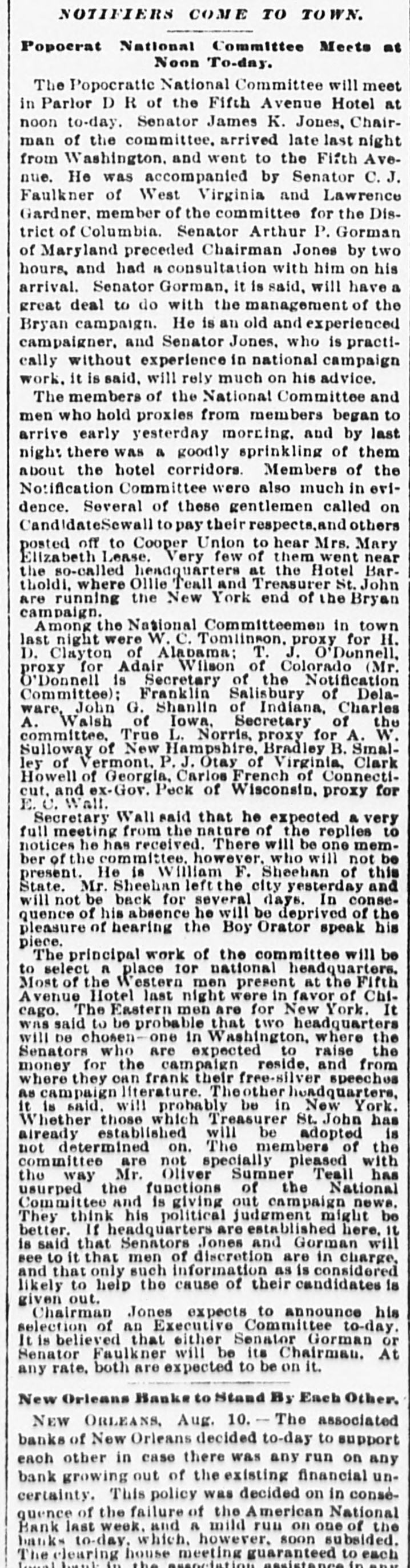
NOTIFIERS COME TO TOWN. Popoerat National Committee Meets at Noon To-day. The Popocratic National Committee will meet in Parlor D R of the Fifth Avenue Hotel at noon to-day. Senator James K. Jones, Chairman of the committee. arrived late last night from Washington. and went to the Fifth Avenue. He was accompanied by Senator C.J. Faulkner of West Virginia and Lawrence Gardner, member of the committee for the District of Columbia. Senator Arthur P. Gorman of Maryland preceded Chairman Jones by two hours, and had a consultation with him on his arrival. Senator Gorman, it is said, will have a great deal to do with the management of the Bryan campaign. He is an old and experienced campaigner. and Senator Jones, who is practically without experience in national campaign work. it is said, will rely much on his advice. The members of the National Committee and men who hold proxies from members began to arrive early yesterday morning. and by last night there was a goodly sprinkling of them about the hotel corridors. Members of the Notification Committee were also much in evidence. Several of these gentlemen called on CandidateSewall to pay their respects,and others posted off to Cooper Union to hear Mrs. Mary Elizabeth Lease. Very few of them went near the so-called headquarters at the Hotel Bartholdi, where Ollie Teall and Treasurer St. John are running the New York end of the Bryan campaign. Among the National Committeemen in town last night were W. C. Tomiinson. proxy for H. D. Clayton of Alabama: T. J. O'Donnell, proxy for Adair Wilson of Colorado (Mr. O'Donnell is Secretary of the Notification Committee): Franklin Salisbury of Delaware, John G. Shanlin of Indiana, Charles A. Walsh of Iowa, Secretary of the committee. True L. Norris, proxy for A. W. Sulloway of New Hampshire, Bradley B. Smalley of Vermont, P. J. Otay of Virginia, Clark Howell of Georgia, Carlos French of Connecticut, and ex-Gov. Peck of Wisconsin, proxy for E. C. Wall. Secretary Wall said that he expected a very full meeting from the nature of the replies to notices he has received. There will be one member of the committee. however. who will not be present. He is William F. Sheehan of this State. Mr. Sheehan left the city yesterday and will not be back for several days. In consequence of his absence he will be deprived of the pleasure of hearing the Boy Orator speak his piece. The principal work of the committee will be to select a place for national headquarters. Most of the Western men present at the Fifth Avenue Hotel last night were in favor of Chicago. The Eastern men are for New York. It was said to be probable that two headquarters will be chosen-one in Washington, where the Senators who are expected to raise the money for the campaign reside, and from where they can frank their free-silver speeches as campaign literature. Theother headquarters, it is said. will probably be in New York. Whether those which Treasurer St. John has already established will be adopted is not determined on. The members of the committee are not specially pleased with the way Mr. Oliver Summer Teall has usurped the functions of the National Committee and is giving out campaign news. They think his political judgment might be better. If headquarters are established here. 1t. is said that Senators Jones and Gorman will see to it that men of discretion are in charge, and that only such information as is considered likely to help the cause of their candidates is given out. Chairman Jones expects to announce his selection of an Executive Committee to-day. It is believed that either Senator Gorman or Senator Faulkner will be its Chairman. At any rate. both are expected to be on it. New Orleans Banks to Stand By Each Other. NEW ORLEANS, Aug. 10. The associated banks of New Orleans decided to-day to support each other in case there was any run on any bank growing out of the existing financial uncertainty. This policy was decided on in conséquence of the failure of the American National Bank last week, and a mild run on one of the banks to-day. which, however, soon subsided. using en


Article from The Sun, August 11, 1896

Click image to open full size in new tab

Article Text

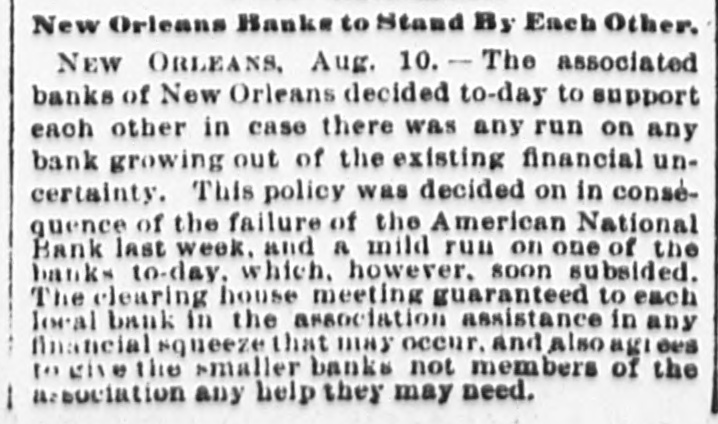
New Orleans Banks to Stand By Each Other. NEW ORLEANS, Aug. 10. - The associated banks of New Orleans decided to-day to support each other in case there was any run on any bank growing out of the existing financial uncertainty. This policy was decided on in conséquence of the failure of the American National Bank last week, and a mild run on one of the banks to-day. which, however, soon subsided. The clearing house meeting guaranteed to each local bank in the association assistance in any financial squeeze that may occur, and also agi ees to en " the smaller banks not members of the association any help they may need.


Article from The Progressive Farmer, August 11, 1896

Click image to open full size in new tab

Article Text

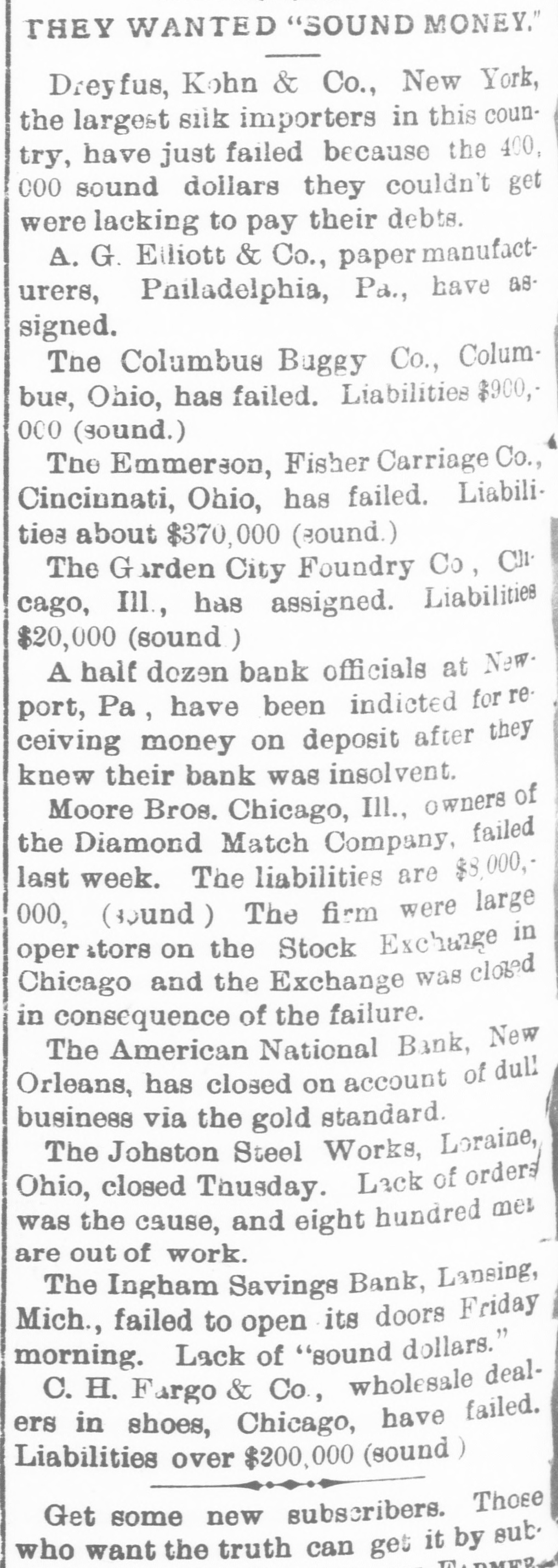
THEY WANTED "SOUND MONEY." Dreyfus, Kohn & Co., New York, the largest siik importers in this country, have just failed because the 400, 000 sound dollars they couldn't get were lacking to pay their debts. A. G. Elliott & Co., paper manufacturers, Philadelphia, Pa., have as signed. The Columbus Buggy Co., Columbus, Ohio, has failed. Liabilities $900,OCO (sound.) The Emmerson, Fisher Carriage Co., Cincinnati, Ohio, has failed. Liabilities about $370,000 (sound.) The Garden City Foundry Co, CII. cago, Ill, has assigned. Liabilities $20,000 (sound ) A half dozen bank officials at New port, Pa, have been indicted for receiving money on deposit after they knew their bank was insolvent. Moore Bros. Chicago, Ill., owners of the Diamond Match Company, failed last week. The liabilities are $8,000,000, (sound ) The firm were large oper tors on the Stock Exchange in Chicago and the Exchange was closed in consequence of the failure. The American National Bank, New Orleans, has closed on account of dull business via the gold standard. The Johston Steel Works, Loraine, Ohio, closed Thusday. Lack of orders was the cause, and eight hundred met are out of work. The Ingham Savings Bank, Lansing, Mich., failed to open its doors Friday morning. Lack of "sound dollars." C. H. Fargo & Co, wholesale dealers in shoes, Chicago, have failed. Liabilities over $200,000 (sound) Get some new subscribers. Those who want the truth can get it by sub.


Article from The Free Press, August 13, 1896

Click image to open full size in new tab

Article Text

The American National Bank of New Orleans has suspended.


Article from Richmond Dispatch, August 23, 1896

Click image to open full size in new tab

Article Text

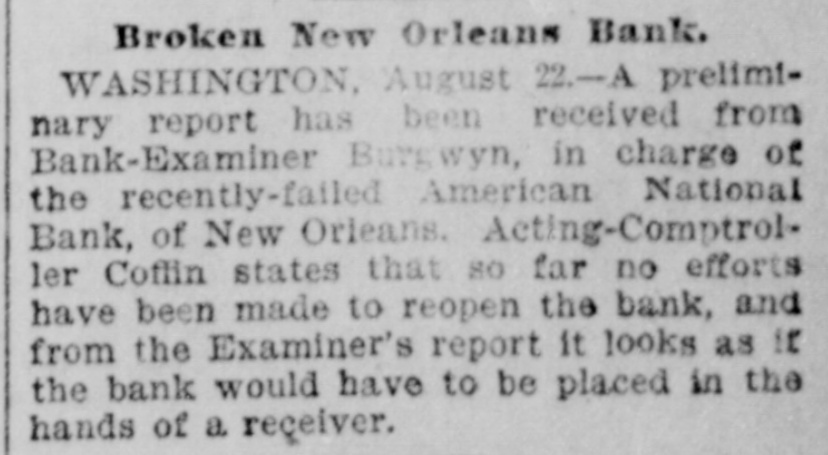
Broken New Orleans Bank. WASHINGTON August 22.-A preliminary report has been received from Bank-Examiner Burgwyn, in charge of the recently-failed American National Bank, of New Orleans. Acting-Comptroller Coffin states that 80 far no efforts have been made to reopen the bank, and from the Examiner's report it looks as If the bank would have to be placed in the hands of a receiver.


Article from Hutchinson Gazette, September 3, 1896

Click image to open full size in new tab

Article Text

LATE NEWS NOTES. Bill Doolin's remains were interred in a cemetery at Guthrie, Ok. Two Texans fought a duel with knives near Dallas and carved one another in a frightful manner. The West German M. E. conference found Rev. August Lemkan of Topeka guilty of imprudent conduct. The president and vice president of the American National bank of New Orleans have been arrested. Of the $300,000 needed for the Omaha exposition, $250,000 has been raised. The Salvation army bicycle brigade has made its appearance in New York. Vice Consul Piatt at Dublin says that American bicycles are having a big run in Ireland. Mrs. J. Cagles and son, Charles, of Perry, Okla., have been arrested for killing a man several years ago for his money. A new national organization of wholesale liquor dealers is to be organized to protect dealers against unfavorable legislation. At Lake Chautauqua. N. Y., 10,000 people crowded into hall that would A hold only 8,000 to hear Bryan. panic was narrowly averted by Mr. Bryan refusing to speak until some of the people left the building. Congressman Sibley addressed those who went outside. After thirty-five minutes Mr. Bryan was enabled to begin his speech. The amount of gold coming to this country is estimated at $10,000,000. The ex-Confederate Home at Higginsville, Mo., is to be controlled by a stock company. Miss Laura Ray of Terre Haute sustained injuries by a fall from a bicycle from which she died. At Palestine, Tex., Zach Day, ex sheriff, and T. M. Butler had a diffi culty and Butler was shot through the heart. The presidential campaign is having a depressing effect on the glass dustry. All the glass factories will be late in starting this fall. The production of refined lead in this country during the first six months of 1896 was 130,696 net tons against 105,970 for the first half of last year. Of this amount 109,592 tons was desilverized lead and 21,108 tons soft lead. The apparent home consumption for the first half of this year was 106,932 against 241,892 for the year 1895. The big strike of Australian coal miners was lost by the men. The cruiser Brooklyn averaged 21.92 knots an hour on her trial trip and earned a bonus of $350,000 for her builders, the contract requirement being 20 knots. The tin plate trust has collapsed. C. M. Sharlee and J. T. George have resigned as receivers of the Conkling Bros.' banks at Nevada Sheldon, Richards and Bronaugh. It is said that if the court appoints more satisfactory receivers litigation will be stopped and affairs adjusted. Tin plate strike at Elwood, Ind., has been settled by the company signing the scale. The "Saxton Place" near St. Joseph, the residence of J. O. Brady, which cost $55,000 when erected a few years ago, was totally destroyed by fire. W. H. and J. B. Moore of Chicago, who attempted to run a corner on Diamond Match stock recently; are unable to settle as they are possessed of no assets. At the meeting of the Cundiff camp of the Daughters of the Confederacy at St. Joseph, the proposition to turn the home at Higginsville, Mo., over to the state was unanimously rejected. Alfred George Whitehead, the IrishAmerican political prisoner recently released from the Portland prison, visited his mother, became deranged, disappeared and has not been seen since. The executive committee of the Irish National alliance has issued an appeal to the Irish people in America to contribute funds for, the relief of the Irish prisoners released and to be released from English prisons. At Danville, Tenn., Ab. Hinson, a well known farmer, was fataliy shot from ambush. A son of Hinson, supposing the crime to have been committed by the Wiggins brothers, shot and killed one of the latter and cut his heart out. General Gomez asserts that he is sure to wrest Cuba from Spain. A Cedar Rapids girl was fastened with a log chain for wanting to ride a bicycle. Miss Margaret Ingels, of Paris, Ky., will take the stump for Bryan and freesilver. James G. Blaine's old home and birthplace in Pennsylvania has been torn down. In 9 wreck of a fast mail train near Pittsburg eight persons were seriously and fifteen slightly hurt. President Cleveland commuted the death sentence of Robert E. Boutwell of Paris, Texas, to life imprisonment. Prof. Andree has arrived at Tromsoe, Norway, having given up his balloon trip to the North Pole. Texas fever has been discovered among cattle herds in Australia. W. H. McDole of Indianapolis has been appointed receiver for the Louisville, New Albany and Chicago railroad. Railroad rates on cattle from Northern and Western Texas to Kansas City, St. Louis and Chicago have been reduced to meet the cut made by the Indian Territory lines. Four bandits held up a stage full of passengers in Day county, Okla. and secured $800 in money and valuables. Mrs. Ray Reems of Philadelphia refused so hand out and shot dead
Article from The Globe-Republican, September 3, 1896

Click image to open full size in new tab

Article Text

LATE NEWS NOTES. Bill Doolin's remains were interred in a cemetery at Gathrie, Ok. Two Texas fought & duel with knives near Dallas and carved one another in a frightful manner. The West German M. E. conference found Rev. August Lemkan of Topeka guilty of imprudent conduct. The president and vice president of the American National bank of New Orleans have been arrested. Of the $300,000 needed for the Omaha exposition, $250,000 has been raised. The Salvation army bicycle brigade has made its appearance in New York. Vice Consul Piatt at Dublin says that American bicycles are having a big run in Ireland. Mrs. J. Cagles and son, Charles, of Perry, Okla., have been arrested for killing a man several years ago for his money. A new national organization of wholesale liquor dealers is to be organized to protect dealers against unfavorable legislation. At Lake Chautauqua. N. Y., 10,000 people crowded into a hall that would hold only 8,000 to hear Bryan. A panic was narrowly averted by Mr. Bryan refusing to speak until some of the people left the building. Congressman Sibley addressed those who went outside. After thirty-five minutes Mr. Bryan was enabled to begin his speech. The amount of gold coming to this country is estimated at $10,000,000. The ex-Confederate Home at Higginsville, Mo., is to be controlled by a stock company. Miss Laura Ray of Terre Haute sustained injuries by a fall from a bicycle from which she died. At Palestine, Tex., Zach Day, ex sheriff, and T. M. Butler had a diffi culty and Butler was shot through the heart. The presidential campaign is having a depressing effect on the glass dustry. All the glass factories will be late in starting this fall. The production of refined lead in this country during the first six months of 1896 was 130,696 net tons against 105,970 for the first half of last year. Of this amount 109,592 tons was desilverized lead and 21,108 tons soft lead. The apparent home consumption for the first half of this year was 106,932 against 241,892 for the year 1895. The big strike of Australian coal miners was lost by the men. The cruiser Brooklyn averaged 21.92 knots an hour on her trial trip and earned a bonus of $350,000 for her builders, the contract requirement being 20 knots. The tin plate trust has collapsed. C. M. Sharlee and J. T. George have resigned as receivers of the Conkling Bros.' banks at Nevada Sheldon, Richards and Bronaugh. It is said that if the court appoints more satisfactory receivers litigation will be stopped and affairs adjusted. Tin plate strike at Elwood, Ind., has been settled by the company signing the scale. The "Saxton Place" near St. Joseph, the residence of J. O. Brady, which cost $55,000 when erected a few years ago, was totally destroyed by fire. W. H. and J. B. Moore of Chicago, who attempted to run a corner on Diamond Match stock recently; are unable to settle as they are possessed of no assets. At the meeting of the Cundiff camp of the Daughters of the Confederacy at St. Joseph, the proposition to turn the home at Higginsville. Mo., over to the state was unanimously rejected. Alfred George Whitehead, the IrishAmerican political prisoner recently released from the Portland prison, visited his mother, then became deranged, disappeared and has not been seen since. The executive committee of the Irish National alliance has issued an appeal to the Irish people in America to contribute funds for the relief of the Irish prisoners released and to be released from English prisons. At Denville, Tenn., Ab. Hinsoa, a well known farmer. was fataliy shot from ambush. A son of Hinson, supposing the crime to have been committed by the Wiggins brothers. shot and killed one of the latter and cut his heart out. General Gomez asserts that he is sure to wrest. Cuba from Spain. A Cedar Rapids girl was fastened with a log chain for wanting to ride a bicycle. Miss Margaret Ingels, of Paris, Ky., will take the stump for Bryan and freesilver. James G. Blaine's old home and birthplace in Pennsylvania has been torn down. In a wreck of a fast mail train near Pittsburg eight persons were seriously and fifteen slightly hurt. President Cleveland commuted the death sentence of Robert E. Boutwell of Paris, Texas, to life imprisonment. Prof. Andree has arrived at Tromsoe, Norway, having given up his balioon trip to the North Pole. Texas fever has been discovered among cattle herds in Australia. W. H. McDole of Indianapolis has been appointed receiver for the Louisville New Albany and Chicago rail-


Article from The Evening Times, September 10, 1896

Click image to open full size in new tab

Article Text

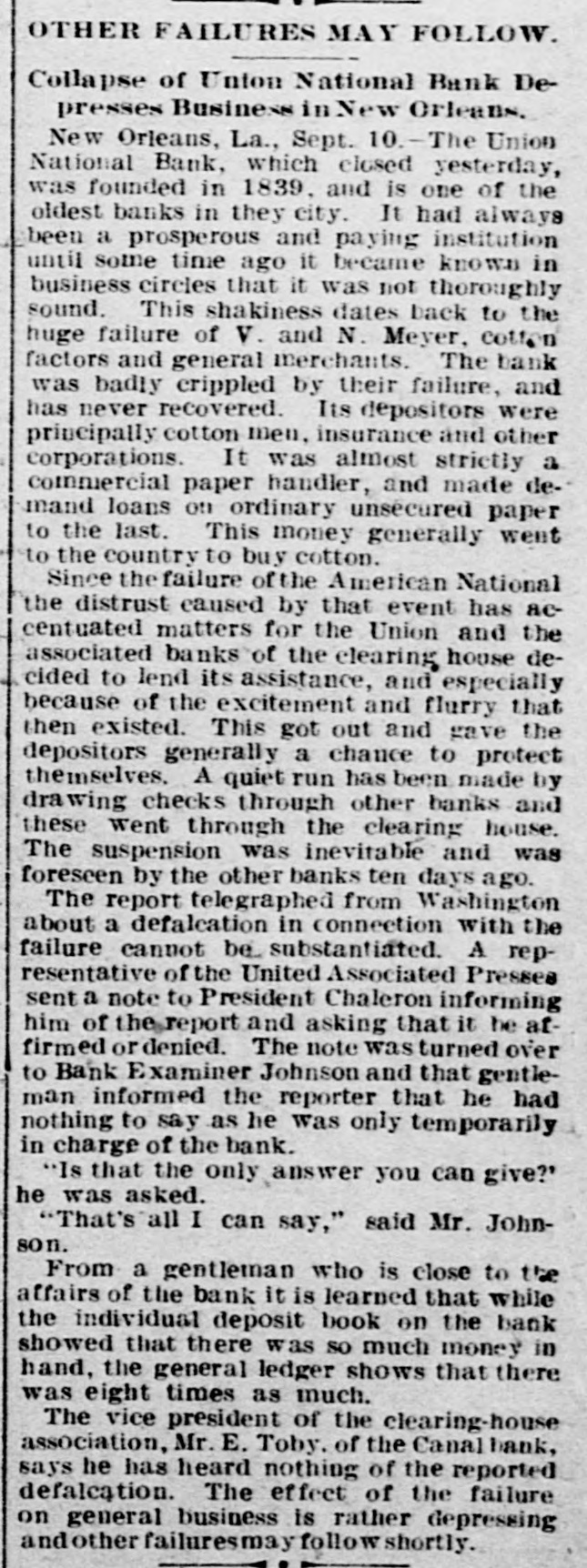
OTHER FAILURES MAY FOLLOW. Collapse of Unton National Bank Depresses Business in New Orleans. New Orleans, La., Sept. 10.-The Union National Bank, which closed yesterday, was founded in 1839, and is one of the oldest banks in they city. It had always been a prosperous and paying institution until some time ago it became known in business circles that it was not thoroughly sound. This shakiness dates back to the huge failure of V. and N. Meyer, cotton factors and general merchants. The bank was badly crippled by their failure, and has never recovered. Its depositors were principally cotton men, insurance and other corporations. It was almost strictly a commercial paper handler, and made demand loans on ordinary unsecured paper to the last. This money generally went to the country to buy cotton. Since the failure of the American National the distrust caused by that event has accentuated matters for the Union and the associated banks of the clearing house decided to lend its assistance, and especially because of the excitement and flurry that then existed. This got out and gave the depositors generally a chance to protect themselves. A quiet run has been made by drawing checks through other banks and these went through the clearing house. The suspension was inevitable and was forescen by the other banks ten days ago. The report telegraphed from Washington about a defalcation in connection with the failure cannot be. substantiated. A representative of the United Associated Presses sent a note to President Chaleron informing him of the report and asking that it be atfirmed or denied. The note was turned over to Bank Examiner Johnson and that gentleman informed the reporter that he had nothing to say as he was only temporarily in charge of the bank. "Is that the only answer you can give?' he was asked. "That's all I can say," said Mr. Johnson. From a gentleman who is close to the affairs of the bank it is learned that while the individual deposit book on the bank showed that there was SO much money in hand, the general ledger shows that there was eight times as much. The vice president of the clearing-house association, Mr. E. Toby. of the Canal bank, says he has heard nothing of the reported defalcation. The effect of the failure on general business is rather depressing andother failuresmay follow shortly.


Article from The Wichita Daily Eagle, September 11, 1896

Click image to open full size in new tab

Article Text

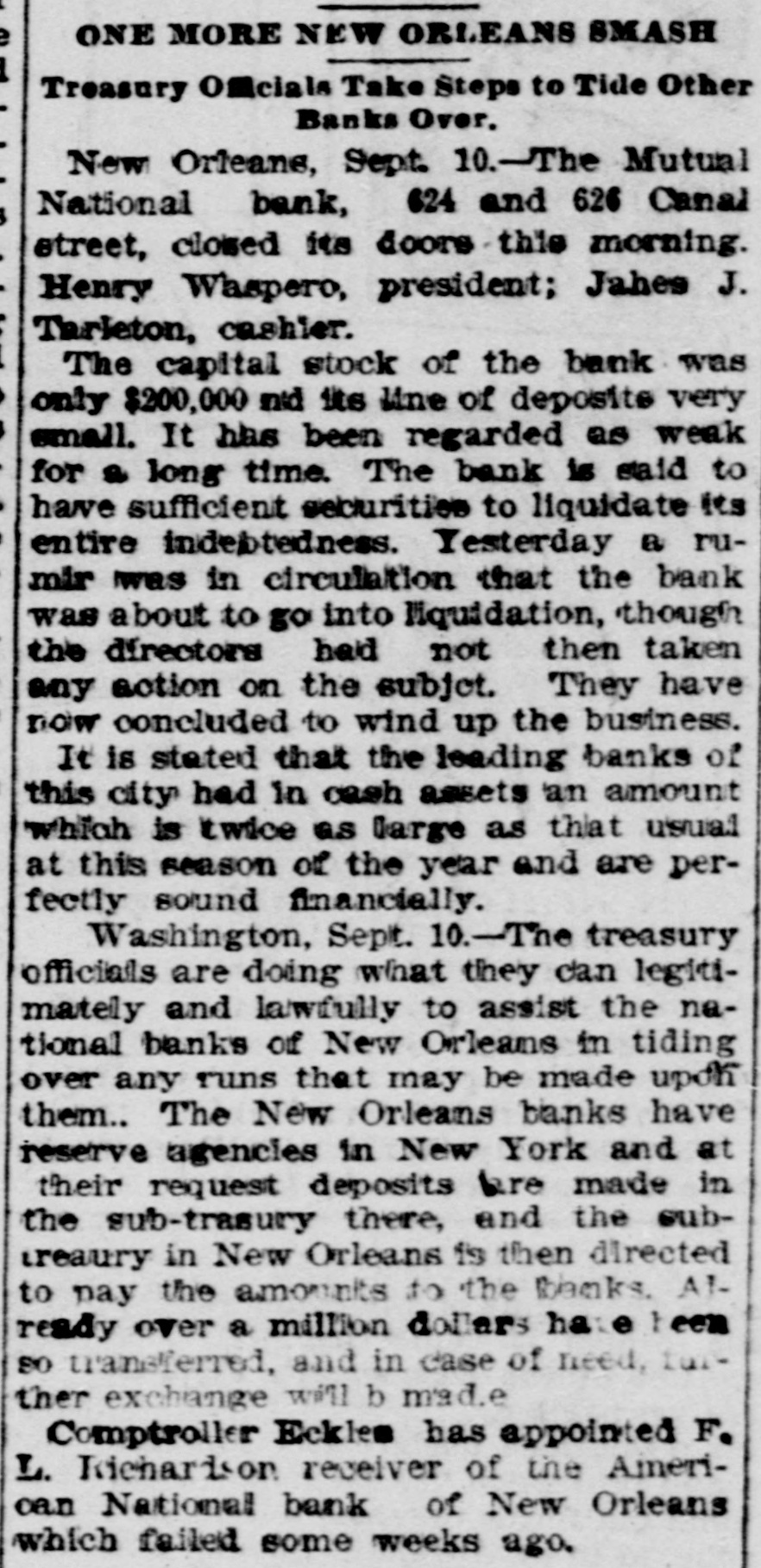
ONE MORE NEW ORLEANS SMASH Treasury Officials Take Steps to Tide Other Banks Over, New Orleans, Sept. 10.-The Mutual National bank, 624 and 626 Canal street, closed its doors this morning. Henry Waspero, president; Jahes J. Tarleton, cashier. The capital stock of the bank was only $200,000 nid its line of deposite very small. It has been regarded as weak for a long time. The bank is said to have sufficient securities to liquidate its entire indeptedness. Yesterday a rumir was in circulation that the bank was about to go into liquidation, though the directors had not then taken any action on the subjet. They have now concluded to wind up the business. It is stated that the leading banks of this city had in cash assets an amount which is twice as Garge as that usual at this season of the year and are perfectly sound financially. Washington, Sept. 10.-The treasury officials are doing what they can legitimately and lawfully to assist the national banks of New Orleans in tiding over any runs that may be made upon them.. The New Orleans banks have reserve agencies in New York and at their request deposits are made in the sub-trasury there, and the subtreaury in New Orleans is then directed to pay the amounts to the Banks. Already over a million dollars have een so transferred, and in case of need, turther exchange will b made Comptroller Eckles has appointed F. L. Richardson receiver of the American National bank of New Orleans which failed some weeks ago.


Article from The Times, September 11, 1896

Click image to open full size in new tab

Article Text

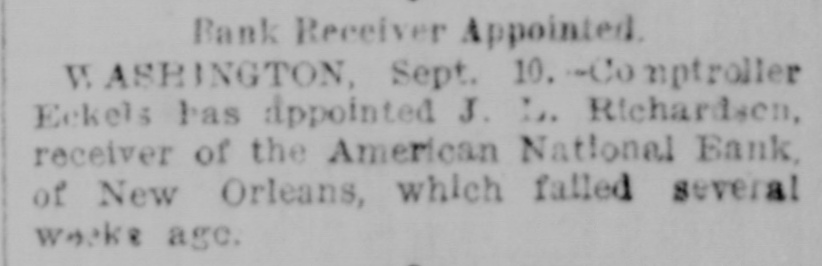
Bank Receiver Appointed WASHINGTON Sept. 10.-Comptroller Eckels has appointed J. i. Richardsen, receiver of the American National Bank of New Orleans, which falled several weeks age.


Article from Birmingham State Herald, September 11, 1896

Click image to open full size in new tab

Article Text

IN CRASH NEW ORLEANS The Mutual National Forced to Close Its Doors. AT THE END ITS TETHER Refused to Advance on The Clearing H Its Last der of Collaterals. PRESIDENT OWINSAYSITWILLPAY OUT Situation in Und Crescent City Relieved by the Action of the Treasury and the Worst Is Believed to Be Over. New Orleans, Sept. 10.-The Mutual National bank closed its doors this morning. The effect of this bank's suspension has been discounted as it was well known to be in a bad way. Shortly after the American National bank failed a run was made on the Mutual, and the collapse of the bank at that time appeared inevitable. Luckily the run was started on Saturday, shortly before noon, and Saturday being a legal half holiday in New Orleans, Providence was on the side of the sorely pressed institution. By Monday morning it had a chance to recuperate. The clearing house held a meeting and the other banks of the city fearing a panic came to the rescue and advanced money enough to meet all demands on that Monday. Large sums of money came here from various sources and the United States sub-treasury was paying out the sugar bounty as fast as possible. Before noon on that day the run ceased and all was serene. The president states that a steady drain has been maintained by depositors checking out their money. The unexpected failure of the Union National Wednesday aroused the susof on the the first occasion the a more house was picions Mutual made had on depositors $100,000, Mutual. and little another The advanced clearing than rush $17,000 of which had been repaid. Last night the Mutual tendered the clearing house another lot of collaterals and asked for further assistance to the extent of $25,000. This the clearing house refused and the suspension of the Mutual followed this morning. The president says: "The bank owes depositors $92,993.72, which we have ample assets to pay dollar for dollar.' President Baldwin of the clearing house says: "The officers of the bank foresaw what was coming, and as is customary in such cases called upon other banks to come once more to their assistance. A bank in distress is expected to hypothecate securities of such a kind as will justify the other banks in lending the assistance. The security offered by the Mutual was not considered the proper quality of paper to justify the clearing house in making the loan and the assistance was refused. The Mutual National was organized in 1871 with a capital stock of $500,000. This was reduced in January, 1894, to $200,000. In January, 1895, the Mutual absorbed the Traders' bank. Most of the stockholders of the Traders' became interested in the Mutual. At a meeting of the clearing house held last night the financial situation was earnestly discussed, and the following resolution was adopted: "Resolved, That for the present the clearing house banks should not pay out on checks more than $100 to any one depositor in one day-al other payments shall be made by certification of checks, which shall be received on deposit by the clearing house banks. This step was necessary as a precaution. Employers of labor will be supplied with money to meet their pay rolls. It was also agreed to adopt a system of clearing house certificates similar to that utilized in New York and elsewhere during the crisis of 1893. The savings banks also took steps to prevent a run by posting the sixty day rule. This is allowed by their charters. A depositor must give sixty days notice of his intention to withdraw his deposit. There are no new developments in the case of the Union National. President Chalaron is bitterly criticised today for his precipitate action in closing the bank without consulting the directors. He is in seclusion and will see no one. There are all sorts of rumors, one to the effect that two sets of books were kept by the Union National-one for thedfrectors and one for the bank officers-and that there is a discrepancy between these of an amount exceeding $600,000. Bank Examiner Johnson, temporarily in charge of the Union, was formerly confidential bookkeeper and agent for A. & V. Meyer, whose failure seriously affected the bank. This fact has caused much comment. Today another bank examiner here to take his place, having been a has protest been ordered wired to Comptroller Eckels against Mr. Johnson's continuance in charge.


Article from The Indianapolis Journal, September 11, 1896

Click image to open full size in new tab

Article Text

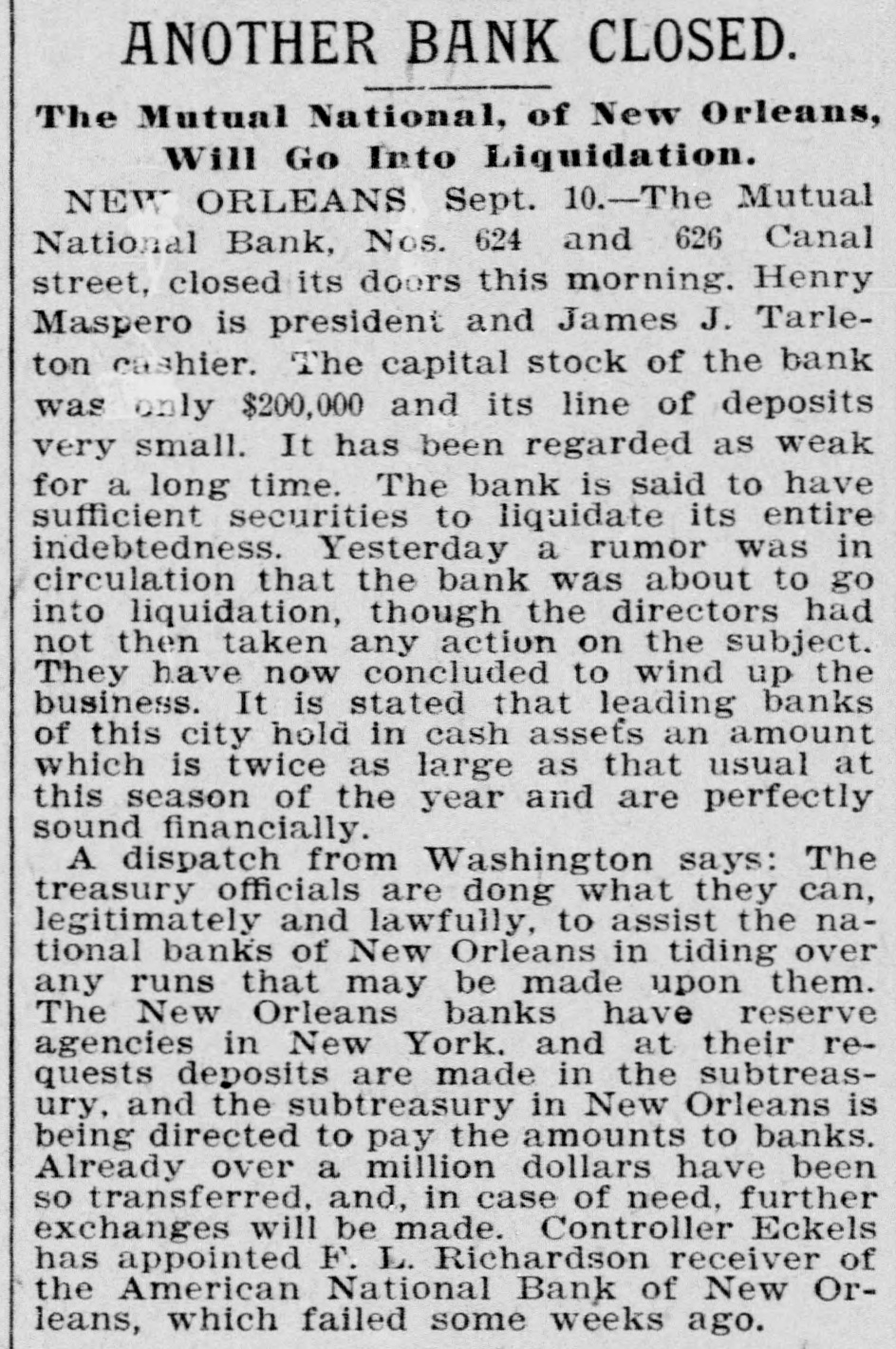
ANOTHER BANK CLOSED. The Mutual National, of New Orleans, Will Go Into Liquidation. NEW ORLEANS Sept. 10.-The Mutual National Bank, Nos. 624 and 626 Canal street, closed its doors this morning. Henry Maspero is president and James J. Tarleton cashier. The capital stock of the bank was only $200,000 and its line of deposits very small. It has been regarded as weak for a long time. The bank is said to have sufficient securities to liquidate its entire indebtedness. Yesterday a rumor was in circulation that the bank was about to go into liquidation, though the directors had not then taken any action on the subject. They have now concluded to wind up the business. It is stated that leading banks of this city hold in cash assets an amount which is twice as large as that usual at this season of the year and are perfectly sound financially. A dispatch from Washington says: The treasury officials are dong what they can, legitimately and lawfully, to assist the national banks of New Orleans in tiding over any runs that may be made upon them. The New Orleans banks have reserve agencies in New York. and at their requests deposits are made in the subtreasury, and the subtreasury in New Orleans is being directed to pay the amounts to banks. Already over a million dollars have been so transferred. and, in case of need, further exchanges will be made. Controller Eckels has appointed F. L. Richardson receiver of the American National Bank of New Orleans, which failed some weeks ago.


Article from The Salt Lake Herald, September 11, 1896

Click image to open full size in new tab

Article Text

BANK BURSTS. Mutual National of New Orleans Closes Its Doors-Others Will Follow. NEW ORLEANS, La., Sept. 10.-The Mutual National bank closed its doors this morning. The effect of this bank's suspension has been discounted, as it was well known to be in a bad way. Shortly after the American National bank failed a run was made on the Mutual, and the collapse of the bank at that time appeared inevitable. Luckily the run was started on Saturday, shortly before noon, and Saturday being a half holiday in New Orleans, fortune was on the side of the pressed institution. By Monday morning it had a chance to recuperate. The clearing house held a meeting and the other banks in the city, fearing a panic, came to the rescue and advanced money enough to meet all demands on that day. Large sums of money came here from various sources and the United States sub-treasury was paying out the sugar bounty as fast as possible. Before noon of that day the run ceased and all looked favorable. The president states that a steady drain has been maintained by depositors checking out their money. The unexpected failure of the Union National Wednesday aroused the suspicions of the depositors and another rush was made on the Mutual. The clearing house banks had on the first occasion advanced the Mutual $100,000, a little more than $17,000 of which had been repaid. Last night the Mutual tendered the clearing house another lot of collaterals and asked for further assistance to the extent of $25,000. This the clearing house refused and the suspension of the Mutual followed this morning. The president says: "The bank owes depositors $92,993.72, which we have ample assets to pay dollar for dollar." President Baldwin of the Clearing house says: "The officers of the bank foresaw what was coming and, as is customary in such cases, called on the other banks to come to their assistance. A bank in distress is expected to hypothecate securities of such a kind as will justify other banks in lending the assistance. The security offered by the Mutual was not considered the proper quality of paper to justify the clearing house in making the loan, and the assistance was refused." The Mutual National was organized in 1871 with a capital stock of $500,000. This was reduced in January, 1894, to $200,000. In January, 1895, the Mutual absorbed the Traders' Bank and most of the stockholders of the Traders' Bank became interested in the Mutual At a meeting of the clearing house last night, the financial situation was earnestly discussed and the following resolution adopted: Resolved, That for the present the clearing house banks should not pay out on checks more than $100 to any one depositor in one day-all other payments shall be made by certification of checks which shall be received on deposit by the clearing house banks." This step was necessary as a precaution. Employers of labor will be supplied with money to meet their pay rolls. It was also agreed to adopt a system of clearing house certificates 1 similar to that used in New York and elsewhere during the crisis of 1893. The savings banks also took steps to prevent a run by posting a sixty days rule. There are no new developments in the case of the Union National. President Chalaron is bitterly criticized today for his precipitate action in closing the bank without consulting the directors. He is in seclusion and will see no one. Bank Examiner Johnson, temporarily


Article from The Morning Times, September 11, 1896

Click image to open full size in new tab

Article Text

NEW ORLEANS BANK FAILS. Mutual Union Follows the Suspension of the American National. New Orleans, Sept. 10.-The Mutual National Bank closed its doors this morning. The effect of this banks' suspension has been discounted as it was well known to be in a bad way. Shortly after the American National Bank failed a run was made on the Mutual and the collapse of the bank at that time appeared inevitable. Luckily, the run was started on Satururday shortly' before noon and Saturday being a legal half holiday, in New Orleans, Providence was on the side of the sorely pressed institution. By Monday morning, it had a chance to recuperate. The unexpected failure of the Union National Wednesday aroused the suspicions of depositors and another rush was made on the Mutual. The clearing-house refused further assistance and suspension followed.


Article from The Morning Times, September 11, 1896

Click image to open full size in new tab

Article Text

Receiver for New Orleans Bank. Comptroller Eckels has appointed F. L. Richardson receiver of the American National Bank at New Orleans, which failed several weeks ago,


Article from Omaha Daily Bee, September 11, 1896

Click image to open full size in new tab

Article Text

NEW ORLEANS LOSES A BANK. Crescent City Has Its Third Financial Failure. NEW ORLEANS, Sept. 10.-The Mutual National bank, 624 and 626 Canal street closed its doors this morning. Henry Maspero, president; James J. Tarleton. cashier. The capital stock of the bank was only $200,000 and its line of deposits very small. It has been regarded as weak for a long time. The bank is said to have sufficient securities to liquidate its entire indebtedness. WASHINGTON, Sept. 10.-The treasury officials are doing what they can legitimately and lawfully to assist the national banks of New Orleans in tiding over any runs that may be made upon them. The New Orleans banks have reserve agencies in New York, and at their request deposits are made in the subtreasury there and the subtreasury in New Orleans is then directed to pay the amounts to the banks. Already over $1,000,000 have been transferred, and in case of need, further exchanges will be made. Comptroller Eckels has appointed F. L. Richardson receiver of the American National bank of New Orleans, which failed some weeks ago.


Article from Evening Journal, September 14, 1896

Click image to open full size in new tab

Article Text

SYNDICATE OF ROBBERS Seven Persons In the New Orleans Steal of $602,000. CONFESSIONS HAVE BEEN MADE. Two Clerks of the Union National, Colcomb and Leone, Did the Work Inside. Money Spent In Luxurious Living and Speculation-Arrests to Be Made. NEW ORLEANS, Sept. 14.-There is only one more secret to come out in the wreckIng of the Union National bank and the bank panic which raged here last week, and it is announced that it will be disclosed within the next 24 hours. That is the names of the confederates, the men on the outside who drew out and appropriated the $602,000 of the bank's money. Colcomb and Leone, the bookkeepers, cooked the accounts so as to keep the bank always in debt to these confederates. The bank was robbed by a syndicate composed of seven persons, two on the inside of the bank and five on the outside. The whole transaction was businesslike and systematic, including an agreement as to the amount to be drawn out or stolen each day and the division of the funds. Colcomb, whose lack of nerve was shown by his suicide the moment suspicion pointed to him, was the organizer of the project and its director. It is reported that a confession has been made: that three members of the syndicate have been named, and that the only reason their names are not now made public is to prevent any escape, as some of them are out of town. The money went mainly in riotous living, the balance on speculation, with the hope of recovering the amount stolen. In the big cotton speculation last year when cotton went up so high the syndicate was ahead of the game. The sadden collapse of the market prevented it from making good the bank's money and rendered a new raid necessary. The bank has been plundered more heavily than ever since. The outside members of the syndicate are said to lie high livers. Not so Colcomb and Leone; they could not be so, for they were kept all the day at their desks working away to cover up the crookedness in their books. Money Spent In Luxurious Living. They had little time for a spree. Colcomb spent most of his share of the swag on his family. He lived most luxuriously, had ten servants and a housekeeper to relieve his wife of the trouble of domestic affairs, a rather large household for a clerk on a salary of $150 a month. He had evidently anticipated that the defalcation would come out sooner or later and had determined on suicide when 18 did, for he carried the poison on his person. to be used at a moment's notice. He had many friends, and they all speak of him as generous and brave. To commit suicide is the only thing a gentleman could do under the circumstances, they say. Colcomb was interviewed on Thursday night about the bank's condition. He was calm and collected then and apparently in the best of humor, although it was only a few hours before his death. and he had then evidently determined on suicide. He did not tell his family of his intention, and it was not until several hours later that he took the poison and was discovered in an insensible condition. Once or twice in the next 36 he rrs he opened his eyes and looked argePPine room, but he neither spoke nos seemed to know any one. Colcomb's death renders the work of investigating the defalcation very difflcult, and United States Bank Examiner Escott doubts whether it will ever be pos. sible to know all the details. The receivers of the Bank of Commerce and American National bank will take possession of them today. The other two closed banks, the Mutual National and Union National, still remain in the hands of the United States examiners. It is thought that the panic is over. United States Bank Examiner Escott completed his first trial balance of the Union National bank and found the amount stolen to be $602,687.07. This is subject to an increase when all the accounts are carefully examined.


Article from Vermont Phœnix, September 18, 1896

Click image to open full size in new tab

Article Text

THE NEWS IN BRIEF. A Bank Panic. Four Institutions Close Their Doors--a Defalcation of $600,000. The banking houses of New Orleans, La., have suffered a disastrous run within the last ten days as a result of which the American, Union and Mutual, all national banks, and the Bank of Commerce, a state bank, have succumbed. The failure of the first two revealed strong evidence of crookedness in their management and a panic would have resulted had it not been for the prompt action of the associated banks in adopting the rule of paying not more than $100 a day to any single depositor, and of the savings banks in adopting the 60-day clause, requiring a notification before payment of deposits. There was no hope for the Mutual, however, as it was already on the down grade.' The run on the banks began originally in the disposition to hoard money in consequence of the political situation. When the American National failed and revealed a corrupt condition of affairs it created a lack of confidence. This was intensified by the failure of the Union National which was due partly to a defalcation of about $600,000, although the fact of the defalcation was not discovered until after the failure. The adoption of the $100 a day rule had a tendency to restore confidence, as it was thought that, with assistance from other banks, the Bank of Commerce, which was in a solvent condition, would be able to pull through, but when it was found that its securities, consisting mainly of real estate mortgages, could not be realized on, the other banks refused to advance cash, and the bank was advised to close to better protect its depositors, as it would be obliged to close its doors eventually. Returning confidence was at once checked and the run on the smaller banks continued for several days. The mystery of the Union national was cleared up by Bank Examiner Escott, who made careful examination of the books and showed that the bank has been robbed of $592,000 by its individual bookkeepers, Frank Leefe and Louis Colomb, Leefe getting $185,000 and Colomb $407,000. The trick was worked by means of dummy depositors who were credited by the two bookkeepers with depositing large sums of money. Both Leefe and Colomb are men of excellent family and of the best personal reputation. They were placed under arrest. Colomb took poison soon after being arrested and has since died.


Article from Tensas Gazette, September 25, 1896

Click image to open full size in new tab

Article Text

THE NEW ORLEANS BANK FAILURES. The failure of four National Banks within a short time in New Orleans, to-wit: the American, Mutual, Union and Bank of Comшегсе, has alarmed the people throughout Eouisiana. The causes assigned for the-failure of two of them are gross mismanagement, and criminal conduct on the part of the officers in charge.. It is said that in China when a bank fails the law is to cut off the head of the man who is responsible for the management of the bank, and more than a thousand years have passed since one has failed in "The Flowery Kingdom." Every one thought when the $5,000,000 of sugar bounty money was paid into the vaults of the banks it would make them safe and sound, and nothing can make up for the criminal course pursued by the officers in charge of those institutions. A bank failed in Glasgow, Scotland, some years ago, the effects of which were felt far and wide and much distress and poverty was entailed upon the depositors on account of its failure. The law took hold of this matter, and every director, no matter how High his station in life, was held to strict accountability for the mismanagement of the Bank. But in this country it is unfortunate the case that when a man has money, power and influence through the ability of his law yers and influence of his friends,- no matter how guilty, he almost in every instance goes unwhipped of justice- How far the officers of these New Orleans institutions will be held accountable to the law for their shortcomings remaine to be seen- The truest test of a high covilization is the manthem enfureed


Article from The Salt Lake Herald, October 31, 1896

Click image to open full size in new tab

Article Text

BANKERS IN TROUBLE. NEW ORLEANS, Oct. 30.-The grand jury yesterday indicted Henry Gardes, president of the American bank; W. A. Gerault, cashier; W. H. Renaud, Julius Keifer and T. Dumas, directors, for having received deposits in the bank after they knew it to be insolvent. These indictments are the result of the recent bank panic in New Orleans. The American National was the first of the four banks to go down, and the wretched condition of affairs exposed by its failure caused a panicky feeling and a run on the other banks.


Article from The Evening Bulletin, October 31, 1896

Click image to open full size in new tab

Article Text

Spanish soldiers wounded'in Cuba. The queen regent has contributed 10,000 pesetas to the fund. FIVE INDICTMENTS. Law's Hand Laid on Bankers Who Violate Their Trust. NEW ORLEANS, Oct. 31.-The grand jury indicted Henry Gardes, president of the American National bank; W. A. Gerault, cashier; W. H. Renaud, Julius Keifer and T. Dumas, directors, for having received deposits in the bank after they knew it to be insolvent. These indictments are the result of recent bank panic in New Orleans. The American National was the first of the four banks to go down, and the wretch. ed condition of affairs, exposed by its failure, caused a panicky feeling and a run on the other banks.


Article from The Saint Paul Globe, March 9, 1897

Click image to open full size in new tab

Article Text

NEW YORK MINING STOCKS. Bulwer $0 50, Ontario $9 00 Cholor 80 90 Ophir 15 Crown Point 20 Plymouth Con. Cal. & Va. 1 40 1 00 Quicksilver Deadwood 1 25 10 00 do pfd 30 25 Sierra Nevada Gould & Curry Hale & Norcross. 80 Standard 1 75 Homestake 29 00 25 Union Con Iron Silver 39 20 Yellow Jacket Mexican 25 BOSTON MINING SHARES. Allouez Min. Co.. 1 Franklin 10½ Atlantic 21 181/4 Kearsarge 32 Osceola Boston & Mont 120% 111 Butte & Boston 18½ Quincy Calumet & Hecla.375 120 Tamarack Centennial Wolverine 891/4 97/8 FOREIGN FINANCIAL. NEW YORK, March 8.-Evening Post's London financial cablegram: Nothing is doing in the stock markets, pending Greece's definite reply to the powers, and the course of prices merely reflects local opinion on the situation. That this at the moment is favorable may be gathered from the rise of 1½c in consols and the material gains in all the leading securities. Turkish securities were especially good. Briefly put, London has made up its mind that the powers want peace. Germany is supposed to be the only power really wishing to apply immediate and excessive coercion to Greece. Japan continues to absorb all the arrivals of gold other than sovereigns. Silver is demoralized by Japan's abandonment of the silver standard. Brazils were exceptionally flat on unfavorable reports of that country's finance and on the further fall in exchange. The Berlin market was steady. The Paris bourse was better, the settlements hi ving only forced one failure. INSOLVENT DIVIDENDS. WASHINGTON, March 8.-The comptroller of the currency has declared dividends in favor of the creditors of insolvent national banks, as follows: 10 per cent, the Marine National bank, of Duluth, Minn.; 10 per cent, the American National bank, of New Orleans; 5 per cent, Central National bank, Rome, N. Y. NEW YORK MONEY. NEW YORK. March 8.-Money on call easy, 11/2@1% per cent; last loan, 1½; closed at 1½ @1% per cent. Prime mercantile paper, 3@4 per cent. Sterling exchange strong, with actual business in bankers' bills at $4.87½ for demand and $4.85% for sixty days. Posted rates, $4.861/2 and $4.881/2. Commercial bills, $4.841/2. Silver certificates, 63%@64/c. Bar silver, 63%c. SAVINGS COMPANY FAILS. CINCINNATI, 0., March 8.-Hermann Brockman was this afternoon appointed receiver of the Consolidated Building and Savings company. The shareholders are mostly street railway employes. Liabilities, $230,000; assets, $175,000. BANK CLEARINGS. St. Paul-$448,426.47. Minneapoiis-$1,032.459. New York-Clearings, $63,703,781; balances, $3,878,296. Boston-Clearings, $11,384,010; balances, $1,156,608. TREASURY STATEMENT. WASHINGTON. March 8.-Today's statement of the condition of the treasury shows: Available cash balances, $212,245,324; gold reserve, $150,804,733. CHICAGO MONEY. CHICAGO, March 8.-New York exchange, 55c discount. Foreign exchange firm; demand, $4.871/4; sixty days, $4.851/2.