Albion National Bank (Albion, MI)

Episode Information

Episode UID
755201345
Episode Type
Suspension โ†’ Closure
Bank Type
national
Bank ID
75520 national
Charter Number
7552
Start Date
January 2, 1912
Location
Albion, Michigan (42.243, -84.753)

Metadata

Model
gpt-5-mini (chosen from majority vote of a three-model LLM ensemble)
Short Digest
c36f7836475f344a

Response Measures

None

Receivership Details

Depositor recovery rate
33.4%
Date receivership started
1912-01-04
Date receivership terminated
1916-10-31
OCC cause of failure
Fraud
Share of assets assessed as good
50.0%
Share of assets assessed as doubtful
40.5%
Share of assets assessed as worthless
9.5%

Events (4)

1. January 11, 1905 Chartered
Source
historical_nic
2. January 2, 1912 Suspension
Cause
Bank Specific Adverse Info
Cause Details
Forged notes placed in the bank by its cashier (initially reported ~$144,000, later findings up to ~$300,000) caused insolvency and closure.
Newspaper Excerpt
ALBION, Mich, Jan. 2.-The Albion National bank closed today. ... the bank officials admitted the bank had been defrauded out of $90,000 by forgeries.
Source
newspapers
3. January 4, 1912 Receivership
Source
historical_nic
4. January 4, 1912 Receivership
Newspaper Excerpt
Receiver is Appointed. Washington. Jan. 4.-Frank L. Irwin, of Albion, Mich., has been appointed receiver for the failed Albion National bank.
Source
newspapers

Newspaper Articles (21)

Article from Arizona Republican, January 3, 1912

Click image to open full size in new tab

Article Text

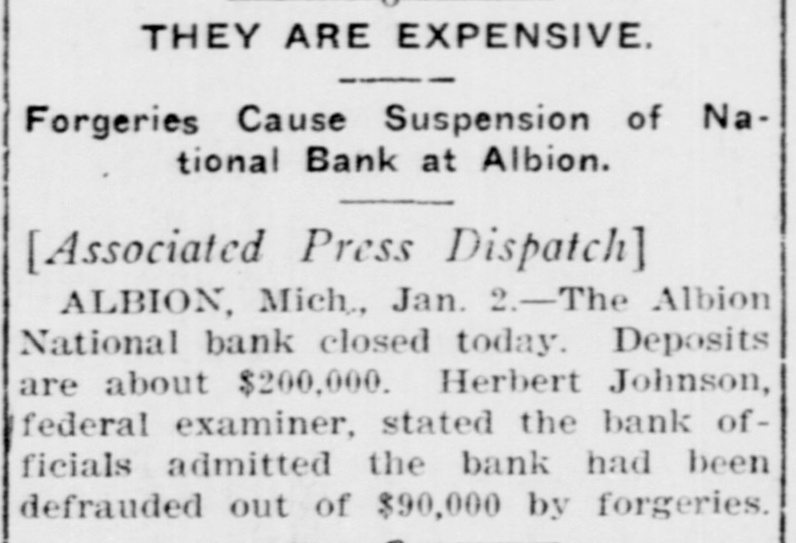
THEY ARE EXPENSIVE Forgeries Cause Suspension of National Bank at Albion. [Associated Press Dispatch] ALBION, Mich, Jan. 2.-The Albion National bank closed today. Deposits are about $200,000. Herbert Johnson, federal examiner, stated the bank officials admitted the bank had been defrauded out of $90,000 by forgeries.


Article from Santa Fe New Mexican, January 3, 1912

Click image to open full size in new tab

Article Text

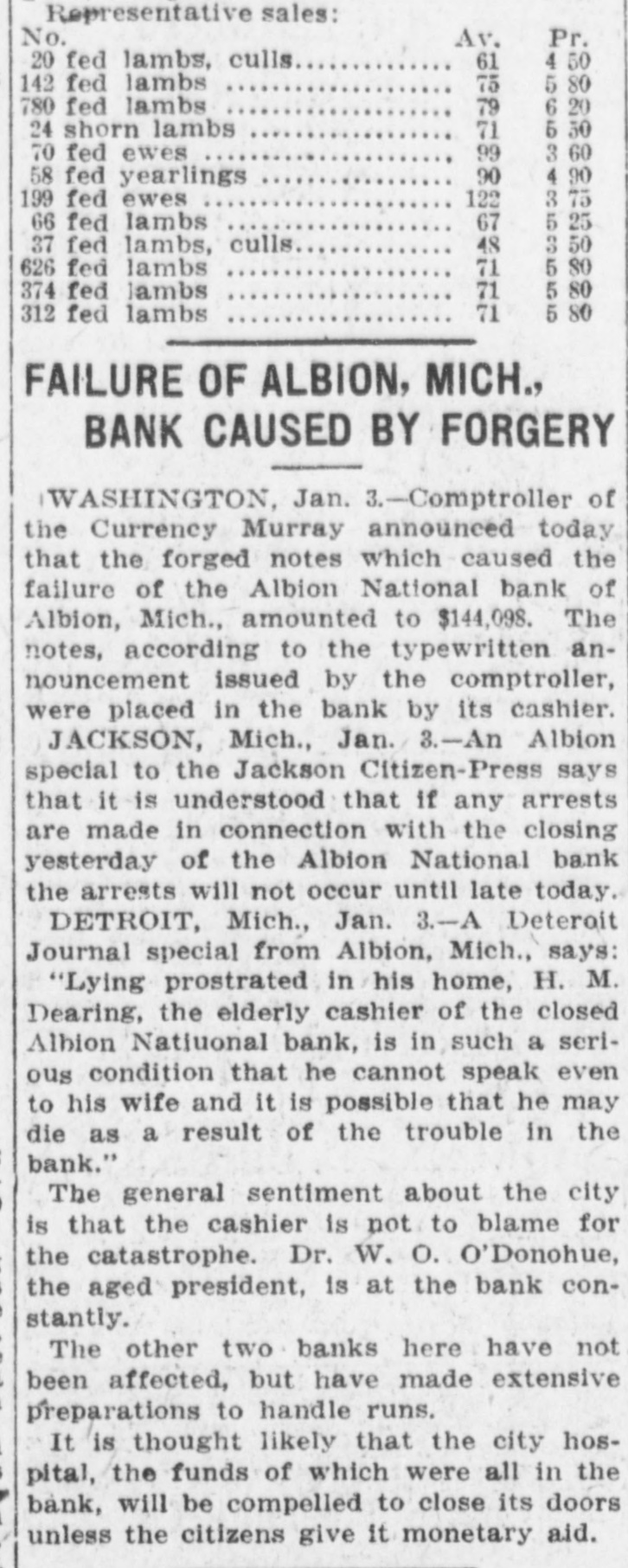
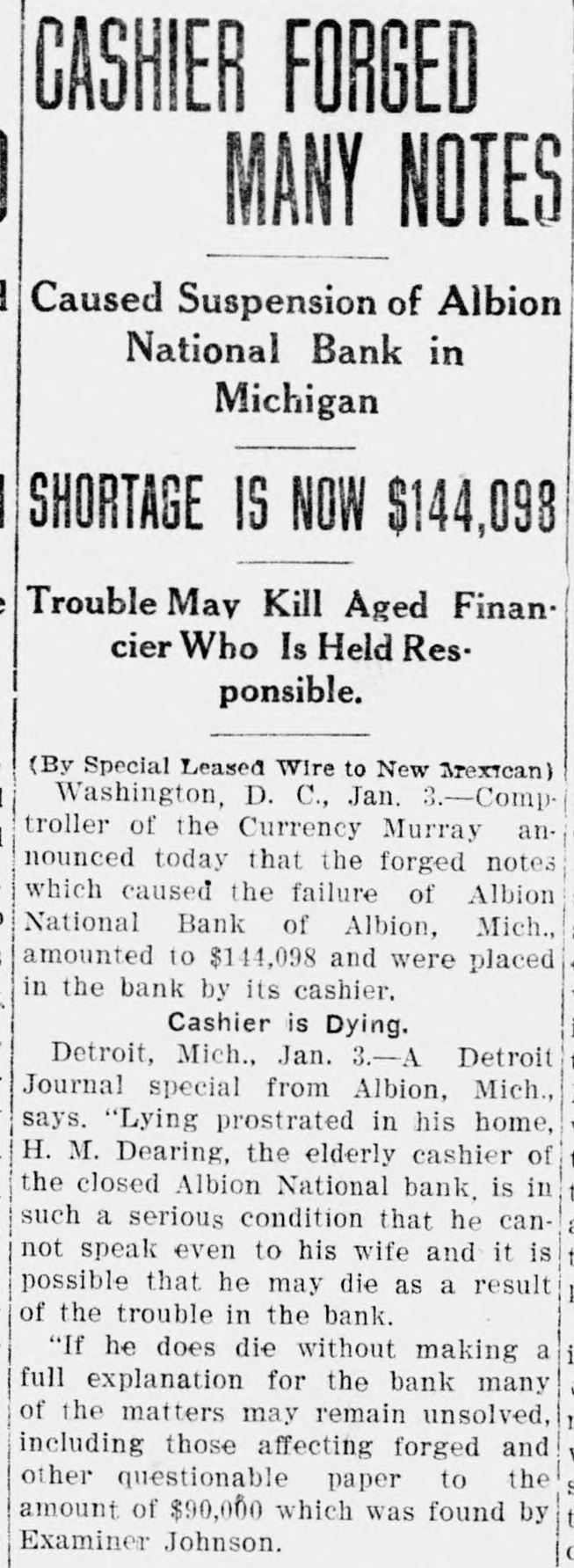
CASHIER FORGED MANY NOTES Caused Suspension of Albion National Bank in Michigan SHORTAGE IS NOW $144,098 Trouble May Kill Aged Financier Who Is Held Responsible. (By Special Leased Wire to New Mexican) Washington, D. C., Jan. 3.-Comptroller of the Currency Murray announced today that the forged notes which caused the failure of Albion National Bank of Albion, Mich., amounted to $144,098 and were placed in the bank by its cashier, Cashier is Dying. Detroit, Mich., Jan. 3.-A Detroit Journal special from Albion, Mich., says. "Lying prostrated in this home, H. M. Dearing, the elderly cashier of the closed Albion National bank, is in such a serious condition that he cannot speak even to his wife and it is possible that he may die as a result of the trouble in the bank. "If he does die without making a full explanation for the bank many of the matters may remain unsolved, including those affecting forged and other questionable paper to the amount of $90,000 which was found by Examiner Johnson. o


Article from The Daily Telegram, January 3, 1912

Click image to open full size in new tab

Article Text

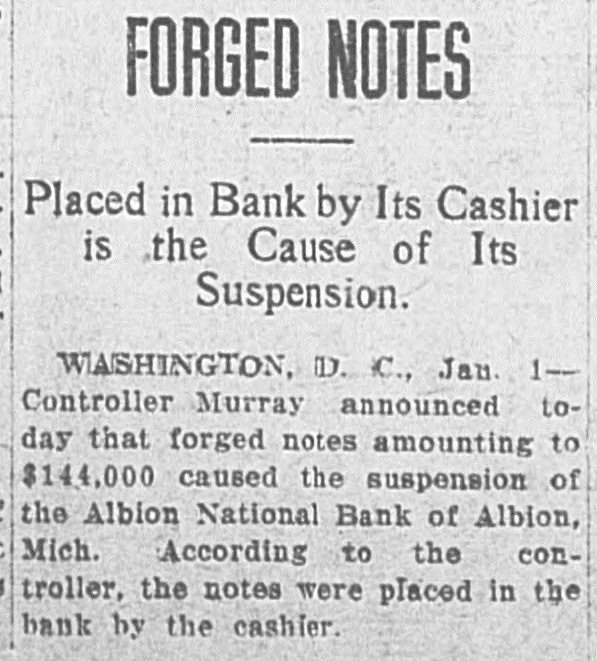
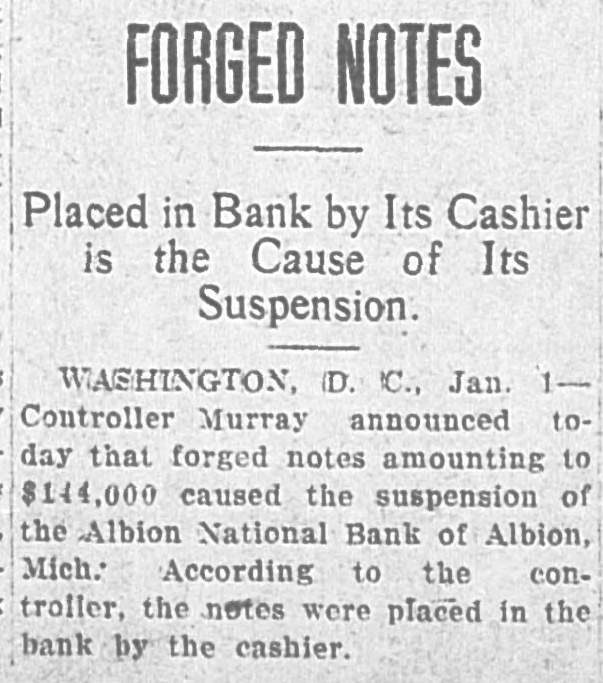
FORGED NOTES Placed in Bank by Its Cashier is the Cause of Its Suspension. WASHINGTON, D. IC., Jan. 1Controller Murray announced today that forged notes amounting to $144,000 caused the suspension of the Albion National Bank of Albion, Mich.: According to the controller, the notes were placed in the bank by the cashier.


Article from The Washington Herald, January 4, 1912

Click image to open full size in new tab

Article Text

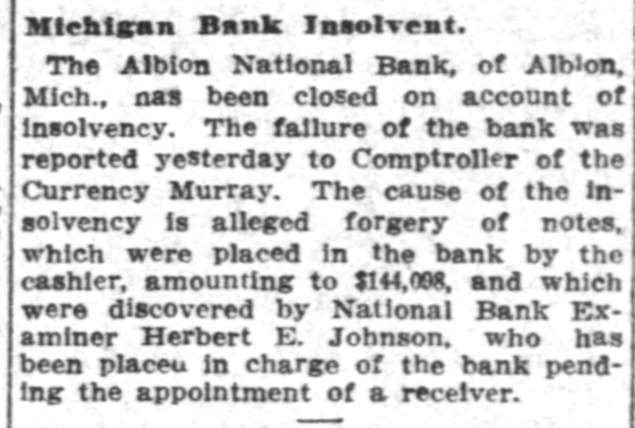
FINANCE AND REALTY There was an unusually good attendance at the meeting of the local stock exchange yesterday, and lively session resulted. Washington Gas and Railway common were again the leaders. While large advances in the prices were no recorded, fractional gains were made. The buying was largely of an investment nature. Railway common was freely sold at 52ยฝ, which is a half point higher than the price at which most of the sales were made the day previous. The total trading in this stock was represented by the exchange of 285 shares, including odd and quotation lots. At the close the bid was 521/40 but none of the stock was to be had at less than 52ยฝ. There was also a good demand for the preferred stock of the Washington Railand Electric Company, sales of quotation way and 100-share lots being made at 88% and 88ยฝ Odd lots brought 88%. After 205 shares of the preferred stock had been traded, the best bid received was 88ยฝ. Washington Gas stock sold at 90%, which is three-eighths of a point better than the sales of the previous day. After several quotation lots had been traded, was then paid for odd lots. At the 90% close the stock was to be had at 90%. but the best bid received was a quarter point less than this figure. Georgetown Gas stock created quite a surprise yesterday, when twenty-five shares were sold at 115. For several weeks there has been little attention paid to this stock, and the same bid and asking prices have been carried along from day to day. It was generally understood for that there was none of the stock sale. Yesterday, when the asking price of 115 was renewed, one broker Immediately bought a quotation lot at that price. still It then developed that there was but another piece of the, stock for sale, the asking price was 130. Will Discuss Proposed Law. The meeting of real estate brokers and property owners to discuss the proposed law regarding deeds and mortgages, which was scheduled to be held at 3:30 January 7 in the rooms of the Chamber of Commerce, will be held this afternoon the instead. In printing the notices of meeting a mistake was made, and Janu- of ary 7 announced as the date instead January 4. It is understood that the meeting will be be largely attended, as the question to as discussed is of interest to brokers been well as owners. The meeting has the called by a committee of fifteen of most prominent brokers of the city. Arlington Changes Hands. The Arlington Hotel yesterday became the property of the Arlington Hotel Coma Delaware corporation, when a deed pany, conveying title to the historic landmark was placed on record. The deed the was signed by Woodbury Blair and National Savings and Trust Company, trustees. The consideration was not mentioned, but it is understood the price paid was about $1,400,000. The company immediately executed a deed of trust to the American Security Trust Company to secure the pay- the and ment to the trustees of $1,000,000 of purchase price. This indebtedness is represented all by twenty-nine notes of various amounts, 5 payable in one year, with interest at . per cent. payable semi-annually. The conveyance to the hotel company Mrs. subject to the lease held by the Roessle is of the hotel property and lease of the I street houses to George Washington University. Michigan Bank Insolvent. The Albion National Bank, of Albion, P Mich., nas been closed on account of insolvency. The failure of the bank was reported yesterday to Comptroller of the Currency Murray. The cause of the Insolvency is alleged forgery of notes, de which were placed in the bank by the cashier, amounting to $144,098, and which discovered by National Bank Examiner were Herbert E. Johnson, who has been placeu in charge of the bank pending the appointment of a receiver. May Re-enter Banking Business. do It was reported yesterday that J. Selwin Tait, in connection with other capitalists, had about decided to start a private bank or to organize under the banking laws of a near-by State. When sh Tait's attention was called to this report Mr. last night, he said that he did not intend to open al private bank. Mr. Tait was the organizer and for eight years the manager of the local branches of the International Banking m Corporation. He resigned the position about a year ago. His friends have for some time been anxious that he should return to the pe banking business, and it was decided to organize a banking institution in WashAs soon as this was known


Article from The Washington Herald, January 4, 1912

Click image to open full size in new tab

Article Text

Michigan Bank Insolvent. The Albion National Bank, of Albion, Mich., nas been closed on account of insolvency. The failure of the bank was reported yesterday to Comptroller of the Currency Murray. The cause of the insolvency is alleged forgery of notes, which were placed in the bank by the cashier, amounting to $144,098, and which were discovered by National Bank Examiner Herbert E. Johnson, who has been placeu in charge of the bank pending the appointment of a receiver.


Article from The Clarksburg Telegram, January 4, 1912

Click image to open full size in new tab

Article Text

FORGED NOTES Placed in Bank by Its Cashier is the Cause of Its Suspension. WASHINGTON, D.C., Jan. 1Controller Murray announced today that forged notes amounting to $144,000 caused the suspension of the Albion National Bank of Albion, Mich. According to the controller, the notes were placed in the bank by the cashier.


Article from The Times Dispatch, January 4, 1912

Click image to open full size in new tab

Article Text

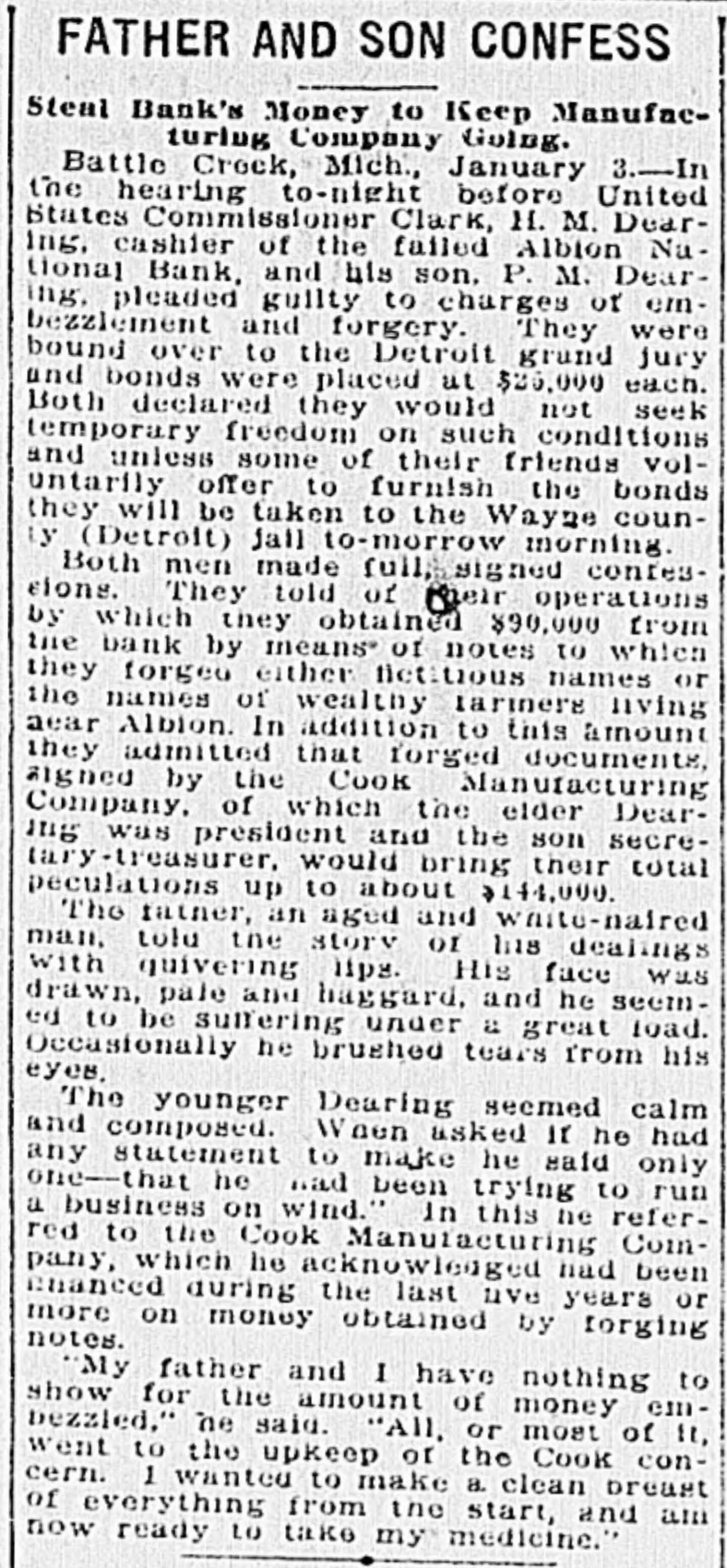
FATHER AND SON CONFESS Steal Bank's Money to Keep Manufacturing Company Golng. Battle Creek, Mich., January 3.-In the hearing to-night before United States Commissioner Clark, H. M. DearIng. cashier of the failed Albion Nutional Bank, and his son, P. M. Dearing. pleaded guilty to charges or embezzlement and forgery. They were bound over to the Detroit grund jury and bonds were placed at $26,000 each. Both declared they would not seek temporary freedom on such conditions and unless some of their friends voluntarily offer to furnish the bonds they will be taken to the Wayne counly (Detroit) Jall to-morrow morning. Both men made full, signed confessions. They told of meir operations by which they obtained $90,000 from the bank by means* of notes to which they forgeo either fictitious names or the names of wealthy tarmers living aear Albion. In addition to this amount they admitted that forged documents, signed by the Cook Manufacturing Company, of which the elder Dearmg was president and the son secretary-treasurer, would bring their total peculations up to about $144,000. The father, an aged and white-naired man, tolu the storv or his dealings with quivering Hps. His face was drawn, pale and haggard, and he seemed to be suffering under a great load. Occasionally he brushed tears from his eyes. The younger Dearing seemed calm and composed. When asked If he had any statement to make he said only one-that he had been trying to run a business on wind." in this he referred to the Cook Manufacturing Company, which he acknowledged had been manced during the last ave years or more notes. on money obtained by forging "My father and I have nothing to show for the amount of money embezzled," he said. "All, or most of it, went to the upkeep or the Cook concern. 1 wanted to make a. clean breast of everything from the start, and am now ready to take my medicine."


Article from Evening Times-Republican, January 4, 1912

Click image to open full size in new tab

Article Text

Arrested at Albion. Albion, Mich., Jan. 4.-H. M. Dearing. cashier of the Albion National Bank. which was closed Tuesday, and his son. Palmer Dearing. were arrested last night in connection with the shortage in the bank's funds. The arrests followed a dispatch from Washington stating that Comptroller of the Currency Murray had announced that the forged notes, which caused the failure of the bank, amounted to $144,088. The notes, according to the typewriten announce. ment issued by the comptroller, were placed in the bank by its cashier. Dr. W. O. O'Donohue, the aged prestdent. is the only one of the officials who comes to the bank's offices at all. and he is there constantly, answering questions and explaining things as beat hec an. The other two banks here have not been affected, altho extensive preparations were made by both to handle runs. It is thought likely that the city hospital. the funds of which were all In the bank, will be compelled to close its doors unless the citizens give it monetary aid.


Article from The Calumet News, January 4, 1912

Click image to open full size in new tab

Article Text

ALBION BANKERS IN DETROIT JAIL DEARINGS, WHO CONFESSED TO FORGERIES OF $165,000, ARE NOW FEDERAL PRISONERS. -Detroit, Mich., Jan. 4.-H. M. Dearing and son, Palmer M. Dearing, the Albion bankers, who confessed to forgeries, of $165,000. which caused the closing of the bank at Albion, were received in jail here today as federal prisoners. Each is under a $25,000 bond. The grand jury is in session and it may be two months before indictments against the bankers can be returned. Before leaving Battle Creek for Detroit the elder Dearing expressed a desire to be sent to Fort Leavenworth as soon as possible. Asked If there was any hope for depositors receiving their money he said, "None at all." H. M. Dearing is one of the oldest and best known bankers of Michigan. Many bankers of prominence remember him as one of the leading bankers back in the days when they were just entering their careers. Receiver is Appointed. Washington. Jan. 4.-Frank L. Irwin, of Albion. Mich., has been appointed receiver for the failed Albion National bank.


Article from The Detroit Times, January 4, 1912

Click image to open full size in new tab

Article Text

ALBION DEFAULTER AND SON IN DETROIT JAIL H. M. Dearing and Palmer Dearing Confess Taking $144,000 From Bank. H. Montgomery Dearing, cashier of the defunct Albion National bank. and his son, Palmer Dearing, who admit discrepancies which are placed at more than $144,000. were brought to Detroit this morning by United States Marshal Campbell and placed in the county jail. Looking pale and wan, and with heavy circles under his eyes, which look as they had not known sleep for many nights, the elder Dearing, who confessed wrecking the Albion National bank, by flooding it with forged notes, politely arose in his cell in Ward I of the county jail, and talked courteously with a Times representative, though he declined to discuss his case. His son. Palmer M. Dearing, whose attempt to operate the Cook Manufacturing Co. "on wind," resulted in the immense defalcation, is in an adjoining cell in the same ward, but did not come out to greet any callers. The father seems to have been selected as spokesman for the pair, and to bear the burdens, as that was also the situation at the court session in Battle Creek. Wednesday night. The elder Dearing, who says he is 72 years old, has very white hair and mustache, which, framing a face almost ghastly in its pallor as he leaned against the cell bars, made him look like a very sick man, but he smiled when asked as to his health, and said he felt as well as could be expected. "It was reported that you were confined to your bed in your home, as late as Wednesday afternoon," he was told. "I was confined to the house, but I am not sick, exactly," he replied, with a brave attempt at cheerfulness. Asked whether he thought the court hearing, the trip to Detroit, and his confinement in jail here would cause any serious illness, he replied that he did not anticipate such a thing. His tired looking eyes lighted up a little at the surprise exhibited by his interviewer when he told of his family-his wife and two sons-one the 45-year-old man who occupies an adjoining cell, and the other a mere babe of four years, Robert by name, and the pride of his aged parent. The lad is in Albion with his mother, and there was just the suggestion of moisture in the aged bank wrecker's eyes as he mentioned the boy. "I made a complete statement to the district attorney in Battle Creek, Wednesday night, and I really wouldn't want to discuss the case any further," he said, when pressed for an explanation of the method used in getting the forged checks into the bank's cash fund. The elder Dearing pleaded guilty last night before Circuit Court Commissioner O. S. Clark, in Battle Creek, to a specific charge of misappropriating more than $40,000 of the funds of the Albion bank. Dearing said his bank lost $21,000 on drafts which were cashed by Charles Young, who figured in the news of the failure of the Springport bank. This was followed by a loss of $44,000 through a transfer of assets that were supposed to be good and then came forgeries that led to the downfall of Dearing and his son. Dearing and his son were taken to Battle Creek for arraignment. Their bonds were fixed at $25,000, and, unable to give bail, they were held in custody last night to be brought to Detroit by United States Marshal Campbell. pleaded guilty to


Article from The Marion Daily Mirror, January 4, 1912

Click image to open full size in new tab

Article Text

FORGED NOTES REACH $144.098 Battle Creek, Mich., Jan. 4.-H. M. Dearing, cashier of the Albion Nationai bank, which was closed yesterday, and his son, Palmer A. Dearing, secrretary and treasurer of the Cook Manufacturing Co., were arrested late yesterday by United States Marshall Campbell, of Detroit. They were trought to this city last night, for a hearing before United States Commissioner S. O. Clark. Controller of the Currency Murray today announced that the forged notes which caused the failure of the bank, amounted to $144.098. The notes, according to the controller, were placed in the bank by its cashier. Cashier Dearing is president of the Cook company, extensive loans to which are said to have precipitated the bank's difficulties. Although considerable feeling prevailed in Albion against them, there was no violence when the prisoners were taken from the city, and only a small crowd was at the depot when they boarded the train. It is thought likely that the city hospital, the funds of which were all in the bank, will be compelled to close its doors, unless the citizens give it monetary aid. But a small amount of city money was deposited in the defunct bank, but the treasurers of three adjacent to wnships had made recent heavy deposits there. Dr. W. O. O'Donough, the aged president, is the only one of its officials who went to the bank offices today. The other two banks at Albion have not been affected, although extensive preparations were made by both to handle runs.


Article from The Birmingham Age-Herald, January 4, 1912

Click image to open full size in new tab

Article Text

DEARING ADMITS FORGING NOTES Battle Creek, Mich., January 3.-P. M. Dearing, implicated with his father, H. M. Dearing, cashier of the closed Albion National bank in the alleged forgery of over $100,000 worth of notes drawn on wealthy farmers in the vicinity of Albion, resulting in the failure of the bank, stated in an interview tonight that that he had been forging the notes for over five years in order to finance the Cook Manufacturing company of which he was secretary and treasurer and which closed down Tuesday. Dearing could not state just how much the forgeries amounted to but said it took $20,000 a year to meet the payroll and that the concern had-lo money for over five years, He asserted that he and his father would plead guilty. He said he wished to be, taken before the grand jury at once and be committed to the federal prison that he might commence his term as soon as possible. Dearing stated that he thought his father was more heavily implicated in the forgeries than himself. In the hearing tonight before United States Commissioner Clark, H. M. Dearing, cashier of the failed Albion National bank, and his son, P. M. Dearing, pleaded guilty to charges of embezzlement and forgery. They were bound over to the Detroit grand jury and bonds were placed at $25,000 each. Both men made full confessions and their statements were taken down and signed. They told of their operations by which they obtained $90,000 from the banks by means of notes, to which they forged either fictitious names or the names of wealthy farmers living near Albion. In addition to this amount, they admitted that forged documents signed by the Cook Manufacturing company would bring the total peculations up to about $144,000. For several hours prior to the arraignment the elder Dearing assisted the district attorney and commissioner in drawing up the warrants that were to send him and his son to prison. The father, an aged, white haired man, told the story of his dealings with quivering lips. His face was drawn, pale and haggard. Occasionally he brushed tears from his eyes. The younger Dearing seemed calm and composed. He permitted his father to do all conferring with the attorney and commissioner. When asked if he had any statement, he said he "had been trying to run a business on wind." "My father and I have nothing to show for the money embezzled," he said. "My father's wife, my stepmother, knew nothing of the defalcations; neither did my brother, who worked in the bank," he continued. "I told my wife three years ago about it. Father and I have left them nothing to live on."


Article from Evening Star, January 6, 1912

Click image to open full size in new tab

Article Text

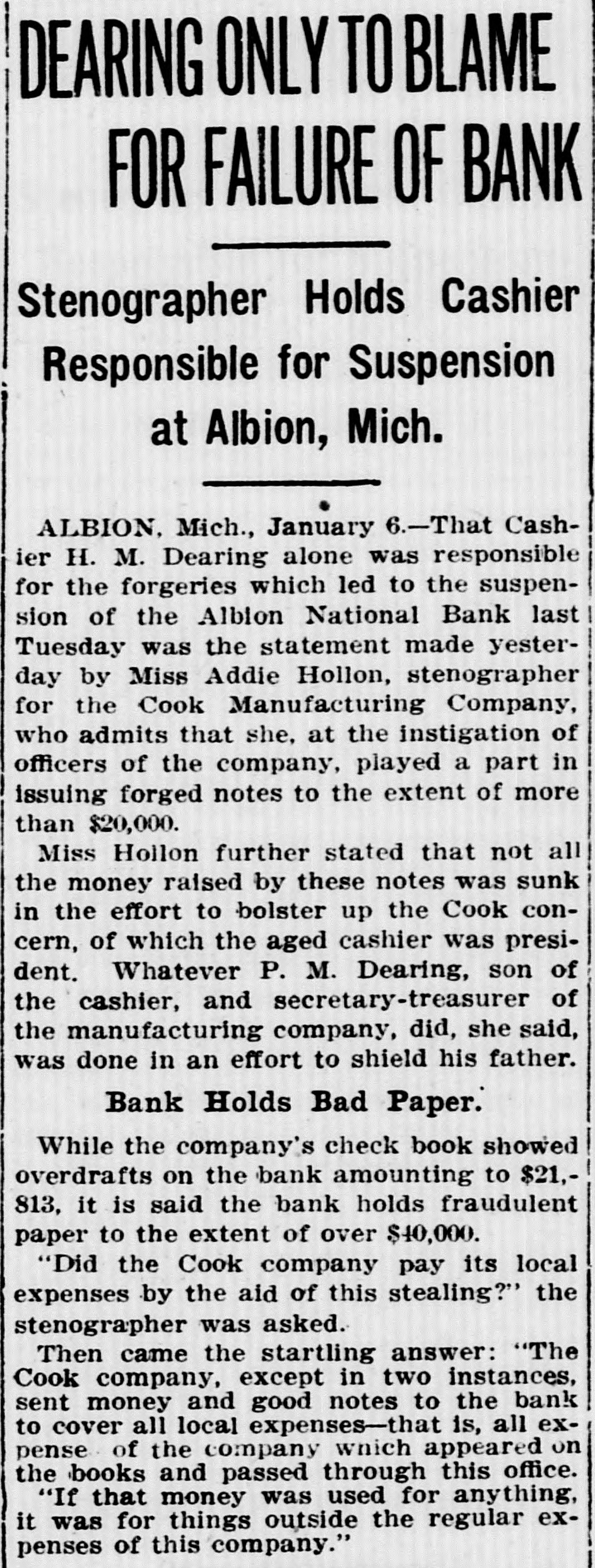
DEARING ONLYTOBLAME FOR FAILURE OF BANK Stenographer Holds Cashier Responsible for Suspension at Albion, Mich. ALBION, Mich., January 6.-That Cashier H. M. Dearing alone was responsible for the forgeries which led to the suspension of the Albion National Bank last Tuesday was the statement made yesterday by Miss Addie Hollon, stenographer for the Cook Manufacturing Company, who admits that she, at the instigation of officers of the company, played a part in issuing forged notes to the extent of more than $20,000. Miss Hollon further stated that not all the money raised by these notes was sunk in the effort to bolster up the Cook concern, of which the aged cashier was president. Whatever P. M. Dearing, son of the cashier, and secretary-treasurer of the manufacturing company, did, she said, was done in an effort to shield his father. Bank Holds Bad Paper. While the company's check book showed overdrafts on the bank amounting to $21,813, it is said the bank holds fraudulent paper to the extent of over $40,000. "Did the Cook company pay its local expenses by the aid of this stealing?" the stenographer was asked. Then came the startling answer: "The Cook company, except in two instances, sent money and good notes to the bank to cover all local expenses-that is, all expense of the company which appeared on the books and passed through this office. "If that money was used for anything, it was for things outside the regular expenses of this company."


Article from Alexandria Gazette, January 11, 1912

Click image to open full size in new tab

Article Text

Dearing's Thefts and Forgeries. Battle Creek, Mich , Jan. 11.-It is rumored that following the conference between depositors of the Albion National Bank, wrecked by the thefts and forgeries of H. M. Dearing, casbier and local attorneys, more arrests will be made today in connection with the defunct institution. According to it statement of Receiver Irwin, the thefts of the Dearings have now reached $300,000. The new losses were discovered when leaves cut from the cash ledger were found secreted in Dearing's desk.


Article from The Detroit Times, January 11, 1912

Click image to open full size in new tab

Article Text

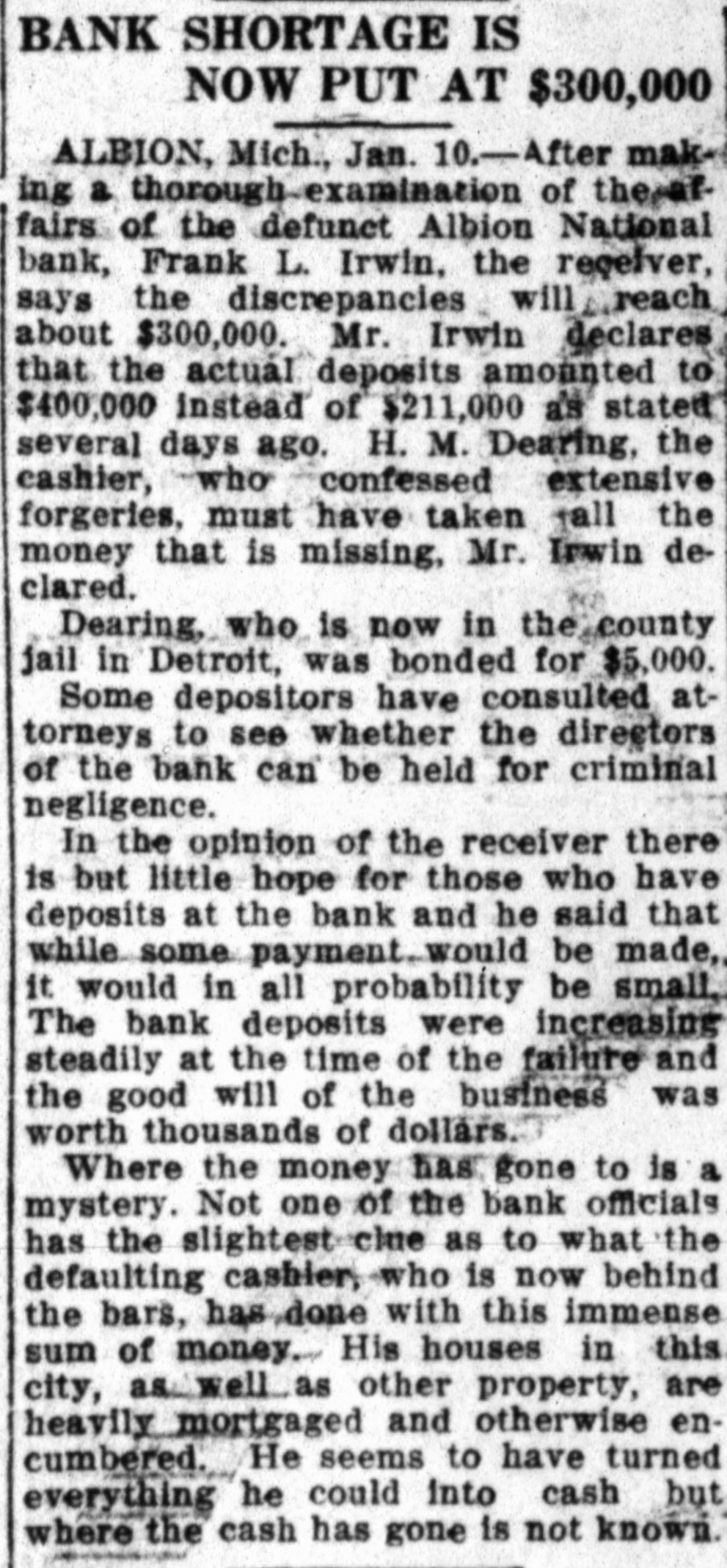
BANK SHORTAGE IS NOW PUT AT $300,000 ALBION, Mich., Jan. 10.-After making a thorough examination of the affairs of the defunct Albion National bank, Frank L. Irwin, the reqeiver, says the discrepancies will reach about $300,000. Mr. Irwin declares that the actual deposits amounted to $400,000 instead of $211,000 as stated several days ago. H. M. Dearing, the cashier, who confessed extensive forgeries, must have taken tall the money that is missing, Mr. Irwin declared. Dearing who is now in the county jail in Detroit, was bonded for $5,000. Some depositors have consulted attorneys to see whether the directors of the bank can be held for criminal negligence. In the opinion of the receiver there is but little hope for those who have deposits at the bank and he said that while some payment would be made, it. would in all probability be small, The bank deposits were increasing steadily at the time of the failure and the good will of the business was worth thousands of dollars. Where the money has gone to is a mystery. Not one of the bank officials has the slightest clue as to what the defaulting cashier, who is now behind the bars, has done with this immense sum of money His houses in this city, as well as other property, are heavily mortgaged and otherwise encumbered. He seems to have turned everything he could into cash but where the cash has gone is not known.


Article from The Daily Gate City, January 11, 1912

Click image to open full size in new tab

Article Text

MORE ARRESTS WILL FOLLOW Pages From the Ledger of Wrecked Bank Had Been Cut From Book. [United Press Leased Wire Service.] BATTLE CREEK, Mich. Jan. 11. It is reported that following the conference between depositors of the Albion National bank, wrecked by the thefts and forgeries of H. M. Dearing, cashier, and local attorneys, more arrests will be made today in connection with the defunct institution. According to a statement of Receiver Frank L. Irwin, the thefts of the Dearing's have now reached $300,000. The new losses were discovered when leaves cut from the cash ledger were found secreted in Dearing's desk, While the published report showed the bank to have deposits of $211,000, the actual deposits amounted to over $400,000.


Article from The Yale Expositor, February 15, 1912

Click image to open full size in new tab

Article Text

Checks Forged On Very Last Day. Checks that were forged by H. M. Dearing, defaulting cashier of the Albion National bank, on the last day on which the bank did business have turned up. These forgeries took place while the federal examiner was conducting the examination which closed the institution. Several other suits are expected to be started by the bank receiver within the coming week.


Article from The Detroit Times, February 27, 1912

Click image to open full size in new tab

Article Text

WILL SIFT BANK MIX-UP AT ALBION BATTLE CREEK, Mich.. Feb. 27.An investigation of the affairs of the wrecked Albion National bank began Monday when Judge Walter H. North appointed D. A. Carfield, of Albion, receiver for the First National bank, of Albian. This bank was the predecessor of the Albion National, and John H. Callahan, who was a stockholder in the old bank and a director in the new one, wants the receiver to run down the assets of the original bank. He believes the wrecking of Albion National really. started before the merger.


Article from The Detroit Times, March 29, 1912

Click image to open full size in new tab

Article Text

CASE AGAINST DEARINGS PRESENTED TO GRAND JURY Expected That Men Implicated in Wrecking Albion Bank Will Be Indicted Indictments, it is expected, will be found, Saturday, by the federal grand jury against H. M. Dearing, cashier of the defunct Albion National bank and his son, Palmer, implicated with him in the wrecking of the institution. District Attorney Tuttle personally presented the case to the grand jury Friday. A score or more of witnesses in the case from Albion were on hand. Some of these included women who had lost money through the defalcations of the elder Dearing. The bank closed its doors Jan. 2 and a day or two later the Dearings were arrested. Investigation revealed that the elder Dearing had looted the bank of approximately $300,000. The Dearings were brought to Detroit and lodged in the county jail where they confessed all, the elder Dearing seeking to bear the responsibility for the wreck of the bank. The son was employed by the Cook manufacturing company, and the father was also interested in the enterprise of manufacturing gasoline engines. It was a losing business and the elder Dearing took money from the bank to keep the company running. Dearing's son is charged with having knowledge of the thefts and conspiring with his father in covering the defalcations.


Article from The Detroit Times, April 25, 1912

Click image to open full size in new tab

Article Text

WOULD TO GOD THAT THAD BEEN DISCOVERED WHEN MY THIEVINGS WERE SMALL -HENRY M. DEARING. "Now I'm Utterly Ruined," Wails Albion Bank Wrecker, Starting For Prison EXAMINERS WERE EASY Says Government Should Ap1 point Competent Men Who Can Detect Crookedness Henry M. Dearing, aged 73 years, former cashier of the National bank of Albion, before leaving Detroit, Wednesday morning, in company with his son, Palmer, for the federal penitentiary in Leavenworth, Kas., to which they were sentenced for five years by Judge Angell, gave out a statement to The Times in which he analyzed the cause ef his downfall, the wreck of the bank and the loss of approximately $150,000 to depositors. 'Not overlooking his own responsibility in the affair, the elder Dearing held the lax system of the government in conducting examinations of the smaller banks to blame for the fact that the bank was completely ruined before detection came. The defalcations extended over period of nearly 11 years and examinations were supposed to have been made twice yearly, but the government examiners did not learn the true condition of affairs until the elder Dearing confessed everything. "Would to God, he cried, "that I had been discovered when my thievings were small. I would have suffered, know, but not as I have suffered, and could have made amends. Now I have lost everything, all my friends, all my money am utterly ruined, and, as though that were not enough burden, I have always before me the knowledge that I took my son down with me, my son, for whom I should have set a better example. The old man's slight frame trembled, he leaned against the bars of his cell for support, a mist came before his pale, blue eyes. His thin, white hair and furrowed forehead added to the picture of age and despair. Points to a Lesson. "There is one lesson I would like to draw for the world in my failure, he continued, and the reporter expect ed to hear the old, threadbare moral, "Don't begin. But the lesson was more practical. Dearing went on "The first necessary step for stopping such a theft as the one which am guilty is the elimination of political considerations in the appointment of our national bank examiners. Men should be appointed who have long practical experience in bank affairs, men who understand the running of banks and who can be depended on at all time to take pains and make conscientious examinations. "Take my case as an example. I had no trouble, whatever, in covering up my shortages as cashier of the Albion National bank. It was a simple matter and could have been exposed in a simple way If the examiners had gone about it right. I don't think it would be good policy to give the details of just how I covered up the shortages for so long a period; It is best that such things should not be commonly known. Neither do I wish to criticize my superiors in the bank, but I will say that if the smaller banks of our country had such thorough-going business men for directors as have the larger banks in Detroit failures like that of the Albion bank would seldom occur. "I consider the present national bank examiner, H. E. Johnson, thoroughly efficient. He made one examination of the bank prior to the examination made in January, when confessed to having stolen the bank's money. But when he made the for mer examination he was comparative ly new at the business. As for the assistant examiners it was a very easy matter to throw them off the track. They would take too much for granted. Should Pass on Notes. "Another point I want to make is that the examiners should meet with the directors and pass on all notes. The national bank examining department should take more interest in the personnel of the boards of directors and the latter should not be mere figureheads. It is that condition to day which is causing so many bank smashes in this country. If the system were changed the shortages would be detected as soon as they began and the banks could not get hopelessly involved. The government has a moral duty to perform in this mat ter in safeguarding the public, if not in keeping a banker who starts to go wrong from ruin. "Have you ever had a secret in your heart that you felt you could not give up and yet it tortured you so that you almost prayed that it might be revealed? That is the way I felt for years, until it got to a point where I was glad when the examiner got suspicious and closed the bank. I might have held off. I might, even, have attempted to allay his suspicion, possibly, thrown him entirely off the scent, but it had come to such a pass shat I felt a sense of relief when caught. I even told the examiner his suspicions were well-founded and con fessed everything. Study for Psychologists. Dearing's case is study for psy chologists. Going back to its Incep tion the story concerns an ambitious promoter, how he got the Dearings in terested in a gasoline engine enter prise and how, to use the language of the son, "we built too much on our hopes.' The elder Dearing went to Albion in 1855, and conducted a store there for about 17 years. He wanted to go to war in 1861 but he was physically unfit. He joined the National bank staff in 1877. His first wife died in 1888, and he now has a wife about 40 years of age, who is left to shift for Irerself with their youngest son, aged four years. His wife had about $90 on deposit in the bank and she will receive her proportion of what is left the receiver having estimated tha the depositors will receive about 5 cents on the dollar. which means that
Article from Belding Banner, October 27, 1915

Click image to open full size in new tab

Article Text

NEIGHBORHOOD NEWS Defunct Bank to Pay Albion-Uncollected accounts of the bankrupt Albion National bank, amounting to more than $20,000, will be sold at public auction Monday, and it is expected that sale, which was petitioned for the receiver, Charles A. Korbly, of Washington, will close up the affairs of the bank which failed so sensationally in January, 1912. It is expected that the final dividend, which will be more than 5 per cent, will be paid shortly after the sale, giving depositors in all approximately 35 cents on the dollar. H. M. Dearing, the cashier of the defunct bank, whose embezzlements amounted to over $250,000, is just completing a five-year term in Leavenworth prison while his sons, P. M. and George V. Dearing, are serving like terms for complicity, the former in Leavenworth and the latter in the Detroit house of correction.