
Commercial & Railroad Bank (Vicksburg, MS)

Episode Information

Episode UID
7566174990450
Episode Type
Run β†’ Suspension β†’ Reopening
Bank Type
state
Bank ID
756617499 hash
Start Date
June 3, 1837
Location
Vicksburg, Mississippi (32.353, -90.878)

Metadata

Model
gpt-5-mini (chosen from majority vote of a three-model LLM ensemble)
Short Digest
e71142844b69f161

Response Measures

None

Description

The suspension date is not stated explicitly in the articles; resumption is announced 1838-12-13 for Jan 1 resumption.

Events (3)

1. June 3, 1837 Run
Cause
Macro News
Cause Details
Context of 1837 indicates banking panic conditions (Panic of 1837) producing runs and heavy withdrawals.
Measures
Cashier statement that bank was paying specie and would continue to pay during the run.
Newspaper Excerpt
The Cashier of the Commercial and Rail Road Bank of Vicksburg-then in New Orleans-addressed a letter to the Bulletin on the 12th, in which he says, that the Bank was then paying, and will continue to pay, specie, come the run ever so hard.
Source
newspapers
2. December 1, 1838* Suspension
Cause
Macro News
Cause Details
Article refers to a prior suspension of specie payments (likely linked to ongoing regional/national monetary difficulties); exact trigger not specified.
Newspaper Excerpt
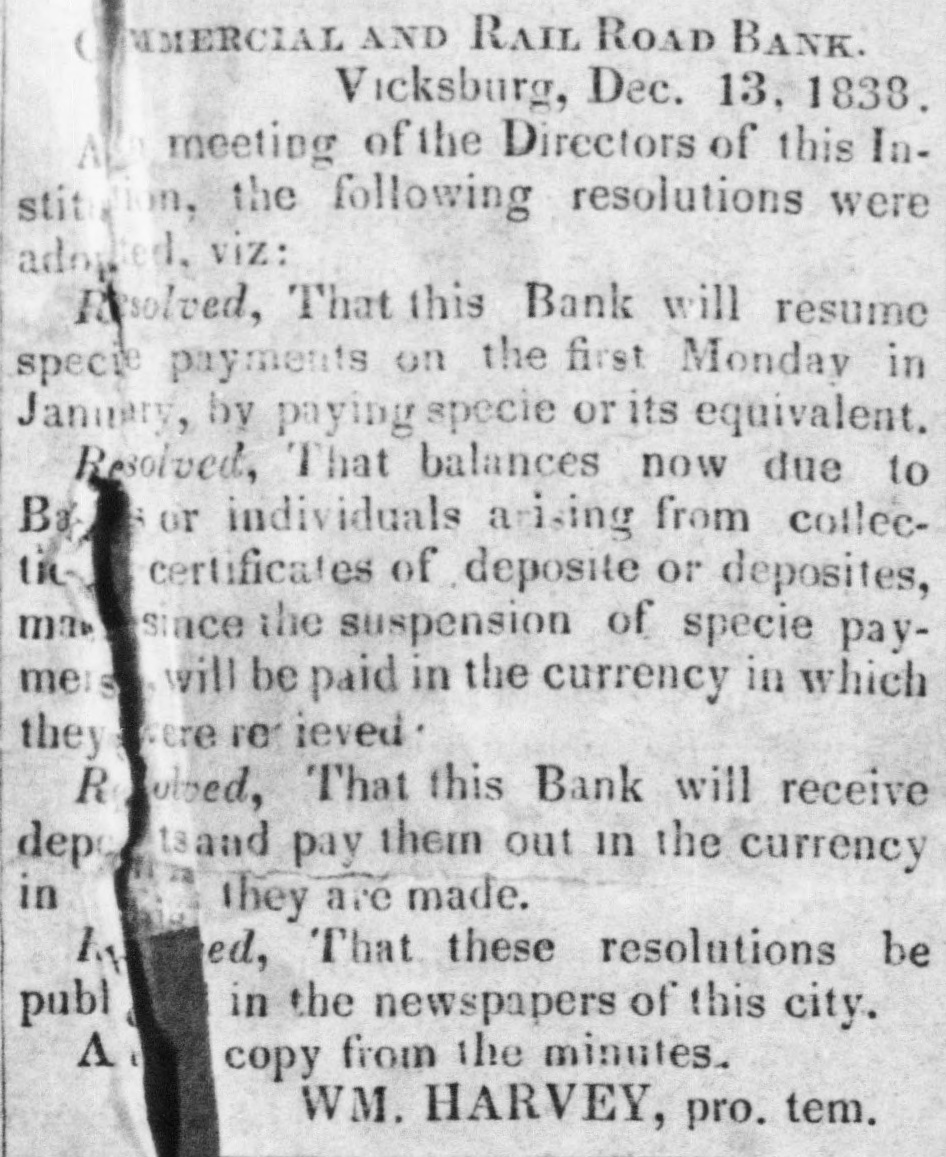
Resolved, That balances now due to Banks or individuals arising from collections, certificates of deposite or deposites, made since the suspension of specie payments, will be paid in the currency in which they were received.
Source
newspapers
3. January 1, 1839 Reopening
Newspaper Excerpt
Resolved, That this Bank will resume specie payments on the first Monday in January, by paying specie or its equivalent.
Source
newspapers

Newspaper Articles (3)

Article from Iowa News, June 3, 1837

Click image to open full size in new tab

Article Text

tender and water tank, and of a special atten- dant to the fire in each engine-will be whol- ly dispensed with. This saving for one engine in daily use throughont the year may be rea- sonably estimated at three thousand dollars. -And in repairs there will be a saving more than equal to the whole probable expense of transportation, and repairs of a locomotive, moved by the newly discovered application of power. Winchester Virginian. A gentle hint. A native of the Emerald Isle lately went to consult the printer of a newspa- per in a neighboring county, respecting his runaway apprentice. The printer proposed to advertise him in the usual form with a suit- able reward; this did not meet Patrick's idea: ---"he did not wish to advertise him, only jist to give him a hint." After various attempts at framing a suitable notice, the following was suggested by himself, as all sufficient, viz:--- "Patrick Flagherty would inform his appren- tice, Timothy Dougherty, that he does not wish to expose him, but give him the hint to return to his master, and serve out his inden- ture, like a good boy, or he will be advertised in the newspapers. He is only 18 years of age, tho' he thinks he is 21." An Irish woman called at a grocer's the oth- er day, and asked for a quart of vinegar. It was measured and put in a gallon jug. She then asked for another quart to be put in the same vessel. "And why not ask for a half gallon and be done with it?" said the grocer. "Oh! bless your little bit of a soul," answer- ed she, "it's for two persons." EMIGRATION.---Our friends at the west expect to be over whelmed with new comers this sea- son. The pecuniary troubles high rents, dear living, and the reduced demand for labor, will drive many to emigration that would not other- wise have dreamed of it. Living is indeed high at the west, but rents are nothing to a poor man, since a log cabin can be put up for fif- ty dollars, or less. We advise every laborer of whatever trade, to take up his march unable to get employment at a fair prico, unless his circumstances forbid the attempt Let him not endeavor to get beyond sun-down---there is an abundance of land this said, which may be had cheap and is not wholly without the pale of churchs, schools, newspapers and civilization. If he take our advice he will not enter largely upon the embryo city manufctory---that busi- ness requires too much capital, and has been rather overdone already; he will find the pro- duction of potatoes horseshoes, pork or plank nearly as profitable now, and a great deal safer. If he go prepared to throw off his coat, fare rudely, work heartily; sleep soundly and rise seasonable, he will be likely to thrive there, and can afford to enliven his solitude with a weekly desert of literature and intelligence of the first quality, fresh from the grat focus of knowledge and civilization for the continent.--- Ahem!-New York. ### THE NEPHEWS OF NAPOLEON. It is not generally known. perhaps, that two of the nephews of the Emperor NAPO- LEON, are now in this city, residing at the Washington Hotel. Napoleon Louis, son of the ex-King of Holland. who was compromised in the Strasburg affair, and Pierre Napoleon, son of Lu- cien, who had some difficulties with a platoon of the Pope, soldier at Rome. The former is rather of short stature- exceedingly plain in his manners and dress-affableand intelligent, and is the author of several able publications on mi- litary matters. - Pierre is tall & shy, and his dark hair and profile bear a strong resemblence to his illustrious uncle. It is the intention of Louis Napoleon to make the tour of this coun- try the present year. He speaks the English with much fluency. [N. Y. Star. ### Alarming from Florida The Charleston Mercury says: "The most important face in the last account from Florida, is that a large negro (equal to twosmall ones) had been seen prow- ling about. Fortunately the army did not get in his way, so that he did com- paratively little demage. We are not informed of his exact size." The Cashier of the Commercial and Rail Road Bank of Vicksburg-then in New Orleans-addressed a letter to the Bulletin on the 12th, in which he says, that the Bank was then "paying, and will continue to pay, specie, come the run ever so hard." Com. PORTER has resigned his sta- tion in the Navy. ### THE FORCE OF RIDICULE. No dirk has been seen in the Ohio Legislature since a member appeared there with a wooden one stuck in his bosom, and a long corn cob handle attached to it.

Article from Southern Marksman, December 18, 1838

Click image to open full size in new tab

Article Text

COMMERCIAL AND RAIL ROAD BANK. Vicksburg, Dec. 13, 1838. At a meeting of the Directors of this Institution, the following resolutions were adopted, viz: Resolved, That this Bank will resume specie payments on the first Monday in January, by paying specie or its equivalent. Resolved, That balances now due to Banks or individuals arising from collections, certificates of deposite or deposites, made since the suspension of specie payments, will be paid in the currency in which they were received. Resolved, That this Bank will receive deposits and pay them out in the currency in which they are made. Resolved, That these resolutions be published in the newspapers of this city. A true copy from the minutes. WM. HARVEY, pro. tem.


Article from Lexington Union, December 22, 1838

Click image to open full size in new tab

Article Text

BANK CONVENTION. At meeting of the delegates from the Banks of Mississippi and Tennessee, convened at the Commercial & Rail Road Bank of Vicksburg, the following Banks were represented, viz: Farmers & Mechanics Bank of Memphis; Planters Bank, Natchez; Agricultural Bank, Commercial & Rail Road Bank of Vicksburg, West Feliciana Rail Road & Banking Company, Commercial Bank of Natchez, Commercial Bank of Manchester, Commercial Bank of Rodney, Bank of Lexington, Vicksburg Waterworks & Banking Company, Mississippi Rail Road Company, Citizens Bank of Madison County, Mississippi Union Bank, Real Estate Banking Company of Hinds County, Bank of Vicksburg. On motion, H G Runnels was called to the Chair, and J J Chewning was appointed Secretary. On motion, Resolved, That Messers. J Wood and George G Skipwith of Nashville, be invited to take a seat in this Convention. The following resolutions was offered by Stephen Duncan: Resolved, That the first monday in January next be the period fixed on for a resumption of specie payments by the Banks represented in this Convention; provided the delegates from the Union Bank of Mississippi will give assurance that the post notes of that Bank will be redeemed with specie, or its equivalent, when presented at her counter. On motion to strike out all after the word "provided," the yeas and nays being called, the vote stood thus; Ayes.β€”E Montgomery, of Planters Bank; M B Hamer, Commercial Bank of Manchester; J C Bole, Lexington Bank; S P Webster, Vicksburg W W & Banking Co; J A Quitman, Miss. R R Co; W Hardeman, Citizens Bank of Madison county; H G Runnels and R M Williamson, Mississippi Union Bank. Naysβ€”E W Lucas, of Famers and Mechanics Bank, Memphis; S Duncan, Agricultural Bank, J J Chewning, Com. & R R Bank of Vicksburg; G H Gordon, West Feliciana R R & Banking Co; L R Marshall, Com. Bank of Nathez; Thos. Freeland, Com. Bank of Rodney; A M Paxton, Bank of Vicksburg. This being a tie, the motion was lost. S P Webster proposed to strike out all the above resolutions, after the word "resolved," and proposed the following as a substitute: Whereas, in the opinion of this Convention, a resumption of specie payments by the Banks of Mississippi on the first day of January next, would be prejudicial to the interest of the community, for the following, among other reasons: 1. Because the month of January is the middle of the business season, and the period of the year when both planter and merchant stand in most need of all the bank facilities which can be afforded them. 2. Because it is the season of the year at which the largest amount of engagements have usually been made to fall due, and causes the months of January and February, in ordinary times, to be seasons of peculiar pressure in the money market. 3. Because the engagements maturing in January and Febuary have, to a considerable extent, been passed to foreign creditors, and would immediately be demanded in specie or Eastern exchange. 4. Because of the present high rate of exchange against this state, in which condition a resumption of specie payments is unprecedent in any state or nation.β€”The recent resumption in New York not being made until exchange had been for a period of two months in their favor, and in Philadelphia not until five months after that condition of things existed and at a time when the importation of specie by the banks of those places was a business of profit. 5. Because a resumption in January would cause the whole bank note circulation of the State to come in upon the banks, and leave the state without a circulating medium at all, to the great detriment of trade, and to the utter ruin of all who have money to pay at our spring courts, or provisions to purchase for the coming season. 6. Because it would be a burden of from 2 to 5 percent. of their whole circulation, upon the resuming banks without corresponding benefit to any class of persons, other than the Northen holders of our circulation, who have purchased it on speculation at from 15 to 40 percent discount.