Article Text
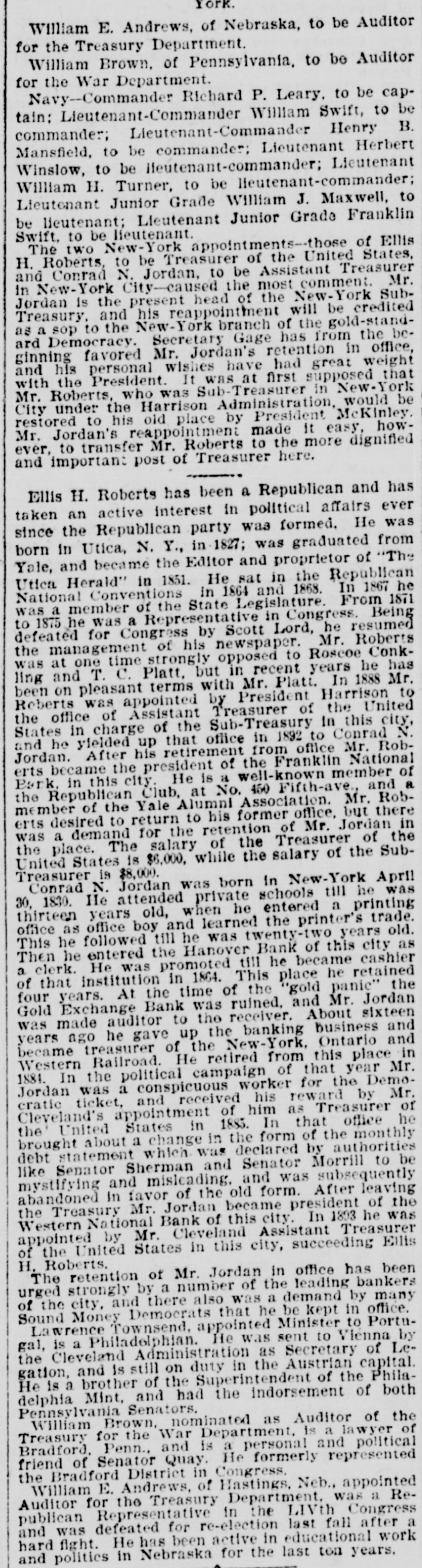
# CONRAD N. JORDAN. Conrad N. Jordan, of New-York, to be Assistant Treasurer of the United States at New-York City, vice Ellis H. Roberts, resigned. Daniel M. Browning, of Illinois, to be Commissioner of Indian Affairs. Frank C. Armstrong, of Washington, D. C., to be Assistant Commissioner of Indian Affairs. Henry V. Johnson, of Colorado, to be Attorney of the United States for the District of Colorado: Charles B. Bellinger, of Oregon, to be United States District Judge for the District of Oregon: William K. Reid, of Utah, to be Judge of Probate in the County of San Pete, Territory of Utah. Henry L. Peckham, of Rhode Island, to be a third lieutenant in the revenue cutter service. It becomes apparent as the President proceeds in the task of parcelling out the spoils that Tammany is not "in it." The visit of "Blue-eyed Billy" Sheehan on Saturday last has been without effect. In fact, it is now said that he would not even have had a chance to use the key to his celebrated satchel had he found it. Those to whom he confided his emotions upon leaving the White House say that they were the reverse of pleasant and that what he so glibly told to reporters in New-York upon his return from Washington as to the "pleasant chat" he had with the "old man" is so much moonshine. The President instead of promising to grant him an interview on Tuesday, which is to-day, intimated that it would not be convenient to see him before Friday next. As an expedient to gain time and give Mr. Sheehan an opportunity for reflection this worked admirably. What adds to the interest of the situation is the fact that neither Senator Hill nor Senator Murphy is disposed to aid Mr. Sheehan. On the contrary, they have expressed themselves as strongly averse to accepting the morsels which fall from the White House table. They prefer to "play the waiting game," as one of them expressed it to a friend to-day, whatever that may mean in the present case. Mr Jordan has always stood high in the estimation of the President, and to that extent his appointment may be considered a personal one, marking, also, an exception to the rule which was said to bar ex-office-holders from appointment under the present Administration. It cannot bel said that Mr. Jordan's administration of the Treasurer's office was distinguished by conspicuous ability. He had "ideas" no doubt, but they un- fortunately left altogether out of account the existence of statutes. So it was that Mr. Jordin's most noteworthy achievement while Treasure of the United States, the issue of the red-letter certificates at a time when a raid upon the gold reserve threatened to be almost as successful as that of a few weeks ago, soon brought down upon him the criticisms which compelled the Administration practically to disavow what he had done. Another achievement of Mr. Jordan's wis a new form of the monthly debt statement, which such experts as Senator Sherman and Senator Morrill declared to be mystifying and mislading, and which subsequently was abandoned in favor of a return to the old form. Mr. Jordan was considered a man of ability, but possessed of the idea that he could "run" the Treasury like a private banking institution, disregarding the restraints which Congress has placed, wisely or unwisely, but still has placed, upon he officer discharging the duties of the office. In his new plage Mr. Jordan will have less of an opportunity to play the "bull in the china shop" and less of an opportunity, no doubt, to put his "ideas" into practical shape. Of Edward H. Strobel little is known here. His talents have heretofore shone in distant parts only. In the President's first term he served as Secretary of Legation at Madrid. But the official biographer of the White House says that he is an "exceedingly brilliant man." That ought to be enough. Edward H. Strobel, of New-York, nominated to be Third Assistant Secretary of State, served through Mr. Cleveland's first term and a part of the succeeding Republican Administration as Secretary of the Legation at Madrid. He is a gradute of Harvard College and Harvard Law School, having been a member of the class of '70. At present he is practising law. Daniel N. Morgan, of Bridgeport, Conn., is one of the leading citizens of his nathre State socially, politically and financially. He is a man about fifty years of age, has been Mayor of Bridgeport three terms, served in the Legislature, and has been the president of a National bank for ten years. He was warmly Indorsed by the leading men of Connecticut, and especially by the Hon. Callos B. French. Conrad N. Jordan is about sixty-five years old, He began business as a clerk in the Hanover Bank, of this city. He continued with that institution until he rose to the position of general bookkeeper, when he entered a bank at Fishkill, where, however, he only remained a short time. In 1864 he became cashier of the Third National Bank, and held that position for four years. At the time of the gold panic and the ruin of the Gold Exchange Bank. Mr. Jordan Fas made auditor to the receiver, and assisted in the settlement of the bank's affairs. About twelve years ago he gave up the banking business and became treasurer of the New-York, Ontario and Western Eallroad. He retired from this position in 1884, and endeavored to secure the passage of a bill to incorporate the United States Exchange and Transfer Company. During the political campaign of 1884. he Worked for the Democratic ticket, and was afterward made Unked States Treasurer. Through the efforts Mr. Jordan, the change was made in the form of the Treasury debt statement and the presentation of the country's assets and liabilities. After leaving the Treasury, he became president of the Western National Bauk, which position he filled for a short time. Since then he has ilved in comparative retirement. Daniel M. Browning, of Illinois, who is nominated to be Commissioner of Indian Affairs, lives at Benton, He was born in 1846. He is a lawyer, and in 1879 was elected Judge of the Circuit Court of Illinois in his district, where he served six years. He has figured to some extent in politics, and was a candidate for the Congressional nomination against Representative Williams. Mr. Browning is said to have made a strong effort to secure the place of Commissioner of the Land Office. Frank C. Armstrong, who is named as Assistant Commissioner, and is set down as a resident of the District of Columbia, was originally appointed as inspector in the Indian Bureau from Louisiana in Fruident Cleveland's first Administration. In that puetty he made a reputation as one of the best ders in the inspection service. He remained in place for neary a year under President Har- rison's Administration. He was born on the Choc- tow Reservation where his father was a missionary.