Gold Exchange Bank (New York, NY)

Episode Information

Episode UID
7571999390837
Episode Type
Suspension β†’ Reopening
Bank Type
state
Bank ID
757199939 hash
Start Date
September 24, 1869
Location
New York, New York (40.714, -74.006)

Metadata

Model
gemini-3-flash-preview (chosen from majority vote of a three-model LLM ensemble)
Short Digest
a683468c3052840d

Response Measures

None

Description

The bank suspended during the 'Black Friday' gold panic of 1869 due to a clearing deadlock and subsequent receivership, but was later found solvent and reopened.

Events (3)

1. September 24, 1869 Suspension
Cause
Macro News
Cause Details
The 'Black Friday' gold corner and subsequent market collapse caused a clearing deadlock.
Newspaper Excerpt
the Gold Exchange Bank suspending, no deliveries were made.
Source
newspapers
2. September 29, 1869 Receivership
Newspaper Excerpt
The Gold Exchange Bank has been placed in the hands of a receiver.
Source
newspapers
3. November 1, 1869* Reopening
Newspaper Excerpt
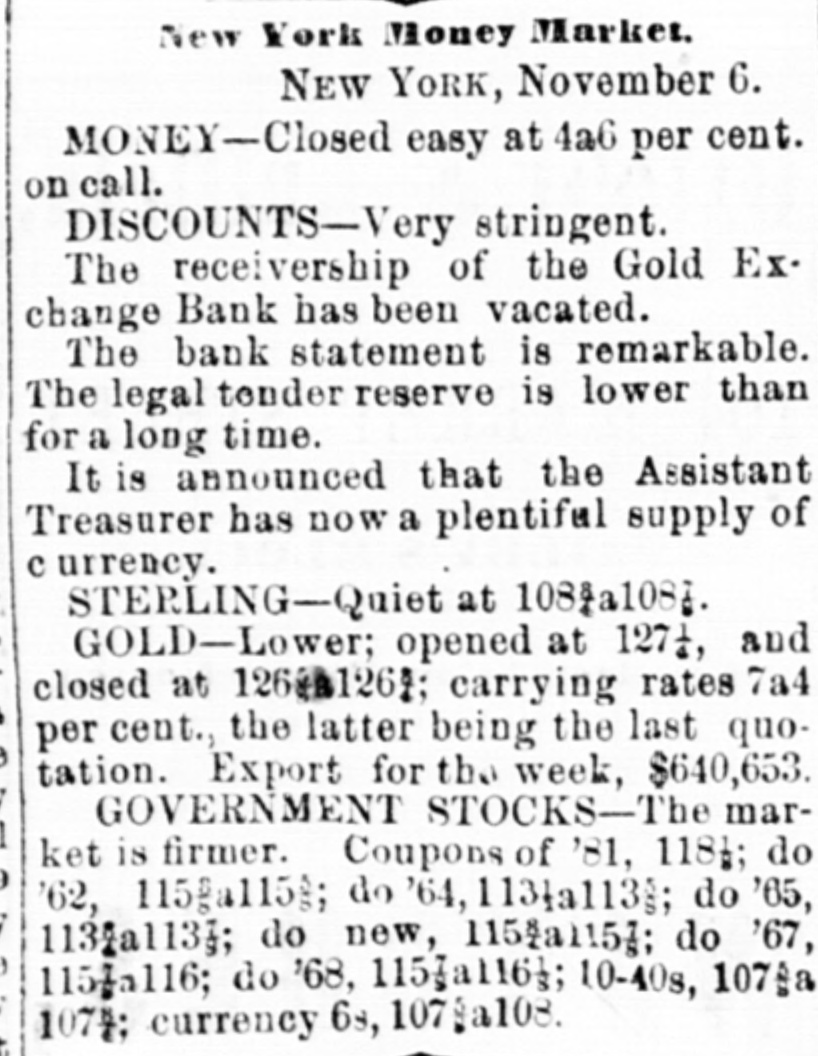
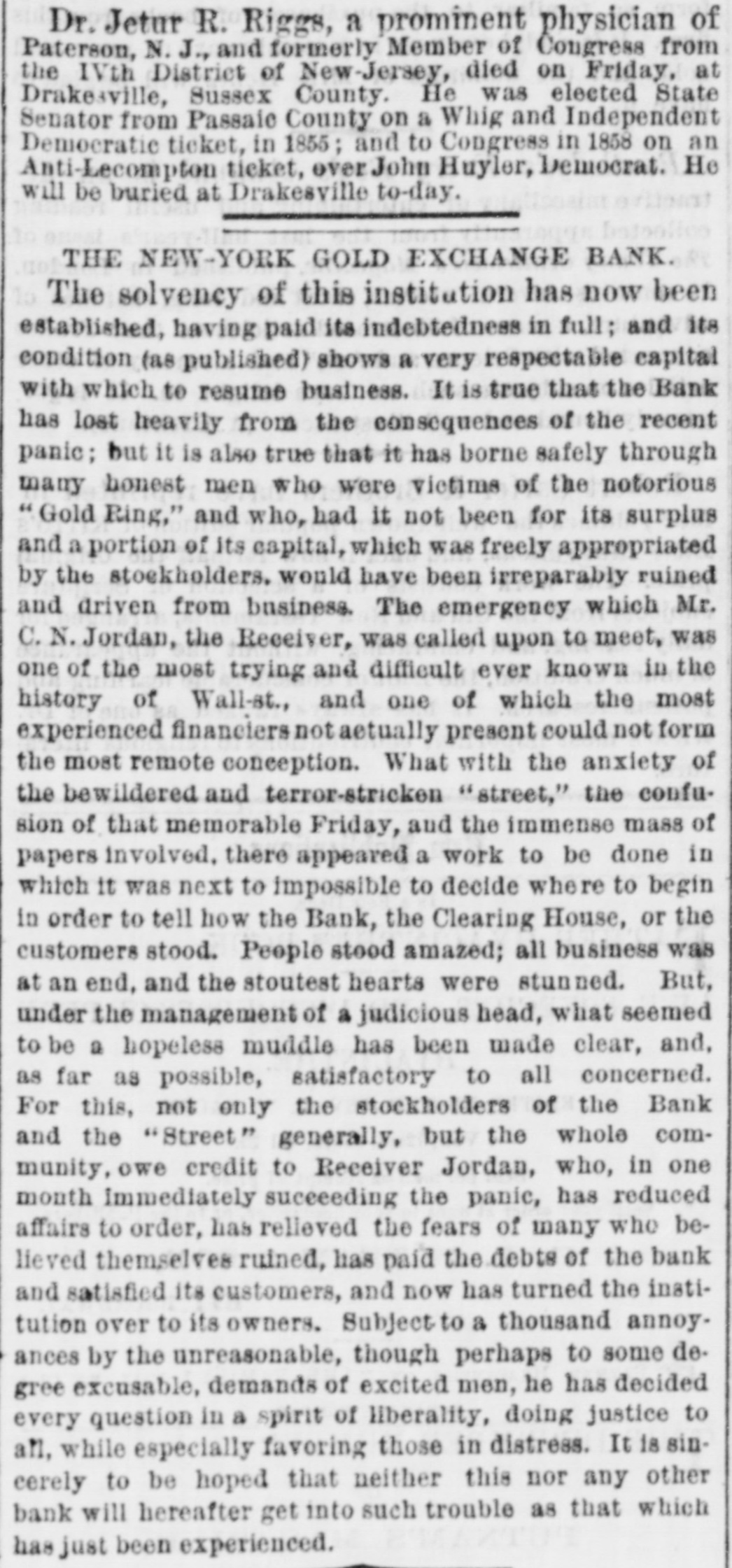
The receivership of the Gold Exchange Bank has been vacated... and now has turned the institution over to its owners.
Source
newspapers

Newspaper Articles (25)

Article from The Daily Dispatch, November 19, 1868

Click image to open full size in new tab

Article Text

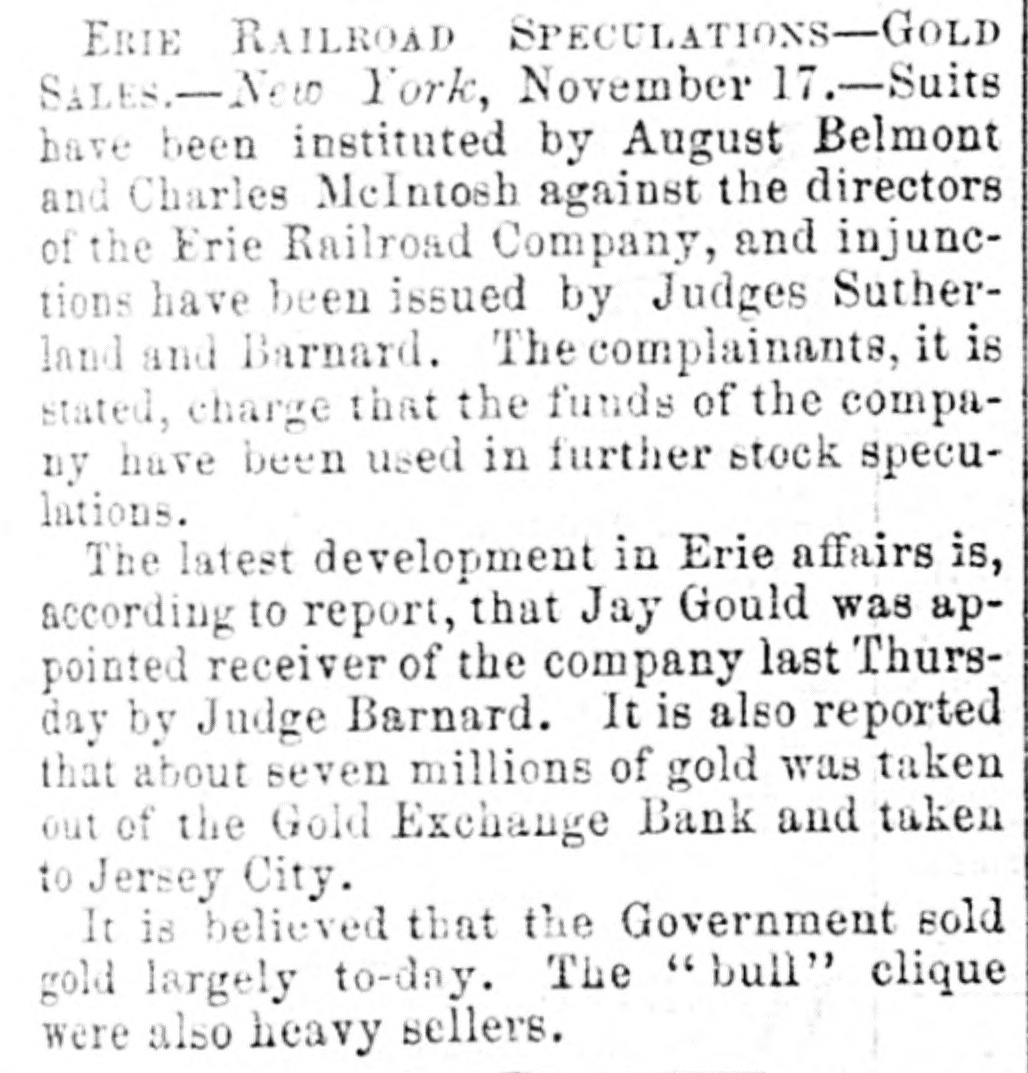
ERIE RAILROAD SPECULATIONS-GOLD SALES.-New York, November 17.-Suits have been instituted by August Belmont and Charles McIntosh against the directors of the Erie Railroad Company, and injunctions have been issued by Judges Sutherland and Barnard. The complainants, it is stated, charge that the funds of the company have been used in further stock speculations. The latest development in Erie affairs is, according to report, that Jay Gould was appointed receiver of the company last Thursday by Judge Barnard. It is also reported that about seven millions of gold was taken out of the Gold Exchange Bank and taken to Jersey City. It is believed that the Government sold gold largely to-day. The "bull" clique were also heavy sellers.


Article from Memphis Daily Appeal, September 28, 1869

Click image to open full size in new tab

Article Text

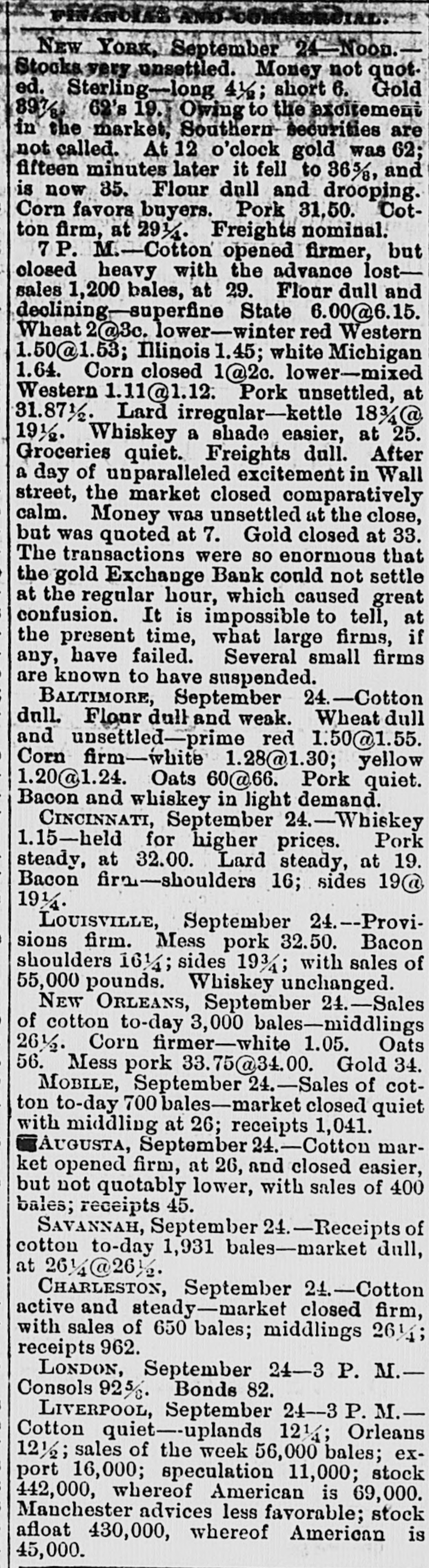
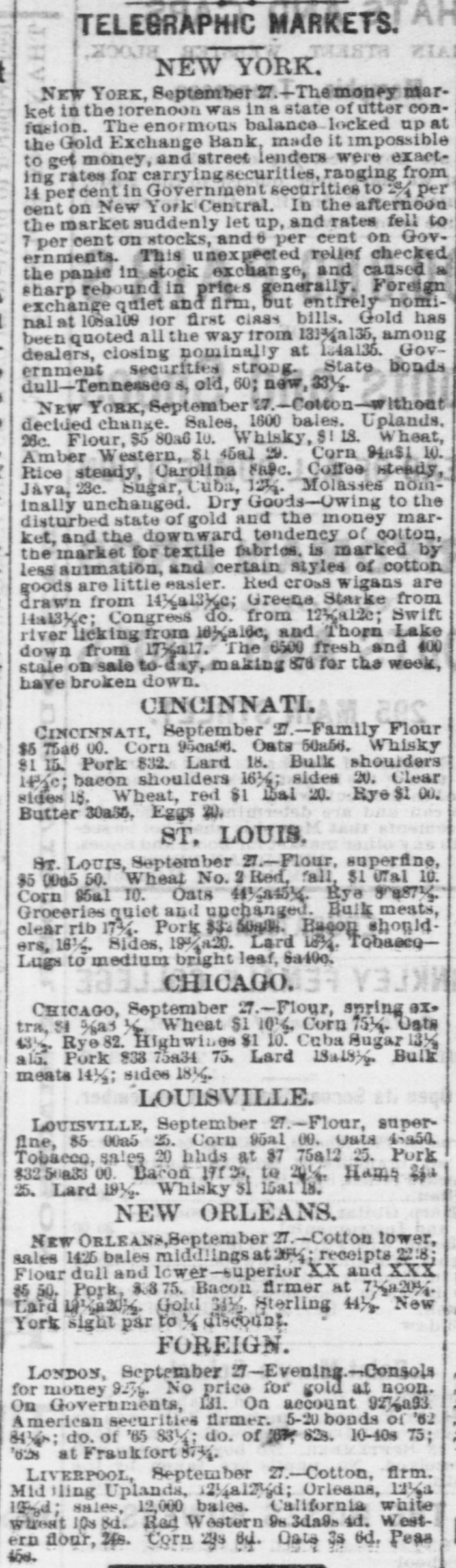
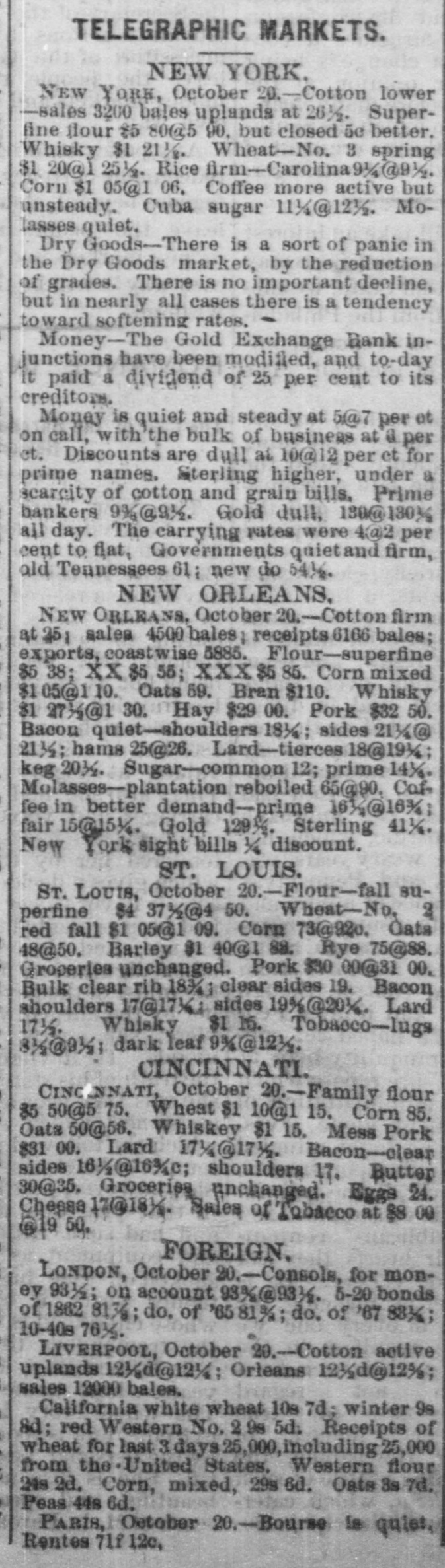
TELEGRAPHIC MARKETS. NEW YORK. NEW YORK, September 27. Themoney market in the torenoon was in a state of utter confasion. The enormous balance locked up at the Gold Exchange Bank, made it impossible to get money, and street lenders were exacting rates for carrying securities, ranging from 14 per dent in Government securities to 2/1 per cent on New York Central. In the afternood the market suddenly let up, and rates fell to 7 per cent on stocks, and 6 per cent on Governments. This unexpected relief checked the panie in stock exchange, and caused a sharp rebound in prices generally, Foreign exchange quiet and firm, but entirely nominal at 108a109 for first class bills. Gold has been quoted all the way from 131% a 135, among dealers, closing nominally at 1:4a136. Govbonds ernment securities strong. State dull-Tennessee 8, old, 60; new,231/4 NEW YORK, September w.-Cotton-without decided change. Sales, 1600 bales. Uplands, 26c. Flour, $5 80a6 10. Whisky, SI 18. Wheat, Amber Western, SI 45al 29. Corn 94a$1 10. Rice steady, Carolina Face. Coffee steady, Java, 23c. Sugar, Cuba, 12% Molasses nominally unchanged. Dry Goods-Owin to the disturbed state of gold and the money market, and the downward tendency of cotton, the market for textile fabrics. is marked by less animation, and certain styles of cotton goods are little easier. Red cross wigans are drawn from 143/a131/c; Greene Starke from 14a131ee Congress do. from 12%(al2c; Swift river licking from 10k/albe, and Thorn Lake down from 17%a.17. The 6500 fresh and 400 stale on sale to day, making 876 for the week, have broken down. CINCINNATI. CINCINNATI, September II.-Family Flour 75a6 00. Corn 950a96. Oats 50a56. Whisky $1 15. Pork 832. Lard 18. Bulk shoulders Here; bacon shoulders 161/2; sides 20. Clear sides 18. Wheat, red $1 was 20. Rye $1 00. Butter 30a35, Eggs 20. ST, LOUIS. Sr. LOUIS, September 27.-Flour, superfine, $5 0085 50. Wheat No. 2 Red, fall, $1 07al 10. Corn 95al 10. Oats 44% Rya 8"8871/2. Groceries quiet and unchanged. Bulk meats, clear rib 173. Pork $2508/H Racon should ers, 161/4. Sides, 193/a20. Lard 1874. TobaccoLugs to medium bright leaf, Sa40o. CHICAGO. CHICAGO, September 2.-Flour, spring 0X tra, 51 Wheat $1 10% Corn 7514. Data Rye 82. Highwises $1 10. Cuba Sugar 13% all. Pork $33 75a34 75. Lard 18a18% Bulk meats 141/g; sides 181/4. LOUISVILLE. LOUISVILLE, September 7.-Flour, superfine, $5 00a5 25. Corn 95al 00. Oats 45a50. Tobacco, sales 20 hids at 87 75a12 25. Pork 832 50a33 00. Baron 171.29 te 24% Hams 26 25. Lard 191/2 Whisky 15al 18. NEW ORLEANS. NEW OrLEANs,September .-Cotton lower, sales 1426 bales middlings at 2614; receipts 22:8; Flour dull and ower-superior XX and XXX 50. Pork, $3.75 Bacon firmer at 71/a 20% Card Gold 3436 Sterling 447/2 New York sight par to 1/4 discount FOREIGN. LONDON, September 1-Evening.-Consols for money 92% No price for gold at noon. On Governments, 131. On account 927493 American securities firmer. 5-20 bonds of '62 do. of '85 8314: do. of 187, 828. 10-40s 75; '628 at Frankfort LIVERPOOL, September 27.-Cotton, firm. Midiling Uplands, 12/4a12yd; Orleans, 12%a 10%d; sales, 12,000 bales. California white wheat 10s 8d. Red Western 98 3da9s 4d. Western flour, 24s. Corn 29s 8d. Oats 3s 6d. Peas 45s.


Article from Gold Hill Daily News, September 28, 1869

Click image to open full size in new tab

Article Text

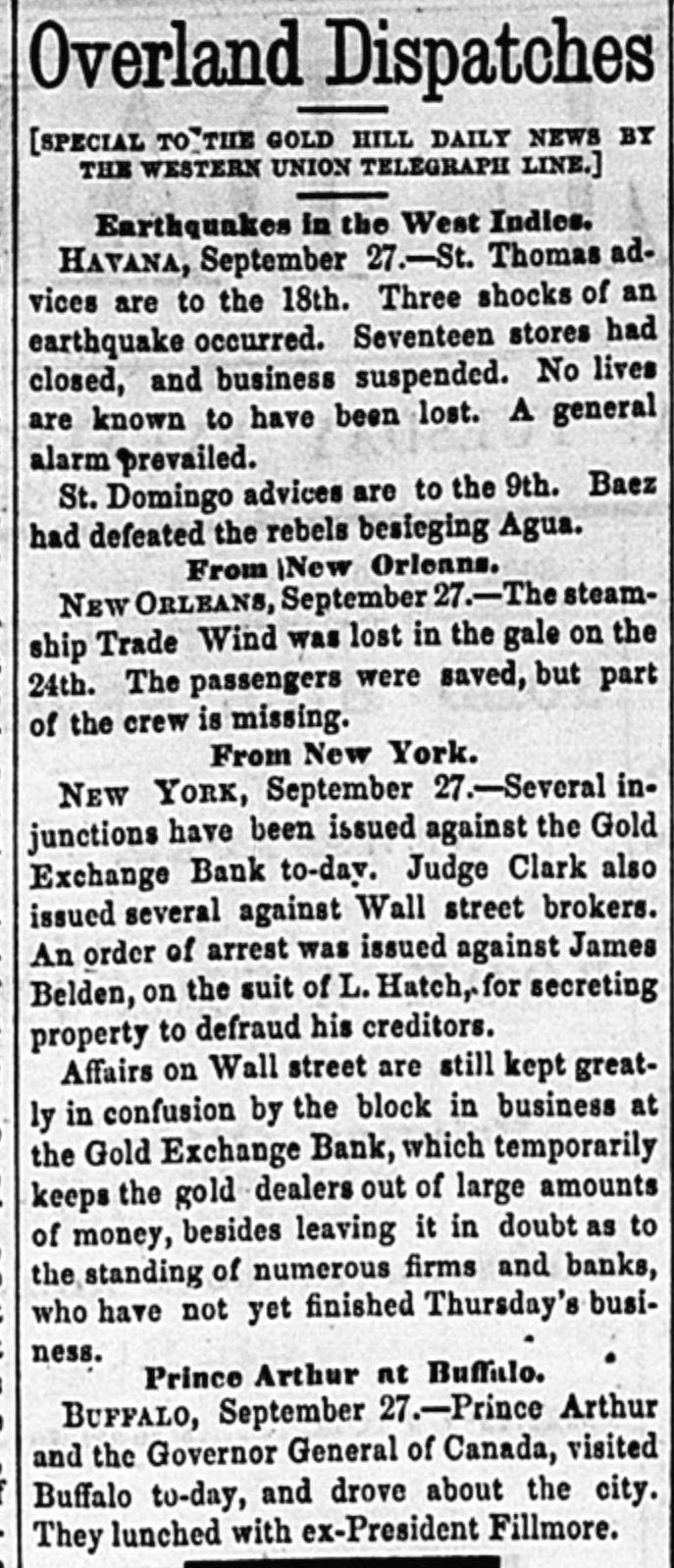
Overland Dispatches [SPECIAL TO THE GOLD HILL DAILY NEWS BY THE WESTERN UNION TELEGRAPH LINE.] Earthquakes in the West Indica. HAVANA, September 27.-St. Thomas advices are to the 18th. Three shocks of an earthquake occurred. Seventeen stores had closed, and business suspended. No lives are known to have been lost. A general alarm prevailed. St. Domingo advices are to the 9th. Baez had defeated the rebels besieging Agua. From New Orleans. NEW ORLEANS, September 27.-The steamship Trade Wind was lost in the gale on the 24th. The passengers were saved, but part of the crew is missing. From New York. NEW YORK, September 27.-Several injunctions have been issued against the Gold Exchange Bank to-dav. Judge Clark also issued several against Wall street brokers. An order of arrest was issued against James Belden, on the suit of L. Hatch, for secreting property to defraud his creditors. Affairs on Wall street are still kept greatly in confusion by the block in business at the Gold Exchange Bank, which temporarily keeps the gold dealers out of large amounts of money, besides leaving it in doubt as to the standing of numerous firms and banks, who have not yet finished Thursday's business. Prince Arthur at Buffalo. BUFFALO, September 27.-Prince Arthur and the Governor General of Canada, visited Buffalo to-day, and drove about the city. They lunched with ex-President Fillmore.


Article from The Evening Telegraph, September 29, 1869

Click image to open full size in new tab

Article Text

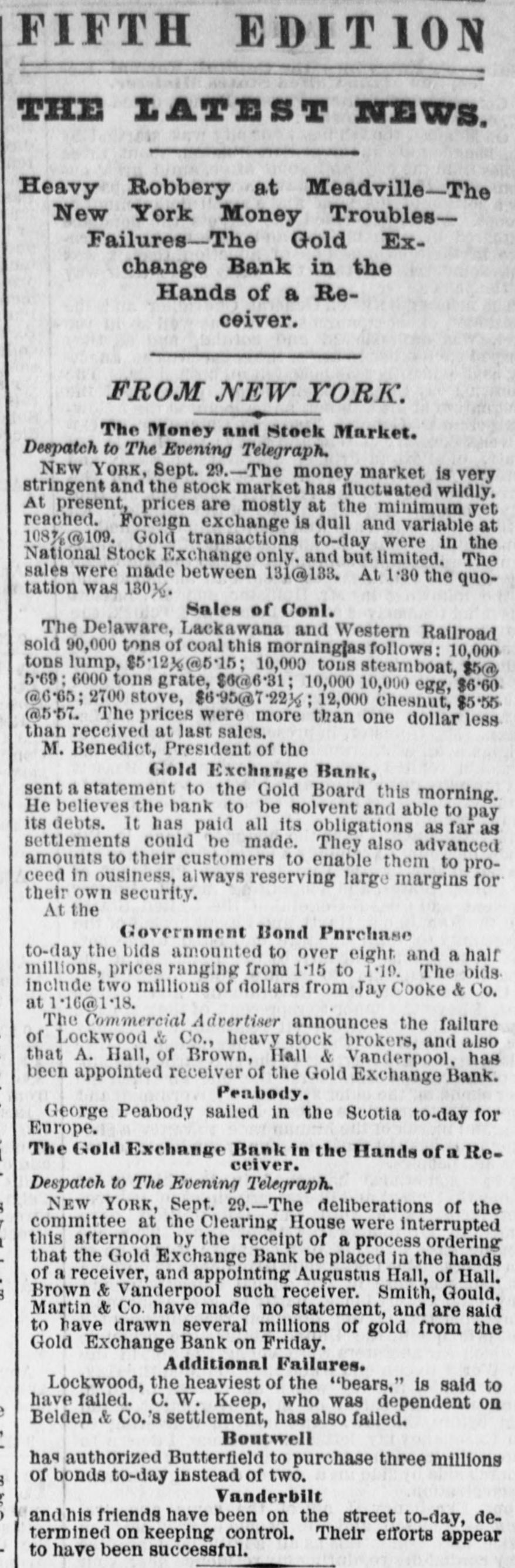
FIFTH EDITION THE LATEST NEWS. Heavy Robbery at Meadville-The New York Money TroublesFailures-The Gold Exchange Bank in the Hands of a Receiver. FROM NEW YORK. The Money and Stock Market. Despatch to The Evening Telegraph. NEW YORK, Sept. 29.-The money market is very stringent and the stock market has fluctuated wildly. At present, prices are mostly at the minimum yet reached. Foreign exchange is dull and variable at 108%@109. Gold transactions to-day were in the National Stock Exchange only. and but limited. The sales were made between 131@133. At 1:30 the quotation was 1301/2. Sales of Conl. The Delaware, Lackawana and Western Railroad sold 90,000 tons of coal this morninglas follows: 10,000 tons lump, $5.12%(55'15; 10,000 tons steamboat, $5@ 5.69: 6000 tons grate, $6@6.31; 10,000 10,000 egg, $6.60 @6.65; 2700 stove, $6'95@7.22% 12,000 chesnut, $5.55 @5-57. The prices were more than one dollar less than received at last sales. M. Benedict, President of the Gold Exchange Bank, sent a statement to the Gold Board this morning. He believes the bank to be solvent and able to pay its debts. It has paid all its obligations as far as settlements could be made. They also advanced amounts to their customers to enable them to proceed in ousiness, always reserving large margins for their own security. At the Government Bond Purchase to-day the bids amounted to over eight and a half millions, prices ranging from 1.15 to 1.19. The bids. include two millions of dollars from Jay Cooke & Co. at 1*16@1*18. The Commercial Advertiser announces the failure of Lockwood & Co., heavy stock brokers, and also that A. Hall, of Brown, Hall & Vanderpool, has been appointed receiver of the Gold Exchange Bank. Peabody. George Peabody sailed in the Scotia to-day for Europe. The Gold Exchange Bank in the Hands of a Receiver. Despatch to The Evening Telegraph. NEW YORK, Sept. 29.-The deliberations of the committee at the Clearing House were interrupted this afternoon by the receipt of a process ordering that the Gold Exchange Bank be placed in the hands of a receiver, and appointing Augustus Hall, of Hall. Brown & Vanderpool such receiver. Smith, Gould, Martin & Co. have made no statement, and are said to have drawn several millions of gold from the Gold Exchange Bank on Friday. Additional Failures. Lockwood, the heaviest of the "bears," is said to have failed. C. W. Keep, who was dependent on Belden & Co.'s settlement, has also failed. Boutwell has authorized Butterfield to purchase three millions of bonds to-day instead of two. Vanderbilt and his friends have been on the street to-day, determined on keeping control. Their efforts appear to have been successful.


Article from The Evansville Journal, September 30, 1869

Click image to open full size in new tab

Article Text

L R PH. Excitement in Wall Street. Rumored Failura of Several Firms. Gold Exchange Bank in the Hands of a Receiver. Republican State Convention in Session at Syracusa, N. Y. a State Ticket Nominated. Late Washington News. Nows by Atlantic Cable. Opinion of Attorney Genoral Hoar. Latest from San Francisco. Destructive Firein Chicago Loss Estimated at $30,000,


Article from The Charleston Daily News, September 30, 1869

Click image to open full size in new tab

Article Text

THE GOLD GAMBLING. NEW YORK, September 29.-The Gold Exchange Bank has been placed in the hands of a receiver. The failure of C. A. Meigs & Son, Fuller, Treat & Cox, and Bloom & Co., is announced. A number of other failures are reported as probable, among them that of Lockwood & Co. No government gold was sold to-day. The sale is postponed until to-morrow.


Article from New-York Tribune, September 30, 1869

Click image to open full size in new tab

Article Text

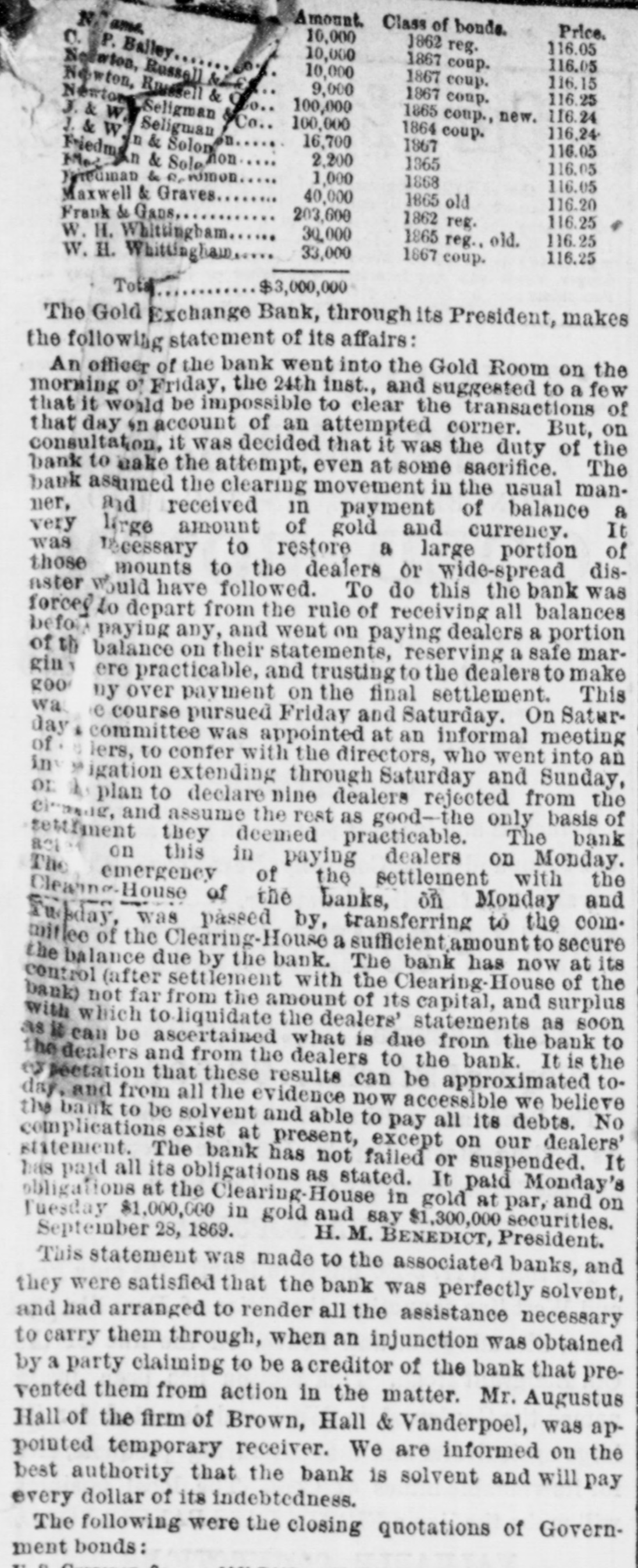
Amount. Class of bonds. Price. 10,000 1862 reg. 116.05 C. P. Balley 10,000 1867 coup. 116.05 10,000 Nelaton, Bussell 1867 coup. 116.15 9,000 Newton Newton, Ringell & 1867 comp. 116.25 100,000 1865 coup., new. 116.24 J. & W Seligman Co 100,000 J. & W Selignan 1864 coup. 116,24 16,700 1867 Friedms in & Solon 116.05 2,200 1365 Mos An & Sole non 116.05 Teredman & rumon 1,000 1868 116.05 Maxwell & Graves 40,000 1865 old 116.20 Frank & Gaos 203,600 116.25 1862 reg. W. H. Whittingham 30,000 116.25 1865 reg., old. 33,000 W. H. Whittingham 116.25 1867 coup. Total $3,000,000 The Gold Exchange Bank, through its President, makes the following statement of its affairs: An officer of the bank went into the Gold Room on the morning of Friday, the 24th inst., and suggested to a few that it would be impossible to clear the transactions of that day in account of an attempted corner. But, on consultation. it was decided that it was the duty of the bank to cake the attempt, even at some sacrifice. The bank assumed the clearing movement in the usual manner, and received in payment of balance 8 very lirge amount of gold and currency. It was Lecessary to restore a large portion of those mounts to the dealers or wide-spread disnster would have followed. To do this the bank was forced to depart from the rule of receiving all balances before paying any, and went on paying dealers a portion of th balance on their statements, reserving a safe margin ere practicable, and trusting to the dealers to make goo my over payment on the final settlement. This wa e course pursued Friday and Saturday. On Saturday & committee was appointed at an informal meeting of lers, to confer with the directors, who went into an in ligation extending through Saturday and Sunday, or plan to declare nine dealers rejected from the Cinna and assume the rest as good-the only basis of settlment they deemed practicable. The bank act on this in paying dealers on Monday. The emergency of the settlement with the Cleano-House of the banks, on Monday and Sunday, was passed by, transferring to the com. witlee of the Clearing-House a sufficient amount to secure the balance due by the bank. The bank has now at its control (after settlement with the Clearing-House of the bank) not far from the amount of its capital, and surplus with which to liquidate the dealers' statements as soon as to call be ascertained what is due from the bank to the dealers and from the dealers to the bank. It is the a fΓ©ctation that these results can be approximated today, and from all the evidence now accessible we believe the bank to be solvent and able to pay all its debts. No complications exist at present, except on our dealers' stitement. The bank has not failed or suspended. It has paid all its obligations as stated. It paid Monday's obligations at the Clearing-House in gold at par, and on Tuesday $1,000,000 in gold and say $1,300,000 securities. Septeinber 28, 1869. H. M. BENEDICT, President. This statement was made to the associated banks, and they were satisfied that the bank was perfectly solvent, and had arranged to render all the assistance necessary to carry them through, when an injunction was obtained by a party claiming to be a creditor of the bank that prevented them from action in the matter. Mr. Augustus Hall of the firm of Brown, Hall & Vanderpoel, was appointed temporary receiver. We are informed on the best authority that the bank is solvent and will pay every dollar of its indebtedness. The following were the closing quotations of Government bonds:


Article from Wilmington Journal, October 1, 1869

Click image to open full size in new tab

Article Text

From New York, NEW YORK, Sept. 29-P. M. The Gold Exchange Bank has been placed in the hands of a Receiver. The failure of Sloom & Co. has been announced. There aro quite a number of other failures rumored, among them Lockwood & Co.


Article from The Athens Post, October 8, 1869

Click image to open full size in new tab

Article Text

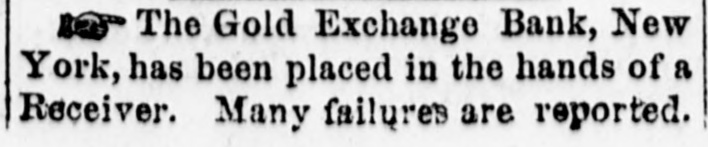
The Gold Exchange Bank, New York, has been placed in the hands of a Receiver. Many failures are reported.


Article from The New York Herald, October 8, 1869

Click image to open full size in new tab

Article Text

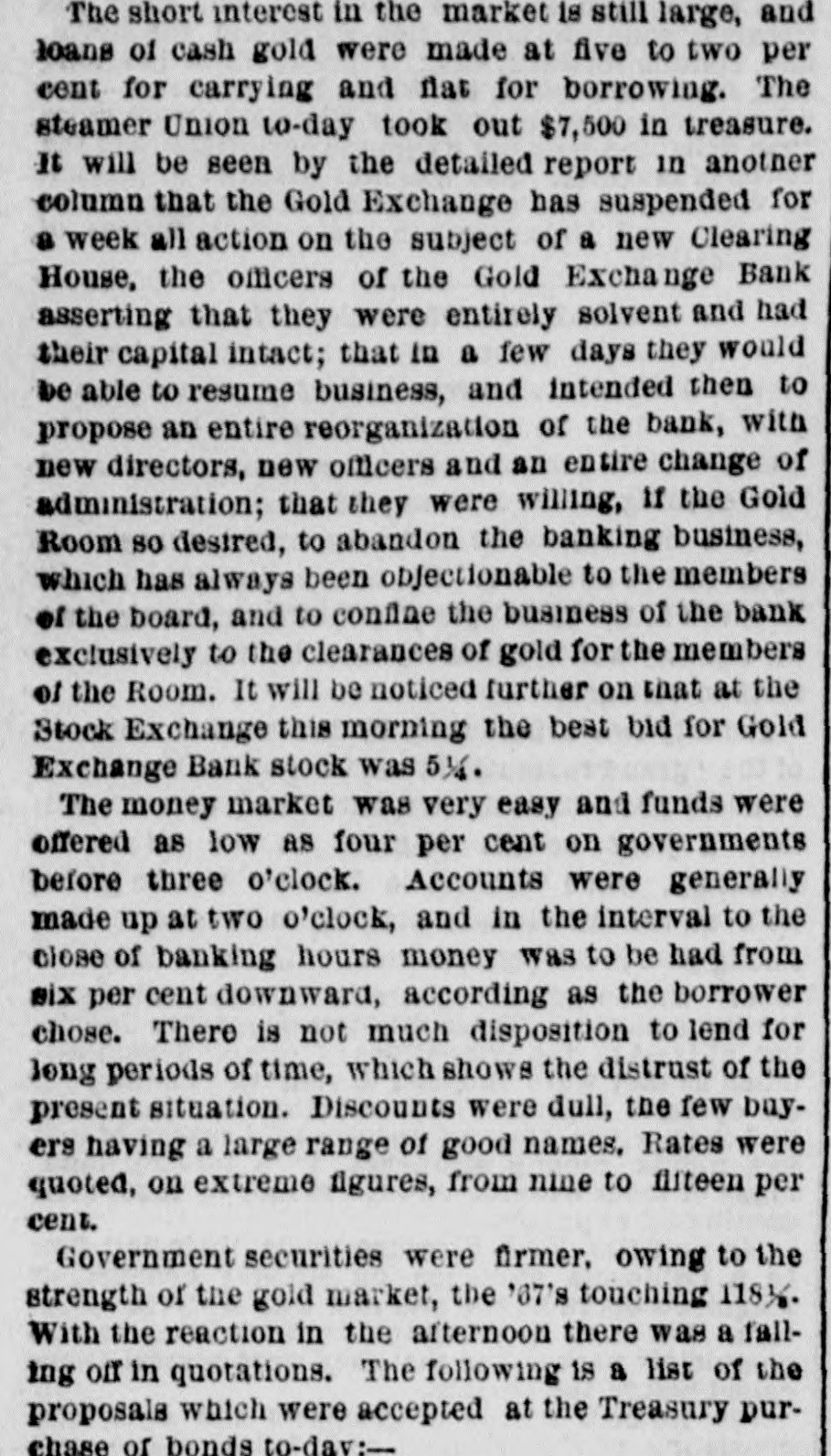
The short interest in the market is still large, and loans of cash gold were made at five to two per cent for carrying and flat for borrowing. The steamer Union to-day took out $7,500 in treasure. It will be seen by the detailed report in another column that the Gold Exchange has suspended for a week all action on the subject of a new Clearing House, the officers of the Gold Exchange Bank asserting that they were entirely solvent and had their capital intact; that in a few days they would be able to resume business, and intended then to propose an entire reorganization of the bank, with new directors, new officers and an entire change of administration; that they were willing, If the Gold Room so desired, to abandon the banking business, which has always been objectionable to the members of the board, and to confine the business of the bank exclusively to the clearances of gold for the members of the Room. It will be noticed further on that at the Stock Exchange this morning the best bid for Gold Exchange Bank stock was 514. The money market was very easy and funds were offered as low as four per cent on governments before three o'clock. Accounts were generally made up at two o'clock, and in the interval to the close of banking hours money was to be had from six per cent downward, according as the borrower chose. There is not much disposition to lend for long periods of time, which shows the distrust of the present situation. Discounts were dull, the few bayers having a large range of good names. Rates were quoted, on extreme figures, from nine to fifteen per cent. Government securities were firmer, owing to the strength of the gold market, the '07's touching 118% With the reaction in the afternoon there was a falling off in quotations. The following is a list of the proposals which were accepted at the Treasury purchase of bonds to-day:-


Article from The Evansville Journal, October 11, 1869

Click image to open full size in new tab

Article Text

New York Items. NEW YORK, October 9. / Arrangements are stated to have been made, which will result in the formal removal of the Receivership over the Gold Exchange Bank on Tuesday next, and the affairs of the bank will then pass temporarily into the hands of the trustees, under the direction of C. N. Jordan, cashier of the Third National back. Their chief business will be to settle the business of Friday the 24th ultimo, which, when completed, the Bank will resume business as usual.


Article from The Charleston Daily News, October 11, 1869

Click image to open full size in new tab

Article Text

made for the removal of the receivership over the New York Gold Exchange Bank on Tuesday next. The coal was removed from the steamship Cuba, at Wilmington, N. C., on Saturday. She had ten tons, enough to run eight hours, which evidently proves she came in in distress. The New Orleans Times, of Saturday evening, says that the steamship Lillian arrived at Cedar Keys in time, took on board her freight and passsengers, and sailed without being molested. Parties in search of her came too late.


Article from The Wheeling Daily Register, October 11, 1869

Click image to open full size in new tab

Article Text

New York Money Market. NEW YORK, October 9. Arrangements are stated to have been .made which will result in the formal removal of the receivership over Gold Exchange on Tuesday next. The affairs of the bank will then pass temporarily into the hands of the trustees, under the direction of C. N. Jordan, cashier of the Third National Bank. Their chief business will be to settle the business of Friday, the 24th ult., which, when completed, the bank will resume business as usual. One party has consented to the removal of his injunction on the bank. MONEY-Easy, and the latest transactions were at 4a6 per cent. on call loans. The Bank Statement is favorable. STERLING-Firm at 1091 asked. GOLD-Opened at 1304, and closed at 1304. Carrying rates at 5a51 per cent. GOVERNMENT STOCKS - Dull Coupons, 81, 1194a120; do '62, 1201a 1201; do '64, 119a119g; do '65, 119!a120; do new, 118a118}; do '67, 118a118}; 10-40s, 108a109.


Article from The New York Herald, October 13, 1869

Click image to open full size in new tab

Article Text

NEW YORK CITY. THE COURTS. UNITED STATES DISTRICT COURT-IN BANKRUPTCY. The New York Gold Exchange Diffenlty-The Petition Filed in Bankruptcy Against the Bank Dismissed. Before Judge Blatchford. Ernest Otten and Edward G. Taege, Petitioning Creditors vs. the New York Gold Exchange Bank, Defendants.-An - order has been signed by Judge Blatchford in the above entitled case, dismissing the petition of Edward G. Taege and Ernest Otten who Bought to place the affairs of the Gold Exchange Bank in bankruptcy. The order states that the petitioners, Otten and Taege, failed to sustain their allegations. which were that the Gold Exchange Bank. while insolvent, or contemplating bankruptcy or inscivency, had, during the recent panic in Wall street, made preference payments or transfers of money, in some instances of $1,000,000 or upwards, to certain creditors in fraud of other persons. Failure in the Far Trade. Before a Register in Bankruptcy. In the Matter of David J. & W. King. 1 This was the meeting for the choice of assignees and the proof of debts under this estate. The petitioners had carried on business as retail dealers in furs in Broadway; their Habitities are stated at $70,000, and assets about $20,050. Various creditors had placed attachments upon property in their store, and they filed their petition in bankruptcy to save the stock for division among their creditors. Edwin James, who, with Mr. J. Fletcher, appeared as council for the bankrupts, presented a written request on behalf of the creditors asking for an adjournment in order to effect a compromise which IS now in progress. Mr. McMahon, council for the creditors, consented, and the Register adjourned the meeting till Saturday next, at twelve o'clock.


Article from New-York Tribune, October 19, 1869

Click image to open full size in new tab

Article Text

It is stated that Mr. C. N. Jordan, Receiver of the Gold Exchange Baulr, resigned his position as Cashier of the Third National Bank before accepting the trust. The bonds of the Union Pacific Railroad were to-day placed on the bond list at the New. York Stock Exchange,


Article from The New York Herald, October 22, 1869

Click image to open full size in new tab

Article Text

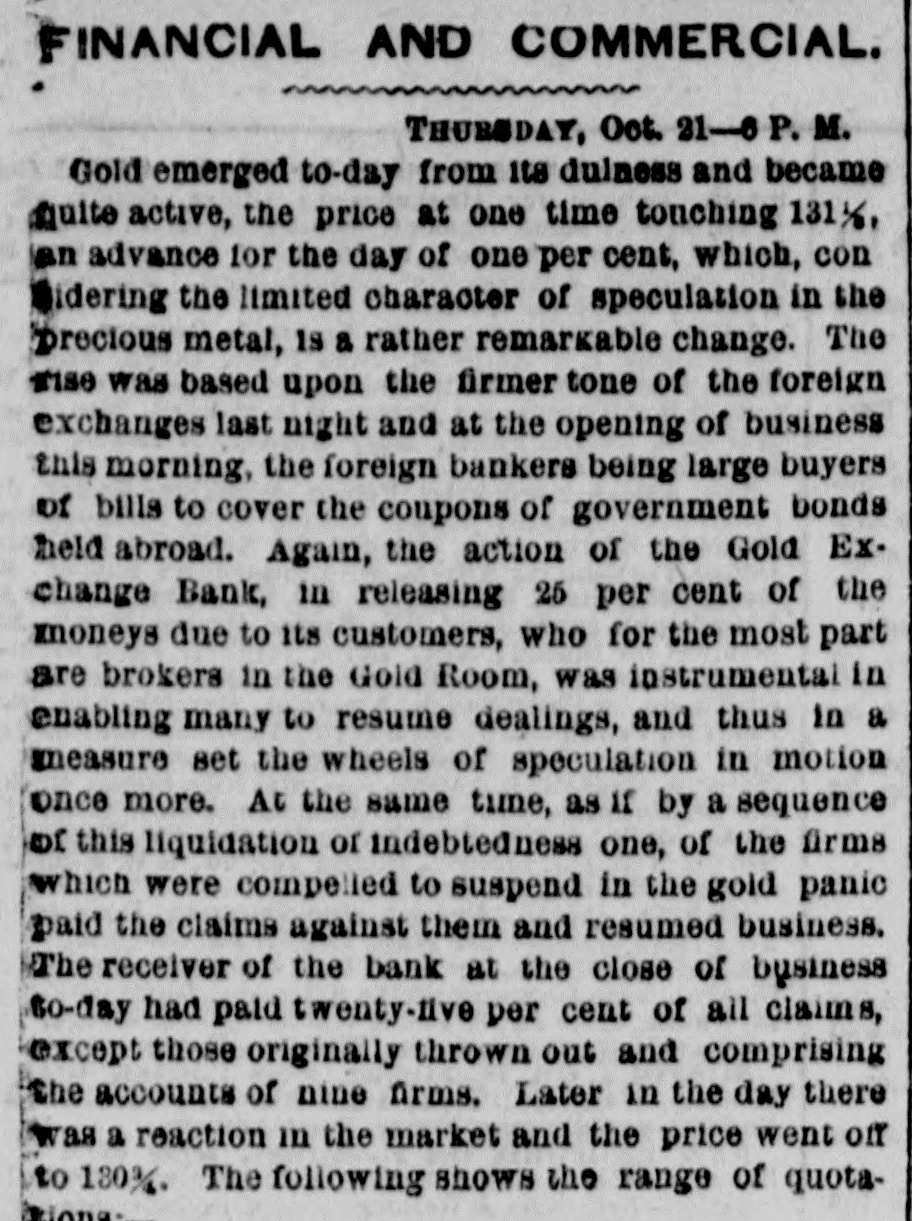
FINANCIAL AND COMMERCIAL. THURSDAY, Oct. 21-8 P. M. Gold emerged to-day from its dulness and became quite active, the price at one time touching 131%, an advance for the day of one per cent, which, con idering the limited character of speculation in the Drecious metal, is a rather remarkable change. The rise was based upon the firmer tone of the foreign exchanges last night and at the opening of business this morning, the foreign bankers being large buyers of bills to cover the coupons of government bonds held abroad. Again, the action of the Gold Exchange Bank, in releasing 25 per cent of the moneys due to its customers, who for the most part are brokers in the Gold Room, was instrumental in enabling many to resume dealings, and thus in a measure set the wheels of speculation in motion once more. At the same tune, as If by a sequence of this liquidation or indebtedness one, of the firms which were compelled to suspend in the gold panic paid the claims against them and resumed business. The receiver of the bank at the close of business to-day had paid twenty-tive per cent of all claims, except those originally thrown out and comprising the accounts of nine firms. Later in the day there was a reaction in the market and the price went off to 130%. The following shows the range of quotaZiana


Article from The Elko Independent, October 23, 1869

Click image to open full size in new tab

Article Text

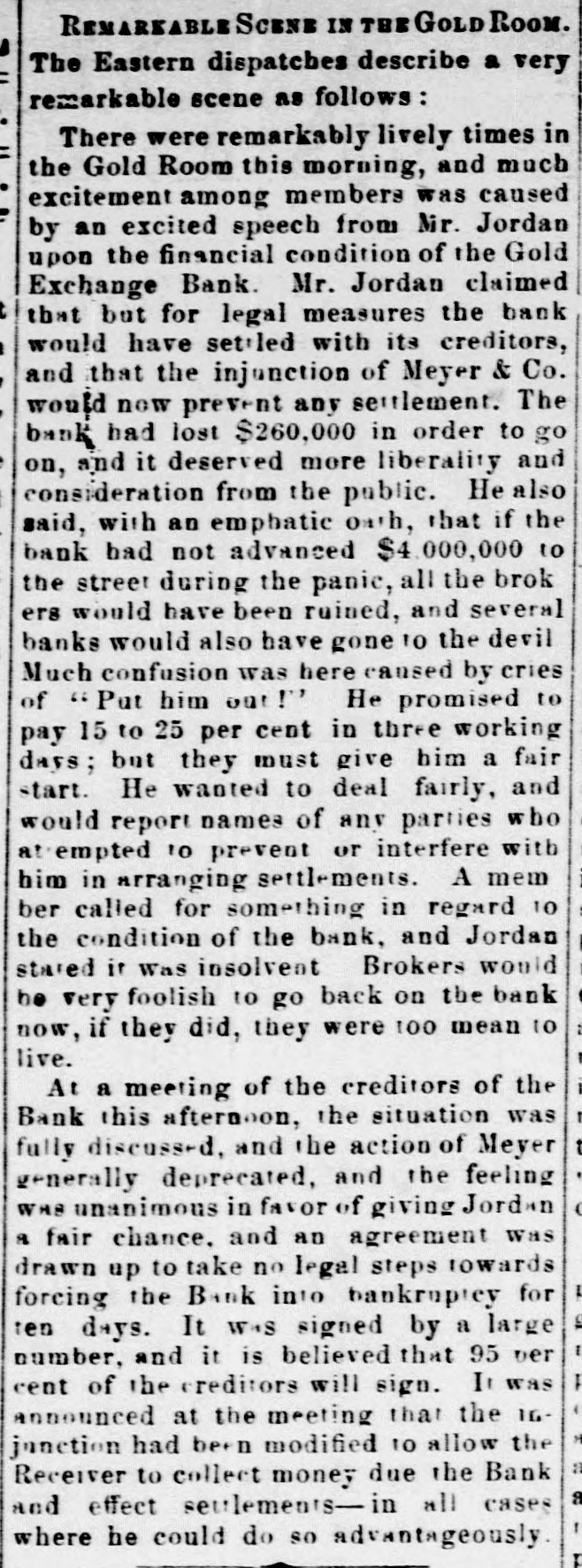
Items of Interest. A dispatch from New York says there were lively times in the Gold Room last Saturday Mr. Jordan, of the Gold Exchange Bank, made a speech, saying that the bank had lost $250,000 in order to go on. and that if the Board had not advanced $4,000,000 to the street during the panic, all the brokers would have been ruined. 'He said the bank was solvent. At a subsequent meeting of the crediitors of the bank, the feeling was unanimous in favor of giving Jordan A fair chance, and it was agreed to take no legal steps against the bank for ten days. THE following notice was found posted on a huge-sized trunk at a railroad depot a few days ago: "Baggage smashers are requested to handle this trunk with care, as it contains nitro-glycerine, Greek fire, gun cotton, and two live gorrillas." AN exchange inquires: "How can we increase our producing and consuming population?" Another exchange answers the query as follows: "By persuading the unnarried to get married. settle down and do their duty. E. A. DAVIS, United States Surveyor General for Nevada, will take charge. as assignee, of the effects of the First National Bank at Austin THE Worrell sisters are astonishing the world at St. Louis, THE merchants' clerks in Paris are on a general strike. Two more Cuban privateers left New York last week.


Article from The Wheeling Daily Register, October 27, 1869

Click image to open full size in new tab

Article Text

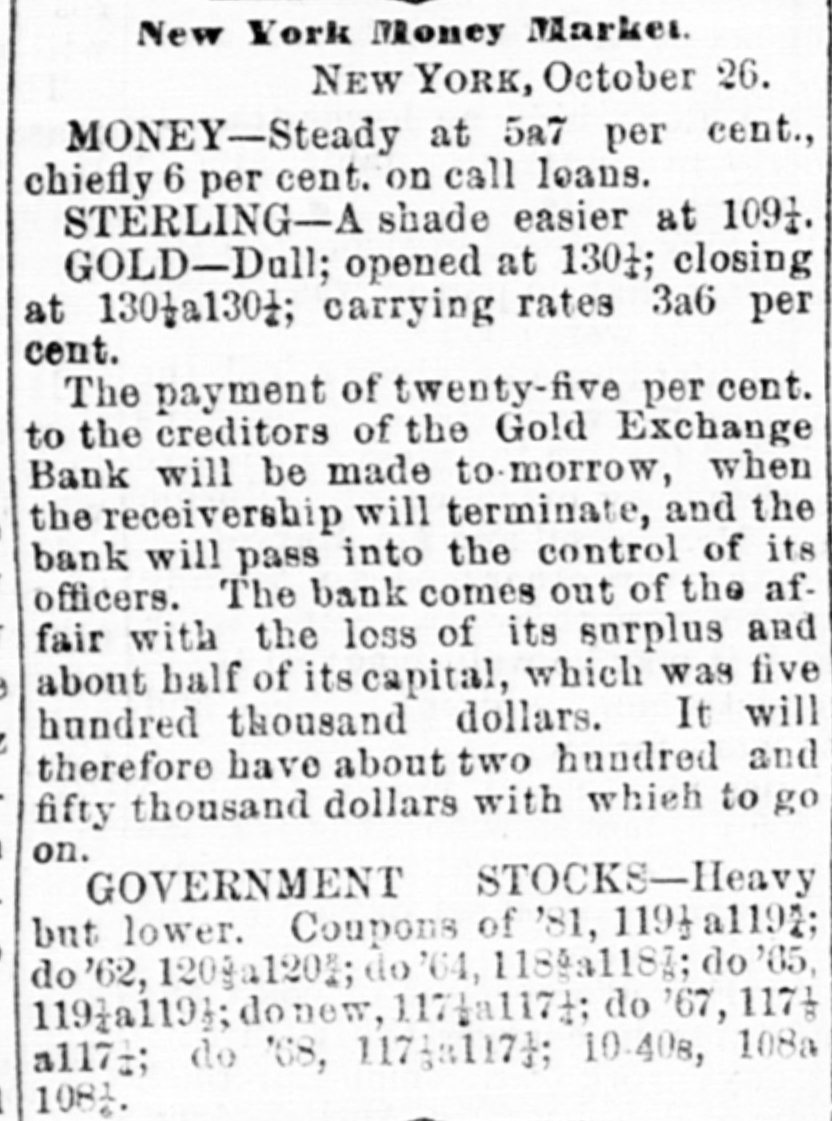
New York Money Market NEW YORK, October 26. MONEY-Steady at 5a7 per cent., chiefly 6 per cent. on call loans. STERLING-A shade easier at 1091. GOLD-Dull; opened at 1301; closing at 1301a1301; carrying rates 3a6 per cent. The payment of twenty-five per cent. to the creditors of the Gold Exchange Bank will be made to-morrow, when the receivership will terminate, and the bank will pass into the control of its officers. The bank comes out of the affair with the loss of its surplus and about half of its capital, which was five hundred thousand dollars. It will therefore have about two hundred and fifty thousand dollars with which to go on. GOVERNMENT STOCKS-Henvy but lower. Coupons of 'S1, 1191 a1192; do'62, 120ga1201; do'64, 1189all8g; do '05, 119}a119}; donew, 1174all7;; do '67, 1171 a117t; do '68, 1173a117}; 10.408, 108a 1081.


Article from The Wheeling Daily Register, November 8, 1869

Click image to open full size in new tab

Article Text

New York Money Market. NEW YORK, November 6. MONEY-Closed easy at 4a6 per cent. on call. DISCOUNTS-Very stringent. The receivership of the Gold Ex. change Bank has been vacated. The bank statement is remarkable. The legal tender reserve is lower than for a long time. It is announced that the Assistant Treasurer has now a plentifal supply of c currency. STERLING-Quiet at 1081081. GOLD-Lower; opened at 1271, and closed at 12601261; carrying rates 7a4 per cent., the latter being the last quotation. Export for the week, $640,653. GOVERNMENT STOCKS-The market is firmer. Coupons of '81, 1181; do '62, 115ga115g; do '64, 1131all3g; do '65, 1131all3}; do new, 1154a115g; do '67, 1151al16; do '68, 1153a116}; 10-40s, 107ga 107#: currency 6s, 107 a108.


Article from New-York Tribune, November 9, 1869

Click image to open full size in new tab

Article Text

Dr. Jetur R. Riggs, a prominent physician of Paterson, N. J., and formerly Member of Congress from the 1Vth District of New-Jersey, died on Friday, at Drakesville, Sussex County. He was elected State Senator from Passaic County on a Whig and Independent Democratic ticket, in 1855; and to Congress in 1858 on an Anti-Lecompton ticket, over John Huyler, Democrat. He will be buried at Drakesville to-day. THE NEW-YORK GOLD EXCHANGE BANK. The solvency of this institution has now been established, having paid its indebtedness in full; and its condition (as published) shows a very respectable capital with which to resume business. It is true that the Bank has lost heavily from the consequences of the recent panic: but it is also true that it has borne safely through many honest men who were victims of the notorious "Gold Ring," and who, had it not been for its surplus and a portion of its capital, which was freely appropriated by the stockholders. would have been irreparably ruined and driven from business. The emergency which Mr. C. N. Jordan, the Receiver, was called upon to meet, was one of the most trying and difficult ever known in the history of Wall-st., and one of which the most experienced financiers not actually present could not form the most remote conception. What with the anxiety of the bewildered and terror-stricken "street," the confusion of that memorable Friday, and the immense mass of papers involved. there appeared a work to be done in which it was next to impossible to decide where to begin in order to tell how the Bank, the Clearing House, or the customers stood. People stood amazed; all business was at an end, and the stoutest hearts were stunned. But, under the management of a judicious head, what seemed to be a hopeless muddle has been made clear, and, as far as possible, satisfactory to all concerned. For this, not only the stockholders of the Bank and the "Street" generally, but the whole community, owe credit to Receiver Jordan, who, in one month immediately succeeding the panic, has reduced affairs to order, has relieved the fears of many who believed themselves ruined, has paid the debts of the bank and satisfied its customers, and now has turned the institution over to its owners. Subject to a thousand annoyances by the unreasonable, though perhaps to some degree excusable, demands of excited men, he has decided every question in a spirit of liberality, doing justice to all, while especially favoring those in distress. It is sincerely to be hoped that neither this nor any other bank will hereafter get into such trouble as that which has just been experienced.


Article from The New York Herald, January 12, 1870

Click image to open full size in new tab

Article Text

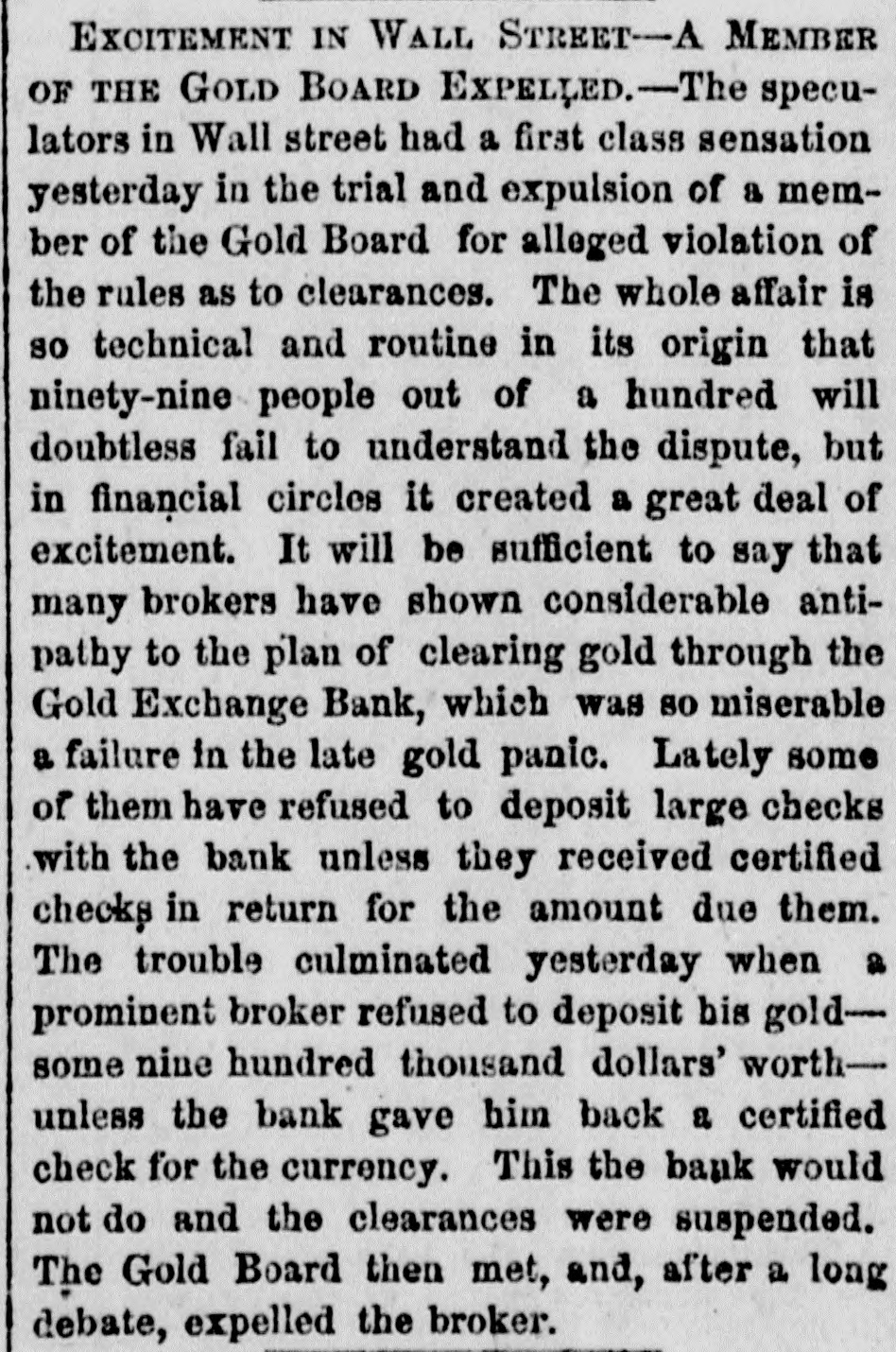
EXCITEMENT IN WALL STREET-A MEMBER OF THE GOLD BOARD EXPELLED.-The speculators in Wall street had a first class sensation yesterday in the trial and expulsion of a member of the Gold Board for alleged violation of the rules as to clearances. The whole affair is so technical and routine in its origin that ninety-nine people out of a hundred will doubtless fail to understand the dispute, but in financial circles it created a great deal of excitement. It will be sufficient to say that many brokers have shown considerable antipathy to the plan of clearing gold through the Gold Exchange Bank, which was so miserable a failure in the late gold panic. Lately some of them have refused to deposit large checks with the bank unless they received certified checks in return for the amount due them. a The trouble culminated yesterday when prominent broker refused to deposit bis goldsome nine hundred thousand dollars' worthunless the bank gave him back a certified check for the currency. This the bank would not do and the clearances were suspended. The Gold Board then met, and, after a long debate, expelled the broker.


Article from The Sun, May 27, 1870

Click image to open full size in new tab

Article Text

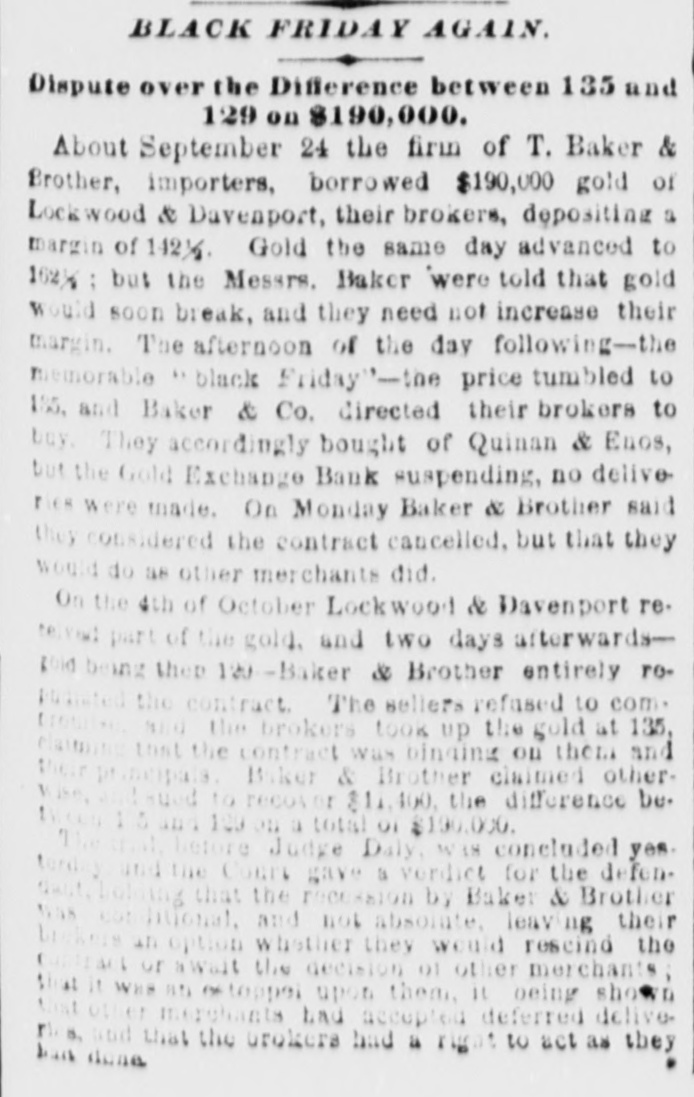
BLACK FRIDAY AGAIN. Dispute over the Difference between 135 and 129 on $190,000. About September 24 the firm of T. Baker & Brother, importers, borrowed $190,000 gold of Lockwood & Davenport, their brokers, depositing a margin of 142 1/2. Gold the same day advanced to 102/4 : but the Messrs. Baker were told that gold would soon break, and they need not increase their margin. The afternoon of the day following-the memorable " black Friday'--the price tumbled to 125, and Baker & Co. directed their brokers to buy They accordingly bought of Quinan & Euos, but the Gold Exchange Bank suspending, no delive tics were made. On Monday Baker & Brother said this considered the contract cancelled. but that they would do as other merchants did. On the 4th of October Lockwood & Davenport repart of the gold. and two days afterwardsfold being then 120 Baker & Brother entirely reprinted the contract The sellers refused to com. treated and the brokers took up the gold at 135, claimant that the contract was binding ou them and their incipals Baker & Brother claimed other!sued to recosor $11,400 the difference be. 100 on it total or $190.000. before Judge Daily, WIN concluded yes. Monday and the Court gave is verdice for the defendoing that the recession by Baker & Brother internal. and not absolute leaving their Unknow in option whether they would rescind the or await this decision of other merchants, that it WHB an extopper upon them. 11 oeing shown Visit other merchants Lad accepted deferred delive this and that the brokers had is right to act as they base done


Article from New-York Tribune, April 13, 1872

Click image to open full size in new tab

Article Text

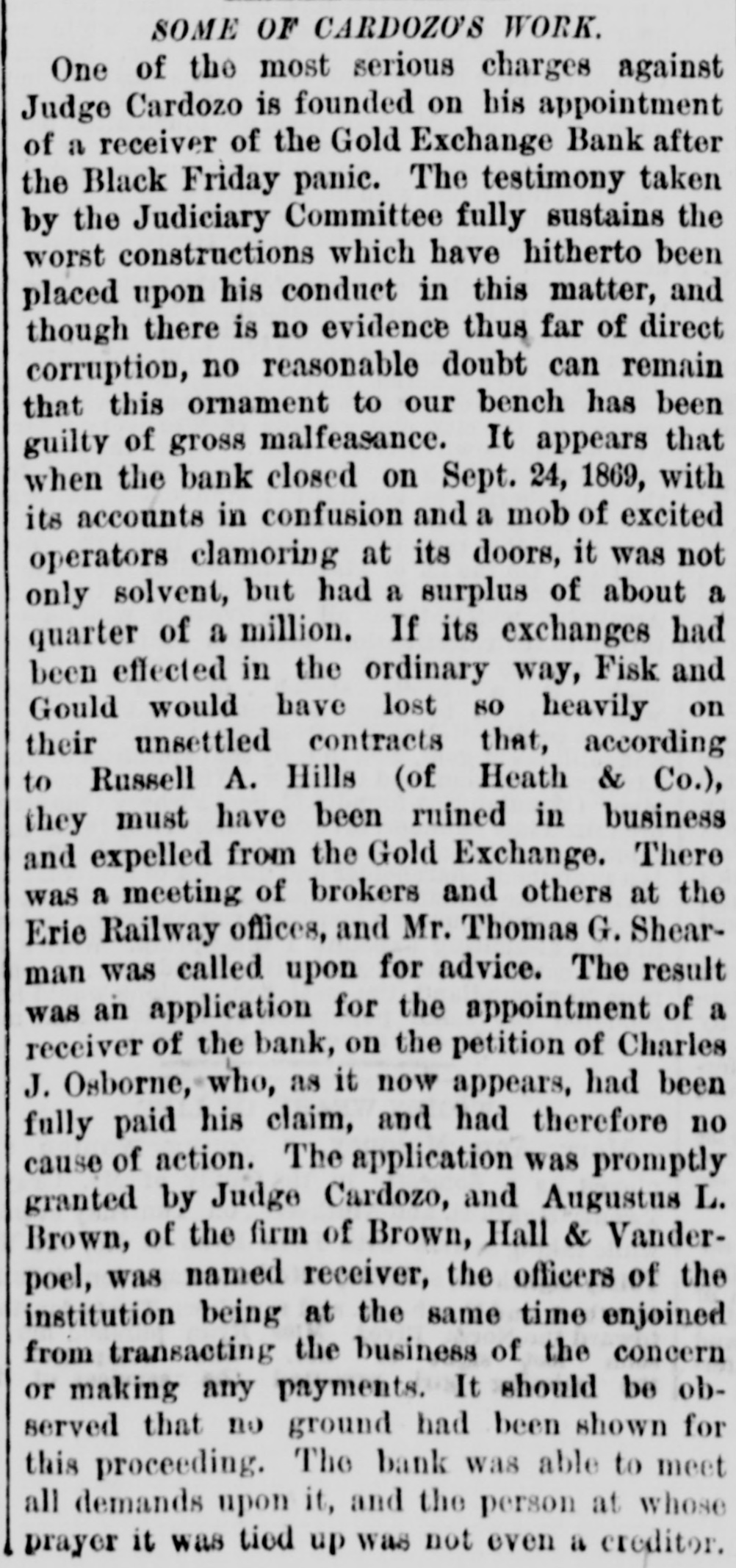
SOME OF CARDOZO'S WORK. One of the most serious charges against Judge Cardozo is founded on his appointment of a receiver of the Gold Exchange Bank after the Black Friday panic. The testimony taken by the Judiciary Committee fully sustains the worst constructions which have hitherto been placed upon his conduct in this matter, and though there is no evidence thus far of direct corruption, no reasonable doubt can remain that this ornament to our bench has been guilty of gross malfeasance. It appears that when the bank closed on Sept. 24, 1869, with its accounts in confusion and a mob of excited operators clamoring at its doors, it was not only solvent, but had a surplus of about a quarter of a million. If its exchanges had been effected in the ordinary way, Fisk and Gould would have lost so heavily on their unsettled contracts that, according to Russell A. Hills (of Heath & Co.), they must have been ruined in business and expelled from the Gold Exchange. There was a meeting of brokers and others at the Erie Railway offices, and Mr. Thomas G. Shearman was called upon for advice. The result was an application for the appointment of a receiver of the bank, on the petition of Charles J. Osborne, who, as it now appears, had been fully paid his claim, and had therefore no cause of action. The application was promptly granted by Judge Cardozo, and Augustus L. Brown, of the firm of Brown, Hall & Vanderpoel, was named receiver, the officers of the institution being at the same time enjoined from transacting the business of the concern or making any payments. It should be observed that no ground had been shown for this proceeding. The bank was able to meet all demands upon it, and the person at whose prayer it was tiod up was not even a creditor.


Article from Palestine Daily Herald, October 30, 1907

Click image to open full size in new tab

Article Text

ed, and several less important failures occurred in the same month. September, 1873, is remembered as one of the most disastrous months in the history of the stock exchange. It was on the 20th of that month that conditions become so bad that the authorities of the stock exchange closed the institution for ten days. On the same day trading on the stock exchange was suspended at the height of the panic, but not before a score or more of houses had gone to the wall. Probably the most famous of all the panics that at one time or another have seized the financial community in this country was "Black Friday," September 24, 1869. For this the FiskGould corner in gold was responsible. On that day gold rose to 162 1-2, and the stocks broke with unprecedented violence. Lockwood & Co., prominent in those days, failed, and the announcement of their suspension was followed by the failure of many other firms. The Gold Exchange Bank became involved and suspended. The declines from the high point of that month to the low point on "Black Friday" in some of the stock active at that time were 23 1-4 points in Chicago & Northwestern, 16 in the preferred; 13 1-8 in Chicago & Rock Island; 15 in Erie, 13 1-2 in the preferred; 52 5-8 in Hudson River; 30 1-4 in Lake Shore; 19 3-4 in Milwaukee & St. Paul, 14 1-4 in the preferred: 53 1-4 in New York Central; 8 3-8 in Ohio & Mississippi; 8 7-8 in Western Union, and 21 1-4 in Pacific Mail. When it is recalled that these were the declines not of the day of the panic alone, but of the entire month. it will be seen that they offer striking comparison with the declines of the early days of last week.


Article from New-York Tribune, September 4, 1910

Click image to open full size in new tab

Article Text

THOMAS F. B. PARKER. Thomas F. B. Parker, a retired broker, died yesterday at his home, No. 98 College avenue, New Brunswick, N. J. He was eighty-three years old. The funeral will be held at his home on Tuesday at 2:30 o'clock and the burial will be in the family plot in Elmwood Cemetery, New Brunswick. Mr. Parker came into considerable prominence when, during the panic of Black Friday, he took an active part in straightening out the finances of the Gold Exchange Bank. Later he became its vice-president, and in conjunction with R. L. Edwards, the president, succeeded in getting the bank out of its difficulties. Born in London in 1827, Mr. Parker came to this country when he was twenty-one years old. During the Civil War, when gold was selling at a premium, Mr. Parker became one of the original members of the New York Exchange. Then he became a member of the New York Stock Exchange and remained actively engaged up to a quarter of a century ago, when he retired because of ill health. He leaves a wife, two sons and a daughter,