Bank of Mecklenburg (Charlotte, NC)

Episode Information

Episode UID
759336590908
Episode Type
Run β†’ Suspension β†’ Closure
Bank Type
state
Bank ID
75933659 hash
Start Date
August 1, 1875*
Location
Charlotte, North Carolina (35.227, -80.843)

Metadata

Model
gpt-5-mini (chosen from majority vote of a three-model LLM ensemble)
Short Digest
d2b058ed56da29c6

Response Measures

None

Description

Assignment to Judge Shipp and later bankruptcy proceedings indicate permanent closure/liquidation.

Events (3)

1. August 1, 1875* Receivership
Newspaper Excerpt
an assignment has been made to Judge Shipp, as Trustee ... assignee's statement of the condition ... liabilities $209,179.19, assets $29,421.29. creditors have filed a petition ... asking to have the Bank adjudged a Bankrupt. creditors ... notified ... meeting ... for the purpose of winding up the affairs of the bank (1880). The Bank of Mecklenburg ... has suspended and gone into liquidation. A full statement of the assets and liabilities is promised this week. bills of said bank, bought after the suspension of that institution on the 17th day of August last, cannot be used to set off claims ... (1876 decision).” (articles describe assignment, liquidation, assignee, bankruptcy proceedings and winding up.)
Source
newspapers
2. August 7, 1875 Run
Cause
Bank Specific Adverse Info
Cause Details
Death of the cashier (Mr. Dewey) impaired confidence and provoked heavy withdrawals
Measures
Assignment to Judge Shipp as trustee; made an assignment to prevent one creditor gaining advantage
Newspaper Excerpt
confidence has been temporarily impaired ... heavy demands have been made
Source
newspapers
3. August 7, 1875 Suspension
Cause
Bank Specific Adverse Info
Cause Details
Unable to meet heavy demands after loss of confidence following cashier's death; bank suspended and made assignment
Newspaper Excerpt
The Bank of Mecklenburg ... closed its doors on Saturday last. ... has suspended
Source
newspapers

Newspaper Articles (9)

Article from Yorkville Enquirer, August 12, 1875

Click image to open full size in new tab

Article Text

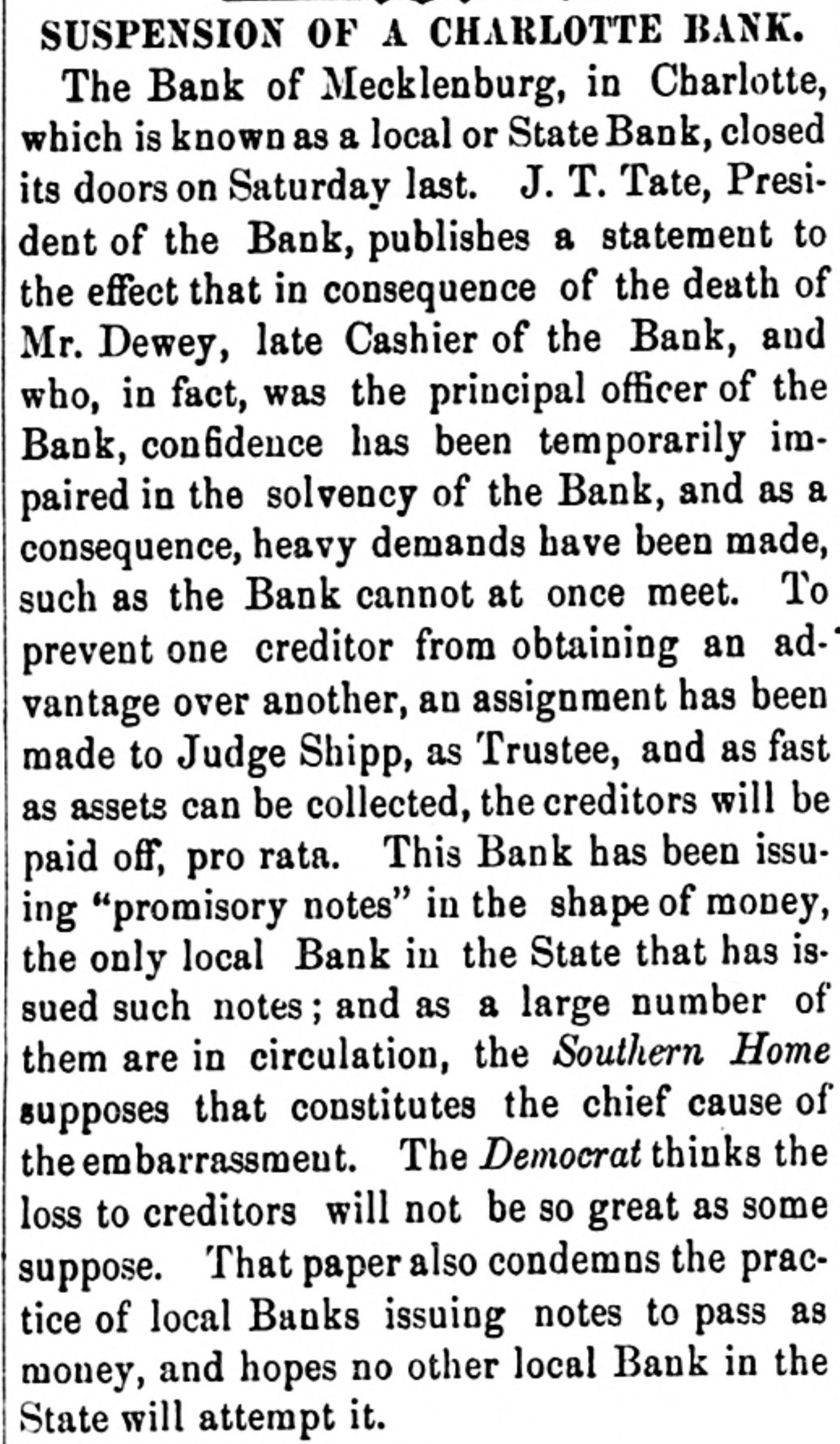
SUSPENSION OF A CHARLOTTE BANK. The Bank of Mecklenburg, in Charlotte, which is known as a local or State Bank, closed its doors on Saturday last. J. T. Tate, President of the Bank, publishes a statement to the effect that in consequence of the death of Mr. Dewey, late Cashier of the Bank, and who, in fact, was the principal officer of the Bank, confidence has been temporarily impaired in the solvency of the Bank, and as a consequence, heavy demands have been made, such as the Bank cannot at once meet. To prevent one creditor from obtaining an advantage over another, an assignment has been made to Judge Shipp, as Trustee, and as fast as assets can be collected, the creditors will be paid off, pro rata. This Bank has been issuing "promisory notes" in the shape of money, the only local Bank in the State that has issued such notes; and as a large number of them are in circulation, the Southern Home supposes that constitutes the chief cause of the embarrassment. The Democrat thinks the loss to creditors will not be so great as some suppose. That paper also condemns the practice of local Banks issuing notes to pass as money, and hopes no other local Bank in the State will attempt it.


Article from Yorkville Enquirer, August 12, 1875

Click image to open full size in new tab

Article Text

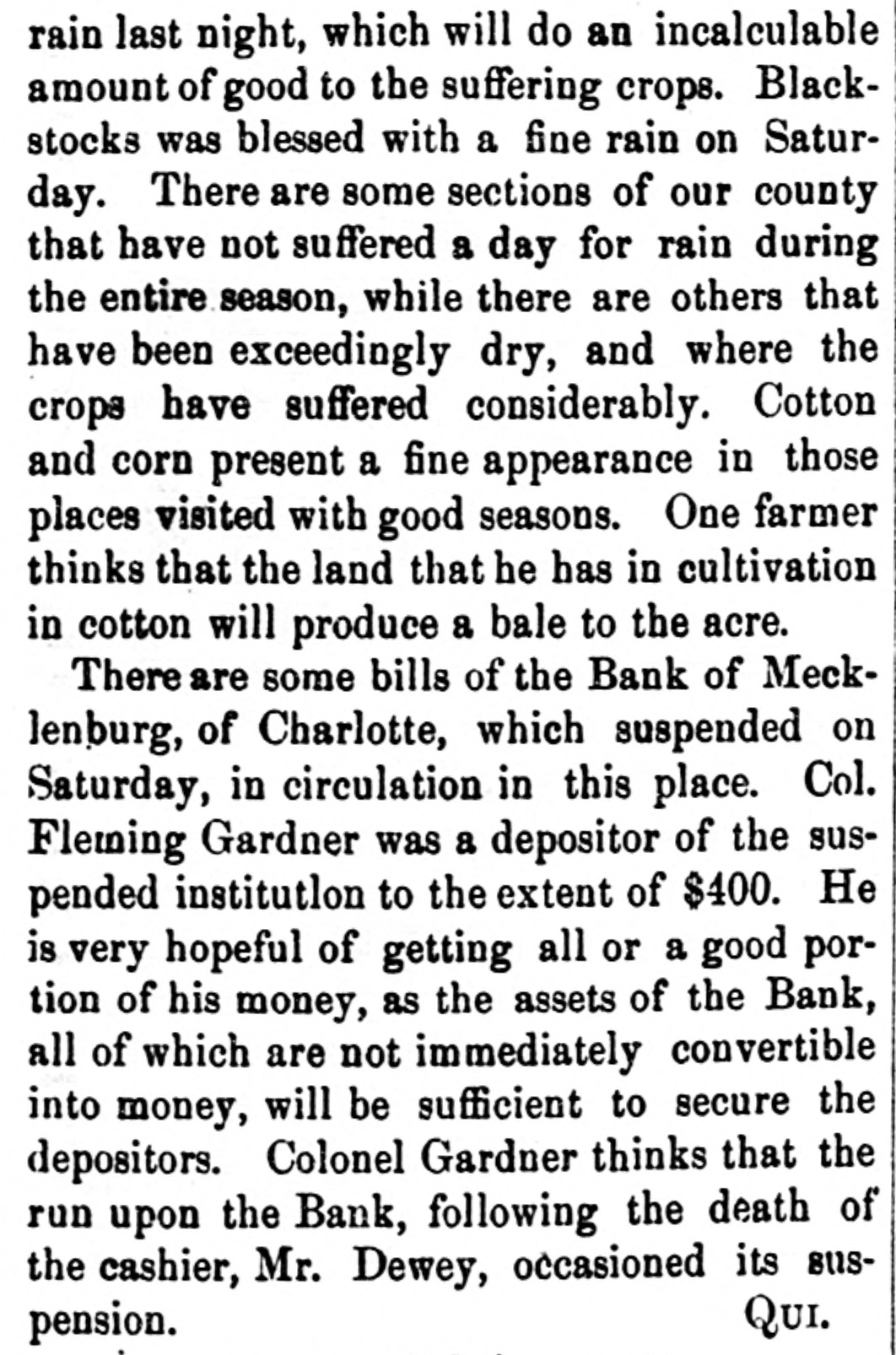
rain last night, which will do an incalculable amount of good to the suffering crops. Blackstocks was blessed with a fine rain on Saturday. There are some sections of our county that have not suffered a day for rain during the entire season, while there are others that have been exceedingly dry, and where the crops have suffered considerably. Cotton and corn present a fine appearance in those places visited with good seasons. One farmer thinks that the land that he has in cultivation in cotton will produce a bale to the acre. There are some bills of the Bank of Mecklenburg, of Charlotte, which suspended on Saturday, in circulation in this place. Col. Fleming Gardner was a depositor of the suspended institutlon to the extent of $400. He is very hopeful of getting all or a good portion of his money, as the assets of the Bank, all of which are not immediately convertible into money, will be sufficient to secure the depositors. Colonel Gardner thinks that the run upon the Bank, following the death of the cashier, Mr. Dewey, occasioned its susQUI. pension.


Article from Wilmington Journal, August 13, 1875

Click image to open full size in new tab

Article Text

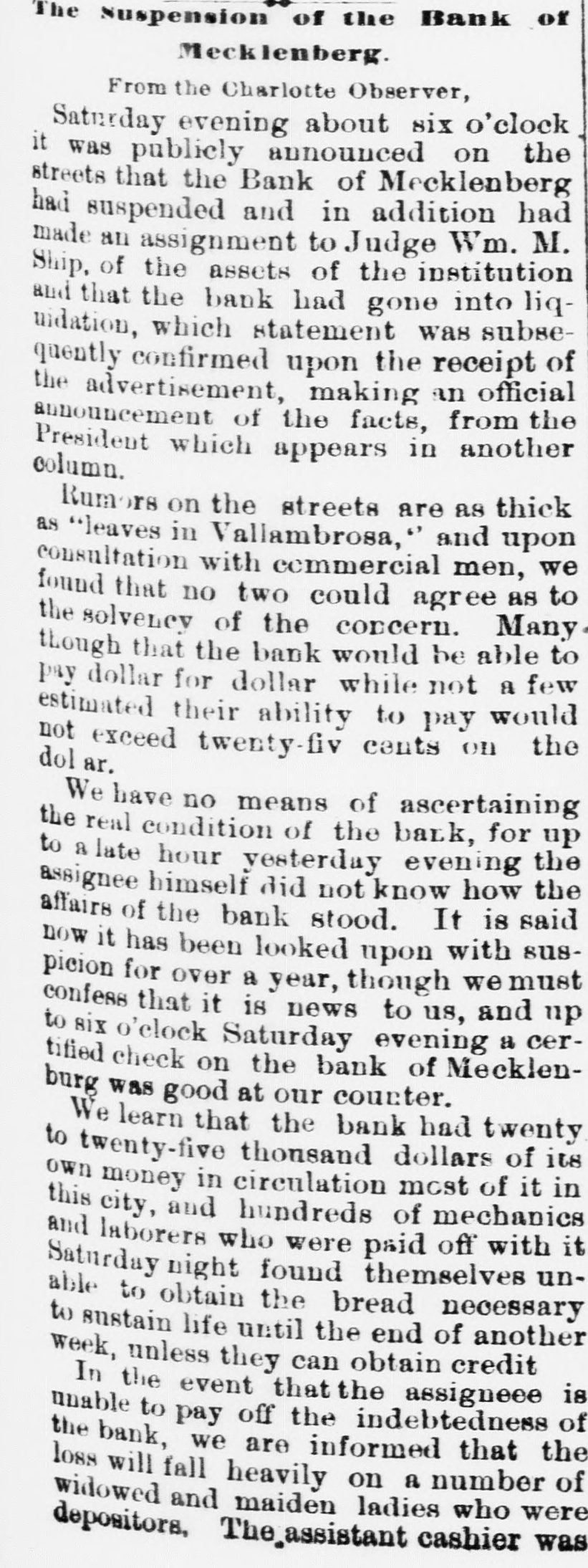
The Suspension of the Bank of Mecklenberg. From the Charlotte Observer, Saturday evening about six o'clock it was publicly announced on the streets that the Bank of Mecklenberg had suspended and in addition had made an assignment to Judge Wm. M. Ship, of the assets of the institution and that the bank had gone into liquidation, which statement was subsequently confirmed upon the receipt of the advertisement, making an official announcement of the facts, from the President which appears in another column. Rumors on the streets are as thick as "leaves in Vallambrosa, and upon consultation with commercial men, we found that no two could agree as to the solvency of the concern. Many though that the bank would be able to pay dollar for dollar while not a few estimated their ability to pay would not exceed twenty-fiv cents on the dol ar. We have no means of ascertaining the real condition of the bank, for up to a late hour yesterday evening the assignee himself did not know how the affairs of the bank stood. It is said now it has been looked upon with suspicion for over a year, though wemust confess that it is news to us, and up to six o'clock Saturday evening a certified check on the bank of Mecklenburg was good at our counter. We learn that the bank had twenty to twenty-five thousand dollars of its own in and mechanics this city, money circulation hundreds of most of it in and laborers who were paid off with it Saturday night found themselves unable to obtain the bread necessary to sustain life until the end of another week, unless they can obtain credit In the event that the assigneee is unable to pay off the indebtedness the we are will fall on a number of loss bank, heavily informed that the of widowed and maiden ladies who were depositora, The assistant cashier was


Article from Yorkville Enquirer, August 19, 1875

Click image to open full size in new tab

Article Text

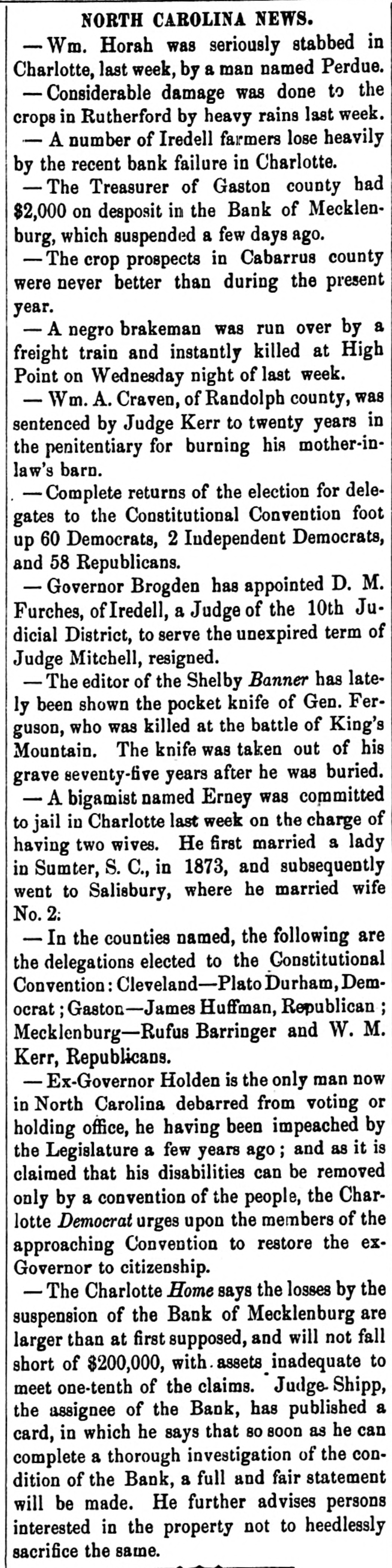
NORTH CAROLINA NEWS. - Wm. Horah was seriously stabbed in Charlotte, last week, by a man named Perdue. - Considerable damage was done to the crops in Rutherford by heavy rains last week. - A number of Iredell farmers lose heavily by the recent bank failure in Charlotte. - The Treasurer of Gaston county had $2,000 on desposit in the Bank of Mecklenburg, which suspended a few days ago. - The crop prospects in Cabarrus county were never better than during the present year. - A negro brakeman was run over by a freight train and instantly killed at High Point on Wednesday night of last week. - Wm. A. Craven, of Randolph county, was sentenced by Judge Kerr to twenty years in the penitentiary for burning his mother-inlaw's barn. - Complete returns of the election for delegates to the Constitutional Convention foot up 60 Democrats, 2 Independent Democrats, and 58 Republicans. - Governor Brogden has appointed D. M. Furches, of Iredell, a Judge of the 10th Judicial District, to serve the unexpired term of Judge Mitchell, resigned. - The editor of the Shelby Banner has lately been shown the pocket knife of Gen. Ferguson, who was killed at the battle of King's Mountain. The knife was taken out of his grave seventy-five years after he was buried. - A bigamist named Erney was committed to jail in Charlotte last week on the charge of having two wives. He first married a lady in Sumter, S. C., in 1873, and subsequently went to Salisbury, where he married wife No. 2: - In the counties named, the following are the delegations elected to the Constitutional Convention: Cleveland-Plato Durham, Democrat; Gaston-James Huffman, Republican ; Mecklenburg-Rufus Barringer and W. M. Kerr, Republicans. - Ex-Governor Holden is the only man now in North Carolina debarred from voting or holding office, he having been impeached by the Legislature a few years ago ; and as it is claimed that his disabilities can be removed only by a convention of the people, the Charlotte Democrat urges upon the members of the approaching Convention to restore the exGovernor to citizenship. - The Charlotte Home says the losses by the suspension of the Bank of Mecklenburg are larger than at first supposed, and will not fall short of $200,000, with assets inadequate to meet one-tenth of the claims. Judge. Shipp, the assignee of the Bank, has published a card, in which he says that 80 soon as he can complete a thorough investigation of the condition of the Bank, a full and fair statement will be made. He further advises persons interested in the property not to heedlessly sacrifice the same.


Article from The Anderson Intelligencer, August 19, 1875

Click image to open full size in new tab

Article Text

News of the Week. - Mrs. John C. Breckenridge is going to move from Kentucky to Arkansas. - Last week three prominent business men of Boston all died of paralysis OFF the same day. - Ex-Governor Palmer, of Illinois, is named for the Democratic nomination for Governor of that State. - The Charlotte Observer nominates Jefferson Davis for President of the University of North Carolina. - Bishop Quintard has gone to Europe to get help for the University of the South, at Sewanee, Tennessee. - Gen. Joseph E. Johnston has written to Gov. Garland declining the Presidency of the Arkansas Industrial University. -- Saratoga water agrees with VicePresident Wilson. He has written two hundred pages of his book since he arrived there. The Ohio election comes off on the 12th of October. A Governor, Lieutenant Governor and members of the Legislature are to be chosen. - There is a little talk in Tennessee of urging the governor to appoint Jefferson Davis to the seat of Andrew Johnson in the United States Senate. - The Bank of Mecklenburg, at Charlotte, has suspended and gone into liquidation. A full statement of the assets and liabilities is promised this week. - General Longstreet has decided to become a citizen of Georgia, and to settle in Gainesville in that State, should his family be pleased with the location. - The official majority for the Alabama Convention is 16,500. The delegates elected are eighty-one Democrats, six Independentsand twelve Republicans. - Bishop Cummins, of the Reformed Episcopal Church, now claims that there are fifty ministers and forty congregations of that sect in the United States and Canada. - The loss by the destruction of crops through the recent floods and rains will amount to about the same as the loss by the Chicago fire; in round numbers $200,000,000. - Gen. E. Kirby Smith is now chancellor of the State University at Nashville, Tenn., but thinks of leaving to become professor of natural history in the University of the South at Sewanee. - The latest authentic reports show that the election in North Carolina has gone as follows: Democrats, 60; Republicans, 59 Independent Democrat, 1. Sixty-one is necessary for a majority. - The Mississippi Press Association, which is composed exclusively of editors and proprietors of Democratic and Conservative newspapers, started last week on an excursion among the cities of the Northern States. - Andrew Johnson is the third President whose remains are in Tennessee, and there is a project to bury him with the others in Nashville and erect a grand monument; but his family prefer a simpler grave in East Tennessee. A monument to Wm. Gilmore Simms, the most gifted novelist of the South, will shortly be erected in Magnolia Cemetery, near Charleston. It will be a bronze bust placed on a granite pedestal, and will cost about $2,500. - The St. Louis Globe-Democrat learns that twelve families have been compelled to leave Williamson county, Illinois, to escape the vengeance of outlaws, who rule that county. Many more are quietly arranging business to leave. - Governor Ames, the champion carpet-bagger of Mississippi, has been absent since April, and as the acting Governor, a negro named Davis, is making a sort of general jail delivery, the newspapers are calling on Ames to come back. - Ex-Treasurer Niles G. Parker has published a card in reference to his escape from the jail in Columbia, saying that he had no assistance from the Sheriff or any of his employees, and neither of them had any knowledge of his plans for escape. - The richest woman in America is the wife of Prof. Gammel, formerly of Brown University, Rhode Island. She has an income of at least $1,000,000 a year, her father's estate, which she has just inherited being estimated at fully $20,000,000. Col. J. Addison Moroso, of the Charleston News and Courier, has invented a machine for breaking the backs of small boys which he calls the street car Bogardus kicker. He desires to employ active young men in all parts of the State to act as agents. - In the recent great storm near Geneva, in Switzeriand, a man was killed by a hail-stone striking him on the temple, and another had his wrist broken. An extraordinary number of small birds were killed by the hail, and one person is said to have picked up five hundred birds. - At the last extra term of court in Lancaster County, says the Ledger, Jury No. 2, composed of nine intelligent white men and three colored men, was presided over by an illititerate colored man, who could neither read nor write, by direct appointment of Judge T. J. Mackey. - The Lancaster Ledger states that a negro scoundrel, near Fort Mill, wrote an insulting note to a respectable young lady one day last week, proposing a conference. The young lady handed the document over to her father, who appeared upon the spot designated and emptied thirteen buckshot into the villain's carcass. - During the past three years about thirty English and Irish gentlemen have settled in Amelia county, Virginia, on estates which in the aggregate amount to nearly 10,000 acres. These colonists have, it is estimated, invested in real and personal property and otherwise, between $400.000 and $500 000


Article from Yorkville Enquirer, September 9, 1875

Click image to open full size in new tab

Article Text

A negro man named Murphy Harshaw, who lived in Cherokee county, was brutally murdered several days ago, by persons of his own color, who suspected him of being a witch, and were laboring under the painful delusion that they had been "bewitched" by him. In their confession, the murderers, who have been arrested, say that they were advised by a negro doctor that in order to be relieved from the witchery of Murphy, they must cut his throat and bury him in mud, which they accordingly did. # EDITORIAL INKLINGS. ## The California Election. On Wednesday of last week, there was an election in California for Governor, members of Congress and of the Legislature, and also upon the question of calling a convention to amend the Constitution of the State. There were three candidates for Governor, viz: T. G. Phelps, Republican; William Irwin, Democrat; and John Bidwell, Independent. The vote of the State, as far as heard from, gives Irwin 43,000, Phelps 25,000, and Bidwell 18,000. The Democrats elect three Congressmen, and the fourth one is in doubt, while they also have a plurality in the Legislature, and probably a majority over both the Independents and the Republicans. ## An Important Capture. On the 24th of July last, the passenger train of the Air-Line Railroad, when about three miles from Senaca City, was thrown off the track by means of a rail placed thereon, fatally injuring the engineer and wrecking the engine and several cars. The railroad company at once secured the services of Captain Alley, the Spartanburg detective, to ferret out the perpetrators of the deed. This he successfully accomplished in the following manner, as narrated by the Greenville News: The first move of Capt. Alley was to send a "French gentleman" down on the train, and at Senaca he involved himself in a row with the conductor, and was severely beaten and put off the train. The beating was no sham; it was genuine, as the "French gentleman's" appearance to-day will testify. He muttered vengeance, but went to work at Senaca, keeping in almost daily communication with Capt. Alley. By Wednesday, sufficient evidence was obtained to convict J. N. Smith, a discharged section master at Senaca, and a man named Ranther, a former section hand, of the horrid crime. They were both arrested before they had any suspicion that they were shadowed. After the arrest, Ranther made a confession, giving all the details of the transaction. Revenge was the motive actuating Smith, who planned the plot. Outside the confession, Capt. Alley was in possession of ample testimony to convict. ## The Bank of Mecklenburg. The assignee's statement of the condition of the Bank of Mecklenburg at the time the assignment was made, shows the liabilities of that institution to be $209,179.19, with assets amounting to $29,421.29. This showing renders it probable that creditors will receive nearly fourteen per cent. of their claims. Speaking of the management of this bank, the Charlotte Observer indulges the following remarks: Creditors have waited with patience for three weeks to know what would be the probable worth of their claims, and they had a right to expect a full exhibit of the workings of the Bauk, which has been the means of ruining hundreds of innocent creditors. The money of many women and children, who are now almost if not quite penniless, has been ruthlessly squandered by the officers of the bank, who have lived sumptuously and in style; and to say that the bank has lost $78,173.31 as one item only of the losses as per profit and loss account, is not at all satisfactory. The exhibit shows that the Bank has received, and ought to have had on hand, at the time of its suspension, $347,499.46. This has all been squandered except the sum of $29,421.29, making a deficit of $318,078.17. This is the exhibit, taking Mr. Brenizer's statement as correct, and shows gross, culpable, inexcusable negligence or guilt, on the part of the officers of the Bank. It will not do for the President to say that he was ignorant of the condition of the Bank, for, as President, if he did not know, he ought to have known. The same reasoning will apply to the Assistant Cashier, and the public is left to the conclusion, drawn from Judge Shipp's exhibit, that the Bank has been a wild-cat concern, unworthy of confidence for several years, at least, and that fact must have been known to the officers of the Bank. To a very large extent, the prominent business men of Charlotte are responsible for bolstering up this festering and cankerous sore on the commercial interests of this community, by giving it credit and character, as an institution worthy of the confidence of the people, where none was deserved. It is true that very few of them lose anything, but by giving their countenance, they have deliberately stood by and seen innocent persons suffer, when by a word they could have prevented it. ## The Riot in Mississippi. There was a serious riot at Clinton, Miss., last Saturday, between whites and negroes, who had assembled at a public speaking. The Vicksburg Herald gives the following as the true origin of the difficulty: There is a law prohibiting the sale of liquor in Clinton. Some young men from Raymond brought a bottle with them, and while the speaking was going on, Martin Siveley and some of his friends went off a short distance to take a drink. The colored marshal for the occasion approached them and forbade their drinking. This order was not regarded, and when the marshal attempted to take the bottle out of Siveley's hand, Siveley struck him over the head with it. Senator Caldwell, colored, started to settle the difficulty, and was followed by some twenty negroes, whom he ordered back, but about one hundred more came rushing on. Some one then fired a shot, which was followed by a general firing and a stampede. Siveley fired all the barrels of his pistol, and the negroes then demanded his surrender. He surrendered and gave up his pistol, after which he was shot and his brains
Article from Yorkville Enquirer, September 23, 1875

Click image to open full size in new tab

Article Text

It ously or die righteous without a wife." is said that A. T. Stewart intends to build a grand hotel in Washington, D. Carl Schurz, who has just returned from a visit to Europe, expects to make nine speeches in Ohio, the present campaign, in favor of hard The Ticket Agents' Convention money. for considering a reduction of rates for the Centennial for a period of six months, will meet next month at Jacksonville, Fla. EDITORIAL INKLINGS. North Carolina Convention. - The Orange county election to fill the vacancy caused by the death of W. A. Graham, resulted in the election of Patterson, Democrat, by about six hundred majority. This gives the Democrats a majority of two in the Convention. In the convention an ordinance fixing the per diem of. members of the General Assembly at 84, with a limited session of sixty days, and making the mileage ten cents per mile each way, passed its third and final reading. An ordinance reducing the number of Supreme Court Judges from five to three passed its third and final reading on Saturday, and it is probable that the number of Superior Court Judges will be reduced from twelve to nine. Mixed Schools in Brooklyn. - Last week, Judge Gilbert, of the Supreme Court of Brooklyn, N. Y., rendered a decision in the civil rights case, wherein William F. Johnson, a colored man, sought to compel the principal of the public school to admit his son thereto, instead of sending him to the school provided for colored children. The Court holds that the common schools are public charity that the benefits conferred by them are a free gift from the State, and like every other donor, the State may prescribe in what manner and upon what terms and conditions the gift may be enjoyed. In conclusion, Judge Gilbert says that the statute, by guaranteeing equal privileges, does not confer the right to enjoy them in common with any class of persons, or in any particular school, and that nothing has been shown from which it can be inferred that the relator has been deprived of equality of privilege to which he is entitled. A motion for a mandamus was denied. The First Paper Money. - A hundred years ago, on the 22nd of June, 1775, the Continental Congress put in circulation its first issue ($2,000,000) of paper money. These issues were repeated from time to time till they reached, in the aggregate, $300,000,000. Their subsequent depreciation, and worthlessness, notwithstanding a law of Congress making them legal tenders for the payment of debts, are familiar facts of history. In 1788, thirteen years subsequent to the first issue of paper money by Congress, Madison, in a communication to the Federalist, says: "The loss which America has sustained since the peace, from the pestilent effects of paper money, on the necessary confidence between man and man, on the necessary confidence in public councils, on the industry and morals of the people, and on the character of republican government, constituting an enormous debt against the States chargeable with this unadvised measure, which must long remain unsatisfied, or rather an accumulation of guilt, which can be expiated no otherwise than by a voluntary sacrifice on the altar of justice of the power which has been the instrument of it." The Bank of Mecklenburg. The Charlotte Observer gives the following information to those interested in the assets of the Bank of Mecklenburg The creditors of the Bank of Mecklenburg, have filed a petition in the office of the Clerk of the District Court of the United States at Greensboro, asking to have the Bank adjudged a Bankrupt. Among the creditors who have signed the petition, are The Mecklenburg Building and Loan Association, the Charlotte Building and Loan Association, Dr. Jos. Graham, R. B. Alexander, D. M. Rigler and many others. Among the acts of bankruptcy charged against the Bank, are: Its suspension of payment and failure to resume also its refusal to pay depositors on demand. The petitioning creditors represent a large majority in numbers and amount of debts against the Bank. The order to show cause upon the petition, will be heard at Greensboro within a short time before Judge Dick. The action of the creditors will be a matter of news to many. It has not been much discussed, but on yesterday Thos. B. Keogh, Esq., of Greensboro was telegraphed for, and arriving in the city last night, received the petition. The purpose of the creditors in forcing the bank into bankruptcy, is to render its assets available, and get its affairs in better shape. The Gale on the Gulf. - The wind and rain storm which set in on the Gulf of Mexico last Wednesday evening and continued until Friday night, was more disastrous in its effects than at first reported. The water from the Gulf overflowed half of Galveston island, knocking down some hundred small tenements and unroofing several churches, cotton presses, and residences, knocking down signs, awnings and other hangings. The water on the principal streets and in the market was several times two feet deep. Three large schooners lying in the harbor were swamped. One steamboat and two tugs sunk, one being completely demolished. One large English bark was forced from her moorings and driven ashore one schooner is forty feet on land, and some ten men working on the breakwater at the bar theer Dr. G W


Article from Wilmington Journal, April 21, 1876

Click image to open full size in new tab

Article Text

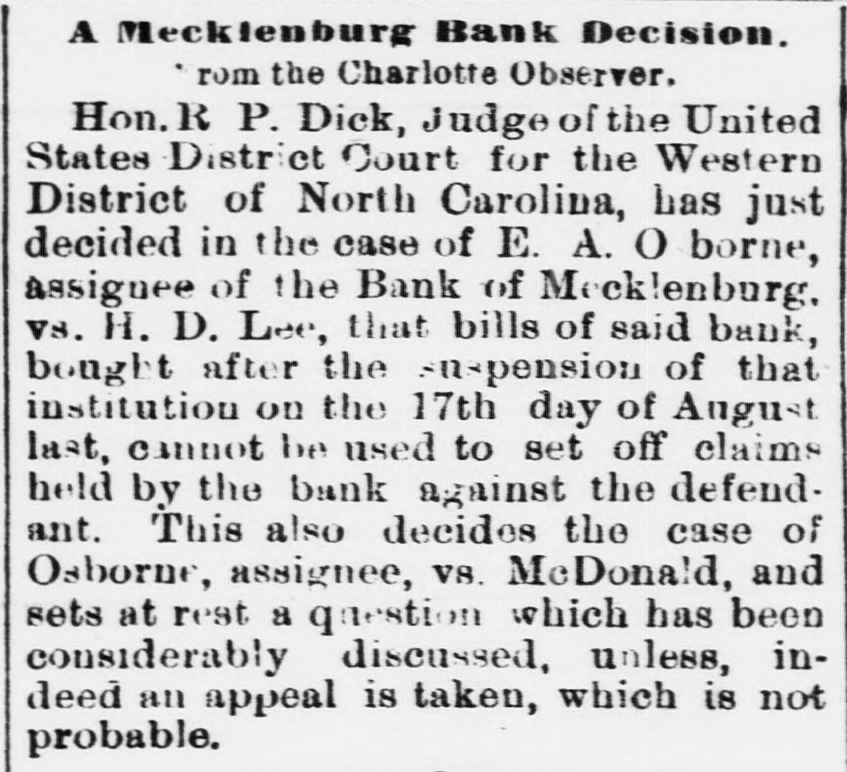
A Meckienburg Bank Decision. from the Charlotte Observer. Hon. R P. Dick, judge of the United States District Court for the Western District of North Carolina, has just decided in the case of E. A. O borne, assignee of the Bank of Mecklenburg, VS. H. D. Lee, that bills of said bank, bought after the -unpension of that institution on the 17th day of August last, cannot be used to set off claims held by the bank against the defendant. This also decides the case of Osborne, assignee, VS. McDonald, and sets at rest a question which has been considerably discussed, unless, indeed an appeal is taken, which is not probable.


Article from Yorkville Enquirer, August 12, 1880

Click image to open full size in new tab

Article Text

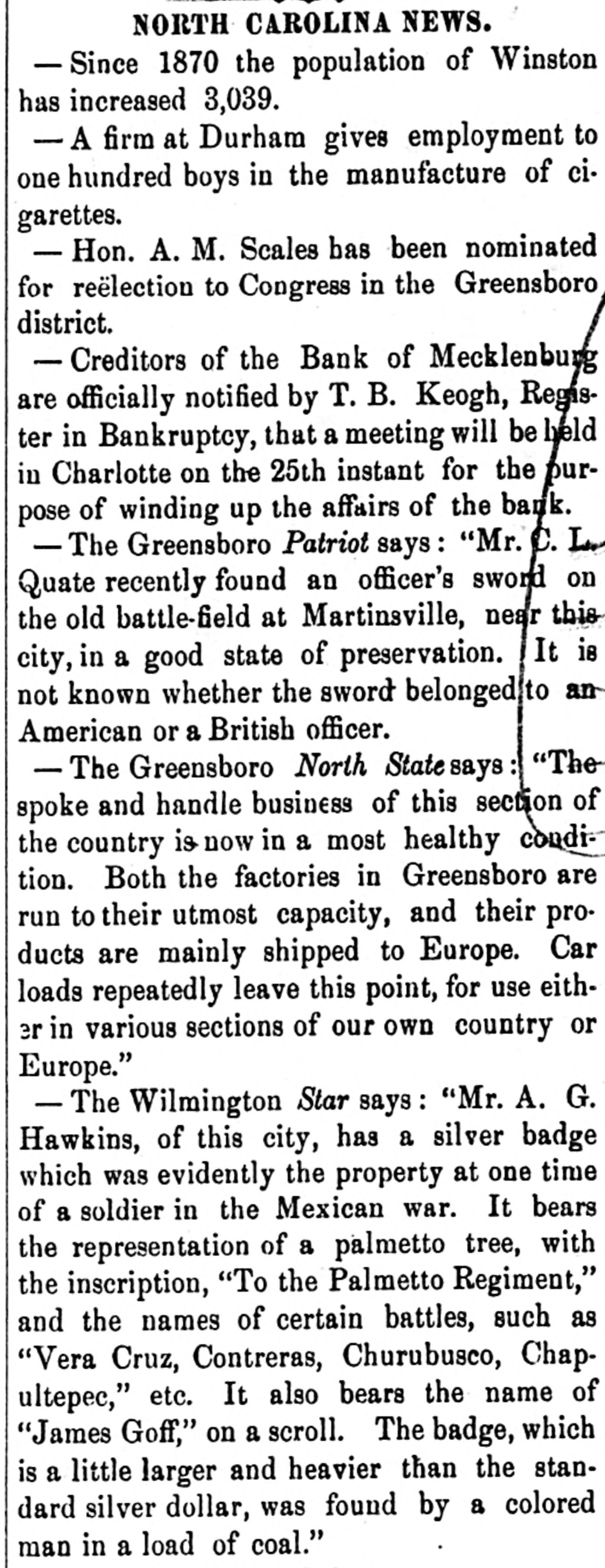
NORTH CAROLINA NEWS. - Since 1870 the population of Winston has increased 3,039. - A firm at Durham gives employment to one hundred boys in the manufacture of cigarettes. - Hon. A. M. Scales has been nominated for reΓ«lection to Congress in the Greensboro district. - Creditors of the Bank of Mecklenburg are officially notified by T. B. Keogh, Register in Bankruptcy, that a meeting will be held in Charlotte on the 25th instant for the purpose of winding up the affairs of the bank. - The Greensboro Patriot says: "Mr. C. L. Quate recently found an officer's sword on the old battle-field at Martinsville, near this city, in a good state of preservation. It is not known whether the sword belongedito an American or a British officer. - The Greensboro North State says "The spoke and handle business of this section of the country is now in a most healthy condition. Both the factories in Greensboro are run to their utmost capacity, and their products are mainly shipped to Europe. Car loads repeatedly leave this point, for use either in various sections of our own country or Europe." - The Wilmington Star says : "Mr. A. G. Hawkins, of this city, has a silver badge which was evidently the property at one time of a soldier in the Mexican war. It bears the representation of a palmetto tree, with the inscription, "To the Palmetto Regiment," and the names of certain battles, such as "Vera Cruz, Contreras, Churubusco, Chapultepec," etc. It also bears the name of "James Goff," on a scroll. The badge, which is a little larger and heavier than the standard silver dollar, was found by a colored man in a load of coal."