Bank of Bayard (Bayard, NE)

Episode Information

Episode UID
76059171582
Episode Type
Suspension โ†’ Closure
Bank Type
state
Bank ID
7605917 routing
Routing Number
76-0591
Start Date
October 29, 1931
Location
Bayard, Nebraska (41.755, -103.324)

Metadata

Model
gpt-5-mini (chosen from majority vote of a three-model LLM ensemble)
Short Digest
9504defeac689efe

Response Measures

None

Description

Multiple articles describe the bank as defunct with a court-appointed receiver.

Events (1)

1. October 29, 1931 Receivership
Newspaper Excerpt
Torgeson of Scottsbluff appointed ... Bank of Bayard at Bayard; ... Arthur Torgeson succeeds Bliss as bank receiver
Source
newspapers

Newspaper Articles (10)

Article from The Lincoln Star, December 8, 1930

Click image to open full size in new tab

Article Text

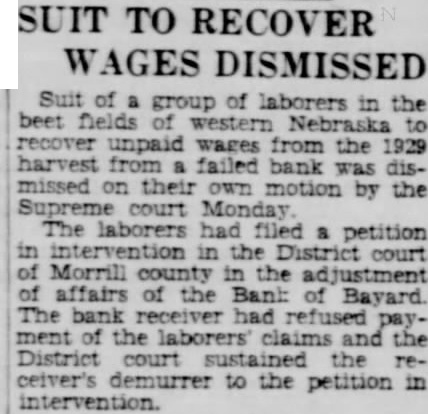
SUIT TO RECOVER WAGES DISMISSED of a group of laborers in the beet fields to unpaid wages from the 1929 harvest from dismissed on their by the court The had petition District court Morrill county the adjustment affairs of the Bank of Bayard. The bank receiver had refused ment of the and the District court redemurrer to the petition in


Article Text

ART TORGESON SUCCEEDS BLISS AS BANK RECEIVER Arthur Torgeson, brother of Atty. Torgeson of this city and forbank employe here, will succeed H. Bliss as bank receiver in this district. special from Gering says: Bliss, former secretary of trade and commerce, presented his final report and resignation as receiver for seven defunct state banks in the Seventeenth judicial district to Judge Carter here Tuesday. Torgeson of Scottsbluff appointed to succeed Bliss as The defunct banks involved in Tuesday's reports are Irrigators', Scottsbluff; American bank and Mitchell State, Mitchell; Lyman State, Lyman: State bank, Bank of Bayard at Bayard; Nebraska State at Bridgeport.


Article Text

TORGESON SUCCEEDS BLISS Scottsbluff Man Named as Bank Receiver-Files Bonds at Once. GERING. (AP). District u d Carter Monday accepted the resignation of Clarence G. Bliss, former secretary of the state department of trade and commerce, as receiver of seven defunct state banks in western Nebraska. A.E. Torgeson of Scottsbluff, assistant to, the receiver, was named to the position vacated by Bliss. Torgeson filed bonds immediately after his Judge Carter previously had denied the application of E. H. Luikart, present secretary of the commerce department, for appointment as receiver. According to state law the commerce department secretary shall be receiver of failed state banks. Judge Carter, however, declined to transfer the receiverships to Luikart, saying he would not make the transfer to Luikart until he was assured there would be no interference from Governor Bryan. The seven banks are located at Bridgeport, Bayard, Lyman, two at Mitchell. Scottsbluff and Minatare. Torgeson now is receiver of eleven failed banks in this district.


Article Text

Seven Institutions That Have Closed Doors SUCCEEDS BLISS WHO WAS UNSEATED The resignation Clarence G. Bliss, former secretary of the partment of trade and commerce, received for seven failed banks in western was accepted Wednesday by District Judge Carter at Gering and the appointment of Torgeson of Scottsbluff succeed Bliss confirmed. Bliss filed his final reports October His resignation was ed in district court Benyon, former attorney for the banking partment. Banks which Bliss control Nebraska State bank, Bridgeport; Bank of Bayard, Lyman state Mitchell State rigators bank Scottsbluff; Ameribank, State Bank of These defunct institutions all located in the 17th judicial district. the district Luikart, present secretary of the trade and commerce, had asked control in an application for appointment receiver filed at (Continued on page


Article Text

Luikhart Files Suit To Oust Torgeson as Failed More fireworks broke out this week in the defunct bank situation in westNebraska, when word was received that E. H. Luikart and Gov. Bryan were filing suit to have Torgeson removed as receiver eleven failed banks in western Nebraska. Torgeson was appointed by Judge E. Carter some time ago. The Governor charges that Torgeson has received more pay than any other bank receiver, and that such excess salary must come out of the depositors' share of recovered funds in failed banks. further declared that banks in of the state would not pay out percent under Torgeson. Mr. Torgeson states that he will be glad to have an investigation of his management of failed banks. He cites several instances where banks he has handled have paid out considerably more than that, as follows Irrigators, Scottsbluff, 57 per cent; American State, Scottsbluff, 58.25; American bank, Mitchell, 50; Bank Bayard, Bayard, 50; Nebraska State, Bridgeport, 55.9; Mitchell State, Mitchell, 35.5; Lyman, 17; State Bank. of Minatare, Minatare, Bridgeport bank, Bridgeport, 16 per cent.


Article Text

POWER TO SELECT BANKS' RECEIVERS Legislature Held to Have Overstepped Powers in Enacting Law. Declaring that the imperative duty the judicial department of government to protect its jurisdiction. at the boundaries power fixed by the constitution and that the naming of state bank judicial function which exercised or trolled the governor or legislature, supreme Saturday upheld the action of District Judge Carter Morrill in refusname H. Luikart, secretary trade commerce, receiver for Mitchell State bank, Irrigators bank Bridgeort, Lyman State bank, State bank of Scottsbluff, State bank Bridgeport, State Bank of Minatare, and Bank of Bayard. Justices Paine and Day dissented. The court, an opinion written Justice Rose, that legislative act providing that the secretary trade commerce shall be the receiver of all insolvent state banks amounts no more than judicial proceedproperly pending court equity liquidation of bank, than legislative recommendation to the judiciary to point him, otherwise the enactment an encroachment on judicial power. Judge Carter Named Torgeson. Judge Carter was the only district judge who refused name Luikart, when the latter succeeded Bliss. He appointed Torgeson, who been assistant ceiver under Bliss, the ground that having had actual charge liquidation of these seven banks better position serve all interests than Luikart, name one to handle their The court points out in its sion that the statutes nowhere provide for the liquidation of state banks invoking the judicial power the state, the has granted any officer, administrative board, or tribunal (Continued on Page 8.)


Article Text

"In a pending cause, the chief executive and the legislature cannot change or modify judicial orders or lawfully require the court to do so. A judicial order in pending litigation does not change with political fortunes or legislative acts or executive appointments." Outlining the separation of powers in both the federal and state governments, Judge Rose wrote that it is imperative that the judicial department of the government protect its jurisdiction at the boundaries of power fixed by the constitution. Quasi Public Business. Judge Paine, however, in his dissenting opinion argued that banking is a quasi public business which the state may control as it sees fit and that the legislature had authority to provide any means of liquidating insolvent state banks. The plan adopted by the 1929 legislature of liquidating failed banks with a state official as receiver brought order out of chaos, reduced the expense of liquidation, and need be considered no limitation on judicial power, Judge Paine held. "The old plan of individual receiverships under individual district judges having been tried and found wanting, the new plan promises a great improvement," he wrote, "and should not in these times of distress, be hampered by any undue jealousy on the part of the judiciary for fear its right may be infringed upon." He urged that the judiciary should co-operate with the will of the legislature "to the great end that the depositors may receive the largest possible sum from a prompt, vigorous and efficient liquidation of banks by one responsible person, to-wit, the secretary of the department of trade and commerce." The seven banks for which Torgeson had been named receiver and in which the appointment was upheld Saturday were the State bank of Minatare, Mitchell State bank, Irrigators' State bank, Scottsbluff; Lyman State bank, American bank, Mitchell; Nebraska State bank, Bridgeport and the Bank of Bayard.


Article Text

COURTS ONLY HAVE POWER TO SELECT BANKS' RECEIVERS Legislature Held to Have Overstepped Powers in Enacting a Law. Declaring that it is the imperative duty of the judicial department of government to protect its jurisdiction at the boundaries of power fixed by the constitution and that the naming of state bank receivers is a judicial function which cannot be exercised or controlled by the governor or legislature, the supreme court Saturday upheld the action of District Judge Carter at Morrill in refusing to name E. H. Luikart, secretary of trade and commerce, as receiver for the Mitchell State bank, Irrigators State bank of Bridgeport, Lyman State bank, American State bank of Scottsbluff, Nebraska State bank of Bridgeport, State Bank of Minatare, and Bank of Bayard. Justices Paine and Day dissented. The court, in an opinion written by Justice Rose, says that a legislative act providing that the secretary of trade and commerce shall be the sole receiver of all insolvent state banks amounts to no more than a judicial proceeding, properly pending in a court of equity for the liquidation of a bank, than a legislative recommendation to the judiciary to appoint him, as otherwise the enactment would be an unconstitutional encroachment on judicial power. Judge Carter Named Torgeson. Judge Carter was the only district judge who refused to name Luikart, when the latter succeeded Bliss. He appointed A. E. Torgeson, who had been assistant receiver under Bliss, on the ground that having had actual charge of the liquidation of these seven banks he was in a better position to serve all interests than Luikart, who must necessarily name some one to handle their liquidation. The court points out in its decision that the statutes nowhere provide for the liquidation of state banks without invoking the judicial power of the state, and the legislature has never granted to any executive officer, administrative board, department or tribunal (Continued on Page 8.)

Article Text

COURT FIGHT LOST BY CASES Decision Upholds Torgeson as Liquidation Officer in 17th District LINCOLN, April 16, Nebraska supreme court Saturday sustained the action of District Judge E. F. Carter of Gering in appointing A. Torgeson of Scottsbluff as receiver of seven failed state banks in the Seventeenth judicial district. Judge Carter had refused the application of E. H. Luikart, secretary of the state department of trade and commerce. to be made succeeding Clarence Bliss, his predecessor in office. The supreme court held that where liquidation of state bank conducted court equity the procedure is judicial and not The court also ruled appointment of receiver should not be made controlled by the governor legislature. the imperative duty of the judicial to protect its jurisdiction the boundaries power fixed the constitution, the declared legislative act providing for appointment of the secretary department of trade and commerce receiver for all insolvent state banks must be regarded merely legislative recommendation the court, the opinion stated. Otherwise this act would unconstitutional, the court finds. decision terminates con troversy between state banking officials, Governor Bryan and Judge Carter appointed receivof the banks when Bliss. of the department of trade and resigned. Radke, counsel for receivership division, applied for appointment of Luikart. Judge Carter refused to consider this unless assured Bryan would not interfere with Luikart ceiver Torgeson subsequently was The seven banks concerned are the State Bank of Minatare. Mitchell State bank. Irrigators Bank of Lyman State American Bank Mitchell braska State Bank of Bridgeport and the Bank Bayard eighth the Seventeenth district turned Torgeson was the Bridgeport bank. Bayard A. Paine and L. Day dissented from the supreme court decision.


Article Text

SUPREME Says Judiciary Has Sole To Name Receivers For Insolvent Banks The Supreme Court of Nebrasdecision down last Saturday, upheld the position District Judge Carter when he appointed Torgeson of receiver for seven failed banks in his judicial district. The attracted statewide interest since rested squarely the proposition whether or not the governor could dictate to the courts as the appointing of receivers. The Supreme Court held that receiver is an officer the court and any attempt of the executive the legislative name the officers of the court and tional and upon the authority of the judiciary. Judge Carter is the only district judge in the state who pointed receiver other than the one named by the governor. He refused to appoint H. Lulkart receiver unless Governor Bryan promised to refrain from interfering with the receivership. dispatch from Lincoln on the states: Declaring that it is the impera. duty of the department the tect its jurisdiction at the boundaries power fixed by the and that the naming state bank receivers judicial which cannot be exercisor controlled by the governer legislature, supreme court Saturday upheld action of District Judge Carter in refusing name secretary trade and commerce. receivfor the Mitchell State State Bank Bridgeport, Lyman State Bank. American State Bank Scottsbluff, Nebraska State Bank of Minatare the Bank Bayard. Justices Payne and Day dissented. The court, in an opinion written by Justice Rose, says that legislative act providing that the secretary trade and shall the sole receiver all solvent state banks amounts no more than Legislative to the judielary appoint him, otherwise the enaetment would be an unconstitutional encroachment judicial power. Judge Carter the only district judge refused to appoint Luikart, when latter aucceeded Bliss. He appointed Torgeson, who has been sistant receiver under Bliss, the ground that having had tual charge of the liquidation of seven banks he than must necessarily someone to handle their liquidation.